









Disclosure. Not investment advice, and nothing here is a recommendation to buy, sell or hold any security. A member of the Convexity team holds the SPDR S&P 500 ETF (SPY), which holds Berkshire Hathaway, and also Broadcom, Danaher, TransDigm and Teledyne, which are named below as companies Bending Spoons studied; no other position, and no position in Bending Spoons. Figures are from Bending Spoons' IPO prospectus, its Forms 6-K and its August 13 earnings call, and from Berkshire Hathaway's 1985 letter to shareholders. The call is available to us only as a machine-made transcript that garbles several names, so we paraphrase it rather than quote it. Share prices are closing prices from our brokerage data feed. The closing note lists what is our arithmetic. This note was drafted with Claude.
On Wednesday, October 14, Bending Spoons said Berkshire Hathaway had agreed to buy 10 million new shares from it at $33 each, $330 million in all, on top of the $600 million Berkshire put into the company's Nasdaq listing in July. Berkshire's price was 12.8% below the previous day's close. The shares closed that Wednesday 41.2% higher, at $53.46, and on Thursday at $55.81, close to twice the $29 at which they listed on July 1 (our arithmetic on closing prices). Most of the coverage was about Berkshire. This note is about the company Berkshire bought into, which is little known outside the software industry even though it now owns AOL.
Bending Spoons is a Milan company that buys digital businesses and runs them. It owns Evernote, WeTransfer, Vimeo, Eventbrite, AOL and, since September, Airtable, and it has agreed to buy Miro. Those are the products it sells. They are not what it sells to its shareholders. Its revenue rose 126% from a year earlier in the second quarter, and 3% on its own organic measure. What it sells shareholders is the next acquisition: a promise that it can keep buying businesses, rebuild each around a much smaller team, and borrow against the improved earnings to buy the next one. Its founders put it in almost those words in the letter that opens their prospectus, where they say they decided at the outset to treat the operating machine itself as their most important product. That framing is the right one, and it tells you what to watch: not the apps, but whether the machine keeps finding deals, keeps cutting costs it can count on, and keeps getting the capital it runs on. Berkshire's $930 million (our sum) is some of that capital.
Organic growth, staff, votes and Berkshire's stake are from Bending Spoons' prospectus of July 1, 2026, its second-quarter results of August 13 and its Form 6-K of October 14. The $930 million is our sum of the two purchases the company announced.
Thirteen years from $40,000
The company tells its own origin story in that prospectus letter, and the details explain most of what followed. In August 2010, three engineering graduates, Luca Ferrari, Matteo Danieli and Francesco Patarnello, decided on a backpacking trip in Indonesia to start a company. Evertale, a smartphone app that used AI to generate a diary for its user automatically, raised $1 million and hired ten people. By the middle of 2013 it had almost no revenue and about four months of cash. The founders wound it up and, with the roughly $40,000 left over, started Bending Spoons that year in Copenhagen with two Evertale colleagues, Luca Querella and Tomasz Greber. The company moved its headquarters to Milan through a cross-border merger completed in 2015.
What they took from the failure is the whole strategy. Finding a product people want, they concluded, depends heavily on luck, while running a digital business well depends on skill, which can be trained. So they would become the best operators they could and buy businesses that had already found their market, which the letter describes as outsourcing the search for product-market fit. The playbook has three steps and the company says it has not changed since 2013: acquire, transform and optimize, then reinvest. The first acquisition cost $10,000. There have been more than 50 since. The name is a nod to the idea of bending spoons with the mind, chosen, the founders say, partly because it sounded a little silly for a company with five people and a record of one failure.
The letter also names its models. The founders say they learned from Henry Singleton at Teledyne and Tom Murphy at Capital Cities, and more recently studied Broadcom, Danaher and TransDigm, all serial acquirers that compounded capital by running what they bought better than its previous owners had. Murphy is the one Berkshire knows best, and we come back to him below.
The people who run the machine are called Spooners, the company's term for staff who pass its selective hiring process and can be moved between businesses at short notice. There were nearly 700 of them in August, Ferrari said on the company's first earnings call. In 2025 the company received about 800,000 job applications and hired 286 people. It says it prefers talent to experience, so that nearly all of its businesses and functions are run by people in their twenties or thirties, most of whom had little or no work experience before joining. Two of the practices it lists as ones not every investor will like are favoring returns over organic revenue growth and bringing established businesses back to startup mode. Both turn out to be central.
What it owns, and what it paid
The oldest of its main businesses is Remini, an AI photo and video enhancer bought in 2021. The acquisitions since 2023 are the ones most readers will recognize. The prices below are as Bending Spoons filed them. Most are stated as total consideration, while Tractive, Airtable and Miro are stated as enterprise value, which excludes the target's own net cash, so the figures are not strictly comparable.
| Business | Joined | Price as filed | What it does |
|---|---|---|---|
| Remini | June 2021 | not disclosed | AI photo and video enhancement |
| Evernote | January 2023 | $199.7 million | Notes and personal knowledge management |
| WeTransfer | July 2024 | $476.3 million | File transfer and storage |
| Meetup, StreamYard, Issuu | 2024 | $280.7 million together | Local groups, live streaming, digital publishing |
| Brightcove | February 2025 | $218 million | Video hosting for enterprises |
| komoot, Harvest, MileIQ, Loomly | 2025 | $701 million together | Outdoor route planning, time tracking, mileage logs, social media scheduling |
| Vimeo | November 2025 | $1.36 billion | Video hosting |
| AOL | January 2026 | $1.45 billion in cash | Email, news portal and search |
| Eventbrite | March 2026 | $505 million | Event ticketing |
| Tractive | May 2026 | $759 million enterprise value | Pet trackers and health monitoring |
| Airtable | September 2026 | $1.285 billion enterprise value | No-code databases and workflow apps |
| Miro | Pending, expected fourth quarter | $1.355 billion enterprise value | Online whiteboard for teams |
The scale has grown quickly. By enterprise value the company deployed $194 million in acquisitions in 2023, $876 million in 2024 and $1.92 billion in 2025, then $2.01 billion in the first quarter of 2026 alone. With Tractive and Airtable, the deals it has closed this year come to $4.05 billion of enterprise value, more than the $2.99 billion of the three previous years combined (our sums), and Miro would add $1.355 billion. On the August call Ferrari put the total since the start of 2023 at nearly $6 billion across 15 acquisitions.
Two features of the list matter for the argument. The first is that the portfolio is diluted by each new purchase. The businesses that produced all of Bending Spoons' revenue in the first quarter of 2024 produced 24% of it two years later, even though their revenue grew in dollars, and the company says its targets keep getting larger. The second is that nothing leaves. Bending Spoons says it has never sold a material business and does not expect to sell often, because it doubts any buyer could get more out of one than it does, because Spooners expect to rotate across the portfolio, and because the businesses are wired into its shared technology. Every purchase is meant to be permanent, so the price paid has to be earned by running the business, never by selling it.
The two newest purchases are also a different kind of business. Airtable's annual recurring revenue was about $480 million in June and growing more than 20% a year, the company said when it agreed the deal, and Miro's is about $600 million, nearly 90% of it from business and enterprise customers. Both were bought for between two and three times that recurring revenue in enterprise value (our arithmetic), and both came with large cash balances: Airtable's implied equity value of about $2.25 billion is roughly $965 million more than its enterprise value. Ferrari told analysts that enterprise software had been priced at levels he considered irrational until recently, and that the company is buying more of it now because the prices have come down, not because its view of the category has changed.
The transformation is mostly a smaller team
Step two of the playbook, as the prospectus describes it, typically means reorganizing teams, overhauling technology, redesigning the product and improving marketing and monetization. The filings let you measure the first of those directly.
Bending Spoons counted 405 full-time equivalent staff, including contractors, at the end of 2023, 785 at the end of 2024, 1,834 at the end of 2025 and 2,284 at the end of March 2026. It says the vast majority of that growth came from acquired teams rather than hiring. In the fourth quarter of 2025 and the first quarter of 2026 it took on 1,830 people with AOL, Eventbrite and Vimeo. It had already parted ways with many of them by the end of March, and it says that once the three transformations are substantially complete, later in 2026, it expects only a few hundred to remain. On the call Ferrari described Eventbrite as having completed a deep reorganization into a leaner team, and said about 60 Spooners worked on Vimeo in the second quarter, roughly the number that worked on Evernote in 2023, although Vimeo is about four times Evernote's size by revenue.
The same discipline runs the other way inside the portfolio. Remini's team of Spooners peaked at an average of 64 in 2024, when the company saw a growing opportunity, and was cut to about 20 by the end of 2025 as the returns on more work diminished. The company presents that as evidence it can move people quickly. It is also evidence of how small the teams are: revenue per full-time Spooner was $1.12 million in 2023, $1.64 million in 2024 and $2.57 million in 2025, and Ferrari said it passed $4 million at an annualized rate in the second quarter. The prospectus credits AI for part of that. It estimates that more than 90% of the code changes its engineers proposed by the end of March 2026 were written or co-written by AI, and about 70% by AI alone.
The other lever is price. The company says it ran about 3,000 product experiments in 2025, and Ferrari described them on the call as covering everything from features to prices. Its prospectus explains part of 2025's organic growth at Issuu and StreamYard as higher revenue per subscriber, partly offset by fewer subscribers, which is what a price rise that loses some customers looks like. An analyst on the August call said he understood AOL had begun raising prices at the end of June. Ferrari did not give a figure; he said the company was testing several pricing configurations at AOL and that the early responses were promising.
The prospectus is candid about the cost of all this. Its risk factors say the company makes changes that customers, staff or the public may see negatively, naming reorganizations and price increases, and that it has faced employment claims in connection with past reorganizations. The separation packages show up in the income statement as reorganization-related expense, a line the company then adds back when it reports adjusted profit. That line is where the next two sections begin.
The products grow slowly, by design
The company's organic measure compares each business with itself a year earlier, including the revenue it earned before Bending Spoons owned it. On that measure, revenue grew 7% in 2024, 13% in 2025, 6% in the first quarter of 2026 and 3% in the second. Reported growth over the same periods was 73%, 95%, 132% and 126%. Organic growth was at most a seventh of the reported figure in every one of those periods (our arithmetic).
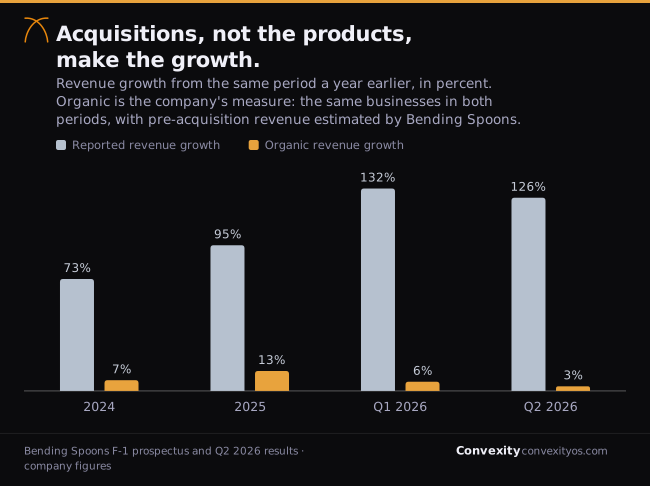
The second-quarter release names the moving parts: Tractive and WeTransfer contributed most of the growth, and declines at Remini and at Splice, a video editing app, offset some of it. On the call Ferrari added that AOL, Eventbrite and Vimeo together were growing in the low single digits, and that Remini's problem was mostly a saturated market for AI image generation, though he allowed that cheaper AI tools may have made new customers harder to win. Customers already in the portfolio are sticky. Net revenue retention, the subscription revenue a year's existing customers produce against what they produced a year earlier, was 95% in 2025 and 94% in the first quarter of 2026, and the average subscriber, weighted by revenue, had been a customer for eight years. Retention under 100% means the existing base shrinks slowly before new customers are counted, so these are durable businesses, not growing ones.
The company does not see a problem in any of this. Ferrari told analysts that organic growth is an output of the company's capital deployment, not something it tries to maximize, and that it is neutral on growth when it buys: it will pay more for a fast-growing business but is happy to own one that is flat or even shrinking if the price is right, citing AOL, which grows in the low single digits, as a purchase it is very pleased with. The prospectus says the same thing in its list of unusual practices. That is a coherent position, and it is why reported growth is the wrong number to judge Bending Spoons by. If the businesses grow slowly, the growth investors are paying for comes from buying more of them.
One fairness point about the next few quarters. Because the organic measure includes acquired businesses from the day they close, measured against their own revenue a year earlier, Airtable joined it in September and Miro will when it closes. Airtable's recurring revenue is growing more than 20% a year, against 3% for the portfolio, so organic growth is likely to rise for reasons that have little to do with the older products. Readers should treat a jump in the organic figure in the fourth quarter accordingly.
Two kinds of profit
Bending Spoons reports two operating profits, and the gap between them is the cost of the playbook. Its GAAP operating income was $278 million in 2025, a 21% margin, and its Adjusted Operating Income was $613 million, a 47% margin. Net income for the year was close to zero, and diluted earnings per share rounded to nothing, while Adjusted Earnings per Share was $0.60. In the second quarter of 2026 the margins were 34% and 54%.
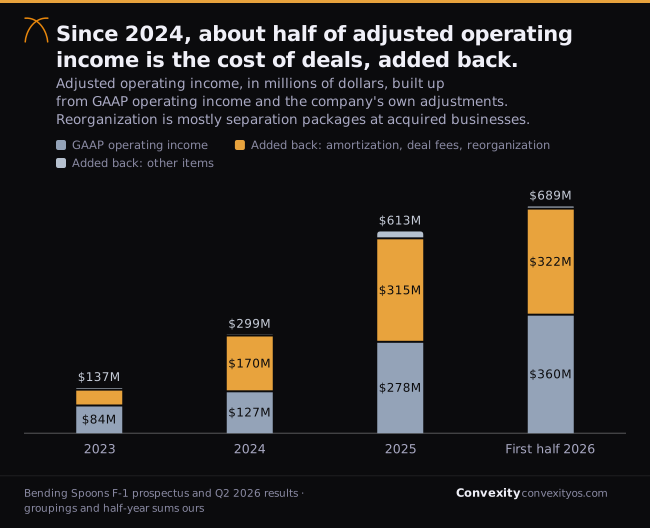
Three items make most of the difference. Amortization of acquired intangible assets spreads part of each purchase price over the following years. Transaction-related expense is the cost of doing the deals themselves. Reorganization-related expense, the prospectus says, was driven in each year by separation packages offered to staff at the businesses being restructured. Together those three were 57% of Adjusted Operating Income in 2024, 51% in 2025 and 47% in the first half of 2026 (our arithmetic). Reorganization expense alone was $13.5 million in 2023, $51.8 million in 2024 and $78.6 million in 2025, and $126.6 million in the first six months of 2026, already more than the whole of 2025 (our sum).
The company calls these items not indicative of its ongoing operations, and for an ordinary business that would be a fair description. Bending Spoons is not an ordinary business. Buying businesses and restructuring them is its ongoing operation, and these costs have recurred every year and grown with the pace of its deals. Amortization is the most defensible add-back, because it is a non-cash charge and the economic cost was paid up front in the purchase price. Severance and deal costs are paid in cash, and they will continue for as long as the company keeps buying. A reader who wants to know what the machine earns after paying for what it does should look at both numbers and expect the truth to sit between them.
The machine runs on borrowed money
The cash flow statement makes the model plain. In the first six months of 2026 Bending Spoons spent $2.29 billion on acquisitions, net of the cash the acquired companies held, while its operations generated $254 million, after paying $161 million of interest. Acquisition spending was nine times operating cash flow (our arithmetic). It borrowed $2.57 billion and repaid $204 million.
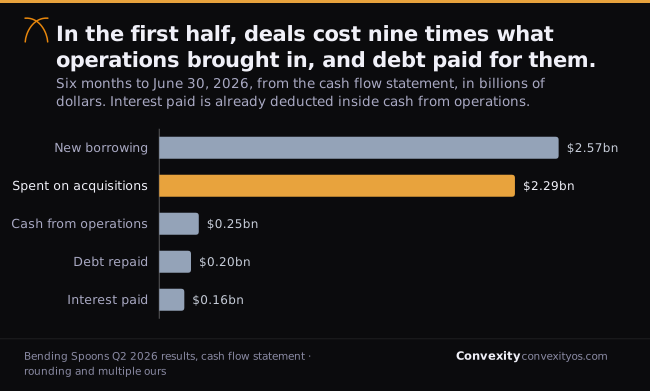
At the end of June the company had $4.88 billion of long-term debt, $794 million of it due within a year, and $793 million of cash, leaving net debt of $4.09 billion. Interest expense was $109 million in the second quarter, about three times the $36 million of a year earlier, and over the first half it came to $202 million, 56% of GAAP operating income (our arithmetic). The company has never issued a bond. It borrows from banks and institutional lenders through term loans and revolving credit, and since June it has added €590 million of new or expanded term loans, a larger euro revolving facility, and two add-ons to its existing term loans of $1.25 billion and €395 million, both larger than the $750 million and $250 million it originally set out to raise. The add-ons fund Miro. In the same week Moody's raised its rating to Ba3 and S&P to BB-, both still below investment grade.
The company's preferred measure of its debt is a leverage ratio, net debt divided by adjusted EBITDA. It was 2.24 at the end of 2025, 2.19 at the end of March and 2.4 at the end of June, against a maximum of 4.00 in its loan agreements. Two details of the definition matter. Adjusted EBITDA is calculated as though every acquired business had been owned for the full twelve months, and it counts savings from reorganizations as though they had been achieved from the start of the period. The second-quarter release adds that it also includes certain expected cost savings, which the prospectus says are subject to a cap set in the credit agreements. So the ratio that measures the debt against earnings counts some layoffs before they have produced savings. That is common in leveraged lending and the cap limits it, but it means the 2.4 is a measure of the plan, not only of the past.
Equity has started to matter too. The prospectus says the company has always considered its cost of equity high and has been selective about issuing shares: it had raised $549 million of primary equity in its history by March 2026, 99% of it since 2023. Since then it has raised $1.10 billion net in the IPO, agreed the $330 million with Berkshire, and agreed with some of Miro's shareholders that they will reinvest $295 million of their sale proceeds in new Bending Spoons shares. That is about $1.7 billion of new equity, roughly three times what the company raised in its first thirteen years (our arithmetic). Ferrari told analysts in August that as a public company there were interesting things it could do with its equity. Two months later, it has done two of them.
What Berkshire bought
The October 14 filing sets out the terms. Berkshire will buy 10 million ordinary shares at $33 in a private placement, Bending Spoons will use the money for general purposes and new acquisitions, the shares carry registration rights, and the deal is expected to close in the fourth quarter. Together with the IPO purchase, the company says, Berkshire will own about 4%. Patarnello, who leads acquisitions, said in the release that the pipeline remains strong and that the investment improves the company's flexibility to pursue deals. The $930 million Berkshire has put in or committed is less than Airtable's enterprise value alone (our comparison). It is a meaningful sum for Bending Spoons and roughly one deal's worth of capital.
It buys no control. The four founders, Ferrari, Danieli, Patarnello and Querella, hold all of the company's class A shares, which carry five votes each, and the prospectus says they held 82.71% of the votes after the IPO while owning close to half of the shares (our arithmetic from the share counts). Bending Spoons is also a foreign private issuer, which exempts it from the quarterly 10-Q and from some Nasdaq governance rules, though it reports quarterly anyway, and its prospectus discloses material weaknesses in internal control over financial reporting, which it attributes partly to the strain of integrating acquired businesses.
Berkshire has done something like this before. Its 1985 letter to shareholders explains that it bought 3 million shares of Capital Cities at $172.50, and that the purchase helped Capital Cities finance its $3.5 billion acquisition of ABC. Buffett called Tom Murphy's management the best of any public company, and gave Murphy the right to vote Berkshire's shares. Forty-one years later Bending Spoons names Murphy as one of its models, and Berkshire is again buying new stock in a company whose stated use for the money is acquisitions. The difference is in the votes. In 1985 Berkshire handed its votes to management. At Bending Spoons there is nothing to hand over, because the founders already hold most of them.
The market has been less patient than either. The shares listed at $29, closed their first day at $40.50 and reached a closing high of $53.44 on August 11, a week after the Airtable deal. They fell 16.5% on August 13, the day of the second-quarter results, which showed organic growth down to 3% from 6% in the first quarter, and slid to $32.03 by October 2. They rose 24% on October 7, a move no Bending Spoons filing explains, and 41% on the Berkshire news (our arithmetic on closing prices). In three and a half months, a company whose apps grow at a few percent a year has been valued by the market at prices ranging from about 1.1 times to about 1.9 times its IPO price, depending largely on what investors thought about its access to capital and its deals.
The case against this note
The strongest objection is that this note judges a serial acquirer by the wrong yardstick. The companies Bending Spoons studies, Danaher and TransDigm among them, are usually judged less by the organic growth of what they bought than by the returns they earned on the capital they deployed, and some of the best records in American business were built that way. Bending Spoons says it underwrites every deal assuming it will never sell, and that it has applied hurdles of 25% a year unlevered and 65% levered to nearly every acquisition since 2023. If those returns are real, slow organic growth does not matter, and the add-backs are simply the visible part of an investment that pays.
The second objection is that the adjustments are ordinary. Most acquirers add back amortization, which is a non-cash charge, and GAAP operating margins are themselves rising, to 34% in the second quarter. The third is that the debt is moderate: a ratio of 2.4 against a covenant of 4.00, ratings moving up, and, as Ferrari said on the call, a ratio that would fall quickly if the company simply stopped buying. The fourth is that the newest purchases weaken the claim that the products barely grow, because Airtable and Miro are growing businesses bought at modest multiples of their recurring revenue.
We accept most of this. The note does not argue that the model fails, and it may well work for a long time. Its argument is narrower: that Bending Spoons should be understood and watched as a machine for buying and restructuring, so that the numbers that matter are the returns on new deals, the share of profit that comes from restructuring, and the price and availability of the capital it runs on, rather than the growth of any app. On the first of those we have only the company's word, because the returns are not disclosed deal by deal. On the last, Ferrari himself was the most cautious voice on the call. Asked whether the returns could hold at a larger scale, he said that so far he had seen no deterioration, and that a prudent investor should nonetheless assume some.
What would prove this wrong
- Organic growth reaches double digits and stays there while the deal pace slows. That would mean the products, not only the purchases, drive the business. The test is 2027, once Airtable and Miro have been in the organic base for a full year and cannot flatter the comparison.
- Reorganization expense becomes small. If it falls below about a tenth of Adjusted Operating Income for a full year while acquisitions continue, restructuring is a phase of each deal rather than a permanent cost of the business, and the adjusted figure is the better guide.
- GAAP earnings per share compound with the adjusted figure. In 2025 one was about zero and the other $0.60. If GAAP earnings per share grows alongside Adjusted Earnings per Share through 2027, the add-backs are not hiding a lasting cost.
- Leverage falls without a pause in buying. A ratio well under 2 with deals continuing, or a disclosure showing the expected-savings component is small, would show the debt is supported by earnings already in hand.
- Retention holds at the newest businesses after their price changes. If net revenue retention at AOL, Vimeo and Eventbrite stays at or above the portfolio's 94% a year after their restructurings and price tests, the cuts are not eroding the customer base the whole model depends on.
The filings, call and records this is built on
- 424B4Bending Spoons S.p.A. prospectus, 57,971,015 ordinary sharesLetter from the team (origins, playbook, hurdle rates, influences), headcount, organic growth by period, operating income reconciliation, retention and tenure, leverage ratio definition and covenant, cost of equity and primary equity raised, acquisition prices in the notes to the financial statements, founders’ voting power and share counts, material weaknessesJul 1, 2026
- 6-KBending Spoons announces Q2 2026 resultsRevenue, organic growth and its contributors, operating income and the reconciliation, the six-month cash flow statement, net debt, leverage ratio and its expected-savings definition, financing after the quarter, Tractive’s enterprise value, progress at AOL, Eventbrite and Vimeo, and the 2026 outlookAug 13, 2026
- CallBending Spoons Q2 2026 earnings conference callMachine-made transcript published by Benzinga; it omits the co-chief financial officer’s prepared remarks and garbles several names, so the call is paraphrased here rather than quoted. Spooner count, deployment since 2023, Vimeo team size, revenue per Spooner, organic growth commentary, AOL pricing tests and the remarks on returns and leverage; retrieved 2026-10-15Aug 13, 2026
- 6-KBending Spoons has entered into a definitive agreement to acquire Airtable for $1.285 billionEnterprise value, implied equity value of about $2.25 billion, and annual recurring revenue of about $480 million growing more than 20%Aug 4, 2026
- 6-KBending Spoons completes the acquisition of AirtableSep 4, 2026
- 6-KBending Spoons enters into a definitive agreement to acquire Miro for $1.355 billionEnterprise and equity value, annual recurring revenue of about $600 million, and the $295 million reinvestment by Miro shareholdersSep 10, 2026
- 6-KBending Spoons successfully syndicates upsized term loan B add-onsThe $1.25 billion and €395 million add-ons, the original targets, their use for Miro, and the Moody’s and S&P upgradesOct 2, 2026
- 6-KBerkshire Hathaway invests further $330 million in Bending Spoons following $600 million IPO investmentThe private placement terms, the use of proceeds, registration rights, expected closing and the 4% stakeOct 14, 2026
- LetterBerkshire Hathaway 1985 letter to shareholdersThe Capital Cities purchase, its role in financing the ABC acquisition, and the voting arrangement with Tom MurphyMar 4, 1986
- PricesDaily closes for BSP since listingFrom our brokerage data feed, July 1 to October 15, 2026; every percentage change is oursOct 15, 2026
Not investment advice. This note is analysis of public filings, an earnings call and share prices, published for research purposes, and not a recommendation to buy, sell or hold any security. A member of the Convexity team holds SPY, which holds Berkshire Hathaway, Broadcom, Danaher, TransDigm and Teledyne; no other position in any company named here, and no position in Bending Spoons. We did not ask Bending Spoons for comment, and everything attributed to it here comes from its filings and its call. This note was drafted with Claude.
What here is the company's and what is ours. As filed, and not ours: every revenue, growth, organic growth, margin, income, cash flow, debt, interest and headcount figure; the acquisition prices; the leverage ratios and the covenant; the hurdle rates; the founders' 82.71% of the votes; the $549 million of historical primary equity; the Airtable and Miro values and recurring revenue; the Berkshire terms and the 4% stake; and Berkshire's 1985 figures. Said on the call and paraphrased, not filed: the Spooner count of nearly 700, the nearly $6 billion across 15 acquisitions, the Vimeo team of about 60, revenue per Spooner above $4 million, the low-single-digit growth at AOL, Eventbrite and Vimeo, and the pricing tests at AOL. Ours: the $930 million sum; the 2026 deployment of $4.05 billion and the $2.99 billion for 2023 to 2025; the multiples of recurring revenue and Airtable's roughly $965 million of net cash; the claim that organic growth was at most a seventh of reported growth; the grouping of three add-backs as the cost of deals and their 57%, 51% and 47% shares; the first-half sums; the nine-times multiple; interest as 56% of operating income; the roughly $1.7 billion of new equity and its ratio to the historical total; the founders' share of the shares; the comparison with Airtable's enterprise value; and every share price change, computed from closing prices.