








Disclosure. Not investment advice, and nothing here is a recommendation to buy, sell or hold any security. A member of the Convexity team holds the SPDR S&P 500 ETF (SPY), which holds Delta and United Airlines; no other position. Figures are from Delta's earnings releases, its Forms 10-Q and 10-K, and its July 10 and October 9 earnings calls, quoted from the corrected transcripts posted on Delta's investor site, and from the U.S. Energy Information Administration and the Bureau of Labor Statistics. The chief financial officer's remark about fuel was made to reporters rather than on the call, and is quoted from Reuters. The closing note lists what is our arithmetic. This note was drafted with Claude.
Asked by reporters on October 9 what drove the cut to Delta Air Lines' 2026 profit forecast, Erik Snell, its chief financial officer, answered, as Reuters reported it: "All of it's fuel." Delta now expects adjusted earnings of $5.10 to $5.60 a share this year, down from the $6.50 to $7.50 it affirmed on July 10. On the October call, Snell put this year's rise in Delta's fuel bill at "a roughly $6 billion increase in fuel expenses this year." On the July call, he had put it at "a nearly $4 billion increase in fuel cost."
That is a claim with numbers attached, so we checked it against Delta's own. Between July and October, Delta added about $2 billion to its 2026 fuel forecast. The cut to its earnings guide, converted into pre-tax dollars at the midpoints, is about $1.4 billion (our arithmetic). Fuel accounts for all of the cut, with some to spare; the rest of the business, taken together, is now expected to do slightly better than Delta planned in July, though not every part of it is. Demand is not the problem. Adjusted revenue rose 16% in the September quarter, and Delta expects about 20% in the December quarter.
The more useful finding is about timing. In the first nine months of 2026, Delta's ticket revenue rose $3,985 million from a year earlier and its fuel bill rose $3,687 million, so passengers have paid for the year's fuel increase so far, and a little more. But they paid it late. In the June quarter, the first after jet fuel spiked in March, fuel rose faster than ticket revenue. By the September quarter, ticket revenue had caught up. An airline has sold most of a quarter's seats by the time the quarter is under way, and it buys the fuel when the plane flies. The second run-up in jet fuel began within days of the date of the forward curve behind Delta's July guidance, and much of it landed on seats Delta had already sold.
For travelers, Delta's guidance is a forecast of its own: about 20% more revenue in the holiday quarter from fewer than 2% more seats, with fewer seats in the main cabin than a year ago.
Delta Air Lines earnings releases of July 10 and October 9, 2026; Delta's corrected transcripts of both calls; the pre-tax conversion is ours.
The quarter, against what Delta promised in July
Start with the September quarter. Adjusted revenue was $17,585 million, up 16% from a year earlier and a record for the quarter. Adjusted pre-tax income was $1,497 million, against $1,477 million a year earlier, and adjusted earnings were $1.72 a share against $1.70. The adjusted operating margin fell to 9.4% from 11.1%, because the same profit was earned on more revenue. On a reported basis the quarter looks worse: pre-tax income of $1,074 million and earnings of $1.15 a share, after $218 million of losses on Delta's equity investments and $208 million of fuel hedge results tied to its refinery, both of which the adjusted figures leave out.
For the year-earlier quarter, Delta reported $1.71 a share in October 2025; it now shows $1.70, because in 2026 it began excluding hedge settlements on refinery inventory still on hand and adjusted prior periods to match. We use the adjusted figures throughout.
In July, Delta's guidance for this quarter was earnings of $2.00 to $2.50 a share, an operating margin of 11% to 13%, and revenue up by a mid-teens percentage. It said: "Our outlook assumes an all-in fuel price of approximately $3.15 per gallon, including a $0.05 refinery benefit. Total fuel expense is expected to be about 40% higher than last year."
Revenue met the guide. Profit did not, and fuel is why. Delta paid an adjusted $3.61 a gallon, 46 cents more than it planned, on 1,146 million gallons. That is $527 million of fuel above the July plan (our arithmetic), and Delta's release puts it at "more than $500 million of higher fuel costs compared to our guidance in early July." Earnings of $1.72 a share were 53 cents below the guide's $2.25 midpoint. On 659 million diluted shares, grossed up at the quarter's adjusted tax rate of 24.25%, that is $461 million of pre-tax profit short of the midpoint (our arithmetic). Fuel more than covers the gap.
Fuel was not the only thing that went wrong in the quarter. In July, Snell said Delta expected "September quarter non-fuel unit cost performance to improve modestly" from the June quarter's 6.8% increase. Non-fuel unit costs rose 7.3% instead. The release blames "higher crew and revenue-related costs on capacity growth that was several points below our original plan, including nearly one point of impact from summer storms." Delta had planned capacity up 1%; it came in flat. So in the September quarter the miss was fuel, partly offset by revenue that met its guide and partly worsened by costs that did not.
Checking "all of it's fuel" for the year
The full-year test is the one Snell's remark was about. In July, Ed Bastian, the chief executive, said: "For the full year, we are affirming the guidance that we set at the start of the year, even with a multibillion-dollar fuel headwind." Snell sized that headwind at "a nearly $4 billion increase in fuel cost." In October, Bastian said Delta expects "pre-tax profits of roughly $4.5 billion, fairly close to last year's profitability, even with our fuel bill expected to increase by 60%, or $6 billion."
So the fuel side of the ledger moved by about $2 billion between the two calls, which is also how Reuters summarized it. The midpoint of the earnings guide fell from $7.00 to $5.35 a share, a cut of $1.65, or 23.6%. On about 658 million diluted shares, at a 24% tax rate (the middle of the 23% to 25% annual rate Delta's 10-Q projects), that is about $1.43 billion of pre-tax profit (our arithmetic). Comparing the bottoms of the two ranges gives $1.21 billion and comparing the tops gives $1.65 billion. The conversion squares with Bastian's figure: $5.35 a share is about $4.6 billion before tax, and the three reported quarters plus his $1.2 billion for the fourth add up to about the same.
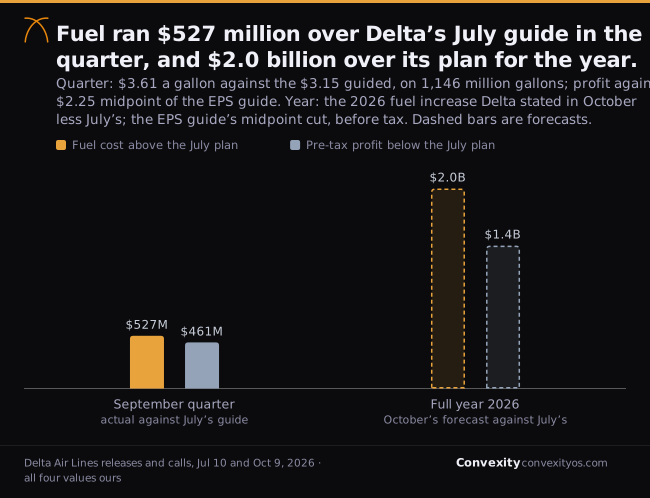
Fuel, at about $2 billion, is larger than the cut, at about $1.4 billion. One mechanical offset narrows the gap without closing it. Delta pays employees a share of its profit, so a dollar of extra fuel does not cost a full dollar of pre-tax profit. In the September quarter, profit sharing was $389 million, about a fifth of pre-tax profit before profit sharing (our arithmetic: $389 million against $1,886 million). If roughly a fifth of the fuel increase comes back through lower profit sharing, fuel still takes about $1.6 billion off pre-tax profit, more than the cut.
There is a limit to how hard these figures can be pushed. "Nearly $4 billion" and "roughly $6 billion" are rounded, and if the true difference were $1.8 billion rather than $2 billion, fuel net of profit sharing would match the cut rather than exceed it. On any reading of Delta's own numbers, though, the answer the chief financial officer gave reporters survives: fuel accounts for all of the cut. Everything else Delta revised between July and October roughly cancels out, leaving about $0.6 billion in its favor before the profit-sharing offset and about $0.2 billion after it (our arithmetic).
Why fuel came back after July
Delta did not misjudge fuel in July so much as set its guidance at the bottom of a dip. Its guidance uses the forward curve, the prices at which fuel for future delivery trades on a given day: the July guide used the curve as of July 2, and the October guide the curve as of October 2.
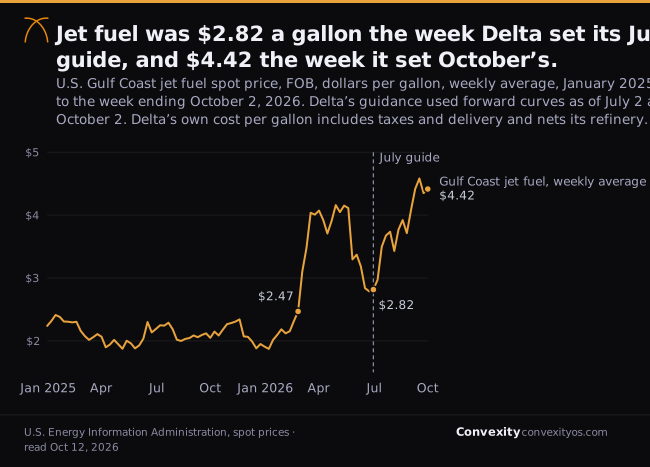
On the Energy Information Administration's figures, U.S. Gulf Coast jet fuel averaged $2.47 a gallon in the last week of February 2026 and more than $4 by the third week of March. It stayed near $4 into May, then fell, to $2.79 in the week ending June 26 and $2.82 in the week ending July 3, the week of the forward curve behind Delta's July guidance. Two weeks later the price was $3.50. It was $3.92 in late August, $4.58 in the week ending September 18 and $4.42 in the week ending October 2. September's average, $4.39, was more than double September 2025's $2.09.
Forward curves miss in both directions, and Delta's have done both this year. In April, Delta guided the June quarter on an all-in fuel price of about $4.30 a gallon and paid $3.93. In July it guided the September quarter at about $3.15 and paid $3.61. The 10-K gives the scale: "A one cent increase in the cost of jet fuel per gallon would result in approximately $40 million of additional annual fuel expense based on annual consumption of approximately four billion gallons of jet fuel." It also says Delta buys most of its fuel "under contracts that establish the price based on various market indices and therefore do not provide material protection against price increases," and that substantially all of its fuel derivatives relate to the refinery's inventory. Bastian put the industry's version plainly in July: "No one has fuel hedges of any note."
The reason for the second run-up is in the Energy Information Administration's October outlook. Brent crude, the international benchmark, averaged $114 a barrel in September after attacks on oil infrastructure and tankers in the Middle East, including on Saudi Arabia's East-West pipeline, a route around the Strait of Hormuz. Brent reached $131 on September 15. The agency also pointed to "extreme tightness in diesel markets" and said East Coast distillate inventories were 32% below their five-year seasonal average in September. It forecasts Brent at $105 in the fourth quarter and $87 by the second quarter of 2027, and expects "the majority of production in the region to return to pre-conflict averages by the end of 2Q27." The same oil move figures in our note on the long end of the Treasury market, as one reason long-term yields rose with short-term ones. Delta's 10-Q is less specific: "elevated jet fuel costs are anticipated to persist until market disruptions and geopolitical events are resolved."
For the December quarter, Delta assumes an all-in price of about $4.25 a gallon. A year earlier it paid $2.28, so the price is up 86% (our arithmetic), which is what Bastian meant by "fuel prices expected to double over last year."
Passengers are paying for the fuel, a quarter late
The year-over-year picture matters more for fares, and it uses only reported results. Delta reports two lines of ticket revenue, premium products and main cabin. Together they exclude miles redeemed for travel and fees such as checked bags, so they come closest to what passengers pay for seats.
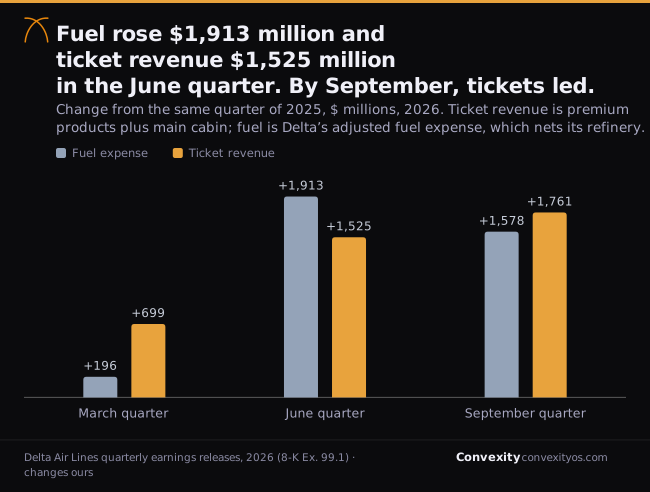
In the March quarter, fuel had barely moved: Delta's fuel bill rose $196 million and ticket revenue rose $699 million. In the June quarter, the first full quarter of expensive fuel, the fuel bill rose $1,913 million and ticket revenue $1,525 million, $388 million short. In the September quarter, the fuel bill rose $1,578 million and ticket revenue $1,761 million, $183 million ahead (our arithmetic on Delta's releases). Across the nine months, ticket revenue rose $3,985 million and fuel $3,687 million.
The June quarter fell short for a reason Delta's chief commercial officer, Joe Esposito, gave in July, describing how Delta's "fuel recapture strategy" moved through the quarter: "Don't forget, we started it in March, and in April, we were already 70% booked." Seats sold before the spike flew at the old prices. The September quarter was the first sold mostly after it.
The increase came from price, not from more passengers. In the September quarter, revenue passenger miles, a measure of traffic, rose 1%, capacity was flat and the load factor held at 86%. Passenger yield, the average fare per mile flown, rose 14%. Main cabin ticket revenue rose 12% and premium ticket revenue 18%. Delta says main cabin unit revenue rose 17% "on seats down low-single digits," and premium revenue rose 18% "on a 6 percent increase in seats." Bastian described the customer response to higher fares as "the limited amount of resistance that we see," and said air travel is still seen "as reasonably affordable even at a 20% price increase, which largely we have taken this year." That is a contrast with the packaged food makers we wrote about on Sunday, where volume fell at seven of the nine companies that report it; Delta has raised prices about a fifth and kept its planes as full as they were.
The official statistics show the same thing across the industry. The Bureau of Labor Statistics' consumer price index for airline fares was 23.4% higher in August than a year earlier, the latest month published when this note was written, and the increase over April to August averaged about 25% (our arithmetic on the unadjusted index). The September index was released at 8:30 a.m. Eastern on October 14, shortly before this note went out. In January, before the spike, the year-over-year increase was 2.2%.
The costs fares are not covering
Fuel explains the guidance cut. It does not explain why Delta's profit is flat on 16% more revenue, which matters for anyone reading "all of it's fuel" as a description of the whole year.
In the September quarter, adjusted revenue rose $2,388 million. Fuel took $1,578 million of it, and non-fuel costs, which rose 7.6% to $11,125 million, took $786 million. What was left was $24 million, roughly the $20 million by which adjusted pre-tax income rose (our arithmetic). Per available seat mile, the industry's unit of capacity: adjusted revenue rose 2.96 cents, fuel 1.98 cents (our arithmetic) and non-fuel cost 0.95 cents. Over nine months, revenue rose $5,769 million, fuel $3,687 million and non-fuel costs $2,359 million, and adjusted pre-tax income was $3,388 million against $3,672 million a year earlier.
So fares have covered fuel, and the shortfall in profit is in everything else. The 10-Q gives the main items. Salaries rose 9%, or $379 million, from "4% base pay increases for eligible employees effective on June 1, 2026 and for Delta pilots on January 1, 2026," annual step-ups and premium pay during disruptions. Landing fees and rents rose 11% as airports finished redevelopments. Snell, asked why non-fuel unit costs keep running above Delta's low-single-digit target, named "three buckets": "operational investments and improvements that we're making," "capacity discipline," and "higher revenue related costs." Flying the same capacity spreads the same fixed costs over no more seats, which is the cost of not growing into a fuel spike.
Delta expects non-fuel unit cost growth to improve by 1 to 2 points in the December quarter and to return to low single digits in 2027. "We're at the peak of our CASM right now," Snell said, using the industry's term for cost per available seat mile.
The refinery Delta owns
Delta owns an oil refinery, which Snell described to reporters, as Reuters reported it, as "a partial offset to fuel prices that no one else does." This is the kind of year it exists for. Its subsidiary Monroe Energy operates the Trainer refinery near Philadelphia, which the 10-Q says "typically produces approximately 200,000 barrels of refined products (primarily gasoline, diesel and jet fuel) per day." The 10-K says Delta owns it "as part of our strategy to mitigate the cost of the refining margin reflected in the price of jet fuel, as well as to maintain sufficiency of supply to our New York operations." The refining margin, which the industry calls the crack spread, is the gap between the price of crude oil and the price of the fuels made from it, and the Energy Information Administration counted "rising crack spreads" among the reasons retail fuel prices rose sharply in September. The airline pays market price for the refinery's jet fuel, priced off New York Harbor, so the benefit is the refining profit Delta keeps rather than handing to an outside refiner.
The refinery has had an uneven year. Its benefit was 6 cents a gallon in the March quarter, 11 cents in the June quarter after an outage that, the 10-Q says, "halted production at the refinery beginning in the middle of June 2026," and 13 cents in the September quarter, when the refinery segment posted a $33 million operating loss against a $53 million profit a year earlier. It is now back to normal production. Snell said that, with it "now fully online," Delta expects the December-quarter benefit "at roughly three times the September quarter level." The release puts it at about 40 cents a gallon, and Snell said: "Our outlook includes a refinery benefit of more than $700 million, underscoring its unique value."
Those figures hang together. At each quarter's stated benefit and gallons consumed, the first nine months come to about $332 million, and 40 cents on roughly 1.1 billion gallons in the December quarter adds about $430 million to $440 million, for a year of about $760 million (our arithmetic). Without the refinery, Delta's December-quarter fuel would cost about $4.65 a gallon rather than $4.25 (our arithmetic). The offset is real, and it is partial: it covers about 9% of the December-quarter price (our arithmetic), while the price itself is up 86%.
What it means for holiday fares
Delta's guidance for the December quarter is, in effect, a fare forecast. Esposito said Delta expects "revenue growth of approximately 20% year-over-year on roughly 3% capacity growth," and added: "With seat growth below 2%, including a year-over-year reduction in Main Cabin seats, our capacity positioning supports another sequential improvement in unit revenue growth as we continue to cover higher costs." On those figures, revenue per available seat mile would rise about 16.5% (our arithmetic), faster than the September quarter's 15%. Part of that is an easy comparison: Esposito said last year's government shutdown cost the December quarter "about 2 points of headwind."
Demand, on Delta's account, is not slowing. "We're already greater than 60% booked for the quarter," Esposito said on October 9. "Our demand in premium products continues to be high-teens," and corporate travelers show "no cracks." Forward cash sales grew "nearly 20%" in the September quarter. Half of the quarter's capacity growth, he said, goes to long-haul international flying.
For a traveler, the plan is easy to state. There will be slightly more seats than last holiday season, more of them in premium cabins and on long-haul flights, fewer of them in the main cabin, and prices that Delta expects to cover fuel at about $4.25 a gallon. Seats still unsold are the ones Delta can price for today's fuel. In July, Bastian said the low-fare end of the industry "still has to increase fares by another 5%, by our estimate, just to get to breakeven at today's fuel environment," and fuel is higher now than it was then. Abroad, Esposito said foreign competitors' fuel "hedges will start coming off," and expected them to have to "manage their businesses for margins as well." Asked about rivals charging higher fuel surcharges on peak travel days, he said: "We haven't moved in that direction."
The quarter is still expected to earn no more than last year's. Delta guides earnings of $1.15 to $1.65 a share against $1.55 a year earlier, an operating margin of 7% to 9% against 10.1%, and pre-tax profit of about $1.2 billion against $1,311 million. Snell said the guide "positions earnings consistent with last year at the upper end of the range." Twenty percent more revenue buys a flat quarter, at best, when fuel costs almost twice as much.
What Delta is doing about it
Delta's response is capacity restraint, pricing and debt reduction; its non-fuel costs are still rising. It held September-quarter capacity flat against a July plan of 1% growth and is growing seats by less than 2% in the December quarter. For 2027, Bastian would not commit to a growth rate: "you can expect our capacity not going to be normal by past measures, but it's going to be adaptive to the environment," and Delta will be "cautious I'd say going into the next year until we see the all-clear sign, particularly on fuel." He said the rest of the domestic industry earns a 3% return on invested capital, against Delta's 11%, and that "in a high-cost environment, you cannot grow your way out of it."
The fuel bill also shows up in cash. Delta cut its free cash flow outlook to about $2.5 billion from $3 billion to $4 billion and now expects gross leverage of about 2.2 times at year end, against about 2 times in July, while still paying down more than $2 billion of debt.
The market's reaction was muted. On our brokerage data, Delta's shares fell from $93.14 at the close on August 5 to $76.38 on September 1 as jet fuel climbed, and recovered part of that in late September. On October 9 they opened 3.0% below the previous close and finished at $82.17, unchanged from $82.14 the day before.
What would prove this wrong
This note argues three things: that fuel accounts for all of Delta's guidance cut, that passengers are paying for the fuel with a lag of about a quarter, and that holiday fares will be higher because of it. Each can be checked against data with a date.
- The December-quarter results, due in January on the pattern of past years. If Delta's December-quarter fuel comes in near $4.25 a gallon and earnings still fall below $1.15 a share, something other than fuel went wrong. The same is true if non-fuel unit costs fail to improve by the 1 to 2 points Delta guided.
- Ticket revenue against fuel in the December quarter. On Delta's 60% full-year increase, the December-quarter fuel bill rises about $2.2 billion from a year earlier (our arithmetic). If premium and main cabin ticket revenue rises by less than that, with more than 60% of the quarter already sold at higher fares, the catch-up this note describes did not hold.
- The consumer price index for airline fares. The September index came out on the morning of October 14, after this note was written, and the October index is due on November 10. A sharp slowdown in fare inflation while jet fuel stays above $4 a gallon would mean the industry is no longer passing fuel through. One wrinkle: the Bureau of Labor Statistics published no October 2025 value for this index.
- Rival airlines' results. United Airlines and American Airlines report later in October, according to Reuters. Neither owns a refinery. If they recover fuel at a similar pace, the pass-through is an industry fact; if they cannot, Delta's version of it depends on its brand and its refinery.
- Fuel and the refinery. By the 10-K's rule of thumb, each cent a gallon is about $10 million a quarter, so a 25-cent move in the December-quarter price is worth about $250 million, roughly a fifth of the quarter's pre-tax guide (our arithmetic). A refinery benefit well below 40 cents would raise Delta's fuel cost even if the market price held.
The filings and documents this is built on
- 8-KDelta Air Lines, September quarter 2026 earnings release (Exhibit 99.1)Revenue, fuel, non-fuel costs, ticket revenue lines, EPS, the December-quarter and full-year guidance and the $0.40 refinery assumptionOct 9, 2026
- CallDelta Air Lines September quarter 2026 earnings call, corrected transcriptFactSet CallStreet corrected transcript posted on the Delta investor site, the only full transcript we read; every October call quotation is from this textOct 9, 2026
- 10-QDelta Air Lines, quarterly report for the period ended September 30, 2026The refinery segment and its outage, salaries and landing fees, the projected tax rate and the outlook for fuel pricesOct 9, 2026
- 8-KDelta Air Lines, June quarter 2026 earnings release (Exhibit 99.1)The affirmed $6.50 to $7.50 guide, the September-quarter guide and the $3.15 fuel assumptionJul 10, 2026
- CallDelta Air Lines June quarter 2026 earnings call, corrected transcriptFactSet CallStreet corrected transcript posted on the Delta investor site, the only full transcript we read; the nearly $4 billion fuel increase and every July call quotation are from this textJul 10, 2026
- 8-KDelta Air Lines, March quarter 2026 earnings release (Exhibit 99.1)March-quarter fuel and ticket revenue, and the June-quarter guide of about $4.30 a gallonApr 8, 2026
- 8-KDelta Air Lines, December quarter and full year 2025 earnings release (Exhibit 99.1)Fuel, revenue and pre-tax income for the December quarter of 2025 and the full yearJan 13, 2026
- 8-KDelta Air Lines, September quarter 2025 earnings release (Exhibit 99.1)The year-earlier quarter as first reported, before the 2026 restatement of hedge settlementsOct 9, 2025
- 10-KDelta Air Lines, annual report for the year ended December 31, 2025The Trainer refinery and why Delta owns it, how Delta buys fuel, and the $40 million per cent sensitivityFeb 11, 2026
- DataU.S. Energy Information Administration, U.S. Gulf Coast kerosene-type jet fuel spot price FOB, weeklyWeekly averages, January 2025 to the week ending October 2, 2026; daily and monthly views used for single dates and monthly averages; read 2026-10-12Oct 7, 2026
- ReportU.S. Energy Information Administration, Short-Term Energy Outlook, October 2026Brent in September, the East-West pipeline attacks, diesel tightness, East Coast distillate inventories and the Brent forecast; read 2026-10-12Oct 6, 2026
- DataBureau of Labor Statistics, Consumer Price Index for All Urban Consumers, airline fares, not seasonally adjusted (CUUR0000SETG01)Monthly index levels through August 2026; the year-over-year changes are ours; read 2026-10-12Aug 2026
- ReportReuters, "Delta Air cuts profit forecast as $6-billion fuel-cost surge outweighs fare gains," as published by The Globe and MailThe chief financial officer remark to reporters, which is not in the call transcript, and the refinery remarks; retrieved 2026-10-12Oct 9, 2026
- PricesDelta Air Lines daily prices, July to October 9, 2026From our brokerage data feed; regular-session open and closeOct 9, 2026
Not investment advice. This note is an analysis of Delta's public disclosures and of official energy and price statistics, published for research purposes, and not a recommendation to buy, sell or hold any security. A member of the Convexity team holds SPY, which holds Delta and United Airlines; no other position.
What here is ours rather than Delta's. As filed or stated by Delta: every revenue, cost, fuel, gallon, earnings, margin, capacity and cash figure; every guidance figure and fuel assumption; the refinery benefits per gallon and the more than $700 million for the year; and every quotation, which is from Delta's filings, from its corrected transcripts of the two calls, or, for the remark to reporters, from Reuters. As published by the Energy Information Administration and the Bureau of Labor Statistics: the jet fuel prices, the Brent figures and forecast, and the airline fare index levels. Ours: the $527 million fuel overrun and the $461 million profit shortfall in the September quarter; the conversion of the guidance cut into about $1.43 billion of pre-tax profit, with its share count and tax rate; the roughly $2 billion change in the fuel forecast as the difference between the two stated figures; the $4.6 billion pre-tax equivalent of the new guide; the profit-sharing share, the netted fuel figure and the $0.6 billion and $0.2 billion left for everything else; every year-over-year change in ticket revenue and fuel and the comparison between them; the fuel and costs per available seat mile and the residual of revenue after fuel and non-fuel costs; the refinery dollar totals; the 86% December-quarter fuel price increase, the 16.5% unit revenue growth implied by the guide and the $2.2 billion December-quarter fuel increase; the jet fuel monthly comparisons; the fare index changes; the sensitivity of the December quarter to fuel; and the share price changes from the closes in our data feed.