








Disclosure. Not investment advice, and nothing here is a recommendation to buy, sell or hold any security. A member of the Convexity team holds the SPDR S&P 500 ETF (SPY), which holds RTX and Northrop Grumman; no other position. Figures are from RTX's earnings releases, its Forms 10-Q and 10-K, the October 20 earnings call, read in two independently produced transcripts and quoted only where both carry the same words; from the Department of War's contract announcements and the Navy's release on the Tomahawk award; from the Defense Federal Acquisition Regulation Supplement; and from Northrop Grumman's October 20 earnings release. The closing note lists what is our arithmetic. This note was drafted with Claude.
RTX ended September with a record backlog of $340 billion, and most of the quarter's $51 billion increase came from one part of it. Defense backlog rose to $164 billion from $119 billion at the end of June, a $45 billion jump in three months. In the seven quarters before that it had grown $29 billion in total (our arithmetic on RTX's releases).
Two contracts account for most of the jump. On the October 20 call, Chris Calio, RTX's chairman and chief executive, said the company booked "approximately $23 billion for Tomahawk and over $14 billion for AMRAAM," the Navy's long-range cruise missile and the air-to-air missile RTX calls the most widely deployed in the world. Together that is about $37 billion, roughly 82% of the defense increase and 73% of the increase in the whole backlog (our arithmetic). Without them, defense backlog would have been about $127 billion, up about $8 billion, a pace like the quarters before.
The release names what kind of contracts they are: RTX "Awarded Tomahawk and AMRAAM multi-year undefinitized production contracts in the third quarter." An undefinitized contract action lets work begin before the parties have finished agreeing what they are buying and for how much. The Pentagon's acquisition rules define it as a contract action "for which the contract terms, specifications, or price are not agreed upon before performance is begun." The government announces such a contract at a ceiling, and the same rules cap how much of that ceiling it may commit in funds before the contract is definitized.
So the biggest addition to RTX's backlog this year is two contracts whose final terms are still open, and where the government has published what it committed, it is a small fraction of the ceiling. That is not a hidden fact; RTX's release says it in the first block of bullets. What the release does not say, and the call answered only in part, is what the contracts will earn, when, and on whose appropriation. Those are the questions this note works through, using RTX's filings, the Pentagon's own contract notices and the call.
RTX third-quarter 2026 earnings release and October 20 call; Department of War contract announcement of September 28, 2026; the share obligated is ours.
What the quarter added
RTX reports backlog in three businesses: Collins Aerospace and Pratt & Whitney, which are mostly commercial aerospace, and Raytheon, which is defense. Raytheon carried the quarter. Nathan Ware, vice president of investor relations, said on the call that Raytheon's bookings were "$52.3 billion, resulting in a book-to-bill of 6.54 and a backlog of $130 billion." Its backlog was $86 billion at June 30, according to the June-quarter 10-Q, so it rose $44 billion. The arithmetic closes: $86 billion, plus $52.3 billion of bookings, less the segment's $8.0 billion of third-quarter sales, comes to about $130 billion (our arithmetic). Across RTX, Calio put defense awards at nearly $59 billion, a book-to-bill of 4.57.
Tomahawk and AMRAAM were most of Raytheon's bookings. Ware listed the next largest awards as "$3.1 billion to provide training systems for the British Army, $3 billion of classified awards, and $1.8 billion for SPY-6 production," the Navy's shipborne radar. Neil Mitchill, the chief financial officer, added that Raytheon "booked $9 billion worth of international orders" in the quarter.
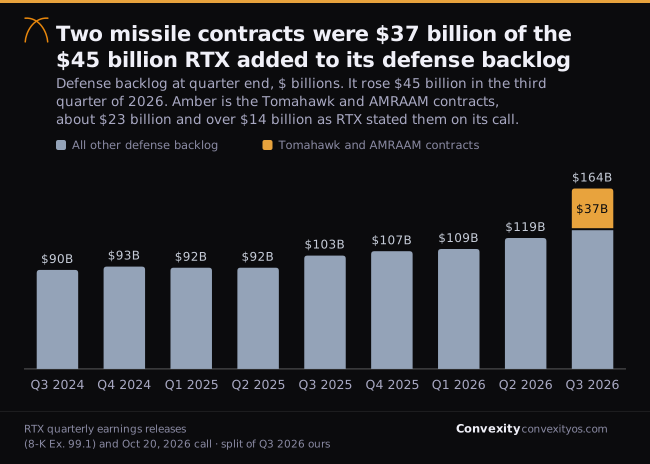
Mitchill gave a second way to size the two contracts. Asked about Raytheon's foreign backlog, he said: "37% of the total backlog is international. It's 52% if you exclude the munitions contracts, Tomahawk and AMRAAM, that we added." Reading those shares against Raytheon's $130 billion backlog, since the question was about Raytheon, 37% is about $48 billion of international orders. For the same $48 billion to be 52% of what remains, the excluded contracts have to be about $37.5 billion (our arithmetic), the same size Calio's two figures add up to. The two descriptions agree.
Two more of these contracts are already signed and will show up in the December quarter. Calio said that earlier in October RTX "signed multi-year contracts" for SM-6 and SM-3 Block IB, two Standard Missile interceptors, and Mitchill said: "We had two more that came here in the fourth quarter, so those will be included in our fourth quarter bookings." Calio put the four contracts at about $70 billion "in combined value," enough to give Raytheon "almost a decade of demand visibility."
The record does not depend on them. Total backlog without the two contracts would have been about $303 billion, still above June's $289 billion (our arithmetic), because commercial backlog rose too, to $176 billion from $170 billion, and so did the rest of defense. What depends on them is the size of the step: the defense side of RTX added more backlog in one quarter than in the previous seven together.
A contract signed before it is finished
The four contracts began as framework agreements. On February 4, Raytheon announced five of them with the Department of War, covering Tomahawk, AMRAAM, SM-6 and two versions of the SM-3, "up-to-seven-year agreements" under which RTX would raise annual production of Tomahawk "to more than 1,000, AMRAAMs to at least 1,900, and SM-6 to more than 500." The release said many of the munitions would grow "2 to 4 times their existing production rates." A framework is not an order, and RTX did not count the frameworks in backlog. They entered it only as they became contracts. "We got two of the frameworks converted to undefinitized contracts in the third quarter," Mitchill said on the call, and those two are the Tomahawk and AMRAAM bookings.
That timeline matters for how to read the jump. The frameworks were signed on February 4, three and a half weeks before the United States and Israel launched Operation Epic Fury against Iran on February 28, as the Department of War describes it. The decision to buy these missiles at higher rates predates the war. The conversion into contracts came during it: the Navy announced the Tomahawk award on August 17, and its acting secretary, Hung Cao, said the department was "utilizing every available tool to meet the demands of current operations." The war is in the timing and the urgency. The demand signal was already there.
The Pentagon's notices show what an undefinitized multiyear contract looks like on paper. The AMRAAM award, dated September 25 and announced on September 28, opens: Raytheon "was awarded a not-to-exceed $20,699,334,581 fixed-price incentive firm and firm-fixed-price-undefinitized contract action multi-year contract for the Advanced Medium-Range Air-to-Air Missiles (AMRAAM)." It covers foreign military sales to 16 countries, from Australia to the United Kingdom, runs to June 30, 2033, and was sole-source. At award, the notice says, the government obligated "$85,715.00" of fiscal 2026 Air Force weapons procurement funds and $154,266,225 of foreign military sales funds. That is $154 million against a $20.7 billion ceiling, about 0.75% (our arithmetic). The Air Force figure is as printed; it may be a typographical slip on the department's part, and the share barely moves either way.
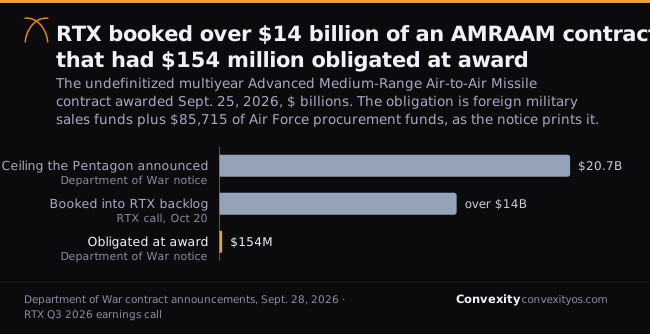
RTX booked "over $14 billion" of that $20.7 billion ceiling, which its quarterly report, filed on the evening of October 20, puts at approximately $14.3 billion. The same report describes the AMRAAM award as a five-year contract action "with two one-year options," and RTX's 10-K defines backlog as "firm orders" that "excludes unexercised contract options." That would account for the difference, about $6.4 billion (our arithmetic): the two option years are not yet orders. RTX does not state the split, so that reading is ours.
Tomahawk is less visible. The Navy's release gives a value, $22.9 billion, and nothing else: no contract type, no quantity, no unit price and no obligated amount. We did not find the award in the Department of War's daily contract announcements for the days around August 17. RTX's own description is the one on record: its quarterly report calls the Tomahawk award "a seven-year UCA valued at up to approximately $23 billion," and RTX booked approximately $23 billion against the Navy's $22.9 billion.
The fourth-quarter awards follow the same pattern. The Missile Defense Agency's SM-3 Block IB contract, dated October 7, is a "multi-year undefinitized contract action" with a base value of $4.43 billion and $6.34 billion including options, on which $454 million of fiscal 2026 procurement funds were obligated, about 10.2% of the base value (our arithmetic). We could not find the SM-6 award in the department's announcements. RTX's quarterly report values it at up to $24.4 billion, and SM-3 Block IB at up to $6.3 billion, each a five-year contract action with two one-year options, like AMRAAM. Across the four, the ceilings add up to about $74.4 billion (our arithmetic), against the roughly $70 billion Calio gave on the call.
"Including price"
The rules that govern these contracts are specific. Under the Defense Federal Acquisition Regulation Supplement, an undefinitized contract action must be definitized by the earlier of 180 days after the contractor submits a qualifying proposal or the date the government has obligated more than half the not-to-exceed price. Until then, "The Government shall not obligate more than 50 percent of the not-to-exceed price before definitization," a limit that rises to 75% once a qualifying proposal is in. For AMRAAM, half the ceiling is about $10.35 billion (our arithmetic). Definitization itself is defined as "the agreement on, or determination of, contract terms, specifications, and price."
RTX's management described the contracts in different terms. "These are binding contracts," Calio said on the call. "They've got robust terms, including price, delivery schedules and the like." Asked by Ron Epstein of Bank of America how RTX was protected if the contracts were not definitized the way it hoped, Calio said: "I won't get into the detailed terms," and that "we are protected if there are changes in the budgetary environment and changes in volumes." He called RTX "protected on the downside."
Both descriptions can be true. A not-to-exceed figure is a price of a kind: it caps what the government can pay. The rule's definition is also written with an or: an action is undefinitized if the terms, the specifications or the price are not agreed, so a contract can have settled prices and still be undefinitized on something else. RTX has not said which elements remain open. What the rule and RTX's own annual report make clear is what remains at stake until definitization.
The 10-K, in the section on government contracts, says RTX may "begin performance on an undefinitized contract action with a not-to-exceed price before completing contract negotiations on the terms, specifications, or price between the parties." It continues: "The U.S. government has the ability to unilaterally definitize contracts, which would obligate us to perform under terms and conditions imposed by the U.S. government without our agreement." And the risk factor ends: "Uncertainties in final contract price, specifications and terms, or loss of negotiating leverage associated with particularly long delays in contract definitization may negatively affect our profitability."
The acquisition rules add a reason the profit on these contracts is not yet knowable. When the final price "is negotiated after a substantial portion of the required performance has been completed," the profit allowed must reflect "Any reduced cost risk to the contractor for costs incurred during contract performance before negotiation of the final price." Work done before the price is final is treated as lower-risk work, and lower-risk work earns less profit. How much that matters depends on how fast these contracts are definitized relative to how fast RTX spends on them, and neither the company nor the department has published a schedule.
Booked, but not yet funded
A backlog figure counts orders. It does not say whether Congress has appropriated the money to pay for them. Some contractors split the two. Northrop Grumman, which reported the same morning, publishes funded and unfunded backlog in its release, defining funded backlog as "firm orders for which funding is authorized and appropriated." At September 30, $50.1 billion of Northrop's $109.6 billion backlog was funded and $59.5 billion, about 54%, was not (our arithmetic on the share).
RTX publishes no such split, in its release, its 10-Q for the quarter or its 10-K. The 10-Q, filed on the evening of October 20, states the condition for all four munitions contracts in one line: "Funding for each UCA is subject to Congressional appropriations made on a fiscal year basis." It adds that "If appropriate funding is not provided, Raytheon has certain contractual recovery remedies," without saying what they are. Its annual report explains why the distinction matters in general terms: "because the funding of U.S. government programs is subject to congressional appropriations made on a fiscal year basis even for multi-year programs, programs are often only partially funded initially and may not continue to be funded in future years." On the AMRAAM contract, the notice shows how partial: $154 million of funding against more than $14 billion that RTX counts as firm.
The company says it is not carrying the cost of the ramp in the meantime. The February release said the agreements "incorporate a collaborative funding approach designed to preserve upfront free cash flow," and Mitchill repeated the point on the call: "these contracts include a funding approach that will essentially preserve upfront free cash flow." He said RTX would be "making capex and other investments on these contracts over the next two to three years," and described the frameworks as "largely a cash neutral event" in 2027. RTX has not disclosed how the funding approach works.
The budget is the open variable, and management said so. Calio noted that the government is "operating under a continuing resolution," the stopgap that funds agencies when Congress has not passed the year's appropriations. Mitchill, asked about the timing of revenue from the contracts, said the variables included "the most important of which is how the defense budgets play out in the coming months." Calio said he believed the munitions "will be prioritized" whatever happens in the budget process. That is an expectation about Congress, not a disclosure.
When it reaches earnings
The contracts add almost nothing to this year's results. Mitchill said RTX had "booked a little bit of revenue" on them in 2026, and that it will "recognize revenue as costs are charged to the programs." Calio called it the same treatment as the rest of the business: "we're going to account for these like other defense programs." Revenue therefore follows spending, and spending follows the ramp. Mitchill said he saw the contracts "starting to ramp over the next two years in earnest," and "continuing through 2030" when the munitions reach full-rate production. Calio said RTX would execute them over the next seven to ten years.
Spread evenly over seven to ten years, $37 billion would be $3.7 billion to $5.3 billion of revenue a year (our arithmetic), against $8.0 billion of Raytheon sales in this quarter alone. It will not be spread evenly. On the company's own description, the early years are tooling, supplier purchase orders and qualification, and the volume comes later.
Raytheon's strong quarter is not evidence of what these contracts will earn. Its adjusted operating margin rose to 14.1% from 12.2%. The release says the quarter included "approximately $85 million of benefits associated with an international contract modification and a favorable adjustment related to an offset obligation." That is about 1.1 points of the 1.9-point improvement; without it the margin would have been about 13.1% (our arithmetic). The rest came, in the release's words, from "improved net productivity, higher volume, and favorable mix, including Patriot programs."
On what the new contracts will earn, management offered a direction and no number. Mitchill: "these contracts have the potential to support margin expansion at Raytheon as we scale production." Gautam Khanna of TD Cowen asked whether their profit rates would approach those on Raytheon's foreign backlog. Calio answered that as volume rises and the supply base matures, "we think that these can support margin expansion at Raytheon." That is a forecast about efficiency at scale. It does not say what margin RTX is recognizing on the contracts today, and the 10-K's risk factor and the profit rule above both describe forces pushing the other way until the contracts are definitized.
The capacity it has to buy
Doubling or quadrupling missile output is mostly a supply-chain problem, and Calio said as much. Raytheon is "lining up the supply chain, putting up POs for tooling and test equipment," and has been working with the department on "streamlining test requirements, improving producibility where we can, addressing obsolescence, qualifying new suppliers." He said: "In 2025 alone, Raytheon added 150 new suppliers." He put this year's output growth across RTX's critical munitions at more than 90%.
He named the bottlenecks when Scott Mikus of Melius Research asked whether RTX would buy a solid rocket motor maker. "We see constraints, as I mentioned earlier, in castings," Calio said, and RTX is "investing in our own Asheville facility there." He went on: "We see constraints in rocket motors." On rocket motors, he said RTX is adding suppliers through partnerships rather than acquisition, because "that's just an area that you're never going to have enough suppliers." He also listed critical minerals. Epstein raised another: "Nobody can get printed circuit boards," he said, describing what he heard walking around the Association of the United States Army's conference, and he tied the shortage to demand from the AI buildout. Calio agreed that supply was "the single biggest enabling factor" for the higher rates.
The connection to the contracts is direct. A cost-to-cost contract recognizes revenue only as costs are incurred, so a supplier that cannot deliver a rocket motor or a circuit board does not just delay a missile, it delays the revenue the backlog figure implies. The same constraint shapes the profit question: if the ramp is slower than the definitization schedule, more of the work is priced while RTX is still learning what it costs.
The tariff refund in the quarter
The quarter's headline earnings carried a different one-time item. Adjusted earnings per share were $2.26, up 56 cents from $1.70 a year earlier, and the release says the figure included "$0.25 from IEEPA cost recovery," the refund of tariffs imposed under the International Emergency Economic Powers Act, which the Supreme Court held in February did not authorize them. RTX said in its June-quarter 10-Q that it had paid "approximately $0.5 billion" of such tariffs since their inception. In the third quarter the recovery added about $0.4 billion to adjusted segment operating profit, about $250 million at Collins and $160 million at Pratt & Whitney, and Mitchill said it accounted for about 160 basis points of the 310-basis-point rise in segment margin.
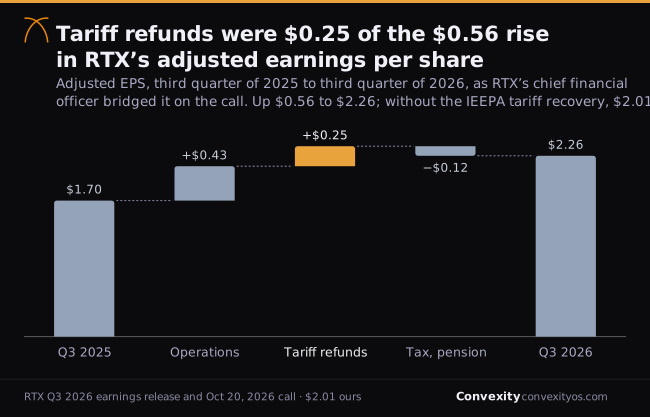
Without the recovery, adjusted earnings would have been $2.01 a share, up about 18% rather than 33% (our arithmetic). The recovery was about 45% of the year-over-year increase. It also drove the guidance: the midpoint of the full-year range rose about 53 cents, which Mitchill split into "approximately $0.28 of performance across the company and approximately $0.25 of IEEPA recovery," and the higher free cash flow outlook was, in his words, "driven primarily by IEEPA recovery."
RTX left the refund inside adjusted earnings, as most companies did. In our September note on tariff refunds, 35 of the 45 S&P 500 companies with an adjusted earnings measure that booked a refund kept it in. There is an argument for it, since the tariffs were paid and expensed through adjusted earnings over earlier quarters, and a refund reverses that. The same release does exclude a $363 million charge at Pratt & Whitney "related to a customer bankruptcy" from adjusted results. That treatment is RTX's choice and it is disclosed; it simply means the adjusted figure removes a one-time cost from this quarter and keeps a one-time gain. Mitchill said the remaining cash, about $50 million, arrives in the fourth quarter, after which the refunds stop.
What would prove this wrong
This note argues that most of RTX's third-quarter defense backlog increase is two contracts whose final terms, profit and funding are not yet settled, and that the quarter's strong margins and earnings came from elsewhere, including a tariff refund. Each part can be checked against events with dates or documents that will exist.
- Definitization. If the Tomahawk and AMRAAM contracts are definitized within the regulation's window at values near what RTX booked, with no reduction in backlog and no change to the margin RTX recognizes on them, the caveat this note puts on them was a formality. RTX's 10-Q for the quarter, filed on October 20, still describes all four as undefinitized contract actions; its later filings should say when either contract is definitized.
- Appropriations. If the fiscal 2027 defense appropriation, or a supplemental, funds the multiyear munitions buys in full, the gap between what RTX counts and what Congress has paid for closes. If the continuing resolution runs long or the munitions lines are cut, watch for RTX to adjust the bookings or for the department to obligate funds slowly against the ceilings.
- Fourth-quarter bookings. RTX said the SM-6 and SM-3 Block IB contracts, signed in October, will be booked in the December quarter. If defense backlog in January rises by roughly their value, the pattern of this quarter repeats; if RTX books them well below their announced values, as it booked AMRAAM below its ceiling, it suggests the company is counting only firm quantities, which is the conservative reading.
- Raytheon margins as the contracts ramp. Management says the contracts can raise Raytheon's margins. If Raytheon's adjusted margin holds near or above 14% in 2027 and 2028 while these contracts become a larger share of sales, the profit concern here was overstated. A margin that slips as their share grows would point the other way.
- Supply. RTX's outlook for 2027, due on its January call, will show how much revenue it expects from the contracts next year. If it is more than "a little bit," the supply constraints Calio described are easing faster than this note assumes.
The filings and documents this is built on
- 8-KRTX Corporation, third quarter 2026 earnings release (Exhibit 99.1)Backlog of $340 billion, $176 billion commercial and $164 billion defense; the undefinitized Tomahawk and AMRAAM contracts; adjusted EPS and the $0.25 of IEEPA recovery; segment results, the Raytheon one-time benefits and the Pratt customer bankruptcy chargeOct 20, 2026
- CallRTX third quarter 2026 earnings call, transcript published by BenzingaOne of two independently produced transcripts read; quotations used only where this and the Investing.com transcript carry the same words; retrieved 2026-10-20Oct 20, 2026
- CallRTX third quarter 2026 earnings call, transcript published by Investing.comThe second transcript read; speakers and titles taken from the operator introduction; retrieved 2026-10-20Oct 20, 2026
- 10-QRTX Corporation, quarterly report for the period ended September 30, 2026The four critical munitions UCAs, their terms, option years and values; the approximately $14.3 billion AMRAAM booking; funding subject to annual appropriations and the contractual recovery remediesOct 20, 2026
- 10-QRTX Corporation, quarterly report for the period ended June 30, 2026Raytheon backlog of $86 billion at June 30; the Supreme Court IEEPA ruling as RTX describes it and the approximately $0.5 billion of IEEPA tariffs paidJul 23, 2026
- 10-KRTX Corporation, annual report for the year ended December 31, 2025The definition of backlog; undefinitized contract actions, unilateral definitization and the profitability risk factor; partial funding of multi-year programsFeb 2026
- 8-KRTX Corporation, second quarter 2026 earnings release (Exhibit 99.1)Backlog of $289 billion, $170 billion commercial and $119 billion defense; the July full-year guidanceJul 23, 2026
- 8-KRTX Corporation, earnings releases from the third quarter of 2024 to the first quarter of 2026 (Exhibit 99.1)Commercial and defense backlog at each quarter end; the EDGAR filing index for RTX lists each release2024 to 2026
- ReleaseRTX, "RTX's Raytheon partners with Department of War on five landmark agreements to expand critical munition production"The five framework agreements, the production targets and the collaborative funding approach; retrieved 2026-10-20Feb 4, 2026
- NoticeDepartment of War, Contracts for Sept. 28, 2026The AMRAAM award: the not-to-exceed value, contract type, foreign military sales countries and the funds obligated at awardSep 28, 2026
- NoticeDepartment of War, Contracts for Oct. 8, 2026The SM-3 Block IB award: base value, value with options and funds obligated; read through the GlobalSecurity.org mirror after the department site refused our readerOct 8, 2026
- ReleaseU.S. Navy, "U.S. Navy and RTX Accelerate Critical Munitions Production Through Tomahawk Award"The $22.9 billion value and the acting secretary's statement; retrieved 2026-10-20Aug 17, 2026
- RuleDefense Federal Acquisition Regulation Supplement, subpart 217.74, undefinitized contract actionsDefinitions (217.7401), definitization schedule (217.7404-3), limits on obligations (217.7404-4) and allowable profit (217.7404-6); read 2026-10-20May 7, 2026
- NewsDepartment of War, "Four Days In, Hegseth, Caine Say U.S. Making Decisive Progress in Iran"The February 28 launch of Operation Epic Fury; retrieved 2026-10-20Mar 4, 2026
- 8-KNorthrop Grumman, third quarter 2026 earnings release (Exhibit 99)Funded and unfunded backlog at September 30, 2026, and its definition of funded backlogOct 20, 2026
Not investment advice. This note is an analysis of RTX's public disclosures, of Department of War and Navy contract announcements and of federal acquisition rules, published for research purposes, and not a recommendation to buy, sell or hold any security. A member of the Convexity team holds SPY, which holds RTX and Northrop Grumman; no other position.
What here is ours rather than RTX's. As filed or stated by RTX: every backlog, booking, sales, profit, margin, earnings and guidance figure; the values of the Tomahawk and AMRAAM bookings; the terms, option years and ceilings of the four munitions contracts as its 10-Q states them; the international shares of Raytheon's backlog; the IEEPA recovery amounts and the tariffs paid; and every quotation, which is from RTX's filings and releases or from the call as both transcripts carry it. As published by the Department of War and the Navy: the contract values, ceilings, types, terms and obligated funds, and the date of Operation Epic Fury's launch. As published by Northrop Grumman: its funded and unfunded backlog. Ours: the $45 billion quarterly increase in defense backlog, the $51 billion increase in total backlog and the $29 billion defense increase over the seven quarters before; the roughly $37 billion combined value of the two contracts and their 82% and 73% shares of the increases; the $127 billion and $303 billion figures without them; the $37.5 billion implied by the international shares; the Raytheon backlog walk; the 0.75% of the AMRAAM ceiling obligated and the $6.4 billion between that ceiling and RTX's $14.3 billion booking, with our reading that it is the option years; the $74.4 billion sum of the four contracts' ceilings; half the AMRAAM ceiling, $10.35 billion; the SM-3 Block IB obligation as 10.2% of its base value; the 54% unfunded share of Northrop's backlog; the $3.7 billion to $5.3 billion a year from spreading the contracts evenly; Raytheon's margin without its one-time benefits and their share of the improvement; adjusted EPS of $2.01 without the tariff recovery, the 18% growth on that basis and the recovery's 45% share of the increase; and the 53-cent rise in the guidance midpoint.