









Disclosure. Not investment advice, and nothing here is a recommendation to buy, sell or hold any security. A member of the Convexity team owns Nu Holdings shares directly and stands to benefit if they rise, so we are not neutral on what Nu pays for anything, Monzo included. The same team member owns shares of the SPDR S&P 500 ETF (SPY); the S&P 500 appears below only as a market benchmark. No position in Monzo, long or short. The talks described here were reported by Sky News and have not been confirmed by either company. Several of the reports we cite sit behind paywalls or bot blocks we could not get past, and the text says so wherever that matters. Every figure about the two banks is quoted from a Nu Holdings filing, Monzo's audited annual report, or Nu's earnings call, or is our arithmetic on figures in them; the closing note separates the two.
On Saturday, September 26, Sky News reported that Nu Holdings, the company behind Brazil's Nubank, had begun preliminary talks to buy Monzo, the British digital bank, in a deal that could value it at between £8 billion and £10 billion. That is $10.6 billion to $13.3 billion at Friday's European Central Bank reference rates, or 16% to 20% of what Nu itself was worth at Friday's close, both our arithmetic. The outlets that followed Sky's report say the terms under discussion would likely mix cash and shares, and that Monzo's board is also weighing a new funding round at a valuation above £8 billion. Nu's only public response, as City AM printed it, was that it "does not comment on rumours or speculation." It has filed nothing about Monzo with the SEC.
The market's first answer came on Monday, September 28. By 3:19 p.m. Eastern time, with the session still open, Nu's shares were down 9.7% from Friday's close, against 0.7% for the S&P 500 and 1.5% for the iShares MSCI Brazil ETF.
The coverage has read the talks as Nubank buying its way into Europe, and that is accurate as far as it goes. What it leaves out is on file. Monzo's audited accounts for the year to March 31, 2026 describe a bank that lends out about a tenth of its deposits, earned more from its reserves at the Bank of England than from all of its lending put together, spent three quarters of its income on operating costs, and earned 6.9% on its equity. Nu's filings describe a bank built on the opposite of each of those. Its loans come to most of its deposits, most of its revenue is credit, it runs on a cost base its founder describes as a fraction of the industry's, and it earned 33% on its equity last quarter. At £8 billion to £10 billion, Nu would be paying more for each pound of Monzo's book value than the market pays for each dollar of its own.
What was reported, and what we could read
Sky's report came from Mark Kleinman, who summarized it himself on X: Monzo "is in talks about a sale to Brazil's Nu Holdings which could value it at between £8bn and £10bn" (Kleinman on X, retrieved 2026-09-28). Sky's own summary of the story says Nu "has begun preliminary talks." We could not read the article itself. Sky's article pages refused every automated request we made, as did the Financial Times and Bloomberg, so the detail below comes from outlets that quote those reports, and each point is attributed to whoever it came from.
According to The Next Web's account of Sky's story, the talks are at a relatively early stage, outline terms are being negotiated, a deal would likely be paid in cash and shares, and a sale to Nu is one of two main options for Monzo's board and shareholders. The other is a funding round at a valuation above £8 billion, which would pay for expansion in mainland Europe (The Next Web, Sept 28, retrieved 2026-09-28). The same coverage puts Monzo's last valuation at £4.5 billion, set in an employee share sale in October 2024, so the range under discussion is 1.8 to 2.2 times that mark, our arithmetic on the reported figures. On Sunday, Sky reported that the buyout firm Advent International is interested in buying a stake in Monzo (Sky News business feed, Sept 27, headline and summary retrieved 2026-09-28). Benzinga's account of the Financial Times coverage adds that Nu may take a stake in Monzo rather than buy all of it (Benzinga, Sept 28, retrieved 2026-09-28). Monzo declined to comment, according to City AM, which printed Nu's full statement: "Nubank does not comment on rumours or speculation. We reaffirm our commitment to maintaining open, clear, and timely communication regarding all significant business matters" (City AM, Sept 26, retrieved 2026-09-28).
Nu's own filing record says nothing about any of it. Its most recent reports to the SEC are a September 10 notice that it had launched in the United States and a September 2 notice that it will hold its first investor day on December 8. Neither mentions Monzo, Britain or an acquisition.
So everything below about the deal itself is conditional. There may be no deal, it may be a stake rather than a takeover, and the price may move. What is not conditional is what the two banks are. Both have published audited or filed accounts in the last five months, and they describe businesses that earn their money in nearly opposite ways.
Monzo is a deposit bank
Monzo's customers held £25.7 billion with it on March 31, up 55% in a year, of which £10.2 billion was in current accounts and £15.5 billion in savings (Monzo Annual Report 2026). Its gross lending on the same date was £2.63 billion, across personal loans, overdrafts and Monzo Flex, its pay-later product. Loans were therefore 10.2% of deposits, our arithmetic on the two reported figures. The rest of the money sits in two places the report describes plainly. Its chief financial officer writes that the bank keeps "cash reserves at the Bank of England being 60% of total customer deposits," and a treasury portfolio of gilts, supranational bonds and senior asset-backed securities grew 76% during the year to £9.5 billion.
The income statement follows the balance sheet. Of £1.2 billion of interest income, £377.1 million came from loans and advances to customers: £145.2 million from overdrafts, £138.2 million from loans and £93.7 million from Flex. Cash and cash equivalents produced £482.6 million, which note 2 says was "primarily earned on reserves held at central bank," and the treasury portfolio another £339.0 million. The chief financial officer's review puts interest on "deposits held with the Bank of England" at £484 million, up 12% in a year in which rates fell. Monzo earned more last year from the Bank of England than from every borrower it has. Measured against total revenue of £1.71 billion, interest on customer lending was 22%, which matches the share Monzo gives "Borrowing" in its own revenue chart, and interest on cash and securities was 48%, our arithmetic.
From Monzo Bank Holding Group's Annual Report 2026, for the year to March 31, 2026. The 10.2% is our arithmetic on the two reported balances.
This is not a phase Monzo is passing through. Net of loss allowances, its five-year balance sheet puts loans at 11.0% of deposits in February 2023, 10.6% in March 2024, 9.7% in March 2025 and 9.0% at the latest year end, our arithmetic on the reported lines, while the deposit base grew from £5.9 billion to £25.7 billion. Lending has grown quickly in absolute terms, 42% last year on the gross measure, and it has not caught up, because deposits grew faster still.
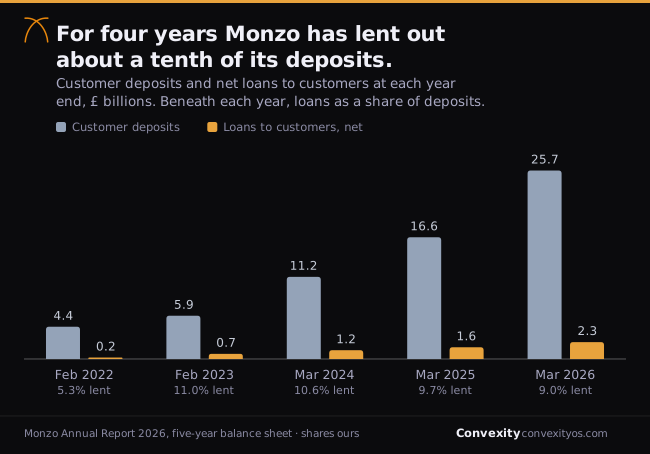
None of this is a flaw, and Monzo does not present it as one. Its report calls the model a "capital-light approach" that is "designed to support a high return on equity model over time." The bank's common equity tier 1 ratio was 33%, down from 56% a year earlier because lending growth and operational risk lifted its risk-weighted assets from £2.1 billion to £3.8 billion, and its liquidity coverage ratio was 1,261%. It is safe, liquid and heavily capitalized, and by the standards of a lender it has lent very little.
The return it earns on that model is the other half of the picture. Profit before tax for the year was £87.3 million and profit after tax £86.3 million; the tax charge was only £1.0 million because a £24.6 million deferred tax credit offset £25.7 million of corporation tax. Average equity over the year was £1.25 billion, so the return on equity was 6.9%, our arithmetic. Monzo's own headline measure, adjusted profit before tax, adds back £59.0 million of share-based payments, a £21.1 million fine from the Financial Conduct Authority for financial crime control failings between 2018 and 2020, and a £5.3 million provision for closing its American business, to reach £172.6 million. Even that figure, before any tax at all, is a 13.8% return on average equity, our arithmetic.
Its sensitivity to interest rates is modest by design. A structural hedge covers 46% of deposit balances, and Monzo says a 100 basis point change in rates would move annual interest income by about £23.9 million. Its net interest margin still fell to 3.7% from 4.1% as the Bank of England cut its rate by 75 basis points during the year.
Nubank is a lender
Nu's second-quarter release, filed with the SEC on August 13, reports a credit portfolio of $39.4 billion against deposits of $45.3 billion (Nu Holdings Form 6-K, Aug 13, 2026). Its loans come to 87% of deposits, our arithmetic on those two figures. Even in Mexico, where Nu has been letting deposits shrink as part of what the release calls a "deliberate deposit-optimization strategy," the release describes the loan-to-deposit ratio as "just 35%." Of $5.88 billion of revenue in the quarter, $3.60 billion was credit income, $1.45 billion was float income earned on deposits held as cash and securities, and $0.82 billion was fees. Credit was 61% of revenue, our arithmetic. One section of the release is headed "Credit as a Superpower, Underpinned by Customer Primacy." The net interest margin was 22.9%, and 12.4% after the cost of credit.
On the call that evening, David Vélez, Nu's founder and chief executive, described its balance sheet as "very unlevered" and the opportunity in front of it as "reallocating a lot of deposits" into higher-yielding lending, which "falls directly into margin and into ROE." (We quote the call only where the transcripts published by The Motley Fool and by Stock Analysis agree word for word.) Nu's plan for its own deposits is to lend more of them. Monzo earns most of its interest on deposits it has not lent.
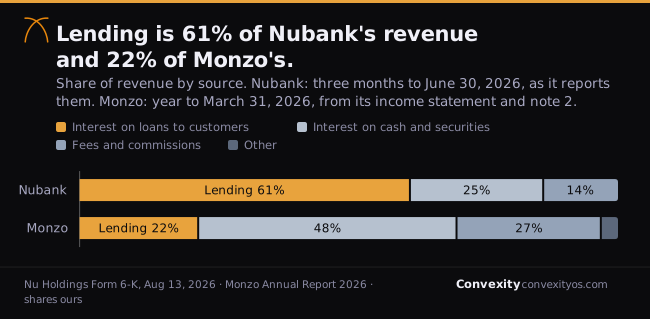
The returns follow from the model. Nu reported net income of $1.06 billion for the quarter, the first time it has passed a billion, a return on equity of 33%, and an efficiency ratio, operating expenses over net revenue, of 19.5%. Monzo's cost-to-income ratio, which it builds on nearly the same construction, was 74%.
The customers cost what British customers cost
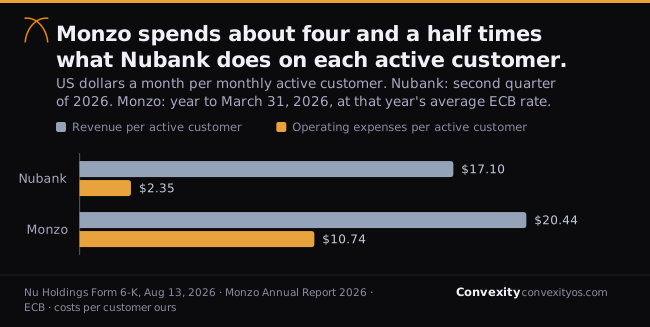
The two banks earn broadly similar amounts from each customer who uses them, Monzo somewhat more. Nu reported monthly average revenue per active customer of $17.1 in the second quarter. Monzo reported average revenue per active customer of £183 for its year, which is £15.25 a month, or $20.44 at the average European Central Bank reference rate over those twelve months, our conversion.
Where they part is in what it costs to earn it. Dividing operating expenses by the average number of monthly active customers over each period, Nu spent $2.35 a month on each active customer in the second quarter. Monzo spent £8.01 a month, or $10.74, over its year: about four and a half times as much, our arithmetic. If anything the comparison understates the gap, because Nu's second quarter was its most expensive of the year so far, with operating expenses up 20% on the first quarter as real estate and marketing spending moved into it. Monzo's figure uses its own adjusted operating expenses, which leave out the FCA fine and the American restructuring. Both banks' headline measures leave something out, so the same division was run on the statutory lines as well: Nu's operating expenses as its IFRS income statement reports them, $299.4 million more for the quarter than the managerial figure after the reclassifications its release sets out, come to $3.22 a customer a month, and Monzo's unadjusted operating expenses to $11.06. On that basis the gap is about three and a half times rather than four and a half, and nothing below depends on which of the two is used.
Monzo's cost lines are the costs of running a bank in Britain. Personnel cost £421.6 million for an average of 4,674 people. Marketing cost £143.1 million, with referral payments tripling to £29.5 million. Monzo reimbursed £59.6 million to victims of fraud, 85% more than a year earlier, reflecting a full year under the mandatory reimbursement regime for authorized push payment scams that the Payment Systems Regulator introduced in October 2024. On top of that came the £21.1 million fine. Most of those costs come with the country rather than with the software, and an owner cannot engineer away British salaries or a British regulator's reimbursement rules.
Nu's founding claim, which Vélez repeated in the release, is that a bank built on technology "could serve hundreds of millions of people better, and at a fraction of the cost." That claim is about Nu's own platform and its home markets. Owning Monzo would not bring São Paulo's cost base to Britain. It would add Britain's to Nu's, and the effect is measurable on the ratio Nu uses to judge itself. Take Nu's second-quarter operating expenses and net revenue at an annual rate, add Monzo's adjusted operating expenses and its revenue net of interest and fee expense for its year at that year's average exchange rate, and the combined efficiency ratio comes to about 24.4%, against 19.5% for Nu alone, our arithmetic on definitions that are close to each other but not identical. That is roughly five points on a ratio Nu reports to the tenth.
What Nubank has said about new markets
This is where the talks sit furthest from Nu's own recent account of itself, and the account is detailed.
When the Office of the Comptroller of the Currency conditionally approved a national bank charter for Nu on January 29, Vélez said: "While we remain fully focused on our core markets in Brazil, Mexico, and Colombia, this step allows us to build the next generation of banking in the United States" (Nu Holdings Form 6-K, Jan 29, 2026). The same filing set out the pace: capitalize the new bank within twelve months and open it within eighteen. In July, Nubank México received its final authorization to operate as a bank, and Nu agreed to buy Banco Porto Real to add a banking license in Brazil. Both were presented as completing structures Nu already runs, not as entries into anything new.
On the August 13 call, Rob Livingston, who took over as chief financial officer from Guilherme Lago on July 13, put a number on the American entry: "we are not planning to spend more than 100 basis points in our efficiency ratio on the U.S. entry." On the quarter's net revenue of $4.13 billion, one point of efficiency ratio is about $41 million a quarter, our arithmetic. He also said how long it takes to trust a credit model in a market where Nu has no history: the models built for the United States "will take somewhere between 12 and 30 months," and the priority at entry is to "test, learn, build out our data set." Vélez opened the call by saying the quarter's operating leverage lets Nu keep investing in "our three core markets" while "laying the foundation for our international expansion."
On September 10, Nu launched in the United States through a partner bank, Lead Bank, while its own bank is still being organized, and introduced Nu Global, a multi-currency account whose money transfers run "initially between Europe and Latin America," with dollar and euro balances held as the USDC and EURC stablecoins (Nu Holdings Form 6-K, Sept 10, 2026). So Europe was already on Nu's map two weeks before the Monzo reports, and the product it chose for it was an account that holds stablecoins rather than a bank that holds deposits.
Set those statements beside a Monzo deal and the difference is one of scale. Nu told investors its American entry would move its efficiency ratio by no more than one point. Monzo, on the arithmetic above, would move it by about five, five times the ceiling Nu set for the market it chose to enter this year. And the lending that would have to lift Monzo's returns toward Nu's is the kind Nu's chief financial officer says needs one to two and a half years of local data before its models can be trusted in a new market.
The case for the deal deserves the same care, and it is strong. Monzo would hand Nu two things the charter process takes years to produce: a British banking license, and a European one, granted by the Central Bank of Ireland and the European Central Bank in December 2025, with an Irish launch in April 2026 and a Spanish branch since opened. It would bring 15.2 million customers, a net promoter score Monzo puts at 76, a brand that won around 79% of last year's new customers by word of mouth, and £25.7 billion of deposits in a currency Nu has not taken deposits in before. It would bring Monzo's own credit history with 4.1 million borrowers, which is the local data Livingston says the American business will spend a year or more collecting. Monzo's chief financial officer, Tom Oldham, was Nubank's global head of financial planning and analysis during its 2021 listing. And the two banks' maps do not overlap anywhere: Monzo decided during its last financial year to close its American business, and Nu opened one this month.
The price, in Nubank's own shares
At Friday's close of $13.59 and the 4.83 billion shares outstanding at June 30, Nu was worth $65.6 billion, our arithmetic (Nu Holdings interim financial statements, Form 6-K, Aug 13, 2026). Its net income over the last four reported quarters was $3.61 billion, so its shares traded at 18.2 times earnings, and 5.0 times its $13.25 billion of shareholders' equity at June 30, both our arithmetic.
At £8 billion to £10 billion, Monzo would cost 93 to 116 times its profit after tax for the year to March, and 6.2 to 7.8 times its £1.28 billion of equity, our arithmetic. Forbes made the pre-tax version of the first calculation over the weekend (Zennon Kapron, Forbes, Sept 27, headline retrieved 2026-09-28). The book-value comparison is the sharper one for a bank. Nu's shares trade at about five times book on a 33% return on equity. The price reported for Monzo is six to eight times book for a 6.9% return.
All four multiples are our arithmetic: the reported price range over Monzo's profit and equity for the year to March 31, 2026, and Nu's September 25 closing value over its net income for the four quarters to June 30, 2026 and its equity at that date.
Paying in shares converts that gap directly into dilution, because every Nu share issued would buy less profit than it carries. As an illustration only, since the reported terms are cash and shares in an unknown mix, an all-stock deal at Friday's close would need 780 million to 975 million new shares, 16% to 20% of the company. Add Monzo's profit for its year to Nu's last four quarters, and trailing earnings per share would fall from $0.747 to $0.664 to $0.642, a decline of 11% to 14% before any cost savings, our arithmetic. The direction holds for any share component, because 93 to 116 times is above 18.2 times. Paying cash instead changes it only if the cash would otherwise earn less than about 1% a year, which is what Monzo's profit returns on the price, our arithmetic.
Two filed facts sharpen that. The first is the buyback. On June 3, the day Nu's shares touched their 52-week low of $11.20, its board authorized repurchases of up to $1.0 billion of its Class A shares, to be paid for, the announcement said, from "cash balances derived from retained and future earnings" (Nu Holdings Form 6-K, June 4, 2026). By June 30 it had bought back 40.7 million shares for $500.4 million, an average of $12.31 each, our arithmetic. On Monday afternoon the shares traded about 3 cents below that average, so the board would be offering, as currency, stock at roughly the price at which it had been buying the same stock back. An all-stock Monzo deal would issue 19 to 24 times the shares that half of the program retired.
The second is who decides. As a foreign private issuer, Nu follows Cayman Islands practice rather than the New York Stock Exchange rule that would otherwise require a shareholder vote before issuing shares to buy another company, and Cayman law requires no such vote while the shares are authorized (Nu Holdings Form 20-F for 2025). Vélez controls 74.3% of the votes through Class B shares that carry twenty votes each, and the Class B holders have a right, with exceptions, to buy new shares on the same terms to keep their proportion. Class A holders would carry most of the dilution and would not be asked.
The balance sheet adds a third. Nu's goodwill at June 30, from every acquisition it has made, was $409.4 million, of which $348.3 million came from its acquisition of Nu Investimentos, its investments business. The excess of the reported price over Monzo's book value would be $8.9 billion to $11.6 billion at Friday's rate, our arithmetic, most of which would land on Nu's balance sheet as goodwill and acquired intangibles. The low end alone is more than twenty times the goodwill Nu carries from every acquisition it has made, our arithmetic. On the cash side, Nu's filings show $13.6 billion of consolidated cash at June 30, but not how much of it sits outside the regulated subsidiaries that hold its customers' money, which is the part that could pay for an acquisition. Its Brazilian banking group reported a common equity tier 1 ratio of 11.9%, down from 13.0% at December, and $1.85 billion of capital above its required minimum.
What the market did
By 3:19 p.m. Eastern time on Monday, with the session still open, Nu's shares had traded as low as $12.27 and stood at $12.275, down 9.7% from Friday's close of $13.59 (market data, retrieved 2026-09-28). About 119 million shares had changed hands by then, against a 30-session average of about 68 million for a whole day. Over the same hours the S&P 500 was down 0.7% and the iShares MSCI Brazil ETF, which holds the country's largest listed companies, was down 1.5%, so almost all of Nu's fall was its own. At that price Nu was worth about $6.4 billion less than at Friday's close, our arithmetic on the June 30 share count, which is 48% to 60% of the dollar price reported for Monzo.
One afternoon proves little, and this one was reacting to a report rather than to terms. Neither company has confirmed anything, and the price, the mix of cash and shares, and the choice between a takeover and a stake are all still unknown. The stock was also already well below its peak: Nu's 52-week high of $18.98 was set on January 29, the day it announced conditional approval for its American bank. What the session does show is where investors looked first. The coverage led with a foothold in Europe. The tape, within hours, took about half the reported price off Nu's own value.
What would make us wrong
Six things would weaken or overturn this reading, and each can be observed.
It is a stake, not a takeover. The FT's reporting, as relayed by Benzinga, is that Nu may take a stake in Monzo rather than buy all of it. A minority stake would put none of Monzo's cost base on Nu's income statement, need far less cash or stock, and leave Monzo's funding-round path intact. Most of the arithmetic in the price section would not apply.
Someone else pays the same price. Monzo's alternative to a sale is a funding round above £8 billion, and Advent has reportedly shown interest in a stake. If independent investors fund Monzo at £8 billion or more, the price is the market's rather than Nu's, and the objection narrows to whether Nu in particular should pay it.
Monzo's lending catches up under Nu. The whole case for paying a lender's price for a deposit bank is that the deposits get lent. If Monzo's loans rose from about a tenth of deposits toward a quarter within two years of a deal, without its full expected loss rate of 9.0% of average lending rising with them, Nu would have done in Britain what it has done in Brazil and Mexico. Monzo's annual accounts would show it.
The costs come down. If Monzo's cost-to-income ratio fell from 74% toward 50% within two years, the gap in the per-customer chart above would be closing, and Nu's platform and its automation, which it says already handles more than 60% of customer support conversations in Brazil, would have proved portable. The fraud, marketing and regulatory lines are the ones to watch, because those are the least portable.
Monzo's growth closes the multiple. Monzo's revenue grew 39% last year and its statutory profit before tax 44%. Profit compounding at that pace would shrink the multiple quickly. For the midpoint price to match Nu's own multiple of trailing earnings, Monzo would need profit after tax of about £495 million, nearly six times what it earned last year, our arithmetic. That is a long way, but it is not an impossible distance for a bank growing this fast, and a buyer paying for the next decade rather than the last year would say so.
The consideration is mostly cash and the capital is shown. If the terms turn out to be predominantly cash, funded from capital Nu can show sits outside its regulated subsidiaries, the dilution argument falls away, and what remains is a question about returns on capital that Nu's investor day on December 8 is well placed to answer.
What has happened so far is narrower than any of that. A broadcaster has reported talks that neither company has confirmed, at a price whose premium over Monzo's book value would be more than twenty times all the goodwill Nu carries today. What is on file is that the bank being discussed lends out about a tenth of what it holds, earns more from the Bank of England than from its borrowers, spends three quarters of its income running itself, and returned 6.9% on its equity last year. The buyer's own filings describe a lender that runs on a fifth of its income, earns a third of its equity in a year, and told investors in August that its next market would take one to two and a half years of data before it lends there with confidence. Nothing about that rules the deal out. It does mean the price assumes Nu would turn Monzo into something much closer to Nubank.
The filings and reports this is built on
- 6-KNu Holdings, second quarter 2026 financial resultsCredit portfolio, deposits, the managerial P&L, customers, ARPAC, efficiency ratio, return on equity, and the Mexican 35%Aug 13, 2026
- 6-KNu Holdings, unaudited interim financial statements, six months to June 30, 2026Shares issued, the June share repurchase program, equity, goodwill, consolidated cash and the Brazilian conglomerate capital ratiosAug 13, 2026
- CallNu Holdings second quarter 2026 earnings call, Motley Fool transcriptThe 100 basis point ceiling on the American entry, the 12 to 30 months, and the remarks on deposits and leverage; quoted only where the two transcripts agreeAug 13, 2026
- CallNu Holdings second quarter 2026 earnings call, Stock Analysis transcriptThe second, independently produced transcript used to check every quotationAug 13, 2026
- 6-KNu Holdings, quarterly results for the third and fourth quarters of 2025Net income of $782.7 million and $894.8 million, for the trailing four quartersNov 13, 2025
- 6-KNu Holdings, fourth quarter and full year 2025 resultsFeb 25, 2026
- 20-FNu Holdings, annual report for 2025Voting control, the Class B preemptive right, and the home-country exemption from the NYSE shareholder approval ruleApr 8, 2026
- 6-KNu Holdings, conditional approval for a US national bankThe "fully focused on our core markets" statement and the twelve- and eighteen-month timetableJan 29, 2026
- 6-KNu Holdings, United States launch and Nu GlobalSept 10, 2026
- 6-KNu Holdings, investor day on December 8, 2026Sept 2, 2026
- 6-KNu Holdings, share repurchase program of up to $1.0 billionFunded from "cash balances derived from retained and future earnings"June 4, 2026
- 6-KNu Holdings, acquisition of Banco Porto RealJuly 20, 2026
- 6-KNu Holdings, Nubank México authorized to operate as a bankJuly 10, 2026
- Annual reportMonzo Bank Holding Group Limited, Annual Report 2026Every Monzo figure: deposits, lending, note 2 on interest income, the five-year balance sheet, capital, customers, ARPAC, costs and the alternative performance measuresMay 15, 2026
- XMark Kleinman, Sky News, on the talksThe £8 billion to £10 billion range, in the reporter's own wordsSept 26, 2026
- PressSky News, digital bank Monzo in talks about £10bn tie-up with Brazil's NubankThe original report. Unread: the site refused every automated request, so its claims are taken from the posts and coverage listed hereSept 26, 2026
- PressSky News, buyout firm Advent eyes Monzo stake amid £10bn Nubank bid talksHeadline and summary read from Sky's business feed; article unread for the same reasonSept 27, 2026
- PressThe Next Web, Nubank's owner is in talks to buy Monzo at up to £10bnSky's detail on stage, form of payment and the funding-round alternative, and Bloomberg's account of the talksSept 28, 2026
- PressCity AM, Monzo in talks over £10bn sale to NubankNu's statement and Monzo's decision not to commentSept 26, 2026
- PressBenzinga, Nu stock slips as Monzo buyout talks emergeThe Financial Times reporting that Nu may take a stake instead; the FT article itself is unreadSept 28, 2026
- PressForbes, the pre-tax multiple, by Zennon KapronHeadline only; the calculation in this note is our ownSept 27, 2026
- ECBEuropean Central Bank euro foreign exchange reference ratesPound-dollar crosses: 1.3252 on September 25, 2026, and a 1.3403 average for Monzo's year to March 31, 2026
Not investment advice. This is a reading of public filings, an audited annual report, an earnings call and press reports, published for research purposes. It is not a recommendation to buy, sell or hold any security, and it is not a valuation or a price target. A member of our team owns Nu Holdings shares directly and owns SPY. No position in Monzo, long or short, at publication.
What here is the companies' and what is ours. As filed, and not ours: every balance, income line and ratio quoted from Nu's releases, interim statements and Form 20-F, including the credit portfolio, deposits, revenue by category, the 19.5% efficiency ratio, the 33% return on equity, ARPAC of $17.1, the share counts, the repurchase authorization and purchases, goodwill, consolidated cash and the Brazilian capital ratios; every figure quoted from Monzo's Annual Report 2026, including deposits, gross lending, the 60% held at the Bank of England, note 2's interest lines, the five-year balance sheet, profit, equity, the CET1 and liquidity ratios, ARPAC of £183, the 74% cost-to-income ratio and adjusted profit before tax; and every quotation. Ours: the dollar values of the price range and its share of Nu's value; the range as a multiple of the £4.5 billion last valuation, which is the coverage's figure rather than a filed one; loans as a share of deposits for both banks and for each of Monzo's year ends; each bank's revenue shares by source and the grouping of Monzo's lines into those sources; Monzo's 6.9% return on equity and 13.8% adjusted pre-tax return; the monthly conversions; operating expenses per active customer for both banks and the ratio between them; the combined efficiency ratio; one point of efficiency ratio in dollars; Nu's market value, its multiples of earnings and book, and Monzo's at the reported prices; the all-stock share counts and earnings per share; the average repurchase price and the comparison with the shares an all-stock deal would issue; Monday's percentage moves, the value Nu had shed by the 3:19 p.m. snapshot and its share of the reported price, and the gap between that price and the repurchase average; the excess of price over Monzo's book value; and the profit Monzo would need to match Nu's multiple. Every one of those was recomputed from the filed figures by the checks that publish this note's charts.
On our own position. A member of our team owns Nu Holdings shares, so a note about what Nu might pay for Monzo is one where our interest is visible: the holder gains if Nu's shares rise, and what Nu pays for anything bears on that. We would rather you weigh the argument with that in front of you than discover it afterwards.
What we could not read. Sky News, the Financial Times and Bloomberg refused every automated request we made. Sky's claims are taken from its reporter's posts and its own feed summary, and the detail from The Next Web, City AM and Benzinga, each of which is attributed where it is used. Earnings call quotations come from two independently published transcripts and appear only where they agree word for word; they are not the company's own record of the call. Market prices are from a brokerage data feed, retrieved 2026-09-28; Monday's are a snapshot at 3:19 p.m. Eastern time with the session still open, not closing prices, and the close may differ. The talks have not been confirmed by either company, and any terms described here may change or never exist.