





Disclosure. Not investment advice, and nothing here is a recommendation to buy, sell or hold any security. A member of the Convexity team holds the SPDR S&P 500 ETF (SPY), whose holdings include Workday and Autodesk, and also Moody's and S&P Global, whose credit ratings of the two companies' notes are cited below. No other position in any company or fund named here. Every reported figure comes from Workday's and Autodesk's own earnings releases (Exhibit 99.1 to each Form 8-K), their Forms 10-Q and 10-K, their other Forms 8-K and their pricing term sheets, all linked at the bottom; nothing here relies on press reports. Quotations from each company's calls appear verbatim in both transcripts of that call listed below; points the two carry differently are reported in our words. Share prices are Nasdaq's official closes through November 25. The closing note lists what is our arithmetic.
Every quarter, Workday and Autodesk report two sets of numbers. One is what they earned: revenue, profit, cash. The other is what their customers have already promised to pay, under contracts signed but not yet used. For a company that sells software by subscription, the promises are the better guide to the years ahead, because most of next year's revenue is already in them.
On Tuesday, November 24, both companies reported the three months to October 31. Both beat the forecasts they gave in August, and both raised their outlook for the year.
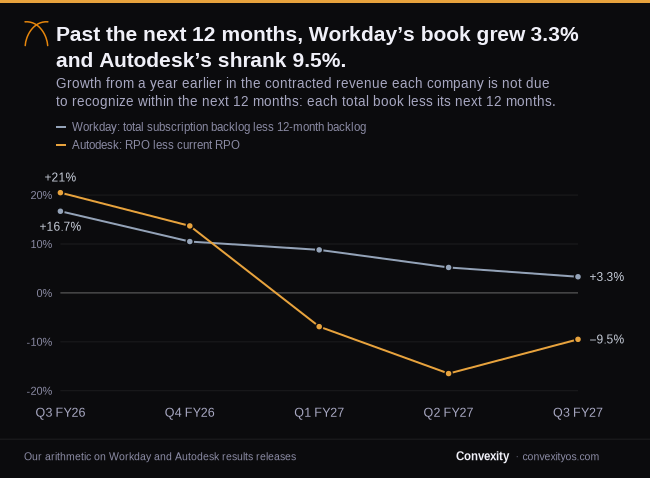
Underneath, the promises told a quieter story. The part of each company's book that runs past the next 12 months has grown more slowly at Workday in each of the last four quarters, and at Autodesk it is smaller than it was a year ago. This note is about that gap: what it is, why each company says it is happening, and what each is doing with its money while it waits to be proved right.
- +12.3%
- Workday’s 12-month subscription revenue backlog, above its 11% to 12% forecast
- +3.3%
- Workday’s backlog beyond the next 12 months, from +16.7% a year earlier (ours)
- +10%
- Autodesk’s current RPO, from +12% in July
- −9.5%
- Autodesk’s RPO beyond the next 12 months, after −16.5% in July (ours)
Third quarter of fiscal 2027, ended October 31, 2026, from each company’s results release of November 24, 2026. Each figure beyond the next 12 months is the total book less the part due within 12 months, our arithmetic.
The two halves of a contract book
When a company signs up for three years of Workday (WDAY), Workday does not book three years of revenue. It books the service a month at a time as it delivers it, and the rest of what the customer has committed to pay waits in a ledger. Workday calls the ledger subscription revenue backlog. Autodesk (ADSK) calls the same kind of thing remaining performance obligations, or RPO. Each splits its total in two: what it expects to recognize as revenue in the next 12 months, and everything after that.
The first half is mostly this year's business: renewals falling due, price rises, a new customer's first months. The second half is where conviction shows. It grows only when customers commit for longer than a year, or commit to more, and it is where a three- or five-year contract lands. Workday's annual report says its subscription contracts "typically have a term of three years or longer and are generally noncancelable."
Neither results release reports the second half as a line. Autodesk's quarterly reports do, as non-current RPO; Workday's do not, so there it is one reported figure less another, and the subtraction is ours. How fast the second half grows is our arithmetic for both.
Through October the two halves kept moving apart. Workday's next 12 months grew 12.3% from a year earlier, a shade faster than the 11% to 12% it had forecast. Everything after them grew 3.3%, down from 16.7% a year before. Autodesk's next 12 months grew 10%. Everything after them shrank 9.5%.
| Workday: total subscription backlog less 12-month backlog | Autodesk: RPO less current RPO | |
|---|---|---|
| Q3 FY26 | 17%+16.7% | +21% |
| Q4 FY26 | 11% | 14% |
| Q1 FY27 | 9% | -7% |
| Q2 FY27 | 5% | -17% |
| Q3 FY27 | 3%+3.3% | -10%−9.5% |
The two lines bend for different reasons, and the reasons matter more than the shape.
A quarter that beat its forecasts
Start with what the quarter delivered, because neither company fell short of much it had promised.
Workday's subscription revenue, the fee customers pay to use its software and about 94% of its revenue, was $2.532 billion, up 12.8% from a year earlier. In August it had forecast $2.515 billion. Its non-GAAP operating margin, which leaves out share-based pay, restructuring and acquisition costs, was 31.4% against a forecast of about 30%. Professional services, the one line that came in under its forecast, brought in $173 million against about $175 million. Free cash flow was $691 million, up from $550 million a year earlier.
It raised its forecast for the year to $9.958 billion of subscription revenue, growth of 13%, from $9.940 billion to $9.950 billion, and its margin forecast to 31.5% from 31%. For the fourth quarter it expects $2.600 billion, growth of 10%, down from 12.8% in the third quarter and 15.7% a year earlier.
That fourth-quarter figure deserves a second look. Take the August range for the year, subtract the first two quarters as reported and the third as forecast, and what was left for the fourth quarter was about $2.60 billion to $2.61 billion. The new forecast sits at the bottom of that range, which is why the year went up by less than the third quarter's $17 million beat.
On the call, Workday's chief financial officer, Zane Rowe, said the near book beat because customers renewed early. The 12-month backlog came in above his range "with early renewals driving the outperformance relative to our guidance," he said, and "we don't expect that level of renewal activity as we head into Q4." He expects it to grow about 10% to 11% in the fourth quarter. For fiscal 2028 he still expects subscription revenue growth of about 11%, with a non-GAAP operating margin of at least 33%, and formal guidance comes with the fourth-quarter results.
Autodesk's revenue was $2.16 billion, up 17%, or 14% at constant exchange rates, against a forecast of $2.125 billion to $2.14 billion. Billings, the amount it invoiced customers, rose 12% to $2.07 billion. Its non-GAAP earnings per share were $3.20, 11 cents above the top of its forecast. Its GAAP earnings per share were $2.68 against a forecast of $1.57 to $1.87, but about $105 million of the quarter's GAAP profit came from a tax benefit, a change in how certain non-U.S. research costs are treated, which Autodesk says does not touch operating results or cash.
It raised its revenue forecast for the year to $8.36 billion to $8.375 billion, from $8.295 billion to $8.345 billion, and lifted the bottom of its billings range by $25 million, to $8.6 billion to $8.65 billion. Its forecast for free cash flow, $2.725 billion to $2.75 billion, did not move. Its chief financial officer, Janesh Moorjani, put the raise this way in the release: "Despite incremental headwinds from dollar appreciation, we've raised the mid-points of our full-year billings and revenue outlook to reflect the third-quarter outperformance and stronger underlying expectations for the remainder of the year."
| Forecast in August | Reported November 24 | |
|---|---|---|
| Workday subscription revenue, third quarter | $2.515B, +12% | $2.532B, +12.8% |
| Workday 12-month backlog growth, third quarter | 11% to 12% | 12.3% |
| Workday non-GAAP operating margin, third quarter | about 30% | 31.4% |
| Workday subscription revenue, fiscal 2027 | $9.940B to $9.950B | forecast now $9.958B |
| Autodesk revenue, third quarter | $2.125B to $2.140B | $2.160B |
| Autodesk non-GAAP EPS, third quarter | $3.04 to $3.09 | $3.20 |
| Autodesk revenue, fiscal 2027 | $8.295B to $8.345B | forecast now $8.360B to $8.375B |
| Autodesk billings, fiscal 2027 | $8.575B to $8.650B | forecast now $8.600B to $8.650B |
On Autodesk's call, Moorjani said renewals helped: "Renewal rates remained strong, contributing to our outperformance in the quarter." MaintainX, he said, "had an outstanding first quarter within Autodesk, with revenue of almost $33 million." The forecast still assumes what Autodesk expected from MaintainX before, so the raise to the year's billings forecast came entirely from the rest of the business, he said.
Shorter promises, by whose choice
Both companies have explained the long end of the book, and neither explanation is that customers are leaving.
Autodesk's explanation is a footnote to the RPO table in its results release. It first appeared in August, and in November it read: "Reflects our sustained program reducing multi-year discounts, including winding down multi-year Maintenance-to-Subscription renewals. The reduction of discounting for multi-year contracts benefits price realization over time while temporarily weighing on unbilled deferred revenue, RPO and current RPO growth."
In plainer words: Autodesk used to sell several years of a subscription at a lower price to customers who committed up front. It is withdrawing that discount. Some customers who would once have locked in three years now buy one, so Autodesk earns more per year of use and holds fewer years in its book. Its annual report describes the same drift from the billing side: customers moving "from multi-year subscription contracts billed upfront to annual billing installments," some of whom "may choose annual contracts instead."
Only the footnote's last words changed this quarter. In August the program was weighing on "unbilled deferred revenue and RPO growth." In November it added current RPO, the part due within the next 12 months.
That is not quite what Autodesk expected at the start of the year. The same annual report, filed in March, walked through the case of customers choosing annual contracts and concluded that "deferred revenue, billings, current RPO, revenue, non-GAAP operating margin, and free cash flow would remain broadly unchanged in this scenario." Current RPO growth has since slowed from 18% in April to 12% in July and 10% in October, and the footnote now counts current RPO among what the program weighs on.
There is also a sign that the worst of the shrinking has passed. Autodesk's book beyond the next 12 months was $2.29 billion at the end of October, $102 million more than in July, and the first quarter-on-quarter rise since January. A fall of 9.5% from a year earlier is still a fall, but in July it was 16.5%.
Moorjani did not put a date on the drag. "We expect these dynamics will continue to weigh on total RPO and current RPO growth for some time," he said on the call. Anagnost, asked whether customers renewing enterprise agreements were willing to expand their commitments, described buyers who want more of the software but hold back on what they pay for in advance. Customers "tend to be conservative about how much consumption they want to buy" up front, he said, "but they're very interested in getting broader access to more and more of the portfolio."
The customers Autodesk already has are paying more, not less. Its quarterly report, filed on Wednesday, says its net revenue retention rate, which compares what last year's customers pay now with what they paid a year before, "approximated the top end of the range" of 100% to 110% at the end of October, at constant exchange rates. A year earlier it was "slightly above the range."
Workday's explanation came from Rowe, on the August call. Total backlog growth, he said, "was impacted by a continued mix shift towards customer-based bookings versus net new, and the mix of industries that drove our net new bookings." A new customer's first contract is the long one. When more of a quarter's bookings come from customers already on Workday, adding modules or renewing, and fewer from new names, the book still grows, but less of the growth lands years out.
On Tuesday he said it again and named the mechanism. Total backlog was $27.5 billion, up 6%, "reflecting the ongoing mix shift towards customer-based bookings and renewals, which have lower duration than net new contracts." The base itself is holding. Gross revenue retention, which counts what existing customers keep paying before any expansion, stayed at 97%, he said, and "net expansion from existing customers led to about 65% of subscription revenue growth."
Workday's quarterly report adds a detail its results release leaves out. It splits the backlog three ways: due within 12 months, within 24 months, and later. At the end of October about $9.2 billion of the $27.5 billion was due within 12 months and about $16.2 billion within 24. By our subtraction, about $11.3 billion was due more than two years out. A year earlier, by the same subtraction from that quarter's report, it was about $11.4 billion.
So the second year of the book grew by about $0.6 billion, and the part beyond it did not grow at all. The report rounds these to a tenth of a billion, so read them for direction rather than decimals. The direction is plain enough: Workday's long book is slowing at its far end.
Both explanations can be true and still leave the question open. Autodesk's is a choice it says it made, and it can point to the price it gains in return. Workday's is a description of who is buying, and it says less about how long the shift will last.
What Workday did with its cash
Workday spent the year as if it were sure of the answer.
It began by changing who runs it. On February 4 it said reorganizations would remove about 2% of its workforce, mostly in roles that do not bring in revenue in its customer operations group, at a cost of about $135 million, $80 million of it for writing down office space and other long-lived assets. Two days later the board made Aneel Bhusri, its co-founder and executive chair, chief executive again. Carl Eschenbach gave up the job and his board seat the same day. Bhusri's return came with $60 million of restricted stock that vests over four years and a $75 million award that pays out only if the share price reaches targets over five years. With the other co-founder, David Duffield, he controls about 68% of the votes.
In September it cut again. It said then that about 2.5% of the workforce would go, mainly in Product and Technology, the group that builds its software, at a cost of $65 million to $80 million. The quarterly report filed on Tuesday puts the cut at about 2% and the cost at about $65 million, the bottom of the range, $53 million of it in the quarter just reported.
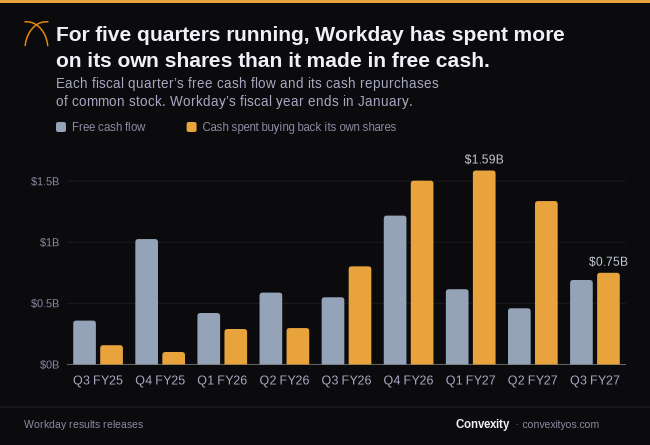
Then it spent. In the three months to October, Workday bought back about 3.8 million of its shares for $750 million. That is about half what it spent in each of the two quarters before, and none of it was in August: it bought about 0.9 million shares in September at an average of $192.23 and about 2.9 million in October at $197.20. It made $691 million of free cash flow in the quarter. For the fifth quarter in a row it spent more on its own shares than it generated, though this time by $59 million, against $877 million in July.
| Free cash flow | Cash spent buying back its own shares | |
|---|---|---|
| Q3 FY25 | $0.4B | $0.2B |
| Q4 FY25 | $1.0B | $0.1B |
| Q1 FY26 | $0.4B | $0.3B |
| Q2 FY26 | $0.6B | $0.3B |
| Q3 FY26 | $0.6B | $0.8B |
| Q4 FY26 | $1.2B | $1.5B |
| Q1 FY27 | $0.6B | $1.6B$1.59B |
| Q2 FY27 | $0.5B | $1.3B |
| Q3 FY27 | $0.7B | $0.8B$0.75B |
Over those five quarters Workday spent $5.98 billion on buybacks against $3.54 billion of free cash flow. The difference came from the balance sheet. At the end of January its cash and marketable securities exceeded its debt by about $2.46 billion; at the end of October, by about $0.18 billion. Both figures are ours, from its balance sheets.
The buybacks show up where shareholders look first. Workday's diluted share count in the quarter was 8.4% lower than a year earlier, so non-GAAP net income up about 12% became non-GAAP earnings per share up about 22%. Almost half of the per-share growth was fewer shares. Of the $4.0 billion its board authorized in August, $3.25 billion was still unspent at the end of October.
The borrowing came in October. Workday raised its revolving credit line from $1.0 billion to $1.5 billion and sold $2.5 billion of notes in four parts, the shortest due in 2029 at 5.700% and the longest in 2036 at 6.500%, to retire $1.0 billion of 3.500% notes due in April and for general corporate purposes. It also agreed in October to buy C1.ai, which governs what people and AI agents can reach inside a company's systems. The quarterly report says that purchase closed in November for about $850 million, a price Workday had not disclosed before.
The same report carries one more commitment, easy to miss. In October Workday signed "a non-cancelable purchase obligation of approximately $1.9 billion for a third-party hosted infrastructure platform with a contractual term of five years." It does not name the provider. Spread evenly, that is about $380 million a year. Its own capital spending in the first nine months of the year was $183 million.
On the call, Rowe described a direction rather than a contract. Asked about margins, he said "we see a little bit more pressure in gross margins as we pivot more and more to the public cloud with our customer base, and obviously as we lean into AI," and that next year's margin target is "not predicated on future restructurings." C1.ai, he said, adds "just over $5 million to fourth quarter CRPO," Workday's 12-month backlog. Bhusri called it a big long-term bet.
Autodesk cut first and bought later
Autodesk's year ran the other way round.
On January 22 it said it would cut about 7% of its workforce, about 1,000 people, a significant portion of them in customer-facing sales, for $135 million to $160 million of charges. On May 28 it agreed to buy MaintainX for about $3.575 billion. MaintainX sells the software that the people who keep factories and buildings running use for work orders, inspections and tracking equipment. Autodesk's quarterly report for July calls it "a leading modern maintenance and asset operations solution" and says it takes Autodesk's relationship with manufacturing and construction customers into "asset operations and maintenance management." The deal closed on August 3, two days into the quarter just reported.
The results release reorganized its product lines to make room. A new line, Other products, holds media and entertainment software and what Autodesk calls operations solutions; its revenue was $135 million, up 35%. Architecture, engineering and construction, the largest line, grew 19% to $1.097 billion, and Autodesk's chief financial officer singled out "continued strength in AEC, particularly construction and emerging markets, alongside strong renewal rates."
Autodesk lined up the money for MaintainX in stages: a revolving credit line raised from $1.5 billion to $2.0 billion and a $1.0 billion term loan for 364 days in June, a $2.0 billion commercial paper program in July, and, after the deal closed, $1.0 billion of notes in September to repay the term loan. At the end of October it owed $993 million of short-term debt, $499 million of notes due within a year and $2.98 billion of longer notes. By our arithmetic its debt exceeded its cash and investments by about $2.57 billion; in January it had held about $0.49 billion more in cash and investments than it owed.
It kept buying back shares through all of it: $1.25 billion in the nine months to October, $350 million of it in the third quarter, by our subtraction of its six-month figure from its nine-month one. Its quarterly report counts about 1.5 million shares bought in the quarter at an average of $228.93, about half of them in September at $217.37.
On the call Moorjani said Autodesk now expects to spend $1.5 billion on buybacks this fiscal year, up from $1.4 billion last year, which leaves about $250 million for the fourth quarter. Its stated goal is "returning roughly 50% of free cash flow to shareholders every year through the buyback program," and $1.5 billion is about 55% of the free cash flow it forecasts for the year. Workday, over its last five quarters, spent about 1.7 times its free cash flow.
The two notes sales, six weeks apart, are as close as the public record comes to a lender's price on each company. In September Autodesk borrowed until 2029 at 0.63 percentage points over Treasuries, a yield of 5.097%. In October Workday borrowed until 2029 at 0.82 points over, a yield of 5.732%. S&P rates both BBB+; Moody's rates Autodesk a notch higher, A3 against Baa1. Most of the difference in yield is the Treasury market, which moved in between: the benchmark each was priced against yielded 4.467% in September and 4.912% in October. The difference in spread, 0.19 points, is the part that is about the borrowers, and even spreads move with the market over six weeks.
What the AI money looks like
The question over both companies this year is whether AI shrinks what they sell. Workday's annual report says its subscription revenue is "driven primarily by the number of customers, the number of workers at each customer, the specific applications subscribed to by each customer, and the price of our applications." If software agents do work that people used to do, the number of workers is the line that would feel it.
Workday's answer this quarter came in a number it chose to put in its release. Bhusri said its AI products "drove nearly $150 million in new ACV, more than three times what we delivered a year ago." ACV is annual contract value, the yearly worth of newly signed contracts. More than 2,200 of its core customers have bought at least one AI product, up nearly 25% from the quarter before.
The call added the rest. Workday's AI products ended the quarter with more than $750 million of annual recurring revenue, up more than 130% from a year earlier, said Gerrit Kazmaier, its president of product and technology. Much of it is still sold as premium subscriptions, said Rob Enslin, its chief commercial officer, beside a newer way to pay for AI by use: "More than 525 customers have licensed Flex Credits." Bhusri was careful about how far that has gone. "I still think we're in the early days of the AI consumption model," he said.
Asked where customers find the money, Kazmaier said they weigh what they spend on whole functions, such as HR case delivery, and that this is how a customer can "stay flat with headcount like we do, and reinvest that into AI automation." Bhusri said the same of Workday, which ended October with 20,941 employees. He wants to "keep headcount as close to flat as possible," moving people within sales and marketing toward AI rather than adding them.
Autodesk's chief executive, Andrew Anagnost, framed the question from the other side in his company's release: "As AI becomes more capable and accessible, differentiation will increasingly come from the ability to combine intelligence with trusted engineering capabilities, rich project context and complex industry workflows." Read plainly: the models will be everywhere, and Autodesk is betting that what stays scarce is the engineering context around them, which lives in its customers' files.
On the call he was plainer about what that means for the people who use the software. "We want them bidding on and winning more projects with fewer people for projects," he said of Autodesk's customers. Autodesk has not yet really started charging for automation by AI agents, he said: "You'll see that ramp up over time." And Moorjani, asked about pricing, said he sees room for volume to play a bigger role, and "that volume will increasingly come from both seats and usage."
None of this settles it, and there is a way the AI question and the shorter promises could be the same question. A customer that expects AI to change how many people it employs, or how many designers it licenses, has a reason to commit for one year rather than three. That would show up first in the long end of the book, which is exactly where both companies are soft. It is also exactly what Autodesk's pricing change and Workday's customer mix would produce on their own, and the published numbers cannot tell those stories apart.
How the market took it
Both shares went into the results down for the year. On Tuesday, before either reported, Workday closed at $179.23, 16.6% below its $214.78 close at the end of 2025, and Autodesk at $255.70, 13.6% below $296.01. Neither has closed above its last close of 2025 on any day this year. Workday's lowest close of the year was $112.50, on April 10, 47.6% below where it began; Autodesk's was $187.72, on June 22.
On Wednesday the two went separate ways. Workday rose 0.7% to $180.44. Autodesk fell 3.5% to $246.785, a close Nasdaq records to a tenth of a cent. The iShares Expanded Tech-Software Sector ETF (IGV), a fund of software stocks, slipped 0.3%, and the Invesco QQQ Trust (QQQ), which tracks the Nasdaq-100, fell 0.7%.
That leaves Workday down 16.0% for the year and Autodesk down 16.6%, while IGV is down 10.1% and QQQ is up 3.2%. Software has had a harder year than the Nasdaq-100, and these two a harder one than the software fund.
One session says little about a contract book. The books themselves will say more, and the next look at them comes with each company's fourth-quarter results.
What would prove this wrong
Our reading is that the long end of both books is fading because customers are committing for shorter terms, by Autodesk's design and through Workday's customer mix, and not because demand is going away. Three things would prove it wrong.
Workday's near book follows the far one down. At Workday, shorter terms should not cut what customers will pay over the next 12 months; less demand would. Rowe expects 12-month backlog growth of about 10% to 11% in the January quarter, down from 12.3% in October, in part because the early renewals will not repeat. If it falls below 10% in either of the next two quarters, the problem is not the length of the promises.
Workday's far book picks up in January. Workday signs "a significantly higher percentage" of its new and renewal agreements in its fourth quarter, its annual report says, which is why its backlog jumps every January. If the part beyond the next 12 months grows faster in the January quarter than the 3.3% it managed in October, the fade was timing, and this note is too gloomy about Workday.
Autodesk's "temporarily" runs long. If Autodesk's book beyond the next 12 months is still smaller than a year earlier in the quarter ending October 2027, a full year from now, the footnote's word will have needed more time than it implied, and price realization will have to show up somewhere in revenue to justify the trade.
Not investment advice. This note is an analysis of Workday's and Autodesk's public filings, the transcripts of their calls and public share prices, published for research purposes, and not a recommendation to buy, sell or hold any security. A member of the Convexity team holds SPY, whose holdings include Workday and Autodesk, and also Moody's and S&P Global, whose ratings are cited here; no other position in any company or fund named here.
What here is ours rather than the companies'. As filed or stated by Workday or Autodesk: every revenue, backlog, RPO, billings, margin, earnings, cash flow, repurchase, debt, restructuring and forecast figure; the RPO footnote and the annual report's scenario; the purchase prices of C1.ai and MaintainX; the hosting commitment; the notes' coupons, yields, spreads and ratings; Autodesk's non-current RPO, net revenue retention and repurchases by month; and what the executives said on the calls, including Workday's AI revenue, retention and headcount, MaintainX's revenue and Autodesk's buyback plan for the year. Call quotations use only wording that two independently produced transcripts share, and the call figures reported in our words are ones both transcripts carry. The share prices are Nasdaq's official closes through November 25. Ours: the growth of each company's contracted revenue beyond the next 12 months, and its size at Workday, each one reported figure less another; Workday's backlog in its second year and beyond 24 months, from its quarterly reports' rounded figures; subscription revenue's share of Workday's revenue; how far each result landed from its forecast, and what Workday's August forecast left for its fourth quarter; Workday's buybacks set against its free cash flow and its earlier quarters, as a total and as a multiple, and the count of quarters in a row; each company's cash and investments less its debt; Workday's share count change, the growth in its non-GAAP net income and earnings per share, and the part of that growth fewer shares explain; Autodesk's third-quarter repurchases, what its plan for the year leaves for the fourth quarter and that plan as a share of its free cash flow forecast, and the quarter-on-quarter change in its far book; the hosting commitment's yearly average; the differences in yield and spread between the two companies' notes; each share's lowest close of the year, and that neither has closed above its last close of 2025; every percent change in a price.
The filings, calls and prices this is built on
33 documents
- 018-KWorkday third-quarter fiscal 2027 earnings release (Exhibit 99.1)Subscription and total revenues, 12-month and total subscription revenue backlog, margins, earnings per share, free cash flows and repurchases for the quarter ended October 31, 2026; the fourth-quarter and fiscal 2027 outlook; new ACV from AI productsNov 24, 2026sec.gov
- 0210-QWorkday Form 10-Q for the quarter ended October 31, 2026Backlog due within 12 and 24 months; the September 2026 restructuring plan; repurchases by month and the remaining authorization; the $1.9 billion hosting commitment; the C1.ai acquisition completedNov 24, 2026sec.gov
- 0310-QWorkday Form 10-Q for the quarter ended October 31, 2025Backlog due within 12 and 24 months a year earlierNov 26, 2025sec.gov
- 04CallWorkday third-quarter fiscal 2027 earnings call, transcript (gloom.sh)The chief financial officer on early renewals, backlog duration, retention, the fourth-quarter and fiscal 2028 outlook, gross margins and C1.ai; AI revenue, Flex Credits and headcount; quoted only where the Stock Analysis transcript carries the same wordsHeld Nov 24, 2026retrieved Nov 24, 2026gloom.sh
- 05CallWorkday third-quarter fiscal 2027 earnings call, transcript (Stock Analysis)The chief financial officer on early renewals, backlog duration, retention, the fourth-quarter and fiscal 2028 outlook, gross margins and C1.ai; AI revenue, Flex Credits and headcount; quoted only where the gloom.sh transcript carries the same wordsHeld Nov 24, 2026retrieved Nov 24, 2026stockanalysis.com
- 068-KAutodesk third-quarter fiscal 2027 earnings release (Exhibit 99.1)Revenue, billings, deferred revenue, RPO and current RPO with the footnote on multi-year discounts; revenue by product line; margins, earnings per share and cash flows; the fourth-quarter and fiscal 2027 outlookNov 24, 2026sec.gov
- 0710-QAutodesk Form 10-Q for the quarter ended October 31, 2026Current and non-current RPO; the net revenue retention rate against its 100% to 110% range; repurchases by month and what remained under the authorizationsNov 25, 2026sec.gov
- 08CallAutodesk third-quarter fiscal 2027 earnings call, transcript (gloom.sh)The chief financial officer on renewals, MaintainX, RPO, buybacks and pricing; the chief executive on customers, consumption and automation; quoted only where the roic.ai transcript carries the same wordsHeld Nov 24, 2026retrieved Nov 24, 2026gloom.sh
- 09CallAutodesk third-quarter fiscal 2027 earnings call, transcript (roic.ai)The chief financial officer on renewals, MaintainX, RPO, buybacks and pricing; the chief executive on customers, consumption and automation; quoted only where the gloom.sh transcript carries the same wordsHeld Nov 24, 2026retrieved Nov 24, 2026roic.ai
- 108-KWorkday second-quarter fiscal 2027 earnings release (Exhibit 99.1)Subscription revenue, the 12-month and total subscription revenue backlog, free cash flows and repurchases for the quarter ended July 31, 2026; the third-quarter and fiscal 2027 outlook; the $4.0 billion repurchase authorizationAug 27, 2026sec.gov
- 118-KWorkday, earnings releases for the quarters from October 2024 to April 2026 (Exhibit 99.1)Each quarter’s subscription revenue, 12-month and total subscription revenue backlog, free cash flows and repurchases of common stock, with the year-earlier comparisons; the fiscal 2025 and 2026 totalsNov 2024 to May 2026sec.gov
- 12CallWorkday second-quarter fiscal 2027 earnings call, transcript (gloom.sh)The chief financial officer on total backlog growth and the third-quarter forecasts for 12-month backlog and professional services; quoted only where the Stock Analysis transcript carries the same wordsHeld Aug 27, 2026retrieved Nov 23, 2026gloom.sh
- 13CallWorkday second-quarter fiscal 2027 earnings call, transcript (Stock Analysis)The chief financial officer on total backlog growth and the third-quarter forecasts for 12-month backlog and professional services; quoted only where the gloom.sh transcript carries the same wordsHeld Aug 27, 2026retrieved Nov 23, 2026stockanalysis.com
- 1410-KWorkday Form 10-K for the fiscal year ended January 31, 2026Subscription contract terms; what drives subscription revenue; the Class B voting structureMar 6, 2026sec.gov
- 158-KWorkday Form 8-K, Items 2.02, 2.05 and 2.06: reorganizations and fourth-quarter expectationsAbout 2% of the workforce; about $135 million of charges, of which about $80 million for impairing office space and other long-lived assetsFeb 4, 2026sec.gov
- 168-KWorkday Form 8-K, Item 5.02: Aneel Bhusri appointed chief executiveCarl Eschenbach ceased to serve and left the board; the $60 million RSU award and the $75 million performance award; the voting agreement covering about 68% of the voting powerFeb 6, 2026sec.gov
- 178-KWorkday Form 8-K, Item 2.05: reduction of about 2.5% of the workforceMainly Product and Technology; $65 million to $80 million of charges, $55 million to $70 million of them in the third quarterSep 29, 2026sec.gov
- 188-KWorkday Form 8-K, Item 1.01: amended revolving credit agreementCommitments raised from $1.0 billion to $1.5 billionOct 1, 2026sec.gov
- 198-KWorkday Form 8-K: agreement to acquire ConductorOne (C1.ai)With the press release as Exhibit 99.1; no price disclosedOct 13, 2026sec.gov
- 20FWPWorkday pricing term sheet: $2.5 billion of senior notes due 2029, 2031, 2033 and 2036Priced October 21; coupons, yields and spreads to Treasuries; ratingsOct 22, 2026sec.gov
- 218-KWorkday Form 8-K: issuance of the senior notesUse of proceeds, including retiring the 3.500% notes due April 2027Oct 23, 2026sec.gov
- 228-KAutodesk second-quarter fiscal 2027 earnings release (Exhibit 99.1)Revenue, billings, RPO and current RPO for the quarter ended July 31, 2026, with the first version of the footnote on multi-year discounts; the third-quarter and fiscal 2027 outlook; six-month repurchasesAug 27, 2026sec.gov
- 238-KAutodesk, earnings releases for the quarters from October 2024 to April 2026 (Exhibit 99.1)Each quarter’s revenue, billings, RPO and current RPO, with the year-earlier comparisonsNov 2024 to May 2026sec.gov
- 2410-KAutodesk Form 10-K for the fiscal year ended January 31, 2026The shift from multi-year contracts billed upfront to annual billing, and what it would and would not changeMar 3, 2026sec.gov
- 2510-QAutodesk Form 10-Q for the quarter ended July 31, 2026Current and non-current RPO at July 31; MaintainX described; preliminary purchase consideration of about $3.53 billion, net of cash acquiredAug 28, 2026sec.gov
- 268-KAutodesk Form 8-K, Item 2.05: restructuring planAbout 7% of the workforce, about 1,000 people; $135 million to $160 million of chargesJan 22, 2026sec.gov
- 278-KAutodesk Form 8-K, Item 1.01: agreement to acquire MaintainXAbout $3.575 billionMay 28, 2026sec.gov
- 288-KAutodesk Form 8-K, Items 1.01 and 2.03: amended credit agreement and term loanRevolver raised from $1.5 billion to $2.0 billion; $1.0 billion 364-day delayed-draw term loanJun 15, 2026sec.gov
- 298-KAutodesk Form 8-K: commercial paper programUp to $2.0 billion outstandingJul 13, 2026sec.gov
- 308-KAutodesk Form 8-K: acquisition of MaintainX completedClosed August 3, 2026Aug 3, 2026sec.gov
- 31FWPAutodesk pricing term sheet: $1.0 billion of senior notes due 2029 and 2033Priced September 8; coupons, yields and spreads to Treasuries; ratingsSep 9, 2026sec.gov
- 328-KAutodesk Form 8-K: issuance of the senior notesProceeds to repay the $1.0 billion term loanSep 10, 2026sec.gov
- 33PricesNasdaq historical prices: WDAY, ADSK, IGV, QQQOfficial closes, December 31, 2025 to November 25, 2026Nov 25, 2026retrieved Nov 25, 2026nasdaq.com