








Disclosure and method. Convexity builds research tools for public-market data. This note is analysis, not investment advice, and nothing in it is a recommendation to buy, sell, or short any security. A member of the Convexity team owns shares of the SPDR S&P 500 ETF Trust (SPY), which holds Costco and every other S&P 500 company named here, and so stands to benefit if those shares rise. No other position in any company named, long or short, at publication. Every figure comes from a Costco filing, from Costco's own earnings calls, or from the court records linked at the bottom. We read Costco's calls of September 2025, December 2025, March 2026 and May 2026 in Callsider, the earnings call transcript store we also build, and checked every quotation from them word for word against the stored transcript. The call of September 24, 2026 was not yet in Callsider when this was written, so its quotations were checked against two public transcripts produced independently of each other, and we quote only wording that both carry. Where a number is our arithmetic rather than Costco's, the sentence using it says so, and the closing note lists every one.
Costco reported on September 24 that it had received $184 million of tariff refunds in its fiscal fourth quarter, the 16 weeks to August 30. That was $174 million of import duties collected under the International Emergency Economic Powers Act, a statute the Supreme Court held in February does not authorize tariffs at all, and $10 million of interest. What the company did with the money is the thing it has been promising its members since March, and the thing four lawsuits against it are about.
Its chief executive, Ron Vachris, described it on the call that afternoon: "we received some initial tariff refunds in the fourth quarter and we reinvested some of these dollars to give value back to our members." The reinvestment came, he said, "predominantly through price reductions on a number of items in the second half of the quarter," among them produce, meat and beverages, and non-food goods such as home furnishings and hardware.
A lower price is a real way to hand money back, and for a warehouse club whose whole case to its members is that it is cheaper than everyone else, it is the natural way. It also has one property worth stating plainly: a price cut reaches whoever buys the item after the price comes down. The duties being returned were collected on goods Costco imported from February 2025 until collection stopped on February 24, 2026. The price cuts that return them arrived in the summer of 2026, in the second half of a quarter that ended on August 30.
The part of the refund that did not become lower prices stayed in earnings. Costco's release calls it "a non-recurring benefit of $0.15 per diluted share from IEEPA tariff refunds received in the quarter, less partial reinvestment of those refunds in increased member values." Costco did not say how the $174 million divided between the two. Its own margin figures bound the split, and on our arithmetic from them about half went into prices and about half stayed.
Our note of September 15 read how 61 of the largest American companies booked their refunds this summer, and it set one question aside as beyond its evidence: whether the money should go to the companies that paid the duties or to the customers who paid the higher prices. Costco has answered it in public, more than once and in its own words, on its calls, in its filings and in court. Its answer is that members get back the part of the tariffs Costco passed on to them, as lower prices, and that Costco decides how large that part was.
Costco's Form 8-K of September 24, 2026 and its call the same day, and its Form 10-Q of June 3, 2026 for the lawsuits. The share spent on prices is ours: the net benefit of 9 basis points of gross margin that Costco reported leaves $84.8 million to $94.2 million of the $174 million, on the assumption that the whole refund passed through merchandise costs in the quarter.
Three versions of one promise
The promise has taken three forms since the Supreme Court ruled, and the differences between them are most of the story.
The first came on March 5, thirteen days after the decision in Learning Resources, Inc. v. Trump, when Vachris opened Costco's second-quarter call with it.
Throughout the past year, we've taken action to reduce the impact of tariffs. In many cases, we didn't pass the full cost on to our members. The complexity of the tariffs implemented over the past year, including layering of different tariffs on top of each other and multiple changes in rates throughout the year, also made it challenging to track the exact impact to an individual item sold. As we've done in the past, when legal challenges have recovered charges passed on in some form to our members, our commitment will be to find the best way to return this value to our members through lower prices and better values.
Ron Vachris, chief executive, Costco second-quarter fiscal 2026 earnings call, March 5, 2026
Three commitments sit inside that paragraph, and every one of them was still in force in September. What would come back was value, "through lower prices and better values," rather than cash. It would cover charges "passed on in some form to our members," which is a narrower thing than the refund. And the item-by-item arithmetic that would say how much had been passed on was, by the company's own account, "challenging to track."
Six days later, on March 11, a member in Illinois named Matthew Stockov sued. His complaint read the March 5 statement the way this note's title does. A commitment of lower prices, it argued, is "a promise of possible future benefit to an indeterminate group of future shoppers," and returning value that way is "a commitment to benefit future purchasers at the expense of past ones." Three more class actions followed within the month: in federal court in Puerto Rico, in federal court in Seattle, and in the King County Superior Court in Washington, the county where Costco has its headquarters. Costco's quarterly report of June 3 lists all four as suits "seeking a refund of tariffs paid by the Company" under the statute "that were passed on to members through higher prices."
Costco answered the Illinois suit on May 18 with a motion to dismiss, and its lawyers wrote the second version of the promise. It is cooler than the first. "Plaintiff got what he paid for," the brief said, "and Costco never suggested that it would (or even might) later refund part of the purchase price." It argued that the case was premature, since "Costco has received no tariff refunds yet," and it told the court that "Costco has not yet determined exactly how it would share value from any tariff refunds with its members."
Ten days after that, on May 28, Vachris gave investors the third version.
As we've mentioned before, our plan is to return to our members, in some form, the portion of tariffs that were passed on to them. How much we return and when depends on a variety of factors, including how much refund money we receive and when it arrives as well as developments in the lawsuit filed against the company regarding the return process.
Ron Vachris, Costco third-quarter fiscal 2026 earnings call, May 28, 2026
The phrase to hold onto is "the portion of tariffs that were passed on to them." It says, without quite saying it, what becomes of the rest. A tariff Costco absorbed, by accepting a thinner margin rather than raising a price, was paid out of Costco's own pocket, and on this reading its refund is Costco's to keep. The company has said more than once that it absorbed some of the cost. Its chief financial officer, Gary Millerchip, told analysts in September 2025, while the tariffs were still being collected, that "part of it is that we have absorbed costs ourselves." It has never said how much.
By August about a third of the refunds had arrived, and Costco told the Illinois court so on August 5. "To date, Costco has received approximately one-third of the total refunds to which it is entitled," its notice said, and "Costco has started to return recovered value to members in the form of better values and lower prices on certain products." The plaintiff's response a week later called that "barely more than shapeless adspeak." It asked what "better values" meant, which "certain [unnamed] products" had lower prices, and what the prices were lower than. The call of September 24 answered two of those questions, as far as they are likely to be answered: which products got cheaper, and roughly how much of the refund went into making them so.
| Date | Where | What Costco said |
|---|---|---|
| March 5, 2026 | Second-quarter call | "our commitment will be to find the best way to return this value to our members through lower prices and better values" |
| May 18, 2026 | Motion to dismiss, Illinois | "Costco never suggested that it would (or even might) later refund part of the purchase price" |
| May 28, 2026 | Third-quarter call | "our plan is to return to our members, in some form, the portion of tariffs that were passed on to them" |
| August 5, 2026 | Notice to the Illinois court | "Costco has started to return recovered value to members in the form of better values and lower prices on certain products" |
| September 24, 2026 | Fourth-quarter release | "a non-recurring benefit of $0.15 per diluted share from IEEPA tariff refunds received in the quarter, less partial reinvestment of those refunds in increased member values" |
Read together, the five are consistent. The return is voluntary, in a form Costco chooses and at a size Costco chooses, and it is measured against a quantity, the tariffs passed on to members, that Costco has said is hard to track item by item. The lawsuits exist to contest exactly those three choices.
What arrived, and what it bought
Millerchip gave the figures on the call. The $184 million was "made up of $174 million in refunds and $10 million in interest," and he said it represents a little more than a third of the refunds Costco expects in total. Costco's annual report, filed on October 7, gives the total: it paid the government about $500 million in IEEPA tariffs. It also says that since the fiscal year ended on August 30 it has received $155 million more in refunds. So $329 million has come back so far, about two-thirds of what Costco paid (our arithmetic).
Costco publishes no adjusted earnings, so there is no reconciliation table for a refund to sit in or be taken out of. It disclosed the effect in two other places instead, and more plainly than most of the companies in our summer count. The release names the refund in its paragraph on net income, as the $0.15 benefit quoted above. The supplemental slides then state the growth without it: net income up 12.3% and earnings per share up 12.4%, against 14.9% and 15.0% as reported. That is the comparison a one-time item makes necessary, and Costco printed it rather than leaving readers to work it out.
The slides also give the refund its own line in the gross margin walk, labelled "Other," with a footnote that says what it is: the refunds received in the quarter, "less partial reinvestment of those refunds." Millerchip told analysts that the line "was 9 basis points both with and without gas inflation," and that "As this was a non-recurring item, this impact is excluded from the core gross margin results."
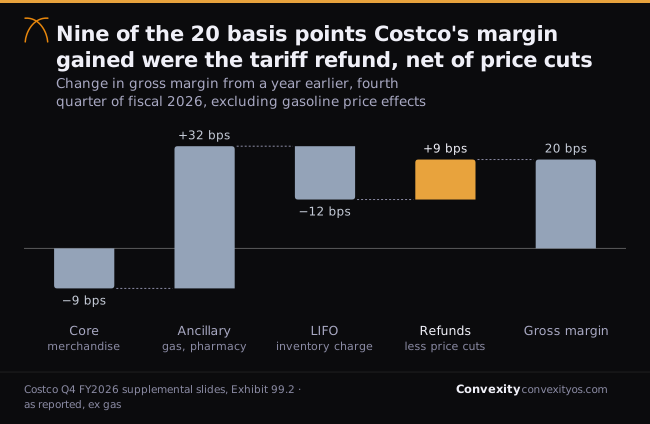
Excluding the effect of gasoline prices, which push Costco's margin rate around with every move at the pump, gross margin rose 20 basis points on a year earlier, and 9 of the 20 were the refund net of what it paid for. The largest contribution came from the ancillary businesses, chiefly gas stations, pharmacy and e-commerce, which grew faster than the warehouses. Core merchandise subtracted 9 basis points as a share of all sales, and Millerchip put that down to the same mix: measured on its own sales, the core business earned 18 basis points more margin than a year earlier, excluding the refund and the price cuts. The LIFO line took 12 basis points, a $152 million inventory charge against $43 million a year earlier, driven by the cost of memory chips in consumer electronics and by oil-related goods. It is a cost almost as large as the refund, running the other way.
Costco did not say what the price cuts cost, but the 9 basis points bound it. The slide rounds to whole basis points, so the net benefit was between 8.5 and 9.5 basis points of $93.9 billion of net sales, which is $79.8 million to $89.2 million. If the whole $174 million of refunds ran through merchandise costs in the quarter, the price cuts cost the difference, $84.8 million to $94.2 million, or between 48.7% and 54.1% of the refund. That assumption should hold closely. The duties were paid on goods imported before late February, and Costco's year-end inventory of $19.3 billion is about 27 days of its merchandise costs, so almost nothing the refunds relate to was still unsold by the summer. All of that is our arithmetic, from Costco's figures.
The annual report confirms the split from a second direction. For fiscal 2026 as a whole, it says, "IEEPA tariff refunds, net of investment in price reductions for members, positively impacted gross margin by three basis points." The refunds arrived only in the fourth quarter, so the full-year figure should be the quarter's 9 basis points spread over a full year of sales, and it is: 9 basis points of the quarter's $93.9 billion is 2.84 basis points of the year's $297.2 billion, which rounds to 3 (our arithmetic). The report also says the $174 million was "recorded as a reduction to merchandise costs," which is the assumption the split rests on.
Two other readings point the same way. The first question on the call, from Michael Lasser of UBS, put the price investment at about $100 million, and Millerchip's answer did not put a number on it. Millerchip also described what comes next as a plan to "continue reinvesting the majority of the dollars" Costco receives, which fits a quarter in which about half was spent.
The part that stayed is the $0.15 a share. On 444.4 million diluted shares that is about $67 million after tax, which matches the gap between the 14.9% and 12.3% net income growth rates; both calculations are ours. It is 2% of the quarter's $6.75 of earnings per share. At Target the refund was $1.65 of $4.11. Costco's quarter did not need the money. Comparable sales excluding gasoline and currency rose 6.7%, and earnings per share rose 12.4% without the refund. So this is not a note about flattered earnings; Costco disclosed its refund more clearly than most companies in our count. It is a note about whose money the refund is.
Who a price cut reaches
Lasser's question was whether the price cuts were buying anything, and Millerchip's answer described how the money had been spread. "Our goal was to make sure that we spread those as we could to items that would have the most impact for members," he said. "So as Ron mentioned, quite a few everyday items were impacted. We did also invest some dollars into a number of non-food areas where tariffs would have had an impact on those items."
Two criteria are in that answer. One is reach: everyday items that most members buy, which is why produce and meat head the list. The other, for "some dollars," is exposure: non-food categories the tariffs actually hit. Only the second is about where the duties fell. The first is about where a dollar of price cut touches the most members, which is a sound way to spend it and a different thing from returning a tariff to the person who paid it.
The timing does the rest. The tariffs being refunded were collected over a year, on goods members bought from early 2025 onward. The second half of Costco's fourth quarter began in early July 2026. A member who paid a tariff-inflated price for a television or a sofa in 2025 recovers some of it only by buying produce, meat, hardware or furniture after the cuts, and in proportion to what they buy now, not to what they paid then.
In Costco's favor, the two groups overlap more than they would at most retailers. Its members pay a fee to shop there and mostly keep paying it: the renewal rate in the United States and Canada was 92.3% at the end of the quarter, according to the slides. Most people who paid tariff-inflated prices at Costco in 2025 are still shopping there, and still buying produce, in 2026. The plaintiffs' objection bites at the edges, on the members who have left, and on the members whose tariffed purchases were large items unrelated to what got cheaper.
The Illinois complaint makes a sharper point about records. Costco "links every purchase to a membership account and maintains a complete transactional record," it says, so the people who bought tariffed goods can be identified. A warehouse club that asks for a membership card at every checkout is unusually well placed here, because it removes the usual objection to refunding shoppers directly, which is that nobody knows who they are. What Costco does not know, on its own account, is how much of each price was the tariff. That was the "challenging to track" of March, and it is the argument its lawyers made on August 5, that the refunds received so far "might relate to tariffs on completely different products" from the ones the plaintiff bought.
The sums per member are small, which is part of why a price cut is the practical answer and a class action the only vehicle for any other. Costco's United States business took in $207.0 billion of revenue in the four fiscal quarters that fell entirely inside the tariff period. The roughly $500 million of duties Costco paid is about 24 cents in every $100 of that, on our arithmetic, before any question of how much of it was passed on at all.
Vachris, near the end of the call, described the price cuts as an investment as much as a return: "we've made significant tariff investments. Unit growth has been fantastic." That is how Costco's model is meant to work, and it is also why Lasser asked his question. He told Millerchip that "we really haven't seen a meaningful change in the trajectory of the monthly sales." A price cut paid for with a refund can be value returned to members and a bet on volume at the same time. What it cannot be is a refund to the person who paid the tariff, because it goes to whoever shops next.
The half Costco kept
If the plan is to return "the portion of tariffs that were passed on," then the half that stayed is, on Costco's own logic, the portion it did not pass on: duties it paid and absorbed. That would make the fourth-quarter split an estimate that Costco passed on roughly half of the tariffs these refunds cover, if the split holds for the refunds still to come. Costco has not described its method, and it has not said this is how the split should be read. It is the arithmetic of the May promise applied to the September figures, and the reading is ours.
Is it plausible that Costco absorbed half of its tariffs? The only public evidence is the margin record, and it points both ways.
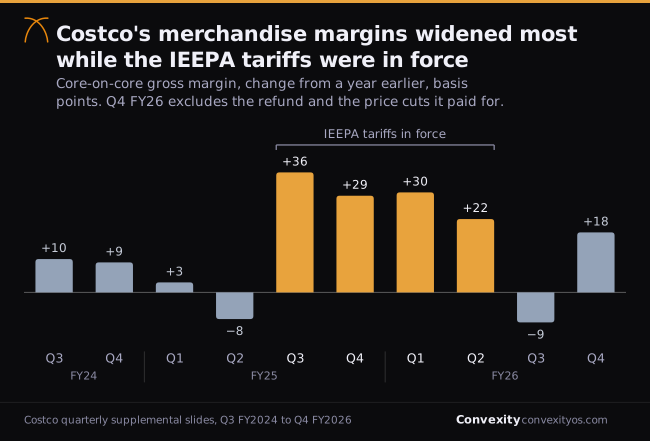
Costco reports the margin on its core merchandise every quarter, measured on the core business's own sales. In the four quarters before the tariffs, that margin changed by +10, +9, +3 and −8 basis points against a year earlier, an average of 3.5. In the four quarters that fell entirely within the tariff period it rose 36, 29, 30 and 22, an average of about 29. In the two since, it has moved −9 and +18. The four quarters in which Costco was paying the tariffs throughout were its four largest margin gains in the ten.
The plaintiffs read that as pass-through. Their complaint cites two of the four figures and says Costco "was able to expand margins during the peak of the IEEPA tariff regime by selectively raising prices on tariffed goods." Costco's explanation at the time was consistent from quarter to quarter. "Supply chain improvements and an increase in KS penetration benefited margins in all categories," Millerchip said in September 2025, KS being Kirkland Signature, Costco's own brand; in December he gave the same two reasons and added "additional marketing revenue." In the first quarter after the tariffs ended, the measure fell 9 basis points, which he attributed to lower prices "on several everyday items such as eggs and beef" and to transportation costs.
One detail from March sits on the plaintiffs' side of the ledger. "As some tariffs have been reduced," Vachris said then, "we are lowering prices on affected items such as certain textiles, bedding and cookware SKUs." Prices that came down when a tariff did had presumably moved with it on the way up. That inference is ours, and it covers a handful of categories, not the store.
Costco's lawyers put the other side in the May brief. The company "rais[ed] prices on tariffed goods" only "selectively," it said, quoting the complaint, and it will receive no refund at all on imports where "its supplier was the importer of record" rather than Costco.
What the margin record cannot do is separate price from cost. A margin rate rises if prices go up faster than costs, or if costs other than the tariff fall faster than prices, and Costco's supply chain savings are real and were reported quarter after quarter. The chart shows that Costco's merchandise margins widened rather than narrowed while it paid the tariffs. It cannot show why, and so it cannot say whether half is the right share to keep. The only record that could is Costco's own item-level pricing, which is what discovery in the lawsuits would reach if any of them survives a motion to dismiss.
Where the lawsuits stand
One of the four cases has already survived Costco's first attempt to end it. Costco's annual report discloses that the Washington state court hearing Gower v. Costco denied Costco's motion to dismiss on July 17, 2026, and that "a motion seeking discretionary appellate review of that decision is pending." The quarterly report Costco filed in June predates the ruling, and the annual report is the first of its filings we have read that records it.
The Illinois case has been ready for a decision since the summer. Costco's motion to dismiss was fully briefed on June 30, then supplemented by the August notice and the plaintiff's response to it, and CourtListener's copy of the docket, read on October 7 with its last entry dated September 30, shows no ruling. Costco's arguments are about timing and about what a sale is. On timing, it says the plaintiff's injury "remains hypothetical unless and until Costco receives all of the relevant refunds and determines how to handle those refunds." On the sale, its June reply argued that "any retention of tariff refunds" would "not violate any fundamental equitable principle," and neither would "any future choice to pass refunds through to members in the form of lower prices or other value." A court, it said, could not fashion a remedy "without a complete picture of what refunds Costco ultimately does (or does not) receive, whether those refunds relate to costs passed on to members, and how Costco decides to return any such recovered value."
The Seattle federal case, brought by seven plaintiffs from four states, makes materially the same claims. Costco has asked the court to dismiss it or to pause it behind the Illinois case, and that briefing ended on August 7. The Puerto Rico plaintiffs amended their complaint on August 17, and Costco has said it will move to dismiss again. The fourth is Gower, in Washington state court.
The question is not Costco's alone. On August 14, plaintiffs in other suits asked the Judicial Panel on Multidistrict Litigation to send 25 consumer actions against 15 companies to a single judge in Chicago. The defendants range from online marketplaces to clothing brands, and they include four companies from our summer count: Walmart, Target, Nike and J.M. Smucker. Their joint opposition, which Costco joined and supplemented with a brief of its own, describes the plaintiffs as generally seeking "a cut of any tariff refund received by the importer of record." Several plaintiffs opposed centralization too, among them Stockov in Illinois. Briefing closed on September 18, and as of October 7 the panel had not ruled.
Those companies made different choices with their refunds. Target kept its $994 million in both its reported and adjusted earnings, and its chief financial officer asked investors to judge the business without it. Walmart said it would put its refunds into prices. The suits against them seek the same thing either way, which makes Costco a clean test of the idea behind all of them, because Costco has committed in public, repeatedly, to giving members back the part of the tariffs it passed on to them.
Why retail refunds become price cuts
Our summer count suggests why Costco landed where it did. Among the companies it documented passing refunds on, the ones that paid money back to customers directly were companies that invoice their customers by name. Mettler-Toledo paid $27.8 million of its $52.4 million refund to customers. IDEX cut its net sales by $14.7 million for expected customer rebates. Cardinal Health netted its refund against payables to customers for the higher prices they had paid. FedEx ended its fiscal year holding about $800 million of refunds for its customers. The retailers that passed money on did it through prices or value: Walmart, Dollar General, Kroger and Dollar Tree all described reinvesting their refunds, and Costco now joins them.
A duty billed to an account has an address. A duty folded into a shelf price does not, and a retailer that collected it that way can return it only to the shelf. Costco sits between the two cases. Its receipts know who bought what, but not how much of each price was the tariff, and it has said it cannot readily work that out item by item.
The law makes the gap. Only the importer of record can claim a refund from Customs, which is why, as the Illinois complaint puts it, shoppers have "no direct avenue for redress." The economic cost of a tariff, meanwhile, lands wherever prices push it. Nothing in the refund process connects the two, so a company deciding what to return decides on its own, and the lawsuits are an attempt to have a court decide instead.
What would prove this wrong
- The split is timing, not a division. Costco said it will provide "a similar level of information about the net impact on future quarterly earnings calls." If the net benefit in the next two quarters is small or negative, with price cuts running ahead of new refunds, then the fourth quarter's half-and-half was a lag, and Costco will end up keeping far less than half. The December call is the first test.
- The price cuts outlast the refunds. If the prices Costco cut stay down after the refunds run out, and their cost shows up in core margins in 2027, members will have received a lasting price reduction rather than a one-time transfer. For the great majority who keep renewing, that could be worth more than a refund of what they paid, and the objection described here shrinks to the members who left.
- Costco explains its method. If Costco discloses how it decided what counts as "the portion of tariffs that were passed on," in the annual report, in court or on a call, then the reading that it judges roughly half was absorbed can be checked against it, and it may prove wrong.
- A court decides first. If the Illinois court dismisses the case on the merits, then at least in that court the choice of how to return a refund is the retailer's to make, and the split is Costco's prerogative. If it survives, as Gower has so far in Washington, discovery reaches the item-level pricing the margin record cannot, and the passed-on share becomes a number someone other than Costco has to accept.
The next evidence arrives on a schedule. The Illinois ruling can come at any time, and so can a decision on whether a Washington appeals court will review Gower. And the call in December will show whether the $155 million that has arrived since the year ended divided the way the first $174 million did.
Primary sources
- 8-KCostco fourth quarter and fiscal year 2026 earnings release, Exhibit 99.1Net income of $2.998 billion, $6.75 a diluted share, including a non-recurring benefit of $0.15 a share from IEEPA tariff refunds less partial reinvestment in increased member values; net sales, merchandise costs, inventory and diluted sharesSeptember 24, 2026
- 8-KCostco fourth quarter fiscal 2026 supplemental information, Exhibit 99.2The gross margin matrix with the refund on its own line, the core-on-core figure excluding it, net income and EPS growth of 12.3% and 12.4% excluding the benefit, and the 92.3% renewal rateSeptember 24, 2026
- CallCostco Q4 fiscal 2026 earnings call, full transcript as published by BenzingaChief executive Ron Vachris on price reductions in the second half of the quarter; chief financial officer Gary Millerchip on $184 million received, $174 million of refunds and $10 million of interest, a little more than a third of the total, a similar amount already received since, the 9 basis point net benefit, how the reinvestment was spread, and reinvesting the majority of future refunds; the UBS question. Retrieved 2026-09-25September 24, 2026
- CallCostco Q4 fiscal 2026 earnings call, second transcript, GloomThe independently produced transcript every quotation from the call was checked against; only wording both transcripts carry is quoted. Retrieved 2026-09-25September 24, 2026
- CallCostco Q3 fiscal 2026 earnings callVachris on submitting refund claims and on the plan to return to members, in some form, the portion of tariffs passed on to them; Millerchip on core-on-core margins down 9 basis points after price cuts on eggs and beef. Read in CallsiderMay 28, 2026
- CallCostco Q2 fiscal 2026 earnings callVachris on not passing the full cost on in many cases, on the impact being challenging to track by item, on returning value through lower prices and better values, and on lowering prices as some tariffs were reduced. Read in CallsiderMarch 5, 2026
- CallCostco Q1 fiscal 2026 earnings callMillerchip on core-on-core margins up 30 basis points from supply chain improvements, Kirkland Signature penetration and additional marketing revenue. Read in CallsiderDecember 11, 2025
- CallCostco Q4 fiscal 2025 earnings callMillerchip, while the tariffs were being collected, on having absorbed costs, and on supply chain improvements and Kirkland Signature penetration lifting margins. Read in CallsiderSeptember 25, 2025
- 10-QCostco Form 10-Q for the quarter ended May 10, 2026The four March 2026 class actions seeking a refund of IEEPA tariffs passed on to members, and the motions to dismissJune 3, 2026
- 10-QCostco Form 10-Q for the quarter ended February 15, 2026United States segment revenue for the 24 weeks to February 15, 2026 and to February 16, 2025March 11, 2026
- 10-KCostco Form 10-K for fiscal 2025United States segment revenue for the 52 weeks to August 31, 2025October 8, 2025
- DataCostco earnings releases and supplemental slides on EDGARThe core-on-core figures for the third quarter of fiscal 2024 through the third quarter of fiscal 2026, from Exhibit 99.2 to each earnings Form 8-KMay 2024 to May 2026
- SlidesCostco Q1 fiscal 2025 earnings supplement, as posted on its investor siteThe core-on-core figure for the first quarter of fiscal 2025, a quarter whose deck was not filed as an exhibit. Retrieved 2026-09-25December 12, 2024
- CourtStockov v. Costco Wholesale Corp., No. 1:26-cv-02734 (N.D. Ill.), complaintThe claim that lower prices benefit future purchasers at the expense of past ones; the margin figures cited as pass-through; the transactional recordMarch 11, 2026
- CourtStockov v. Costco, Costco memorandum in support of its motion to dismissPlaintiff got what he paid for; no refunds received yet; how Costco would share value not yet determined; price increases only selective; no refund where a supplier was the importer of recordMay 18, 2026
- CourtStockov v. Costco, Costco reply in support of its motion to dismissRetaining refunds, or passing them through as lower prices, would violate no equitable principle; no remedy without knowing whether refunds relate to costs passed on to membersJune 30, 2026
- CourtStockov v. Costco, Costco notice related to its pending motion to dismissApproximately one-third of the total refunds received; value returned as better values and lower prices on certain productsAugust 5, 2026
- CourtStockov v. Costco, plaintiff's response to Costco's noticeShapeless adspeak, and the three questions the notice left openAugust 12, 2026
- DocketStockov v. Costco Wholesale Corp., docket on CourtListenerNo ruling on the motion to dismiss; last entry dated September 30, 2026. Retrieved 2026-10-07September 30, 2026
- CourtIn re: Retailer Tariff Litigation, MDL No. 3202, defendants’ joint opposition to centralizationTwenty-five actions against fifteen companies; plaintiffs generally seeking a cut of any tariff refund received by the importer of recordSeptember 10, 2026
- CourtIn re: Retailer Tariff Litigation, MDL No. 3202, Costco opposition to centralizationThe status of the Illinois, Seattle and Puerto Rico cases against CostcoSeptember 11, 2026
- DocketIn re: Retailer Tariff Litigation, MDL No. 3202, docket on CourtListenerMotion filed August 14, 2026; briefing closed September 18, 2026; no decision as of the last entry, September 24, 2026. Retrieved 2026-10-07September 24, 2026
- 10-KCostco Wholesale Corporation, annual report for the fiscal year ended August 30, 2026About $500 million of IEEPA tariffs paid; $174 million of refunds recorded as a reduction to merchandise costs; $155 million more received after year end; the three basis point net effect on the year; the Gower ruling and the pending appealOctober 7, 2026
- OpinionLearning Resources, Inc. v. Trump, Supreme Court of the United States, No. 24-1287The holding that IEEPA does not authorize the President to impose tariffsFebruary 20, 2026
- DataSPDR S&P 500 ETF Trust daily holdingsHoldings as of September 24, 2026, for the disclosure above. Retrieved 2026-09-25September 24, 2026
- NoteThe tariff refund stayed in adjusted earningsOur count of 61 S&P 500 companies, the source of the Target, Walmart, Mettler-Toledo, IDEX, Cardinal Health, FedEx, Dollar General, Kroger and Dollar Tree figures hereSeptember 15, 2026
Not investment advice. This is a reading of public filings, earnings calls and court records, published for research purposes. It is not a recommendation to buy, sell or hold any security, and it is not a price target. A member of our team owns SPY, which holds Costco, Walmart, Target, Nike, J.M. Smucker, Mettler-Toledo, IDEX, Cardinal Health, FedEx, Dollar General, Kroger and Dollar Tree. No other position in any company named, long or short, at publication. Nor is it legal advice: the lawsuits described here are undecided, and the summaries of each side's arguments are ours.
What here is Costco's and what is ours. As filed or said, and not ours: the $184 million received, $174 million of refunds and $10 million of interest; the statement that this was a little more than a third of the expected total; the roughly $500 million paid and the $155 million received since the year ended, from the annual report; the three basis point net effect on the year; the $0.15 a share benefit and the 12.3% and 12.4% growth rates excluding it; every step of the gross margin walk, including the refund's 9 basis points; every core-on-core figure in the second chart; the 92.3% renewal rate; the segment revenue figures; and every quotation, from the calls and from the court filings. Ours: the $329 million received so far and its two-thirds share of what was paid; the 2.84 basis points that the quarter's 9 come to over a full year; the $79.8 million to $89.2 million that 9 basis points can stand for, and the $84.8 million to $94.2 million, 48.7% to 54.1% of the refund, that it leaves for price cuts, on the stated assumption that the whole refund passed through merchandise costs in the quarter; the 27 days of inventory; the $67 million after tax; the 2% share of earnings per share; the $207.0 billion of United States revenue over the four tariff quarters and the 24 cents in every $100; the averages of the core-on-core changes; the reading that the split implies Costco judges about half of the tariffs were absorbed; the inference drawn from the March price cuts on textiles, bedding and cookware; and the pattern across our summer count of which companies refunded customers directly. Every one of those figures is recomputed by the checks that publish the charts.
On sources. The calls of September 2025, December 2025, March 2026 and May 2026 were read in Callsider, which we build. The September 24, 2026 call was not yet stored there when this was written, so its quotations come from two public transcripts produced independently, and only wording that both carry is quoted. The court filings were read from the public dockets, where the documents are free to download.