
Disclosure and method. Convexity builds research tools for public-market data. This note is analysis, not investment advice, and nothing in it is a recommendation to buy, sell, or short any security. We hold no position in any company named and have no relationship with any of them. Every figure comes from an earnings release furnished to the SEC on Form 8-K between June 1 and September 14, 2026, from the earnings call that accompanied it, or from the Supreme Court opinion and the U.S. Customs and Border Protection notice linked at the bottom. We read the calls in Callsider, the earnings call transcript store we also build, and checked every quotation from a call word for word against the stored transcript. The count of 61 S&P 500 companies is ours: each classification rests on a sentence in that company's own release, except Home Depot's, which rests on its call, and the full list is at the end. Where a number is our arithmetic rather than the company's, the sentence using it says so.
Target reported second-quarter adjusted earnings of $4.11 a share on August 19, double the $2.05 of a year earlier. The same bullet of its release says that $1.65 of the $4.11 was a refund of tariffs Target had paid, and that without it, adjusted earnings per share rose 20%.
On the call that morning, an analyst asked what the right starting point was for thinking about next year. Chief financial officer Jim Lee answered with the number that leaves the refund out.
The way I would look at the underlying performance is we are trying to focus on adjusted EPS, excluding the tariff refunds. We think that's a better measurement, just especially given the timing of how the refunds are coming through our P&L.
Jim Lee, chief financial officer, Target second-quarter 2026 earnings call, August 19, 2026
He added that the ex-refund figure was "the number we probably want everyone to anchor on to grow off of going forward."
That is an unusual thing for a company to say, because adjusted earnings per share is already the number a company builds for investors to anchor on. It exists to remove what does not recur. Target's adjusted figure kept the refund in, and its finance chief asked investors to take it back out.
Target is not the exception. We read every earnings release filed this summer by an S&P 500 company whose text mentions a tariff refund or recovery, 61 companies in all, and what each of them said about refunds on its earnings call. Fifty-one booked a refund in the quarter they reported, and 45 of those publish an adjusted earnings measure. Of the 45, 35 left the refund inside it. Nine took it out and one took out part of it.
Reading the calls changed that count. Home Depot's release never mentions the $685 million of refunds that lowered its cost of goods sold in the quarter. Its chief financial officer walked analysts through the figure on the call the same day.
Earnings releases furnished on Form 8-K between June 1 and September 14, 2026, and the calls that accompanied them. The 35 of 45 is our classification of every S&P 500 company whose release mentions a tariff refund, each resting on a sentence in its own release or, for Home Depot, its call. Target's and TJX's figures are as reported. Home Depot's is its chief financial officer's, from the call.
What was refunded
On February 20, 2026, the Supreme Court decided Learning Resources, Inc. v. Trump. The syllabus states the holding in one sentence: "IEEPA does not authorize the President to impose tariffs." The International Emergency Economic Powers Act was the statute behind the reciprocal and drug trafficking tariffs the case concerned, and the duties collected under it became refundable.
U.S. Customs and Border Protection built a system to pay it back. Its notice to importers gave the first phase of the Consolidated Administration and Processing of Entries system a deployment time of 8 a.m. Eastern on April 20, 2026. Refunds began arriving in the quarters that companies reported between June and September, and several came with interest: lululemon booked $4.1 million of it, Williams-Sonoma $6.3 million, J.M. Smucker $4.0 million, and Dollar Tree $14 million.
The sums are not small. Walmart's chief financial officer, John David Rainey, told analysts the company had been eligible for approximately $2.9 billion of refunds, "amounting to about 0.5% of annual U.S. net sales," and had received substantially all of it. Target recognized $994 million. Nike recognized $986 million it expects to recover. Home Depot received $730 million, a figure that appears on its call and nowhere in its release. Caterpillar recorded $392 million of expected recoveries, Dollar Tree $383 million including interest, TJX $331 million and Ross Stores about $253 million.
The feature that matters for everything below is timing. A refund reverses tariffs that were paid, and expensed, over several earlier quarters, and it lands in one. The companies say so plainly. Starbucks wrote that the refunds it received "largely offset related tariffs incurred in the first three quarters of fiscal 2026." Nike wrote that its benefit "largely offsets the impact of the IEEPA tariffs recognized during fiscal 2026," a full year of cost reversed in its fourth quarter. Disney described its roughly $100 million refund as "reversing out tariff payments earlier in the fiscal year," and McCormick said its $28 million reversed "tariff costs the business absorbed in prior periods."
So the cost depressed earnings across a year, and the refund lifts one quarter. Whether that quarter's adjusted earnings should carry it is a real question with a real answer on both sides, and the companies did not agree on it.
The count
The method is mechanical, so anyone can repeat it. We ran thirteen EDGAR full-text searches over Form 8-K filings furnishing results of operations (Item 2.02) between June 1 and September 14, 2026, for phrases including "tariff refunds", "tariff recoveries" and "IEEPA" beside "refund" or "recovery". The recovery wording is not decoration: Caterpillar and Deere call the money "tariff recoveries", and Caterpillar's release misspells the statute as the "International Emergency Economic Power Act", so a search for the correct name alone misses both. The searches matched releases from 285 companies.
We then read, in full, the refund language of every one of those companies that was a member of the S&P 500 as of September 11, according to the holdings file of the SPDR S&P 500 ETF Trust. That is 61 companies. For each of the 61 we also read every passage of its earnings call that discusses tariffs or refunds. Ten mentioned refunds without booking one in the quarter: Allegion discussed guidance, Ford referred to a reimbursement recorded in an earlier quarter, FedEx was holding about $800 million of refunds for its customers, and the other seven mentioned refunds or recoveries only in guidance, risk factors or plans, or, in Wabtec's case, in contract pricing. None of their calls describes a refund booked in the quarter either.
The remaining 51 booked a refund, and each of them sits in one of four places.
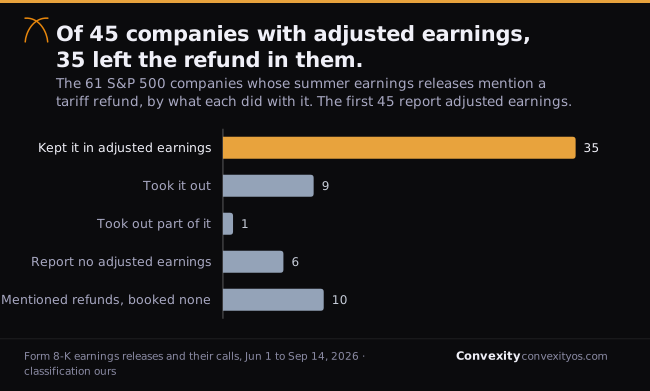
Thirty-five kept the refund inside their adjusted earnings. For 24 of them the release says so in words: Target's "GAAP and Adjusted EPS" both carry the $1.65, HP's non-GAAP earnings per share is "inclusive of an $0.11 favorable impact from tariff refunds," Amphenol's "GAAP and Adjusted Operating Income include an $80 million ($0.04 per share) net benefit." For ten more (Best Buy, Caterpillar, Disney, Kroger, Lennox, McCormick, Starbucks, Teledyne, Textron and Zebra) the release shows the refund inside results and lists no adjustment that removes it, which keeps it in by construction. We read each of those ten reconciliations to confirm it carries no refund line under another label.
The 35th is Home Depot, and it is in that row only because of its call. Its release mentions tariff refunds once, in its outlook: "Guidance includes IEEPA tariff refunds, which are expected to partially offset unplanned fuel, energy, and other product input costs throughout the fiscal year." It reports adjusted diluted earnings per share of $4.92, up 5.1%, adjusted only for the amortization of acquired intangible assets. Read on its own, that release describes a company expecting refunds, and our first pass, built from releases alone, put Home Depot among the companies that booked none.
On the call, chief financial officer Richard McPhail said the company "received IEEPA tariff refunds, which reduced our cost of goods sold by $685 million." Answering a question, he gave the rest: $730 million received "right around the end of the month of June," $685 million of it applied to products already sold, and "The remaining $45 million remains in inventory." No adjustment in the release removes the $685 million, so it is inside the $4.92, and nothing in the release tells a reader so.
Eight of the 35 releases kept the refund in without saying how much it was: Home Depot, Kimberly-Clark, Kroger, Solventum, Starbucks, Teledyne, Textron and Walmart. Most of them put a size on it during the call. Beyond Home Depot's figures and Walmart's roughly $2.9 billion, Solventum's chief financial officer described "a onetime tariff refund benefit of $100 million," which he said added $0.48 a share to the first half. Kimberly-Clark's said of the U.S. refund that "it was $45 million," Textron's put its gross refund at $21 million at one business, and Teledyne's chief executive, George Bobb, said the benefit, net of some other items, "was about a $10 million pickup in the quarter." Kroger's chief financial officer declined to give a number and called it "pretty modest." Walmart's release says only that adjusted operating income growth "includes the impact of tariff refunds received, partially offset by price investments."
At least eight of the 35 described the refund as one-time or nonrecurring and kept it in anyway. Cardinal Health's non-GAAP earnings per share rose 40% "including the recognition of a one-time net operating profit impact of IEEPA tariff refunds of $100 million," and its chief financial officer, Aaron Alt, told analysts: "We view the refund as nonrecurring." Kimberly-Clark said adjusted operating profit rose 6.2% "driven by one-time tariff refunds." The other six said it on their calls. Solventum's chief financial officer used the word "onetime," Revvity's called the refund "this one-time benefit," and Baxter's chief executive called it "the nonrecurring tariff benefit." Masco's chief executive, Jon Nudi, described pricing after "taking out the onetime impact of the tariff refund," Pentair's interim chief financial officer, Bob Fishman, said price offset inflation "excluding the onetime tariff refund benefit," and HP's chief financial officer said its long-term print margin range excludes "any one-time benefit that we might get from tariff refunds." Adjusted earnings are the measure companies define precisely in order to remove one-time items, which makes this the sharpest version of the pattern.
Nine took the refund out: Boston Scientific, Emerson Electric, Fortive, Mettler-Toledo, Parker-Hannifin, Tapestry, TJX, Williams-Sonoma and Xylem. Their reasons are the case against keeping it in, stated by the companies making it. Fortive said the gain "may not be reflective of the results of our operations in such period." Parker-Hannifin called it "a discrete, non-operating item." Boston Scientific said the amount "is excluded from management's assessment of operating performance used for making operating decisions and assessing performance."
GE HealthCare split the difference by vintage. It excluded $106 million of refunds of tariffs it had paid in 2025 from adjusted results and kept $23 million of refunds of 2026 tariffs in. Outside the S&P 500, Dick's Sporting Goods and YETI drew the same line, removing the prior-year portion and keeping the current-year one.
Six companies publish no adjusted earnings figure at all: Apple, Deere, Dollar General, lululemon, Nike and Ross Stores. For them the question never arises, because the refund is necessarily inside the only earnings number they print. We count them separately rather than folding them into the 35.
Both treatments have a case
It would be easy to write this as a story about companies flattering their numbers. The filings do not support that reading, and the strongest argument for keeping the refund in deserves to be stated before any of the arithmetic.
When companies paid the tariffs, the cost ran through cost of goods sold like any other duty, and a recurring cash cost of buying inventory is exactly what adjusted earnings are meant to include. A company that kept those costs in its adjusted earnings and then took the refund out would be counting the expense and ignoring its reversal. Measured over the whole period the tariffs were in force, keeping the refund in is the more accurate result, and Nike's own description of a benefit that "largely offsets" a fiscal year of tariffs is that argument in one sentence.
Executives who kept it in made the case on their calls, in three versions. Disney's chief financial officer, Hugh Johnston, made the accounting one: the full-year impact "will really be immaterial because the costs associated with those tariffs were actually in the first half of '26." Lennox's chief executive, Alok Maskara, made a pricing one. He said it was not "fair to exclude the tariff refunds as one-time," because the company's price increases were only now taking effect, and "pricing would have offset portions of that if it had not come through." Home Depot's McPhail made a cost one: the refunds "are being used to offset unplanned and rising cost pressures throughout the year," and "tariff refunds are a market-borne benefit, they're not unique to The Home Depot." Masco's answer was plainer. Asked by an analyst about the thinking behind including the refund in its core numbers, its chief financial officer, Rick Westenberg, said "we thought it was appropriate to include in terms of providing financial forecast for the full year."
The case for taking it out is about the quarter, not the year. A reversal of several quarters of cost, recognized in one quarter, makes that quarter's growth rate and margin a poor guide to the next one, and a guide to the next one is what an adjusted figure is for. Fortive's chief financial officer, Mark Okerstrom, put it in a sentence: "To help investors more easily compare results across periods, we exclude the impact of IEEPA tariff refunds from our adjusted metrics." He added: "But the cash benefit is very real." It is also the reason Target's chief financial officer gave, which is why his comment is worth more than the release it sits beside. Some of the audience plainly prefers it. On the call of Emerson, which took its refund out, one analyst, before asking his question, thanked the company "for taking a more conservative approach."
Neither choice is wrong. The difficulty is that both are called adjusted earnings. A screen for earnings growth, a comparison against consensus, and a table of margin expansion across a sector all put the two treatments in the same column, and nothing in the column says which is which.
What it did to the growth rates
The effect is easiest to see where a company disclosed both the per-share refund and the year-earlier figure, so that growth can be recomputed without it. Seven of the companies that kept the refund in did.
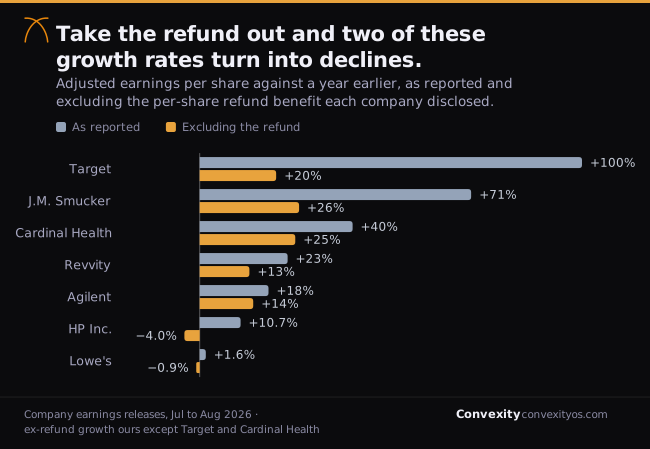
Target's adjusted earnings per share rose 100% with the refund and 20% without it, on the company's own figures. J.M. Smucker's rose 71% including an $0.84 benefit from refunds received in its quarter; without the benefit, the $3.24 becomes $2.40 against $1.90, growth of about 26% on our arithmetic. Cardinal Health printed both of its numbers, 40% with the refund and 25% without, and deserves credit for putting the second one in its headline bullet.
Two of the seven change sign. HP's non-GAAP earnings per share of $0.83 rose 10.7% from $0.75 and included $0.11 of refunds. Without them it was $0.72, a decline of 4% by our calculation. HP's release also says the $0.83 was "above the previously provided outlook of $0.61 to $0.71," so most of the distance above that outlook was the refund, and the rest was a single cent.
Lowe's adjusted earnings per share "increased 1.6% to $4.40." The release says both its diluted and adjusted figures "include an $0.11 benefit from IEEPA tariff refunds," and its reconciliation gives the prior year as $4.33. Without the refund, adjusted earnings per share was $4.29, down about 0.9% on our arithmetic. The headline direction of the quarter depends on the refund.
Both companies argued on their calls that the refund was not the whole story, and the arithmetic leaves room for that. Lowe's chief financial officer, Brandon Sink, said its "$80 million or $0.11" was "largely offset by fuel and transportation pressure," and that adjusted earnings per share "exceeded expectations even excluding this benefit." HP's interim chief executive, Bruce Broussard, said HP delivered "EPS above our expectations even when excluding a tariff refund benefit," which against its published outlook holds, by that single cent. Both statements can be accurate while the refund still decides whether the printed growth rate is a rise or a fall.
Baxter's adjusted earnings per share fell 5% to $0.56 including "a $0.11 per diluted share benefit related to an IEEPA tariff refund." Excluding it, the decline is about 24% by our calculation against the $0.59 of a year earlier. Its chief executive, Andrew Hider, said the quarter exceeded expectations, driven by operating performance "and an additional benefit from a tariff refund that was not previously contemplated in our guidance." Nike said much the same in an unusual preannouncement on June 23, a week before its own report: its results would "include a benefit from tariff refunds that was not contemplated in the company's previously provided guidance," and "Excluding this one-time benefit," the quarter would be "generally in line with previously provided guidance." Nike publishes no adjusted figure, so on its call chief financial officer Matt Friend supplied the number without the refund himself: "Earnings per share for the quarter was $0.72 and excluding the benefit on tariff recovery was $0.20."
Other companies said outright how much of a beat was the refund. Stanley Black & Decker's chief executive, Chris Nelson, said adjusted earnings per share of $1.57 were "$0.37 above the midpoint of our guidance range," and that "Below the line items contributed about $0.20 and net tariff refunds contributed about $0.17," which between them account for the whole $0.37. Revvity's chief financial officer, Max Krakowiak, said the refunds "drove about half of the adjusted EPS upside." Kimberly-Clark's chief financial officer, Nelson Urdaneta, said organic growth came in below expectations and that "the tariff refund that we received in the second quarter drove the better-than-expected and solid operating profit growth and EPS performance." Caterpillar's chief executive, Joe Creed, said its adjusted operating margin came in better than anticipated "primarily due to IEEPA tariff recoveries of $392 million and lower-than-expected tariff costs."
Where it shows up first: gross margin
Tariffs are paid on imported goods and flow through the cost of those goods, so a refund reverses cost of sales, and the first line it moves is gross margin. That makes gross margin expansion the most contaminated comparison of the reporting season.
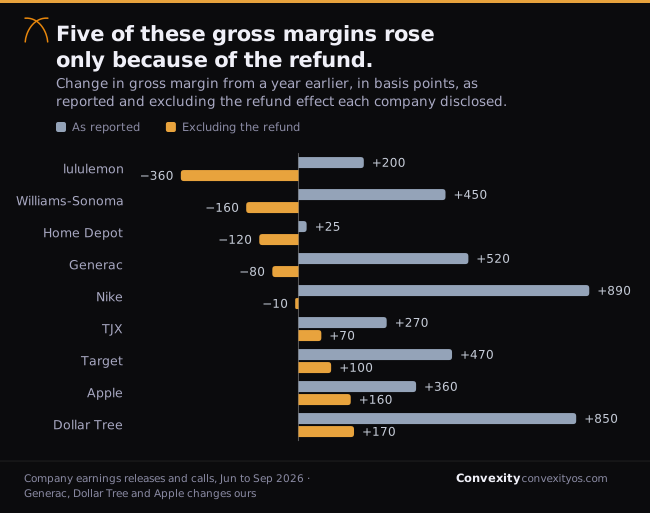
Five of the nine gross margins in the chart rose only because of the refund. Williams-Sonoma is the cleanest case, because the company prints both numbers: gross margin of 51.6% on a GAAP basis, up 450 basis points, and 45.5% on a non-GAAP basis, down 160 basis points. Generac's gross margin rose from 39.3% to 44.5%, and the release says refunds "contributed approximately 6% to gross margin," so without them it fell. Nike's rose 890 basis points and the refund "increased gross margin by approximately 900 basis points"; on the call, Friend said that excluding it, gross margin "would have been 40.2%, down 10 basis points versus the prior year." lululemon, which we wrote about on September 13 in a note on its quarter, rose 200 basis points including 560 from its refund, and Meghan Frank, its interim co-chief executive and chief financial officer, told analysts: "Excluding the tariff refund, gross margin was 50 basis points better than our guidance for a 410 basis point decline."
Home Depot is the fifth and the narrowest case. McPhail put gross margin at 33.7%, "an increase of approximately 25 basis points from the second quarter of last year, which was primarily driven by the benefit from the IEEPA tariff refund," and said the $685 million "was about 145 basis point gross impact to margin." The rest he called "around 120 basis point pressure": about 60 basis points of rising costs the refund offset, and about 60 from the mix of acquired businesses. One analyst prefaced his question about that pressure by citing "some discussion in the market this morning" over whether Home Depot had missed the consensus profitability forecast once the refund was excluded.
The other four still expanded without the refund, by far less than the headline. Dollar Tree's gross margin rose 850 basis points, of which 680 were the net refund. Target's rose 470, and the company says it rose about 100 excluding refunds. TJX's rose 270 and 70 without. Apple does not report adjusted earnings, and its gross margin of 50.1% included "a favorable impact of approximately 2 percentage points from tariff refunds." Its chief financial officer, Kevan Parekh, put the margin without the refund at 48.1% and said: "When you remove this favorable impact, we would have been at the midpoint of the guidance range we provided last quarter." Against the year-earlier quarter, on our arithmetic from Apple's reported dollars, that is a gain of about 160 basis points rather than 360.
Outside the chart, Solventum's chief financial officer, Wayde McMillan, said its gross margin rose 410 basis points and that without the refund it was "approximately 55.6%, consistent with our expectations and 40 basis points lower compared to prior year."
A screen for gross margin expansion run across this reporting season is, in part, a screen for companies that paid IEEPA duties on their own imports and received the money back in 2026.
When a refund becomes earnings
The treatment question has a second layer that is easier to miss, because it sits in the accounting policy rather than the adjustments. Companies also disagreed about when a refund becomes income at all.
Some waited for the cash. Target recognized its $994 million for refunds "received during the second quarter." Parker-Hannifin recognized $84 million of refunds received and wrote that for further claims "No receivable has been recorded for these additional refunds as the amount and timing remain uncertain." lululemon, J.M. Smucker and Estée Lauder likewise describe refunds received.
Fortive recorded a recovery for refund claims that CBP had accepted. Others recognized a refund once they judged collection probable. Motorola Solutions wrote that after CBP launched its system, "the company determined that the recovery of a portion of these refunds is now probable," and recognized $60 million. Nike "deemed the recovery of IEEPA tariffs paid to be probable" in its fourth quarter. Cardinal Health's chief financial officer said its benefit "reflects increased clarity and confidence in receiving approximately $200 million in IEEPA tariff refunds."
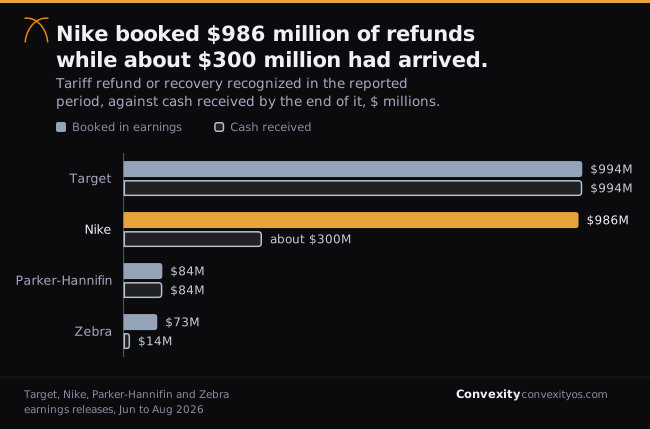
The gap can be large. Nike recognized $986 million while its cash from operations included approximately $0.3 billion received from tariff recoveries. Zebra recorded $73 million of recoveries, "of which $14 million received in the quarter." Caterpillar's operating profit included "$392 million of expected" tariff recoveries. Ford's second-quarter release refers to "the $1.3 billion IEEPA reimbursement recorded in the first quarter" and expects "cash recovery of approximately $500 million" of it in 2026.
None of this is improper on its face. Recognizing a recovery of a cost already expensed when it becomes probable is a defensible policy, and waiting for cash is a conservative one. But it means two companies owed identical refunds could report them in different quarters, and a second-quarter comparison across companies compares recognition policies as well as businesses. Inventory adds a third timing layer. Williams-Sonoma deferred $29.3 million of refund income as a reduction of inventory, which it expects to recognize in its third quarter, and Home Depot said the $45 million of its refund still sitting in inventory "will hit the P&L as we turn inventory through the remainder of the year."
Where the money went
A refund is not all profit. Several companies disclosed that part of it left the business in the same quarter, and the recipients are revealing.
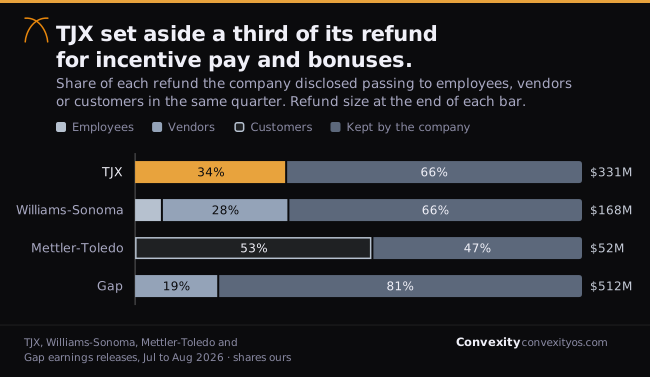
TJX received $331 million and, because of it, accrued $112 million of year-end incentive compensation and discretionary bonuses for eligible associates globally, a third of the refund. TJX took both out of its adjusted results, and its chief financial officer, John Klinger, opened his remarks by saying he would "speak to everything on an adjusted basis, which excludes the impact from the tariff refunds received as of the end of the second quarter and the related incremental compensation expense accruals." The company expects more refunds in its third quarter, and more accruals with them.
Williams-Sonoma booked a $47.5 million provision "to reimburse certain merchandise vendors that previously provided tariff-related concessions," which returns money to suppliers who had absorbed part of the tariff, and a $10.0 million one-time employee recognition cost "in the form of a discretionary 401(k) contribution." Its chief executive, Laura Alber, explained the vendor payment on the call: "They gave us discounts. And when we got the money back, we gave them their money back." Gap, outside the count, offset refunds of approximately $512 million with "a commitment of appreciation of approximately $95 million for certain vendors." Stanley Black & Decker reported its refund net of "directly attributable variable incentive compensation costs, growth investments, and taxes," and Masco's Nudi said its net benefit of about $95 million came after growth investments and "employee-related incentive compensation costs associated with this favorable impact."
Some went to customers. Mettler-Toledo paid $27.8 million of its $52.4 million out as "related customer tariff refunds." IDEX reduced net sales by $14.7 million for "expected customer rebates associated with refunds." Cardinal Health's net $100 million came from about $200 million of refunds, Alt said, "offset primarily by payables to customers for the increased prices they paid." FedEx ended its fiscal year with cash that included "approximately $800 million in IEEPA tariff refunds held for refund to customers," and its chief customer officer, Brie Carere, said that "beginning in August, we will be passing these refunds through to our customers."
Some went into prices, and competitors noticed. Lowe's chief executive, Marvin Ellison, said that "competitors use tariff refunds to lower prices later in the quarter," that Lowe's chose not to match those promotions, and that "It's pretty easy to determine who did what, just look at their tariff refunds versus their gross margin versus last year." He did not name anyone. Church & Dwight, which expects its own refund in the second half, saw promotions hold up at a time when high commodity costs usually pull them back, and its chief executive, Rick Dierker, offered an explanation: "My belief is a lot of people got tariff refunds and they're spending it back and trying to drive volume."
Walmart said it would spend its refund on prices. Chief executive John Furner told analysts that "any refunds that we had, we would prioritize price investments," and Rainey asked investors to look at the second and third quarters together because "a large portion of the refunds were invested at the end of Q2." He put the refunds' net contribution to second-quarter operating income growth at approximately 750 basis points, said that setting it aside, underlying growth was at the top of the company's 7% to 10% guidance, and guided third-quarter operating income growth of 2% to 4% in constant currency "Inclusive of planned investment of tariff refunds." Dollar General's chief executive, Todd Vasos, said the company "reinvested a substantial portion primarily to further enhance the overall value proposition for our customers." Kroger's chief financial officer, David Kennerley, said its refunds "were not a meaningful driver of results, and they were fully reinvested back in value." Dollar Tree is running the same sequence in its own numbers: its third-quarter adjusted earnings outlook includes "a $0.50 impact related to tariff refund reinvestments."
That sequence is the best argument that a quarter is the wrong unit. At Walmart and Dollar Tree, the refund lifts one quarter's adjusted earnings and the spending lowers the next one's, and both sit inside the adjusted figure.
The comparison that arrives next summer
Every refund kept in adjusted earnings becomes part of a base that will not recur. Target's second quarter of 2027 will be measured against $4.11, of which $1.65 was refund. Its chief financial officer has already told investors which base he would rather be judged against, and it is the other one.
Cardinal Health has done the rebasing formally. Its fiscal 2027 guidance growth rates are "based upon adjusted fiscal year 2026 results which exclude the fiscal year 2026 benefit from IEEPA tariff refund," which means the refund raised the growth the company reported this year and is removed from the base against which next year's growth will be measured. Both halves are disclosed, and both flatter the growth rate that gets quoted.
Several companies expect the refund to wash out over a longer period than the quarter that carried it. Stanley Black & Decker's refunds added about $0.17 to its second quarter, and its chief financial officer, Patrick Hallinan, said they would net out "at about $0.05 on the full year" once the growth investments they fund, most of them planned for the third and fourth quarters, are paid for. Home Depot's McPhail said that because the refunds offset cost pressures across the year, "there shouldn't be a lap from an annual perspective when we head into 2027," while allowing that individual quarters next year will show one. Walmart's Rainey expects the effect of the refunds and their reinvestment to be "largely contained within the current fiscal year." Starbucks' chief financial officer, Cathy Smith, pointed investors to year-to-date cost figures instead of the quarter's, saying "we believe the year-to-date view provides a more normalized perspective." Baxter's chief executive was blunter: "the nonrecurring tariff benefit won't flow through next year."
Guidance is split the same way the adjustments are. Target's guidance "excludes any potential future tariff refunds," as do Lowe's, Agilent's and lululemon's. Masco raised its adjusted earnings guidance because of "the anticipated full year net benefit from IEEPA tariff refunds of approximately $85 million," Generac said its raised outlook "is primarily due to the tariff refund included in the second quarter," and Baxter's vice president of investor relations, Kevin Moran, said its higher earnings guidance "reflects the tariff refund that we received in the quarter." Apple went the other way and put future refunds into its forecast: its September-quarter gross margin guidance of 47% to 48% "includes an expected benefit of approximately one percentage point related to tariff refunds." A company that guides without refunds and then receives more will beat its guidance by construction, so the third quarter's beats deserve the same reading as the second quarter's.
What this note is not claiming
It is not claiming that any company misreported or hid anything. Every refund in the count is disclosed, most of them quantified, and many in the first bullet of the release. Home Depot's is the one release in the count that does not mention a refund it booked, and its chief financial officer walked analysts through the figures on the call the same day. The finding is about comparability, not concealment.
It is not claiming that keeping the refund in adjusted earnings is wrong. The symmetry argument above is a strong one, and over a full year it is probably the more accurate treatment. The claim is narrower: this reporting season, the same label covers two different treatments, and the difference is large enough to change the direction of some companies' headline growth.
It is not a claim about the tariffs themselves, the Supreme Court's reasoning, or whether the refunds should have gone to the companies that paid the duties or to the customers who paid higher prices. Those are real questions and this note does not have the evidence to answer them.
What would prove this wrong
- The refunds keep coming. This note treats a refund as a one-time reversal. Target's chief financial officer said "We do expect some more to come," TJX expects more in its third quarter, HP's chief financial officer said the company has "signaled more next quarter," Fortive expects "another roughly $20 million to $25 million of tariff refunds in the coming quarters," and Lowe's said its second-quarter refund "represents a smaller portion of the total IEEPA tariffs that we paid." If material refunds recur for several quarters, the argument for keeping them in adjusted earnings strengthens and the argument for removing them weakens.
- Consensus already carried the refunds. Whether a company beat expectations depends on what analysts had modeled, and this note cannot see inside consensus. If estimates included the refunds, the reported beats were not flattered relative to expectations, though the growth rates still were. Baxter and Nike said the refund was not in their guidance, and Zebra's chief financial officer said its recovery "was not included in our outlook."
- The count misses refunds. It rests on full-text search, and a release describing refunds in wording none of the thirteen searches matched would be absent. Caterpillar's and Deere's releases were missed by our first searches and found only after we checked companies reported to have booked recoveries, which is how we learned the recovery wording mattered. Releases alone also miss refunds they do not describe: from the releases, our first pass read 34 of 44, and Home Depot's call moved it to 35 of 45. We read the calls of the 61 companies in the population, not of the rest of the S&P 500, so a member whose release never mentions a refund is outside the count however large its refund was. A different S&P 500 membership date would also change the population at the margin.
- The by-construction classifications are wrong. For ten companies the refund is kept in because no adjustment removes it, not because the release says so in words, and for Home Depot the classification rests on its chief financial officer's statements rather than its release. We read each reconciliation for a refund line under another label, and a company that removed it inside a broader adjustment without naming it would belong in the other column.
- Most of the money was passed on. Where a large share of a refund left in bonuses, vendor reimbursements, customer rebates or price cuts in the same period, the net effect on earnings is smaller than the gross refund suggests. The examples with dollar figures run from about a fifth to about half, Kroger says it reinvested all of its refund without saying how much that was, and most companies disclosed nothing on it either way.
- Next year, nobody is misled. If companies rebase their comparisons the way Cardinal Health did, and investors read the ex-refund figures Target and Cardinal Health now print, then the distinction this note draws is a one-season footnote rather than a comparability problem.
The third-quarter reports that begin in October are the test. The lines worth finding first are whether refunds recur, whether companies that guided without them report them as beats, and whether Walmart's and Dollar Tree's reinvestment shows up as the drag on adjusted earnings their own guidance says it will.
Every company in the count
The 51 S&P 500 companies that booked a tariff refund in the quarter their summer earnings release reports, by how the release treats it in adjusted earnings. Each company name links to the release. "By construction" means the refund is inside results and no adjustment in the release's reconciliation removes it, though no sentence says so in words. Where a release gives no amount and the call did, the call's figure is shown and marked.
| Company | Quarter | Refund, as disclosed | Adjusted earnings |
|---|---|---|---|
| Agilent Technologies | Q3 FY2026 | $20M pretax, net; $0.06 a share | Kept in |
| Amphenol | Q2 2026 | $80M, net; $0.04 a share | Kept in |
| Axon Enterprise | Q2 2026 | $47M of cash received | Kept in |
| Baxter International | Q2 2026 | $0.11 a share | Kept in |
| Best Buy | Q2 FY2027 | About $34M | Kept in, by construction |
| Cardinal Health | Q4 FY2026 | $100M of operating profit; $0.31 a share | Kept in |
| Caterpillar | Q2 2026 | $392M, expected | Kept in, by construction |
| Dollar Tree | Q2 2026 | $383M with interest; $1.31 a share, net | Kept in |
| Estée Lauder | Q4 FY2026 | $38M; $0.07 a share, adjusted | Kept in |
| Generac | Q2 2026 | About $71M pretax | Kept in |
| Home Depot | Q2 FY2026 | Not in the release; $685M of $730M received, per the call | Kept in, per the call |
| HP Inc. | Q3 FY2026 | $0.11 a share | Kept in |
| IDEX | Q2 2026 | $0.08 a share, net | Kept in |
| Intuitive Surgical | Q2 2026 | $28M after tax; $0.08 a share | Kept in |
| J.M. Smucker | Q1 FY2027 | About $115M; $0.84 a share | Kept in |
| Kimberly-Clark | Q2 2026 | Not in the release; $45M in the U.S., per the call | Kept in |
| Kroger | Q2 2026 | Not stated; "pretty modest", per the call | Kept in, by construction |
| Lennox International | Q2 2026 | $30M | Kept in, by construction |
| Lowe's | Q2 2026 | $0.11 a share | Kept in |
| Masco | Q2 2026 | About $95M, net | Kept in |
| McCormick | Q2 2026 | $28M | Kept in, by construction |
| Motorola Solutions | Q2 2026 | $60M pretax; $0.25 a share | Kept in |
| Pentair | Q2 2026 | About $35M | Kept in |
| Revvity | Q2 2026 | $16M; about $0.11 a share | Kept in |
| Solventum | Q2 2026 | Not in the release; $100M, per the call | Kept in |
| Stanley Black & Decker | Q2 2026 | About $0.17 a share, net | Kept in |
| Starbucks | Q3 FY2026 | Not stated | Kept in, by construction |
| Target | Q2 2026 | $994M; $1.65 a share | Kept in |
| Teledyne Technologies | Q2 2026 | Not in the release; about $10M, net, per the call | Kept in, by construction |
| Textron | Q2 2026 | Not in the release; $21M gross at one business, per the call | Kept in, by construction |
| Veralto | Q2 2026 | About $0.05 a share | Kept in |
| W.W. Grainger | Q2 2026 | $43M | Kept in |
| Walmart | Q2 FY2027 | Not in the release; about $2.9B eligible, per the call | Kept in |
| Walt Disney | Q3 FY2026 | About $100M | Kept in, by construction |
| Zebra Technologies | Q2 2026 | $73M recorded, $14M received | Kept in, by construction |
| Boston Scientific | Q2 2026 | $83M; $0.05 a share | Taken out |
| Emerson Electric | Q3 FY2026 | $82M; $0.11 a share | Taken out |
| Fortive | Q2 2026 | $4.5M | Taken out |
| Mettler-Toledo | Q2 2026 | $52.4M, less $27.8M refunded to customers | Taken out |
| Parker-Hannifin | Q4 FY2026 | $84M; $0.65 a share | Taken out |
| Tapestry | Q4 FY2026 | $98.2M of gross profit; $0.43 a share | Taken out |
| TJX Companies | Q2 FY2027 | $331M, less $112M of incentive pay | Taken out |
| Williams-Sonoma | Q2 2026 | $167.8M | Taken out |
| Xylem | Q2 2026 | $16M | Taken out |
| GE HealthCare | Q2 2026 | $129M, of which $106M excluded | Part taken out |
| Apple | Q3 FY2026 | About 2 points of gross margin; $0.11 a share | No adjusted measure |
| Deere | Q3 FY2026 | $110M | No adjusted measure |
| Dollar General | Q2 2026 | About 66 bps of operating margin, net | No adjusted measure |
| lululemon | Q2 FY2026 | $134.5M; $0.86 a share | No adjusted measure |
| Nike | Q4 FY2026 | $986M, expected; $0.52 a share | No adjusted measure |
| Ross Stores | Q2 2026 | About $253M; about $0.60 a share | No adjusted measure |
Primary sources
- OpinionLearning Resources, Inc. v. Trump, Supreme Court of the United States, No. 24-1287The holding as stated in the syllabus, "IEEPA does not authorize the President to impose tariffs"February 20, 2026
- CSMSU.S. Customs and Border Protection, CSMS #68340863, Consolidated Administration and Processing of Entries (CAPE) for IEEPA RefundsPhase 1 of the refund system scheduled to deploy at 8 a.m. EDT on April 20, 2026April 13, 2026
- 8-KTarget second quarter 2026 earnings release, Exhibit 99GAAP and Adjusted EPS of $4.11 against $2.05, including $1.65 of tariff refunds; growth of 20% excluding refunds; $994 million recognized for refunds received; gross margin rate of 33.7% against 29.0% and about 100 basis points higher excluding refunds; guidance that excludes future refundsAugust 19, 2026
- CallTarget Q2 2026 earnings callChief financial officer Jim Lee, answering a question on the right starting point for 2027: focusing on adjusted EPS excluding tariff refunds as the better measurement, the ex-refund figure as the number to anchor on, and more refunds expected. Read in CallsiderAugust 19, 2026
- 8-KHome Depot second quarter fiscal 2026 earnings release, Exhibit 99.1The only mention of tariff refunds, in guidance; adjusted diluted EPS of $4.92 against $4.68, adjusted only for acquired intangible asset amortizationAugust 18, 2026
- CallHome Depot Q2 fiscal 2026 earnings callChief financial officer Richard McPhail: $730 million of refunds received around the end of June, $685 million reducing cost of goods sold and $45 million remaining in inventory; gross margin of 33.7%, up approximately 25 basis points, with the refund about 145 basis points of it and around 120 basis points of pressure beneath; refunds used to offset rising costs as a market-borne benefit; no annual lap expected in 2027. An analyst question citing market discussion of the quarter excluding the refund. Stored in Callsider under fiscal label 2027-2. Read in CallsiderAugust 18, 2026
- 8-KTJX Companies second quarter fiscal 2027 earnings release, Exhibit 99.1Refunds of $331 million received, $112 million of incentive compensation and discretionary bonuses accrued because of them, and their exclusion from adjusted results; gross margin of 33.4% against 30.7%, and 31.4% excluding the net refund; the expected third-quarter refunds and accrualsAugust 19, 2026
- CallTJX Companies Q2 fiscal 2027 earnings callChief financial officer John Klinger on speaking to results on an adjusted basis that excludes the refunds and the related compensation accruals. Read in CallsiderAugust 19, 2026
- 8-KWalmart second quarter fiscal 2027 earnings release, Exhibit 99.1Adjusted operating income growth that includes the impact of tariff refunds received, partially offset by price investments; the prioritization of remaining refunds into price investmentsAugust 20, 2026
- CallWalmart Q2 fiscal 2027 earnings callChief financial officer John David Rainey on eligibility for approximately $2.9 billion of refunds, substantially all received, their net benefit of approximately 750 basis points to operating income growth, investing a large portion at the end of the quarter, third-quarter operating income growth of 2% to 4% inclusive of that investment, and the effect being largely contained within the fiscal year; chief executive John Furner on prioritizing refunds into price. Read in CallsiderAugust 20, 2026
- 8-KCardinal Health fourth quarter fiscal 2026 earnings release, Exhibit 99.1Non-GAAP diluted EPS of $2.91, up 40%, including a one-time $100 million net operating profit impact of refunds, and $2.60, up 25%, excluding $0.31; the repayment to customers; fiscal 2027 growth rates based on results excluding the refundAugust 11, 2026
- CallCardinal Health Q4 fiscal 2026 earnings callChief financial officer Aaron Alt on the $100 million net benefit reflecting confidence in receiving approximately $200 million of refunds, offset primarily by payables to customers, and on viewing the refund as nonrecurring. Read in CallsiderAugust 11, 2026
- 8-KJ.M. Smucker first quarter fiscal 2027 earnings release, Exhibit 99.1Adjusted EPS of $3.24, up 71%, including an $0.84 benefit from refunds received, against $1.90; approximately $115.0 million of refunds in gross profit; $4.0 million of interestAugust 26, 2026
- 8-KHP Inc. third quarter fiscal 2026 earnings release, Exhibit 99.1Non-GAAP diluted net EPS of $0.83, up 10.7% from $0.75, inclusive of an $0.11 favorable impact from tariff refunds, against an outlook of $0.61 to $0.71August 26, 2026
- CallHP Inc. Q3 fiscal 2026 earnings callInterim chief executive Bruce Broussard on EPS above expectations even excluding the refund benefit; chief financial officer Karen Parkhill on the long-term print margin range excluding any one-time refund benefit, and on more refunds signaled for the next quarter. Read in CallsiderAugust 26, 2026
- 8-KLowe's second quarter 2026 earnings release, Exhibit 99.1Adjusted diluted EPS up 1.6% to $4.40 against $4.33, with both diluted and adjusted figures including an $0.11 benefit from IEEPA tariff refunds; an outlook that excludes further refundsAugust 19, 2026
- CallLowe's Q2 2026 earnings callChief financial officer Brandon Sink on the $80 million, or $0.11, benefit being largely offset by fuel and transportation pressure, adjusted EPS exceeding expectations excluding it, and the refund being a smaller portion of the tariffs paid; chief executive Marvin Ellison on competitors using refunds to lower prices. Read in CallsiderAugust 19, 2026
- 8-KRevvity second quarter 2026 earnings release, Exhibit 99.1Pro forma adjusted EPS of $1.41 against $1.15, including approximately $0.11 from tariff related refundsAugust 4, 2026
- CallRevvity Q2 2026 earnings callChief financial officer Max Krakowiak on the $16 million of refunds driving about half of the adjusted EPS upside and on reinvesting about half of the one-time benefit. The transcript is dated August 6, 2026 in Callsider, two days after the release, and its refund figure matches the release. Read in CallsiderAugust 6, 2026
- 8-KAgilent Technologies third quarter fiscal 2026 earnings release, Exhibit 99.1Non-GAAP EPS of $1.62, up 18% from $1.37, including a $0.06 net benefit from tariff refunds; fourth-quarter guidance that includes no future refund benefitAugust 26, 2026
- 8-KBaxter International second quarter 2026 earnings release, Exhibit 99.1Adjusted diluted EPS from continuing operations of $0.56 against $0.59, including a $0.11 benefit from an IEEPA tariff refund; chief executive Andrew Hider on a refund not previously contemplated in guidanceJuly 30, 2026
- CallBaxter International Q2 2026 earnings callChief executive Andrew Hider on the nonrecurring tariff benefit not flowing through next year; vice president of investor relations Kevin Moran on the higher EPS guidance reflecting the refund received in the quarter. Read in CallsiderJuly 30, 2026
- 8-KNike fourth quarter fiscal 2026 earnings release, Exhibit 99.1The $986 million expected recovery of IEEPA tariffs and its approximately 900 basis point effect on a gross margin up 890 basis points; approximately $0.3 billion of cash received; recovery deemed probable; the benefit largely offsetting a fiscal year of tariffsJune 30, 2026
- 8-KNike preliminary fourth quarter results announcement, Exhibit 99.1Results to include a refund benefit not contemplated in guidance, and to be generally in line with guidance excluding itJune 23, 2026
- CallNike Q4 fiscal 2026 earnings callChief financial officer Matt Friend on gross margin of 49.2% that would have been 40.2%, down 10 basis points, excluding the benefit, and on EPS of $0.72, or $0.20 excluding it. Read in CallsiderJune 30, 2026
- 8-KWilliams-Sonoma second quarter 2026 earnings release, Exhibit 99.1Gross margin of 51.6% GAAP, up 450 basis points, and 45.5% non-GAAP, down 160; the $167.8 million refund, $6.3 million of interest, $47.5 million vendor provision, $10.0 million employee 401(k) contribution and $29.3 million deferred into inventoryAugust 26, 2026
- CallWilliams-Sonoma Q2 2026 earnings callChief executive Laura Alber on rewarding employees with part of the refund and returning vendors the discounts they had given. Stored in Callsider under fiscal label 2027-2. Read in CallsiderAugust 26, 2026
- 8-KGenerac second quarter 2026 earnings release, Exhibit 99.1Gross margin of 44.5% against 39.3%, with refunds contributing approximately 6%; a raised outlook primarily due to the refundJuly 29, 2026
- 8-KApple third quarter fiscal 2026 earnings release, Exhibit 99.1Gross margin of 50.1% including approximately 2 percentage points from tariff refunds; diluted EPS including $0.11; gross margin and net sales in dollars for both yearsJuly 30, 2026
- CallApple Q3 fiscal 2026 earnings callChief financial officer Kevan Parekh on gross margin of 48.1% adjusted for the tariff refund, the midpoint of prior guidance without the refund, and September-quarter gross margin guidance of 47% to 48% including approximately one percentage point of expected refunds. Read in CallsiderJuly 30, 2026
- 8-KDollar Tree second quarter 2026 earnings release, Exhibit 99.1Gross margin up 850 basis points including 680 from the net impact of refunds of $383 million with interest; reinvestment costs; a third-quarter outlook including a $0.50 impact related to refund reinvestmentsAugust 27, 2026
- Calllululemon athletica Q2 fiscal 2026 earnings callInterim co-chief executive and chief financial officer Meghan Frank on gross margin excluding the tariff refund being 50 basis points better than guidance for a 410 basis point decline. Read in CallsiderSeptember 3, 2026
- CallSolventum Q2 2026 earnings callChief financial officer Wayde McMillan on a onetime refund benefit of $100 million, gross margin of approximately 55.6% excluding it, 40 basis points lower than a year earlier, and the refund adding $0.48 to the first half. Read in CallsiderAugust 5, 2026
- CallKimberly-Clark Q2 2026 earnings callChief financial officer Nelson Urdaneta on the U.S. refund of $45 million and on the refund driving the better-than-expected operating profit growth and EPS. The transcript is dated August 6, 2026 in Callsider, two days after the release, and discusses the same second-quarter refund. Read in CallsiderAugust 6, 2026
- CallTextron Q2 2026 earnings callChief financial officer David Rosenberg on a gross refund of $21 million at one business and a net impact of about $18 million. Read in CallsiderJuly 28, 2026
- CallTeledyne Technologies Q2 2026 earnings callPresident and chief executive George Bobb on the tariff benefit, net of some other one-time items, as about a $10 million pickup in the quarter, mostly in Digital Imaging. Read in CallsiderJuly 22, 2026
- CallPentair Q2 2026 earnings callInterim chief financial officer Bob Fishman on price offsetting inflation excluding the one-time tariff refund benefit. Read in CallsiderJuly 28, 2026
- CallKroger Q2 2026 earnings callChief financial officer David Kennerley on refunds that were pretty modest, not a meaningful driver of results, and fully reinvested. Read in CallsiderSeptember 11, 2026
- 8-KParker-Hannifin fourth quarter fiscal 2026 earnings release, Exhibit 99.1The $84 million of refunds received and excluded from adjusted results as a discrete, non-operating item; no receivable recorded for further claimsAugust 6, 2026
- 8-KFortive second quarter 2026 earnings release, Exhibit 99.1A recovery recorded for refund claims accepted by CBP, and its exclusion as not reflective of operating results in the periodJuly 29, 2026
- CallFortive Q2 2026 earnings callChief financial officer Mark Okerstrom on excluding refunds from adjusted metrics to aid comparison across periods, the cash benefit being very real, and another roughly $20 million to $25 million of refunds expected. Read in CallsiderJuly 29, 2026
- CallLennox International Q2 2026 earnings callChief executive Alok Maskara on why excluding the refunds as one-time would not be fair, given pricing actions taking effect in the third quarter. Read in CallsiderJuly 29, 2026
- CallMasco Q2 2026 earnings callChief financial officer Rick Westenberg, asked about including the refund in core numbers, on its inclusion in the full-year forecast; chief executive Jon Nudi on the net benefit after growth investments and incentive compensation, and on pricing after taking out the one-time impact of the refund. Read in CallsiderJuly 29, 2026
- CallWalt Disney Q3 fiscal 2026 earnings callChief financial officer Hugh Johnston on about $100 million of refunds in the quarter and a full-year impact that is immaterial because the tariff costs fell in the first half. Read in CallsiderAugust 5, 2026
- CallEmerson Electric Q3 fiscal 2026 earnings callAn analyst thanking the company for taking a more conservative approach in excluding refunds. Read in CallsiderAugust 4, 2026
- CallStanley Black & Decker Q2 2026 earnings callChief executive Chris Nelson on adjusted EPS of $1.57, $0.37 above the guidance midpoint, with about $0.20 from below-the-line items and about $0.17 from net refunds; chief financial officer Patrick Hallinan on refunds netting to about $0.05 for the full year. Read in CallsiderJuly 29, 2026
- CallCaterpillar Q2 2026 earnings callChief executive Joe Creed on adjusted operating margin better than anticipated primarily due to $392 million of IEEPA tariff recoveries and lower-than-expected tariff costs. Read in CallsiderAugust 4, 2026
- CallZebra Technologies Q2 2026 earnings callChief financial officer Nathan Winters on the $73 million recovery not being included in the outlook. Read in CallsiderAugust 4, 2026
- 8-KZebra Technologies second quarter 2026 earnings release, Exhibit 99.1IEEPA tariff recoveries of $73 million recorded, of which $14 million received in the quarterAugust 4, 2026
- 8-KMotorola Solutions second quarter 2026 earnings release, Exhibit 99.1A $60 million benefit recognized once recovery became probable, inside both GAAP and non-GAAP operating marginAugust 5, 2026
- 8-KCaterpillar second quarter 2026 earnings release, Exhibit 99.1Operating profit including $392 million of expected IEEPA tariff recoveriesAugust 4, 2026
- 8-KFord Motor second quarter 2026 earnings release, Exhibit 99The $1.3 billion IEEPA reimbursement recorded in the first quarter and the expected 2026 cash recovery of approximately $500 millionJuly 28, 2026
- 8-KMettler-Toledo second quarter 2026 earnings release, Exhibit 99.1Refunds of $52.4 million, customer tariff refunds of $27.8 million, and the exclusion of both from non-GAAP resultsJuly 30, 2026
- 8-KIDEX second quarter 2026 earnings release, Exhibit 99.1Net sales reduced by $14.7 million of expected customer rebates associated with refundsJuly 29, 2026
- 8-KFedEx fourth quarter fiscal 2026 earnings release, Exhibit 99.1Approximately $800 million of IEEPA tariff refunds held for refund to customersJune 23, 2026
- CallFedEx Q4 fiscal 2026 earnings callExecutive vice president and chief customer officer Brie Carere on filing claims on behalf of customers and passing refunds through to them from August. Read in CallsiderJune 23, 2026
- CallChurch & Dwight Q2 2026 earnings callChief executive Rick Dierker on promotions that did not pull back and his belief that companies receiving refunds were spending them to drive volume. Read in CallsiderJuly 31, 2026
- CallDollar General Q2 2026 earnings callChief executive Todd Vasos on reinvesting a substantial portion of refunds into the value proposition for customers. Stored in Callsider under fiscal label 2027-2. Read in CallsiderAugust 27, 2026
- CallStarbucks Q3 fiscal 2026 earnings callChief financial officer Cathy Smith on refunds offsetting tariffs from the first three quarters and the year-to-date view as the more normalized perspective. Read in CallsiderJuly 29, 2026
- 8-KGap Inc. second quarter fiscal 2026 earnings release, Exhibit 99.1Refunds of approximately $512 million, partially offset by approximately $95 million of appreciation committed to certain vendors. Not an S&P 500 member and outside the countAugust 27, 2026
- 8-KDick's Sporting Goods second quarter 2026 earnings release, Exhibit 99.1Refunds attributable to prior-year tariffs excluded from non-GAAP EPS and current-year refunds kept in. Outside the countAugust 25, 2026
- 8-KYETI Holdings second quarter 2026 earnings release, Exhibit 99.1Refunds of tariffs expensed in 2025 excluded from adjusted gross margin, and those expensed in 2026 kept in. Outside the countAugust 13, 2026
- 8-KGE HealthCare second quarter 2026 earnings release, Exhibit 99Refunds of $106 million related to 2025 excluded from Adjusted EBIT and $23 million related to 2026 includedJuly 29, 2026
- 8-KStanley Black & Decker second quarter 2026 earnings release, Exhibit 99.1Refund gains reported net of directly attributable variable incentive compensation costs, growth investments and taxesJuly 29, 2026
- 8-KMasco second quarter 2026 earnings release, Exhibit 99Adjusted EPS guidance raised on an anticipated full-year net refund benefit of approximately $85 millionJuly 29, 2026
- 8-KStarbucks third quarter fiscal 2026 earnings release, Exhibit 99.1Refunds received largely offsetting tariffs incurred in the first three quarters of fiscal 2026July 29, 2026
- DataSPDR S&P 500 ETF Trust daily holdingsS&P 500 membership used to define the population, holdings as of September 11, 2026. Retrieved 2026-09-14September 11, 2026
- SearchSEC EDGAR full-text searchThe thirteen phrase searches over Form 8-K filings, June 1 to September 14, 2026, that define the 285 companies. Retrieved 2026-09-14September 14, 2026
- NoteLululemon's beat was a tariff refundOur note on the quarter behind the lululemon margin figures used hereSeptember 13, 2026
Disclosure, again. Convexity builds research tools for public-market data, including Callsider, where the earnings calls quoted here were read. This note is analysis, not investment advice, and nothing in it is a recommendation to buy, sell, or short any security. We hold no position in any company named. Every reported figure is from the filings, notices and calls cited above, and every quotation from a call was checked word for word against the stored transcript. The following are ours, not the companies': the population and the classification of all 61 companies, including the ten kept in by construction and Home Depot's, which rests on its call; the tallies of companies that did not state an amount and that called the refund one-time; the growth rates excluding the refund for J.M. Smucker, Revvity, Agilent, HP, Lowe's and Baxter, and Revvity's as-reported rate, each computed from the per-share figures in the company's release; the gross margin changes excluding the refund for lululemon, Generac and Dollar Tree, computed from each company's stated refund effect, with Generac's approximate because its stated effect is; both of Apple's gross margin changes, computed from its reported dollars a year earlier, its reported 50.1% and the 48.1% its chief financial officer gave, rounded to ten basis points; the sum of Stanley Black & Decker's two stated contributions to its beat; and the shares of each refund passed to employees, vendors and customers, computed from the dollar amounts each release gives. Target's and Cardinal Health's ex-refund growth rates, Williams-Sonoma's non-GAAP margin, Nike's and Home Depot's gross margin figures, Nike's earnings per share excluding the refund, and TJX's, Target's and Walmart's ex-refund figures are the companies' own. Consensus estimates are not used anywhere in this note.