




Disclosure. Not investment advice, and nothing here is a recommendation to buy, sell or hold any security. A member of the Convexity team holds the SPDR S&P 500 ETF (SPY), which holds CrowdStrike and Palo Alto Networks; no direct position in CrowdStrike, Zscaler or Palo Alto Networks, or in any other company named here. Every reported figure comes from CrowdStrike's and Zscaler's Forms 8-K of November 23, 2026 and the merger agreement filed with them, the two companies' quarterly results released that day, their latest annual results, two public transcripts of CrowdStrike's November 23 call, Nasdaq's listing rules and historical closing prices. Quotations appear verbatim in both transcripts listed below; points carried differently between them are reported in our words. The closing note lists what is our arithmetic.
The headline number in CrowdStrike's agreement to buy Zscaler is $43.9 billion. The number that decides who comes out ahead is 1.135.
That is how many CrowdStrike shares each Zscaler share will become. CrowdStrike (CRWD) announced the deal on Monday, November 23, alongside its third-quarter results, a day after the two companies signed it. Zscaler (ZS) built its business by sending companies' internet traffic through its own cloud for inspection, instead of through firewalls sitting in their data centers, and on Monday's call CrowdStrike chief executive George Kurtz said that "overnight, we become the number one SASE and zero trust provider." Those are the industry's names for security delivered from the cloud and for checking every connection instead of trusting anything already inside a company's network.
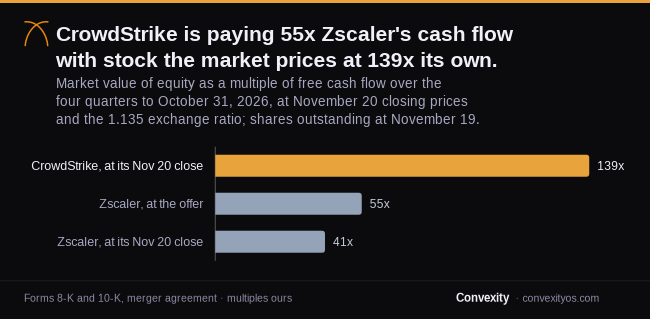
The deal is all stock. Zscaler's owners are being paid in CrowdStrike shares, and CrowdStrike shares are an expensive currency. At Friday's close, investors valued CrowdStrike at about 139 times the free cash flow it produced over the past four quarters, the cash left after running the business and paying for equipment and software. They valued Zscaler at about 41 times its own (both our arithmetic).
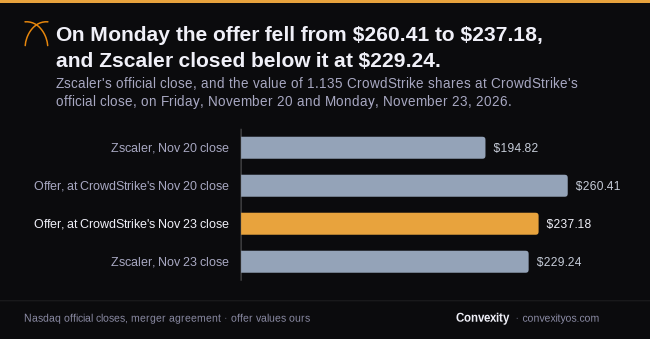
That gap explains almost everything about the deal. It is why CrowdStrike can pay a premium of about 34% and still describe the purchase, in its release, as "significantly and immediately accretive to free cash flow per share before factoring in any synergies." It is why Zscaler's holders, who bring well over a third of the combined revenue, will own less than a sixth of the combined company. And because the price is fixed in shares rather than dollars, it is why the offer was already worth less by Monday's close than it had been on Friday: CrowdStrike's shares fell 8.9% on Monday, and 1.135 of them were worth about $237.18 at the close, against $260.41 on Friday.
This note walks through the deal the way the filings describe it: what each company brings, what the multiple buys, who carries the risk between now and closing, and the stock-exchange rule that means CrowdStrike's own shareholders will not vote on it. Then it says what would prove our reading wrong.
The deal, briefly
Under the merger agreement filed with CrowdStrike's Form 8-K, each Zscaler share becomes 1.135 CrowdStrike shares. At CrowdStrike's November 20 close of $229.44, that was worth about $260.41 per Zscaler share, roughly 34% above Zscaler's own close of $194.82 that day. CrowdStrike expects its current shareholders to own about 84.1% of the combined company and Zscaler's about 15.9%, and Zscaler founder and chief executive Jay Chaudhry is to join CrowdStrike's board.
The companies expect to close in the second half of CrowdStrike's fiscal 2028, which runs from August 2027 to January 2028. Three things stand in the way. A majority of Zscaler's shares must vote yes, and holders of about 34% of them, including Chaudhry and related trusts, have already signed agreements to do so. Regulators must clear it. And the clock must not run out: the agreement can be ended if the deal has not closed by November 23, 2027, a date that extends automatically to February 23, 2028 if only antitrust or foreign-investment approvals are outstanding, and by up to 60 more days if a U.S. government shutdown stalls the review.
Zscaler, meanwhile, has gone quiet. Its first-quarter results, released the same day, came with a note that it would not hold its scheduled earnings call and was withdrawing its previously issued financial guidance. For the next year or so, the best guide to what a Zscaler share is worth will be the price of a CrowdStrike share.
What Zscaler brings, and what its holders get
Both companies closed a quarter on October 31, which makes a clean comparison possible.
CrowdStrike ended its third quarter of fiscal 2027 with $6.26 billion of annual recurring revenue, the yearly value of its subscription contracts, up 27% from a year earlier, and quarterly revenue rose 28% to $1,583 million. Zscaler ended its first quarter of fiscal 2027 with $3,882 million of ARR, up 21%, on revenue up 20% to $949 million. Together they carry about $10.1 billion of ARR, which is the "more than $10 billion in combined annual recurring revenue" the release advertises.
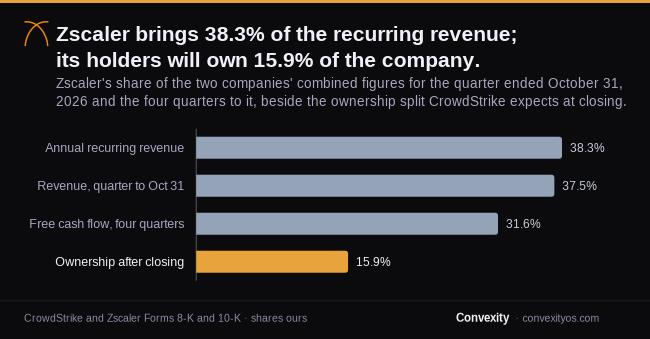
On those figures Zscaler supplies 38.3% of the combined ARR and 37.5% of the combined quarter's revenue. Its share of free cash flow is smaller but still large: over the four quarters to October 31, Zscaler generated $782 million against CrowdStrike's $1,697 million, 31.6% of the total. (All three shares are our arithmetic on the companies' reported figures.)
Its shareholders will own 15.9% of the company.
| Zscaler's share of the combined company | |
|---|---|
| Annual recurring revenue | 38.3% |
| Revenue, quarter to Oct 31 | 37.5% |
| Free cash flow, four quarters | 31.6% |
| Ownership after closing | 15.9% |
Read on its own, that chart looks like a poor trade for Zscaler's owners. They put in almost two-fifths of the revenue and take out less than a sixth of the equity. It is not that simple, and the reason it is not is the most interesting thing about the deal.
The currency: why a 34% premium still adds to CrowdStrike's cash per share
Every all-stock deal carries two prices. One is what the buyer pays for the target. The other is what the market thinks the buyer's own shares are worth, because those shares are the money.
At Friday's close, CrowdStrike's 1.03 billion shares were worth about $236.5 billion, 139 times its trailing free cash flow. Zscaler's 164 million shares were worth about $32.0 billion, 41 times its own. Even with the premium, the offer prices Zscaler's shares at about 55 times its trailing free cash flow, well under half the multiple on the stock CrowdStrike is paying with (all our arithmetic, on shares outstanding as of November 19).
| Market value as a multiple of trailing free cash flow | |
|---|---|
| CrowdStrike, at its Nov 20 close | 139.4139x |
| Zscaler, at the offer | 54.655x |
| Zscaler, at its Nov 20 close | 40.941x |
Think of it as a currency exchange at a very good rate. When the market prices your cash flow at $139 for every dollar and you can buy someone else's at $55, each share you hand over brings back more cash flow than it carried away. On the trailing figures, CrowdStrike's free cash flow per diluted share would rise from about $1.61 to about $1.98, roughly 23%, before any synergies, deal costs or financing effects. That is our arithmetic, not a company figure, but it is what "significantly and immediately accretive to free cash flow per share" looks like in numbers.
The arithmetic is close to guaranteed. Whether it creates any value is a separate question, and it is the one both sets of shareholders are now betting on. Accretion that comes from a gap in valuations is a statement about prices rather than about the business: the combined company's cash flow is, at first, simply the two companies' cash flows added together. If investors keep paying CrowdStrike's multiple for all of it, everyone gains, because Zscaler's cash flow has been repriced at 139 times overnight. If they instead value the combined company as the sum of the two companies' Friday market values, the blended multiple works out to about 108 times (our arithmetic). CrowdStrike's holders then own more cash flow per share, valued at a lower price per dollar, and the premium becomes a plain transfer from them to Zscaler's holders.
That is what we mean when we say CrowdStrike is paying with its own multiple. The 1.135 converts Zscaler's cash flow into CrowdStrike's valuation. The deal works best for both sides if the market accepts the conversion.
Monday's first verdict
Both companies reported a quarter on Monday as well as the deal, so nobody can say how much of either stock's move belongs to the deal alone. The moves were large either way. CrowdStrike's shares closed at $208.97, down 8.9% from Friday, which on the agreement's count of 1.03 billion shares took about $21.1 billion off its market value, a little under half of the deal's $43.9 billion headline. Zscaler's closed at $229.24, up 17.7%, adding about $5.6 billion to its own. Palo Alto Networks (PANW), the rival two analysts named on the call, closed up 2.9% at $353.43 (all our arithmetic).
The fixed ratio did the rest. Because Zscaler's holders were promised shares rather than dollars, the fall in CrowdStrike's price came straight out of their offer: at Monday's close, 1.135 CrowdStrike shares were worth about $237.18, $23.23 less than on Friday. The agreement sets no collar, the kind of band that adjusts a ratio to protect the seller when the buyer's stock moves, so every dollar CrowdStrike gains or loses between now and closing is worth $1.135 to a Zscaler holder.
Zscaler's own shares stopped short of the offer. At $229.24 they closed 3.3% below the value of 1.135 CrowdStrike shares, a gap of $7.94 a share (our arithmetic). That gap is the spread, the market's price for waiting a year or more to be paid and for the chance that the deal never closes. It moves every time CrowdStrike's shares do, which makes it the simplest public measure of how safe the market thinks the deal is: a narrowing spread says the market sees less risk, and a widening one says it sees more.
| Value of one Zscaler share | |
|---|---|
| Zscaler, Nov 20 close | $195$194.82 |
| Offer, at CrowdStrike's Nov 20 close | $260$260.41 |
| Offer, at CrowdStrike's Nov 23 close | $237$237.18 |
| Zscaler, Nov 23 close | $229$229.24 |
Who pays if the deal fails
The merger agreement, filed as Exhibit 2.1 to CrowdStrike's 8-K, answers a question the release does not: who bears the cost if the deal never closes? Mostly Zscaler's holders.
Start with the fee. If Zscaler's board changes its recommendation, or Zscaler ends the agreement to accept a better offer, Zscaler owes CrowdStrike $1.4 billion, and the same fee falls due if Zscaler agrees to another buyer within 12 months of certain other terminations. That is a standard protection for a buyer. What is notable is what runs the other way. We found no fee payable by CrowdStrike anywhere in the agreement, including if regulators block the deal or the clock runs out. Buyers that expect a long antitrust review sometimes agree to pay the target a fee in exactly that case. This agreement contains none.
Then there is the definition that decides how hard CrowdStrike has to fight for approval. The agreement calls any requirement to sell, license, hold separate or otherwise dispose of any business, or to accept any structural remedy, a "Burdensome Condition." Behavioral remedies, such as limits on how the combined company operates, count too, unless they would not reasonably be expected to materially reduce the deal's benefits to CrowdStrike or to be material relative to Zscaler's value. CrowdStrike is not required to accept a Burdensome Condition, Zscaler may not agree to one without CrowdStrike's written consent, and clearance without one, unless CrowdStrike chooses to accept it, is a condition of closing.
Put those terms together and the shape is plain. If regulators ask for nothing material, the deal closes. If they ask for a divestiture, CrowdStrike can decline and, once the deadline passes, walk away owing nothing under the agreement, while Zscaler's holders are left with a company whose shares will have spent a year trading as a fraction of CrowdStrike's, that skipped its November earnings call and that has withdrawn its guidance. Kurtz described the deal as a chance "to put two market leaders in different categories together," which in our reading is also the case the companies will make to regulators. If regulators accept it, none of this matters. If they do not, the contract has already decided who pays.
The 20% line, and the vote CrowdStrike's owners will not get
Look again at the conditions and one group is missing: CrowdStrike's own shareholders. The release lists approval by Zscaler's shareholders and by regulators, and nothing from CrowdStrike's.
The reason is a stock-exchange rule. Nasdaq Listing Rule 5635(a) requires a listed company to get its shareholders' approval before issuing stock to buy another company when the shares to be issued, counting shares issuable through convertible securities, will equal 20% or more of the shares outstanding before the issuance. CrowdStrike's 1,030.6 million shares outstanding on November 19 put that line at about 206.1 million shares.
The merger agreement writes the line into the deal. Section 2.02(e), which it calls the "Share Cap," says that if the deal would result in the issuance, or potential issuance, of more than one share less than 20.0% of CrowdStrike's outstanding shares, counted under Nasdaq's rules and guidance, the 1.135 ratio shrinks automatically, in steps of 0.0001, until the issuance fits, and CrowdStrike pays the difference in cash.
How close does the deal come? That depends on what Nasdaq counts, and the agreement leaves the counting to Nasdaq. On the counts the agreement itself gives, all as of November 19:
- Zscaler's 164.1 million common shares become about 186.3 million CrowdStrike shares, 18.08% of CrowdStrike's count.
- Adding the CrowdStrike shares that would replace Zscaler's 13.0 million outstanding restricted stock units, performance units and options brings the total to about 201.1 million, 19.51%.
- Adding the shares behind Zscaler's $1.725 billion of convertible notes at their current conversion rate brings it to about 205.5 million, 19.94%, roughly 575,000 shares under the line.
- At the notes' maximum conversion rate the total would be about 207.3 million, 20.12%, and the cap would trim the ratio to 1.1283, with the 0.0067-share difference paid in cash: about $1.40 per Zscaler share at Monday's CrowdStrike close (our arithmetic).
(All four totals are our arithmetic on the agreement's counts.)
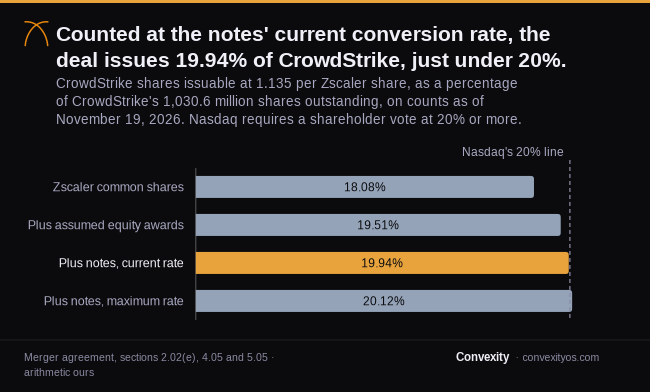
The counts will move before closing. CrowdStrike issues new shares to its employees every quarter, which raises the line, and Zscaler grants new awards, which raise the total. We also do not know how Nasdaq will count the awards and the notes. What the filing does show is a purchase worth about a fifth of CrowdStrike, built to stay on the side of the line where its board can approve it alone. CrowdStrike's owners will have their say the only way public shareholders can in a deal like this: through the share price, which is how they spoke on Monday.
What CrowdStrike is buying
Strip out the arithmetic and the strategy is easy to state, and both chief executives stated it on Monday.
CrowdStrike grew up on the endpoint: the laptops, servers and cloud workloads where its Falcon software watches for attackers. Zscaler grew up in the network, inspecting traffic in its own cloud on the way between users and the applications they use. The release says the deal takes CrowdStrike into network security, "cybersecurity's largest single addressable market segment," that it gives CrowdStrike a path to sell its platform to about 8,000 Zscaler customers, and that the two companies already share more than 2,000 customers and 16 product integrations.
Kurtz pitched the combination as a break from the hardware era. "This is not the world of network appliances," he said, arguing that secure access starts on the device rather than in a box in the data center. Chaudhry made the same point from the other side, saying that Zscaler has well over 55 million endpoint sensors already sending traffic to its cloud. And Kurtz named what he expects to do the selling: "the big unlock is Falcon Flex," CrowdStrike's flexible licensing program, through which the release says Zscaler's products will be sold.
Then Chaudhry went after the incumbents. "Firewalls are designed to protect servers," he said, and "firewall technology is 30 years old." Answering an analyst, Evercore's Peter Levine, who had asked how the combined company would compete with "the other platform vendors like Palo," Chaudhry recalled a customer who said: "I was sold a platform by a firewall vendor." The customer had found "eight separate products underneath with eight policy engines," and, as Chaudhry told it, one benefit: "I got an integrated invoice." Chaudhry himself named no vendor.
That exchange is the competitive center of the deal. Palo Alto Networks, which built its business on firewalls, has spent billions of dollars on acquisitions to assemble the one-vendor security platform its customers buy today. Our note on Palo Alto's latest quarter, published this morning, found that strategy working and expensive. Monday's deal is, in our reading, the strongest endorsement of the strategy so far, from a rival that intends to sell the same promise without the boxes.
Chaudhry, for his part, was not modest about the result. "When leaders come together, magic happens," he said, and in his closing remarks he called the combination "a watershed event that's changed cybersecurity forever."
The bar the synergies have to clear
The release promises two kinds of synergy. Revenue synergies are to build over the first 30 months after closing to about $1 billion of annualized run-rate revenue, mostly from selling each company's products to the other's customers. Cost synergies are to reach $500 million a year within 18 to 24 months, mainly from consolidating data center infrastructure, vendors and broader operations.
Chief financial officer Burt Podbere was careful about how much of the case rests on the first number. Asked how fast the combined company would grow, he said the two companies' growth rates are "not very far apart," so CrowdStrike is "not going to need a lot of revenue synergies" to lift the combined growth rate.
That claim is easy to check. CrowdStrike's ARR grew 27% in the year to October 31 and Zscaler's 21%. Combined, the two grew about 25% (our arithmetic), so on the day the deal closes, the merged company will be growing more slowly than CrowdStrike alone. That is why the release promises the deal will be accretive to revenue growth only "after synergies, within the first fiscal year after close." The gap is not large, but it is real: to have grown as fast as CrowdStrike's 27% over the past year, Zscaler would have needed about $190 million more ARR than it added (our arithmetic), nearly a fifth of the run rate the revenue synergies are meant to reach after 30 months. Chaudhry argued that Zscaler brings momentum rather than drag: "Zscaler net new ARR has been accelerating for the last couple of years."
The cost side matters more to the cash-flow case than it first appears. If all $500 million a year of savings reached free cash flow, which is a generous assumption, it would add about a fifth to the two companies' combined trailing free cash flow of $2.48 billion (our arithmetic). Kurtz called the combination "a home run and a generational opportunity," and he was also the one who said, of fitting Zscaler's technology into CrowdStrike's, that "there's hard work to be done."
What would prove us wrong
We are making three claims: that the deal's accretion comes from the gap between the two companies' valuations rather than from anything the combination does on day one; that its terms leave Zscaler's holders the price risk and most of the regulatory risk; and that the merged company starts out growing more slowly than CrowdStrike alone. Here is what would show each to be wrong.
- The market accepts the conversion. If CrowdStrike's shares close above their pre-announcement price of $229.44 on the day the deal closes, the market will have paid CrowdStrike's multiple for Zscaler's cash flow after all, and our reading of the accretion as a pricing effect will have understated what the combination is worth.
- The spread closes before the regulators rule. If Zscaler trades within 1% of the value of 1.135 CrowdStrike shares on March 31, 2027, before any antitrust clearance, the market will be saying the regulatory risk we describe is small.
- CrowdStrike accepts a remedy. If CrowdStrike agrees to sell a business or accept a material operating restriction to win approval, rather than using its right to walk away, its commitment to the deal is stronger than the contract required, and our account of where the risk sits is too harsh.
- The combined company grows as fast as CrowdStrike alone. If the combined company reports ARR growth of 27% or more for its first full fiscal year after closing, the growth gap we describe will have closed on schedule, and the synergy skepticism in this note will have been misplaced.
What this note is claiming, and what it is not
It is claiming that CrowdStrike is paying with a richly valued currency, that the 1.135 ratio and the contract around it leave Zscaler's holders most of the risk between now and closing, and that the issuance is built to stay under the 20% line that would otherwise have required CrowdStrike's shareholders to vote.
It is not claiming that the deal is good or bad for either set of shareholders, that regulators will object, or that either stock is cheap or expensive at Monday's prices. The 139 times multiple describes what investors were paying on Friday, not what they should pay.
Not investment advice. This note is an analysis of public company filings, the transcripts of CrowdStrike's November 23 call and public share prices, published for research purposes, and is not a recommendation to buy, sell or hold any security. A member of the Convexity team holds SPY, which holds CrowdStrike and Palo Alto Networks; no direct position in CrowdStrike, Zscaler or Palo Alto Networks, or in any other company named here.
What here is ours rather than the companies'. Deal terms come from CrowdStrike's November 23, 2026 Form 8-K and the merger agreement filed with it; results from the two companies' November 23 releases and their prior annual results; quotations from both public transcripts of the November 23 call; closing prices from the price histories cited below, checked against Nasdaq's official closes. Our arithmetic: market values and free-cash-flow multiples; trailing four-quarter free cash flow and revenue; Zscaler's shares of combined ARR, revenue and free cash flow; combined ARR growth; free cash flow per diluted share before and after the deal; the blended multiple; the share-cap totals, the trimmed ratio and its cash value; the November 23 price moves and market-value changes, the offer's value at that day's close and Zscaler's discount to it; the ARR Zscaler would have needed to grow at CrowdStrike's 27%; and the cost synergies as a share of combined free cash flow.
Primary sources
15 documents
- 018-KCrowdStrike to acquire Zscaler (Exhibit 99.1)The joint release: 1.135 CrowdStrike shares per Zscaler share, an enterprise value of about $43.9 billion and $260.41 per Zscaler share on the November 20 CrowdStrike close, 84.1% and 15.9% expected ownership, the revenue and cost synergy targets, the accretion language, and closing expected in the second half of CrowdStrike fiscal 2028Nov 23, 2026sec.gov
- 028-KAgreement and Plan of Merger among CrowdStrike, Neon Speedway and Zscaler (Exhibit 2.1)The Share Cap (section 2.02(e)); share counts as of November 19, 2026 (sections 4.05 and 5.05); the Burdensome Condition and the efforts covenant (section 8.01(c)); the closing conditions (section 9.01); the End Date and its extensions (section 10.01(b)(i)); and the $1.4 billion fee payable by Zscaler (section 11.04(b))Nov 22, 2026sec.gov
- 038-KCrowdStrike Form 8-K, Item 1.01The voting and support agreements covering about 34% of Zscaler common stock, and Jay Chaudhry joining the CrowdStrike board at closingNov 23, 2026sec.gov
- 048-KZscaler Form 8-K, Item 1.01Zscaler's own description of the merger agreement and the form of voting and support agreementNov 23, 2026sec.gov
- 058-KCrowdStrike reports third quarter fiscal year 2027 financial results (Exhibit 99.1)Q3 revenue of $1,583.4 million, ending ARR of $6.26 billion up 27%, free cash flow of $1,320.3 million for the nine months to October 31, 2026, and Q3 weighted-average diluted shares of 1,052.2 millionNov 23, 2026sec.gov
- 068-KCrowdStrike reports fourth quarter and fiscal year 2026 financial results (Exhibit 99.1)Free cash flow of $376.4 million for the quarter to January 31, 2026, the first of the four quarters to October 31, 2026Mar 3, 2026sec.gov
- 078-KZscaler announces first quarter fiscal year 2027 financial results (Exhibit 99.1)Q1 revenue of $949.3 million, ARR of $3,882 million up 21% from $3,204 million, free cash flow of $416.5 million against $413.3 million a year earlier, and the cancelled call and withdrawn guidanceNov 23, 2026sec.gov
- 0810-KZscaler annual report for fiscal year 2026Operating cash flow of $1,129.7 million less $277.3 million of property, equipment and other assets and $73.2 million of capitalized internal-use software, for the year to July 31, 2026Sep 3, 2026sec.gov
- 09RuleNasdaq Listing Rule 5635(a), acquisition of stock or assets of another companyShareholder approval required before issuing, in an acquisition, shares equal to 20% or more of the shares or voting power outstanding, counting shares issuable on conversion; retrieved 2026-11-23listingcenter.nasdaq.com
- 10CallCrowdStrike Q3 fiscal 2027 earnings and Zscaler acquisition call transcript (ROIC.ai)Kurtz, Chaudhry and chief financial officer Burt Podbere on the combination, the platform question and the synergy caseNov 23, 2026roic.ai
- 11CallCrowdStrike Q3 fiscal 2027 earnings and Zscaler acquisition call transcript (Investing.com)Second public transcript of the November 23, 2026 call, used to cross-verify every verbatim quotation and speaker attributionNov 23, 2026investing.com
- 12PricesStockAnalysis, CrowdStrike historical pricesClosing prices of $229.44 (Nov 20) and $208.97 (Nov 23, 2026); retrieved 2026-11-23Nov 23, 2026stockanalysis.com
- 13PricesStockAnalysis, Zscaler historical pricesClosing prices of $194.82 (Nov 20) and $229.24 (Nov 23, 2026); retrieved 2026-11-23Nov 23, 2026stockanalysis.com
- 14PricesStockAnalysis, Palo Alto Networks historical pricesClosing prices of $343.32 (Nov 20) and $353.43 (Nov 23, 2026); retrieved 2026-11-23Nov 23, 2026stockanalysis.com
- 15NoteConvexity: Palo Alto beat our call, then reached for its checkbookCompanion note on Palo Alto's first quarter of fiscal 2027, published the morning of this noteNov 24, 2026