





Disclosure. Not investment advice, and nothing here is a recommendation to buy, sell or hold any security. A member of the Convexity team holds the SPDR S&P 500 ETF (SPY), which holds Palo Alto Networks and CrowdStrike; no direct position in Palo Alto Networks, Applied Compute, CrowdStrike or Zscaler, or in any other company named here. Every reported figure comes from Palo Alto Networks' Q1 FY2027 earnings release and acquisition release (Form 8-K, November 18, 2026), its Form 10-Q (filed November 19, 2026), two public transcripts of its November 18 earnings call, CrowdStrike's November 23 Form 8-K on its agreement to acquire Zscaler and two public transcripts of that day's call, and historical closing prices. Quotations from Palo Alto's November 18 call and CrowdStrike's November 23 call appear verbatim in both transcripts of each call listed below; points carried differently between them are reported in our words. The closing note lists what is our arithmetic.
When a company beats the exact numbers you told readers to watch, the only honest way to open a follow-up is to say so in the first paragraph.
In September, our second note on Palo Alto Networks (PANW) argued that its headline 63% growth in Next-Generation Security annual recurring revenue was inflated by acquisitions, and that its own fiscal 2027 guidance of 22% to 23% was the real speed of the business. We wrote down two plain tests that would prove that reading too cautious: first-quarter recurring revenue beating management's $9.54 billion to $9.56 billion range materially, and underlying growth climbing back above 22% once the new fiscal year's segment reporting arrived.
On Wednesday, November 18, Palo Alto cleared both bars. Next-Generation Security ARR reached $9.73 billion, beating the top of its own range by $170 million (our arithmetic). Revenue rose 39% to $3,445 million. And in Note 18 of the Form 10-Q filed the next day, the company finally split CyberArk out into its own reporting segment, called Idira, showing $353 million of quarterly revenue and a 90.1% segment gross margin while core Network & AI Security grew 20%. Management raised its full-year revenue and recurring-revenue outlook to 26% to 27%.
Shares jumped 6.4% on Thursday, November 19, from $339.92 to $361.73. Then on Friday, November 20, they fell 5.1% to $343.32, giving back almost the entire post-earnings rally to finish just 1.0% above where they stood before the release (all our arithmetic on historical closes).
If you open the Form 10-Q and read past page one of the press release, that two-day round trip makes complete sense. Inside the same quarter that proved Palo Alto's security business is running well, two very different things happened. GAAP pre-tax profit collapsed 94% to $25 million, leaving a $457 million tax benefit to supply almost every dollar of reported GAAP net income. And on the exact afternoon Palo Alto finally gave shareholders clean numbers after absorbing CyberArk, management announced another $4.5 billion all-stock acquisition, buying an 18-month-old AI startup called Applied Compute and signing up to build more than 100 megawatts of data-center inference capacity.
You do not need an accounting background to see the tension here. Palo Alto just proved it can grow its core cybersecurity business faster than we expected. It also showed that it is not done issuing shares to chase the next frontier, and that the bill for doing so is getting larger, not smaller.
- $9.73B
- Next-Generation Security ARR, $170M above the top of Q1 guidance
- $353M
- first breakout quarter for Idira (CyberArk), at a 90.1% segment margin
- $457M
- income tax benefit supplying 95% of Q1's $482M GAAP net income
- $4.5B
- all-stock price for Applied Compute, on top of 838M diluted shares
First quarter of fiscal 2027, ended October 31, 2026, from Palo Alto Networks' Form 8-K (Nov 18, 2026) and Form 10-Q (Nov 19, 2026). The $170M beat over the top of the $9.56B guide and the 95% tax-benefit share are our arithmetic.
Grading our September call honestly
Before we look at the new deal or the tax line, it helps to score the exact falsifiers we published in September. Keeping score in public is what separates analysis from cheerleading or skepticism on autopilot, and it gives you a clean baseline for what actually changed in ninety days.
| What we said in September would prove us wrong | What Q1 FY2027 delivered | Grade |
|---|---|---|
| Q1 NGS ARR beats the $9.54B to $9.56B guide materially | Came in at $9.73B, adding ~$630M net new ARR vs. $440M to $460M guided (our arithmetic) | Fired |
| Underlying growth returns above 22% | Network & AI Security grew 20%; Cortex grew 40% pro forma; Idira grew 23% pro forma; full-year NGS ARR guide raised to 26% to 27% | Fired |
| Share count peaks near the 844M to 847M FY27 guide | Q1 landed at 838M GAAP / 837M non-GAAP, zero shares bought back, and $4.5B all-stock Applied Compute adds ~13M more shares in Q3 | Did not hold |
| GAAP operating income recovers as deal costs fade | GAAP operating income fell 69% YoY to $96M (2.8% margin), and $71M of that was a new Israeli government R&D credit | Did not hold |
| Adjusted free cash flow does the heavy lifting (38% FY27 guide) | Q1 hit $1.94B (56.2% margin), and FY27 held at 38%, though FY28+ language shifted to "excluding data center CapEx" | Mixed |
Read down that table and the real picture jumps off the page. On demand, our September warning was too conservative. Customers are buying faster than management's own initial fiscal 2027 plan assumed. On accounting quality and dilution, the concerns from August and September got sharper rather than fading away.
Both halves can be true at the same time. In fact, understanding how a strong operating business can sit beside weak GAAP earnings and rising share counts is one of the most useful habits you can build when reading any large software stock.
Inside the first real segment split
For two quarters after the CyberArk acquisition closed, outside investors had to subtract estimates by hand to figure out how much of Palo Alto's growth came from buying companies and how much came from selling more to its own customers. Beginning in fiscal 2027, chief executive Nikesh Arora reorganized the business into three reportable segments, and Note 18 of the November 19 Form 10-Q prints their revenue and gross profit side by side for the first time.
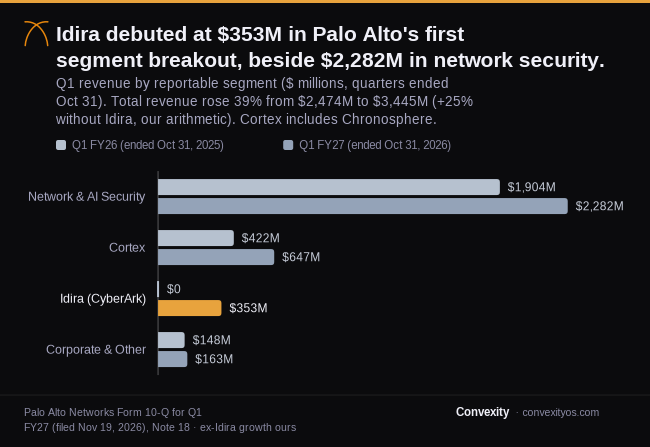
This is the first table you should pull up if you are reviewing Palo Alto's Financials lens in the terminal:
| Q1 FY26 (ended Oct 31, 2025) | Q1 FY27 (ended Oct 31, 2026) | |
|---|---|---|
| Network & AI Security | $1,904M | $2,282M |
| Cortex | $422M | $647M |
| Idira (CyberArk) | $0 | $353M |
| Corporate & Other | $148M | $163M |
Walk across those three operating pillars in plain English, because each tells a slightly different story about what you own when you buy a share of Palo Alto Networks.
Network & AI Security is the core business: hardware and software firewalls, cloud-delivered security subscriptions, secure remote access (SASE), and Prisma AIRS, the new suite built to monitor and protect enterprise AI apps and agents. Revenue grew 19.9% year over year to $2,282 million (our arithmetic on Note 18), up from $1,904 million. Segment gross profit was $1,818 million, a 79.7% margin, down from 81.9% a year ago as elevated hardware component costs weighed on physical firewalls. On the call, management reported that Prisma AIRS has reached nearly $170 million in annual recurring revenue in just five quarters, making it the fastest-growing product in the company's history, while SASE annual recurring revenue grew 30%. For a $9 billion-a-year core business to grow 20% cleanly without CyberArk inside it is genuinely impressive.
Cortex holds security operations (the automated software that spots and stops breaches) and observability (tools that watch whether a company's cloud systems are healthy). Reported revenue jumped 53.3% to $647 million from $422 million. Notice the plain-English catch in the 10-Q's management discussion: the filing states that Cortex's increase was "primarily driven by observability revenue from the Chronosphere, Inc acquisition." Even setting that aside, chief financial officer Dipak Golechha told analysts on the call that Cortex grew "40% year-over-year on a pro forma basis," meaning even if you treat the acquired business as if Palo Alto had already owned it a year earlier. Cortex's segment gross margin dipped to 67.5% from 71.6% (our arithmetic), which Golechha attributed to fast-growing cloud products still early in their margin curve and an ongoing customer migration from Prisma Cloud to Cortex Cloud.
Idira is CyberArk, the identity-security business that guards high-level logins and machine credentials. It contributed $353 million in Q1 revenue (compared with zero a year earlier, before the deal closed) and $318 million in segment gross profit, a 90.1% segment margin (our arithmetic). On the call, both Arora and Golechha said Idira revenue grew "23% year-over-year on a pro forma basis," that the joint sales force won more than 100 new Idira customers from Palo Alto's existing base in the quarter, and that Idira's operating margins are converging with the core business in roughly "half the time" originally planned.
There is one fourth row in Note 18 that most summaries skip, and you should never skip it: Corporate & Other. It brought in $163 million of revenue (mostly professional services and financing income) and booked $394 million of cost of revenue, for a gross loss of $231 million. Why is corporate cost of revenue suddenly $394 million, up from $174 million a year earlier? Because Palo Alto parks two very real expenses inside Corporate & Other instead of charging them to the three segments: employee stock-based compensation in cost of revenue, and the amortization of intangible assets bought in acquisitions ($185 million in cost of revenue alone in Q1, per the intangibles note, plus another $98 million in sales and marketing).
That single design choice explains why every operating segment can show a sparkling 68% to 90% gross margin while consolidated GAAP gross margin dropped 623 basis points in one year, from 74.2% down to 68.0% (our arithmetic). The three segments are genuinely healthy on a stand-alone product basis. Corporate & Other is where the purchase-accounting bill for assembling them lives.
The demand engine is real, and it is worth crediting
Before looking at the bottom line, give the commercial quarter full credit. None of the accounting caveats below mean customers stopped buying.
Remaining performance obligations (RPO), the total signed contract value Palo Alto has not yet recognized as revenue, grew 35% year over year to $21.0 billion. Note 2 of the Form 10-Q tells you how much arrives soon: approximately $9.4 billion, or 44.8% of the book (our arithmetic), is expected to turn into revenue over the next twelve months, up 36% from a year ago. Management noted on the call that average contract duration stayed flat, which matters because stretching out contract lengths is an easy way to inflate RPO without selling faster.
The consolidation pitch is also landing. Arora reported roughly 170 net new "platformizations" in the quarter, more than the prior two first quarters combined, with platformized customers now representing two-thirds of Next-Generation Security ARR and expanding their spending at a net retention rate above 120%. The headline deal in the quarter was an $83 million transaction with a global financial institution that consolidated network security alongside what Arora described as the largest identity deal in CyberArk's history.
On the call, Arora gave a concrete, non-technical explanation for why security budgets are moving faster right now: AI coding and agent tools are helping both defenders and attackers find software bugs far faster than human IT teams can patch them, creating a surge in demand for "virtual patching" (shielding vulnerable systems at the network layer until real software fixes can be safely tested and installed). Even if you discount half of a CEO's enthusiasm on an earnings call, $630 million of net new recurring revenue in a seasonally quiet fiscal first quarter is hard cash-backed demand.
That is why management raised full-year fiscal 2027 guidance across the board: revenue up to $14.52 billion to $14.57 billion (from $14.10 billion to $14.20 billion in September), Next-Generation Security ARR up to $11.475 billion to $11.525 billion (adding $2.38 billion to $2.43 billion for the year instead of $1.97 billion to $2.08 billion, our arithmetic), and non-GAAP diluted EPS up to $4.26 to $4.30 (from $4.16 to $4.19).
Now look at the other half of the same Form 10-Q.
How $25 million before taxes became $482 million after them
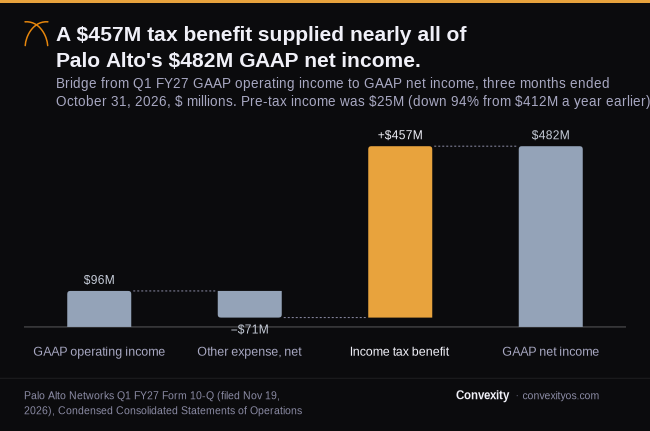
Open the income statement on page 2 of the Form 10-Q, or pull up GAAP Operating Income beside GAAP Net Income in Chart Studio. If you only read the press release bullet saying "GAAP net income for the fiscal first quarter 2027 was $482 million, or $0.57 per diluted share, compared with $334 million, or $0.47 per diluted share," you would walk away thinking GAAP profits jumped 44% right alongside revenue.
They did not. Follow the four lines from operating profit down to net income:
| Q1 FY27 GAAP bridge | |
|---|---|
| GAAP operating income | $96M |
| Other expense, net | −$71M |
| Income tax benefit | +$457M |
| GAAP net income | $482M |
Here is what happened on each step, translated into plain English:
- Operating income dropped 69%. Revenue climbed $971 million (+39.2%), yet GAAP operating income fell from $309 million down to $96 million. GAAP operating margin shrank from 12.5% to 2.8% (our arithmetic). Three costs ate the extra gross profit: employee stock-based compensation jumped 61% to $622 million (including payroll taxes), amortization of acquired intangible assets multiplied sevenfold from $39 million to $282 million, and acquisition-related costs rose to $55 million.
- A brand-new Israeli government grant propped up even that $96 million. Turn to Note 15 ("Government Grants") on page 20 of the Form 10-Q. In March 2026, Israel's Knesset Finance Committee passed a new refundable R&D tax credit law. Palo Alto elected to record that credit as a reduction to research and development expense, booking a $71 million benefit in Q1 FY27. Without that $71 million government credit, R&D would have been $869 million instead of $798 million, and GAAP operating income on $3.45 billion of revenue would have been just $25 million, a 0.7% operating margin (our arithmetic).
- Pre-tax profit fell 94%. Below the operating line, "other income (expense), net" swung from positive $103 million a year earlier to negative $71 million, weighed down by a $141 million fair-value charge on convertible senior notes and capped calls inherited from CyberArk. That left income before income taxes of just $25 million, down 93.9% from $412 million a year earlier (our arithmetic).
- A $457 million tax benefit turned $25 million into $482 million. Note 14 ("Income Taxes") explains why Palo Alto's effective tax rate printed at negative 1,828.0%. Recent court interpretations of the 2017 Tax Cuts and Jobs Act allowed Palo Alto to recognize a one-time $369 million discrete U.S. federal tax benefit tied to a historical transaction from its fiscal 2018 transition year, alongside excess tax benefits from employee stock awards. That single 2018 tax adjustment supplied 76.6% of the quarter's GAAP net income, and the total $457 million tax benefit supplied 94.8% of it (our arithmetic).
Notice how Palo Alto's non-GAAP reconciliation handles this. To be completely fair to management, Palo Alto stripped that huge one-time tax windfall out of its non-GAAP net income (backing out $705 million in tax adjustments) so it did not inflate non-GAAP EPS with a 2018 tax ruling. That is the right way to handle a one-off tax credit.
At the same time, look at what non-GAAP leaves out every single quarter: $622 million of stock-based compensation in three months, equal to 18.1% of total revenue (up from 15.6% a year ago) and running at nearly $2.5 billion a year annualized (our arithmetic). Note 12 of the 10-Q tells you how much more is already sitting in the pipeline: as of October 31, 2026, Palo Alto has $4.5 billion of unvested employee stock awards not yet recognized as expense, which will hit the income statement over the next 2.4 years, alongside 16 million unvested RSUs and up to 10 million unvested performance stock units.
And look at what rising share counts already did to Q1's non-GAAP results. Non-GAAP net income grew a brisk 33.1% year over year, from $662 million to $881 million. Non-GAAP earnings per share grew just 12.9%, from $0.93 to $1.05 (our arithmetic). More than half of the company's adjusted profit growth disappeared before it reached an individual share, because weighted-average diluted shares jumped 18.2% from 709 million to 837 million non-GAAP (838 million GAAP).
Meanwhile, Note 11 confirms Palo Alto bought back zero shares during the quarter ("We had no share repurchases in the quarter," Golechha confirmed on the call), even as the board extended the $1.0 billion remaining buyback authorization through December 2027.
The checkbook stayed open all quarter, then opened wider
If CyberArk had been the final big deal in a multi-year acquisition sprint, shareholders could treat the 129 million extra shares and $22.6 billion of goodwill (45.9% of total assets, or 59.9% when you add $6.9 billion of net intangibles, our arithmetic) as a one-time reset.
The Form 10-Q shows the checkbook never closed. Even before November 18, Note 7 records two more acquisitions closed inside Q1 alone: Embrace Mobile for $292 million on August 27 ($287 million in cash, plus $38 million in replacement stock awards) and Console for $393 million ($354 million of it booked directly to Cortex goodwill). Those two deals added $544 million of fresh goodwill to the balance sheet in ninety days.
Then came Exhibit 99.2 and Note 19 on Wednesday afternoon: a definitive agreement to acquire Applied Compute, Inc., a privately held AI post-training and inference startup founded roughly 18 months ago, for $4.5 billion paid entirely in Palo Alto stock, expected to close in the fiscal third quarter of 2027.
Pause on the plain-English math of that deal, using only figures management stated on the November 18 call and in the filing:
- The price tag: $4.5 billion in newly issued shares for a startup that has reached roughly $100 million in annualized revenue (about 45 times annualized revenue, or 40 times if you credit the roughly $500 million in cash and prepaid compute commitments Golechha said Applied Compute brings along, our arithmetic).
- The new dilution: Palo Alto's updated fiscal 2027 guidance explicitly excludes Applied Compute and already puts the diluted share count at 844 million to 847 million shares. At Palo Alto's closing price on November 18 ($339.92) or November 20 ($343.32), issuing $4.5 billion of stock adds roughly 13.1 million to 13.2 million more shares (our arithmetic), pushing the diluted count near 860 million before future employee stock grants vest.
- The margin drag: Golechha told analysts that assuming a Q3 FY27 close, Applied Compute will reduce operating margins by "up to 100 basis points" in fiscal 2027 and "up to 200 basis points" in fiscal 2028 before margins return toward 29% to 30% in fiscal 2029.
- The business-model shift: Until Wednesday, Palo Alto was a textbook capital-light software company. Capital expenditures in Q1 FY27 were just $87 million, or 2.5% of revenue (our arithmetic). To run Applied Compute's secure AI training and inference platform, management plans to build out more than 100 megawatts of global inference capacity over the next three to five years, requiring cumulative capital spending of up to $3 billion through fiscal 2030.
Now listen closely to one five-word phrase in Dipak Golechha's prepared remarks on the call, because it is the exact kind of detail you catch only when you read the transcript. Discussing long-term cash generation after Applied Compute, he said Palo Alto expects to maintain "38% plus margins excluding data center CapEx" in fiscal 2028 and beyond.
Hold onto those four words: excluding data center CapEx. Free cash flow exists to measure the cash left over after a company pays for the equipment required to run its business. If Palo Alto starts spending hundreds of millions of dollars a year on GPUs and server racks to host AI inference for customers, and then excludes that spending when reporting its headline free cash flow margin, the yardstick itself has moved. Calling a multi-billion-dollar GPU buildout a "capital-light approach" works only while the buildout stays small.
That is almost certainly why the stock gave back 5.1% on Friday after surging 6.4% on Thursday. Thursday rewarded the security beat. Friday started pricing in 13 million more shares, two years of margin dilution, and a software company stepping into the capital-intensive world of AI compute.
The strongest case for Palo Alto's bet
An honest note does not mock a bold strategic move just because it looks expensive on day one. Arora has been criticized on major deals before, including CyberArk, and Q1 just handed him real evidence that his consolidation strategy works when executed well.
His argument on the November 18 call is straightforward and worth reading on its own terms. Today, most enterprises are experimenting with closed frontier AI models, mostly for coding, with minimal security controls around the prompts and autonomous agents those models spawn. Arora believes enterprises will increasingly adopt open-weight AI models tuned on their own proprietary corporate data so they keep control inside their own walls, noting on the call that open-weight traffic has risen sharply over the past year.
In his view, static rule-based firewalls cannot police an autonomous AI agent; you need a supervisory AI model trained alongside the application model to know when it is misbehaving. Buying Applied Compute brings roughly 100 frontier AI researchers in-house (expected by year-end) and lets Palo Alto sell both secure model training and secure inference to its 70,000+ enterprise customers, targeting $1 billion in additional NGS ARR by fiscal 2029. If it hits $1 billion in recurring revenue inside three years, a $4.5 billion price tag stops looking stretched and starts looking like an early land grab.
Backing that ambition is an extraordinary cash machine. Palo Alto generated $1,929 million in GAAP operating cash flow and $1,842 million in unadjusted free cash flow in Q1 alone ($1,937 million adjusted, a 56.2% margin), and sits on $9.1 billion in cash, short-term investments, and long-term investments ($2,594 million cash, $461 million short-term, $6,080 million long-term) against $1,930 million of short-term convertible notes (all from the Q1 balance sheet). Even $3 billion of cumulative CapEx spread across four years really is roughly half of one year's annual free cash flow. Palo Alto is not stretching its balance sheet to take this swing; it is asking shareholders to fund the purchase price with stock and tolerate two years of lower operating margins while it builds.
On Monday, two rivals made Arora's argument
One development landed after this note was written. On Monday, November 23, CrowdStrike (CRWD) said it had agreed the day before to buy Zscaler (ZS) for 1.135 CrowdStrike shares per Zscaler share, an all-stock deal at an enterprise value of about $43.9 billion on CrowdStrike's Friday close and expected to close in the second half of CrowdStrike's fiscal 2028 (August 2027 to January 2028). CrowdStrike's release says the purchase takes it into network security, the market Palo Alto's largest segment sells into, and on the call CrowdStrike chief executive George Kurtz said that "overnight, we become the number one SASE and zero trust provider." Answering an analyst's question about "the other platform vendors like Palo," Zscaler founder Jay Chaudhry went after the word "platform" itself, recalling a customer "sold a platform by a firewall vendor" who found "eight separate products underneath with eight policy engines" and one benefit: "an integrated invoice." Chaudhry himself named no vendor. Our reading: the deal endorses the consolidation strategy Arora has spent billions on, and it hands the same one-platform promise to a rival that already meets Cortex in security operations and would now meet Palo Alto in secure remote access too. On Monday's official closes, Palo Alto's shares rose 2.9% to $353.43 from Friday's $343.32, CrowdStrike's fell 8.9% to $208.97, and Zscaler's rose 17.7% to $229.24, 3.3% below the $237.18 that 1.135 CrowdStrike shares were worth at that close (all our arithmetic). The deal still needs Zscaler's shareholders and regulators, so for the year this note covers, it is a rival on paper rather than in the field.
What this note is claiming, and what it is not
It is not claiming Palo Alto's core business is slowing down. Our September caution on Q1 ARR was wrong, the new segment split confirms real 20% growth in Network & AI Security alongside strong pro forma growth in Cortex (40%) and Idira (23%), and platformization wins accelerated sharply.
It is claiming two simpler things that any shareholder can track on their own screen over the next year:
- Headline GAAP profitability in Q1 was an illusion created by tax and grant accounting. Pre-tax operating profit was $25 million, not $482 million, and employee stock pay is now running at $2.5 billion a year before Applied Compute's research team arrives.
- Palo Alto has shifted from a pure software consolidator into a hybrid software-and-AI-compute builder, funded with equity. Paying 45 times annualized revenue in stock while buying back zero shares tells you management still prioritizes top-line scale and strategic scope over near-term per-share discipline.
What would prove this reading wrong
Just as our September note named the exact numbers that ended up refuting its caution on Q1 ARR, here are the concrete signs over the next four quarters that would prove this skepticism about Applied Compute and dilution wrong:
- Applied Compute scales toward $1 billion ARR on schedule. If Palo Alto breaks out Applied Compute's revenue or ARR after closing in Q3 FY27 and shows a credible ramp from $100 million toward $1 billion by fiscal 2029, the 45-times purchase price will look disciplined rather than expensive.
- Data-center CapEx stays genuinely modest and stays inside free cash flow. If total capital expenditures stay well under the $3 billion cumulative ceiling through fiscal 2030 and unadjusted GAAP operating cash flow minus total CapEx still clears 35% to 38% of revenue without excluding GPU spending, the "capital-light" label holds up.
- Share buybacks actually offset dilution. Palo Alto holds $9.1 billion in cash and investments and a $1.0 billion repurchase authorization extended to December 2027, yet repurchased zero shares in Q1. If management steps in to retire the ~13 million shares issued for Applied Compute once the deal closes, the per-share drag disappears.
- GAAP operating income recovers cleanly without one-time credits. If GAAP operating margin climbs back toward double digits over the next four to six quarters without relying on tax windfalls or government R&D credits, purchase accounting really was just a passing storm.
- Per-share EPS growth catches up to net-income growth. In Q1, non-GAAP net income grew 33% while non-GAAP EPS grew 13%. Once the CyberArk and Applied Compute share steps lap, a return to EPS growing in line with net income would close the dilution chapter for good.
Palo Alto reports its fiscal second quarter in late February 2027, guiding $3.53 billion to $3.55 billion in revenue, $10.20 billion to $10.22 billion in NGS ARR, and 837 million to 842 million diluted shares. The three lines to open first in the terminal next quarter are Idira's second stand-alone segment margin, GAAP operating income before tax and grant credits, and whether the share repurchase line finally moves off zero.
The filings, transcripts and prices this note is built on
13 documents
- 018-KPalo Alto Networks fiscal first quarter 2027 financial results (Exhibit 99.1)Q1 FY27 revenue ($3,445M), NGS ARR ($9.73B), RPO ($21.0B), GAAP operating income ($96M), pre-tax income ($25M), income tax benefit ($457M), GAAP net income ($482M), non-GAAP reconciliations ($622M SBC, $282M intangible amortization, $1,059M non-GAAP operating income, $881M non-GAAP net income, $1.05 non-GAAP EPS), free cash flow ($1,842M; adjusted $1,937M), and Q2/FY27 guidanceNov 18, 2026sec.gov
- 028-KPalo Alto Networks to acquire Applied Compute (Exhibit 99.2)$4.5 billion all-stock acquisition of Applied Compute, expected to close in Q3 FY27, targeting secure open-weight AI post-training and inferenceNov 18, 2026sec.gov
- 0310-QPalo Alto Networks quarterly report for the period ended October 31, 2026Note 2 RPO ($21.0B, $9.4B within 12 months); Note 7 Acquisitions (Embrace $292M, Console $393M) and goodwill ($22,559M); Note 11 zero Q1 share repurchases; Note 12 pure SBC ($606M), $4.5B unrecognized SBC over 2.4 years, 16M RSUs and 10M PSUs; Note 14 discrete $369M FY18 TCJA tax benefit and -1,828.0% effective tax rate; Note 15 $71M Israeli R&D government grant reducing R&D expense; Note 18 first three-segment revenue and gross profit breakout; Note 19 Applied Compute and repurchase extensionNov 19, 2026sec.gov
- 04CallPalo Alto Networks Q1 fiscal 2027 earnings call transcript (The Motley Fool)Arora on 170 net new platformizations, >120% net retention, Prisma AIRS (~$170M ARR), Applied Compute (~$100M annualized revenue, 100+ MW inference, $1B ARR target by FY29); Golechha on 40% Cortex and 23% Idira pro forma growth, >100 Idira cross-sell wins, zero buybacks, $500M Applied Compute cash/prepaid compute, <$3B cumulative CapEx through FY30, 100/200 bps operating margin impact, and 38%+ FCF margin excluding data center CapExNov 18, 2026fool.com
- 05CallPalo Alto Networks Q1 fiscal 2027 earnings call transcript (Stock Analysis)Second public transcript of the November 18, 2026 call, used to cross-verify every verbatim quotation and speaker attributionNov 18, 2026stockanalysis.com
- 068-KCrowdStrike to acquire Zscaler (Exhibit 99.1)Agreement signed November 22: 1.135 CrowdStrike shares per Zscaler share, an all-stock deal at an enterprise value of about $43.9 billion on the November 20 CrowdStrike close, entry into network security, and close expected in the second half of CrowdStrike fiscal 2028, subject to Zscaler shareholder and regulatory approvalNov 23, 2026sec.gov
- 07CallCrowdStrike Q3 fiscal 2027 earnings and Zscaler acquisition call transcript (ROIC.ai)Kurtz on becoming "the number one SASE and zero trust provider"; Evercore analyst Peter Levine on "the other platform vendors like Palo"; Chaudhry on the "firewall vendor" platform and its "integrated invoice"Nov 23, 2026roic.ai
- 08CallCrowdStrike Q3 fiscal 2027 earnings and Zscaler acquisition call transcript (Investing.com)Second public transcript of the November 23, 2026 call, used to cross-verify every verbatim quotation and speaker attributionNov 23, 2026investing.com
- 09PricesStockAnalysis, Palo Alto Networks historical pricesClosing prices of $339.92 (Nov 18), $361.73 (Nov 19), $343.32 (Nov 20) and $353.43 (Nov 23, 2026); retrieved 2026-11-23Nov 23, 2026stockanalysis.com
- 10PricesStockAnalysis, CrowdStrike historical pricesClosing prices of $229.44 (Nov 20) and $208.97 (Nov 23, 2026); retrieved 2026-11-23Nov 23, 2026stockanalysis.com
- 11PricesStockAnalysis, Zscaler historical pricesClosing prices of $194.82 (Nov 20) and $229.24 (Nov 23, 2026); retrieved 2026-11-23Nov 23, 2026stockanalysis.com
- 12NoteConvexity: Palo Alto guided its run rate in halfPrior note in this series setting the September falsifiers graded above ($9.54B to $9.56B Q1 NGS ARR guide, >22% underlying growth, and 844M to 847M share count)Sep 4, 2026
- 13NoteConvexity: Palo Alto is buying growth faster than it earns itFirst note in this series examining CyberArk acquisition accounting and diluted share growthSep 1, 2026
Not investment advice. This note is an analysis of public company filings and earnings calls, published for research purposes, and is not a recommendation to buy, sell or hold any security. A member of the Convexity team holds SPY, which holds Palo Alto Networks and CrowdStrike; no direct position in Palo Alto Networks, Applied Compute, CrowdStrike or Zscaler, or in any other company named here.
What here is ours rather than Palo Alto's. Every reported revenue, ARR, RPO, segment, GAAP, non-GAAP, cash flow, balance sheet, tax, grant, equity-award, acquisition and guidance figure comes from the November 18 Form 8-K, November 19 Form 10-Q and November 18 earnings call transcripts cited above. The CrowdStrike and Zscaler deal terms come from CrowdStrike's November 23 Form 8-K, and the quotations from that day's call appear verbatim in both of its transcripts. Derived by our arithmetic on those filings: the $170 million Q1 NGS ARR beat over the top of the $9.56 billion guide and ~$630 million net new Q1 ARR ($9.73B minus $9.10B Q4 close); the $2.38 billion to $2.43 billion of implied full-year net new NGS ARR under the raised guide; the two-day share price moves (+6.4% on Nov 19, -5.1% on Nov 20, +1.0% net from Nov 18 to Nov 20); revenue excluding Idira ($3,092M, +25.0% YoY); segment growth rates (Network & AI Security +19.9%, Cortex +53.3%) and segment gross margins (Network 79.7%, Cortex 67.5%, Idira 90.1%); consolidated GAAP gross margin of 68.0% vs. 74.2% (-623 bps); GAAP operating income decline (-68.9%), operating margin (2.8% vs. 12.5%), and operating income without the $71M Israeli R&D grant ($25M, 0.7% margin); pre-tax income decline (-93.9%); the tax benefit's 94.8% share of GAAP net income and the discrete 2018 TCJA adjustment's 76.6% share; stock-based compensation as 18.1% of revenue ($2.49B annualized); the 18.2% GAAP diluted share increase (+129M shares) and the spread between non-GAAP net income growth (+33.1%) and non-GAAP EPS growth (+12.9%); goodwill (45.9%) and goodwill plus intangibles (59.9%) as shares of total assets; Q1 CapEx as 2.5% of revenue; Current RPO as 44.8% of total RPO; cash and investments totaling $9.1 billion; Applied Compute's ~45x gross (~40x net of $500M cash and prepaid compute) revenue multiple and ~13.1M to 13.2M implied new shares at November 18 to 20 closing prices; the November 23 share price moves for PANW, CRWD and ZS, the value of 1.135 CrowdStrike shares at that day's close and Zscaler's discount to it, and the calendar months of the second half of CrowdStrike's fiscal 2028.