








Disclosure. Not investment advice, and nothing here is a recommendation to buy, sell or subscribe to any security. This note is a reading of one document, the September 8 amendment to Holtec Nuclear Corporation's registration statement, which is public and linked at the bottom. We hold no position in Holtec, which is not yet listed, and no position in any underwriter or counterparty named. We have not spoken to the company. Every figure below is either quoted from the filing or is our arithmetic on figures in it, and the closing note separates the two line by line. The deal had not priced as of the evening of September 20, so a reader should check whether the terms described here are still the terms on offer.
Correction and update, October 7, 2026. This note was published after the offering had been suspended, and it did not say so. Holtec postponed the IPO on September 16, Reuters reported it that night, and the company published its own statement on September 17; we had checked EDGAR, where nothing had been filed, and not the deal calendar or the company newsroom. On September 25 Holtec asked the SEC to withdraw the registration statement because it "no longer wishes to conduct a public offering of securities at this time." The reading of the filing below is unchanged: the operating losses, the investment returns behind the profits and the absence of any binding reactor order are in the document whether or not the shares are offered. What the withdrawal costs the company, from the same filing, is in Holtec needed its IPO far more than Oura did.
Holtec Nuclear Corporation wants to sell you fifty million shares at fifteen to eighteen dollars, and the reason to want them is a number on page one: a "global opportunity pipeline of approximately 47 GW of potential capacity."
Forty-seven gigawatts is a very large number. For scale, it is roughly half the entire operating nuclear fleet of the United States. It is the number the offering is built around, and it is the number that makes a company with $270 million of half-year revenue look like an energy major in waiting.
The filing then tells you, in its own words, what the 47 gigawatts consists of. It is worth reading slowly, because the company does the work for you:
approximately 2 GW in respect of ongoing offtake discussions, approximately 13 GW related to identified sites under development, approximately 8 GW related to identified sites for which development activities had not yet commenced, approximately 5 GW related to projects that had received letters of support for our DOE Tier 1 proposal expressing interest in follow-on projects and approximately 19 GW related to projects for which we had signed non-binding memoranda of understanding
Two plus thirteen plus eight plus five plus nineteen is forty-seven. Every gigawatt is accounted for, and not one of the five buckets is an order.
The firmest category, at 2 GW, is "ongoing offtake discussions." The largest, at 19 GW, is explicitly non-binding. Eight gigawatts are sites where "development activities had not yet commenced." And separately, in a different section, the company states the position directly: it has "not entered into any binding agreements with respect to the construction of our SMR-300s or agreed to any delivery timelines."
Pipeline figures quoted from the S-1/A No. 2 filed September 8, 2026. The zero-orders characterization is ours, from the filing's own five-way breakdown and its statement that no binding construction agreements exist. The 76% is our arithmetic on the filing's income statement.
What the pipeline is not
None of this makes Holtec unusual, and it is important to say so before anything else. Pre-revenue reactor developers market pipelines because pipelines are what they have. A memorandum of understanding is a real thing: it costs both sides time and signals genuine interest, and some fraction of them convert. Nobody building a first-of-a-kind reactor has a backlog of firm orders, because nobody buys a reactor that has not been licensed.
The objection is narrower and it is about the arithmetic being invited. Forty-seven gigawatts, stated in the same units and the same sentence structure that a utility would use for operating plant, reads as capacity. It is not capacity. It is a count of conversations, weighted by the size of the plant that each conversation would build if it happened.
The company's own conversion estimate is in the filing and it is worth more than the headline: "of the 47 GW, we expect to deliver 27 GW in installed capacity by 2040." That is management's number, not ours, and it implies they expect to lose 20 GW of the pipeline. It is also fourteen years out, which is long enough that the estimate is a statement of ambition rather than a forecast anyone can be held to.
What would make the 47 GW mean something is a single binding order with a delivery date. The filing says there is not one.
The reactor has not been built
The SMR-300 is the product. Its status in the filing is unambiguous and the company does not hide it: the design "has not been commercially deployed to date and remains subject to regulatory approval, project financing, construction and successful commercialization."
The regulatory path is early. Holtec submitted Part I of its construction permit application for Pioneer One on December 31, 2025, and asked the Nuclear Regulatory Commission to review it within twelve months. A construction permit is not an operating licence; it is permission to start building. The company's stated target is to secure it in 2029.
The one hyperscaler relationship in the document, which is the kind of counterparty that would make this a different story, is a framework agreement that "memorializes the parties' intent to reach a definitive agreement" for up to 680 megawatts. An agreement to intend to agree is a real commercial artifact and it is not a contract. It is in the prospectus because it is the best evidence available, which tells you what the rest looks like.
So the SMR business, the thing the valuation rests on, consists today of a design awaiting a construction permit, a pipeline of conversations, and an intent to reach a definitive agreement. That is a perfectly normal position for a company at this stage. It is not a normal position for a company asking public markets to fund it at scale, and the distance between those two sentences is the entire question a buyer has to answer.
Where the money actually comes from
The reactor business has no revenue. The business that does have revenue is nuclear decommissioning: Holtec takes over retired plants, manages the spent fuel, dismantles the site, and manages the trust funds that were set aside to pay for it. That business is real, it is large, and it is profitable in a way the income statement repays reading carefully.
Here is the first half of 2026, in thousands, exactly as filed.
Revenues of $269,879. Direct operating costs of $151,422, leaving gross operating profit of $118,457. Total operating expenses of $147,898.
Subtract the second from the first and operations lost $29,441.
The filing does not stop there, and neither should we, because the next line is a credit: an "asset retirement obligation settlement and measurement gain" of $88,666. That is the accounting entry recognized when the estimated cost of a future decommissioning obligation is revised downward or settled for less than accrued. Add it and income from operations becomes the $59,225 the filing reports. The arithmetic ties exactly, and the gain is disclosed on its own line, which is to the company's credit.
Then comes other income of $188,714, and pre-tax income of $247,939.
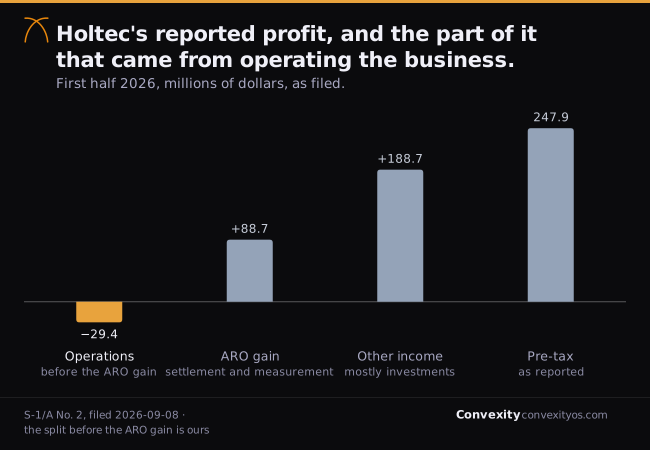
So of $247.9 million of pre-tax income in the half, $188.7 million, or 76%, was not operating income at all. Break the other income open and it is investments: $202.2 million of realized gains, less $44.0 million of unrealized losses, plus $34.8 million of interest and investment income. Those three lines come to $193.0 million, which is 78% of pre-tax income on their own.
This is not a one-period artifact. Run the same subtraction across every historical period the filing presents:
| Period | Operations before the ARO gain | Other income as a share of pre-tax |
|---|---|---|
| 1H 2026 | -$29.4m | 76% |
| 1H 2025 | -$28.0m | 92% |
| FY 2025 | -$21.1m | 92% |
| FY 2024 | +$113.3m | 57% |
Three of the four historical periods show operations losing money before the asset-retirement credit. In the first half of 2025 and the full year 2025, other income was more than nine tenths of pre-tax profit.
None of this is concealed. Every figure above is on the face of the income statement, and the ARO gain has its own labelled line. But it does change what the headline numbers describe. The filing reports an EBITDA margin of 112% for the half, which is a striking figure precisely because it is impossible for an operating business: EBITDA exceeds revenue only when the earnings are coming from somewhere other than selling things. That is the correct reading, and it is the disclosed one.
The company in the audit is not the company on offer
Here is the part that took the longest to understand and matters most.
The audited financial statements in this prospectus describe a group that includes the decommissioning sites and, critically, the trust funds whose investment returns produce the other income above. Those assets are being moved.
The transaction is called the NAMCO Restructuring. Phase I has already happened: decommissioning assets and associated liabilities were transferred to DEAMCO, which the filing defines as "Decommissioning Asset Management Company, LLC, a wholly owned subsidiary of Holtec Holdings." Holtec Holdings is the parent, the entity that will control 99.0% of the voting power after the offering. It is not the company being listed.
Phase II follows, "subject to receipt of required NRC and certain other regulatory approvals, which may occur after the closing of this offering," and upon its completion the company intends "to deconsolidate DEAMCO and its subsidiaries from the consolidated financial statements of Holtec Nuclear."
And then the sentence that governs everything above: "Our consolidated financial statements included in this prospectus do not give effect to the NAMCO Restructuring."
The pro forma statements do. Comparing them against the audited ones for the same half year is the most informative thing in the document:
| First half 2026 | As filed | Pro forma | Change |
|---|---|---|---|
| Revenues | $269.9m | $488.4m | +81% |
| Income from operations | $59.2m | $104.7m | +77% |
| Asset retirement gain | $88.7m | $1.6m | -98% |
| Net other income | $188.7m | $42.0m | -78% |
| Income before taxes | $247.9m | $146.8m | -41% |
| EBITDA margin | 112.0% | 41.1% |
Read that table in the company's favour first, because it deserves it. The pro forma business has nearly double the revenue and a genuinely profitable operating line: $103.1 million before the asset-retirement credit, against a $29.4 million loss on the audited basis. On the numbers that describe actually selling things to customers, the pro forma company is the better business by a wide margin.
But it earns 41% less pre-tax, because the investment returns and the accounting gains that carried the audited statements go with the assets that are leaving. The 112% EBITDA margin belongs to a group that is being taken apart. A buyer reading the audited history to understand what they are purchasing is reading about a different company, and the prospectus says so in a sentence most readers will skim past.
After Phase II, Holtec expects "to continue to generate decommissioning services revenues pursuant to a contractual services arrangement with DEAMCO." That is the shape of the future: a service provider to an entity owned by its own controlling shareholder, rather than the owner of the sites and the trusts.
The backlog is real, and it is very slow
Against the 47 gigawatts of pipeline sits something firmer, and it is the strongest asset in the document. Holtec reports backlog, which it defines as "the dollar amount of revenue we expect to recognize in the future from signed contracts with customers." Signed contracts, not conversations. This is the real thing.
There are two pools. The decommissioning segment carries $10,566,625 thousand. Palisades carries $10,218,690 thousand. Together, a little over $20.8 billion of contracted future revenue at a company doing $270 million of revenue in a half year. On its face that is an extraordinary ratio, and it is the number that ought to anchor a valuation far more than the pipeline does.
Then read the maturity split, which the filing gives on the next line of the same table.
Of the decommissioning backlog, $391,294 thousand is "expected to earn over next 12 months." Of the Palisades backlog, $183,211 thousand. Together that is $574.5 million of the $20.8 billion, which is 2.8%. The remaining 97.2% falls beyond the next twelve months.
That is not a criticism, it is the nature of the business. Decommissioning a nuclear plant takes decades by design, and a fixed-price power purchase agreement runs for as long as the plant runs. A backlog of this shape is what a company doing genuinely long-dated work should report, and the transparency of the twelve-month split is a point in the filing's favour: many companies report a single backlog number and leave you to guess.
But it does mean the $20.8 billion is not a near-term earnings pool, and it interacts with the restructuring in a way worth holding in mind. Roughly half of that backlog is the decommissioning segment whose assets are moving to DEAMCO, and the other half is Palisades power revenue that, in the filing's own words, has not started: "historical results of operations do not reflect revenue from sales of power from Palisades."
Who controls this, and where the money goes
Two structural facts a buyer of Class A stock is agreeing to.
The first is control, and it is close to absolute. Holtec Holdings will "directly or indirectly control 516,666,667 shares of our common stock, which represents approximately 99.0% of the voting power with respect to director elections." That is the Class B mechanism doing its work: ten votes a share and no economics. Public holders supply capital and elect essentially nobody.
The company qualifies as a "controlled company" under the Nasdaq listing standards as a result, which permits it to opt out of independent-majority board and independent-committee requirements. Its stated position is measured and worth quoting rather than paraphrasing: "we do not intend to take advantage of exemptions from certain corporate governance requirements but may elect to do so in the future for as long as we remain a controlled company." That is a present intention and not a commitment, and the filing does not pretend otherwise. Holtec is separately an "emerging growth company," which carries its own reduced reporting obligations.
The second fact is the flow of the money, and it is the one most likely to be skimmed. The proceeds are not simply retained by the company you are buying. The filing says the net proceeds will be used to "(i) purchase Class A Interests from Holtec International at a per interest purchase price equal to the per share price paid by the underwriters" and "(ii) cause Holtec International to use the net proceeds for general corporate purposes, which may include accelerating SMR-300 licensing, deployment and manufacturing capacity."
So the listed entity buys interests in the operating parent, and the parent spends the cash. That is a common holding-company structure and it is disclosed plainly. It is also worth understanding precisely: the discretion over the money sits at Holtec International, and the filing adds that "management, guided by our board of directors, will have broad discretion in the application of such net proceeds," on a board that 99.0% of the voting power elects.
At the $16.50 midpoint the offering raises net proceeds the filing puts at $893.1 million with the underwriters' option exercised in full.
Four smaller things worth knowing
The customers are concentrated and getting more so. One customer was about 10.1% of consolidated revenue in 2025. Two customers were about 38% in the first half of 2026. As of June 30, 2026, three customers in the decommissioning segment were about 49% of accounts receivable.
The related-party borrowing is expensive. Holtec had borrowed $175.0 million under a 2025 related-party agreement as of July 2026. A 2026 agreement allows up to $150.0 million more, of which $60.0 million was drawn in July 2026, and its principal "bears interest at a fixed rate of one percent (1.00%) per month." Twelve percent a year, simple, from an affiliated lender, at a company weeks from a public listing.
The government money is conditional. The $1.52 billion Department of Energy loan guarantee is real and drawn against. The $400 million grant for Pioneer One and Pioneer Two is "subject to certain conditions, including the negotiation and execution of a funding agreement," which is to say it is not yet a funding agreement.
Palisades is not in the numbers. The filing states plainly that "historical results of operations do not reflect revenue from sales of power from Palisades," so the restart "is expected to affect the comparability of our financial results between periods." The roughly $10.2 billion of Palisades backlog is fixed-price power purchase revenue that has not yet begun.
Where the first reactors would actually go
One sentence ties the two halves of this note together, and it is easy to read past.
Describing where the SMR-300 fleet begins, the filing says: "At Palisades and on the sites owned by DEAMCO following the NAMCO restructuring, we currently expect to deploy at least 6 GW, subject to regulatory approvals and other development, financing, commercial and construction milestones."
Six gigawatts is the nearest-term, most concrete slice of the whole reactor ambition, and it is nearly a quarter of the 27 GW the company expects to have installed by 2040. Its location is Palisades plus "the sites owned by DEAMCO."
DEAMCO, again, is the wholly owned subsidiary of the parent. So the most advanced part of the reactor plan is expected to be built partly on land that the restructuring moves out of the listed company and into an entity controlled by the same shareholder who will hold 99.0% of the votes.
That is not necessarily adverse. Keeping decommissioning liabilities away from a growth business while retaining access to the sites may be exactly the right structure, and the company expects to "collaborate with DEAMCO to pursue future development opportunities at these sites, including the potential deployment of our SMR-300 reactors." But it means the relationship between the listed company and its parent is not a governance footnote. It is where the reactors go, who owns the ground they stand on, and what the listed entity will have to pay for access to it. None of those terms are in this document.
What would prove this wrong
Four things, and the first would change the piece entirely.
A binding order appears. The central claim here is that 47 gigawatts contains no orders. One signed construction contract with a delivery date, disclosed in a pricing amendment or after listing, and the pipeline becomes something qualitatively different. The Pioneer Framework Agreement converting from an intent into a definitive agreement would be the most likely form, and the most consequential.
The operating losses are a decommissioning-cycle artifact. Decommissioning revenue is lumpy by nature: work is recognized against multi-year contracts and costs do not arrive evenly. Three consecutive loss-making periods before the asset-retirement credit may be the trough of a cycle rather than a run rate, and the pro forma line argues for exactly that reading, since it shows the restructured group comfortably profitable on operations. If the next two reported periods show the pro forma operating margin holding, this note over-weighted the audited history.
The restructuring is neutral or good for public holders. We have described the NAMCO Restructuring as moving profitable assets to the parent, which is what it does mechanically. It may also be what makes the public company investable, by separating a long-tail nuclear liability from the growth business a buyer actually wants. We have not seen the consideration paid, the services agreement's terms, or the fairness analysis, and any of the three could make the transaction plainly reasonable. We are describing what the numbers do, not what the board concluded.
The pipeline converts anyway. Nothing here argues the SMR-300 will fail. Reactors get ordered after they get licensed, not before, so a pipeline of conversations is the correct asset for a company at this stage to hold. If the NRC permit lands in 2029 as targeted and the memoranda convert at anything like the company's own 27 of 47 gigawatt estimate, the 47 GW headline will read as conservative in hindsight and this note will read as having mistaken an early-stage company for a misleading one.
What would not prove this wrong is the stock trading well. The claim is about what the document says, not about what the offering does.
Primary sources
- S-1/AHoltec Nuclear Corporation, Amendment No. 2 to Form S-1The single source for every quotation and every figure in this note. The offering terms and the $15.00 to $18.00 range; the 47 GW pipeline and its five-way breakdown; the 27 GW by 2040 expectation; the statement that no binding SMR-300 construction agreements or delivery timelines exist; the Pioneer Framework Agreement as an intent to reach a definitive agreement; the December 31, 2025 construction permit application; the selected financial data table carrying revenues, direct operating costs, operating expenses, the asset retirement obligation settlement and measurement gain, income from operations, the other income components, pre-tax income and EBITDA for four historical periods and two pro forma ones; the definition of DEAMCO as a wholly owned subsidiary of Holtec Holdings; NAMCO Restructuring Phases I and II and the deconsolidation intent; the statement that the consolidated financial statements do not give effect to the restructuring; the customer concentration disclosures; the 2025 and 2026 related-party agreements and the one percent per month rate; the $1.52 billion DOE loan guarantee and the conditional $400 million grant; and the Palisades comparability statementFiled Sep 8, 2026
- DataHoltec Nuclear Corporation EDGAR filing history, CIK 0002104277Used to establish that the September 8 amendment is still the operative document and that no pricing amendment or final prospectus had been filed as of the evening of September 20, thirteen days after the price range became public. The ticker HNUC is reserved and no exchange is recordedRetrieved Sep 20, 2026
Not investment advice. This is a reading of one public filing, published for research purposes. It is not a recommendation to buy, sell or subscribe to any security, it is not a valuation, and it is not a price target. Anyone acting on any of it should read the prospectus themselves, which is linked above. We hold no position in Holtec, which is not listed and withdrew its registration statement on September 25, 2026.
Correction. This note published on September 21 as if the offering were still in the market. It had been suspended the week before, which the note should have said; the correction is at the top of the note and does not change any figure in it.
What here is ours rather than Holtec's. Every quotation is verbatim from the September 8 amendment and was checked against the filed document rather than against any summary of it. As filed, and not ours: all six columns of the selected financial data, the five-way pipeline breakdown, the 27 GW by 2040 expectation, the EBITDA figures and margins, the customer concentration percentages, the related-party balances and the one percent monthly rate, and every quoted sentence. Ours: the observation that none of the five pipeline buckets is a binding order; the subtraction of total operating expenses from gross operating profit to show operations before the asset retirement credit, and the resulting figures of minus $29.4 million, minus $28.0 million, minus $21.1 million and plus $113.3 million; the share of pre-tax income represented by other income in each period; the grouping of realized gains, unrealized losses and investment income into a single investment-returns figure; the as-filed against pro forma comparison table and its percentage changes; and the characterization of the NAMCO Restructuring as moving assets toward the parent. Every one of those derived figures was recomputed from the filing's own numbers and ties to the totals it reports.
What we could not establish. We did not see the consideration paid for the DEAMCO transfer, the terms of the post-restructuring services arrangement, or any fairness opinion, and we did not speak to the company. The deal had not priced as of the evening of September 20, 2026, so terms may have changed since publication.