Disclosure. Not investment advice, and nothing here is a recommendation to buy, sell or subscribe to any security. Holtec Nuclear, Oura, SB Energy and Motive are not listed, and we hold no position in any of them. Three relationships bear on this note. A member of the Convexity team holds an economic interest in Anthropic, which this note discusses, through a special-purpose vehicle and a fund, and stands to benefit if its valuation rises, so on Anthropic we are not neutral. Convexity's product runs on Anthropic's models. And this note was researched and drafted with Claude, Anthropic's model. A team member also holds the SPDR S&P 500 ETF (SPY), which holds Nvidia, Amazon, Eli Lilly, Goldman Sachs, Morgan Stanley, JPMorgan Chase and Robinhood, all named below; no other position. Every figure is from a filing linked at the bottom or is our arithmetic on one, and the closing note lists which is which. This note also corrects our September 21 note on Holtec, which published after the offering had been suspended and did not say so.
On September 25, Holtec Nuclear Corporation sent the Securities and Exchange Commission a two-page letter asking to withdraw the registration statement for its initial public offering. "The Company is seeking withdrawal of the Registration Statement because it no longer wishes to conduct a public offering of securities at this time," it reads, and it asks that the fees it had already paid be credited "for future use." The offering itself had been suspended more than a week earlier. Four days after the letter, Oura, the smart-ring company, postponed an offering of fifty million shares on the day it was due to price.
They were two of the largest offerings to stop in a month in which, on our count of SEC filings, more companies withdrew an IPO registration than filed a final prospectus. Dated one way, that had last happened in May 2023; dated another, it had happened once already this year, in February. The Federal Reserve had raised its target range on September 16 for the first time since 2023, and the reading that suggests itself is a single event: money got dearer, the window shut, the deals stopped.
The filings of the two companies say something more specific. Their offerings were for different people. Holtec's would have handed the company $775.2 million, and its balance sheet needed every dollar: on June 30 it held $27.4 million of cash, working capital was negative by $225.3 million, and in July it borrowed from its founder's family office at one percent a month. Oura's would have raised $2.1 billion, of which, once employees' tax bill on newly vested stock was paid, $6.2 million was left for Oura. Most of the rest belonged to venture investors selling out, one of them entirely.
A shut window is a delay for one of those companies and a problem for the other. That distinction matters beyond these two, because the issuer next in line, SB Energy, has a filing with a deadline written into it.
Count ours, from SEC EDGAR's full index. Oura S-1/A of September 21 and Holtec S-1/A of September 8, 2026; the Oura remainder is our arithmetic on two filed figures. SB Energy share purchase agreement, Exhibit 10.28 to its S-1 of September 1, 2026.
September, counted
There is no official tally of withdrawn IPOs, and the private ones (Renaissance Capital's is the best known) count deals above a size threshold. We wanted a count that anyone could rebuild from the SEC's own records, so we built one from EDGAR's quarterly full index, which lists every filing with its filer, its form type and its date.
The rule is written in form types because that is all the index carries. A company enters the count with its first S-1, F-1 or S-11 registration statement. It counts as priced in the month of its first final prospectus after that (a 424B4, or a 424B1), and as withdrawn in the month of its first Form RW if no final prospectus came first. Companies that were already filing annual or quarterly reports before they registered are excluded, since they are not making a first offering, and so, by name, are blank-check companies, trusts, funds and insurers registering annuity products. The index runs from 2018, so every company in the count has years of filing history behind it.
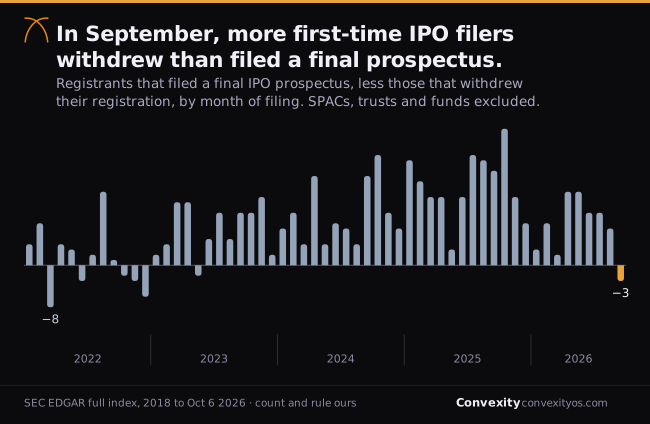
September 2026 had seven companies file a final prospectus and ten withdraw. Dated this way, every month from June 2023 to August 2026, thirty-nine in a row, had more of the former, and the last months to run the other way belong to the drought that followed the 2021 boom: five months of 2022, and May 2023.
That run depends on the date we use, and we should say so before anyone leans on it. A final prospectus is filed a day or two after an offering prices, so a deal priced on the last days of a month counts in the next: Accelevation priced on September 29 and counts in October. The other natural date is the SEC's notice that a registration has become effective, which for an underwritten offering is the pricing day. Dated by those notices, September still runs below zero, eight against ten, but so does February 2026, six against thirteen, because many offerings that went effective in January filed their prospectuses in February. So the honest version of the claim is narrower than a headline would like: September was below zero on every count we ran, and whether it was the first such month in three years depends on which date you think an offering happens on.
A count of filers is crude, and it is worth saying how before leaning on it. It weighs a $5 million listing the same as an $825 million one. It cannot see an offering pulled from the calendar without a filing, which is what Oura did, so Oura appears in neither column. Two of September's seven final prospectuses raised no cash at all: Verdera Energy's distributes shares that enCore Energy already owned to enCore's own shareholders, and ROZE AI's registers resales in a direct listing. On the other side, Glow Holdings withdrew its registration and filed a new one the same day, which is a refiling rather than a retreat. Take out Glow and September still reads seven against nine; take out the two listings that raised nothing as well and it reads five against nine. The month is below zero however it is cut.
The count is also sensitive to how far back the history runs, which we checked rather than assumed. Starting the index in 2020 instead of 2018 moves May 2023 from just below zero to exactly zero, and September 2026 from minus three to minus four. The card claims only what holds under every version: in September, more first-time filers withdrew than filed a final prospectus.
The window was not shut to everyone, but the terms it opened on are informative. Two late-stage biotech companies priced: ADARx Pharmaceuticals sold 26,250,000 shares at $17.00, the top of its range, and Electra Therapeutics 23,333,334 at $15.00, the midpoint. Orion180, a specialty homeowners insurer, sold 20,000,000 at $12.00, three dollars below the bottom of a $15 to $17 range. And on September 29 Accelevation Holdings, which designs, builds and installs power distribution equipment for data centers and reported 147% revenue growth from 2024 to 2025, sold 30,000,000 shares at $18.00, two dollars below its range, two thirds of them from existing holders. A supplier with revenue and a $1.1 billion backlog could still sell stock into the AI buildout in the same fortnight that a reactor developer with no binding reactor orders could not, but it sold at a discount to its own expectations.
What went the other way included Motive Technologies, whose S-1 had been public since December 23, 2025, and which told the SEC on September 10 that it had "determined not to proceed with the proposed initial public offering of the securities contemplated by the Registration Statement at this time." The same day it announced more than $1.3 billion of growth financing from General Catalyst, and said that "given this financing" it had withdrawn the registration. Motive did not need the window because it had found the money elsewhere, which makes it the cleanest example in the month of an issuer for which the public offering was a choice. Most of the other withdrawals were small issuers, several of them foreign. And then there was Holtec.
What Holtec's offering was for
Holtec offered 50,000,000 new shares at $15.00 to $18.00. At the $16.50 midpoint the company expected "approximately $775.2 million of net proceeds," and all of it would have gone to the operating company: the listed entity would "purchase 50,000,000 Class A Interests from Holtec International" and cause it to "use the net proceeds for general corporate purposes, which may include accelerating SMR-300 licensing, deployment and manufacturing capacity." No shareholder was selling. Every dollar was for the business.
The business needed it. Holtec International's condensed balance sheet at June 30, 2026, in the amendment filed September 8, shows cash and cash equivalents of $27.4 million, down from $106.3 million at the end of 2024, against $168.0 million of revolving credit borrowings classified as current. Working capital was negative $225.3 million. The prospectus's own pro forma column shows what the offering would have done to that: cash of $802.7 million and working capital of positive $625.0 million, with the entire difference in cash being the $775.2 million of proceeds. The offering was not a growth round layered on a sound balance sheet. On the company's own presentation, it was the thing that would have made the balance sheet sound.
The filing does say the company could manage without it. "We believe that our existing liquidity and capital resources will be sufficient to meet our anticipated operating, capital expenditure and working capital requirements for at least the next 12 months," it reads. But the passage just before it names how the manufacturing segment's capital spending would be paid for, "through cash flows from operating activities, borrowings under our credit facilities, including related-party facilities, and proceeds from this offering," and the related-party facilities are where the cost of waiting shows.
The price of waiting, in Holtec's own footnotes
Two facilities connect Holtec to its founder, Dr. Krishna P. Singh, and to his family.
The first is a revolving loan from Harbor Associates, an entity he owns and controls. It started in October 2025 at $100.0 million, was raised in 2026 to a $250.0 million limit, and stood at $175.0 million drawn by July according to the management discussion (the related-party section of the same filing gives $125.0 million at July 31; the filing disagrees with itself, and the balance sheet is consistent with $125.0 million at June 30 plus a $50.0 million draw in July). It carries a modest rate: since April 1, 2026, the greater of one-month SOFR plus 1.50% and the applicable federal rate. It has no maturity date. It "is terminable by either party upon written notice, at which time all outstanding principal and accrued interest become immediately due and payable."
The second is newer and much dearer. On July 29, 2026, Holtec entered a loan agreement with Mariner Strategic Investments, which the prospectus describes as "the Legacy Stockholders' family asset management company," for up to $150.0 million. It borrowed $60.0 million in July. The loan "bears interest at a fixed rate of 1.0% per month and, together with accrued and unpaid interest, is due and payable six months after the date of the 2026 RP Agreement." That is roughly twelve percent a year, simple, against the 4.571% effective rate on the federally guaranteed loans that fund the Palisades restart, and it falls due around January 29, 2027 (our date, six months from the agreement).
A company that borrows from its own controlling family at twelve percent for six months is a company bridging to something. The prospectus does not say what, and we will not guess beyond the obvious candidate, which the same document was written to raise. One more line in it is worth having in view. On April 15, 2026, three months before the dearer loan, Holtec International made an ownership distribution of $99.0 million to Harbor, "an entity owned and controlled by our founder." Money went out to the family in April and came back from the family, at one percent a month, in July.
None of this is improper, and all of it was disclosed. But it changes what the September 25 letter means. When Holtec writes that it "no longer wishes to conduct a public offering of securities at this time," the cost of that wish runs at about $600,000 a month on the Mariner loan alone, comes due in January, and leaves a founder's revolving line that either side can call on notice as its largest source of revolving credit. The federally guaranteed loans are not a general cushion: they finance the Palisades restart, about $0.5 billion of the $1.52 billion guarantee is undrawn, and the guarantee agreement "requires us to maintain specific financial metrics and various debt service and other coverage ratios to access advances." Principal and interest on the $1.0 billion already drawn start on December 15, 2027.
Holtec's own account of the postponement, published on September 17, blamed "a perfect storm of adverse developments, driven primarily by uncertainty over data center development," on top of energy costs, trade tensions, military conflicts and the central banks of the European Union, Japan and the United States raising rates. It said the company "intends to maintain its registration statement on file with the SEC." Eight days later it withdrew the registration instead, while asking that its fees be credited "for future use," which is what an issuer asks for when it expects to file again. Neither document explains the change of course. If Holtec does return, the Mariner loan sets the clock: a refiled offering would need to be on the calendar within about four months of the withdrawal to replace that loan with equity before it falls due.
What Oura's offering was for
Oura's offering was larger, and on its own terms it was hardly for Oura at all.
The company offered 13,500,000 shares, and selling stockholders offered 36,500,000, at $40.00 to $44.00. At the $42.00 midpoint that is a $2.1 billion offering, 73% of it secondary. Oura's own net proceeds would have been "approximately $532.6 million," and the use-of-proceeds section allocates them in one sentence: "We intend to use approximately $526.4 million of the net proceeds to satisfy our anticipated tax withholding and remittance obligations related to the RSU Net Settlement ... and the remainder for general corporate purposes." The remainder is $6.2 million.
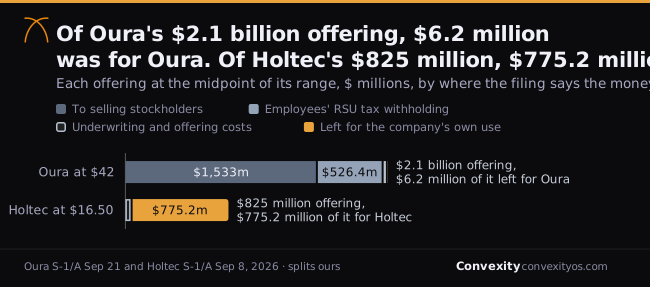
The tax obligation is the mechanics of a private company's equity pay arriving at a listing. Oura's restricted stock units carry a condition that is met only when the IPO registration becomes effective, so the units vest, and the tax falls due, at the offering itself. The company proposed to sell new shares to cover it. That is ordinary. What it means here is that the company's share of the deal would have paid for an obligation the deal itself created, and nearly everything else went to the selling stockholders.
Three sold in the base offering. Entities affiliated with Forerunner Ventures offered 28,679,908 shares, all they hold, which is 78.6% of the secondary and about $1.2 billion at the midpoint (our arithmetic). A member of Oura's board is a managing member of a Forerunner general partner. Entities affiliated with Lifeline Ventures, where another director is a founding partner, offered 6,947,864 of their 22,564,156. Oura's executives would have sold only through the underwriters' option to buy 7,500,000 more shares, all of it from existing holders.
None of this was hidden, and none of it was new to the market. Our note on Oura's first filing, published September 9, found that the company had spent more buying its own stock back from shareholders in the nine months to June 30 than it raised and earned together, and that the revolving credit facility it drew to $375.0 million in those months was used "primarily to fund repurchases of our common and redeemable convertible preferred stock." The offering was the next step of the same project: liquidity for the people who owned Oura, now from public buyers rather than from Oura's balance sheet.
What waiting costs Oura
Very little, on the company's side, and it is worth being precise about why.
Oura is not short of cash in the way Holtec is. It had $371.8 million at June 30 against $380.1 million of debt, nearly all of it the revolver, which matures in June 2029. Over the nine months it generated $328.0 million from operations. The offering would have added about $6.2 million of cash, so not doing it costs about $6.2 million of cash. The tax bill the offering would have paid does not arrive either, because the vesting condition behind it is the offering.
The one concrete cost the filing names is in the credit agreement: $245.0 million of additional revolving commitments "that will become available to us upon the completion of this offering and the satisfaction of certain related conditions." Waiting defers a larger credit line. It does not threaten the business.
Oura said as much when it postponed. "We aim to deliver an extraordinary IPO for our employees and investors and we have the luxury of choosing our moment," its statement read, as reported by IPO Scoop, which also reported that the deal had been set to price that night. A company that would have netted $6.2 million can choose its moment. Holtec's letter four days earlier said "at this time" too, from a balance sheet with far less room to choose.
The cost of waiting falls on the sellers. Forerunner's exit is deferred, and so is the liquidity of every holder who would have been free to sell after the lock-up. That is a real cost, but it is a different kind of cost from Holtec's, and it explains why the two companies stopping in the same week tells you less about either than it seems to. Nor was demand the obvious problem: its filing records indications of interest of up to $100.0 million from Eli Lilly and up to $300.0 million from funds affiliated with Dragoneer, about a fifth of the base deal (our arithmetic). An offering that is three-quarters secondary is priced to suit its sellers, and on the evidence of the filing those sellers, and the company with them, could afford to wait for a better price.
SB Energy has a date in its filing
The issuer that most resembles Holtec in what an offering is for, and least resembles it in how long it can wait, is still in registration.
SB Energy, the SoftBank-controlled developer of solar, storage and data center campuses, filed its S-1 on September 1 and a second amendment on September 21. The price range and share count on the cover are still blank. What the amendment did add was the financing that hangs on the offering, and the agreements behind it, filed as exhibits, put a calendar on the deal that the prospectus itself never states.
Nvidia "has contractually committed to purchase $1.5 billion of a new class of our non-voting Class N common stock in a private placement at a price per share equal to the initial public offering price," a commitment "contingent upon, and ... expected to close simultaneously with, the closing of this offering." The share purchase agreement adds two conditions the cover does not mention. The IPO must raise at least $1.5 billion of gross proceeds from SB Energy's own shares. And the agreement "shall terminate ... automatically, without any further action by either party, on May 15, 2027 if the Closing has not occurred."
A second $1.5 billion is already in hand. Nvidia prepaid it on August 17 under a forward contract to buy shares at 90% of the IPO price, and that contract has no date. Without an offering it settles in a later equity round of at least $500 million, again at 90% of that round's price, or, on a sale or dissolution of the company, for the greater of 1.4 times the money and the money plus 20% a year compounded, capped at 1.7 times. So the prepaid half can wait, at a price, and the committed half has a clock.
So does the corporate credit facility. The amendment finalized a $3.0 billion facility, a $1.875 billion revolver and a $1.125 billion letter of credit line, to replace the company's only material recourse debt, the $473.0 million Hickory facilities. A condition of its closing is "the pricing of this offering, which must generate gross proceeds of at least $3.0 billion." If the offering does not happen, the filing says, "we would need to repay the Hickory Facilities using cash on hand or alternative financing sources prior to their October 2027 maturity."
Beneath that sits the construction calendar. Of about $4.0 billion of debt at June 30, approximately $1.2 billion was classified as current, and the two largest pieces fall due before May: the $857.8 million Pelicans Jaw facility "by March 2027" and the $361.9 million Athos Storage facility "by February 2027." The company expects to handle them "through term loan conversions upon project completion, refinancings, and tax equity funding." And the capital plan behind the $439 billion backlog is $178 billion of spending, about $48 billion of it within 24 months, which the company plans to fund mostly with project-level debt and partly with "newly raised corporate-level equity financing."
To be fair to SB Energy, its liquidity looks nothing like Holtec's. It had $1.199 billion of unrestricted cash at June 30 before Nvidia's prepayment arrived, $2.5 billion of undrawn committed borrowing capacity, and a statement that existing resources are sufficient for at least twelve months without counting the offering. It does not need the window in October. It needs it by May, and it needs it to be large: an offering of at least $3.0 billion, in a month in which the largest offering on our list, ADARx's, raised about $446 million.
Anthropic's would be the largest, and the easiest to delay
The offering that would dwarf all of these is not on file. A company may submit a draft registration statement confidentially, which EDGAR does not show, but it has to file publicly at least fifteen days before a roadshow begins, and EDGAR's full-text search returns no S-1 for Anthropic PBC through October 6. There is no public document that dates the offering at all.
What the public record does show is how little the delay costs. Anthropic announced a $65 billion Series H on May 28, at a valuation of $965 billion after the money. Amazon's 10-Q for the second quarter describes a financing facility it made available to Anthropic, reduced to $15.0 billion when Amazon bought Series H stock, from which amounts become available "as we reach certain delivery milestones of compute capacity." Draws come as Anthropic convertible notes or, after a listing, common stock, and the facility will "expire 30 months after an Anthropic liquidity event, including an initial public offering." An offering starts a clock on that facility rather than beating one. On the evidence in public filings, Anthropic sits with Oura rather than with Holtec: an issuer for which waiting is a choice. We repeat that a member of our team holds an interest in Anthropic and benefits if its valuation rises.
What our Holtec note missed
We published a reading of Holtec's S-1 on September 21 under the title "Holtec is selling a reactor business it does not have yet." Its disclosure said the deal "had not priced as of the evening of September 20," and its framing throughout was of an offering still in the market. That was wrong in a way the sentence does not reveal. Holtec had postponed the offering on September 16, Reuters reported it that night, and the company published its own statement on September 17. We checked EDGAR, where nothing had been filed, and not the deal calendar or the company's newsroom, where the change was visible. The reading of the filing in that note stands; the operating losses, the investment income behind the profits and the absence of any binding reactor order are all in the document whether or not the shares are offered. But a reader of it on September 21 should have been told the offering was off, and was not. We have added that to the note.
What would prove this wrong
The argument here is that September's count looks like one event and was at least two, and that the companies with the most to lose from a shut window are the ones whose offerings are for the company rather than for its holders. Each part can fail.
- Holtec raises money elsewhere on easy terms. If it refinances the Mariner loan before January with outside debt at something like its federal rate, or sells equity privately at or above $15.00, the balance sheet was less dependent on the offering than its pro forma column suggests.
- Oura comes back with a larger primary. If a relaunched Oura offering sells materially more new shares than it needs for the tax withholding, the company wanted the cash after all, and the reading that its offering was mainly for its holders was too narrow.
- September is a blip. The first six days of October show two final prospectuses and no withdrawals. If October and November run firmly above zero, September was a skipped beat around a Fed decision rather than a turn.
- SB Energy prices at size, soon. An SB Energy offering of $3.0 billion or more in the fourth quarter, with Nvidia's committed half closing alongside it, would show the window open to a need-driven issuer with an anchor investor, and would make Holtec's withdrawal about Holtec rather than about the market.
- Our count is wrong. It is built from form types and names, and the rule is published so it can be checked. A count weighted by dollars, which ours is not, might show a different September.
The filings and reports this is built on
- RWHoltec Nuclear Corporation, request for withdrawal of registration statement on Form S-1The withdrawal and its stated reasonSep 25, 2026
- S-1/AHoltec Nuclear Corporation, Amendment No. 2 to Form S-1Offering terms and use of proceeds; the condensed balance sheet, summary and pro forma data; the Harbor and Mariner related-party loans; the April distribution; the DOE loan guarantee; the liquidity statementSep 8, 2026
- S-1/AOura Inc., Amendment No. 1 to Form S-1Offering terms, use of proceeds and the RSU Net Settlement; principal and selling stockholders; cash, debt and the revolving credit facility; the cornerstone indications of interestSep 21, 2026
- FWPOura Inc., free writing prospectus announcing the launch of the offeringSep 21, 2026
- S-1/ASB Energy, Inc., Amendment No. 2 to Form S-1The blank cover, the Nvidia private placement and prepaid forward, the Credit Facility and its conditions, debt maturities, liquidity and backlog-associated capexSep 21, 2026
- Exhibit 10.28SB Energy, Inc. and NVIDIA Corporation, share purchase agreementThe $1.5 billion minimum offering size and the May 15, 2027 termination dateSep 1, 2026
- Exhibit 10.27SB Energy, Inc. and NVIDIA Corporation, prepaid forward contractSettlement without an offering: a qualified equity financing, or a change of control at the preference amountSep 1, 2026
- RWMotive Technologies, Inc., application for withdrawal of registration statement on Form S-1Sep 10, 2026
- 424B4Accelevation Holdings Corp., prospectusPrice, shares offered by the company and by selling stockholders, the business description and the $1.1 billion backlogOct 1, 2026
- 424B4ADARx Pharmaceuticals, Inc., prospectusSep 28, 2026
- 424B4Electra Therapeutics, Inc., prospectusSep 18, 2026
- 424B4Orion180 Insurance Group Inc., prospectusSep 21, 2026
- ReportIPO Scoop, Orion180 prices its IPO at $12, $3 below its rangeThe $15 to $17 range and the September 17 pricing; retrieved 2026-10-07Sep 17, 2026
- ReportIPO Scoop, Accelevation prices its IPO at $18, $2 below its rangeThe pricing on September 29 and the range; retrieved 2026-10-07Sep 29, 2026
- ReportIPO Scoop, ADARx Pharmaceuticals upsizes its IPO and prices it at $17, the high endRetrieved 2026-10-07Sep 24, 2026
- ReportIPO Scoop, Electra Therapeutics upsizes its IPO and prices it at $15, the midpointRetrieved 2026-10-07Sep 17, 2026
- StatementHoltec International, Holtec Nuclear Corporation initial public offering postponedThe postponement, its stated causes, and the intention to keep the registration on fileSep 17, 2026
- ReportRenaissance Capital, Motive Technologies withdraws its IPOThe General Catalyst financing and the company statement; retrieved 2026-10-07Sep 10, 2026
- 10-QAmazon.com, Inc., quarterly report for the period ended June 30, 2026The Anthropic financing facility, its delivery milestones, the form of draws, its reduction to $15.0 billion and its expiry after a liquidity eventJul 31, 2026
- ReleaseAnthropic, Anthropic raises $65B in Series H funding at $965B post-money valuationMay 28, 2026
- IndexSEC EDGAR full index, quarterly master files, 2018 to 2026The population for the monthly count; the rule and the counting script are published with the chart specificationRead Oct 6, 2026
- FOMCFederal Reserve, FOMC statementThe target range raised to 3-3/4 to 4 percentSep 16, 2026
- ReportIPO Scoop, Oura postpones IPO due to market conditionsThe postponement on September 29, the deal set to price that night, and the company statement; retrieved 2026-10-07Sep 29, 2026
- ReportReuters, Holtec suspends its planned U.S. IPO, as carried by IPOXThe suspension, reported September 16; retrieved 2026-10-07Sep 16, 2026
- ReportRenaissance Capital, Holtec Nuclear withdraws its $825 million IPOThe withdrawal date and the earlier postponement; retrieved 2026-10-07Sep 25, 2026
Not investment advice. This is a reading of public filings, published for research purposes. It is not a recommendation to buy, sell or subscribe to any security, and it is not a valuation. None of the four companies whose registrations it discusses is listed, and we hold no position in any of them. A member of the Convexity team holds an economic interest in Anthropic through a special-purpose vehicle and a fund and benefits if its valuation rises; Convexity's product runs on Anthropic's models; this note was researched and drafted with Claude. A team member holds SPY, which holds Nvidia, Amazon, Eli Lilly, Goldman Sachs, Morgan Stanley, JPMorgan Chase and Robinhood; no other position.
What here is ours rather than the companies'. As filed: every offering term, share count, price range and net proceeds figure; Oura's $526.4 million of tax withholding; every balance sheet, pro forma, cash, debt and cash flow figure; the loan terms, rates, dates and the April distribution; the SB Energy agreements' conditions and dates; every quoted sentence. Ours: the monthly count, its rule and both datings, including the seven and ten for September, the eight by effectiveness date, the six and thirteen for February 2026, and every statement about which months fall below zero; Oura's $6.2 million remainder, the $2.1 billion and $825 million gross offerings at the midpoint, the selling stockholders' $1,533 million and 73% share, each company's offering costs, Forerunner's 78.6% of the secondary and its value at the midpoint, and the cornerstones' share of the deal; the twelve percent annual equivalent of the Mariner rate, its monthly interest on $60.0 million, its due date and the four months between the withdrawal and that date; the undrawn part of Holtec's federal guarantee; and the observation that SB Energy's two facilities due by March 2027 fall before the share purchase agreement's termination date. The Harbor balance is given as the filing gives it in two places, because the filing disagrees with itself.
Correction. Our September 21 note on Holtec published after the offering had been suspended and did not say so. The correction is described in the text above and has been added to that note.