








Disclosure. Not investment advice, and nothing here is a recommendation to buy, sell or hold any security. A member of the Convexity team holds the SPDR S&P 500 ETF (SPY), which holds General Mills, Hershey, Hormel, Kraft Heinz, McCormick, Mondelez, PepsiCo and Smucker; no other position. Figures are from each company's earnings release, filed with the SEC on Form 8-K, and from transcripts of the earnings calls; what management said on a call is paraphrased from the transcript unless it appears in quotation marks from a filing. The closing note lists what is our arithmetic. This note was drafted with Claude.
The usual account of packaged food since 2022 runs like this: costs rose, companies raised prices, and shoppers bought less. We set out to test it against every packaged food company that reported a quarter between August 20 and October 6, 2026. There were twelve. We read each earnings release and each call, and counted what each company said happened to its prices and to the amount it sold.
The usual account fits three of them. What fits more is simpler and less comfortable. Of the nine companies that state a total-company volume figure, seven sold less than a year earlier, and only three of those seven raised prices to do it. At three more, prices were flat and volume fell anyway. Where prices did rise, in five businesses that break the figures out, volume fell by more than price added in every one.
And the next round of price increases is already on its way. Campbell's says it has raised prices on about 60% of its portfolio, by 4% to 5% on average, and Conagra says the increases it announced on its previous earnings call are only now reaching shelves. Both told investors they have modeled the volume they expect to lose. The industry is raising prices into volume that is already falling, and planning for it to fall further.
Company earnings releases (Form 8-K exhibit 99), August 20 to October 6, 2026; Campbell's fourth-quarter call. Counts are ours.
The count
The population is every U.S.-listed packaged food maker that filed a quarterly earnings release with the SEC between August 20 and October 6: Flowers Foods, Marzetti (formerly Lancaster Colony), J.M. Smucker, Hormel, Campbell's, Mama's Creations, Hain Celestial, General Mills, Cal-Maine, Conagra, McCormick and Lamb Weston. Kraft Heinz, Mondelez, Hershey, Post and several smaller companies reported earlier in the summer, before the window opened, and PepsiCo had not reported its third quarter when the count closed. Their quarters end on different dates, from June 30 to August 31, so this is a cross-section of one season rather than a single quarter.
Most of the twelve break their sales growth into a price part and a volume part. The definitions differ. Some report volume, others "volume/mix," which also captures shifts toward more or less expensive products; some report price, others "price/mix." We used each company's own figure on its organic basis where it gives one, which strips out acquisitions, divestitures and currency, and we say where a figure is something else.
Three of the twelve give no total-company volume figure, so they are not in the count of nine. Marzetti reports volume in pounds by segment: retail pounds fell 1.7% and foodservice pounds 4.1%. On its call, by the transcript, its finance chief said that excluding the Bachan's sauce business it bought, core volume and mix took 33 basis points off sales while pricing added 40, a small price increase against a small volume decline. Cal-Maine, the egg producer, reports volume and price by product, and its quarter was dominated by the egg price cycle: its average selling price for a dozen conventional eggs fell 59.3% while conventional volume was relatively flat, down 0.7%. Mama's Creations, a small prepared-foods maker whose growth included an acquisition, gives no split at all.
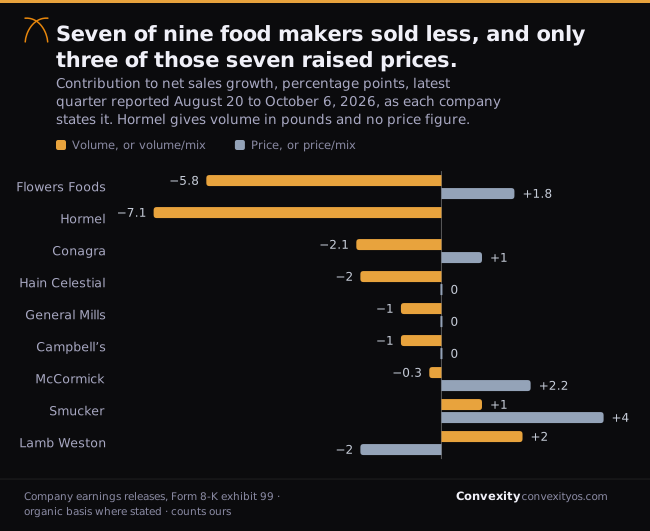
Volume fell where prices did not rise
The finding the chart makes plainest is the middle of it. Hain Celestial's organic net sales fell 2%, "comprised of a 2-point decrease in volume/mix and flat pricing." General Mills held organic net sales level, with organic volume down 1 point and organic price/mix at zero. Campbell's organic net sales fell 1%, "driven primarily by lower volume/mix," with net price realization shown as zero. None of the three raised prices in the quarter, and all three sold less.
General Mills is the sharpest case, because it did more than hold prices. It spent fiscal 2026 cutting them. Its release says that "with its base price investment actions completed in fiscal 2026, the company is shifting its focus in fiscal 2027 to product innovation and renovation." Base price investment is General Mills' term for lowering the everyday prices of its products, and its chief operating officer said on the call, by the transcript, that the company did a lot of work last year to adjust them. A company that spent a year lowering prices, and is still not growing volume, is not suffering from shoppers balking at its prices. General Mills says as much. It expects "category growth to be consistent with recent trends and below its long-term historical growth rate, driven by a continued challenging consumer backdrop."
Hormel, which gives no price figure, sold 7.1% fewer pounds on an organic basis. John Ghingo, its president and incoming chief executive, described "a consumer environment that remains under pressure." On the call, by the transcript, management attributed about half of the retail decline to businesses Hormel chose to exit, among them whole birds and private label snack nuts, and part of the rest to the volume it expected to lose after two rounds of retail price increases. So Hormel is partly a price case and partly a pruning case, and the release does not separate them.
Flowers Foods, the bread maker, is the clearest example of the usual account. Pricing and mix added 1.8% and volume took off 5.8%. But even Flowers shows the weaker pattern inside it. Its "Other" segment, which includes store-brand bread sold under retailers' own labels, lost 3.4% of volume while its pricing and mix fell 1.0%. Flowers put that decline down to "inflationary pressure on consumer spending impacting store branded sales." Store brands are where a shopper goes to spend less, and at Flowers they sold less at lower prices.
Where prices did rise
Five businesses in the count stated a price increase and a volume decline for the segment. In every one, volume fell by more than price added.
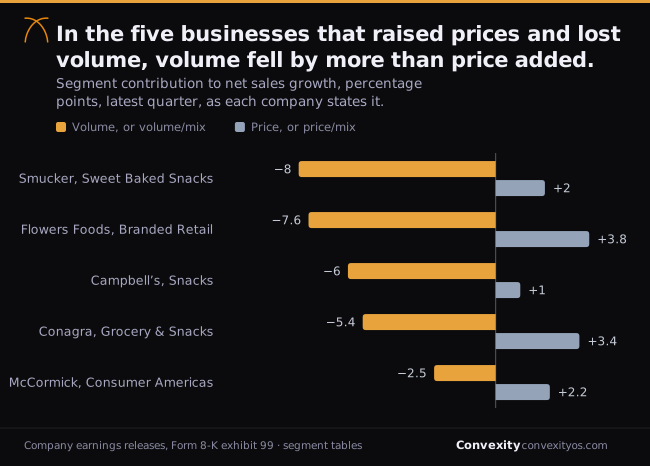
Smucker's Sweet Baked Snacks, the Hostess business, lost 8 points of volume/mix, "primarily reflecting decreases for snack cakes and breakfast," while net price realization added 2 points, "primarily reflecting higher net pricing for snack cakes and donuts." Flowers' branded bread raised pricing and mix 3.8% and lost 7.6% of volume. Campbell's Snacks segment, which includes its salty snacks, took 1% of price and lost 6% of volume/mix. Conagra's Grocery & Snacks segment raised price/mix 3.4% and lost 5.4% of volume. McCormick's consumer business in the Americas raised prices 2.2% and lost 2.5% of volume and mix, which its finance chief said on the call, by the transcript, reflected pressure from the macro environment.
Four of the five are snacks or bread: the purchases a household can most easily shrink, delay or switch to a store brand. That is where the classic price-up, volume-down pattern lives in this count, and in each case the volume loss outweighed the price gain, so the segment's sales fell. A company can make that trade and still come out ahead on profit, if the price it keeps carries more margin than the volume it loses. But it is not growth, and the volume, once lost, has to be won back.
The two companies that sold more show the other side. Smucker's volume/mix rose 1 point while net price realization added 4, "primarily driven by higher net pricing for coffee"; its volume gains came mainly from Uncrustables sandwiches and coffee. Lamb Weston, which sells frozen potatoes mostly to restaurants, is the mirror image of the usual account: its volume rose 2% and its price/mix fell 2%. In North America, volume rose 7% while price/mix fell 2%, "resulting from price and trade support" for customers. Lamb Weston cut prices and won volume. It is the one case in the count where lower prices bought more sales, and it sells to restaurants rather than to shoppers.
Away from home
If shoppers were buying less food in the grocery store because they were eating out more, the foodservice businesses in the count would show it. They show a mixed picture rather than a shift.
General Mills' North America Foodservice segment grew organic net sales 4%, but on 5 points of price/mix with organic volume down 1. Hormel's Foodservice segment, which the release says "once again outperformed industry trends," lost 1% of volume while organic net sales grew 2%. Marzetti's foodservice volume, excluding a supply agreement that ended, rose 0.1%. Conagra's foodservice volume rose 2.5%, of which about 1.5 points the release attributes to the timing of customer orders. Lamb Weston, the one company in the count that sells mostly to restaurants, grew North American volume 7%, helped by customer wins and by lower prices, and its finance chief said on the call, by the transcript, that U.S. restaurant traffic was essentially flat in the quarter while traffic at quick-service chains fell 1%, measured by Circana.
None of that looks like food moving from the supermarket to the restaurant. It looks like a shopper spending less in both places, and the companies that grew volume away from home mostly did it on price or on timing.
What the companies say about the shopper
Each company explained its volume in its own terms, but the explanations converge on the household budget rather than on any one company's prices.
General Mills was the most direct. Asked about promotions, Dana McNabb, its chief operating officer, said the company still sees the consumer as "very stressed, especially the middle and lower-income consumer," and that shoppers "are still waiting to buy products on sale rather than waiting to buy them on everyday shelf price." She said that behavior had not accelerated, and that General Mills set its guidance assuming it would continue all year. Two independently produced transcripts of the call agree on those words.
Conagra's chief executive, by the transcript, called the consumer muted and bifurcated by income, said the convenience-store channel had been under pressure from higher gas prices, and said Conagra had not seen a material step change in behavior. Its release now lists, among the risks to its outlook, "declining benefits or changing eligibility requirements under government food assistance programs for consumers." Flowers' chief executive pointed, by the transcript, to shifts in consumer preference and to some trading down to private label and lower-priced items. McCormick described a value-conscious consumer and said higher seafood and beef prices had pressured parts of its category. Hormel said its dollar consumption, the value of its products bought at retail, fell 1% in the quarter after rising about 1% earlier in the year.
Two companies offered something different. Mama's Creations credited GLP-1 weight-loss drugs, saying, by the transcript, that shoppers are walking past the packaged snack aisle for high-protein prepared meals; it is a small company describing its own market, and none of the larger companies in the count raised the drugs on their calls. And Cal-Maine showed the reverse of the season's pattern in a commodity: by its call, national retail egg volume was slightly higher in the four weeks to August 29 while the average price per dozen fell about 27%. Where prices fell sharply, shoppers bought a little more.
The common thread is a shopper with less room in the budget: lower- and middle-income households waiting for promotions, trading to store brands, and buying fewer snacks and less bread. That matters for what comes next, because a stressed shopper is the one most likely to answer a price increase by buying less.
The next round
The quarter's other theme is cost, and it shows up first in margins. Campbell's adjusted gross margin fell 190 basis points in its fourth quarter, to 28.6%, "driven primarily by cost inflation and other supply chain costs inclusive of the impact from tariffs." Conagra's gross margin fell 50 basis points to 23.8%. General Mills' adjusted gross margin fell 90 basis points to 33.3%. At Flowers, production costs rose to 51.6% of net sales, "mostly due to lower production volumes and an increase in labor costs and outside purchases of product."
That last phrase is the trap in the arithmetic. Lower volume raises the cost of each unit, because the plants and the delivery routes cost much the same with less product moving through them. A company losing volume and facing rising input costs has two levers, cost cuts and price, and most of these companies say they are pulling both. Several raised their inflation estimates for the year, and the ones that have not yet raised prices are about to.
Campbell's is the most explicit. On its call, by the transcript, its finance chief said the company expects inflation of about 5% to 6% for the year, with logistics costs up by double digits, and that it has taken a price increase on about 60% of its portfolio, averaging 4% to 5%. He said Campbell's had modeled an elasticity of 1.5 times, meaning a 1% price rise loses 1.5% of volume, and that the arithmetic will therefore reduce net sales while helping profit. He also said price realization will be negative in the first quarter of the new year and turn positive from the second. Those are the increases that the margin decline above is meant to recover.
Conagra's chief executive said, by the transcript, that the price increases discussed on its previous call are only now reaching the market, and that the company has modeled an elasticity of about 2 to 1 in frozen food and about 1 to 1 in Grocery & Snacks. That segment has just lost 5.4% of volume on a 3.4% rise in price/mix, before the new increases arrive.
General Mills, which spent last year cutting prices, now expects input cost inflation at the higher end of the 4% to 5% it had forecast, and its chief operating officer said, by the transcript, that every lever in its pricing toolkit is on the table, list prices included. McCormick raised its estimate of cost inflation for the year to 6% to 7%, from mid-single digits, and its release says the year's "Total volumes expected to be stable with increased pricing benefits relative to the prior year." Marzetti said, by the transcript, that it expects about 5% commodity inflation in its new fiscal year and will offset it with prices that took effect in its first quarter.
Put the two halves of the season together. Volume was already falling at most of these companies before this round of increases, including at companies that were holding prices flat or cutting them. The increases now arriving are being planned with elasticities of 1 to 2, which assume that volume will fall by as much as, or more than, prices rise. For a business like Campbell's, a 4% to 5% increase at 1.5 times means losing about 6% to 7.5% of volume on the products affected (our arithmetic). The plan, stated openly, is to sell less food at a better margin.
The tariff refunds inside the quarter
One more thread runs through these releases, and it is the one our count of tariff refunds in adjusted earnings followed in September. Smucker's gross profit "included tariff refunds received of approximately $115.0 million during the quarter," and its adjusted earnings per share of $3.24, up 71%, "included an $0.84 benefit from tariff refunds received in the quarter." Conagra's gross profit included "approximately $4 million in tariff refunds." Lamb Weston's North America segment counted "$5 million in tariff refunds." McCormick recognized its refund mainly in its second quarter and says it "will be offset with increased inflationary costs."
The amounts are small for most of the group and large for Smucker. They matter here for a narrower reason: a refund is a one-time lift to margin in the same quarters that cost inflation is pushing companies toward price increases. When the refunds stop, the inflation does not.
The case against this note
There is a more reassuring reading of the same releases.
The first part is that volume/mix is not volume. Four of the companies report a figure that mixes the amount sold with shifts between cheaper and dearer products, and a business that sells fewer, larger or more premium items can report a volume/mix decline without selling less food. Hormel says about half its retail decline came from businesses it chose to leave. General Mills, Hain and Hormel have all sold or closed parts of their portfolios, and organic figures strip out only part of that. Some of what reads as lost volume is pruning.
The second is timing. The quarters in the count end anywhere from June 30 to August 31, so they mix spring and summer, and the sample is twelve companies, of which only nine give the figure we counted. The pattern could shift with the next reports.
The third is that there are signs of improvement inside the numbers. General Mills said on the call that its dollar sales trend improved by 2 points and that its share performance improved in most of its categories, and it expects price/mix to improve from its second quarter, once it laps last year's price cuts. Flowers expects smaller volume losses as it laps last year's increases. Smucker raised its outlook for Uncrustables. McCormick's consumer business outside the Americas grew volume.
We think those points are fair, and this note does not argue that packaged food is in a demand collapse. It argues something narrower: that in this season's releases the volume declines are broader than price increases can explain, and that the price increases now arriving are being planned around volume losses rather than despite them.
What would prove this wrong
- The next reports show volume growth. Kraft Heinz, Mondelez, Hershey and PepsiCo report on calendar quarters, and their third quarters, July to September, cover most of the same months. If most of them show volume rising, this season's pattern was a summer lull rather than a trend.
- Elasticities come in below plan. If Campbell's and Conagra report in their next quarters that the new price increases cost less volume than the 1.5 times and 2 to 1 they modeled, the price round will add to sales rather than trade them away.
- General Mills grows volume on flat prices. If its price/mix turns positive from the second quarter, as it expects, without volume falling further, the company that cut prices hardest will show that demand was waiting for value.
- Inflation estimates come down. If General Mills, McCormick and Campbell's cut their inflation outlooks, the pressure behind the next round of price increases eases.
The filings and documents this is built on
- 8-KFlowers Foods, second quarter fiscal 2026 results (Exhibit 99.1)Pricing/mix +1.8%, volume -5.8%; Branded Retail and Other segment detailAug 20, 2026
- 8-KThe Marzetti Company, fourth quarter fiscal 2026 resultsRetail and foodservice pounds shippedAug 25, 2026
- 8-KThe J.M. Smucker Co., first quarter fiscal 2027 results (Exhibit 99.1)Net price realization and volume/mix, Sweet Baked Snacks, tariff refundsAug 26, 2026
- 8-KHormel Foods, third quarter fiscal 2026 resultsOrganic volume in pounds and organic net salesAug 27, 2026
- 8-KThe Campbell’s Company, fourth quarter fiscal 2026 results (Exhibit 99.1)Organic net sales, volume/mix, net price realization, Snacks segmentSep 3, 2026
- 8-KMama’s Creations, second quarter fiscal 2027 results (Exhibit 99.1)Net sales growth including an acquisition; no price or volume splitSep 3, 2026
- 8-KThe Hain Celestial Group, fourth quarter fiscal 2026 results (Exhibit 99.1)Organic net sales, volume/mix and pricingSep 14, 2026
- 8-KGeneral Mills, first quarter fiscal 2027 results (Exhibit 99)Organic volume and price/mix, base price investments, the category outlookSep 23, 2026
- 8-KCal-Maine Foods, first quarter fiscal 2027 results (Exhibit 99.1)Egg prices and volumes by productSep 30, 2026
- 8-KConagra Brands, first quarter fiscal 2027 results (Exhibit 99.1)Organic price/mix and volume, Grocery & Snacks, tariff refundsSep 30, 2026
- 8-KMcCormick & Company, third quarter 2026 resultsOrganic price and volume/mix by segment, the volume and pricing outlookOct 1, 2026
- 8-KLamb Weston, first quarter fiscal 2027 results (Exhibit 99.1)Volume and price/mix, North America segment, tariff refundsOct 6, 2026
- CallCampbell’s fourth quarter fiscal 2026 call, Motley Fool transcriptInflation outlook, the price increase on about 60% of the portfolio, 1.5 times elasticitySep 3, 2026
- CallConagra Brands first quarter fiscal 2027 call, Motley Fool transcriptPricing reaching shelves, the elasticity assumptions and the consumerSep 30, 2026
- CallGeneral Mills first quarter fiscal 2027 call, Motley Fool transcriptInput cost inflation, the pricing toolkit, price/mix from the second quarterSep 23, 2026
- CallGeneral Mills first quarter fiscal 2027 call, gloom.sh transcriptThe second, independently produced transcript used to check the quoted remarks on the consumerSep 23, 2026
- CallHormel Foods third quarter fiscal 2026 call, Motley Fool transcriptThe share of the retail volume decline from exits and from pricingAug 27, 2026
- CallMcCormick third quarter 2026 call, Motley Fool transcriptConsumer Americas volume and the cost inflation estimateOct 1, 2026
- CallMarzetti fourth quarter fiscal 2026 call, Motley Fool transcriptCommodity inflation and the pricing to offset itAug 25, 2026
- CallLamb Weston first quarter fiscal 2027 call, Motley Fool transcriptU.S. restaurant and quick-service trafficOct 6, 2026
- CallCal-Maine Foods first quarter fiscal 2027 call, Motley Fool transcriptRetail egg volume and price per dozen in the four weeks to August 29Sep 30, 2026
- CallMama’s Creations second quarter fiscal 2027 call, Motley Fool transcriptManagement’s view of GLP-1 drugs and the snack aisleSep 3, 2026
- CallFlowers Foods second quarter fiscal 2026 call, Motley Fool transcriptElasticity expected to ease as last year’s pricing is lapped, and trading down to private labelAug 21, 2026
Not investment advice. This note is an analysis of public disclosures by twelve companies, published for research purposes, and not a recommendation to buy, sell or hold any security. A member of the Convexity team holds SPY, which holds General Mills, Hershey, Hormel, Kraft Heinz, McCormick, Mondelez, PepsiCo and Smucker; no other position.
What here is ours rather than the companies'. As filed or stated by each company: every price, volume, sales, margin and refund figure, by company and by segment, and every quotation, which is from a filing. Paraphrased from call transcripts, and attributed as such: Campbell's inflation outlook, price increase, elasticity and price realization timing; Conagra's elasticity assumptions; General Mills' inflation outlook and pricing levers; Hormel's attribution of its volume decline; McCormick's view of Americas volume and its inflation estimate; Marzetti's commodity inflation; Flowers' expectation for elasticity and its view of trading down; Conagra's and McCormick's descriptions of the consumer; Lamb Weston's restaurant traffic; Cal-Maine's retail egg data; Mama's Creations' view of GLP-1 drugs. The General Mills remarks on the consumer are quoted from a transcript and checked against a second. Ours: the choice of the twelve companies and the window, the counts (seven of nine, three of seven, five of five), the classification of each company's price and volume, the comparison of each segment's volume loss with its price gain, the 6% to 7.5% volume loss implied by Campbell's stated increase and elasticity, the reading that lower volume raises unit costs, the characterization of foodservice as showing no shift from the grocery store, and the characterization of the price round as planned around volume losses.