








Disclosure. Not investment advice, and nothing here is a recommendation to buy, sell or hold any security. A member of the Convexity team holds the SPDR S&P 500 ETF (SPY), which holds Intuit and Berkshire Hathaway, both named below, and also Moody's and S&P Global, whose credit ratings of Bending Spoons are cited below; no other position, and no position in Bending Spoons. Bending Spoons' figures are from its third-quarter results and interim financial statements of November 19, its other Forms 6-K and its IPO prospectus; Intuit's are from its quarterly report on Form 10-Q, its earnings release and its Form 8-K of the same day. What management said is from two public transcripts of Bending Spoons' November 20 call. Share prices are official closing prices. The closing note lists what is our arithmetic.
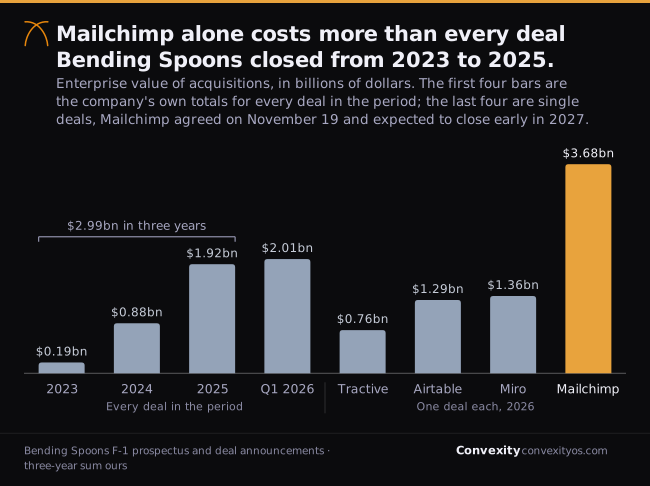
In the 25 minutes after the market closed on Thursday, November 19, Bending Spoons (BSP) published three things at once: its results for the third quarter, a sale of $1.30 billion of new shares, and an agreement to buy Mailchimp, the email marketing service, from Intuit (INTU) at an enterprise value of $3.68 billion. Intuit announced the sale the same afternoon, alongside its own results for the quarter to October 31, and our note on Intuit's side of the sale reads the same deal from the seller's books. Mailchimp is the largest purchase Bending Spoons has agreed. By itself it costs more than every acquisition the company closed in 2023, 2024 and 2025 put together.
Our note in October described Bending Spoons as a machine for buying digital businesses and rebuilding each one around a much smaller team, and argued that the machine, not any of its apps, is what the company really sells to its shareholders. The middle step of that machine is what the company calls a deep transformation: reorganizing teams, overhauling technology, and improving marketing and monetization. Mailchimp is the first large purchase in which the seller appears to have done a good part of that step before the buyer arrived.
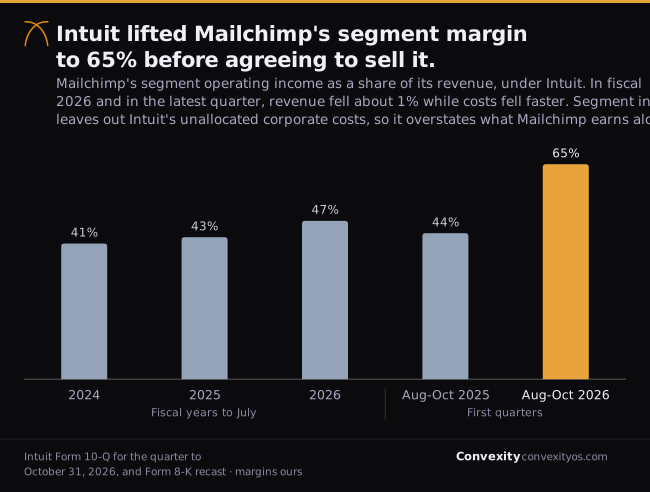
The evidence is in Intuit's filings rather than in Bending Spoons'. Intuit began managing Mailchimp as a segment of its own on August 1, and its quarterly report, filed the same Thursday afternoon, shows what it did in its last months as owner. In the quarter to October 31, Mailchimp's revenue fell 1% to $313 million, while the costs Intuit charges to the segment fell to $111 million from $178 million a year earlier. Segment operating income rose 45% to $202 million, 65% of revenue against 44%. Intuit says where the money came from: $31 million less spent on staff, $19 million less on marketing and $8 million less on outside services.
So Bending Spoons is buying a business at a price set on a profit that its previous owner has already cut its way to. At $3.68 billion it pays about 6.1 times the segment operating income Mailchimp earned in Intuit's last full fiscal year, and about 4.6 times its latest quarter at an annual rate (our arithmetic). Those multiples look low, and part of the reason they look low is that the cutting is already in them. For the deal to clear the returns Bending Spoons says it requires, Mailchimp's profit has to rise again from a level Intuit has already raised, and the company's usual first lever, a far smaller team, has been pulled once. On its call on Friday, November 20, the company said what it expects to find rather than what it will do.
Luca Ferrari, the chief executive, said it sees "substantial opportunity to improve both revenue and cost" at Mailchimp and expects to complete the purchase "sometime in the first part of 2027." He gave no figure for Mailchimp's staff, its prices or the investment the announcement promised, and he said the company expects lower returns from this deal than from some of its others.
- 65%
- Mailchimp’s segment operating margin in Intuit’s quarter to October 31, against 44% a year earlier, after cuts to staff and marketing
- $3.68B
- the enterprise value Bending Spoons agreed to pay for Mailchimp, its largest purchase
- 6.1x
- the price as a multiple of Mailchimp’s segment operating income in Intuit’s fiscal 2026 (our arithmetic)
- 60%
- of the money Bending Spoons has lined up since September 30 that is debt, including its first bonds (our arithmetic)
The margin and segment income are from Intuit's Form 10-Q for the quarter to October 31, 2026, and its Form 8-K of November 19 recasting fiscal 2024 to 2026. The price and the financings are from Bending Spoons' Forms 6-K and its interim financial statements. The multiple and the debt share are ours.
The biggest purchase, by a distance
Bending Spoons' prospectus gives the combined enterprise value of everything it bought in each year: $194 million in 2023, $876 million in 2024 and $1.92 billion in 2025. That is $2.99 billion over three years, the same sum our October note made. Mailchimp's $3.68 billion is about 23% more than all of it (our arithmetic).
This year the pace had already changed. The prospectus puts the first quarter's acquisitions at $2.01 billion. Since then the company has closed Tractive, the pet tracker, at $759 million in May, Airtable at $1.29 billion on September 4 and Miro at $1.36 billion on October 26. That is $5.41 billion of deals closed in 2026, and with Mailchimp the deals closed or agreed this year come to about $9.09 billion (our sums).
| Enterprise value of acquisitions, billions of dollars | |
|---|---|
| 2023 | $0$0.19bn |
| 2024 | $1$0.88bn |
| 2025 | $2$1.92bn |
| Q1 2026 | $2$2.01bn |
| Tractive | $1$0.76bn |
| Airtable | $1$1.29bn |
| Miro | $1$1.36bn |
| Mailchimp | $4$3.68bn |
Measured against the company it joins, Mailchimp is large as well. Its revenue in Intuit's fiscal year to July 2026 was $1.27 billion, about 41% of the $3.08 billion midpoint of the revenue Bending Spoons now forecasts for its own 2026, and its segment operating income of $604 million is about 38% of the $1.59 billion midpoint of the company's forecast Adjusted Operating Income (our arithmetic). The two profit measures are not defined the same way, which the next section takes up, but the order of magnitude is not in doubt. When the deal closes, which both companies expect early in 2027 if regulators approve it, one business will account for somewhere between a quarter and a third of the company's profit.
For Intuit, the sale ends a five-year chapter at a large discount to what it paid. It bought Mailchimp on November 1, 2021, for total consideration of $12.0 billion, $5.7 billion of it in cash and the rest in Intuit shares. The sale price is about 31% of that (our arithmetic). Intuit nonetheless expects to record a pre-tax gain when the deal closes, so the business was carried on its books at less than the price Bending Spoons is paying. Intuit says it will spend the cash on buying back its own shares within its fiscal 2027, after the sale closes, and its release explains the decision as one that "sharpens Intuit's focus" on the tools it sells businesses directly.
Not all of the price is cash. Intuit will take $368 million of it in 8.8 million newly issued Bending Spoons shares, a number its quarterly report says was fixed at signing from a weighted-average share price, and it has accepted a six-month restriction on selling them. Neither company has published that price; the rounded figures imply about $42 a share (our arithmetic), a price the next sections come back to.
Intuit did the cutting first
Intuit has now published three full years of Mailchimp as a separate business, recast in a Form 8-K on November 19 to match the new segment. Revenue barely moved: $1,267 million in fiscal 2024, $1,287 million in 2025 and $1,272 million in 2026, each year ending in July. Segment operating income rose every year, from $516 million to $548 million to $604 million, and the margin with it, from 41% to 43% to 47%. Intuit's explanation of fiscal 2026 is short. Revenue fell $15 million because there were fewer paying customers and the mix shifted, partly offset by higher prices. Segment profit rose $56 million because staff costs fell $32 million and marketing $26 million.
The first quarter of fiscal 2027 then compressed more than a year's change into three months. Segment costs fell 38%, from $178 million to $111 million, and the margin went from 44% to 65%. Four times the latest quarter, a crude way to annualize a business with some seasonality, puts Mailchimp's costs at about $444 million a year, against $668 million in fiscal 2026 (our arithmetic). The quarter also coincided with the end of Intuit's company-wide restructuring, approved in May 2026 to make it what it called a faster, leaner and more focused company, which reduced its full-time workforce and was substantially complete by October 31. Intuit expects that plan to cost $315 million in all, of which it assigns $10 million to the Mailchimp segment.
| Mailchimp segment operating income as a share of its revenue | |
|---|---|
| FY2024 | 41% |
| FY2025 | 43% |
| FY2026 | 48%47% |
| Q1 FY2026 | 44% |
| Q1 FY2027 | 65% |
There is an important limit on these figures, and Intuit states it in its own filings. Segment operating income is not what Mailchimp would earn on its own. Intuit does not charge its segments for share-based compensation, amortization of acquired intangibles, restructuring, or its corporate selling, general, administrative and legal costs. The segment figure covers the costs the business itself controls, which include product development and customer support. A standalone Mailchimp has to pay for some of what Intuit's head office paid for, and Intuit does not disclose how much that was. Bending Spoons runs the businesses it owns on what it calls its Platform, its own people, technology and data shared across all of them, so some of that cost will reappear inside Bending Spoons rather than inside Mailchimp. The 65% overstates what the business earns alone. By how much, no one outside the two companies can say.
Even so, the comparison with Bending Spoons' own margin is striking. In its third quarter, across a portfolio that now includes AOL, Vimeo and Eventbrite after their restructurings, the company's Adjusted Operating Income was 54% of revenue. That measure deducts the company's central costs and its share-based pay, which Intuit's segment figure does not, so the two are not like for like and the gap flatters Mailchimp. But on the closest comparison the filings allow, Mailchimp arrives about as profitable as the portfolio it joins. That is unusual for a Bending Spoons purchase. The October note recorded what happened at AOL, Eventbrite and Vimeo: 1,830 staff acquired with the three, of whom the company expected only a few hundred to remain. Those were businesses with a great deal of cost to take out. Mailchimp's owner has been taking its cost out for more than a year.
What is left to take out
Bending Spoons has said little about its plans for Mailchimp. "After closing, we'll invest substantially in the business," Luca Ferrari, its chief executive, said in the announcement. The same promise appears in nearly the same words in its announcement of Miro in September, and in different words in its announcement of Airtable in August, so it reads better as the company's standard language for a new purchase than as a plan for this one.
The filings do let a reader size what is left. If four times the latest quarter is a fair run rate, Mailchimp spends about $444 million a year to earn about $1.25 billion of revenue. Part of that is the cost of delivering the service itself, which no reorganization removes. The rest is people, marketing and outside services, the three lines Intuit cut by $58 million in a single quarter against the same quarter a year earlier. Bending Spoons' own results show the levers it reaches for once it owns a business. At Tractive it cut more than $10 million of annual marketing by dropping campaigns that did not pay. At Vimeo it expects this year's changes to avoid more than $7 million a year of hosting costs. And it says the number of pull requests, proposed changes to code, per engineer has more than quadrupled since the start of 2026, with the help of its own AI tooling. A company that can run a product with a fraction of the engineers can cut further than Intuit did, even after Intuit's cuts.
Price is the other lever, and Intuit has already used it. Its explanations of both the year and the quarter cite higher effective prices partly offsetting fewer paying customers. A buyer that raises prices again starts from customers who have just absorbed one increase, and the paying base is already shrinking. Intuit's own forecast for Mailchimp's revenue in its fiscal 2027, $1,256 million to $1,266 million, a change of minus 1% to zero, was made on the assumption that it kept the business.
The company's answer to all this, given on its August call and recorded in our October note, is that it is neutral on growth and judges a deal by its return, not by whether the business grows. On that view a flat Mailchimp with lower costs is a good outcome. The question the filings cannot answer is how much lower the costs can go from where Intuit left them, and how many customers a second round of changes would cost.
That question was put to the company on the call. Stefan Slowinski, an analyst at BNP Paribas, said Mailchimp had already seen "a lot of product investment and cost cutting" under Intuit, and asked what gave Bending Spoons confidence it could earn the returns it needs. Ferrari answered with the company's record rather than with Mailchimp's costs. He pointed to Evernote, which had also had heavy investment in its product before Bending Spoons bought it, and said that even people who dislike the company for raising its prices would agree "the product has improved by leaps and bounds." "We have no reason to believe that we will not be able to improve performance at Mailchimp substantially going forward," he said, or the company "wouldn't have offered this price." He did not say how much cost Intuit had removed, how many people Mailchimp employs, or how many of them the company expects to keep.
What he did describe is why Mailchimp should be easier to absorb than the two deals before it. In his prepared remarks he had said that "Spooners are currently our scarcest resource," using the company's name for its own staff, and in his answer to Slowinski he added that the number it has to send into a deal grows far more slowly than the deal's revenue, which is why larger purchases suit it. Answering another analyst, he said Mailchimp serves about a million customers, mostly small and midsize businesses, and is "almost fully self-serve," with almost no sales force, which makes it "closer to our more typical acquisitions" than Airtable and Miro, both of which sell mainly to large companies through sales teams. Later he called deals like Mailchimp "a little bit easier for us to digest" than one like Airtable, with its large sales force. On that account the company's limit is its own people, not the target's, and a business with few salespeople and many self-serve customers asks less of them. It says nothing about how much cost is left at Mailchimp. It does suggest that whatever is left can be reached without much of the company's scarcest resource.
What the price says
There are four simple ways to measure the price, all our arithmetic: 2.9 times Mailchimp's fiscal 2026 revenue, 2.9 times the midpoint of Intuit's fiscal 2027 revenue forecast, 6.1 times fiscal 2026 segment operating income, and 4.6 times segment operating income in the latest quarter at an annual rate. The last two are multiples of a profit measured before tax, before interest and before the corporate costs Intuit does not allocate.
Bending Spoons judges deals by a different yardstick. Its prospectus says that for acquisitions closed from 2023 through the first quarter of 2026 it generally required an internal rate of return of 25% a year unlevered and 65% levered. The unlevered return is built from the target's estimated free cash flow over the five years after closing plus a terminal value. The prospectus added that its hurdles had stayed stable despite the jump in capital deployed, but that it is "plausible that we'll have to lower them as we scale further." Mailchimp is the scale that sentence anticipated.
An earnings yield is not an internal rate of return, but it shows the distance. Mailchimp's fiscal 2026 segment income is 16.4% of the price, and its latest quarter at an annual rate is 22.0% (our arithmetic), both before tax and before the costs of standing alone. To reach 25% a year unlevered after tax and those costs, the cash flow has to rise from where Intuit left it, through more cuts, higher prices or a terminal value well above the purchase price. The levered hurdle is harder to read from outside. The prospectus says it assumed debt equal to the lower of 85% of the enterprise value and the most the target's own projected free cash flow could repay within five years. For Mailchimp, 85% of the price is $3.13 billion, while five years of fiscal 2026 segment income, before tax and before any interest, comes to $3.02 billion (our arithmetic). On the company's own rule, then, Mailchimp's cash flow rather than the 85% cap would set how much debt the deal is assumed to carry. That is our reading of a description, not a calculation the company has published, and it has not said whether it still applies these hurdles at this size.
No one on the call asked about the 25% and 65% hurdles, and management did not mention them. Slowinski's question did reach the price. He asked why the company was paying slightly above the roughly 2.5 times revenue it had paid for earlier purchases. Ferrari said it had paid between 1 and 6 times revenue in most cases, and that the average for deals from 2023 through 2025 was probably about 2.5 times. Mailchimp, he said, was "a little bit above our more recent range," partly because, as the company scales, "it's reasonable to expect returns to moderate a little bit." Then he said it directly: "we do expect slightly inferior returns from this deal than some other deals, but still amazing." He added that it was too early to tell "whether this is a trend or just one deal." That is the prospectus's sentence about lowering the hurdles, said aloud about a specific purchase but without a number. Mailchimp is expected to return less than some of the company's earlier deals, and the company has not said whether less still means 25%.
The share prices tell a separate story. Intuit's $368 million buys its Bending Spoons shares at about $42 each. The placement agreed the same evening sells 32.5 million shares at $40 to new and existing investors. Berkshire Hathaway paid $33 for its 10 million when its purchase closed on October 29, and the IPO in July was priced at $29. The placement price is 21% above Berkshire's and 38% above the IPO's (our arithmetic). The stock had closed at $47.07 on October 16, the day our earlier note was published, and at $41.70 on Thursday, November 19, the last close before the news. The placement's $40 is 4.1% below that close, and Intuit's roughly $42 is within about 1% of it (our arithmetic). The new investors, in other words, bought at a small discount to the market, and Intuit took its shares at about the market price.
On Friday, November 20, after the call, Bending Spoons' shares closed at $41.05, down 1.6% from Thursday's close, which leaves the placement's $40 2.6% below the market (our arithmetic). Intuit's shares fell 12.8%, to $270.44 from $310.02. Intuit reported its own quarter the same afternoon and cut its forecast for Credit Karma's growth, so that move is not the sale's alone.
The quarter, against the October yardsticks
Revenue in the third quarter was $780 million, up 125% from a year earlier, almost all of it from acquisitions. Organic growth, the company's like-for-like measure that counts acquired businesses' revenue from before it owned them, was 3%, the same as in the second quarter. Tractive and WeTransfer contributed most of it, and a decline at Remini, the AI photo app, offset part. Airtable, owned from September 4, added $38 million.
Our October note named the numbers to watch. Here is where they stand.
| What the October note watched | October 16 | November 19 |
|---|---|---|
| Organic revenue growth | 3% in Q2 | 3% in Q3; 5% forecast for Q4 |
| GAAP operating margin | 34% in Q2 | 22% in Q3, about 30% without a one-time catch-up |
| Reorganization expense, share of Adjusted Operating Income | 13.3% in Q2 | 5.9% in Q3; 13.6% over nine months |
| GAAP and adjusted diluted earnings per share | about zero and $0.60 for 2025 | $0.13, down 3%, and $0.42, up 98%, for Q3 |
| Interest expense, share of GAAP operating income | 56% in the first half | 63% in Q3; 58% over nine months |
| Leverage ratio | 2.4 at June 30 | 2.1 at September 30 |
| New equity raised or agreed, the IPO included | about $1.7 billion | about $3.4 billion |
| Bonds issued | none | $1.25 billion and €500 million, due 2032 |
The GAAP margin is the one that moved most, and mostly for one reason. Amortization of acquired intangibles reached $189 million in the quarter, including a $65 million catch-up for earlier periods, booked when the company finalized how it valued what it bought with AOL, Eventbrite, Tractive and Vimeo. Without the catch-up, operating income would have been about $237 million and the margin about 30% (our arithmetic), still below the second quarter's 34%. Our October note listed a rising GAAP margin as one of the strongest objections to its own argument; for now that objection is weaker. Adjusted Operating Income rose 130% to $424 million, a 54% margin.
The three items the October note grouped as the cost of deals, amortization, transaction expense and reorganization expense, came to $233 million, 55% of Adjusted Operating Income, or 40% without the catch-up (our arithmetic), against 47% in the first half. Reorganization expense alone is the yardstick that moved the company's way. One test the October note set was whether it would stay below about a tenth of Adjusted Operating Income for a full year. In the third quarter it was $25 million, 5.9% of Adjusted Operating Income, down from 24.6% in the first quarter and 13.3% in the second. Over nine months it was 13.6% (our arithmetic). That is real progress, but the quarter sat between restructurings. The separation packages behind it were offered at Airtable, AOL, Tractive and Vimeo, and Miro and Mailchimp come next.
Earnings per share went the other way. Diluted earnings per share fell 3% to $0.13 while Adjusted Earnings per Share nearly doubled, to $0.42. Net income rose 7%, to $90 million, only because of a tax benefit that included $57 million from partly releasing a valuation allowance tied to Vimeo. Income before tax fell 44%, to $47 million from $85 million (our arithmetic). Interest expense was $107 million, against $41 million a year earlier, and took 63% of GAAP operating income in the quarter and 58% over nine months, up from 56% in the first half (our arithmetic). The October test was GAAP earnings compounding alongside the adjusted figure. In this quarter they were about a hundred percentage points apart.
Leverage fell, to 2.1 times from 2.4 at the end of June, but not in the way the October test asked for. The test was a ratio well under 2 with deals continuing, supported by earnings. What lowered the ratio was equity: the company's release says net debt fell only $187 million in the quarter, because $1.09 billion of net proceeds from the IPO and $261 million of operating cash flow more than covered the $1.21 billion of net cash it paid for acquisitions, the largest of them Airtable.
The forecast for the rest of the year rose. Bending Spoons now expects 2026 revenue of $3.07 billion to $3.09 billion, up from $2.78 billion to $2.82 billion, and Adjusted Operating Income of $1.58 billion to $1.60 billion, up from $1.46 billion to $1.51 billion. It credits a stronger outlook for the businesses in its earlier forecast and the arrival of Airtable and Miro, and it excludes Mailchimp. The fourth-quarter forecast implies organic growth of 5% at its midpoint, up from 3%. Our October note warned that this figure would rise once Airtable, whose recurring revenue was growing more than 20% a year, and Miro entered the organic base, for reasons that have little to do with the older products. That is what the forecast shows.
The call added detail on the quarter's organic growth and on the forecast. Enrico Martinelli, one of the company's two chief financial officers, broke the organic rate down by the year each business was bought, weighted by revenue and counting revenue from before the company owned a business where that applies. The businesses bought in 2026 and those bought in 2025 each grew 6%, those bought in 2024 grew 8% and those bought in 2023 grew 10%. Remini alone took 2 percentage points off the total, and Ferrari said AOL's move onto the company's own advertising technology cut its contribution by about a point against the second quarter. Martinelli gave no rate for the businesses bought before 2023, Remini among them. For the total to come to 3%, that older group must have grown more slowly than 3% (our inference).
For the fourth quarter, Ferrari said he expects most businesses to continue on similar lines, with AOL and Vimeo to "do most of the heavy lifting" against the third quarter and Eventbrite growing slightly, which would be its first growth after a couple of years of decline. Airtable and Miro, counted for a full quarter, would "contribute approximately 1 percentage point to guidance," he said. On that figure the rest of the portfolio is forecast to grow about 4% (our arithmetic), so about a point of the 5% comes from the two businesses the October note expected to lift it. Martinelli said the forecast's fall in the adjusted margin, to 48% at the midpoint, reflects Airtable's and Miro's costs entering the accounts, and that margins without the two should rise both from a year earlier and from the third quarter. No one gave Airtable's or Miro's growth since closing.
The money behind it
The cash flow statement shows the same model as in October. In the third quarter the company's operations produced $261 million of cash, after $113 million of interest, and it spent $1.21 billion on acquisitions, 4.6 times as much (our arithmetic). Over nine months the figures were $516 million and $3.50 billion, a multiple of 6.8, down from nine times in the first half. Equity from the IPO paid for most of the quarter's buying.
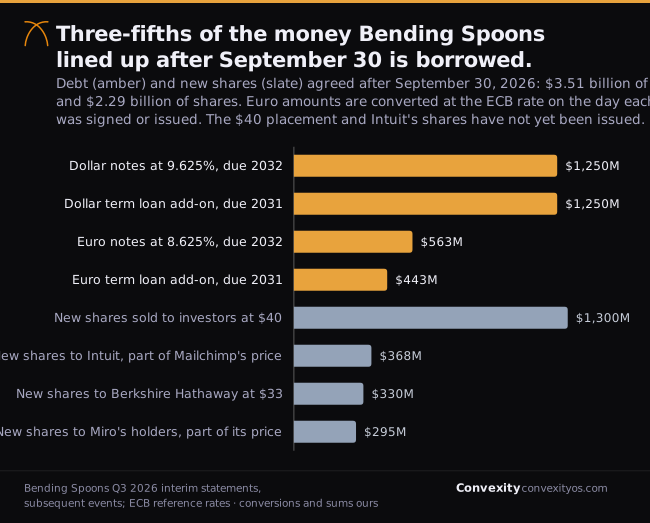
Since the end of September the company has lined up money on a larger scale than ever, and it has done it in a form it had never used. Our October note said Bending Spoons had never issued a bond. On November 4 it did: $1.25 billion of dollar notes at 9.625%, issued by its American subsidiary, and €500 million of euro notes at 8.625%, issued by an Italian subsidiary, both senior secured, both at par and both due in 2032. The parent company neither issues nor guarantees them. The offering was proposed on October 27 at about $1.5 billion and upsized the next day, the company said, following considerable demand. It said the money would fund future acquisitions. That was three weeks before it announced Mailchimp.
| Agreed after September 30, 2026, millions of dollars | |
|---|---|
| Dollar notes at 9.625%, due 2032 | $1K$1,250M |
| Dollar term loan add-on, due 2031 | $1K$1,250M |
| Euro notes at 8.625%, due 2032 | $563M |
| Euro term loan add-on, due 2031 | $443M |
| New shares sold to investors at $40 | $1K$1,300M |
| New shares to Intuit, part of Mailchimp's price | $368M |
| New shares to Berkshire Hathaway at $33 | $330M |
| New shares to Miro's holders, part of its price | $295M |
The notes came on top of two add-ons to the company's existing term loans, $1.25 billion and €395 million due 2031, signed and drawn on October 2, which the company said would pay for Miro and repay its euro revolving credit facility; it repaid the $300 million drawn on that facility on October 5. On the equity side there are four pieces: Berkshire's $330 million, which closed on October 29 and took its stake to 4%; about $295 million that some of Miro's former holders reinvested in about 6.2 million new shares when that deal closed; the $1.30 billion placement, expected to close in the fourth quarter; and Intuit's $368 million at Mailchimp's closing. Converting the euro amounts at the ECB rate on the day of each deal, that is $3.51 billion of debt and $2.29 billion of shares, $5.80 billion in all, of which debt is three-fifths (our arithmetic).
Set against what the company has agreed to buy since September 30, the sums line up closely. Miro and Mailchimp together cost $5.04 billion, and the euro facility took another $300 million. The company has tied the term loan add-ons to Miro. It has tied Mailchimp, which it calls an all-cash transaction, to no financing in particular: on the call Martinelli described the price as a draw on the company's liquidity, its cash plus what it can still borrow under committed facilities, saying the purchase "would reduce liquidity by $3.31 billion, net of Intuit's reinvestment." But the notes, the placement and Intuit's shares come to $3.48 billion, about 95% of the price (our arithmetic). Our reading is that Mailchimp is being paid for with roughly half new debt and half newly issued shares. Counting the IPO, Bending Spoons has now raised or agreed to issue about $3.4 billion of shares since July, roughly six times the $549 million of primary equity it raised in its first thirteen years (our arithmetic). In October the figure was about $1.7 billion, roughly three times.
The debt half has a price that can be stated exactly. The new notes alone carry coupons of $120 million and €43 million a year, together about $169 million at the November 4 exchange rate (our arithmetic), equal to 28% of Mailchimp's segment income in fiscal 2026. The company's interim statements put the hedged rate on its existing dollar term loan at 9.18% and on its euro term loan at 7.69%, so the bonds cost a little more than the loans and lock the rate for longer. At the end of September the company also had $2.33 billion of committed borrowing capacity it had not drawn, and it has added $150 million to its dollar revolving facility and a €150 million term loan facility since.
Martinelli put the rest in one sum. The company reported $3.36 billion of available liquidity at the end of September. Counting the $1.36 billion it paid for Miro afterwards and the $4.46 billion it raised from the loans, the notes, Berkshire, Miro's holders and other borrowings, before fees, that would have been $6.46 billion. The placement adds $1.30 billion and Mailchimp takes $3.31 billion, which would have left $4.45 billion. Ferrari called that "more than $4 billion of available liquidity to support further acquisitions." Later, while encouraging investors to be cautious, he said that "$5 billion on average yearly is a reasonable assumption" for what the company might spend on deals, with the occasional very large one on top. Neither executive gave a leverage ratio for after Miro and Mailchimp close. Ferrari's rule of thumb, given in answer to a question about debt and equity, was that "keeping leverage ratio in the 2 to 3 range" leaves the company in "a highly prudent posture." He also said its credit ratings had improved, to Ba3 at Moody's and BB- at S&P, and that Fitch had now rated it for the first time, at BB. All three are below investment grade.
The case against this note
The strongest objection is that Intuit's cutting is good news for Bending Spoons, not a problem. A buyer that has to create a profit takes the risk that the cuts fail or damage the product, and pays the severance. Here Intuit has taken that risk and paid that bill, and Bending Spoons is paying about 4.6 times a profit that already exists. If Mailchimp simply holds the margin of its last quarter, the price is earned back in under five years before tax, on segment income (our arithmetic). Most buyers would take that.
The second objection is that Intuit's cuts are not Bending Spoons' cuts. Intuit ran Mailchimp as one product inside a large company with its own systems, its own engineers and its own way of working. Bending Spoons has rebuilt businesses on its own technology, with teams a fraction of the size their previous owners used, and its third-quarter release credits AI tooling with a fourfold rise in engineering output per engineer this year. A business that is lean by Intuit's standards can still be heavy by Bending Spoons', and the October note's own figures for Vimeo and Evernote suggest how far the company is willing to go.
The third is that the segment margin may understate the opportunity rather than overstate it. Intuit's revenue explanations describe a shrinking base of paying customers and a mix shift alongside higher prices. A new owner willing to reprice the product for different customers, or to cut the free tier, may find more revenue than a seller preparing a business for sale had any reason to pursue.
We accept part of this. The first objection is right that a lower multiple of an existing profit is a safer purchase than a higher multiple of a promised one. But it is also a different purchase from the ones that built Bending Spoons' record, which came from buying businesses whose costs could be cut sharply. If Mailchimp's return depends more on pricing and further engineering efficiency than on a large reorganization, that is a change in what the machine is being asked to do, at its largest price yet and with its most expensive debt. The second and third objections may well prove correct. The filings do not yet show it.
What would prove this wrong
- A large reorganization at Mailchimp after closing. If Bending Spoons reports separation packages at Mailchimp on the scale of AOL, Eventbrite and Vimeo, or says it expects to keep only a small fraction of Mailchimp's staff, then Intuit left most of the cutting undone and this note's premise was mistaken.
- Mailchimp's profit rising well above Intuit's last quarter while revenue holds. Bending Spoons does not report its businesses separately, but if it discloses Mailchimp's earnings after a year of ownership and they are well above $808 million a year, Intuit's latest quarter at an annual rate, without revenue falling faster than the 1% Intuit itself forecast, the cuts Intuit made were only the first round.
- Reorganization expense below a tenth of Adjusted Operating Income for a full year that includes Mailchimp's first months. That would satisfy the October test even through the biggest integration yet.
- Leverage near or below this quarter's 2.1 after both deals close. The company's own rule of thumb, restated on the call, is a ratio of 2 to 3, so anything up to 3 is within what it calls prudent. If the equity half of the funding holds the ratio down without another round of shares, the debt behind Mailchimp is supported by earnings the company already has.
- GAAP earnings per share rising with the adjusted figure in 2027. In this quarter the two moved in opposite directions; a year in which both grow would show the deal costs are falling as a share of what the business earns.
The filings, records and prices this is built on
23 documents
- 016-KBending Spoons Q3 2026 earnings release (Exhibit 99.1, "Bending Spoons Announces Q3 2026 Results")Revenue, gross profit, operating income and margin, net income, diluted and adjusted earnings per share, organic growth and its contributors, Airtable’s $38 million, the $189 million of amortization and $65 million catch-up, the reconciliation to Adjusted Operating Income, the $57 million valuation allowance release, net debt, leverage, cash, available borrowing capacity, the change in net debt, the operating highlights at AOL, Tractive and Vimeo, the AI tooling and pull requests, the fourth-quarter and full-year forecasts and the earlier ranges, and the call’s date and timeFurnished Nov 19, 2026sec.gov
- 026-KBending Spoons Q3 2026 condensed consolidated interim financial statements (Exhibit 99.2)Quarterly and nine-month income statement and cash flow lines, interest paid, debt principal and the hedged rates on the term loans, and the subsequent-events note: Miro’s closing and shares, Mailchimp’s 8.8 million shares to Intuit, Berkshire’s closing, the placement of 32.5 million shares at $40, the October 2 term loan add-ons, the November 4 notes and their coupons and issuers, the October 5 repayment and the facility increases of October 23, November 10 and November 12Furnished Nov 19, 2026sec.gov
- 03CallBending Spoons Q3 2026 earnings call transcript, The Motley FoolRetrieved 2026-11-20. Speakers as introduced by James Cordwell, head of investor relations: Luca Ferrari, co-founder and chief executive, on Mailchimp’s opportunity, returns, price, customers and closing, the Spooners, the fourth-quarter growth drivers, liquidity for further deals, leverage and ratings; Enrico Martinelli, co-chief financial officer, on organic growth by acquisition year, Remini, the liquidity bridge and the fourth-quarter margin; and the question from Stefan Slowinski of BNP Paribas. Quoted only where the second transcript carries the same wordsHeld Nov 20, 2026fool.com
- 04CallBending Spoons Q3 2026 earnings call transcript, roic.aiRetrieved 2026-11-20. An independently produced transcript of the same call, checked against the first; the period matches the release ($780 million of revenue for the quarter). Where the two differ in wording, the note paraphrasesHeld Nov 20, 2026roic.ai
- 056-KBending Spoons has entered into a definitive agreement to acquire MailchimpThe $3.68 billion enterprise value, Intuit’s $368 million investment, the structure, the expected closing in early 2027, and Luca Ferrari’s statementFurnished Nov 19, 2026sec.gov
- 066-KBending Spoons announces $1.3 billion private placement of ordinary sharesThe 32.5 million shares, $1.30 billion of expected gross proceeds, new and existing investors, and closing in the fourth quarterFurnished Nov 19, 2026sec.gov
- 076-KBending Spoons announces proposed offering of senior secured notesThe proposed $1.5 billion size, the issuers, that the parent will not issue or guarantee the notes, and the stated use of proceedsFurnished Oct 27, 2026sec.gov
- 086-KBending Spoons announces pricing of senior secured notesThe upsized offering of about $1.8 billion, the coupons of 9.625% and 8.625%, issue at par, maturity in 2032, and the expected settlement on November 4Furnished Oct 28, 2026sec.gov
- 096-KBending Spoons successfully syndicates upsized term loan B add-onsThe $1.25 billion and €395 million add-ons due 2031 and their use for Miro and the euro revolving facilityFurnished Oct 2, 2026sec.gov
- 106-KBending Spoons completes the acquisition of MiroThe closing and the about $295 million reinvested by former Miro holders in about 6.2 million sharesFurnished Oct 26, 2026sec.gov
- 116-KBending Spoons enters into a definitive agreement to acquire Miro for $1.355 billionMiro’s enterprise value and Ferrari’s statement on investing after closingFurnished Sep 10, 2026sec.gov
- 126-KBending Spoons has entered into a definitive agreement to acquire Airtable for $1.285 billionAirtable’s enterprise value, its recurring revenue growth of more than 20%, and the statement on investing for the long runFurnished Aug 4, 2026sec.gov
- 136-KBerkshire Hathaway completes further $330 million investment in Bending SpoonsThe closing, 10 million shares at $33.00, and Berkshire’s 4% stakeFurnished Oct 29, 2026sec.gov
- 146-KBending Spoons announces Q2 2026 resultsTractive’s $759 million enterprise value and its May closingFurnished Aug 13, 2026sec.gov
- 15424B4Bending Spoons S.p.A. prospectusThe aggregate enterprise value of acquisitions by year, the 25% unlevered and 65% levered return hurdles and how they are calculated, its remark that the hurdles may have to come down as the company scales, and the $549 million of primary equity raised before the IPOFiled Jul 1, 2026sec.gov
- 1610-QIntuit Inc., quarterly report for the quarter ended October 31, 2026Mailchimp segment revenue, operating income and its share of revenue for both first quarters; the reasons for the changes in revenue and segment income; the sale agreement, its cash and stock components, the share count’s basis and the sale restriction, the expected pre-tax gain and the use of proceeds; the 2026 restructuring plan by segmentFiled Nov 19, 2026sec.gov
- 178-KIntuit Inc., recast fiscal 2026 annual report items for the Mailchimp segment (Exhibit 99.01)Mailchimp revenue, segment costs and segment operating income for fiscal 2024 to 2026, the reasons for the fiscal 2026 changes, and what Intuit leaves out of segment operating incomeFiled Nov 19, 2026sec.gov
- 188-KIntuit reports first-quarter results and enters agreement to sell Mailchimp to Bending SpoonsThe sale terms, the statement on focus, the planned share repurchases and Intuit’s fiscal 2027 forecast for Mailchimp revenue, which excludes the saleFurnished Nov 19, 2026sec.gov
- 1910-QIntuit Inc., quarterly report for the quarter ended January 31, 2022Intuit’s acquisition of Mailchimp on November 1, 2021, for $12.0 billion, $5.7 billion in cash and Intuit shares worth about $6.3 billionFiled Mar 2, 2022sec.gov
- 20DataEuropean Central Bank euro reference rates, US dollar1.1225 dollars per euro on October 2 and 1.1267 on November 4, used to convert the euro term loan add-on and the euro notesRetrieved Nov 19, 2026data-api.ecb.europa.eu
- 21PricesDaily closes for BSPOfficial closing prices from Nasdaq, where Bending Spoons lists: $47.07 on October 16, $41.70 on November 19 and $41.05 on November 20. October 16 and November 19 match the official closes in our brokerage data feedNov 20, 2026nasdaq.com
- 22PricesDaily closes for INTUOfficial closing prices from Nasdaq, where Intuit lists: $310.02 on November 19, matching our brokerage data feed, and $270.44 on November 20Nov 20, 2026nasdaq.com
- 23DataState Street, SPDR S&P 500 ETF Trust (SPY) daily holdingsUsed for the disclosure only: Intuit, Berkshire Hathaway, Moody’s and S&P Global are held; holdings as of November 18, 2026, retrieved 2026-11-19Nov 18, 2026ssga.com
Not investment advice. This is a reading of public filings and official records, published for research purposes. It is not a recommendation to buy, sell or hold any security, and it is not a price target.
What here is ours rather than the companies'. As filed or stated by the companies, and not ours: every revenue, cost, income, margin as Intuit prints it, growth, organic growth, earnings per share, cash flow, debt, interest rate, leverage and forecast figure; the enterprise values of every deal and the yearly totals; the $12.0 billion Intuit paid in 2021; the share counts and prices of the placement, Berkshire's purchase and the Miro and Intuit shares; the hurdle rates and their definitions; the $549 million of earlier equity; every quotation, each from a filing, a company release or the November 20 call in wording both transcripts carry; and the credit ratings, as the chief executive stated them on the call. As published by the ECB: exchange rates. As published by Nasdaq and our brokerage data feed: share prices. Ours: the $2.99 billion three-year sum, Mailchimp's 23% premium over it, the $5.41 billion and $9.09 billion 2026 totals; Mailchimp's shares of Bending Spoons' forecast revenue and Adjusted Operating Income; the sale at 31% of Intuit's price; the roughly $42 a share implied for Intuit's stake; every margin computed from segment figures, the 38% fall in segment costs and the $444 million annual run rate; the four price multiples and the two earnings yields; the $3.13 billion and $3.02 billion hurdle comparison and our reading of it; the placement's premiums to Berkshire's price and the IPO price, its 4.1% discount to Thursday's close and Intuit's price within about 1% of it; the Friday changes of 1.6% in Bending Spoons' shares and 12.8% in Intuit's, and the placement's 2.6% discount to Friday's close; GAAP operating income and margin without the catch-up; the deal add-backs as shares of Adjusted Operating Income; reorganization expense as a share of Adjusted Operating Income by quarter and over nine months; the inference that the businesses bought before 2023 grew more slowly than 3%, and the roughly 4% fourth-quarter forecast without Airtable and Miro; the fall in income before tax; interest as a share of operating income; acquisition spending as a multiple of operating cash flow; every euro conversion, the $3.51 billion, $2.29 billion and $5.80 billion totals and the three-fifths share; the $3.48 billion and its 95% of Mailchimp's price, and our reading that Mailchimp is funded half by debt and half by equity; the $3.4 billion of equity since July and its multiple of the earlier total; the notes' $169 million of annual coupons and their 28% of Mailchimp's segment income; and the payback of under five years.
On our own position. A member of the Convexity team holds SPY, whose holdings include Intuit, Berkshire Hathaway, Moody's and S&P Global. No other position, and no position in Bending Spoons.