
Disclosure. Not investment advice, and nothing here is a recommendation to buy, sell or hold any security. A member of the Convexity team owns Meta shares directly and stands to benefit if they rise, and holds the SPDR S&P 500 ETF (SPY), which holds Microsoft, Alphabet, Amazon, Meta, Oracle and Nvidia, all named below. We hold no position in CoreWeave, SB Energy or Holtec. A team member also holds an economic interest in Anthropic, whose chief executive's essay figures in this note, through a special-purpose vehicle and a fund, and benefits if its valuation rises; Convexity's product runs on Anthropic's models; and this note was researched and drafted with Claude, Anthropic's model. Treasury yields are Treasury's own published par yields, oil prices are the Energy Information Administration's, and bond terms are from the companies' filings; the closing note lists what is our arithmetic.
On September 16, the day the Federal Reserve raised its target range for the first time since 2023, the 30-year Treasury closed at 5.35% on the Treasury's own par yield curve. That was, to the hundredth of a point, its high of 2007. By September 30 it was 5.64%, the highest on the Treasury's curve since July 2001 (a curve that carries no 30-year figure from 2002 to 2006, when the bond was not issued), and on October 6 it was still 5.64%.
The September story most readers heard was about demand. On Monday September 14, the first session after Anthropic's chief executive published an essay arguing that frontier AI labs should slow down, the iShares Semiconductor ETF fell 5.6% and Micron 5.3%. That scare lasted a week. By October 5 the semiconductor fund was 11.8% above its close of September 11. The rise in the price of money, which arrived the same week, has not reversed at all.
This note is about the second shock, because the AI buildout is, more than anything else, a borrower. Our financing ledger of September 24 counted $516.8 billion of debt on the balance sheets of Microsoft, Alphabet, Amazon, Meta, Oracle and CoreWeave, up from $254.7 billion a year earlier, and $1.15 trillion of leases those six have signed and not yet started, most of them for data centers someone else is building and financing. The question a 30-year yield above its 2007 high puts to that structure is not whether it can pay. For most of it, it plainly can. The question is who pays for the change, and the filings give a more specific answer than the headline does: the hyperscalers mostly locked in, their bondholders absorbed the move, and the bill for new money falls on the developers and neoclouds who build what the hyperscalers lease.
U.S. Treasury daily par yield curve rates; the companies' pricing term sheets; CoreWeave 8-K of September 22, 2026; EIA daily Brent spot price. The $17.5 billion is our arithmetic on the filed terms and the published yields.
The long end, measured
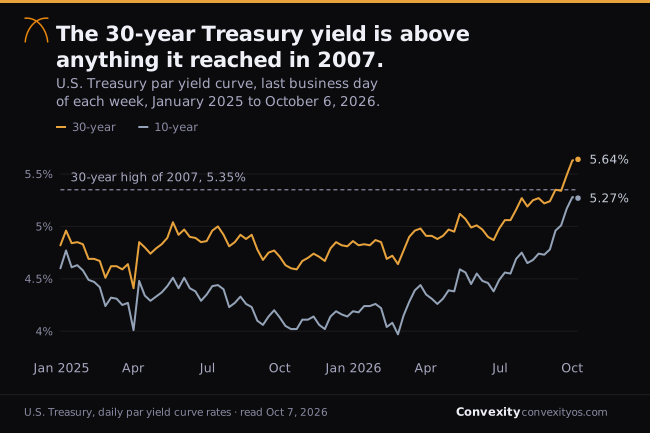
The whole curve moved this year, and it moved in two stages. From the last day of 2025 to October 6 the 2-year rose 132 basis points, the 5-year 130, the 10-year 109 and the 30-year 80, on the Treasury's published par yields. Most of that is the market pricing a hiking cycle, so the short and middle of the curve moved most. Since September 15, the day before the hike, the order has reversed: the 2-year is up 12 basis points and the 30-year 28. The hike itself was expected. What was not expected, judging by the shape of the move, was how long rates would stay high, and that is a question the long end answers. The 2-year closed at 4.79% on October 6, well above the top of the Fed's new 3.75% to 4% range, which is the market saying it expects the September hike to have company. The 10-year closed the same day at 5.27%, a hundredth of a point above its 2007 high, which on the Treasury's curve makes it the highest since May 2002.
Two other prices moved with it, and both bear on the buildout. The Energy Information Administration's daily Brent price was $70.46 on June 30 and $130.80 on September 15, and it closed at or above $100 on nineteen of the twenty-one September sessions it had published by September 29 (our count). Power is the buildout's other large input, and the developers who sign power contracts for data centers price them against it. Holtec's statement postponing its IPO on September 17 listed "rising energy costs" beside the Fed among the reasons, and the oil move is one reason the long end and the short end can rise together: a central bank raising rates into an energy shock is pricing inflation that does not go away by itself, and a 30-year bond holder wants to be paid for the chance that it lasts. That matters for the buildout because its assets are long-lived and its revenue is mostly fixed in contracts signed earlier. Rent that escalates at 2% to 3% a year, against consumer prices that rose 3.4% in the year to August and 4.2% in the year to May (our arithmetic on the Bureau of Labor Statistics index), is a slow transfer from the landlord to the tenant, and it compounds for twenty years.
What the move did to the bonds the buildout sold
Since January 2025, Alphabet, Amazon, Meta and Oracle have sold $250.25 billion of U.S. dollar notes through registered offerings, and about $75.8 billion more in euros, sterling, Canadian dollars and yen, on the dollar amounts their fee exhibits record. Microsoft sold none. The pace has risen: $93.25 billion of dollar notes in all of 2025, and $157.0 billion in 2026 by the end of August. And the buildout borrowed long. Of the dollar notes, $107.25 billion, 43% of the total, mature twenty years or more after they settled, and the longest run to 2075 and 2076. Alphabet's sterling offering in February included a note due in 2126.
What a 30-year yield above its 2007 high does to those notes is arithmetic, and we did it note by note. For each of the 78 fixed-rate dollar tranches, we took the yield it was sold at, moved it by the change in the Treasury par yield at the matching point of the curve between its pricing date and October 6, and priced it again on its remaining term. That holds every note's spread where it was when it was sold, so it isolates what the Treasury market did and says nothing about how the market now judges each company's credit. On that move alone, the $244.0 billion of fixed-rate dollar notes is worth about $17.5 billion less than at issue, and the $107.25 billion of long notes about $10.7 billion less, roughly ten cents on the dollar (our arithmetic). Meta's 5.625% notes due 2055, sold in October 2025 at 5.637%, would price near 87 cents; Amazon's 5.800% notes due 2056, sold in March at 5.840%, near 88.5.
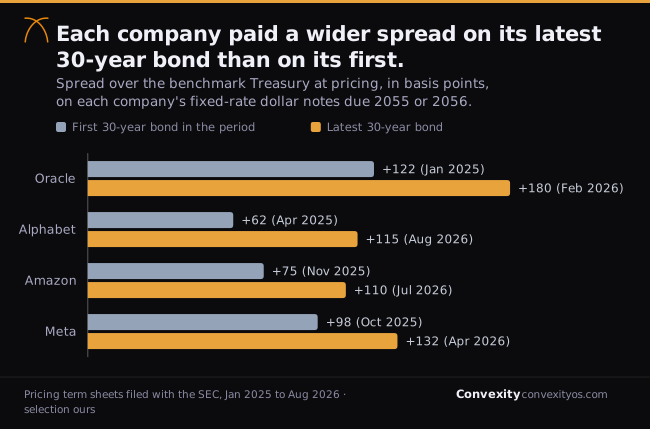
The spreads are the half of the cost the Treasury chart cannot show, and they were moving before September. Every one of the four paid a wider spread on its latest 30-year note than on its first: Oracle 122 basis points over Treasuries in January 2025 and 180 in February 2026, Alphabet 62 in April 2025 and 115 this August, Amazon 75 and then 110, Meta 98 and then 132. Add the Treasury move to the spread and the all-in cost of 30-year money rose by two-thirds of a point to a full point between each company's first such note and its latest, all before the hike: Alphabet from 5.314% to 6.377%, Oracle from 6.014% to 6.714%, Meta from 5.637% to 6.310%, Amazon from 5.483% to 6.147%. Supply is the explanation the issuance numbers support. Four issuers came back to the long end again and again within twenty months, and each time they paid a little more to find the buyers.
What the next bond costs
Put the two halves together and the price of the next 30-year note is easy to estimate, if not to know. Take each company's spread on its latest 30-year note and add it to the 30-year Treasury's 5.64% on October 6. That gives roughly 6.74% for Amazon, 6.79% for Alphabet, 6.96% for Meta and 7.44% for Oracle (our arithmetic, and only an estimate, because a new deal would price against the benchmark bond of the day, at whatever spread the market then asked). Their first 30-year notes in this period priced between 5.31% and 6.01%.
The bill already incurred is modest by the standards of these companies. The 78 fixed-rate dollar tranches carry $12.86 billion a year of coupons, a weighted average of 5.27% (our arithmetic on the filed coupons). The dollar notes sold in 2025 averaged 5.09%; those sold in 2026 averaged 5.39%; the long tranches alone average 5.97%. Our ledger counted $714.2 billion of operating cash across six companies over four quarters, so this interest bill is not where the stress shows, and this note does not argue that it is.
The cost is at the margin. The same ledger found the six spending 85.0% of their operating cash on capital projects, against 63.5% a year earlier, with buybacks turned into stock sales. A buildout funded at that ratio has three sources of money for the rest: cash it stops returning, stock it sells and notes it issues. The third got dearer by two-thirds of a point to a full point between each company's first long note and its latest, and dearer again in September. Every $10 billion of new 30-year paper at the estimates above costs $674 million to $744 million a year in coupons, against $509 million at the 5.09% the 2025 notes averaged (our arithmetic). That difference does not threaten anyone's credit. It does change the hurdle that a data center financed with long debt has to clear, and the companies set those hurdles when they sign the leases.
Who that loss belongs to
For the hyperscalers themselves, a higher long end costs little today, because they borrowed fixed and long. The ledger said as much of four of them in September: the debt is "long-dated, mostly fixed-rate, and smaller than a single year of each company's operating cash." Amazon sold a 40-year note in March at 5.970%, and it pays 5.950% on it until 2066 whatever the long end does next. The mark-to-market loss belongs to whoever bought the note.
What the move changes for the hyperscalers is the next bond. On the Treasury move alone, a new 30-year bond costs about 80 basis points more than it would have on the last day of 2025, and about 28 more than the day before the hike. None of the five has sold a registered bond since the hike (our check of EDGAR's index from September 16 to October 6), and that is weak evidence either way, because the weeks before third-quarter results are a quiet period for most of them. It is not a quiet period for all of them, though: Oracle priced a registered bond deal on September 24, 2025, inside the same window a year earlier.
Oracle is the one hyperscaler where the long end already shows up in the filings. Our note of September 16 marked its borrowings at 84.6 cents on the dollar of carrying value at the end of August, from a five-quarter band near 90, using the fair value Oracle itself reports and a modified duration of 8.5 years. The 20-year Treasury, the benchmark that note used, was 5.24% on August 31 and 5.68% on October 6. On that method, and holding spreads where they were, 44 basis points takes about 3.7 cents more off, to roughly 80.8 cents (our arithmetic), or about $101 billion of market value against $125.0 billion carried. Oracle's next 10-Q will report the real figure; this one is only the Treasury half of it, and the spread half has been moving against Oracle all year: its 30-year notes priced at 122 basis points over Treasuries in January 2025 and 180 in February 2026, the widest of the four. Oracle is also the one hyperscaler whose capital spending runs well ahead of its operating cash, 161% in our ledger's four quarters, so it is the one whose next note matters most. The alternative it has already used is stock: our September note found its $20 billion at-the-market program drawn, $19.9 billion sold in a single quarter. Against paying something like 7.4% for thirty years, a second program looks cheaper than it did in February. Its stock closed at $142.48 on October 5, 5.2% below its close of September 11, in the same weeks the semiconductor fund rose 11.8%.
The borrowers who did not lock in
The buildout is not only the hyperscalers. Most of the $1.15 trillion of unstarted leases are with developers and neoclouds that build the buildings, buy the chips and borrow to do it, and they borrow differently.
CoreWeave borrows at the middle of the curve and at high-yield spreads. Its straight notes carry coupons of 8.5% to 9.75%, and our September 22 note found $15.0 billion of principal falling due by the end of 2028 and refinanced, so far, with new debt rather than from its backlog. On September 17, the day after the hike, CoreWeave priced convertible notes due 2033. The offering was upsized to $4.2 billion, closed on September 22, and carries a coupon of 2.875%. Its two earlier convertible issues carry 1.75%. The notes convert at about $97.85 a share, a premium of 22.50% to the stock's close that day. So the market stayed open to the most leveraged borrower in the group, and the price of staying open was about 1.1 percentage points of coupon on a security that is partly equity. The 5-year Treasury, the tenor CoreWeave's straight notes live at, is up 130 basis points since the last day of 2025. For a company whose interest expense was already $640 million in the second quarter, 24.9% of its revenue on our earlier count, the coupon on the next straight note is not a rounding error, and the convertible's lower coupon was bought with dilution: the notes convert into about 42.9 million shares at the initial rate (our arithmetic, 10.2194 shares per $1,000 on $4.2 billion), before the capped calls it bought to offset some of that.
SB Energy, which is in registration for an IPO and is the subject of our note on the shut IPO window, is the clearest case of the mechanism. Its data center leases are "triple-net lease[s] with yield-on-cost rent" and contractual escalators "generally ranging from 2% to 3% per annum," signed before the debt that funds them is raised. It names the exposure itself: "We are exposed to interest rate risk primarily through our variable rate indebtedness and through timing gaps between the execution of revenue contracts and the closing of project financing." For its Ohio campus it is "targeting up to 90% debt financing of per-building capital expenditures representing a range of $8 billion to $9 billion per building." Rent set before rates rose, debt raised after: the difference is the developer's to absorb. Its own stated sensitivity on existing floating-rate debt is modest, about $29.9 million a year for each 100 basis points before its swaps, because most of what it will borrow has not been borrowed yet.
Holtec, the nuclear developer that withdrew its IPO on September 25, borrowed $60.0 million in July from its founder's family office at one percent a month. That is the far end of the same spectrum: a borrower close enough to the edge of the market that the cost of waiting for it is written in a related-party loan.
So the answer to who pays has two parts. The long end's rise is a loss for the holders of the hyperscalers' long bonds and a higher cost on the hyperscalers' next ones. The rise across the middle of the curve, together with the equity window that shut in September, is a cost for the companies that build what the hyperscalers lease, signed at rents fixed before the move.
The case against this note
There is a good argument that none of this matters much, and it is worth making properly.
The first part is that the long end is not about AI. The Federal Reserve raised rates while describing an economy "expanding at a solid pace," Brent was above $100 for most of September, and a 30-year yield is in large part a price on inflation and on how long the Fed will need to hold rates up. Nothing in this note says the buildout caused the move. It says only that the buildout, as one of the largest borrowers at the long end in this period, bears it.
The second is that the hyperscalers can absorb it. Their coupon bill is a small fraction of their operating cash, spreads of 110 to 180 basis points are investment-grade spreads, and two of the four, Alphabet and Oracle, sold stock in the last four quarters rather than borrow all of what they needed (our ledger counted $49.6 billion and $24.9 billion). On that reading the repricing is a cost of doing business rather than a constraint on it.
The third is that the equity market has looked at the same September and shrugged. The semiconductor fund closed October 5 at its highest level of the period we looked at, Meta's stock rose, and CoreWeave's convertible offering was upsized rather than cut. Investors who buy the equity are not behaving as if the cost of money has changed the outcome.
We think the third point is the strongest, and it is the one this note cannot answer from filings. The first two we accept. What the filings do show is narrower than "rates threaten the buildout" and harder to dismiss: the buildout's long debt has lost about $17.5 billion of value on the Treasury move alone, its 30-year money cost two-thirds of a point to a full point more in each company's latest note than in its first, and the companies that will feel the next point first are the developers, not the hyperscalers.
What would prove this wrong
- The long end gives it back. If the 30-year returns below its 2007 high of 5.35% and stays there, most of the mark in this note unwinds, and the loss to bondholders was a September event rather than a repricing.
- The hyperscalers issue at size and cheaply. A large registered bond deal from any of the five in November, at a spread close to what it paid in the first half, would show the debt window open and the cost limited to the Treasury move itself.
- The developers refinance on old terms. CoreWeave pricing new straight notes inside the 8.5% coupon of its cheapest existing ones, or SB Energy closing its Ohio project financing near the terms it modelled, would say the middle of the curve is not where the cost lands.
- Oracle's next fair value comes in near 85 cents or above. That would mean its spread tightened enough to offset the Treasury move, and the arithmetic here overstates the loss.
The data and filings this is built on
- DataU.S. Department of the Treasury, Daily Treasury Par Yield Curve RatesThe 2-, 5-, 10-, 20- and 30-year par yields cited, 2000 to October 6, 2026, one file per year; read 2026-10-07Oct 6, 2026
- DataU.S. Energy Information Administration, Europe Brent spot price FOB, dailyRead 2026-10-07; latest observation September 29, 2026Sep 29, 2026
- DataBureau of Labor Statistics, Consumer Price Index for All Urban Consumers, all items, not seasonally adjusted (CUUR0000SA0)Monthly index levels through August 2026; the year-over-year changes are ours; read 2026-10-07Aug 2026
- FOMCFederal Reserve, FOMC statementThe target range raised to 3-3/4 to 4 percentSep 16, 2026
- FWPOracle Corporation, pricing term sheet for senior notesJan 30, 2025
- FWPAlphabet Inc., pricing term sheet for senior notesApr 28, 2025
- FWPMeta Platforms, Inc., pricing term sheet for senior notesOct 30, 2025
- FWPAmazon.com, Inc., pricing term sheet for senior notesNov 17, 2025
- FWPOracle Corporation, pricing term sheet for senior notesFeb 2, 2026
- FWPAmazon.com, Inc., pricing term sheet for senior notesMar 10, 2026
- FWPMeta Platforms, Inc., pricing term sheet for senior notesApr 30, 2026
- FWPAmazon.com, Inc., pricing term sheet for senior notesJul 7, 2026
- FWPAlphabet Inc., pricing term sheet for senior notesAug 6, 2026
- EssayDario Amodei, We Must Pace the FrontierSep 12, 2026
- 8-KCoreWeave, Inc., completion of the 2.875% convertible senior notes due 2033Size, coupon, maturity, conversion price and premium, and the existing notes listed in the guaranteeSep 22, 2026
- S-1/ASB Energy, Inc., Amendment No. 2 to Form S-1Lease structure and escalators, the interest rate risk factor, the PORTS-Pike financing target and the rate sensitivitySep 21, 2026
- IndexSEC EDGAR full index, quarterly master files, 2025 Q3 to 2026 Q4Registered bond filings (424B2, 424B5 and FWP) by the five companies; read 2026-10-06Read Oct 6, 2026
- PricesDaily closes for SOXX, MU, NVDA and ORCL, September 10 to October 5, 2026From our brokerage data feed; settled closesOct 5, 2026
Not investment advice. This note is analysis of public data and filings, published for research purposes, and not a recommendation to buy, sell or hold any security. A member of the Convexity team owns Meta shares directly and holds SPY, which holds Microsoft, Alphabet, Amazon, Meta, Oracle and Nvidia; holds an economic interest in Anthropic through a special-purpose vehicle and a fund; and we hold no position in CoreWeave, SB Energy or Holtec. Convexity's product runs on Anthropic's models, and this note was drafted with Claude.
What here is ours rather than the sources'. As published: every Treasury yield, every Brent price, the FOMC decision, CoreWeave's coupon, size, conversion price and premium, every quoted SB Energy sentence, and the closing prices. Ours: every change in basis points, the year-over-year inflation rates computed from the BLS index, the count of Brent sessions at or above $100, the "highest since" dates (from Treasury's files back to 2000, which carry no 30-year yield from 2002 to 2006), the equity returns, the extension of our September 16 Oracle method to October 6 and its 80.8 cents and roughly $101 billion, the observation that none of the five filed a registered bond between September 16 and October 6, the selection of the 78 fixed-rate dollar tranches and their totals, the repricing of each to October 6 on the Treasury move and the $17.5 billion and $10.7 billion that result, the prices quoted for the Meta and Amazon notes, the choice of each company's 2055 and 2056 notes for the spread comparison, and the changes in their spreads and yields. Every tranche is listed, with its term sheet, in the figure files published with this note.