








Disclosure. Not investment advice, and nothing here is a recommendation to buy, sell or hold any security. A member of the Convexity team holds the SPDR S&P 500 ETF (SPY), whose holdings include Intuit; no other position in any company named here, including Bending Spoons, which SPY does not hold. Figures are from Intuit's first-quarter Form 10-Q, its earnings release and its recast fiscal 2026 statements, both filed on Form 8-K on November 19, its annual reports for fiscal 2022, 2023 and 2026, its fact sheet, two transcripts of its November 19 earnings call, and Bending Spoons' announcement and interim financial statements of the same day. Share prices are official closing prices. The closing note lists what is our arithmetic.
In November 2021, Intuit (INTU) paid $12.0 billion for Mailchimp, the email marketing service. On Thursday, November 19, 2026, a little over five years later, it agreed to sell Mailchimp to Bending Spoons (BSP) for about $3.68 billion.
Then, in the quarterly report it filed that same afternoon, Intuit told investors that when the sale closes it expects to record a gain.
Both statements are accurate. The distance between them is the most instructive thing in Intuit's filings this quarter, and it has nothing to do with Mailchimp being worth more than Intuit thought. It comes from where the price Intuit paid has been kept. Most of the $12.0 billion was booked as goodwill, and that goodwill spent nearly five years pooled with QuickBooks. When Mailchimp was given a reporting unit of its own, in the year to July 2026, only $641 million of goodwill went with it. The rest, some $7.5 billion of what the purchase created, stays behind when Mailchimp leaves.
So the gain says something narrow and true: the buyer is paying more than the slice of the books that walks out the door. It does not say the purchase worked. On the cash alone, Intuit paid out $5.7 billion and will take back about $3.31 billion.
The sale arrived beside a quarter that beat Intuit's own forecast and a full-year revenue outlook that Intuit lowered anyway, entirely because of Credit Karma. This note takes the sale first, because the filings explain it fully, and then the quarter.
- $12.0bn
- what Intuit paid for Mailchimp on November 1, 2021, $5.7 billion of it in cash
- $3.68bn
- the agreed sale price, about $3.31 billion in cash and $368 million in Bending Spoons shares
- $641m
- the goodwill that leaves with Mailchimp, of $8.1 billion its purchase created
- $172.5m
- cut from the midpoint of fiscal 2027 revenue guidance, all of it Credit Karma
The purchase figures are from Intuit's fiscal 2022 and 2023 annual reports; the sale and the goodwill from its November 19 Form 10-Q and recast Form 8-K; the guidance from its August 25 and November 19 earnings releases. The midpoint change is our arithmetic.
What $12.0 billion bought, on paper
The purchase closed on November 1, 2021. Intuit paid $5.7 billion in cash, $4.7 billion of it borrowed that same day on a new term loan, and 10.1 million of its own shares, valued at $6.3 billion at the October 29, 2021 closing price of $625.99. It also issued restricted stock units to Mailchimp's people: about $355 million of them replacing awards the employees already held, and $211 million more, which it charged to expense as pay over the following years rather than counting in the price.
When a company buys another, it has to say what the price was for. Intuit's answer, which it completed in fiscal 2023 with no material change to its first estimate, was that it could put a name to about $4.3 billion of it. Mailchimp's customer relationships were valued at $3,160 million and would be written off over 13 years. Its technology was valued at $900 million over nine. The Mailchimp name and trademarks came to $280 million over ten. The ordinary operating balances came to a net negative $446 million, by our sum: $272 million of cash, investments, receivables and other assets, less $718 million of liabilities led by $409 million of accrued pay and $163 million of payables.
Everything else, $8,102 million, was goodwill. Intuit attributed it to "the assembled workforce of Mailchimp and the synergies expected to be achieved."
Goodwill behaves differently from the other assets. It is never written off on a schedule. It sits on the balance sheet at its original amount until a test says the business carrying it is worth less than its book value, at which point it is written down. And the test is not run on each acquisition separately. It is run on reporting units, the groupings of business a company manages, and Intuit assigned all of Mailchimp's goodwill to its Small Business & Self-Employed segment, the home of QuickBooks. That segment's goodwill went from $1,578 million at July 31, 2021, to $9,689 million a year later.
From then on, Mailchimp's goodwill sat beside QuickBooks. In every annual test Intuit has reported since the purchase, through the one in the fourth quarter of fiscal 2026, it found that "the estimated fair values of all of our reporting units substantially exceeded their carrying values." A business whose online ecosystem grew revenue 23% in fiscal 2026 alone could carry a great deal of goodwill that was not its own without coming close to failing that test.
How a $3.68 billion sale becomes a gain
That arrangement ended in fiscal 2026. Intuit says it established a Mailchimp reporting unit during the year to July 2026, and from August 1, 2026, it began managing Mailchimp as a segment of its own. The recast statements it filed on November 19 show what happened to the goodwill. The accounting rule for a reorganization of reporting units is to split the goodwill between them by their relative fair values, and Intuit says that is what it did.
Global Business Solutions, the segment where QuickBooks and Mailchimp's goodwill sat, began fiscal 2026 with $9,825 million of goodwill. It transferred $641 million to Mailchimp. That is 6.5% of the pool, by our arithmetic. Read plainly, Intuit valued Mailchimp at roughly one-fifteenth of the combined business it was being carved from.
Global Business Solutions ended the year with $9,180 million, the remaining difference being $4 million of currency translation and other changes.
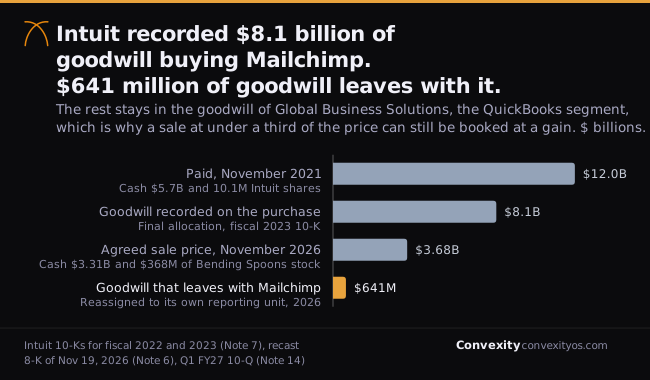
| Dollars | |
|---|---|
| Paid, November 2021 | $12.0B |
| Goodwill recorded on the purchase | $8.1B |
| Agreed sale price, November 2026 | $3.7$3.68B |
| Goodwill that leaves with Mailchimp | $0.6$641M |
A gain on a sale is the price less the book value of what is sold. Mailchimp's book value is now three things: the $641 million of goodwill, whatever is left of the $4,340 million of named intangible assets after five years of amortization, and its operating balances. Intuit does not print the middle number for Mailchimp alone, so here is ours. On the lives Intuit disclosed and the straight-line method it says it uses, 60 months of amortization from November 2021 to October 2026 would leave about $2,485 million of those intangibles, assuming none was written down. With the goodwill, that is about $3,126 million, below the $3.68 billion price.
That is not an estimate of the gain, and we will not offer one. The 10-Q says the amount will depend, "among other things," on "the net carrying value of Mailchimp at closing, closing adjustments, selling costs, and the closing-date fair value of the Bending Spoons common stock." The operating balances were negative at acquisition and nobody outside Intuit knows them now. The number of Bending Spoons shares was fixed at signing, but they will be valued on the day the deal closes, and they carry a six-month contractual restriction on sale. What the arithmetic does show is why a gain is possible at all. Had Mailchimp carried the $8.1 billion of goodwill its own purchase created, the same sale would be a loss measured in billions.
So the right way to read Intuit's expected gain is narrow. It says Bending Spoons is paying more than the part of Intuit's balance sheet that leaves with Mailchimp. It does not say the purchase earned its price. The sale price is 30.7% of what Intuit paid, by our arithmetic. The cash coming back, about $3.31 billion, is $2.4 billion less than the cash that went out in 2021. And the bulk of what Intuit paid for, about $7.5 billion of goodwill that did not move, remains on the books of Global Business Solutions, where it will be tested alongside QuickBooks for as long as Intuit owns QuickBooks.
None of this is hidden or improper. The rules require exactly this treatment, and Intuit disclosed every step. But it does mean the gain line, when it appears in a future quarter, will describe the accounting rather than the investment.
There is one more question the filings leave open, and it is the one with cash attached. Intuit's annual reports for fiscal 2022 and 2023 say that "substantially all" of Mailchimp's goodwill is "deductible for income tax purposes," which generally means it can be written off for tax over time, while the book goodwill sits unchanged. The tax result of the sale therefore depends on a different basis from the one that sets the book gain, and the two need not point the same way. Intuit has not said what tax the sale will carry, and we do not know.
The business Intuit is selling
The recast statements also give, for the first time, three full years of Mailchimp as a business of its own. They describe one that stood still.
Mailchimp's revenue was $1,267 million in fiscal 2024, $1,287 million in fiscal 2025 and $1,272 million in fiscal 2026, Intuit's years ending in July. The one year of growth, Intuit says, came from "higher effective prices." The decline in fiscal 2026 came from "a decrease in paying customers and mix-shift, partially offset by higher effective prices," and the 10-Q gives the same explanation for the first quarter of fiscal 2027: revenue of $313 million, down $4 million, or 1%. Intuit guides Mailchimp's revenue for the full year to between $1,256 million and $1,266 million, flat to down 1%. It does not disclose how many paying customers Mailchimp has, only that the number is falling.
Profit moved the other way. Mailchimp's segment operating income rose from $516 million in fiscal 2024 to $548 million and then $604 million. In the first quarter of fiscal 2027 it was $202 million, up $63 million, or 45%, from a year earlier. The 10-Q names the reasons: lower staffing costs, by $31 million, lower marketing, by $19 million, and lower spending on outside services, by $8 million. Fiscal 2026's increase came the same way, from $32 million less on staff and $26 million less on marketing.
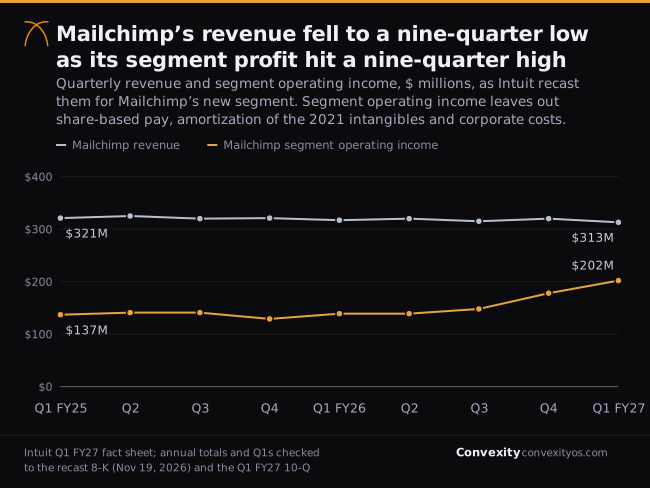
| Mailchimp revenue | Mailchimp segment operating income | |
|---|---|---|
| Q1 FY25 | $321M | $137M |
| Q2 FY25 | $325 | $141 |
| Q3 FY25 | $320 | $141 |
| Q4 FY25 | $321 | $129 |
| Q1 FY26 | $317 | $139 |
| Q2 FY26 | $320 | $139 |
| Q3 FY26 | $315 | $148 |
| Q4 FY26 | $320 | $178 |
| Q1 FY27 | $313M | $202M |
The last two quarters carry nearly all of the change. For seven quarters Mailchimp's segment operating income sat between $129 million and $148 million. Then it rose to $178 million in the fourth quarter of fiscal 2026 and to $202 million in the first quarter of fiscal 2027, the quarter that ended three weeks before Intuit agreed the sale. Revenue in that quarter was the lowest of the nine. Intuit puts the segment margin at 65%, against 44% a year earlier.
Two cautions belong beside those numbers. Segment operating income is Intuit's measure, not Mailchimp's profit. It leaves out share-based compensation, the amortization of the 2021 intangibles and Intuit's unallocated corporate costs, and in the recast Intuit moved into the segment some costs it used to carry centrally, $355 million of them in fiscal 2026. And a margin reached by spending less on staff and marketing in a business with falling customers is a margin a buyer has to decide whether to keep.
Bending Spoons has said what it intends. Its chief executive, Luca Ferrari, said in its announcement: "After closing, we'll invest substantially in the business." The same announcement describes the company's method as "deep transformations" of what it buys, entailing "reorganizing teams, overhauling technology, redesigning user interfaces," and our October note on the company found that in practice the transformation has mostly meant running acquired businesses with much smaller teams. How those sit together at Mailchimp is now the buyer's question rather than Intuit's. Bending Spoons also describes the deal as all cash, with Intuit investing $368 million of its proceeds in newly issued Bending Spoons shares; Intuit describes the same $368 million as part of the price. Both descriptions arrive at the same place.
For Intuit's part, the price works out to 2.89 times Mailchimp's fiscal 2026 revenue and 6.09 times its fiscal 2026 segment operating income, both our arithmetic. Intuit's chief executive, Sasan Goodarzi, gave the strategic reason on the call that evening. Intuit has built AI tools into QuickBooks to help businesses win customers and manage their pipeline, which he called its "lead-to-cash capabilities," and "Selling Mailchimp sharpens our focus behind that strategy." Asked later about the sale, he said Intuit's best path was to build those capabilities natively into QuickBooks, and called the sale "better for our focus, better for our capital allocation." The release says Intuit "intends to use cash proceeds to repurchase shares of its common stock within fiscal year 2027 following the close of the transaction." On the call the chief financial officer, Sandeep Aujla, made it all of them: "Our intent is to use the entirety of the cash proceeds from the sale to do buybacks in fiscal 2027 upon the close of the transaction."
No analyst asked about the price Intuit accepted, the size of the gain or the tax the sale will carry, and management did not raise any of them.
Intuit's shares closed at $310.02 on Thursday, November 19, the last close before the release. At that price, $3.31 billion would buy back about 10.7 million shares, slightly more than the 10.1 million Intuit issued to pay for Mailchimp in 2021 (our arithmetic). The buyback will be made after the sale closes, at whatever the shares cost then, so the count will move with the price.
The quarter Intuit actually reported
The Mailchimp sale came in the same release as Intuit's first quarter of fiscal 2027, the three months to October 31, and on its face the quarter was good.
Revenue rose 12% to $4,354 million, above the $4,294 million to $4,313 million Intuit had forecast in August. Global Business Solutions, which no longer includes Mailchimp, grew 15% to $3.1 billion, and within it the online ecosystem around QuickBooks grew 20%. Earnings per share on Intuit's generally accepted accounting basis rose 63% to $2.59, against a forecast of $1.71 to $1.75, helped by $118 million of unrealized gains on long-term investments, which are mostly stakes in privately held companies and limited partnerships. On the adjusted basis Intuit prefers, which from this quarter no longer excludes share-based pay, earnings per share were $2.91, against a forecast of $2.44 to $2.48. Intuit bought back $1.5 billion of its stock in the quarter and raised its quarterly dividend 15% to $1.38.
The problem was in the Consumer segment, and specifically in Credit Karma, the personal finance service Intuit bought in 2020. Its revenue grew 9% to $708 million. Personal loans added $52 million and insurance $21 million, while credit cards fell by $16 million, and the 10-Q says the results "were impacted by higher interest rates and a shift in consumer behavior."
Goodarzi was blunter on the call. Credit Karma's performance "was below our expectations, reflecting the impact of higher interest rates on our growth and a faster-than-anticipated impact from a shift in consumer behavior." He described the shift: "We see consumers increasingly starting in AI-powered experiences to search for answers and discover financial products." For a service that earns its money by matching people with credit cards and loans, the place where people start that search is the business.
The questions that followed kept coming back to it. Goodarzi split the problem in two, and said both "really started towards the end of the quarter." One is cyclical: higher interest rates slowed demand at a business he put at "about 10% of the company." The other is structural, and it is about where people look. Credit Karma "has not been reliant on SEO," he said, with search engines "less than 1% of the traffic driver." Intuit had already worked to make TurboTax and QuickBooks top choices inside AI assistants, but the same work at Credit Karma was still under way when more consumers began their searches there, and the impact came "faster than we anticipated." The remedy he described is to open up to those assistants the customer interactions Credit Karma now keeps behind a firewall, so that it shows up when people search there. Aujla said Intuit remains confident in its three-year target of 4% to 8% annual growth for the Consumer segment, which rests mostly on assisted tax preparation rather than on Credit Karma.
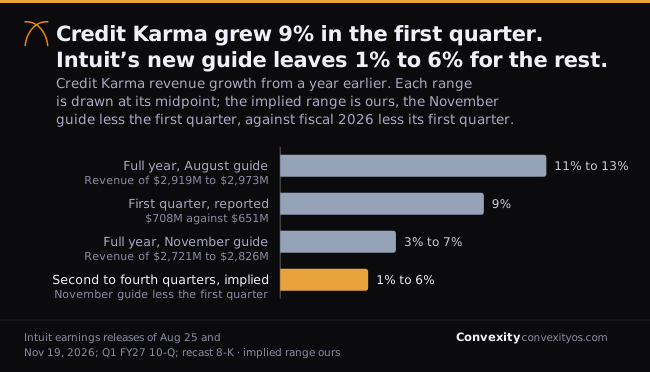
| Revenue growth from a year earlier | |
|---|---|
| Full year, August guide | 11.5%11% to 13% |
| First quarter, reported | 8.8%9% |
| Full year, November guide | 5.0%3% to 7% |
| Second to fourth quarters, implied | 3.8%1% to 6% |
That is why the full-year forecast fell. In August, Intuit expected Credit Karma revenue of $2,919 million to $2,973 million in fiscal 2027, growth of 11% to 13%. Now it expects $2,721 million to $2,826 million, growth of 3% to 7%. The first quarter already delivered 9%, so the new range leaves 1.2% to 6.4% for the remaining three quarters, by our arithmetic.
Intuit's total revenue forecast moved down by exactly the same amount, $198 million at the bottom of the range and $147 million at the top, to $23,081 million to $23,365 million, or growth of 8% to 9%. Every other line in the guidance, Global Business Solutions, TurboTax, ProTax and Mailchimp, is unchanged, which matches what Aujla said on the call: "This update is limited to Credit Karma." The forecasts for operating income and earnings per share were reiterated, which he attributed to cost savings, mainly from "lower-than-expected share-based compensation expense."
The second-quarter forecast is where the slowdown shows. Intuit expects revenue of $4,931 million to $4,954 million, growth of 6% to 7%, half the first quarter's pace. Aujla said Global Business Solutions should still grow in the low to mid-teens, but Consumer revenue is expected to decline in the mid-single digits. Part of that is deliberate. To grow its share of all IRS e-filers, Intuit is improving what it calls its price-to-value proposition for price-sensitive TurboTax customers, which it expects to lower revenue per tax customer this year, most of all in the second quarter. It is also moving its refund transfer processing in-house, which shifts about $30 million of revenue from the second quarter to the third, and it expects TurboTax revenue to fall in the second quarter as a result. Part is Credit Karma, where "our Q2 guidance assumes the demand environment remains at current levels."
Asked what was behind the softer second quarter, Aujla added one factor the release does not spell out. Intuit's desktop business, built on the older installed QuickBooks software, is guided to decline by a low single-digit percentage over the full year. It grew 2% in the first quarter and 10% in the second quarter of last year, and he expects it to be roughly flat in this one. With the TurboTax pricing, the refund transfer change and Credit Karma, that made four factors, three of which he described as "exactly on strategy."
All of this guidance excludes the Mailchimp sale. Intuit says it will update the guidance when the deal closes.
What the market made of it
Intuit's shares closed at $270.44 on Friday, November 20, down 12.8% from $310.02 on Thursday, the last close before the release (our arithmetic). They had already fallen through the week, from $345.56 on Monday, November 16, to $320.79 on Tuesday and $313.24 on Wednesday, so Friday's close was 21.7% below Monday's. The sale was not the only news in the release. The same afternoon Intuit cut its forecast for Credit Karma's growth this year to 3% to 7% from 11% to 13%, guided to revenue growth of 6% to 7% in the second quarter with Consumer revenue declining in the mid-single digits, and kept its forecasts for operating income and earnings per share. How much of the fall belongs to each, the prices cannot say. At Friday's close the same $3.31 billion of buybacks would retire about 12.2 million shares rather than 10.7 million (our arithmetic). Bending Spoons' shares, the other side of the trade, closed at $41.05, down 1.6% from Thursday's $41.70.
What would prove this wrong
The argument here has two halves, and each can fail on evidence Intuit will publish.
The first half says the expected gain is a product of where the goodwill sits, not of Mailchimp's value. It would be wrong if, when the deal closes, Intuit removes materially more goodwill than the $641 million now assigned to Mailchimp, or if the carrying value it reports for the business is far from our rough $3.1 billion of goodwill and remaining intangibles. Intuit will have to disclose the gain in the quarter the sale closes, which it expects to be early in calendar 2027. If the gain turns out to be a loss after all, our reading of the book value is wrong.
It would also be weakened if Intuit had written down Mailchimp's intangibles at some point we missed. Intuit reports no goodwill impairment for any of its reporting units in its annual tests since the purchase, but our estimate of the intangibles assumes the original straight-line schedule and nothing else, and Intuit does not publish a carrying value for Mailchimp's intangibles alone.
The second half says the year now leans on Credit Karma stabilizing at a much lower rate of growth. That would be wrong in the hopeful direction if Credit Karma grows faster than 6.4% over the next three quarters, the top of what the new guide implies, or if second-quarter Consumer revenue falls by less than the mid-single digits Intuit expects. It would be wrong in the other direction if Intuit has to cut the Credit Karma range a second time, or if the savings in share-based pay stop covering the shortfall and the profit guidance moves.
And one thing would change the reading of the sale itself. Intuit receives a number of Bending Spoons shares fixed at signing, but records them at their value on the closing date. If those shares fall sharply before then, the gain shrinks and the $368 million line in the price is worth less than it says.
What we do not know yet
We do not know the size of the gain, and Intuit has not estimated it. We do not know the tax the sale will carry, or the price per share behind the Bending Spoons stock Intuit will receive. Bending Spoons' interim financial statements put the number at 8.8 million shares; Intuit's 10-Q says only that it was "fixed at signing based on the weighted-average share price specified in the agreement," and neither company has published that price. We do not know what Mailchimp's operating balances will be at closing, or what closing adjustments the agreement allows.
Quotations from the November 19 call use only wording that two independently produced transcripts, from Motley Fool and Stock Analysis, both carry; where they differ, we paraphrase.
Primary sources
14 documents
- 0110-QIntuit Inc., quarterly report for the quarter ended October 31, 2026Note 14, Subsequent Events: the sale to Bending Spoons for about $3.68 billion, its cash and stock, the share count fixed at signing, the six-month sale restriction and the expected pre-tax gain and what it depends on; Mailchimp segment revenue and operating income ($313 million and $202 million), the reasons for each and the named cost reductions; Mailchimp goodwill of $641 million; Credit Karma revenue by vertical; the $118 million of unrealized gains on long-term investmentsFiled Nov 19, 2026sec.gov
- 028-KIntuit Inc., first-quarter fiscal 2027 earnings release (Exhibit 99)Revenue by segment and product line, earnings per share; the Mailchimp divestiture and the intended use of proceeds; the updated full-year and new second-quarter guidance by line, which excludes the sale; buybacks and the dividend; the change to non-GAAP measuresFurnished Nov 19, 2026sec.gov
- 038-KIntuit Inc., fiscal 2026 financial statements recast for the Mailchimp segment (Exhibit 99.01)Note 1, the Mailchimp segment from August 1, 2026 and the expenses reclassified into it; Note 6, goodwill reassigned to the Mailchimp reporting unit on a relative fair value basis ($641 million of $9,825 million) and the $9,180 million left; Note 14 and Item 7, Mailchimp segment revenue and operating income for fiscal 2024 to 2026 and the reasons for each change; Online Ecosystem growth of 23% in fiscal 2026Filed Nov 19, 2026sec.gov
- 04CallIntuit first-quarter fiscal 2027 earnings call transcript, Motley FoolRetrieved 2026-11-20. Sasan Goodarzi, chief executive, and Sandeep Aujla, chief financial officer: Credit Karma below expectations and the shift to AI-powered search, the two causes and when they began, SEO as less than 1% of its traffic, the fix; the full-year update limited to Credit Karma and the reiterated profit guide; the second-quarter factors, including desktop; the reason for the Mailchimp sale and the use of all its cash proceeds for buybacks. Quoted only where the Stock Analysis transcript carries the same words; the prepared remarks were also checked against the copy Intuit publishedHeld Nov 19, 2026fool.com
- 05CallIntuit first-quarter fiscal 2027 earnings call transcript, Stock AnalysisRetrieved 2026-11-20. The second, independently produced transcript of the same call, used to confirm every quotation from itHeld Nov 19, 2026stockanalysis.com
- 068-KIntuit Inc., fourth-quarter and fiscal 2026 earnings release (Exhibit 99)The August guidance for fiscal 2027 by line, including Credit Karma at $2,919 million to $2,973 million, and for the first quarterFurnished Aug 25, 2026sec.gov
- 0710-KIntuit Inc., annual report for fiscal 2026The annual goodwill impairment tests for fiscal 2024 to 2026, in which the estimated fair values of all reporting units substantially exceeded their carrying valuesFiled Sep 9, 2026sec.gov
- 0810-KIntuit Inc., annual report for fiscal 2023Note 7, the completed allocation of the Mailchimp purchase price: goodwill of $8,102 million, intangible assets of $4,340 million by class and useful life, the other balances, a total of $11,996 million; the goodwill assigned to Small Business & Self-Employed and substantially all deductible for income tax purposes; the annual goodwill impairment tests for fiscal 2021 to 2023Filed Sep 1, 2023sec.gov
- 0910-KIntuit Inc., annual report for fiscal 2022The acquisition of Mailchimp on November 1, 2021, for $12.0 billion: $5.7 billion in cash, the $4.7 billion term loan borrowed that day, and 10.1 million shares at $625.99; the restricted stock units issued; segment goodwill of $1,578 million and $9,689 millionFiled Sep 2, 2022sec.gov
- 106-KBending Spoons S.p.A., announcement of the agreement to acquire Mailchimp (Exhibit 99.1)The enterprise value of $3.68 billion, the description of the deal as all cash with Intuit investing $368 million of its proceeds in newly issued Bending Spoons equity, the purchase of The Rocket Science Group, LLC, the company’s description of its own method, and Luca Ferrari’s remarksFurnished Nov 19, 2026sec.gov
- 116-KBending Spoons S.p.A., condensed consolidated interim financial statements for the third quarter of 2026 (Exhibit 99.2)The subsequent-events note: the 8.8 million newly issued Bending Spoons shares Intuit will receive in lieu of cashFurnished Nov 19, 2026sec.gov
- 12PricesIntuit daily closes, November 16 to November 20, 2026Official closing prices from Nasdaq, where Intuit lists: $345.56, $320.79, $313.24, $310.02 and $270.44. November 16 to 19 match the official closes in our brokerage data feedNov 20, 2026nasdaq.com
- 13PricesBending Spoons daily closes, November 19 and 20, 2026Official closing prices from Nasdaq, where Bending Spoons lists: $41.70 and $41.05. November 19 matches the official close in our brokerage data feedNov 20, 2026nasdaq.com
- 14DataState Street, SPDR S&P 500 ETF Trust (SPY) daily holdingsUsed for the disclosure only: Intuit is held and Bending Spoons is not; holdings as of November 18, 2026, retrieved 2026-11-19Nov 18, 2026ssga.com
Not investment advice. This is a reading of Intuit's and Bending Spoons' public filings and of its November 19 earnings call, published for research purposes. It is not a recommendation to buy, sell or hold any security, and it is not a price target. The sale has not closed, and every statement here about the gain is about Intuit's stated expectation, not a reported result.
What here is ours rather than Intuit's. As reported or stated by Intuit, and not ours: the $12.0 billion price, its cash and stock, the term loan, the share count and price, and the restricted stock units; the allocation's goodwill, intangible assets, their classes and lives, each of its other lines, and its total; every goodwill balance and the $641 million reassignment; the sale's price, cash and stock; every revenue, segment operating income, segment margin, cost reduction, earnings, buyback, dividend and guidance figure; Credit Karma's revenue by vertical; and every quotation, which is from Intuit's filings, its release or its call, in wording two transcripts share, or, for Luca Ferrari and the description of Bending Spoons' method, Bending Spoons' announcement. As published by Nasdaq and our brokerage data feed: share prices. Ours: the net negative $446 million of other balances in the allocation and its $272 million and $718 million halves; the 6.5% share of the goodwill pool and the reading that Intuit valued Mailchimp at about one-fifteenth of the combined unit; the roughly $7.5 billion ($7,461 million) of the purchase's goodwill that did not move; the estimate of about $2,485 million of remaining intangibles and $3,126 million with the goodwill, which assumes straight-line amortization on the disclosed lives and no write-down; the 30.7% ratio of price received to price paid and the $2.4 billion gap between cash paid and cash received; the multiples of 2.89 times revenue and 6.09 times segment operating income; the roughly 10.7 million shares $3.31 billion would buy at Thursday's close and 12.2 million at Friday's; Friday's 12.8% fall in Intuit's shares, the 21.7% fall from Monday's close and the 1.6% fall in Bending Spoons'; the $172.5 million change in the guidance midpoint and the $198 million and $147 million changes at each end; the 1.2% to 6.4% growth the new guide leaves for Credit Karma's last three quarters; and our readings that the gain describes the accounting rather than the investment and that the year now leans on Credit Karma.
On our own position. A member of the Convexity team holds SPY, whose holdings include Intuit. No other position in any company named here, including Bending Spoons.