








Disclosure. Not investment advice, and nothing here is a recommendation to buy, sell or hold any security. A member of the Convexity team holds the SPDR S&P 500 ETF (SPY), which holds Walmart, Costco, McDonald's, Target, TJX and Lowe's, all named below; no other position. Walmart's figures are from its earnings releases, its quarterly report on Form 10-Q, its earnings presentations, its own transcripts of its earlier calls and two public transcripts of its November 19 call; share prices are official closing prices. The growth rates, averages and differences marked as ours are our arithmetic on those figures, and the closing note lists them.
Walmart (WMT) spent the summer turning a $2.9 billion tariff refund into lower prices, and in August it asked investors for patience. Operating income would grow only 2% to 4% in the third quarter, it said, and the second and third quarters should be judged together. On Thursday, November 19, the third quarter beat that. Adjusted operating income rose 5.5% in constant currency, and sales grew 4.4%, above a range of 3.0% to 3.75%. It is the sixth quarter in a row in which Walmart's sales met or beat the top of its own guide, on our count.
What the price cuts bought is a narrower story. Walmart said they would bring shoppers in, and at its American stores comparable sales did pick up, to 2.9% from 2.6%. But transactions grew 1.5%, exactly as in the second quarter. All of the improvement came from the average ticket, which rose 1.4% after 1.1%, while Walmart's own measure of like-for-like price inflation eased to 1.2%. Shoppers who were already coming put a little more in the basket, at prices Walmart had cut. They did not come more often.
The rest of the quarter fits that reading. The extra profit came from mix: advertising, membership, and an online business Walmart says is now close to breaking even before its advertising income. Walmart still credits upper-income households with leading its share gains. And the holiday guide it gave on its call, sales growth of 4.5% to 5.5%, includes about a point from the timing of a sale in India. Without it, Walmart's plan for the season sits at the bottom of the forecasters' range.
Third quarter of fiscal 2027, the three months to October 31, 2026, from Walmart's earnings release of November 19; the fourth-quarter range is from its call that morning. Operating income and sales are consolidated and in constant currency; comparable sales exclude fuel.
The quarter Walmart asked to be judged with
Three months ago Walmart reported the fastest profit growth in the six quarters charted below, and its shares fell 9.2% that day, on our arithmetic from the closing prices: from $114.30 on August 19 to $103.84 on August 20. Adjusted operating income, in constant currency, rose 17.4% in the second quarter of its fiscal year, the three months to July 31. The company itself had given two reasons to look past it.
The first was that a good part of the profit did not come from selling anything. In that quarter Walmart received about $2.9 billion of refunds of tariffs it had paid as the importer of record under the International Emergency Economic Powers Act, "substantially all of the refunds requested," according to its quarterly report. The money went into cost of sales, so it lifted gross profit, and Walmart left it inside its adjusted figures. John David Rainey, the chief financial officer, put the net benefit at about 750 basis points of the 17.4%. Set that aside and underlying growth was close to 10%, which he said was the top of the 7% to 10% Walmart had guided.
The second reason was sales. Comparable sales at Walmart U.S., the change in sales at stores open at least a year, online orders included and fuel excluded, rose 2.6%, the slowest of the six quarters and down from 4.1% three months earlier. Much of the slowdown was the pharmacy. New maximum fair price regulation for certain drugs, effective January 1, cut prices at the counter and took about 125 basis points off the comparable sales figure. Excluding health and wellness, Walmart says, comparable sales grew 3.4%.
Then came the guidance. For the third quarter, the three months to October 31, Walmart guided operating income growth in constant currency of only 2% to 4%. The reason was where the refund had gone. Walmart said it would spend most of the money on lower prices, and it did: Rainey told analysts about 11,000 rollbacks, the company's word for temporary price cuts. "A large portion of the refunds were invested at the end of Q2. So the full quarter impact of these investments is more pronounced in Q3," he said.
So Walmart asked to be judged on two quarters at once. "When looking at Q2 and Q3 reported operating income together," Rainey said, "growth would average approximately 10% per quarter." On the measure the guide is written in, adjusted operating income in constant currency, the second quarter's 17.4% and the middle of the third-quarter guide average 10.2%, on our arithmetic. He also made a promise about sales: "Walmart U.S. sales growth is expected to improve in Q3 as the investment and customer value translates into stronger sales."
The market took the promise on credit. Walmart's shares closed at $127.36 on Wednesday, November 18, the day before the report, 22.6% above their close on the day of the August report and 11.4% above the close the day before it, both on our arithmetic. The third quarter was where the bill for the price cuts would land, and where the sales they were meant to buy should show.
Walmart kept both halves of the bargain, though not in equal measure. Over the two quarters it asked to be judged on together, adjusted operating income in constant currency grew 11.5% on average, on our arithmetic, against the 10.2% the guide had implied, and adjusted earnings of $0.65 a share beat the top of the $0.62 to $0.64 range. On the call Rainey returned to his August framing: "When looking at Q2 and Q3 together, underlying operating income growth increased double digits over that period." The sales half was thinner. Comparable sales at Walmart U.S. improved, as he had promised, but by three tenths of a point. And Walmart raised its full-year guide again, as it had in August.
Who is filling the carts
Walmart has told the same story about its shoppers for a year and a half. In every quarterly earnings presentation since May 2025, it has described its market share gains as led by upper-income households, in grocery at first and then across the store. In February, John Furner, chief executive since the first of that month, put numbers on it: "the majority of our share gains came from households making more than $100,000. For households earning below $50,000, we continue to see that wallets are stretched and, in some cases, people are managing spending paycheck to paycheck."
The bottom of the income ladder has since had a harder year. In May, Rainey offered a detail from Walmart's gas stations: "the number of gallons that customers fill up with when they come to our fuel stations fell below 10 for the first time since 2022. That's an indication of stress." In August he described what happened when gasoline crossed $4 a gallon. "June was a little more obvious as we look at the quarter in terms of customers making trade-offs," he said. The trade-in from the top has kept coming. Furner said in August that Walmart continues "to see growth from higher income households," and Rainey tied some of it to the shelves: "the share gains that we're getting, notably from higher income consumers, are in part because of the assortment that we have."
The comparable sales figure has a second layer that shows how the shoppers are spending, not just who they are. Walmart splits it into transactions, the number of baskets, and average ticket, the amount in each. For most of the last two years the basket carried the growth. Since the fourth quarter of the last fiscal year, the one that ended in January, transactions have grown faster than ticket in every quarter. Walmart's growth now comes more from extra trips than from bigger baskets.
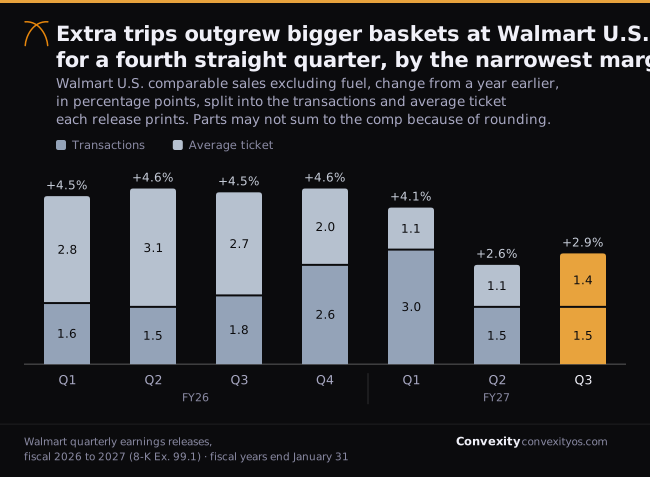
| Transactions | Average ticket | |
|---|---|---|
| FY26-Q1 | 1.6 | 2.8 |
| FY26-Q2 | 1.5 | 3.1 |
| FY26-Q3 | 1.8 | 2.7 |
| FY26-Q4 | 2.6 | 2.0 |
| FY27-Q1 | 3.0 | 1.1 |
| FY27-Q2 | 1.5 | 1.1 |
| FY27-Q3 | 1.5 | 1.4 |
The third quarter kept the pattern, barely. Transactions rose 1.5% and average ticket 1.4%, the fourth quarter in a row in which trips grew faster than baskets, and by the smallest margin of the four. Transactions grew at exactly the second quarter's pace while the ticket picked up from 1.1%, so the improvement in comparable sales that the price cuts were meant to buy came from bigger baskets, not from more visits.
The basket had been the part that went quiet. Average ticket rose 1.1% in each of the first two quarters of the fiscal year. Walmart's own measure of like-for-like inflation, the price change on the same items a year apart, was 1.2% in the first quarter and 1.4% in the second, according to its presentations. So in both quarters the typical basket grew a little more slowly than the prices of the things in it, on our arithmetic, after running 0.9 to 2.3 points ahead of them in the four quarters before. Seth Sigman, an analyst at Barclays, put the point to management in August: ticket "does seem like it's running a little bit below inflation now, and that's been happening for the last couple of quarters." He asked whether shoppers were trading down. David Guggina, chief executive of Walmart U.S., answered with share gains and a summer grilling basket that "fed eight people for under $40."
That gap has an innocent explanation in part, and it should be weighed before it is read as distress. The pharmacy price cuts land in ticket, since a prescription that costs less is a smaller basket of the same size. So do Walmart's own rollbacks, which exist to make the same basket cheaper. The question for the third quarter is which way the gap moves once the rollbacks have had a full quarter to bring shoppers in. If they work as Walmart says, transactions and units should rise, and a still-small ticket would be the cost of a deliberate choice. If transactions fade as well, the small basket starts to look like a shopper with less to spend.
The third quarter did neither. The gap closed from the other side: like-for-like inflation eased to 1.2% while the ticket rose 1.4%, so the basket grew a little faster than its prices again, by 0.2 points on our arithmetic. The rollbacks are visible in Walmart's own price measure. Like-for-like inflation in general merchandise, the aisles from toys to auto care, was 0.3%, which Walmart says is about 140 basis points lower than in the second quarter, when it was 1.7%. Grocery inflation was 1.4%. The pharmacy still weighed on the figure, by about 125 basis points before an offset of about 60 from GLP-1 drugs, a net drag of about 70 by Walmart's figures; outside health and wellness, comparable sales grew 3.6%, up from 3.4%. Shoppers put slightly more in their baskets at prices Walmart had cut, but their visits grew no faster than before.
Walmart's warehouse club shows the same shape, more sharply. At Sam's Club U.S., transactions rose 5.1% in the third quarter while the average ticket fell 0.3%. With this report Walmart revised the club's earlier transactions and ticket figures, calling the correction immaterial and saying it did not change comparable sales; the second quarter now reads transactions up 5.8% and ticket down 1.4%, where Walmart had first reported 7.0% and a 2.5% fall. The pattern is not unique to Walmart, either. In the same season, McDonald's said it lost US guests in its third quarter while other chains said their lower-income diners held up, and the big card lenders said their borrowers were paying on time as long as the jobs held.
Walmart's account of who is shopping did not change either. The third-quarter presentation says "share gains strengthened across categories and income tiers led by upper-income households," the seventh quarterly presentation in a row to credit the top of the income ladder.
On the call, management did not dwell on the income split. Furner described the customer as "stable, resilient." Walmart had seen "some pressure in the first quarter in April," he said, and "some softness in June," and the rollbacks were its answer. Rainey said the reward was in food, where Walmart's share gains were "some of the largest that we have seen in three years," and that customers were responding to the price investments of the third quarter. That is a claim about share, not about trips. Walmart can win a larger part of a household's grocery bill without that household visiting more often, and the third quarter's figures say that is mostly what happened.
Where the profit comes from
There is a reason Walmart can afford to spend a refund on prices. A growing share of its profit no longer depends on the margin on a can of beans.
Walmart's advertising business grew 38% worldwide in the second quarter, and Walmart Connect, its American advertising arm, grew 43% without VIZIO, the television maker Walmart bought. Membership fee revenue grew 17% worldwide. Marketplace sales in the United States, where outside sellers list their goods beside Walmart's own, grew 52%. Walmart U.S. net sales, for comparison, grew 3.5%. The day after the August report, on a follow-up call with investors, Rainey put a figure on what these businesses contribute: "In the most recent quarter, 45% of our operating income growth came from advertising, membership, and marketplace." Their combined margin, he added, is "much more accretive than our overall margin."
Online shopping is where much of that money is made, and it is new money. Walmart's American e-commerce business made its first quarterly profit in the three months to April 2025, Rainey told analysts at the time. E-commerce is now "over 23% of our mix in Walmart U.S.," he said in August, double its share of five years earlier, and the American online business earned "double-digit incremental margins for the first half of the year," meaning each extra dollar of online sales added at least ten cents of operating profit. Advertising sold to the brands on Walmart's shelves, and membership from shoppers who, in Rainey's words, "spend approximately four times more than non-members," are much of the reason.
That mix is what makes the refund decision rational rather than generous. A price cut that wins an extra trip can also win an extra advertising impression, an extra marketplace order and a member who renews. Most of the companies we counted in September left their refunds inside adjusted earnings, as Walmart did; what Walmart has said it will do with the cash is the difference. Costco (COST) spent about half of its $184 million refund on price cuts, on our arithmetic in October. Walmart's quarterly report puts no figure on its own share. It says "a significant portion" of the $2.9 billion went into "customer-focused initiatives" during the quarter, "primarily through price investment and other cost mitigation strategies, with continued prioritization of price investment expected through fiscal 2027," the year that ends in January.
The third quarter says the platform kept paying while the price cuts were paid for. Walmart U.S. advertising grew 37%, and Walmart Connect 36% without VIZIO and Vibe, two businesses Walmart has bought. Worldwide, advertising grew 25%, held back abroad: Walmart International's advertising fell 15%, with Flipkart's big sale moved into the next quarter. Membership fee revenue grew 17% worldwide, the same pace as in the second quarter, and American marketplace sales grew 49%, according to the presentation. Walmart U.S. net sales grew 3.6%; its operating income grew 9.0%. The release names the reasons: a gross profit rate 50 basis points higher, "due primarily to improved business mix and merchandise category mix," better e-commerce economics and other income.
The stores themselves are not where the growth is. American e-commerce sales rose 23% and contributed about 530 basis points to a comparable sales figure of 2.9%. The rest of the business, the stores, subtracted about 2.4 points, on our arithmetic, after about 2.5 in the second quarter, when online contributed about 510 basis points to 2.6%.
Rainey added two figures on the call. Each extra dollar of American online sales earned more than 12 cents of operating profit in the quarter, he said, faster than in earlier quarters, and he expects the rate to stay in the low double digits. And the online business on its own, he said, is getting "pretty close to break-even without advertising." That is the economics behind the refund decision in one sentence: the delivery network is close to paying for itself, so the advertising and membership fees it carries are close to pure profit, and a price cut that brings an order online earns more than the margin on the goods suggests.
The yardstick
Walmart writes its own exam, and the third-quarter paper has three questions on it.
The first is profit. Walmart guided operating income growth in constant currency of 2% to 4% for the three months to October 31, on a base of $7.3 billion of adjusted operating income a year earlier, and adjusted earnings of $0.62 to $0.64 a share, against $0.62 a year earlier. So the guide asks for profit roughly flat to slightly up, after a quarter that rose 17.4%. A result inside that range is what Walmart said it would deliver. A result well above it would raise the question of whether less of the refund was spent than planned, or whether the price cuts began paying for themselves sooner than Walmart expected.
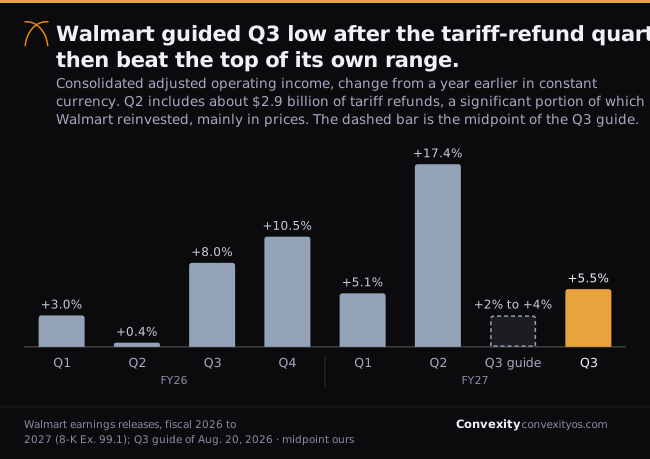
| Adjusted operating income, change from a year earlier, constant currency | |
|---|---|
| FY26-Q1 | +3.0% |
| FY26-Q2 | +0.4% |
| FY26-Q3 | +8.0% |
| FY26-Q4 | +10.5% |
| FY27-Q1 | +5.1% |
| FY27-Q2 | +17.4% |
| FY27-Q3-guide | 3.0%+2% to +4% |
| FY27-Q3 | +5.5% |
The answer to the first question is above the range. Adjusted operating income in constant currency rose 5.5%, from $7.26 billion to $7.66 billion, and adjusted earnings were $0.65 a share. Over the two quarters Walmart asked to be judged together, growth averaged 11.5%, on our arithmetic, against the 10.2% the guide had implied and the "approximately 10%" Rainey described. The release explains the profit at Walmart U.S. with mix: a higher gross profit rate from the mix of businesses and categories, better e-commerce economics and other income, against operating expenses that rose by 45 basis points as a share of sales, on depreciation and higher claims costs. It does not say how much of the refund the quarter spent.
Walmart did not say how much of the refund is left. Rainey said the quarter's gross profit "also reflects the investments we made in price and customer initiatives using the tariff refunds we received," and the rollback count says the spending is tapering. Walmart U.S. had about 7,700 at the end of the third quarter, Furner said, down from just over 11,000 at the end of the second, against the 5,000 to 5,500 Walmart usually runs. The refund also had costs to cover that were not about price. Between diesel and transportation, Rainey said, Walmart has had "over $2 billion of incremental costs" to absorb this year, and at the top of its guide its reported operating income would still grow about 10%.
The second is sales. Walmart guided consolidated net sales growth in constant currency of 3.0% to 3.75%. That includes a known drag. Flipkart, Walmart's Indian e-commerce business, holds an annual sale called the Big Billion Days, and last year's fell in the third quarter while this year's falls in the fourth. Walmart put the effect at "over 100bps" off third-quarter growth, with a similar lift for the fourth. Set it aside and the guide implies underlying growth of at least 4.0% to 4.75%, on our arithmetic, against 5.0% in the second quarter. The day after the August report, Rainey said as much: "The third quarter is probably going to look very similar to the second quarter, particularly when you adjust for the movement of Big Billion Days."
The third question is the one Walmart framed most sharply, the American comparable sales figure it said would improve from 2.6%. Walmart does not guide that number, but it gave the parts. It expects comparable sales outside health and wellness to stay in the 3% to 4% range they have largely held for two and a half years, and it now expects the pharmacy price regime to cost about 125 basis points over the full year. The comparison is a stiff one: a year earlier, the same quarter's comparable sales rose 4.5%.
Walmart's own record said to expect the top of its ranges or better. In each of the five quarters before this one, its consolidated net sales growth in constant currency came in at or above the top of the range it had guided, above it in four of them and exactly at it in the most recent, and adjusted earnings per share beat the top of the range in all four quarters that had one, on our count from its releases. A third quarter inside the guide would have been its weakest print against its own promises in a year and a half, even if it was exactly what the company said it would do.
It was not inside the guide. Consolidated net sales grew 4.4% in constant currency, above the top of the 3.0% to 3.75% range, even though Walmart says the Big Billion Days shift cut about 500 basis points from Walmart International's growth; International grew 3.3%. That makes six quarters out of six at or above the top of Walmart's own sales range, five of them above it, and adjusted earnings per share above the top in all five quarters that had a range, on our count. The American comparable sales figure answered the third question as promised but only just: 2.9%, up from 2.6%, against 4.5% a year earlier, and 3.6% outside health and wellness, inside the 3% to 4% range Walmart expected.
What the holiday guide has to say
Walmart's fourth quarter runs from November through January, which makes it the holiday season with January attached. That makes its guidance a holiday forecast of its own, from a company that says about 280 million customers and members shop with it every week, and a test of the forecasts we examined in October.
That note found that every published forecast for the season was a bet on volume. The National Retail Federation expects sales in November and December to grow 4.2%, Bain expects 4.5%, and Deloitte expects 4.0% to 4.8% from November through January. With prices of the goods those stores sell up only 1.4% in the year to September on our measure, most of that growth has to come from people buying more things rather than paying more for the same ones.
Before November 19, Walmart had given no fourth-quarter guide, but its numbers already implied one. Subtract the first half it reported and the middle of the third-quarter guide from the middle of its full-year guide, which it raised in August to sales growth of 4% to 5% in constant currency, and what is left for the fourth quarter is sales growth of about 4.0%, on our arithmetic. The range is wide, from 1.8% to 6.2%, because a residual collects every uncertainty above it. And it flatters the season: it contains the Big Billion Days shift, worth more than a point, so on the same arithmetic Walmart's underlying holiday quarter was penciled in below 3%.
That is not the same measure as the forecasts. Walmart's figure is worldwide, it includes Flipkart, Walmex in Mexico and Sam's Club, and it is in constant currency, while the forecasters count American retail sales in dollars. And Walmart has a habit of beating its guides. A year ago it guided its fourth quarter to sales growth of 3.75% to 4.75% on its third-quarter call and delivered 4.9%. Still, read as of August, Walmart's own plan for the holidays was more cautious than the forecasts it will be measured against, and the full-year guide it updated on November 19 was the first chance to see whether the third quarter had changed its mind.
It had. The release gives no fourth-quarter range, but Rainey gave one on the call, as he did a year ago: "For Q4, this implies enterprise sales growth in constant currency will be 4.5%-5.5%." Operating income in constant currency should grow 4% to 6%, he said, and adjusted earnings come to $0.73 to $0.78 a share, against $0.74 a year earlier. Behind it is a full-year guide raised to sales growth of 4.9% to 5.2%, from 4% to 5%, and the residual arithmetic agrees: subtract the nine months Walmart has reported and the new full-year guide leaves the fourth quarter about 5.1%, on our arithmetic, inside his range.
Rainey named two assumptions. The guide "assumes underlying sales trends will continue in Q4 with sustained share gains," and the Big Billion Days shift should add about 100 basis points to the quarter. Take that point out and the underlying holiday quarter is 3.5% to 4.5%, on our arithmetic, up from below 3% in August.
That moves Walmart's plan from below every forecast to the bottom of their range. Its midpoint, 4.0%, sits level with the low end of Deloitte's 4.0% to 4.8% and a little under the National Retail Federation's 4.2% and Bain's 4.5%. Walmart is already pricing for the season. Furner said its holiday meal of 26 items costs just over $3.50 a person, with the items carried over from last year about 12% cheaper, and that Walmart had sold a million more turkeys so far this month than a year earlier. The third quarter gives the volume bet some support too: Walmart's basket grew faster than its prices, which means more goods in it, not dearer ones. The caveat is where the volume came from. It came from fuller baskets, not from more trips.
What the week's other stores said
Walmart reported last of the week's big retailers, and the others drew different shapes. Target, which reported on Wednesday, grew comparable sales 5.6% with traffic up 5.0%, its third rise in a row, so almost all of its growth came from shoppers coming more often. TJX, the owner of T.J. Maxx and Marshalls, grew comparable sales 4%, above the 2% to 3% it had planned. Lowe's grew 1.8% the other way, on bigger tickets, with fewer customers paying than a year earlier, as in every quarter since early 2025.
Set beside those, Walmart's 1.5% growth in transactions reads as steady rather than strong. Target is now winning trips it never had, after a year of losing them. Walmart held the pace of visits it already had and sold more on each one, which puts its third quarter nearer Lowe's shape than Target's, though with its transactions still rising rather than falling.
What would prove this reading wrong
This note reads the third quarter as a refund that bought fuller baskets rather than more trips, paid for by a platform whose profits no longer depend on the margin on the goods, and it reads Walmart's holiday plan as sitting at the bottom of the forecasters' range once the sale in India is set aside. The next few months could undo any of that.
- Transactions pick up as the rollbacks fall back. If Walmart's fourth-quarter release in February 2027 shows American transactions growing well above 1.5% while the rollback count returns toward its usual 5,000 to 5,500, the price cuts did buy trips, only later than the third quarter showed.
- The ticket falls back below inflation. If average ticket grows more slowly than like-for-like inflation again in the fourth-quarter presentation, the fuller baskets were the rollbacks' doing alone, and the shoppers underneath them were buying less.
- The profit slips while sales hold. If fourth-quarter operating income grows 4% or less in constant currency while sales reach the top of the 4.5% to 5.5% range, the advertising and membership income did not cover the price cuts, and the mix story is weaker than the third quarter made it look.
- The holiday runs far ahead of the forecasts. If the Census Bureau's retail sales for November and December run well above the forecasters' 4.0% to 4.8%, a guide at the bottom of their range was too cautious, and Walmart's own season should show it.
- The income line goes quiet. If the next presentation stops crediting upper-income households with the share gains, or management says on the next call that the gains came from lower-income shoppers, the trade-in half of the story weakens.
The filings and documents this is built on
21 documents
- 018-KWalmart, third quarter fiscal 2027 earnings release (Exhibit 99.1)Walmart U.S. comparable sales, transactions and ticket and their prior-year column; net sales and adjusted operating income in constant currency; adjusted EPS; advertising, membership and e-commerce growth; the pharmacy headwind; the Big Billion Days shift; the raised fiscal-year guideNov 19, 2026sec.gov
- 02PresentationWalmart, third quarter fiscal 2027 earnings presentation (Exhibit 99.2)Like-for-like inflation, total and by category; the upper-income share gains line; comparable sales excluding health and wellness; e-commerce contribution to comparable sales; marketplace growth; the revised Sam’s Club transactions and ticketNov 19, 2026sec.gov
- 03CallWalmart, third quarter fiscal 2027 earnings call, transcript (Stock Analysis)Rainey on the fourth-quarter guide and its assumptions, the Q2 and Q3 average, the refund in gross profit, e-commerce incremental margins and break-even, food share gains and fuel and transportation costs; Furner on the customer, the rollback count and the holiday meal; quoted only where this transcript and The Motley Fool’s carry the same wordsNov 19, 2026stockanalysis.com
- 04CallWalmart, third quarter fiscal 2027 earnings call, transcript (The Motley Fool)The second public transcript of the same call, used to confirm every quotation from it and to attribute each to its speakerNov 19, 2026fool.com
- 058-KWalmart, second quarter fiscal 2027 earnings release (Exhibit 99.1)Walmart U.S. comparable sales, transactions and ticket; operating income and adjusted operating income growth; advertising, membership and e-commerce growth; the third-quarter and fiscal-year guidance tables and the Big Billion Days sentenceAug 20, 2026sec.gov
- 0610-QWalmart, quarterly report for the period ended July 31, 2026About $2.9 billion of tariff refunds received, recorded as a reduction to cost of sales; price investment expected to continue through fiscal 2027Aug 28, 2026sec.gov
- 07CallWalmart, second quarter fiscal 2027 earnings call, transcript (Walmart investor relations)Rainey on the tariff refund benefit, the Q2 and Q3 average, Q3 sales, e-commerce margins and fuel; Furner on higher-income households; Sigman and Guggina on ticket and inflationAug 20, 2026stock.walmart.com
- 08CallWalmart, second quarter fiscal 2027 buy-side follow-up call, transcript (Walmart investor relations)Rainey on the share of operating income growth from advertising, membership and marketplace, and on the third quarter resembling the secondAug 21, 2026stock.walmart.com
- 09PresentationWalmart, second quarter fiscal 2027 earnings presentationLike-for-like inflation, the upper-income share gains line, and comparable sales excluding health and wellnessAug 20, 2026stock.walmart.com
- 10CallWalmart, first quarter fiscal 2027 earnings call, transcript (Walmart investor relations)Rainey on fuel gallons per fill-up falling below 10May 21, 2026stock.walmart.com
- 11CallWalmart, fourth quarter fiscal 2026 earnings call, transcript (Walmart investor relations)Furner on share gains from households earning more than $100,000Feb 19, 2026stock.walmart.com
- 12CallWalmart, third quarter fiscal 2026 earnings call, transcript (Walmart investor relations)Rainey’s fourth-quarter guidance for fiscal 2026, given on the call rather than in the releaseNov 20, 2025stock.walmart.com
- 13CallWalmart, first quarter fiscal 2026 earnings call, transcript (Walmart investor relations)Rainey on e-commerce profitability in the United States for the first timeMay 15, 2025stock.walmart.com
- 148-KWalmart, first quarter fiscal 2027 earnings release (Exhibit 99.1)Walmart U.S. comparable sales, transactions and ticket; the second-quarter guideMay 21, 2026sec.gov
- 158-KWalmart, fourth quarter fiscal 2026 earnings release (Exhibit 99.1)Walmart U.S. comparable sales, transactions and ticket; fourth-quarter net sales and adjusted EPS; the fiscal 2027 guide and its baseFeb 19, 2026sec.gov
- 168-KWalmart, third quarter fiscal 2026 earnings release (Exhibit 99.1)The year-earlier quarter: comparable sales, transactions and ticket, net sales, adjusted operating income and adjusted EPSNov 20, 2025sec.gov
- 178-KWalmart, second quarter fiscal 2026 earnings release (Exhibit 99.1)Comparable sales, transactions and ticket; the third-quarter guideAug 21, 2025sec.gov
- 188-KWalmart, first quarter fiscal 2026 earnings release (Exhibit 99.1)Comparable sales, transactions and ticket; the second-quarter sales guideMay 15, 2025sec.gov
- 19ReleaseWalmart, Walmart to host Q3 earnings call Nov. 19, 2026Release at 6 a.m. CST and call at 7 a.m. CST on November 19; retrieved 2026-11-14Nov 12, 2026corporate.walmart.com
- 20PricesNasdaq, Walmart historical pricesOfficial closes on August 19 and 20 and November 18, 2026, matched against a brokerage feed; retrieved 2026-11-19Nov 18, 2026nasdaq.com
- 21HoldingsState Street Global Advisors, SPDR S&P 500 ETF Trust daily holdingsWalmart, Costco, McDonald’s, Target, TJX and Lowe’s held as of November 12, 2026; retrieved 2026-11-14Nov 12, 2026ssga.com
Not investment advice. This note is an analysis of public company disclosures, published for research purposes, and not a recommendation to buy, sell or hold any security. A member of the Convexity team holds SPY, which holds Walmart, Costco, McDonald's, Target, TJX and Lowe's; no other position.
What here is ours rather than Walmart's. As filed or stated by Walmart: every comparable sales, transaction, ticket, sales, operating income, earnings per share, advertising, membership, marketplace and e-commerce figure; the tariff refund and its net benefit to operating income growth; like-for-like inflation; the rollback counts; every guidance range, including the fourth-quarter ranges Rainey gave on the November 19 call; and every quotation. Quotations from earlier calls come from Walmart's own transcripts; those from the November 19 call appear word for word in both public transcripts listed above, and what only one of them carries is reported in our words. Target's, TJX's and Lowe's figures are from our note on their quarters. Ours: the share price changes (9.2% on August 20; 22.6% and 11.4% to November 18); the 10.2% average of the second quarter and the middle of the third-quarter guide, and the 11.5% average of the second and third quarters; the gap between average ticket and like-for-like inflation in each quarter (0.2 points in the third); what the stores subtracted from comparable sales once e-commerce's contribution is taken out (about 2.4 points in the third quarter, 2.5 in the second); the third-quarter guide with the Big Billion Days shift set aside; the fourth quarter implied by the August full-year guide (about 4.0%, with a range of 1.8% to 6.2%, and below 3% without the shift) and by the November one (about 5.1% for sales), used as a check on Rainey's range; that range with the Big Billion Days shift taken out (3.5% to 4.5%); and the count of quarters in which Walmart met or beat the top of its own guidance. Costco's share of its refund spent on prices is our arithmetic from our October note.