






Disclosure. Not investment advice, and nothing here is a recommendation to buy, sell or hold any security. A member of the Convexity team holds the SPDR S&P 500 ETF (SPY), which holds Eli Lilly; no other position. Figures are from Lilly's earnings releases furnished on Form 8-K, its Forms 10-Q and 10-K, and its October 29 earnings call; policy facts are from the White House, the Centers for Medicare & Medicaid Services and the Food and Drug Administration. We read the call in two independently produced transcripts and quote only wording both carry. The consensus estimate is from brokerage earnings data, retrieved 2026-10-29. The closing note lists what is our arithmetic.
Eli Lilly sold 53% more medicine in the third quarter than a year earlier, and its realized prices fell 15%. Both numbers are the plan, and the second is bigger than the headline shows.
Lilly reported on October 29. Revenue rose 39% to $24.4 billion. Earnings were $7.48 a share on Lilly's non-GAAP measure, against $6.36 in brokerage consensus data, and Lilly raised its 2026 revenue guidance for the third time this year, to $91 billion to $92 billion. Since February the midpoint of that range has risen by $10 billion.
The earnings line, up 7%, undersells the quarter. Lilly counts the cost of buying drug candidates, acquired in-process research and development, inside its non-GAAP figure, and this quarter carried $4.57 a share of it against $0.71 a year earlier, mostly for the acquisitions of AtaiBeckley and Curevo. Before that charge, earnings were $12.05 a share against $7.73, up 56% (our arithmetic).
Almost all of the growth was volume. Lilly's release credits "a 53% increase in volume, partially offset by a 15% decrease in realized prices." In the United States, volume rose 41% and price fell 7%. Outside it, volume rose 76% and price fell 29%.
This note is about the second half of each of those sentences. Lilly is trading price for patients on purpose, through three channels at once: Medicare, where an agreement with the government set a price of $245 a month; China, where Mounjaro joined the national reimbursement list this year; and a new pill sold at a low starting price.
The trade is working. But the U.S. price decline Lilly reported was flattered by one-time adjustments, Lilly says about $2 billion of this year's revenue will not recur, and its own executives expect next year's mix to push the price of a prescription lower again.
- −10%
- U.S. price change in Q3 before rebate estimate true-ups, as Lilly’s CFO gave it; the reported figure was −7%
- +53%
- worldwide volume growth in Q3; lower realized prices took 15 points of growth back
- 500,000+
- people who filled a Lilly prescription through Medicare’s GLP-1 Bridge since July 1, by Lilly’s count
- ~$2bn
- 2026 revenue from one-time items Lilly does not expect to recur, about 2% of its new guidance
Eli Lilly's Q3 2026 earnings release and its October 29 call. The share of guidance is our arithmetic.
Where the growth came from
Every quarter, Lilly splits its revenue growth into volume, price and currency. For a year the split has had the same shape: very large volume gains, partly given back in price.
What has changed is how much is given back. In the third quarter of 2025, volume added 62 points and price took away 10, about one point in six. This quarter volume added 53 and price took away 15, more than one in four (our arithmetic).
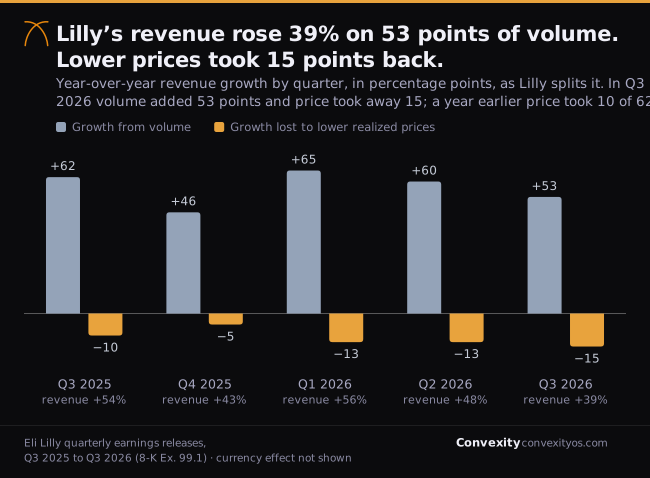
| Growth from volume | Growth lost to lower realized prices | |
|---|---|---|
| Q3 2025 | +62 | −10 |
| Q4 2025 | +46 | −5 |
| Q1 2026 | +65 | −13 |
| Q2 2026 | +60 | −13 |
| Q3 2026 | +53 | −15 |
Two forces drive the larger give-back. Abroad, it is China, where Mounjaro's addition to the National Reimbursement Drug List cut its price and opened a large market. In the United States, Lilly's release says the price decline was "primarily driven by Zepbound," its brand of the same molecule, tirzepatide, for weight loss.
Zepbound's buyers increasingly pay through cheaper channels. Some buy it directly for cash, at prices Lilly has cut. Some now get it through Medicare's new program. And state Medicaid plans have the option of covering it at the Medicare price.
None of this has slowed the business. Mounjaro and Zepbound together brought in $16.1 billion in the quarter, up 59% from $10.1 billion a year earlier and about two-thirds of Lilly's revenue (our arithmetic).
Lilly said on the call that U.S. prescriptions of incretins for obesity, the class that includes tirzepatide and Novo Nordisk's semaglutide, grew 82% in the quarter. About six in 10 of them, and more than seven in 10 of the injectable ones, were for a Lilly medicine.
So the question here is not whether volume beats price. On these numbers it does, comfortably. The question is how much price Lilly is giving up, how much of that the reported figures show, and whether the give is going to grow.
The U.S. price, before the true-ups
Lilly reported that its U.S. realized prices fell 7% in the quarter. Its release adds that the decline was "partially offset by adjustments to estimates for rebates and discounts." On the call, Lucas Montarce, Lilly's chief financial officer, gave the number without them: "Excluding this adjustment, U.S. price declined 10%."
The same thing happened the quarter before, on a larger scale. In the second quarter Lilly reported a 3% decline in U.S. price, and its release said that "excluding these adjustments, U.S. price would have declined by approximately 9%." For two quarters running, the reported figure has understated the decline by 3 to 6 points.
The adjustments are real money, not a modeling quirk. A drugmaker books its revenue net of the rebates and discounts it expects to owe insurers, pharmacy benefit managers, government programs and wholesalers. When the bills come in lower than it reserved, the difference lands as revenue in the quarter it is found, however long ago the drug was sold.
Lilly's 10-Q puts a size on it. Changes in its estimates for its most significant U.S. rebate and discount liabilities, for products shipped in earlier periods, were "2 percent of U.S. revenue" in the third quarter. A year earlier they were "less than 1 percent." On $15.1 billion of U.S. revenue, 2% is about $300 million (our arithmetic).
That squares with the price gap. Three points of the year-earlier U.S. base of $11.3 billion is about $340 million (our arithmetic). Lilly's percentages are rounded, so the two estimates agree within that rounding rather than to the dollar.
The true-up was one of several one-time benefits. The release's own summary says third-quarter revenue "included approximately $900 million of benefits, primarily from $410 million of Jardiance milestones (no further milestones remain) and favorable adjustments to rebate and discount estimates."
Jardiance is a diabetes drug Lilly sells with Boehringer Ingelheim, and the milestones are payments triggered by its sales outside the United States. The parenthesis matters: this was the last of them.
After tax at the quarter's 24% non-GAAP rate, $900 million is worth about $0.77 a share, if none of it carried an offsetting cost (our arithmetic). That is more than two-thirds of the $1.12 by which Lilly beat the consensus. Analysts may have modeled some of it, so the comparison is a ceiling on how much of the beat it explains, not a measure.
Then the year. Montarce said 2026 revenue benefited from "approximately $2 billion of one-time items primarily related to milestones payments and changes in estimates for rebates and discounts," which Lilly does not expect to recur.
The pieces we can see add up to about $1.9 billion. There are $910 million of Jardiance payments across the three quarters, and the U.S. true-ups implied by the second- and third-quarter price gaps, about $650 million and $340 million (our arithmetic). Lilly also booked a first-quarter true-up that it did not size, which would make up the rest.
There is a quieter number on the balance sheet. Lilly's liability for sales rebates and discounts stood at $24.2 billion on September 30, up $6.8 billion, or 39%, since the end of 2025 (our arithmetic on the 10-Q). That reserve is where true-ups come from, in either direction. This year Lilly's estimates have run high, and the release of the excess has shown up as price.
Medicare at $245 a month
The biggest new channel is a government one. On November 6, 2025, the White House announced agreements with Lilly and Novo Nordisk, the maker of Ozempic and Wegovy, on the prices of their obesity drugs.
Its fact sheet said "the Medicare prices of Ozempic, Wegovy, Mounjaro, and Zepbound will be $245," and that "Medicare beneficiaries will pay a co-pay of just $50 per month." State Medicaid programs would have access to the drugs at the same prices.
For scale, the same fact sheet put Zepbound's price at $1,086 a month, falling to an average of $346 through TrumpRx, the government's direct-purchase website. Medicare's $245 is 77% below that list price and TrumpRx's average is 68% below it (our arithmetic). Neither is Lilly's realized price, which it does not disclose by channel, but the direction is not in doubt.
Lilly's 10-Q for the first quarter says it "finalized drug pricing agreements with the U.S. government" in that quarter. The Medicare part became the GLP-1 Bridge, a demonstration run by the Centers for Medicare & Medicaid Services.
CMS says the Bridge operates "outside of the Medicare Part D benefit's coverage and payment flow," so the private insurers that run Part D carry no risk for these drugs. Eligible beneficiaries pay a $50 copay. The program began on July 1, 2026, and runs through December 31, 2027.
The eligible drugs are all forms of Lilly's new pill, Foundayo, all forms of Novo's Wegovy, and one form of Zepbound, the KwikPen; the single-dose vials and pens are excluded. Patients qualify by body mass index, at lower thresholds for those with conditions such as heart failure, a prior heart attack or a stroke.
Uptake has been fast. Dave Ricks, Lilly's chair and chief executive, said that "more than half a million people have filled a prescription for a Lilly medicine through this program," and that seven in 10 new Bridge patients start on a Lilly drug. The White House said on September 18 that 600,000 seniors, across both companies, had used the program in its first two months.
These are mostly new patients, which is the point. Ilya Yuffa, who runs Lilly's U.S. business, said "about 80% of the people getting treatment under Bridge are naive," meaning they had not taken an incretin before. He said about three-quarters of them chose an injection rather than the pill. That is new demand, not switching.
It is also lower-priced demand, and Lilly says so. An analyst asked whether 2027 would bring more pricing pressure than this year, when Lilly's realized prices have fallen 13% to 15% a quarter. Yuffa said the main gains in access next year would most likely come from Medicare and Medicaid, which would shift the mix toward a lower net price.
That is "not about decreasing the price overall, but more just a segment mix," Yuffa said, along with some self-pay at a lower net price per prescription. For anyone reading Lilly's numbers the distinction is thin. Whether a list price falls or prescriptions move to cheaper channels, revenue per prescription goes down.
Montarce built that into his early outline of 2027, which counts on a full year of the Bridge and a U.S. launch of Foundayo for type 2 diabetes. As in earlier years, he said, Lilly expects net realized price "to be a headwind, more than offset by volume growth."
The 10-Q is less sure than the call. "Continued uptake from this expanded access is unknown," it says. The outcome of the agreements, and of broader efforts to align U.S. drug prices with other countries', "could negatively impact our pricing strategies, product demand or access, or competitive positioning across global markets, and may result in reduced revenue in certain markets."
The Bridge also has an end date. CMS's answer to what happens now that a broader Part D payment model, called BALANCE, will not launch in 2027 is that the Bridge "will be extended through December 31, 2027." Beyond that, its pages mention only a "potential implementation of BALANCE in Part D," with no date.
Ricks said on the call that "the right way to do that is put this into the Part D benefit," and that he expected the work with Part D insurers to be about the 2028 calendar year. That is Lilly's expectation, not a commitment anyone has made.
Abroad, the same trade at a steeper discount
Outside the United States the trade is starker. Revenue rose 47% to $9.3 billion in the quarter, on a 76% rise in volume and a 29% fall in realized prices. Lilly's release says the lower prices were "driven primarily by the inclusion of Mounjaro on the National Reimbursement Drug List (NRDL) in China," which took effect in the first quarter.
Mounjaro is Lilly's brand for tirzepatide in most of the world, where it covers obesity as well as diabetes; Lilly markets the drug for obesity as Zepbound only in the United States, Canada and Japan. In the third quarter Mounjaro brought in $5.7 billion outside the United States, up 93%, against $5.0 billion inside it. The crossing came in the first quarter, the first with the Chinese listing.
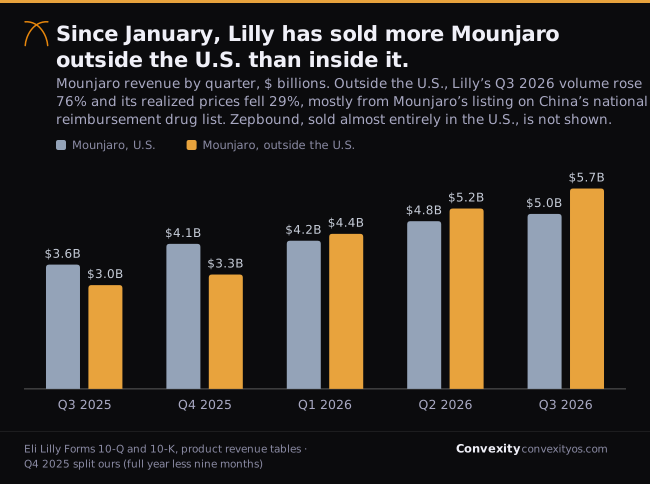
| Mounjaro, U.S. | Mounjaro, outside the U.S. | |
|---|---|---|
| Q3 2025 | $3.6B | $3.0B |
| Q4 2025 | $4.1B | $3.3B |
| Q1 2026 | $4.2B | $4.4B |
| Q2 2026 | $4.8B | $5.2B |
| Q3 2026 | $5.0B | $5.7B |
Ricks said this was one of two things Lilly did not know when it set guidance in February. One was how fast the Bridge would fill. The other was "the depth of the consumer purchasing internationally," and "whether we were really just skimming very high net worth individuals in these out-of-pocket markets," or whether middle-income households would pay at scale.
Both, Ricks said, "turned out to be positive for us," and he credited them for the roughly $10 billion by which revenue guidance has risen since February.
Lilly says it is holding price where it can. Patrik Jonsson, who runs Lilly International, said buyers abroad are "willing to pay for a differentiated product," and that "even after the launch of generics in India, Brazil, and Canada, we're holding our shares and continue to grow." Lilly put its share of the incretin market outside the United States at about 58%, measured by gross sales.
The longer-run pressure points toward higher prices abroad, not lower. The White House said Lilly and Novo agreed to guarantee most-favored-nation prices on new medicines, so that Americans pay no more than the lowest price in other rich countries. The way to keep that from pulling U.S. prices down is to set prices higher elsewhere.
Lilly's 10-Q says it agreed to "launch new medicines with a more balanced pricing approach across developed nations." On December 1, 2025, three U.S. agencies announced an agreement with the United Kingdom that, the White House says, will raise the net price of new prescription drugs there by 25%. Ricks put Lilly's aim for obesity drugs as "a much tighter band of pricing" between the United States and elsewhere.
That matters most for the newest product, which is launching in both kinds of market at once.
The pill
The Food and Drug Administration approved Foundayo, Lilly's once-daily GLP-1 pill, on April 1, 2026. It was the first new molecular entity cleared under the agency's national priority voucher program, approved 50 days after filing. The FDA noted that it does not need to be taken on an empty stomach.
Foundayo sold $184 million in the third quarter, after $97 million in its first partial quarter (our arithmetic on the year-to-date figure). That is small next to tirzepatide's $16.1 billion, and early.
Lilly said on the call that Foundayo is approaching four in 10 new prescriptions among oral obesity drugs, and that it took 45% of the growth in oral prescriptions from the second quarter to the third. Its competitor there is Novo's Wegovy pill.
Revenue per patient starts low. The November fact sheet set the starting dose of an oral GLP-1 drug from either company at $150 a month through TrumpRx, and patients step up to higher doses over months. Lilly said about 25% of Foundayo patients are already at one of its maintenance doses, a higher share, it said, than it sees for the Wegovy pill.
The pill went into the cheapest channel straight away. CMS added Foundayo to the Medicare Bridge on April 6, five days after approval, and every formulation of it has been available there at the $50 copay since the program opened on July 1.
There is also a cost the injections do not carry. Lilly licensed orforglipron, Foundayo's molecule, from Chugai Pharmaceutical, and the 10-Q says Chugai receives royalties on worldwide net sales "ranging in percentages from mid single digits to low teens," booked as cost of sales.
Lilly expects a U.S. decision on Foundayo for type 2 diabetes in the fourth quarter. Abroad it has launched the pill in the United Arab Emirates, the United Kingdom, Saudi Arabia and Mexico.
Why the margins rose anyway
Lower prices usually mean thinner margins. Lilly's widened. Its non-GAAP gross margin was 84.4% of revenue against 83.6% a year earlier. Its performance margin, gross margin less research and marketing costs, rose 5.9 points to 54.2%, Montarce said.
Three things explain it. Volume spreads fixed manufacturing and selling costs over far more doses. The one-time revenue items carry almost no cost, so they lift the margin in the quarter they land. And spending grew far more slowly than revenue: research and development rose 23% to $4.2 billion, and marketing and administration 14% to $3.1 billion.
The cash is following. Operating cash flow over nine months was $27.4 billion, against $13.6 billion a year earlier. After $8.4 billion of capital spending, $19.0 billion was left, against $8.3 billion (our arithmetic).
Lilly broke ground in the quarter on two plants, a $6.5 billion site in Houston and a $5 billion one in Richmond, Virginia. The White House counted at least $27 billion of new U.S. manufacturing investment from Lilly when it announced the pricing agreement.
Much of the cash has gone to buying pipeline. Lilly paid $18.2 billion for business development in the first nine months, its 10-Q says. In the third quarter alone it paid $1.5 billion of dividends and bought back $400 million of stock.
The deals are why the earnings guide has moved the wrong way while the business moved the right one. Across its August and October updates, Lilly raised underlying earnings guidance by $6.85 a share and absorbed $7.60 of acquired research charges. The range's midpoint fell from $36.25 in April to $35.50 now (our arithmetic on Lilly's figures).
What 2027 starts from
Put the pieces together and the revenue guidance reads differently. Lilly's 2026 range is now $91 billion to $92 billion, 40% above 2025's $65.2 billion at the midpoint. Take out the roughly $2 billion of one-time items and the base is about $89.5 billion, 37% above 2025 (our arithmetic).
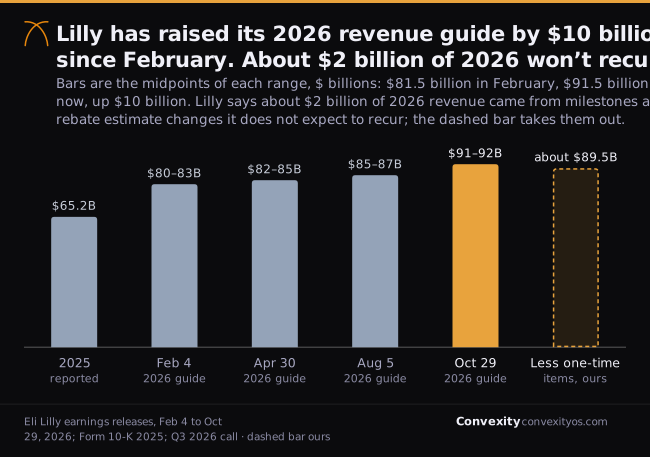
| Revenue, $ billions | |
|---|---|
| 2025 | $65.2B |
| Feb 4 | $81.5$80–83B |
| Apr 30 | $83.5$82–85B |
| Aug 5 | $86.0$85–87B |
| Oct 29 | $91.5$91–92B |
| Less one-time | $89.5about $89.5B |
The range also says something about the fourth quarter. Lilly booked $67.2 billion in the first nine months, so the full-year range implies $23.8 billion to $24.8 billion in the December quarter, 24% to 29% more than a year earlier (our arithmetic).
At its midpoint, that is about level with the third quarter's $24.4 billion, which included $900 million of one-time benefits. Against the third quarter without them, the midpoint is about 3.5% higher (our arithmetic). Lilly is not guiding to a stall, but it is not guiding to a jump either.
Growth is slowing from very high rates, as it was always going to at this size. Revenue rose 54% in the third quarter of 2025 and 56% in the first quarter of 2026; the guide implies about 26% in the fourth.
Lilly's executives argue the ceiling is far away. Montarce said Lilly is "scratching the surface on the number of patients that we can reach," reaching about one in 10 patients in the United States and two in 100 elsewhere. Asked whether guidance was too cautious, Ricks said "we're in the middle of the largest new category expansion in the history of the pharmaceutical industry."
That may be right, and the volume supports it. But 2027 begins with a price per prescription pushed down from three directions: government programs at set prices, cash buyers at reduced ones, and China at reimbursed ones. And it begins without the $2 billion that flattered 2026.
Lilly gave its 2026 guidance with its fourth-quarter results on February 4 this year. The 2027 version will show whether "a headwind, more than offset by volume" is a phrase or a number.
What would prove this wrong
This note argues three things: that Lilly's growth is volume bought with lower prices, on purpose; that the U.S. price decline is larger than the reported figure, because of true-ups that will not recur; and that next year's channel mix pushes the price of a prescription lower still. Each can be checked against something with a date.
- The fourth-quarter results and 2027 guidance, expected in early February. If Lilly's U.S. price decline narrows without the help of estimate adjustments, or its 2027 guide treats price as a smaller headwind than 2026's, the give is smaller than this note says.
- The true-ups themselves. Rebate estimates can move the other way. If a later quarter brings an unfavorable adjustment, the reported decline will overstate the underlying one for a change, and the $24.2 billion rebate liability is where it will show.
- Volume. The argument assumes volume keeps outrunning price. If U.S. obesity prescriptions, up 82% in the third quarter by Lilly's count, slow sharply, or Bridge enrollment stalls, the trade stops paying for itself.
- The Bridge after 2027. CMS has committed to the program only through December 31, 2027. If Part D coverage of obesity drugs does not follow for 2028, as Ricks expects it will, a channel holding more than half a million Lilly patients faces a cliff, and the price question becomes a volume one.
- Prices abroad. If Lilly does launch new medicines at higher prices outside the United States, as its agreements point to, its international price decline should ease once the Chinese listing laps in the first quarter of 2027. If it does not ease, the discount abroad is structural.
- Novo Nordisk. Lilly's main competitor in injections and pills reports separately. A sharp change in Novo's pricing or share, in the Bridge or abroad, would change the terms of Lilly's trade.
The filings and documents this is built on
18 documents
- 018-KEli Lilly, third quarter 2026 earnings release (Exhibit 99.1)Revenue by volume, price and currency, U.S. and outside, the $900 million of one-time benefits, product revenue, the non-GAAP reconciliation and the raised 2026 guidanceOct 29, 2026sec.gov
- 0210-QEli Lilly, Form 10-Q for the quarter ended September 30, 2026Rebate estimate changes as a share of U.S. revenue, the rebate liability, product revenue by market, cash flow, business development spending, the Bridge and pricing-agreement risk language, the Chugai royaltyOct 29, 2026sec.gov
- 03CallEli Lilly third quarter 2026 earnings call, transcript by GloomberbProduced from the public webcast; one of the two transcripts we read, and every quotation from the call is wording both carry; retrieved 2026-10-29Oct 29, 2026gloom.sh
- 04CallEli Lilly third quarter 2026 earnings call, transcript by Stock AnalysisThe second of the two transcripts; speaker titles are taken from the investor relations introduction; retrieved 2026-10-29Oct 29, 2026stockanalysis.com
- 058-KEli Lilly, second quarter 2026 earnings release (Exhibit 99.1)The U.S. price decline of approximately 9% excluding estimate adjustments, against 3% reported; the August guidanceAug 5, 2026sec.gov
- 068-KEli Lilly, first quarter 2026 earnings release (Exhibit 99.1)Volume and price split, the first-quarter true-up and Jardiance benefit, the April guidanceApr 30, 2026sec.gov
- 078-KEli Lilly, fourth quarter 2025 earnings release (Exhibit 99.1)Volume and price split, Q4 2025 revenue and product totals, and the original 2026 guidanceFeb 4, 2026sec.gov
- 088-KEli Lilly, third quarter 2025 earnings release (Exhibit 99.1)The year-earlier volume and price split, U.S. revenue, and the Jardiance and Cialis itemsOct 30, 2025sec.gov
- 098-KEli Lilly, second quarter 2025 earnings release (Exhibit 99.1)Second-quarter 2025 U.S. revenue, the base for the second-quarter 2026 true-up estimateAug 7, 2025sec.gov
- 1010-QEli Lilly, Form 10-Q for the quarter ended June 30, 2026Product revenue by market for the second quarterAug 5, 2026sec.gov
- 1110-QEli Lilly, Form 10-Q for the quarter ended March 31, 2026Product revenue by market for the first quarter, and the statement that the pricing agreements with the U.S. government were finalizedApr 30, 2026sec.gov
- 1210-QEli Lilly, Form 10-Q for the quarter ended September 30, 2025Product revenue by market for the third quarter and first nine months of 2025Oct 30, 2025sec.gov
- 1310-KEli Lilly, annual report on Form 10-K for 20252025 revenue and full-year product revenue by marketFeb 12, 2026sec.gov
- 14StatementThe White House, fact sheet on most-favored-nation pricing agreements with Eli Lilly and Novo NordiskThe $245 Medicare price, the $50 copay, the $1,086 list and $346 TrumpRx prices, the $150 oral starting dose, Medicaid access, most-favored-nation prices on new medicines; retrieved 2026-10-29Nov 6, 2025whitehouse.gov
- 15StatementThe White House, fact sheet on lower drug prices for all 50 state Medicaid programs600,000 seniors in the Bridge in its first two months; the December 1, 2025 agreement with the United Kingdom; retrieved 2026-10-29Sep 18, 2026whitehouse.gov
- 16CMSCenters for Medicare & Medicaid Services, Medicare GLP-1 BridgeProgram dates, the $50 copay, operation outside Part D, the extension through December 31, 2027 and BALANCE; retrieved 2026-10-29Oct 29, 2026cms.gov
- 17CMSCenters for Medicare & Medicaid Services, Medicare GLP-1 Bridge information for providersEligible drugs and formulations, and the April 6, 2026 update adding Foundayo; retrieved 2026-10-29Oct 29, 2026cms.gov
- 18FDAFood and Drug Administration, approval of Foundayo (orforglipron)The first new molecular entity under the national priority voucher program, 50 days after filing; dosing; retrieved 2026-10-29Apr 1, 2026fda.gov
Not investment advice. This note is an analysis of Eli Lilly's public disclosures and of U.S. government statements, published for research purposes, and not a recommendation to buy, sell or hold any security. A member of the Convexity team holds SPY, which holds Eli Lilly; no other position.
What here is ours rather than Lilly's. As filed or stated by Lilly: every revenue, earnings, margin, expense, tax rate, share count, cash flow, capital spending, liability, business development, dividend, buyback and guidance figure; the volume, price and currency splits; the U.S. price declines excluding adjustments (approximately 9% in the second quarter, 10% in the third); the 2% of U.S. revenue; the $900 million and $410 million; the approximately $2 billion of one-time items; product revenue by market; the prescription, share, Bridge and Foundayo figures from the call; and every quotation, from Lilly's filings or from both transcripts of its call. As published by the government: the Medicare, TrumpRx and list prices, the copay, the Bridge's dates, rules and eligible drugs, the 600,000 seniors, the United Kingdom agreement, and the Foundayo approval. The consensus estimate is brokerage data. Ours: earnings before acquired research charges and their growth; the share of volume growth given back in price; tirzepatide's total, growth and share of revenue; the dollar size of the U.S. true-ups and the roughly $1.9 billion of one-time items we can identify; the per-share value of the third quarter's one-time benefits and its share of the beat; the rebate liability's growth; the percentages by which Medicare and TrumpRx prices sit below list; Foundayo's second-quarter revenue; the expense growth rates; operating cash flow less capital spending; the earnings guidance bridge; the $10 billion raise, the $89.5 billion base, 2026 growth with and without one-time items, and the fourth quarter the guidance implies.