








Disclosure. Convexity builds research tools for public-market data. This note is analysis, not investment advice, and nothing in it is a recommendation to buy, sell, or short any security. We hold no position in SanDisk, Dell Technologies, Micron, Western Digital, Samsung, SK Hynix, Kioxia, or any other company named below, and no relationship with any of them. Company figures come from the earnings releases cited at the bottom, and the periods are not the same: SanDisk's fiscal fourth quarter ended July 3, 2026, and Dell's fiscal first quarter ended May 1, 2026. Memory contract price figures are TrendForce's published estimates, retrieved 2026-08-30, and are neither company's costs nor ours. Where a number is our arithmetic on disclosed figures, we say so in the sentence that uses it.
The most informative number produced by the AI buildout this year is not a revenue figure. It is a cost figure, and it did not move.
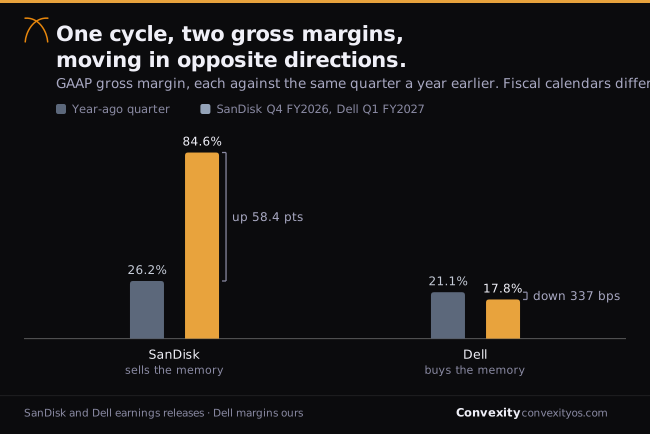
In its fiscal fourth quarter, SanDisk reported revenue of $8,965 million against $1,901 million a year earlier, growth of 372%. Its cost of revenue over the same comparison went from $1,403 million to $1,383 million. It fell.
Revenue up nearly five times, cost of goods down slightly. Gross margin of 84.6% against 26.2%. The company sold roughly the same amount of physical product for roughly the same cost and charged multiples more for it, and said so: two thirds of the sequential growth was pricing.
A margin like that is not an efficiency. It is a transfer. Somebody on the other side of those invoices paid it, and their income statements are where the second half of this story is.
SanDisk figures are for the fiscal fourth quarter ended July 3, 2026; Dell figures are for the fiscal first quarter ended May 1, 2026. The DRAM multiple is our arithmetic on the midpoints of TrendForce's published quarterly ranges and describes an index, not any company's cost.
The cleanest statement of a price move you will find
Cost lines are usually noisy. Volumes move, mix moves, yields improve, one-time charges land. It is rare to get a comparison where the physical business held still and only price moved, and rarer still for it to be this large.
| SanDisk | Q4 FY2026 | Q4 FY2025 | Change |
|---|---|---|---|
| Revenue | $8,965M | $1,901M | +372% |
| Cost of revenue | $1,383M | $1,403M | -1% |
| Gross margin | 84.6% | 26.2% | +58.4pts |
We wrote about that quarter when it landed, in SanDisk's backlog is not the reason to own it, and the argument there was that the margin is a price and prices revert. That remains our view. What we want to do here is follow the money in the other direction, because the same cycle that produced an 84.6% gross margin has to be showing up as a cost somewhere, and it is.
The other end of the invoice
Dell's fiscal first quarter was read as a blowout, and on revenue it was: $43,842 million, up 88%, with AI-optimized server revenue of $16,132 million against $1,882 million a year earlier.
Consolidated gross margin over the same comparison fell from 21.1% of revenue to 17.8%, which is 337 basis points, by our arithmetic on the income statement.
The mechanism is mix rather than any single input cost, and we went through it in Dell's growth is diluting its own margin. Products, which carry a 13.8% gross margin by our arithmetic, went from 75% of revenue to 87%. Services, at 44%, were flat in dollars. The blend moved toward products.
But the level matters as much as the direction. Dell's products gross margin is 13.8%. That is the cushion absorbing every component price move on the hardware side of the company. It is not a lot of cushion, and memory is one of the largest bought-in costs in an AI server after the accelerator itself.
A necessary caution, because the neat version of this is wrong. SanDisk does not sell to Dell in any proportion that would make these two income statements two sides of one ledger. SanDisk makes NAND; an AI server's memory bill is mostly DRAM and high-bandwidth memory, bought from Samsung, SK Hynix and Micron. The relationship here is sectoral, not bilateral. What the two filings jointly demonstrate is that the memory complex repriced enormously and that server builders' margins moved the other way over the same period. They do not demonstrate that one company's margin came out of the other's.
Two managements, one constraint
The strongest evidence that this is the binding constraint did not come from a memory company. It came from two of their customers, independently, on their own earnings calls.
Dell's chief operating officer, describing why the AI backlog keeps growing:
Demand continues to exceed supply, with memory as the primary constraint, and we expect to exit the year with meaningful backlog.
He went further, on what that scarcity is doing to customer behaviour:
The memory uncertainty is driving customers to proactively secure access to infrastructure across both traditional and AI workloads over longer periods of time.
Broadcom's chief executive, asked why bookings ran at nearly three times shipments in a single quarter:
There is not just asking for wafers, to get the chips or memory, to ensure that HBMs are available or DRAM is available. They are also talking about, hey, I have got to have the power.
Read those together and a picture emerges that neither company's headline conveys. The two largest suppliers into the AI buildout are both describing a market where the accelerator is not the scarce thing. Memory is, and power is, and customers are ordering years ahead specifically to secure both.
That reframes a good deal of what gets reported as demand. When Dell books $24.4 billion of AI orders in a quarter, or Broadcom books over $30 billion against $10.8 billion shipped, some of that is customers wanting machines and some is customers queueing for components they fear will not be available. Those are identical in a backlog disclosure and they mean different things about the durability of what stands behind them.
It also locates the pricing power in this supply chain. It is not with the company assembling the rack, and on this evidence it is not entirely with the company designing the accelerator either.
What the index says
The published contract price series is the connective tissue, and it is third-party rather than either company's disclosure.
| Quarter | Conventional DRAM, QoQ | NAND flash, QoQ |
|---|---|---|
| Q1 2026 | +93% to +98% | +55% to +60% |
| Q2 2026 | +58% to +63% | +70% to +75% |
| Q3 2026 | +13% to +18% | +10% to +15% |
Our arithmetic on the midpoints of those ranges: DRAM contract prices compound to roughly 3.6 times their fourth-quarter-2025 level by the third quarter of 2026, and NAND to roughly 3.1 times.
Three tripling-scale input costs inside a hardware business running a 13.8% products gross margin is the whole argument in one sentence. It does not require anyone to be wrong or dishonest. It is what happens when a supply-constrained component gets bid for by buyers who are not price sensitive, and the people assembling the machines sit between the two.
Why the cost line did not move
The SanDisk comparison at the top is stark enough to be worth explaining rather than merely displaying, because the mechanism is what makes this cycle so violent in both directions.
A memory fab is close to pure fixed cost. The plant, the tools and the process are the expense. Once capacity exists the marginal cost of another wafer is small and largely unavoidable, because running a fab below capacity costs more per unit than running it full. Memory makers therefore run flat out through almost any price environment, and industry output does not respond quickly to price.
What that produces is an income statement where cost of revenue is nearly a constant and revenue is a price multiplied by a roughly fixed volume. When price rises steeply, almost all of it reaches gross profit. That is exactly what SanDisk reported: cost of revenue of $1,383 million against $1,403 million a year earlier, revenue of $8,965 million against $1,901 million, and gross margin of 84.6% against 26.2%.
The same mechanism runs in reverse, and has repeatedly. An 84.6% gross margin on a fixed cost base is not a moat. It is a price sitting on a cost structure that does not fall when the price does. We ran that sensitivity when the quarter landed, in SanDisk's backlog is not the reason to own it, and nothing in the operating structure survives a normal reversion with margins intact.
The structure that makes this possible
Memory is among the most concentrated large manufacturing industries in the world, and that concentration is why prices can move like this at all.
Conventional DRAM is effectively three companies: Samsung, SK Hynix and Micron. NAND flash adds Kioxia and SanDisk, the latter separated from Western Digital in February 2025 and reporting prior periods on a carve-out basis. High-bandwidth memory, the stacked DRAM that sits beside an accelerator, is narrower still, and it is where AI demand concentrates.
Three features of that structure matter here.
Supply cannot respond inside a cycle. A new fab is a multi-year, multi-billion-dollar commitment. When demand steps up suddenly the only available response is price.
HBM competes with everything else for the same capacity. Wafer capacity allocated to high-bandwidth memory is capacity not making conventional DRAM. So an AI demand shock does not only lift HBM, it lifts the price of memory in phones, laptops and ordinary servers, which is why the published contract indices moved across every category rather than only the AI-adjacent one.
The buyers at the top are not price sensitive. A frontier lab building a cluster pays what memory costs, because memory is a fraction of a system whose value depends on being built at all. That is a very different customer from a PC maker, which is why PC makers have been visibly cutting memory content per device while AI buyers have not.
The cost that has not shown up yet
One thing the reported margins do not yet contain, and it is the reason this note is about a cycle rather than a quarter.
Memory bought at today's contract price does not reach the income statement until the machine containing it is sold. It sits in inventory first. So a builder's reported gross margin in any quarter reflects components bought some months earlier, at prices set some months before that.
Dell's inventory rose from $10.4 billion to $15.1 billion in a single quarter. Broadcom's days of inventory went from 68 to 86. Whatever those components cost, that cost is on the balance sheet now and reaches the income statement later.
That has two implications worth separating. The first is that the margin compression reported so far understates what has already been committed to, because the most expensive tranche of memory has not yet been sold through. The second, which cuts the other way, is that a company holding a large inventory of cheaply-bought memory into a rising price environment is sitting on an unrealised gain, and the same lag that delays a cost delays a benefit.
Which of those dominates depends on when each company bought relative to the price curve, and no outside reader can see that. What is visible is that both are carrying materially more inventory than a year ago, at a moment when the input has repriced by a multiple. The lag is the reason a reader should not conclude from one quarter's gross margin that the story is over in either direction.
Where the capex dollar goes
Put the pieces together and the interesting question about AI capital spending is not how large it is. It is how it divides.
A dollar spent on an AI server splits between the accelerator vendor, the memory vendors, the other component suppliers, and the company assembling the machine. Commentary almost always treats the first as the story.
Over the last two years the memory share of that dollar has risen sharply on contract prices alone, while the builder's share is a residual squeezed from both ends. Dell's products gross margin of 13.8% is what the residual looks like. SanDisk's 84.6% is what the other end looks like. Neither is a judgment on management at either company. They are positions in a supply chain during a price shock.
The practical consequence is that one headline, "AI capital spending is accelerating," implies very different things for different income statements depending on where a company sits. It is unambiguously good for memory. It is good for the accelerator designer. For the integrator it is revenue growth at a declining margin, financed by working capital, which is a materially worse business than the revenue line suggests.
The inventory signal
There is a smaller tell worth watching, and it appears in the accounts of the buyers rather than the sellers.
Broadcom's chief financial officer disclosed that days of inventory on hand rose to 86 days in the second quarter from 68 in the first, describing it as securing supply "in anticipation of accelerating AI semiconductor growth in the second half of the year." Dell's inventory rose from $10.4 billion to $15.1 billion in a single quarter, roughly doubling year over year.
Companies do not tie up that much cash in components casually. Both are buying ahead, and buying ahead is what firms do when they expect scarcity or higher prices, which in this market are the same expectation.
That is a bullish signal for near-term memory pricing and a bearish one for those same companies' working capital. It is also the clearest available evidence that the people closest to the supply chain believe the constraint persists.
Why this is the AI trade and not a footnote to it
The AI story is told as a compute story: accelerators, model capability, capex totals, power. All of that is real. But if you go line by line through the income statements that have actually moved this year, a surprising share of the movement is memory.
Three ways it shows up:
It decides who keeps the capex. A dollar of AI server spend splits between the accelerator vendor, the memory vendors, and the builder. In 2024 the split heavily favored the accelerator. In 2026, with DRAM up threefold, a materially larger share is going to memory, and the builder's slice is the residual.
It is the part of the buildout with real supply constraints and no software margin. Accelerator supply is constrained by one company's allocation decisions. Memory supply is constrained by fabs, which take years. That is a different kind of scarcity and it reprices differently.
It is where the cycle turns first. Memory is the most cyclical component in the stack and has been for forty years. If the AI buildout decelerates, the memory complex will show it in pricing before anyone's revenue guidance shows it in revenue.
The number that is hardest to argue with
Before the structural argument, it is worth putting the price series and the two income statements in one place, because the correspondence is the whole case.
| Year-ago quarter | Most recent | Change | |
|---|---|---|---|
| SanDisk revenue | $1,901M | $8,965M | +372% |
| SanDisk cost of revenue | $1,403M | $1,383M | -1% |
| SanDisk gross margin | 26.2% | 84.6% | +58.4pts |
| Dell consolidated gross margin | 21.1% | 17.8% | -337bps |
| Dell products gross margin | 14.1% | 13.8% | -32bps |
The two companies report on different fiscal calendars and sell different things to different customers, so this is a sectoral comparison rather than a ledger, as stated above. What it shows is a period in which one participant's cost base did not move while its price quadrupled, and another participant's product margin sat at 13.8% while it doubled the volume it shipped.
Between those two rows sits a price index that roughly tripled. That is the transfer, and it is visible from both ends without anyone having to be accused of anything.
What would make this argument premature
The honest problem with a transfer argument is that it is easiest to make after the transfer has happened, and the data above is entirely backward-looking.
The strongest reason to think the moment has passed is in the third quarter contract price range: DRAM up 13% to 18% against 93% to 98% two quarters earlier. The rate of change has collapsed even though the level has not. A note arguing memory is the trade, published on that data, is arguing it after the largest moves and while the second derivative is negative.
There is a second and more subtle problem. If both Dell and Broadcom are stockpiling, as their inventory disclosures show, then some portion of current memory demand is inventory build rather than consumption. Inventory build is borrowed demand: it pulls purchases forward and leaves a hole behind it. Every previous memory cycle has ended with exactly that mechanism, where the apparent demand turns out to have been the channel filling rather than end use.
Neither of those makes the historical analysis wrong. They bear on whether it is actionable, which is a different question, and one this note cannot settle.
The other constraint in the same sentence
Both quotes above name a second scarcity alongside memory, and it deserves separating out because it behaves differently.
Dell's customers are securing infrastructure over longer periods. Broadcom's are asking about wafers, HBM, DRAM "and, hey, I have got to have the power." Power is the constraint that memory pricing cannot solve, and unlike memory it cannot be relieved by capital expenditure on any relevant timescale. A fab takes two to three years. An interconnection queue for a large load can take longer, and a new generating asset longer still.
That matters to this argument in a specific way. If power rather than memory becomes the binding constraint, then memory demand is capped by how much compute can actually be energised, and the memory cycle turns for a reason that has nothing to do with memory supply. The scarce input would simply have moved.
It also explains a pattern that otherwise looks odd: buyers ordering components years ahead while simultaneously reporting that they cannot deploy everything they have. Ordering early is rational when the lead time on the surrounding infrastructure is longer than the lead time on the parts.
We wrote about the electricity side of this from a different angle in Bloom Energy's best quarter is its least convincing, where the demand narrative ran well ahead of the contracted disclosure. The connection to make here is narrower: the same buildout is bidding for memory and for electrons at the same time, and only one of those can be manufactured faster.
Who else sits on this trade
The two companies at the centre of this note are not the only exposures, and it is worth naming the shape of the others rather than leaving the argument to rest on a pair.
Other memory makers carry the same operating leverage in both directions: Samsung, SK Hynix, Micron and Kioxia all run high fixed-cost fabs into the same pricing environment. Whatever is true of SanDisk's margin structure is broadly true of theirs.
Other server builders carry the same squeeze as Dell. Hewlett Packard Enterprise and Supermicro assemble machines from the same components for overlapping customers, and the original design manufacturers who sell directly to hyperscalers do it with lower overhead still.
The PC and phone makers are the quiet casualties. They buy the same DRAM and NAND without the pricing power of an AI buyer, which is why memory content per device has been visibly reduced rather than paid for. That cost lands on consumer hardware margins with a lag.
The accelerator designers sit closest to insulated. They do not buy the bulk of the memory in the system, and their content is the part customers are least willing to substitute.
Reading those five positions together is the actual point of this note. The AI buildout is not one trade. It is a transfer running through a supply chain, and where a company sits in that chain has mattered more to its margin over the last two years than anything its management did.
What a memory cycle has looked like before
The reason to treat 84.6% as a price rather than a business is that this industry has run this pattern repeatedly, and the shape is well documented.
The mechanism is always the same. Demand outruns installed capacity, prices spike because supply cannot respond, margins go vertical, the whole industry commits capital at the top of the market, the new fabs arrive together eighteen to thirty months later, supply overshoots, prices collapse, and margins go negative for the companies that expanded most aggressively. It is one of the most reliable cycles in manufacturing, and it has bankrupted or forced the consolidation of most of the participants that used to exist. The reason DRAM is three companies today is that it used to be more than twenty.
What makes the current episode genuinely different is worth stating fairly, because a cyclical framing can be lazy.
The demand source is new and is not consumer. Previous cycles were driven by PCs, phones and general-purpose servers, all of which are ultimately consumer-linked and cyclical themselves. This one is driven by AI cluster construction funded partly from capital markets rather than end demand, which is a different kind of buyer with a different sensitivity.
Capacity discipline has held longer than usual. The consolidation to three DRAM players means the historical pattern of everyone expanding at once has, so far, been less pronounced. Three rational competitors behave differently from twenty desperate ones.
HBM is a structurally different product. It carries higher content, tighter qualification and closer customer integration than commodity DRAM, which makes it less of a spot-priced commodity and more of a designed-in component. That should dampen the amplitude, at least for the HBM portion.
Each of those is a real argument for why this time is less cyclical than the last time. None of them repeals the mechanism. Capacity is being added right now at prices that assume the current environment persists, and it will arrive on the usual schedule.
What to actually watch
If the argument in this note is right, the sequence of what breaks first is knowable even if the timing is not.
Contract prices turn before revenue does. The published indices move months ahead of reported results, which is why the third quarter deceleration in the table above matters more than any company's most recent quarter.
Builder gross margins are the confirmation. If memory prices flatten and Dell's blended gross margin stabilises, the transfer has stopped. If builder margins keep compressing while memory prices flatten, something other than memory is doing the work and this note is wrong about the mechanism.
Inventory reverses. Broadcom at 86 days and Dell doubling inventory are both bets on continued scarcity. Days of inventory falling back would be the clearest early signal that the companies closest to the supply chain have changed their minds.
The capex announcements are the top signal. Large, simultaneous capacity commitments from multiple memory makers have marked the top of every previous cycle. They are the thing to watch for, and they are always announced as evidence of strength.
Arguing it at the top
This is the section that matters most, because the honest problem with this note is its timing.
The moderation is already in the data above. DRAM contract prices rose 93% to 98% in the first quarter of 2026 and 13% to 18% in the third. That is still an increase, but the second derivative turned two quarters ago. TrendForce attributes the slowdown to weaker consumer demand and a high comparison base. A piece arguing that memory is the AI trade, published now, is arguing it after the largest moves have happened and while the rate of change is falling.
The specific ways this is wrong:
- The cycle rolls over. If contract prices flatten or fall, SanDisk's 84.6% margin compresses fast, since its cost base is nearly fixed and the entire margin is price. Our earlier note ran that sensitivity: the margin structure does not survive a normal reversion.
- Builders pass it through. If Dell and its peers reprice their order books, the margin pressure moves back up the chain to the buyer and the builder's slice is defended. AI server pricing has not been notably disciplined, but it could become so.
- Mix, not memory, explains Dell entirely. The 337 basis points is demonstrably a mix effect. Nothing in the release attributes any of it to component cost, and we are inferring exposure from the margin level, not measuring it. If Dell's hedging is good, the exposure is smaller than the level suggests.
- The comparison is loose. Different fiscal periods, different products, no commercial relationship. This is a sectoral argument dressed in two companies' numbers, and it should be read as the former.
What would settle it is not another quarter of price prints. It is the gross margin line at the server builders over the next two reports, read against whatever the memory vendors say about contract pricing into 2027. If builder gross margins stabilize while memory prices flatten, this was a cycle that already peaked. If builder gross margins keep compressing, the transfer is still running.
Primary sources
- ConvexitySanDisk's backlog is not the reason to own itOur note on the SanDisk quarter, including the price sensitivity behind the 84.6% marginAug 5, 2026
- ConvexityDell's growth is diluting its own marginOur note on the Dell quarter and the products and services mix behind the 337 basis pointsSep 1, 2026
- 8-KDell Technologies delivers first quarter fiscal 2027 financial results, Exhibit 99.1The Dell income statement and segment figures used hereMay 28, 2026
- CallDell Technologies Q1 fiscal 2027 earnings call transcriptThe statements that memory is the primary constraint and that memory uncertainty is driving customers to secure infrastructure over longer periodsMay 28, 2026
- CallBroadcom Q2 fiscal 2026 earnings call transcriptThe statement on customers securing wafers, HBM, DRAM and power ahead of delivery, and the disclosure that days of inventory rose to 86 from 68Jun 3, 2026
- TrendForceAI server demand continues to support memory prices in 3Q26, but gains moderateThird-party contract price estimates, retrieved 2026-08-30. Not any company disclosure
- TrendForceRapid contract price surge drives 1Q26 DRAM industry up 81% QoQThe first-quarter contract price estimates, retrieved 2026-08-30
Disclosure, again. Convexity builds research tools for public-market data. This note is analysis, not investment advice, and nothing in it is a recommendation to buy, sell, or short any security. We hold no position in any company named here and no relationship with any of them. SanDisk and Dell figures are from the earnings releases cited above and cover different fiscal periods, stated in the text. The following are ours, derived by arithmetic on those releases and not reported by either company: Dell's 337 basis point gross margin change, its products gross margin of 13.8% and the products share of revenue, and the compounding of TrendForce's midpoint ranges to roughly 3.6 times and 3.1 times. Memory contract price ranges are TrendForce's published estimates retrieved 2026-08-30 and describe an index rather than any company's realized cost. SanDisk and Dell have no commercial relationship material to this note, the argument is sectoral rather than bilateral, and the text says so. Statements attributed to Dell and Broadcom management are quoted from their respective earnings call transcripts, and every figure in those transcripts that also appears in the corresponding filed release has been checked against it. The description of memory industry structure and of prior cycles is general industry background rather than a sourced claim about any company, and the arguments for why this cycle may differ are given alongside it.