









Disclosure. I hold no position in SanDisk, held none while this research was done, and did not trade it around this report. I hold no position in Micron, Western Digital, Seagate or Kioxia either. This is not investment advice. Every figure is cited to a filing, an earnings release, or market data with a retrieval timestamp. Where a number is arithmetic on filed figures rather than stated in one, I say so at the point it appears, and the closing note lists every derived figure in one place.
SanDisk reported its fiscal fourth quarter after the close on Wednesday. Revenue was $8.965 billion against a guidance range of $7.75 to $8.25 billion, which is 8.7% above the top end of the company's own forecast. Non-GAAP earnings were $39.25 per share against a guided $30.00 to $33.00. Gross margin was 84.6%. The company then guided the September quarter to $10.3 to $10.8 billion of revenue and $44.00 to $46.00 of non-GAAP earnings per share, against a consensus of $41.45.
The stock fell 3.5% in the after-hours session.
Be careful with that number, because the version being passed around is bigger and wrong. SanDisk also fell 5.31% during Wednesday's regular session, but that happened while the results were still sealed. Western Digital fell almost exactly as much in the same session, before it too reported after the close. Two storage companies falling by the same amount before either published anything is a sector being repriced, not two sets of earnings being judged. Adding the sector move to the earnings move produces a dramatic 8.6% and attributes an afternoon of macro to one company's print. The reaction to these results is the 3.5%, and that is the number this piece uses.
Which makes the honest framing less exciting and more useful. A 3.5% shrug at a beat of this size is not a scandal. It is the market declining to extrapolate, which is usually the correct instinct about a commodity producer at the top of a cycle. So the question worth answering is not "why did it fall." It is what $1,304 a share actually assumes, and whether the exhibit the bulls keep producing supports the price they are defending.
On the second half, my answer is no, and I want to concede it early rather than bury it. I think this stock is interesting at this price. I also think the single most cited argument for it, the $41.6 billion of contracted revenue sitting in a note the earnings release never mentions, is being read about seven times too generously, including by me in an earlier draft of this piece.
Fiscal fourth quarter and fiscal year ended July 3, 2026. Revenue, margin and guidance from the Q4 FY2026 earnings release, filed August 5, 2026. The backlog conversion share is from Note 4 of the Form 10-Q for the quarter ended April 3, 2026. The multiple is arithmetic on company guidance and a share price retrieved 2026-08-05; see the closing note.
The quarter, without commentary
Here is the fiscal fourth quarter as filed, on a GAAP basis, against the same quarter a year earlier.
| Q4 FY2026 | $M | Q4 FY2025 | Y/Y |
|---|---|---|---|
| Revenue | 8,965 | 1,901 | +372% |
| Cost of revenue | (1,383) | (1,403) | -1.4% |
| Gross profit | 7,582 | 498 | +1,423% |
| Total operating expenses | (545) | (480) | +14% |
| Operating income | 7,037 | 18 | n/m |
| Gain on equity securities, net | 804 | (1) | n/m |
| Income tax expense | (946) | (5) | n/m |
| Net income | 6,903 | (23) | n/m |
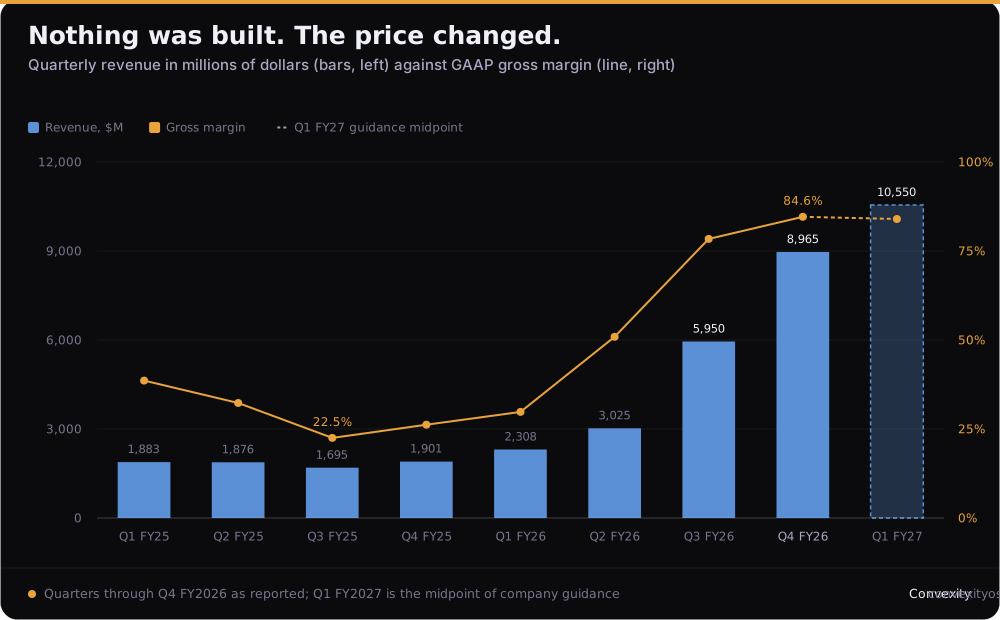
The line that carries the entire quarter is the second one. Cost of revenue fell 1.4% year over year while revenue rose 372%. SanDisk spent slightly less making its product than it did a year ago and charged nearly five times as much for it. Every incremental dollar of revenue above the prior-year level landed in gross profit essentially intact, which is how a company goes from $498 million of gross profit to $7.58 billion in four quarters without building anything.
That is not an operating achievement and the company does not claim it is one. It is price. Management says so directly in the release: sequential revenue growth came "approximately one-third from higher volumes and two-thirds from higher pricing." Hold onto that sentence. It is the strongest argument for the bears and it is in the first bullet of the company's own summary.
Why the price moved is worth stating plainly, because the rest of this piece assumes you know and a lot of coverage does not bother. AI datacenters consume high-capacity storage in quantities nobody built capacity for, and NAND supply cannot be added quickly: it takes years, a fab, and in SanDisk's case a joint-venture partner's agreement to spend the money. Demand arrived faster than supply could answer, and in a commodity that is the whole mechanism of a price spike. SanDisk's own disclosure is the cleanest evidence of where the demand sits. Datacenter revenue grew 437% over the fiscal year, from $960 million to $5.153 billion, and the company now describes it as "a key growth pillar."
That also tells you what the bear case is really about. It is not a claim that AI demand is fake. It is the observation that every previous time this happened, the supply arrived eventually.
The full year:
| Fiscal year | FY2026 | FY2025 | Y/Y |
|---|---|---|---|
| Revenue, $M | 20,248 | 7,355 | +175% |
| Gross margin | 71.5% | 30.1% | +41.4 pt |
| Net income, $M | 11,433 | (1,641) | n/m |
| Diluted EPS, GAAP | $73.76 | $(11.32) | n/m |
| Diluted EPS, non-GAAP | $70.88 | $2.99 | n/m |
| Operating cash flow, $M | 11,671 | 84 | n/m |
Fiscal 2025 included a $1.83 billion goodwill impairment, taken in the March 2025 quarter when the company's own market capitalization was telling it the business was worth less than its carrying value. That impairment is the cleanest available marker of where the cycle bottomed, and it is worth remembering that it happened fifteen months ago.
The end markets tell you where the growth came from:
| Revenue by end market, $M | Q4 FY2026 | Q3 FY2026 | Q/Q | FY2026 | Y/Y |
|---|---|---|---|---|---|
| Datacenter | 2,977 | 1,467 | +103% | 5,153 | +437% |
| Edge | 5,432 | 3,663 | +48% | 12,160 | +195% |
| Consumer | 556 | 820 | -32% | 2,935 | +29% |
| Total | 8,965 | 5,950 | +51% | 20,248 | +175% |
Datacenter doubled sequentially and went from 11% of the company to 33% of it in a single year. Consumer, the retail memory-card business most people still associate with the brand, fell 32% sequentially and is now 6% of revenue. Whatever SanDisk was in 2024, it is now an enterprise storage supplier with a consumer brand attached.
The balance sheet cleared out alongside it. Long-term debt went from $1.829 billion to zero. Cash is $4.762 billion, plus $1.777 billion of marketable equity securities, against no borrowings. The company bought back $4.524 billion of stock in the quarter and the board authorized another $14 billion, bringing the remaining authorization to $15.5 billion.
What the market did with it
The decomposition matters more than the total, so here it is separated.
| Wednesday, August 5 | Move | Results public? |
|---|---|---|
| Tuesday close $1,427.62 to Wednesday close $1,351.76 | -5.31% | No |
| Wednesday close to after hours $1,304.25 | -3.51% | Yes |
| Combined | -8.64% |
Only the middle row is a verdict on this quarter. The top row is an afternoon in which the whole storage complex fell before any of it had reported: Western Digital lost 5.3% in the same session and then a further 10.2% after hours on its own numbers, which were also a beat. Prices were retrieved at 20:44 UTC on August 5, 2026 and are stale the moment you read them.
That distinction is not pedantry. An 8.6% decline on a beat-and-raise is a story about a market rejecting good news, and I would like that story to be true because it is the one that makes this piece dramatic. A 3.5% decline is a market saying it does not believe the run rate is permanent, which is a much more ordinary thing to say and much harder to argue is a mistake.
And the move landed on a stock that had already been dismantled. SanDisk traded as low as $40.53 in the week of August 4, 2025. It reached $2,354.39 in the week of June 22, 2026, a 58-fold move in under a year. It then fell to $998.19 in the week of July 27, a 58% drawdown, before recovering to where it sits now, still 44.6% below the June high.
| SanDisk share price | Date | Level |
|---|---|---|
| 52-week low | Week of Aug 4, 2025 | $40.53 |
| 52-week high | Week of Jun 22, 2026 | $2,354.39 |
| Post-peak low | Week of Jul 27, 2026 | $998.19 |
| Close, Aug 5, 2026 | Regular session | $1,351.76 |
| After hours, Aug 5, 2026 | 20:44 UTC | $1,304.25 |
A stock that goes up 58 times and then falls 58% is not being valued. It is being traded. That does not make it mispriced, but it does mean the current price contains very little information, and it is why the rest of this piece works from the filings rather than from the tape.
The multiple is most of the case
At $1,304.25 and the 155 million diluted shares the company used for fiscal 2026 and guides to for the September quarter, SanDisk's market capitalization is about $202.2 billion. On the 149 million shares actually issued and outstanding at the balance-sheet date it is about $194.3 billion. Take out $4.762 billion of cash and $1.777 billion of marketable equity securities against no debt, and enterprise value is roughly $195.6 billion. All four of those are arithmetic on filed figures and a retrieved price.
Against that:
| Multiple | At $1,304.25 |
|---|---|
| Price / FY2026 GAAP EPS of $73.76 | 17.7x |
| Price / FY2026 non-GAAP EPS of $70.88 | 18.4x |
| Trailing GAAP earnings yield | 5.66% |
| Price / annualized Q1 FY2027 guidance midpoint of $45.00 | 7.25x |
| Forward earnings yield on that run rate | 13.8% |
| FY2026 free cash flow yield on market cap | 5.7% |
Free cash flow there is operating cash flow of $11.671 billion less $177 million of purchases of property, plant and equipment, both from the filed cash flow statement. That capital expenditure figure is 0.87% of revenue and it understates the real capital intensity of the business by a wide margin, for a reason I come back to below. Treat the 5.7% as the flattering version.
The 7.25x deserves a warning label. It annualizes a single guided quarter, which is the most aggressive defensible way to state a forward multiple and not a forecast of fiscal 2027. I use it because it is the only forward number that comes from the company rather than from me.
Now, the ratio the bull case usually reaches for here. On any input you choose, SanDisk's PEG is a rounding error: non-GAAP earnings per share went from $2.99 to $70.88, so the growth denominator is roughly 2,270% and the ratio rounds to 0.01. Do not use it. PEG is a tool for extrapolating a stable growth rate, and this denominator is a trough-to-peak recovery in a commodity price. Quoting 0.01 as evidence of cheapness would be the same error as quoting a 60x multiple at the bottom of the cycle as evidence of expense, and both numbers describe the cycle rather than the company.
The trailing multiple is more useful, but only barely, and only in context.
| Company | Price, Aug 5 close | Market cap | TTM GAAP net income | P/E |
|---|---|---|---|---|
| SanDisk | $1,351.76 | $209.5B | $11,433M | 18.3x |
| Micron | $892.82 | $1,085B | $50,469M | 21.5x |
| Western Digital | $519.22 | $186.2B | $6,511M | 28.6x |
| Seagate | $837.83 | $191.1B | $3,184M | 60.0x |
Those price-to-earnings figures are mine, computed from each company's four most recent reported quarters of GAAP net income and its share count, so they will not match a screen. Three caveats that matter. Western Digital's trailing figure excludes the quarter it reported the same afternoon, and its recent net income includes large non-operating gains, so 28.6x overstates what you are paying for its operations. Seagate and Western Digital are hard-drive businesses rather than NAND, so they share a customer and a cycle but not a cost structure. Micron is the real comparison, and it is the one that makes the point: the closest peer, in the same memory upcycle, trades at a 17% higher multiple of its own trailing earnings than SanDisk does.
What 17.7 times actually prices in
Multiples are only interesting when you convert them into a claim about the future, so here is the conversion.
Suppose you think a durable memory business should trade at 15 times normalized earnings. At a $202.2 billion market capitalization, that implies normalized net income of about $13.5 billion a year. The company guided the September quarter to $44.00 to $46.00 of non-GAAP earnings on roughly 155 million shares, which is about $6.98 billion of net income in one quarter, or $27.9 billion annualized.
So a 15 times multiple on today's price is paying for earnings 52% below the run rate the company guided to yesterday.
Push that back through the income statement. Hold Q4 volumes and unit costs exactly where they were, at $1.383 billion of quarterly cost of revenue and $545 million of operating expense, and vary only price. Apply the 15% tax rate the company itself uses in its guidance.
| Decline in selling prices from Q4 | Quarterly revenue, $M | Gross margin | Annualized net income, $M | P/E at $1,304.25 |
|---|---|---|---|---|
| 0% | 8,965 | 84.6% | 23,926 | 8.4x |
| 20% | 7,172 | 80.7% | 17,830 | 11.3x |
| 30% | 6,276 | 78.0% | 14,782 | 13.7x |
| 40% | 5,379 | 74.3% | 11,733 | 17.2x |
| 50% | 4,482 | 69.1% | 8,685 | 23.3x |
| 60% | 3,586 | 61.4% | 5,637 | 35.9x |
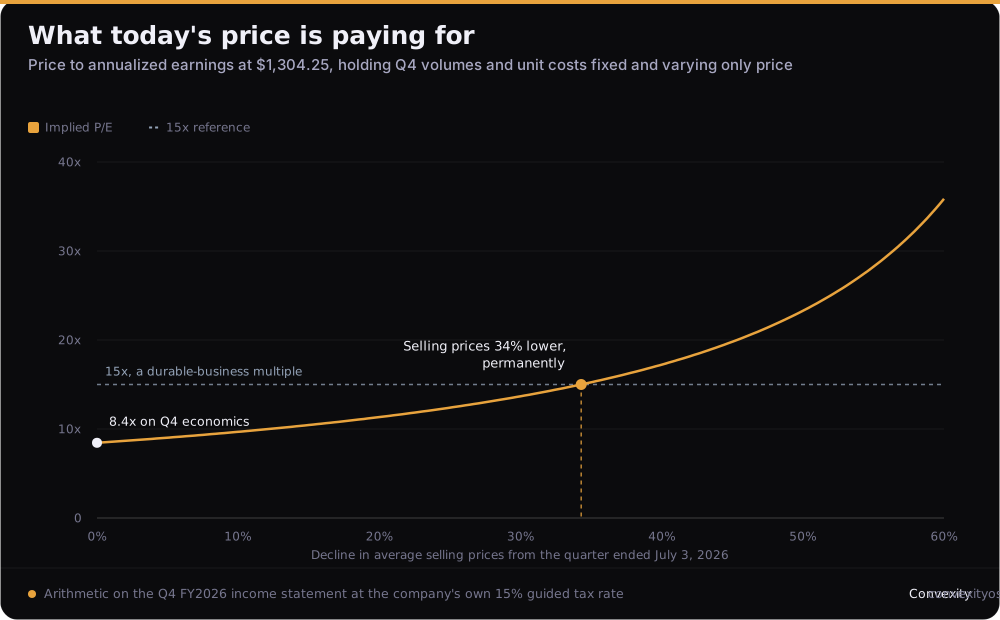
Every row of that table is arithmetic on the filed Q4 income statement, not a forecast, and it freezes two things that would not stay frozen. Read it as a sensitivity, not a projection.
The 15 times case lands at a 34% permanent decline in selling prices. That is what the current price is paying for, on that assumption, and it is worth saying plainly: a third of the price of NAND, gone and not coming back, starting from a quarter in which the company guided prices up again.
Two honest observations about that table, pointing in opposite directions.
The first is that the market's implied number is not absurd, and the best evidence for that is SanDisk's own income statement. Fiscal 2025 ended fifteen months ago with 30.1% gross margins, a $1.641 billion net loss, and a goodwill impairment. The company's own risk factors still lead with "volatile demand and pricing trends and fluctuations in average selling prices." A 34% decline is not a catastrophe scenario in this industry. It is a Tuesday, and the tail below it is fat.
The second is that the table gets much worse for the bulls if you relax the assumption I froze. I held unit costs flat, which means gross margin never falls below 61% even at a 60% price decline. Real NAND downcycles do not work that way, because volumes and costs move too, and because SanDisk is contractually obligated to pay half of the fixed costs of its manufacturing joint venture regardless of how much output it takes. A genuine return to normal memory economics, meaning gross margins in the 30s rather than the 60s, produces annual earnings of a couple of billion dollars, and at that level $202 billion is not cheap at any multiple you would defend.
So the bull case cannot be "it is 17.7 times trailing earnings." That is true and it is not sufficient. The bull case has to be that this cycle does not fully revert, and the only evidence that could settle that is contractual rather than narrative.
Which is where the release stops helping and the filings start, and where the argument most people are making for this stock falls apart on arithmetic.
The note everyone is misreading, including me
On April 3, 2026, SanDisk disclosed in Note 4 of its Form 10-Q that "the transaction price allocated to remaining performance obligations was $41.6 billion, of which $41.2 billion has not yet been billed." Approximately 15% of it is expected to be recognized as revenue over the next twelve months. The note attributes the balance to "long-term agreements with customers." The words "remaining performance obligations" do not appear in Wednesday's earnings release.
Here is the seductive version of that fact, which is the version I wrote first. SanDisk recognized $20.2 billion of revenue in all of fiscal 2026. The backlog is $41.6 billion. Therefore the company has contracted twice its annual revenue, the market has not been told, and a business with two years of revenue nailed down should not trade like a spot commodity producer.
Every number in that paragraph is accurate and the conclusion does not follow, for two reasons that compound.
The first is the denominator. Fiscal 2026 revenue is a historical average across a year that started at a $2.3 billion quarter and ended at an $8.97 billion one. The company has now guided to $10.55 billion for a single quarter, a $42.2 billion annual run rate. Against what SanDisk earns today rather than what it averaged last year, $41.6 billion is 0.99 times revenue. Not twice the company. About one year of it.
The second is the duration, and it is the one that actually settles the question. A backlog is not revenue, it is a schedule. The note says 15% converts within twelve months, which implies the balance runs out somewhere near seven years if it converts evenly. So the correct comparison is not a multi-year total against one year of sales. It is contracted revenue per year against revenue per year.
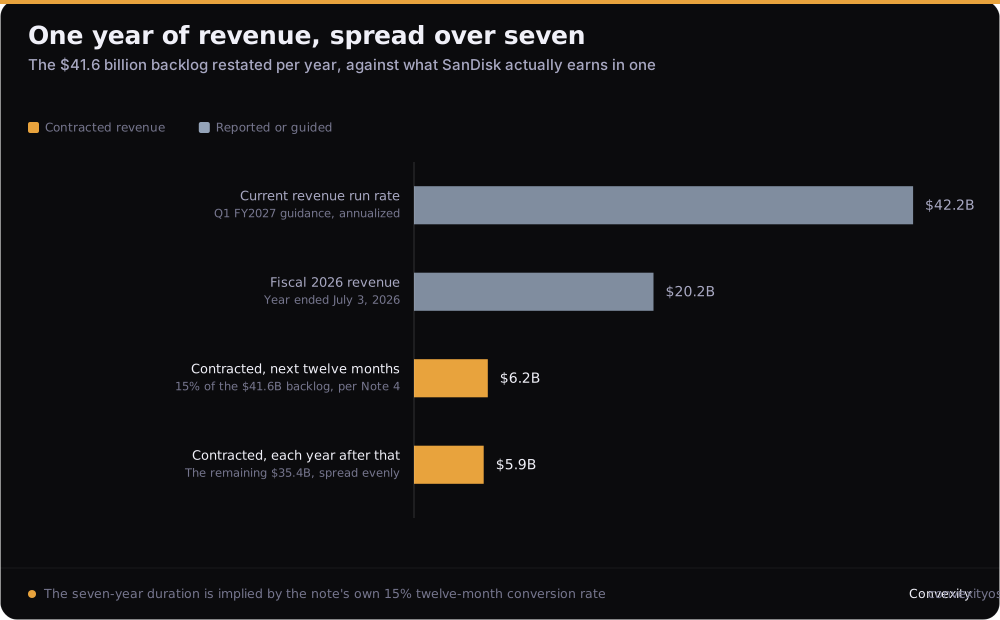
The contracted floor is about $6 billion a year, against a $42 billion run rate. Roughly 15% of it. That is the honest size of the thing, and it is a long way from what the two-times-revenue framing suggests.
Work out what a floor that size is worth and it gets starker. Take the $5.9 billion of average annual contracted revenue after the first year. At the 84.6% gross margin of the quarter just reported, and the company's own operating expense run rate, that produces roughly $3.2 billion of annual net income, a 1.6% earnings yield on the $202.2 billion market capitalization. At a 40% gross margin, which is a good outcome for NAND in a normal year, it is about $0.6 billion, or 0.3%. At the 30.1% margin SanDisk actually posted in fiscal 2025, the contracted business roughly breaks even.
So the backlog does not underwrite the valuation on any margin assumption you care to make. It cannot. It is too small a share of the company for that.
What it is, and this is worth keeping, is a genuine change in the shape of the risk. Every previous NAND upcycle was sold at spot: volume was contracted, price was not. That is a real part of why memory companies have always earned a low multiple of peak earnings, because nothing held the peak in place. Selling a fifth of your output forward for several years, at fixed prices, with prepayments arriving, does not make you a subscription business. It makes the tail thinner. In fiscal 2025 SanDisk lost $1.641 billion; a business with $6 billion of contracted revenue underneath it has a materially harder time doing that again.
That is the correct claim, and it is much smaller than the one I set out to make.
The rest of the disclosure holds up on inspection. The prepayments are real: the 10-Q states $0.4 billion of the $41.6 billion had been received and recorded as contract liabilities at April 3, and the balance sheet shows contract liabilities rising from $25 million at the end of fiscal 2025 to $511 million at April 3 to $1.242 billion at July 3. That is customers paying in advance for storage they have not received, which is not a thing spot buyers do. The count is real: Wednesday's release says five more agreements have been signed since April, three with new customers and two expanding existing ones, for ten in total. The figure widely reported from the April earnings call, that the agreements carry financial guarantees exceeding $11 billion, is management's characterization on a call I have not listened to and have not found restated in any filing. I use it nowhere in the arithmetic, and you should treat it as unverified until the 10-K either supports it or does not.
So: anyone telling you the backlog de-risks fiscal 2027 has not read the note, and anyone telling you it justifies the market capitalization has not divided it by anything.
Everything wrong with the bull case
Everything above is the case for paying attention to this stock. Here is the case against, assembled as unsympathetically as I can manage.
The margin is a price, and the company says so. 84.6% gross margin is not a NAND gross margin. It is the highest I am aware of in the history of the product, and it exists because cost of revenue was flat while price quadrupled. Two-thirds of the sequential growth was pricing, per the release. Nothing in the operating structure of this company would survive a normal reversion with margins intact.
Half the fixed costs are owed regardless. SanDisk's wafers come from Flash Ventures, the joint venture with Kioxia, in which SanDisk takes roughly 50% of output. The 10-Q states the company "is obligated to pay for half of Flash Ventures' fixed costs regardless of the output the Company chooses to purchase." In a downturn that converts a variable cost into a fixed one at exactly the wrong moment. The company's stated maximum estimable loss exposure to Flash Ventures was $2.967 billion at April 3, including $993 million of operating lease guarantees on equipment sold and leased back by the venture.
Capital intensity is off the balance sheet. Capital expenditure of $177 million on $20.2 billion of revenue is not what it costs to make NAND flash. The fabs sit inside Flash Ventures, accounted for by the equity method, funded partly through notes receivable the company issues to it, $462 million of them in fiscal 2026. There is also $1.2 billion of payments due to Kioxia between 2026 and 2029 under the January 2026 collaboration agreement that extended the joint ventures to the end of 2034. The free cash flow yield in the table above is real cash, but do not read it as a business that requires no capital.
Roughly $1.4 billion of tax has been earned and not paid. The fiscal 2026 provision was $1.584 billion. Cash paid for income taxes was $146 million. Income tax payable, current, went from $43 million to $1.286 billion. That is a genuine obligation moving through a future cash flow statement, and it is one reason to prefer the earnings yield to the cash flow yield here.
The GAAP number is flattered. Of $6.903 billion of GAAP net income in the quarter, $804 million was an unrealized gain on marketable equity securities, 11.6% of the total, sitting below the operating line. The company purchased $970 million of those securities during the same quarter and finished it holding $1.777 billion, an 83% gain inside a single quarter. It excludes the gain from non-GAAP, which is the correct treatment, and it does not name the security. The 10-K has not been filed. Use the $39.25 rather than the $43.97.
The share count is still going up. Diluted shares went from 145 million in fiscal 2025 to 155 million in fiscal 2026, a 6.9% increase, and 157 million in the fourth quarter alone. The company spent $4.524 billion on buybacks in the quarter and shares issued and outstanding still rose from 146 million to 149 million over the year. The buyback is currently offsetting compensation rather than shrinking the company. The new $15.5 billion authorization, which is 7.7% of the market capitalization, is large enough to change that, but it has not yet.
Concentration is rising. The top ten customers were 46% of revenue in the April quarter, against 41% a year earlier, and one customer exceeded 10%. A datacenter business growing 437% is a business whose fate is decided by a handful of purchase decisions.
One thing I looked for and did not find. Receivables grew 341% against 175% revenue growth, which is the usual signature of a company pushing product into a channel. It is not what happened here. SanDisk is collecting faster than it was a year ago, not slower: 47.8 days of sales outstanding in the fourth quarter against 51.1 a year earlier, on my arithmetic from the filed balance sheet and income statement. The 10-Q also states no receivables were factored in either fiscal year, so the improvement is not an artifact of selling the book. That specific worry is not supported.
Where that leaves it
Put the two halves together and the case is narrower than the one usually made, and rests on a different beam.
If this is an ordinary memory cycle, SanDisk is not cheap. Ordinary memory cycles end with gross margins in the 30s, and $202 billion against the earnings that produces is an expensive stock, not a bargain. Every bull who cites 17.7 times trailing earnings without engaging that sentence is quoting the peak back at you. The backlog does not rescue you from that argument either, which is the part I got wrong first time: at roughly $6 billion a year it is too small to carry a $202 billion company on any margin you can defend.
What is left is narrower and, I think, still interesting. At $1,304.25 you are paying 7.25 times the run rate the company guided to for the quarter now underway, against a balance sheet with no debt, $6.5 billion of net cash and a buyback authorization worth 7.7% of the company. If fiscal 2027 delivers four of the quarter just guided, that one year alone earns 13.8% of today's market capitalization. The sensitivity table says selling prices have to fall about a third, permanently, before the price starts looking ordinary rather than low.
So the bet is not "the backlog changes the multiple." It is narrower than that: NAND pricing has to land somewhere better than a permanent one-third haircut, and the contracted floor has to keep the downside from looking like fiscal 2025 while you wait. The first is the whole question and I cannot settle it from a filing. The second is what the backlog is genuinely for, and at $6 billion a year it does that job and no larger one.
That is a real asymmetry and a smaller one than I wanted to find. The market is not pricing the first as certain, which is what I thought before I did the division. It is pricing it as likely, which given the history of this industry is not obviously wrong. What the market is arguably underweighting is only the second thing, the thinness of the tail, and that is worth something rather than everything.
If you want the one-line version: this is a cheap cyclical with a slightly better floor than its predecessors, not a commodity business that has quietly become a contracted one.
What would prove this wrong
The backlog grows enough to matter after all. I have sized the floor from a figure disclosed on April 3, before half the agreements existed. Ten signed deals could carry the 10-K number well above $41.6 billion, and if it lands near $70 billion with the same twelve-month conversion, the annual floor moves toward $10 billion and my "too small to matter" verdict weakens considerably. The division is right; the input is four months old. This is the falsifier I consider most likely to fire.
Pricing breaks before any of it matters. If spot NAND falls 40% inside the next twelve months, the earnings decline arrives while 85% of revenue is still spot-exposed, the multiple goes from 7.25 times forward to something much worse, and a floor under the back years will not help anyone who bought here.
The conversion schedule is front-loaded, not even. My seven-year duration assumes the balance converts evenly after year one. If the agreements are five-year deals with a slow start, the annual figure in years two through five is meaningfully higher than the $5.9 billion I used. The note does not say, and the shape of the schedule is the single input my whole correction turns on.
The guarantees turn out to be softer than described. The $11 billion of financial guarantees and the third-party instruments behind them come from management's characterization on the April call. I have not seen the agreements. If the 10-K describes commitments that customers can walk away from at modest cost, the distinction I am drawing between this cycle and every previous one collapses.
Flash Ventures becomes the story. A downturn that forces SanDisk to pay half of the joint venture's fixed costs on reduced output would take earnings below what the price table above implies, because that table holds unit costs flat and reality would not.
Micron's multiple was right and SanDisk's is the outlier for a reason I cannot see. The peer comparison cuts the way I have used it only if the two businesses deserve the same multiple. Micron has DRAM and high-bandwidth memory, a different and arguably better mix. If the market is discounting SanDisk for being pure NAND, that is a judgment about product mix rather than a mistake about valuation.
The simplest way to be wrong. The stock gave back 3.5% on a beat-and-raise because the marginal buyer knows something about NAND contract pricing in the September quarter that is not in any document I can read. Sell-side channel checks lead the filings, and the filings are all I have used here. I did not listen to the earnings call either, which is a real gap and not one I can argue away. That is the honest limit of a filings-based piece, and it is the explanation I would look at first if this ages badly.
Primary sources
- 8-KFiscal fourth quarter 2026 earnings release, Exhibit 99.1Headline figures, end-market revenue, balance sheet, cash flow, guidance, non-GAAP reconciliation, buyback authorizationAug 5, 2026
- 10-QQuarterly report for the quarter ended April 3, 2026Note 4: $41.6B remaining performance obligations and the 15% twelve-month conversion. Flash Ventures fixed-cost obligation, loss exposure and lease guarantees. Customer concentration. No receivables factoring.May 1, 2026
- 8-KFiscal third quarter 2026 earnings releasePrior-quarter figures and the first five New Business Model agreementsApr 30, 2026
- ReleaseKioxia and Sandisk extend Yokkaichi joint venture agreement through 2034Flash Ventures extension and the payments due to Kioxia through 2029Jan 29, 2026
- ReleaseSandisk to report fiscal fourth quarter and fiscal year 2026 results on August 5, 2026Confirms the reporting date and the August 13 investor dayJul 9, 2026
- DataSanDisk, Micron, Western Digital and Seagate quotes, closes and share countsPrices retrieved 20:44 UTC 2026-08-05 from the brokerage market-data feed; peer net income from each company's four most recent reported quartersRetrieved Aug 5, 2026
Disclosure, again. I hold no position in SanDisk, Micron, Western Digital, Seagate or Kioxia, held none while this research was done, and did not trade around this report. Nothing here is investment advice or a recommendation to buy, sell or short any security. Company figures come from SanDisk's SEC filings and earnings releases as cited. The following are arithmetic on filed figures rather than disclosures, and are labeled where they appear: all market capitalizations, enterprise values, price-to-earnings ratios, earnings and free cash flow yields, the annualized guidance run rate, the implied normalized earnings and selling-price sensitivity table, the days-sales-outstanding figures, and every peer multiple. The backlog restated per year is mine and rests on one assumption the company does not make: Note 4 states only that approximately 15% converts within twelve months, and I have taken the balance to convert evenly thereafter, which implies a duration near seven years and an annual figure of about $5.9 billion. A front-loaded schedule would raise that figure and weaken the correction this piece is built on. The $41.6 billion total is as of April 3, 2026 and predates five of the ten agreements. Consensus estimates of $33.38 for the reported quarter and $41.45 for the September quarter come from the brokerage market-data feed rather than a filing. The $11 billion of financial guarantees attributed to the New Business Model agreements is management's characterization as reported from the April 30, 2026 earnings call. I did not listen to the call, did not find the figure restated in any filing, and used it in none of the arithmetic here. Share prices were retrieved on 2026-08-05 and are stale the moment you read this. I have no relationship with SanDisk or any company named here.