








Disclosure. No position in BE, long or short, at publication. Hunterbrook Media, cited below, has disclosed that Hunterbrook Capital was short BE at the time of its report. This is not investment advice. Every figure here is sourced, and where the source is a company marketing claim rather than a filed disclosure, I say so.
Bloom Energy reported the best quarter in its twenty-five year history on July 28. Revenue crossed a billion dollars for the first time, up 166% year over year. It beat the revenue consensus by roughly a third, roughly doubled expected earnings, produced real GAAP operating income, and raised full-year guidance to $3.9 billion to $4.2 billion.
The stock opened at $183.49 the next morning and was trading around $168.63 by mid-morning, below the prior close.
The easy explanation is that the market is still digesting a short report from three weeks ago about the company's scandium supply, and that this is a sentiment problem rather than a business problem. I do not think that is what happened. I think people read the actual filings, including the amendment Bloom filed the morning after the print, and concluded that the quarter is weaker evidence than the headline suggests.
That is the argument here. Not that the short seller is right about scandium, which I cannot verify and neither can you. The bearish case for Bloom sits entirely inside Bloom's own filings, and it does not require anyone to have lied about anything.
Give the quarter its due first
The results are genuinely strong, and a bear case that starts by minimizing them is dishonest. From the July 28 release (Bloom Energy 8-K, Jul 28 2026):
| Metric | Q2 2026 | Q2 2025 | Change |
|---|---|---|---|
| Revenue | $1,065.4M | $401.2M | +165.5% |
| Product revenue | $935.4M | $296.6M | +215.4% |
| Gross margin (GAAP) | 33.4% | 26.7% | +668 bps |
| Operating income (GAAP) | $182.2M | $(3.5)M | +$185.7M |
| Operating income (non-GAAP) | $239.6M | $28.6M | +$211.0M |
| EPS (GAAP) | $0.62 | $(0.18) | +$0.80 |
| Cash from operations | $226.4M | $(213.1)M | +$439.5M |
Positive GAAP operating income and positive operating cash flow, at a company that spent most of two decades producing neither, is a real change. So is the geographic mix: US revenue was 90% of the total in Q2 2026 against 59% a year earlier (Form 10-Q, Jun 30 2026). This is no longer a South Korea channel story.
The underlying demand logic is also sound. Grid interconnection queues run to years, a data center that cannot get power earns nothing, and a customer who can start two years earlier will pay a large premium for that. Bloom sells time-to-power, and time-to-power is scarce.
Management's framing is the strongest sentence in the release:
Today, all the major US hyperscalers and over a dozen US neoclouds, AI labs, and colocation data center operators have validated and approved our power solutions for their AI factories. Bloom is now a standard for AI onsite power.
KR Sridhar, Founder, Chairman and CEO, Q2 2026 press release
Hold onto that sentence. It is a claim about approvals, and it is probably true. The filings tell you what it converted into.
Who actually wrote the check
On July 29, the morning after the print, Bloom filed an amended 10-Q. The stated purpose was narrow: to fix a transposition of the phrases "three months" and "six months" in its concentration-of-risk note. The corrected paragraph reads:
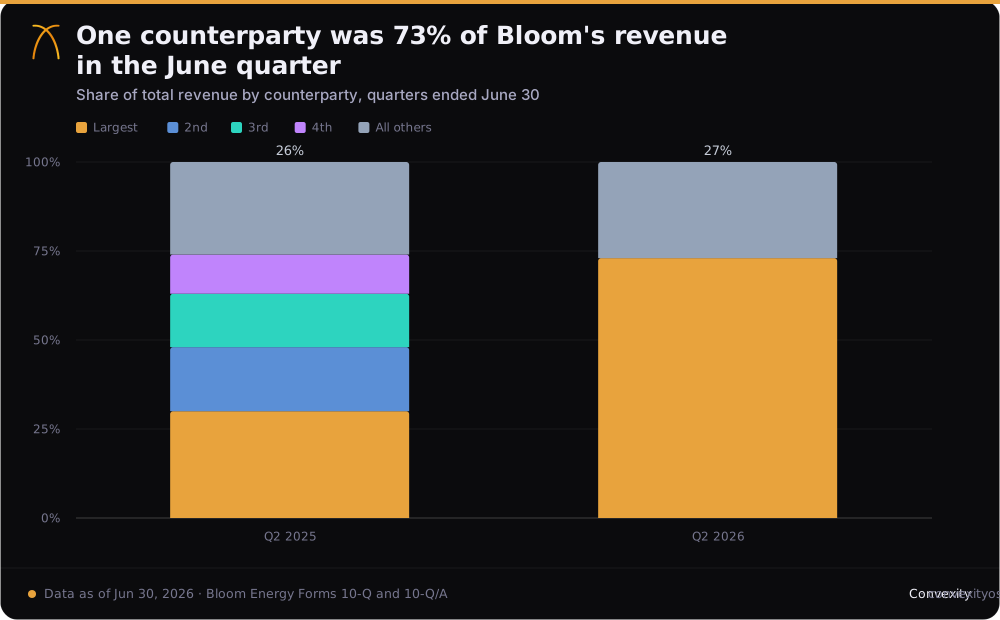
During the three months ended June 30, 2026, revenue from one customer*, which is not our related party, accounted for approximately 73% of our total revenue.
Form 10-Q/A, quarter ended June 30, 2026
Seventy-three percent of the record quarter came from a single counterparty. For the six-month period, two counterparties were 44% and 21%, and the second of those is a related party (Form 10-Q/A, Jul 29 2026).
Now the asterisk, which is the part that matters. Bloom defines the term:
For purposes of the concentration of risk disclosure, "customer" refers to the contractual counterparty to which we sell our products and fulfil installation obligations, which in certain transactions may be a project-finance affiliate rather than the ultimate end user of the products.
So the disclosure does not tell you that a hyperscaler bought roughly $780 million of fuel cells last quarter. It tells you a counterparty did, and that Bloom's own definition permits that counterparty to be a financing vehicle rather than anyone who will ever run a data center. The note points readers to the Brookfield-affiliated financing framework for context.
The balance sheet says the same thing from the other direction: three customers were 36%, 34%, and 17% of accounts receivable at June 30, and the third is a related party (Form 10-Q, Jun 30 2026).
None of this is improper. Project finance is a normal way to fund capital equipment, and selling into a vehicle you co-own with your financier is a disclosed, legal structure. But it means the quarter supports a narrower claim than the headline. "We booked record revenue" is proven. "A broad base of end customers is consuming our product" is not, and a year ago the same disclosure showed four meaningful names instead of one.
The obligation balance did not move
Bloom markets a backlog of roughly $20 billion. That is a real company-published figure: it appears in the fourth quarter 2025 release alongside a product backlog of roughly $6 billion. What it does not appear in is the financial statements. What the statements carry instead is unsatisfied performance obligations, the portion of contracted future revenue that sits inside the disclosures the auditor reviews.
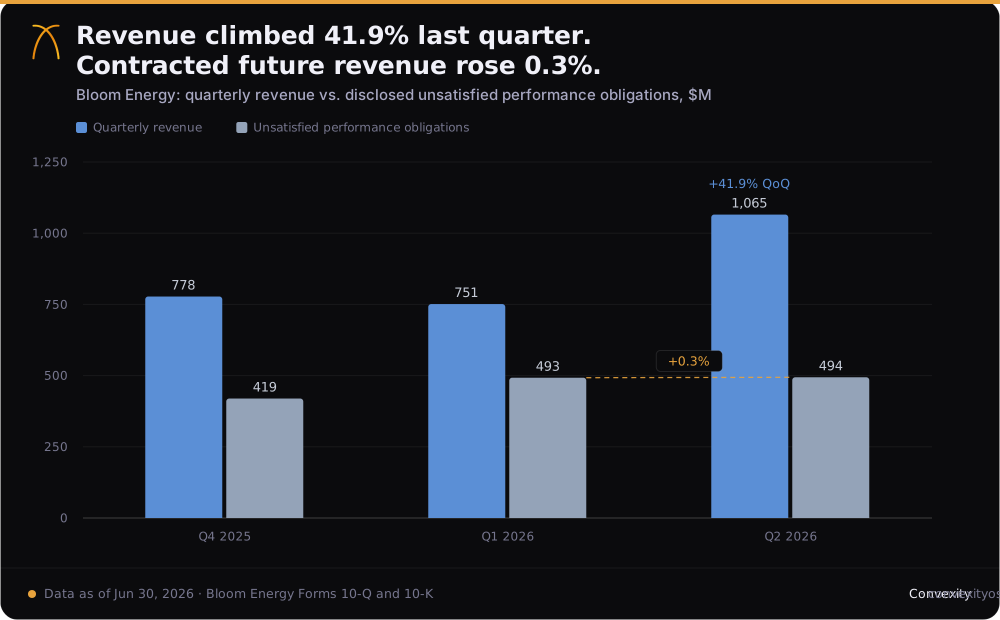
From the Q2 10-Q: $442.4 million of product and installation obligations, plus $51.7 million of deferred service obligations, for $494.1 million as of June 30, 2026. The same two lines in the Q1 10-Q give $441.1 million plus $51.5 million, or $492.6 million as of March 31 (Form 10-Q, Mar 31 2026).
Between those two dates Bloom recognized $1,065.4 million of revenue and raised its full-year outlook by enough to imply a second half above $2 billion. Contracted future revenue rose by $1.5 million. Three tenths of one percent.
There is an innocent reading, and it is probably part of the answer. Bloom excludes two categories from this disclosure: contracts with an original expected length of one year or less, and contracts where it recognizes revenue at the amount it has the right to invoice. Business signed and delivered inside a single year can pass through revenue without ever appearing as a quarter-end obligation. Fast conversion and no backlog look identical in this metric.
But accept that reading and you have conceded the more important point, which is what the $20 billion is made of.
What Bloom says its backlog is
This is the part of the bear case that needs no short seller at all. It is in Bloom's own footnotes to the $20 billion figure (Bloom Energy Q4 2025 results, Feb 5 2026).
Product backlog, Bloom writes, "reflects anticipated ITC and other tax incentives as applicable." Service backlog consists of contracted operations and maintenance revenue over terms of five to twenty years, "subject to termination for convenience on an annual basis by the customer."
Read those together. Part of the marketed backlog is tax credits the government has not granted yet. Another part is service revenue the customer can cancel every year for any reason. Neither is a commitment in the sense a reader hears when a company says "backlog." That is not an allegation, it is the definition, printed by Bloom, in the same release as the number.
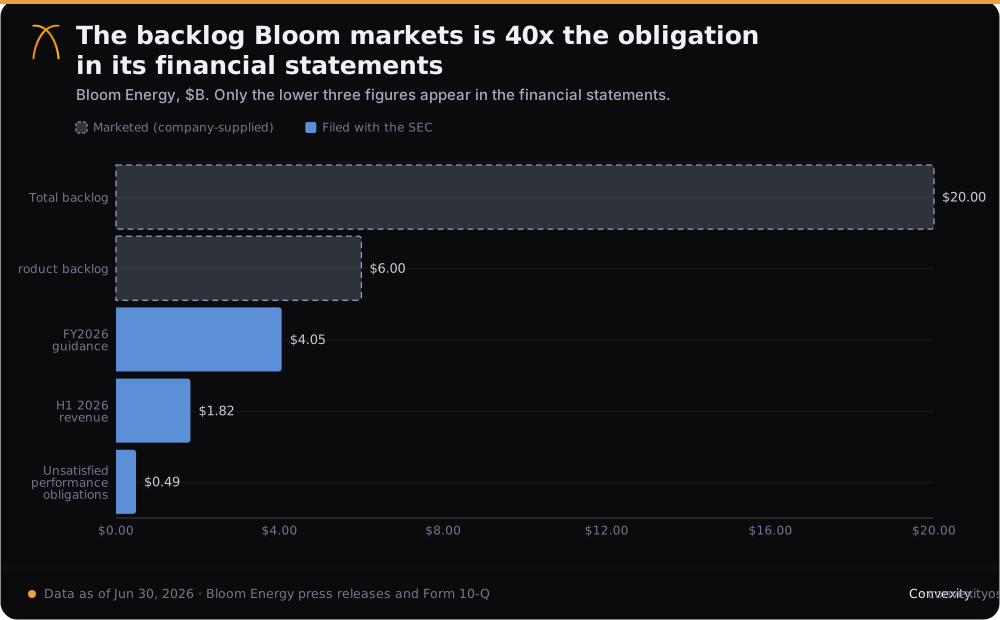
Even on the narrower and more defensible number, the roughly $6 billion product backlog is about twelve times the filed obligation. Bloom is guiding to about eight times that obligation in revenue this year alone. In a business that books and ships inside a quarter that can be fine. It also means there is very little contractual floor under the revenue line if the financing vehicles stop buying.
The scandium overhang, stated fairly
Bloom's cells use a scandia-stabilized zirconia electrolyte. Scandium oxide raises ionic conductivity, which lets a cell run cooler and last longer. Bloom describes the quantity as small relative to its effect, comparing it to "a sprinkle of salt on your dinner," and says it recovers the material as a byproduct of titanium, nickel, cobalt and uranium processing (Bloom Energy, Jul 7 2026, updated Jul 20 2026, retrieved 2026-07-29). By the CEO's own account Bloom is the largest consumer of scandium in the world. The global market is measured in tens of tons, China produces most of it, and since April 2025 Beijing has required an export license for every shipment.
On July 8, Hunterbrook Media published an investigation alleging that Bloom's supply runs through China despite years of explicit denials, and that the arithmetic does not support the ramp implied by the valuation (Hunterbrook Media, Jul 8 2026, retrieved 2026-07-29). Its model puts roughly 220 tons against a 5 GW ramp, versus projected global supply near 240 tons and global demand near 310 tons, and roughly 620 tons against the 25 GW figure Bloom cites, about ten times what the world consumed in 2025.
The denials it is measured against are not hedged. On the April 2025 earnings call, pressed three times on sourcing, Sridhar said:
There is no China supply chain for us.
KR Sridhar, April 2025 earnings call, as reported by Hunterbrook Media
Bloom rejected the report in a filing the next day, stating that it "categorically rejects the Report's claims," that its supply "is not dependent on China," and that it has "clear visibility into our supply chain to support production of 25GW of fuel cells per year" (Bloom Energy 8-K, Jul 9 2026). That is signed by the Chief Legal Officer and furnished to the SEC, which is a materially more serious act than a press statement, and I weight it accordingly.
I am not going to adjudicate this, because the information that would settle it is Bloom's supplier contracts and volumes, and Bloom withholds those as proprietary. That is a defensible commercial posture and it is also unfalsifiable.
Two observations instead. First, the word scandium does not appear anywhere in the Q2 10-Q. The risk factor refers to "certain raw materials" and "the relevant raw materials," and narrows the 8-K's confident visibility to 25 GW into sufficiency for "current fuel cell demand and backlog." Lawyers narrow language for a living and the 10-Q is exactly where you would expect it. But when the marketing voice and the legal voice describe the same fact at different confidence levels, the legal voice is the one carrying liability.
Second, and more usefully: the scandium question only binds at scale. Bloom almost certainly has enough for current demand, which is what the 8-K actually asserts. The exposure is to the 5 GW and 25 GW scenarios, which is to say to the growth that justifies the multiple rather than the business that exists. Treat it as a conditional ceiling on the out-years, not a near-term event. It is the least important part of this note, which is rather the point.
The destinations keep moving right
Hunterbrook also reports that two flagship projects have slipped: Oracle's Project Jupiter in New Mexico has no approved air permit for fuel cells and a gas pipeline pending at FERC, with SemiAnalysis moving its first-power base case to 2029; and AEP's fuel cell order moved from a target of year-end 2028 to "no later than 2030" in AEP's own investor materials. Both are attributed to Hunterbrook's reporting rather than to a Bloom filing, and both postdate Bloom's prior guidance raise.
Bloom's reported revenue does not obviously depend on those sites energizing on schedule, because the revenue is recognized well ahead of deployment. That is precisely the problem. A backlog whose flagship destinations keep moving right, while revenue accelerates anyway, is a combination that eventually has to reconcile.
Separately, the CEO adopted a Rule 10b5-1 plan on May 27, 2026 for up to 200,000 shares, and director Jeffrey Immelt adopted one on May 1 for up to 60,000, both near the highs. Scheduled plans are the correct and boring way for insiders to sell, and reading intent into them is usually a mistake. It is worth writing down anyway.
What you are actually paying for
Bloom peaked at $351.28 on June 25, 2026. It closed at $166.84 on July 28 and traded near $168.63 mid-morning on July 29, roughly 52% below the high, with a market capitalization near $47.9 billion (prices retrieved 2026-07-29).
At the guidance midpoint that is about 11.8 times 2026 revenue and roughly 62 times the midpoint of non-GAAP EPS guidance. For a business compounding at 100% with expanding margins, those multiples are demanding but not absurd. The bull case is that the drawdown already priced the doubt, and that you are buying proven near-term demand at a discount.
Market capitalization retrieved 2026-07-29. Obligations and concentration from the Forms 10-Q and 10-Q/A for the quarter ended June 30, 2026.
Here is why I do not take it. That $47.9 billion is underwritten by $494.1 million of contracted future revenue, a marketed backlog whose own footnotes describe uncommitted tax credits and annually cancelable service, and a quarter in which 73% of revenue came from one counterparty that Bloom's definitions permit to be a financing affiliate. The multiple is not the problem. The problem is the quality of the evidence underneath it, and the evidence got thinner this week rather than thicker, in a quarter that on the surface looked like the opposite.
You are not being asked to bet that Bloom's technology works. It does. You are being asked to bet that a demand base you cannot see in the disclosures is broader than the disclosures suggest.
What would make me wrong
The honest version of a bear case names its own falsifiers, and this one has clear ones.
I am wrong if counterparty concentration falls sharply over the next two quarters as named hyperscalers begin contracting directly. Seventy-three percent from one name can be the lumpiness of a business shipping very large projects, and two quarters distinguishes lumpiness from structure. I am wrong if unsatisfied performance obligations begin compounding alongside revenue, because that would show the pipeline converting into commitments rather than into one-off financed shipments. I am wrong if Bloom publishes verifiable scandium sourcing sufficient for the ramp, which removes the ceiling on the out-years entirely. And I am wrong if the Oracle and AEP timelines firm up rather than continue slipping.
Any one of those would move this materially. None of them happened this quarter, which is the point. Bloom reported the best numbers in its history and, in the same week, disclosed that its revenue is more concentrated than at any point in its recent past and that its contracted obligations did not grow. Both things are true. Only one of them was in the headline.
The filings this is built on
- 10-Q/AConcentration of risk, correctedThe 73% single-counterparty disclosure, and the definition of "customer"Jul 29, 2026
- 10-QQuarter ended June 30, 2026Unsatisfied performance obligations of $494.1M; receivable concentrationJul 28, 2026
- 8-KQ2 2026 results and raised guidanceRevenue of $1,065.4M; FY2026 guidance of $3.9B to $4.2BJul 28, 2026
- 10-QQuarter ended March 31, 2026The $492.6M obligation balance this quarter is measured againstApr 29, 2026
- 8-KQ4 2025 resultsThe ~$20B backlog figure and the footnotes defining what is in itFeb 5, 2026
- 8-KResponse to the short-seller reportCategorical rejection; "clear visibility" to 25GW of annual productionJul 9, 2026
Disclosure, again. No position in BE, long or short. Not investment advice, and nothing here is a recommendation to buy, sell, or short any security. Figures come from Bloom Energy's SEC filings and press releases as cited; market prices were retrieved on 2026-07-29 and are stale the moment you read this. Claims sourced to Hunterbrook Media are that outlet's reporting, not independently verified here, and Hunterbrook has disclosed a short position in BE. I have no relationship with Bloom Energy, Hunterbrook, or any party named here.