









Disclosure. Not investment advice, and nothing here is a recommendation to buy, sell or hold any security. A member of the Convexity team holds the SPDR S&P 500 ETF (SPY), which holds Netflix and Skydance; no other position. Figures are from Netflix's shareholder letters, its Forms 10-K, 10-Q and 8-K, and its January 20 and October 20 earnings interviews, quoted from the transcripts Netflix posts on its investor site and checked word for word against independently produced transcripts (the Motley Fool's for both, and Gloomberb's for October). The closing note lists what is our arithmetic. This note was drafted with Claude.
Netflix's third-quarter letter, published on October 20, repeats a sentence it has used all year. The company prioritizes reinvestment in the business, keeps "a healthy balance sheet and ample liquidity," and then returns "excess cash to shareholders via repurchases." The cash flow statement attached to the same letter shows something else. In the first nine months of 2026, Netflix spent $10,782 million buying back its own shares. Its free cash flow over the same nine months was $9,503 million, and that figure includes the $2.8 billion termination fee Netflix collected in March, when Warner Bros. Discovery walked away from their merger agreement for a rival bid. Without the fee, buybacks were 1.6 times free cash flow (our arithmetic).
From 2023 through 2025, the years Netflix has bought back stock in size, it spent less on buybacks than its free cash flow every year. In 2026 it has spent more, and the balance sheet made up the difference. Cash, cash equivalents and restricted cash fell to $8,198 million at the end of September from $9,039 million on January 1, even though Netflix borrowed $993 million in July. Net debt, Netflix's own non-GAAP measure, rose to $7,114 million from $5,457 million at the end of 2025.
That would be a timing story if the cash behind it were growing. It is not, on Netflix's own forecast. The company now expects about $12.0 billion of free cash flow this year. Take out the Warner Bros. fee and that is $9.2 billion to $9.8 billion, depending on how much tax the fee carried, against $9.46 billion in 2025: flat (our arithmetic). Over the same year Netflix expects operating income to grow more than 20%. Part of the gap is two one-off payments Netflix has named. The part that is not shows up in content: in the first nine months, the cash Netflix paid for films and series rose 18.5%, nearly twice the 9.5% rise in the content expense on its income statement.
Netflix third-quarter 2026 shareholder letter and fourth-quarter 2025 letter (Form 8-K, Exhibit 99.1); the percentage changes are ours.
The quarter, against what Netflix forecast in July
The September quarter met Netflix's July forecast on revenue and beat it on profit. Revenue was $12,874 million, up 12% from a year earlier (11% excluding currency moves), against a forecast of $12,860 million. Operating income was $4,459 million against a forecast of $4,268 million, an operating margin of 34.6% against 33.2% forecast, and diluted earnings were $0.87 a share against $0.82. Netflix attributed the margin beat "primarily" to "the timing of expenses" and slightly higher revenue, which is a way of saying some of the quarter's costs will land in the fourth.
They will. Netflix forecasts fourth-quarter revenue of $13,442 million, up 12%, and an operating margin of 26.0%, against 24.5% a year earlier. That margin includes about 120 basis points of cost from what the letter calls "our recently announced headcount reductions." For the full year Netflix now expects revenue of $51.1 billion, 0.2% below the midpoint of the $51.0 billion to $51.4 billion it forecast in July, and an operating margin of 31.5%, which includes about 30 basis points for the same reductions.
Two forecasts moved down. Netflix now expects about $2.7 billion of advertising revenue this year, against the approximately $3 billion its April and July letters forecast, "due to slightly slower than expected rollout of some ad product capabilities." On the earnings interview the same afternoon, Greg Peters, one of the two co-chief executives, said Netflix had "seen some delays in the rollout and partner integrations" for new ad products and was "a bit behind our aggressive target for the year," while still growing "our ads business over 80% this year." Netflix also cut its free cash flow forecast to about $12.0 billion from $12.5 billion, "due primarily to the expected closing of a real estate transaction in Q4." The letter does not say what the transaction is or what it costs, and the interview did not take it up.
One number moved up. In the September quarter Netflix bought back 63.9 million shares for $4.8 billion, "our largest quarter ever of stock repurchases," after $4.7 billion in the June quarter, the previous record. It has $22.3 billion of authorization left.
Where nine months of cash went
The clearest way to see the year is to follow the cash. Netflix began 2026 with $9,039 million of cash, cash equivalents and restricted cash. Its operations, less capital spending, produced $9,503 million of free cash flow, $2.8 billion of it the Warner Bros. fee. It raised $993 million from the sale of 5.250% notes due 2036 in July, and spent $586 million on an acquisition in March. Every other line of the cash flow statement nets to $31 million. Buybacks took $10,782 million. Netflix ended September with $8,198 million.
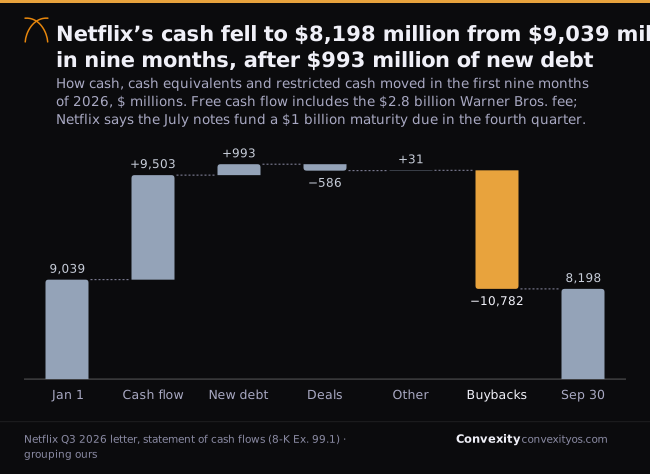
The debt has a stated purpose, and it is not the buybacks. Netflix says the $1 billion of new notes will "fund our upcoming $1B debt maturity in Q4," its 4.375% notes due in November. Money is fungible, though, and the arithmetic does not depend on which dollar went where. Without the July notes, cash at the end of September would have been about $7.2 billion, and when the November notes are repaid, cash falls by another billion dollars unless something else replaces it.
There is a fair objection to treating this as a change in policy, and Netflix made it itself in April. Its first-quarter letter said its cash position was "more elevated than normal" because it had paused buybacks while it pursued Warner Bros. and then received the termination fee. Spending down a pile that built up for a one-time reason is not the same as spending beyond your means. The September balance answers that objection, though. Cash is now below where it stood on January 1, and below the $9,291 million Netflix held at the end of September 2025, before the Warner Bros. bid began. The pile is gone, and net debt is higher than when it started.
Three years under free cash flow, then over
Netflix resumed large buybacks in 2023. That year it spent $6,045 million against $6,926 million of free cash flow, 87% of it. In 2024 the share was 90%, and in 2025, 96% (our arithmetic on the 10-K). Each year the buyback came closer to the cash, and none passed it.
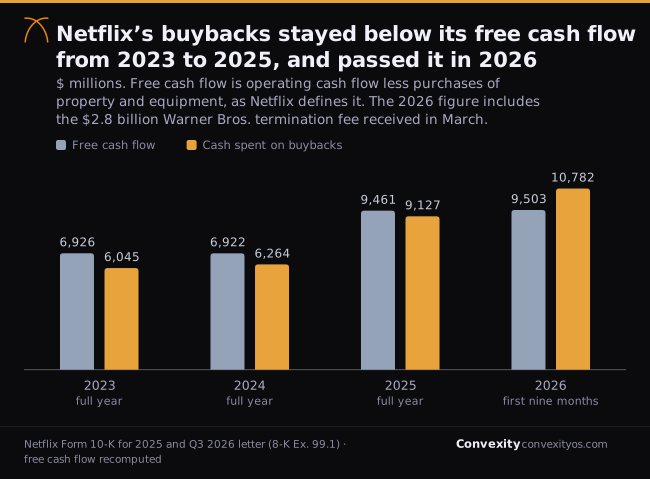
In 2026 the share is 113% with the fee and 161% without it (our arithmetic). The September quarter alone was more lopsided: $4,797 million of buybacks against $2,884 million of free cash flow, 1.66 times.
The full year will probably stay over the line. Netflix's forecast of about $12.0 billion leaves roughly $2.5 billion of free cash flow for the fourth quarter (our arithmetic). Buybacks of more than about $1.2 billion in the quarter would put the year's repurchases above the year's free cash flow, fee included. Netflix has not spent less than $1.27 billion on buybacks in any quarter of 2025 or 2026.
Flat cash in a year of 20% profit growth
The more important question is what is happening to the cash itself. Netflix lists "deliver growing free cash flow" among its goals in each of its letters this year, beside revenue growth and margin. Its free cash flow forecast for 2026 has moved three times. In January, before the Warner Bros. fee, it was "roughly $11B," up 16% from 2025's $9.46 billion. In April it became "approximately $12.5B," which the first-quarter letter attributed "primarily to the after-tax impact of the Warner Bros.-related termination fee." In October it became about $12.0 billion, for the real estate transaction. On the October 20 interview, asked whether revenue can keep growing at a double-digit pace in 2027, Spence Neumann, the chief financial officer, said "our financial objectives are unchanged" and that "we look to increase free cash flow," with 2027 guidance to come in January. None of the analysts' questions read out on the interview concerned this year's cash flow, the buybacks or the real estate deal.
Netflix has not said how much tax it paid on the fee. Subtracting the whole $2.8 billion leaves $9.2 billion; subtracting it after tax at the 21% federal rate leaves about $9.8 billion. Either way, free cash flow excluding the fee is now forecast at between 3% below and 3% above 2025's level, and $1.2 billion to $1.8 billion below what Netflix forecast in January (our arithmetic). Operating income, meanwhile, comes to about $16.1 billion for the year on the nine months reported plus the fourth-quarter forecast, up 21% (our arithmetic; Netflix says "20%+").
Some of the difference is one-off, and Netflix has said so. The first-quarter 10-Q discloses $729 million of "non-routine payments made in connection with non-income tax assessments in Brazil for prior tax periods," the cash side of a charge booked in 2025. The real estate transaction is another. Capital spending is also higher, $694 million in nine months against $449 million a year earlier, before the real estate deal closes. Cash taxes rise with profit. Put the Brazil payments back and free cash flow excluding the fee is still below last year's for the nine months on a pre-tax reading of the fee, though Netflix's undisclosed tax on the fee could move that comparison into modest growth.
What is not one-off is content.
Paying for shows faster than expensing them
Netflix spends cash on a film or series when it licenses or produces it, and expenses the cost over the years members watch it. The 10-K puts the timing gap plainly: "Payment terms for certain content licenses and the production of content require more upfront cash payments relative to the amortization expense." The ratio of the two is a number Netflix manages to. On the January 20 interview, Neumann said: "Our content cash to expense ratio should hold pretty steady at about the 1.1x ratio that we've been managing to the last few years." He added: "We aim to grow content spend slower than revenue."
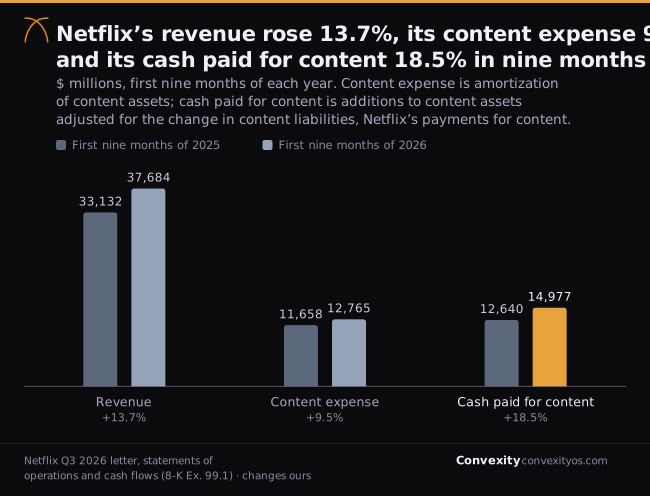
On the income statement, that is exactly what happened. In the first nine months of 2026, revenue rose 13.7% and content amortization rose 9.5%, which is why Netflix's margin is rising. In cash, it did not. Payments for content rose 18.5%, to $14,977 million from $12,640 million, faster than revenue and nearly twice as fast as the expense. Cash paid for content rose $2,337 million while content expense rose $1,107 million, so the gap between the two widened by $1,230 million in nine months (our arithmetic). The ratio Neumann said would hold near 1.1 was 1.08 for 2025 as a whole and is 1.17 so far in 2026; in the September quarter alone it was 1.20, $5,066 million paid against $4,235 million expensed. The balance sheet records the result: net content assets rose $1,827 million between December 31 and September 30.
The second-quarter 10-Q already flagged the direction, putting the six-month increase in "payments for content assets" at $1,900 million. The third-quarter letter still forecasts "an annual cash content spend to amortization ratio of ~1.1x." That forecast has a consequence for the fourth quarter that is worth stating. If content amortization rises about 10% for the year, as Netflix's January and July letters forecast, a 1.1 ratio requires fourth-quarter content payments of about $4.9 billion against about $5.3 billion of fourth-quarter expense (our arithmetic). That would be less cash than in the fourth quarter of 2025, $5,067 million, and the first quarter since at least the middle of 2024 in which Netflix paid less for content than it expensed: in each of the nine quarters from July 2024 through September 2026, it paid more (our arithmetic on its letters). If instead the nine-month pace holds, the year ends near 1.17.
The cash paid this year becomes amortization in the years the titles are watched. This year's margin reflects what Netflix paid for content in earlier, smaller years; the extra cash going out now is a cost that has yet to reach the income statement, and will, unless revenue grows into it.
The margin, with last year's tax charge put back
The profit side of the comparison is also smaller than Netflix's letter makes it look. The letter says operating income rose 37% and the margin rose to 34.6% from 28.2% in the September quarter of 2025. Neither sentence mentions that the 2025 quarter carried an expense of about $619 million for Brazilian non-income tax assessments, which Netflix's own third-quarter 2025 letter said covered "periods from 2022 through Q3'25" and reduced that quarter's margin "by more than five percentage points." Put it back and the year-earlier quarter earned $3,867 million at a 33.6% margin. Against that, operating income rose 15% and the margin rose one point (our arithmetic).
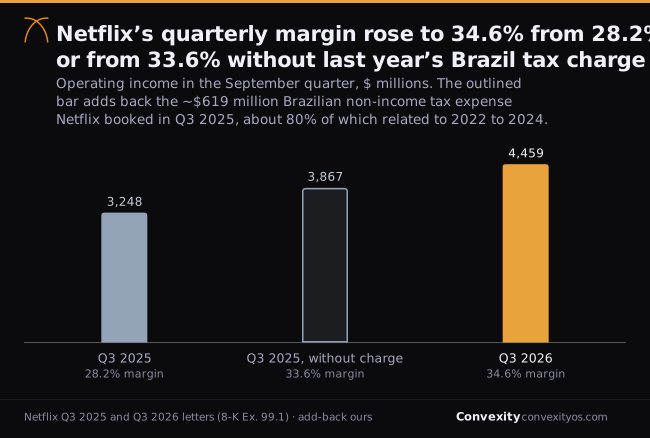
The same adjustment applies to the year. Netflix's 2026 target of 31.5% is two points above 2025's reported 29.5%. Without the part of the Brazil charge that related to 2022 to 2024, about 80% of it by Netflix's account, the 2025 margin was 30.6%, so the like-for-like gain is about 0.9 points. Over the first nine months, the margin is 33.5% against 33.2% with the charge put back (our arithmetic). On January 20, Neumann said the two-point guide included a drag from "the expected M&A expenses," and that without it the guide was "very much in line with what we've been delivering." The adjustment he made to 2026 is fair; the one he did not make to 2025 is larger.
The third quarter's costs also show where the reductions announced this month will land. Content amortization rose 5.8% from a year earlier, half the 11.8% rise in revenue, and that is where the margin came from. Technology and development rose 21.0%. All costs other than content amortization, with the Brazil charge taken out of the base, rose 14.8% (our arithmetic). On January 20, Neumann said Netflix was "increasing our expense growth a bit this year," to invest in its entertainment offering "and our product and commerce capabilities." On October 14, according to a memo from the co-chief executives reported by CBS News and others, Netflix told staff it would cut about 6% of its workforce, roughly 1,000 jobs, mostly in product, technology, legal and human resources. The letter does not give a headcount, only the margin cost, and its basis points imply a charge of roughly $150 million to $160 million (our arithmetic). Netflix's 10-K counted about 16,000 full-time employees at the end of 2025. Asked about the reductions on the interview, Peters said that after years of fast growth it was not unusual to find "some areas that we built quickly" and had overinvested in, and that sometimes "the team needs a forcing function." Neumann declined to put a figure on the savings: "We're not going to specifically quantify the expense impact in 2027."
Ads came in light, and price carried the year
The advertising cut is the one revision in the letter that touches the long-term story. In January, Netflix forecast that ad revenue would "roughly double" in 2026 from 2025's "over $1.5B"; its April and July letters put that at about $3 billion, and in July Netflix said it remained "on track." Three months later the forecast is about $2.7 billion, about 5.3% of the year's revenue (our arithmetic), which Peters put at growth of "over 80%" on 2025. Total revenue barely moved because, the letter says, "subscription revenue growth has outperformed our expectations."
Revenue in the United States and Canada is where the 2026 price increases show. Netflix raised its US prices in March: the ad-supported plan to $8.99 from $7.99, Standard to $19.99 from $17.99 and Premium to $26.99 from $24.99, increases of 12.5%, 11.1% and 8.0% (our arithmetic on Netflix's US pricing page, read on October 20, and on Internet Archive copies of it from February 25, with the old prices, and March 26, with the new). The September quarter was the first full quarter at the new prices, and revenue in the United States and Canada rose 11.0% (our arithmetic). Netflix says membership grew and that churn improved "globally and in the US." It no longer reports members or revenue per member by region, so the split between price and audience cannot be checked from its filings; what can be said is that North American revenue grew at about the rate of the list-price increase, with advertising growth inside the same figure. Peters described the same pattern on the interview. In Netflix's most penetrated markets, which he named as the US, the UK and Australia, "our revenue growth drivers in those markets are going to skew towards ARM and advertising growth," ARM being average revenue per membership; in newer markets such as Indonesia and Colombia, he expects member growth to drive revenue. Ted Sarandos, the other co-chief executive, said the US business is working but "not growing as fast as it could or as fast as we'd like."
The letter is candid that engagement is a question: "We know there's some investor concern about our view hours growth." Its answer is that the response to price increases is "an indicator that our engagement ... remains healthy." The evidence for engagement, in other words, is pricing power, and the evidence for pricing power is revenue. Neumann was blunter on the interview: "we want to grow view hours faster. We're not satisfied." Netflix's next detailed engagement report will not come until early 2027, when it moves the twice-yearly What We Watched report to an annual one.
What the buybacks bought
Netflix's buyback is a bet that its shares are cheap, and it has placed most of it in the last two quarters. In the June quarter it bought 52.9 million shares for $4.7 billion, about $89 a share (our arithmetic on the 10-Q's monthly table); in the September quarter, 63.9 million for $4.8 billion, about $75 a share (our arithmetic). Across the two, 116.8 million shares for $9,511 million, an average of about $81 (our arithmetic). The shares closed at $68.69 on October 20, before the letter came out, and ended the next session, October 21, near $65, about 5% lower (our arithmetic on our brokerage data).
The buybacks have done what buybacks do to per-share figures. Diluted shares in the September quarter were 4,195 million, 3.3% fewer than a year earlier, so earnings per share rose 49% while net income rose 44% (our arithmetic on the net income line). The cost is the cash: the shares retired this year were bought with the fee, the year's free cash flow and some of the balance sheet, and the free cash flow that will pay for next year's buybacks is, on Netflix's forecast, no bigger than last year's once the fee is taken out.
Netflix's side of the argument
None of this makes Netflix's balance sheet stretched. Net debt of $7.1 billion is less than half of one year's operating income, and Netflix said in January that it remains committed to "a solid investment grade rating." Buying back stock with borrowed or stored cash when the price has fallen by a quarter since the start of the year is a defensible use of it, if the company is right about its value. The two one-offs in this year's cash flow, Brazil and the real estate transaction, are real, and Netflix forecasts a content cash ratio of about 1.1 for the year that, if it holds, closes most of the content gap in the fourth quarter. A company paying ahead for programming it believes in is investing, not overspending.
The argument here is narrower than that. Netflix describes its repurchases as a return of "excess cash." In 2026 they have exceeded all of its free cash flow including a one-time fee, while the free cash flow it forecasts excluding that fee is no higher than last year's, and a growing share of that cash is going into content whose cost has not yet been expensed.
What would prove this wrong
This note argues that Netflix's buybacks in 2026 exceed its cash generation, that its underlying free cash flow is flat while its operating income grows about a fifth, and that content paid for ahead of its expense is part of the reason. Each claim has a date.
- The fourth-quarter letter, due in January on the pattern of past years. If fourth-quarter buybacks come in below about $1.2 billion, 2026 repurchases will end within free cash flow, fee included. If free cash flow for the year comes in well above $12.0 billion, the flat-cash claim weakens.
- The fourth-quarter content ratio. If Netflix's full-year payments for content come in near 1.1 times amortization, which needs fourth-quarter payments of roughly $4.9 billion, this year's content gap was timing and has closed. A full-year ratio near 1.17 would mean it has not.
- The 2027 forecast. Netflix gives its full-year outlook in January. A free cash flow forecast for 2027 that grows about as fast as operating income would mean 2026 was the anomaly.
- The third-quarter 10-Q. It should describe the real estate transaction. If the transaction accounts for most of the shortfall from January's $11 billion forecast, the flat-cash finding is mostly one-off.
- Net debt. If net debt is back toward $5.5 billion by the end of 2026 or in 2027, the buybacks were funded by a temporary drawdown rather than a lasting change.
The filings and documents this is built on
- 8-KNetflix, third-quarter 2026 shareholder letter (Exhibit 99.1)Results, statements of operations, cash flows and balance sheet, regional revenue, the fourth-quarter and 2026 forecasts, the ad and free cash flow revisions, the headcount reductions, buybacks and net debtOct 20, 2026
- CallNetflix third-quarter 2026 earnings interview, transcript posted by NetflixS&P Global Market Intelligence transcript on Netflix’s investor site; every October 20 quotation is checked word for word against it and at least one independent transcript below; retrieved 2026-10-21Oct 20, 2026
- CallThe Motley Fool, Netflix (NFLX) Q3 2026 earnings call transcriptIndependent transcript of the October 20 interview; retrieved 2026-10-21Oct 20, 2026
- CallGloomberb, Netflix (NFLX) Q3 2026 earnings call transcriptIndependent transcript of the October 20 interview; retrieved 2026-10-21Oct 20, 2026
- CallNetflix fourth-quarter 2025 earnings interview, transcript posted by NetflixS&P Global Market Intelligence transcript on Netflix’s investor site; Neumann’s remarks on the content cash ratio, margin guidance and expense growth, checked against the Motley Fool transcriptJan 20, 2026
- CallThe Motley Fool, Netflix (NFLX) Q4 2025 earnings call transcriptSecond, independent transcript of the January 20 interview, used to check every quotation from it; retrieved 2026-10-20Jan 20, 2026
- 8-KNetflix, second-quarter 2026 shareholder letter (Exhibit 99.1)The July forecast for the third quarter and the year, the $3 billion ad target "on track," and second-quarter buybacksJul 16, 2026
- 10-QNetflix, quarterly report for the period ended June 30, 2026Monthly repurchases and average prices, and the $1,900 million rise in payments for content assetsJul 17, 2026
- 8-KNetflix, first-quarter 2026 shareholder letter (Exhibit 99.1)The free cash flow forecast raised to about $12.5 billion for the fee, and cash "more elevated than normal"Apr 16, 2026
- 10-QNetflix, quarterly report for the period ended March 31, 2026The $2.8 billion termination fee in interest and other income, and $729 million of non-routine Brazil tax paymentsApr 17, 2026
- 8-KNetflix, termination of the Warner Bros. Discovery merger agreement (Item 1.02)Paramount Skydance paid the $2.8 billion termination fee on behalf of Warner Bros. Discovery on February 27Feb 27, 2026
- 8-KNetflix, fourth-quarter 2025 shareholder letter (Exhibit 99.1)The January forecasts: free cash flow of roughly $11 billion, ad revenue roughly doubling, a 31.5% margin; net debt at December 31, 2025Jan 20, 2026
- 10-KNetflix, annual report for the year ended December 31, 2025Cash flows for 2023 to 2025, payment terms for content, employees, and the Brazil non-income tax matterJan 23, 2026
- 8-KNetflix, third-quarter 2025 shareholder letter (Exhibit 99.1)The ~$619 million Brazil expense, its periods and its effect on the quarter’s marginOct 21, 2025
- 8-KNetflix, $1 billion of 5.250% senior notes due 2036Proceeds to repay the 4.375% notes due 2026Jul 22, 2026
- 8-KWarner Bros. Discovery, completion of its acquisition by Skydance CorporationThe merger with the former Paramount Skydance closed on October 6, 2026Oct 6, 2026
- WebNetflix Help Center, plans and pricing, United StatesCurrent US prices read 2026-10-20; prior prices from the Internet Archive capture of 2026-02-25, new prices already in its capture of 2026-03-26Oct 20, 2026
- ReportCBS News, "Netflix is cutting 6% of its workforce as its revenue growth slows"The co-chief executives’ memo, the teams affected, and the roughly 1,000 positions first reported by the Wall Street Journal (which we did not read); retrieved 2026-10-20Oct 14, 2026
- PricesNetflix daily prices, October 2026From our brokerage data feed; the official October 20 close and the last regular-session trade of October 21Oct 21, 2026
Not investment advice. This note is an analysis of Netflix's public disclosures, published for research purposes, and not a recommendation to buy, sell or hold any security. A member of the Convexity team holds SPY, which holds Netflix and Skydance; no other position.
What here is ours rather than Netflix's. As filed or stated by Netflix: every revenue, operating income, margin, earnings, cash flow, content, buyback, share, debt and net debt figure for a reported period; every forecast, including the fourth-quarter outlook, the $51.1 billion revenue and 31.5% margin for 2026, the 120 and 30 basis points for the headcount reductions, the $2.7 billion and $3 billion ad forecasts and the $11 billion, $12.5 billion and $12.0 billion free cash flow forecasts; the ~$619 million Brazil expense and its periods; the $729 million of Brazil payments; the 63.9 million shares and $4.8 billion repurchased in the third quarter and the monthly repurchases in the second; the US list prices; and every quotation, from Netflix's letters and filings or its January 20 and October 20 interview transcripts. As reported by CBS News: the size of the workforce reduction and the teams affected. Ours: free cash flow for each year, recomputed from the cash flow statements; the share price fall of about 5% on October 21; buybacks as a share of free cash flow and the 1.6 and 1.66 multiples; the nine-month cash walk and its "everything else" line; cash without the July notes; free cash flow excluding the fee and its comparison with 2025 and with January's forecast; 2026 operating income from the nine months and the fourth-quarter guide, and its growth; the fourth-quarter free cash flow and buyback thresholds; every percentage change in revenue, content expense, payments for content and costs; the payments-for-content figures, their ratios to amortization and the $1,230 million widening; the change in net content assets; the fourth-quarter content payments a 1.1 ratio requires; the September 2025 quarter and the 2025 year with the Brazil charge put back, and the margins and growth rates against them; the dollar size of the headcount charge; the ad forecast as a share of revenue; the list-price increases and North American revenue growth; the average prices paid for repurchased shares; and the share price from our brokerage data.