








Disclosure. Not investment advice, and nothing here is a recommendation to buy, sell or hold any security. A member of the Convexity team holds the SPDR S&P 500 ETF (SPY), which holds General Motors; no other position. Figures are from GM's earnings releases furnished on Form 8-K, its Forms 10-Q for the June and September quarters, the earnings presentations and the October 1 U.S. deliveries table posted on GM's investor site, its October 20 earnings call, and the U.S. Energy Information Administration. We read the call in two independently produced transcripts and quote only wording both carry. The closing note lists what is our arithmetic. This note was drafted with Claude.
General Motors reported its third quarter on October 20 with two cash figures at the front. Adjusted automotive free cash flow was $5.9 billion, which GM's presentation calls a four-year high, and $12.2 billion for the first nine months. And its board approved a new $20 billion share repurchase authorization, which Paul Jacobson, GM's executive vice president and chief financial officer, said on the call represents "more than 25% of our current market capitalization." He called it "a meaningful statement of the board's confidence that our cash generation is sufficient to continue investing in the future of the company and returning capital to shareholders."
The adjusted figure leaves one thing out. Since the middle of 2025 GM has recorded $11.2 billion of charges to pull back from electric vehicles, $7.4 billion of them payable in cash, mostly to suppliers and to the battery joint ventures it built with partners. It has paid $4.6 billion so far, $4.2 billion of it this year, and it adds every dollar back when it computes adjusted free cash flow. Before that adjustment, GM's automotive business generated $7.9 billion after capital spending in the first nine months of 2026 (our arithmetic on GM's reconciliation), not $12.2 billion.
The other side of the ledger is in GM's adjusted earnings. GM expects lower EV losses to add $1.0 billion to $1.5 billion to its 2026 EBIT-adjusted, the profit measure it guides to. The charges that produced those savings are excluded from that measure. So the retreat appears in GM's headline numbers only as a gain. In cash, this year, it is a loss: about $5.2 billion paid or due in 2026, counting the roughly $1 billion GM expects to pay in the December quarter, against $1.0 billion to $1.5 billion of lower losses. The payments are larger by $3.7 billion to $4.2 billion (our arithmetic).
None of this is hidden. GM prints the reconciliation, and Jacobson drew the distinction himself on the call. Asked about next year, he described GM's cash flow before these adjustments as "our actual sort of cash available for investment" and said it "should be significantly higher as we lap the bulk of the cash restructuring work that we did on the EV side." That is the bet the new buyback authorization rests on. This note sets out what GM's own numbers say the retreat costs and saves, where each lands in the figures GM leads with, and what the quarter says about gasoline above $4 a gallon, which is the condition under which paying to shrink an EV business could look premature.
GM's earnings releases for the September quarters of 2025 and 2026 and the quarters between, its Q3 2026 presentation and October 20 call, and its Q3 2026 U.S. deliveries table. The pre-adjustment cash figure and the percentage are our arithmetic.
The quarter GM reported
Start with the results. Revenue was $50.0 billion, up 2.9% from a year earlier. Net income attributable to stockholders was $3.3 billion, against $1.3 billion, when GM took $1.9 billion of special charges, most of them for the EV pullback. EBIT-adjusted was $4.1 billion, up 21.6%, and adjusted earnings were $3.70 a share against $2.80. Reported earnings, $3.73 a share, were slightly higher than adjusted ones, because GM excluded both a $208 million tax benefit from a change in a subsidiary's tax classification and the quarter's EV charges, which were $238 million before tax and $181 million after it (our arithmetic on GM's reconciliation), and the benefit was the larger of the two.
North America did the work. GM North America's EBIT-adjusted rose to $3.6 billion from $2.5 billion, and its margin to 8.7% from 6.2%, back inside the 8% to 10% range GM targets. GM's own walk from one year to the next puts $0.4 billion of the gain on volume, $0.2 billion on mix, $0.6 billion on cost and $0.1 billion on other items, with price taking $0.2 billion away. The presentation explains the cost line as "improved warranty and favorable EV inventory adjustments," partly offset by commodities, logistics and the cost of moving production to the United States. Jacobson put the quarter's warranty improvement at $600 million and its year-over-year commodity headwind at about $700 million.
Two things about that comparison matter. The first is the base. A year ago, GM's North American margin of 6.2% "included a $1.1B tariff impact" and a "$0.9B increase in warranty-related expenses," as its third-quarter 2025 presentation put it, so this quarter laps one of GM's weakest. The second is price. GM's presentation describes "slight pricing softness from increased incentives associated with the sell down of current generation full-size pickups," which are being replaced by a new generation starting this quarter. GM says its incentives averaged 4.8% of the sticker price in the quarter, against an industry average of 6.6% on industry estimates, and that its average transaction price was $52,000. For the year to date, Jacobson said, "North American pricing is up $400 million."
The volume line is partly a story about dealer lots. GM shipped 870,000 vehicles to North American dealers in the quarter, 30,000 more than a year earlier, while its U.S. deliveries to customers fell by 39,373. U.S. dealer inventory, including vehicles in transit, ended September at 568,151, up from about 511,000 at the end of June and about 527,000 a year earlier. GM's 10-Q for the June quarter defines its volume line as changes in wholesale volumes "driven by industry volume, market share, and changes in dealer stock levels," so a build on dealer lots counts as volume. At the quarter's selling rate, the September inventory is about 65 days of supply, against about 57 a year earlier (our arithmetic, on GM's 77 selling days in each quarter).
GM says the build is planned. Its Silao plant in Mexico took four down weeks before starting the new truck, and its Fort Wayne plant in Indiana will take four from mid-December. "In preparation for the downtime, the sell-down of the existing truck is on track with inventories at planned levels," Jacobson said. He expects about 35,000 fewer full-size pickups in the December quarter than a year earlier and year-end inventory in GM's target range of 50 to 60 days. If that happens, the third quarter's volume gain was a timing gain, borrowed from the fourth.
What the EV retreat has cost
GM's presentation sets out the bill. Since the second half of 2025, GM has recorded $11.2 billion of EV-related charges. Of those, $3.8 billion are non-cash and $7.4 billion "have a cash impact." The charges came in three waves: $7.6 billion in the second half of 2025, $3.3 billion in the first half of 2026 and $0.2 billion in the third quarter, each rounded separately from the total. The presentation says the cash charges were "primarily related to right sizing the battery supply chain with our joint venture partners."
The 10-Q for the June quarter is more specific. The 2025 charges included "non-cash impairment and other charges of $3.2 billion," including "writing down EV-related tooling and equipment to its nominal salvage value," and cash charges of $4.7 billion, "primarily consisting of supplier commercial settlements, contract cancellation fees, battery cell JV settlements." The June-quarter charges were $1.3 billion "for ongoing commercial negotiations with our supply base and joint venture partners," $1.1 billion of "losses on contractual supply agreements," and $493 million for "compliance-related assets," net of $660 million of recoveries under a cost-sharing arrangement.
All of it is outside the numbers GM leads with. EBIT-adjusted excludes the charges under the heading "EV strategic realignment," and adjusted automotive free cash flow adds back the cash as it is paid. The payments arrived unevenly: $401 million in the December quarter of 2025, $2,232 million in the March quarter, $1,871 million in the June quarter and $139 million in the September quarter, as GM's reconciliations print them.
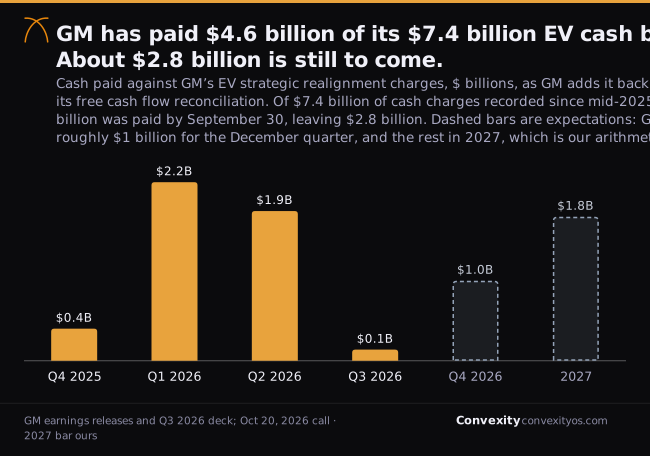
Jacobson said GM has "substantially completed the material cash charges we expect to incur as we align our EV capacity and manufacturing footprint with changes in regulatory policy." That leaves $2.8 billion to pay: about $1 billion in the December quarter and, by our arithmetic, about $1.8 billion in 2027. "As a result," he said, "free cash flow available to be returned to shareholders next year should benefit from a significant year-over-year step down in supplier EV settlement payments." On GM's own schedule, EV payments fall from about $5.2 billion in 2026 to about $1.8 billion in 2027, about $3.4 billion less (our arithmetic).
What it saves, and where the savings land
The savings are in the adjusted figures. GM's 2026 guidance assumes "EV losses improve by $1.0 – 1.5B," and Jacobson said on the call that GM remains on track for that, driven by right-sizing its EV capacity and by much lower EV volumes. Asked about the path to EV profitability, GM's answer, which one transcript attributes to Jacobson and the other leaves unattributed, was that "we've had a good year of EV profitability improvement, primarily from lower volumes as we've adjusted and also the fixed costs coming out of the system as we restructure."
Some of those savings follow mechanically from the charges. Tooling written down to "nominal salvage value" no longer depreciates, so a cost that would have run through EBIT-adjusted for years was taken once, outside it. A loss on a purchase commitment works the same way under U.S. accounting rules: once it is recognized, the excess cost is not charged again when the goods arrive. GM does not say how much of its EV loss reduction comes from either source, and nothing in its filings lets us estimate it. What can be said is that the savings GM counts inside EBIT-adjusted and the charges it excludes from it are, in part, the same costs on different dates.
The 10-Q for the June quarter shows where some of the savings sat. In the first half of 2026, GM North America's EBIT-adjusted benefited from "decreased net realizable value inventory adjustments, primarily EV-related, of $0.8 billion." Those are write-downs of EV inventory to what it can be sold for; GM's EV-related allowances fell to $1.3 billion at the end of June from $1.7 billion at the end of 2025. Against that, the same half year carried "decreased Ultium Cells Holdings LLC equity earnings of $0.8 billion," the battery joint venture with LG Energy Solution, whose income GM counts in cost of sales. The 10-Q for the September quarter, filed on October 20, shows the same pattern in the third quarter: $0.4 billion more from those inventory adjustments, $0.2 billion less from Ultium, and EV-related allowances down to $0.8 billion at the end of September. So the retreat costs something inside adjusted profit too, and GM's $1.0 billion to $1.5 billion is the net figure that matters.
One pair of items shows the asymmetry plainly. Jacobson said "emissions-related regulatory savings are around $500 million year to date," and the 10-Q credits "decreased emissions costs of $0.4 billion" to North America's first-half EBIT-adjusted. GM does not itemize those savings. The loosening of federal emissions rules also produced the $493 million charge for compliance-related assets in the June quarter: "The charge associated with our compliance-related assets in April 2026 was due to the repeal of the EPA's endangerment finding," the 10-Q says. That charge sits inside "EV strategic realignment," outside EBIT-adjusted. So emissions rules show up on both sides of GM's adjustments: about half a billion dollars of savings inside its adjusted profit this year, and a half-billion-dollar write-off outside it.
Two ways to count GM's cash
GM's adjusted free cash flow starts from the cash its automotive business generates from operations, subtracts capital spending and then adds back the cash effect of items it treats as special. In 2026 that last step has been almost entirely the EV payments.
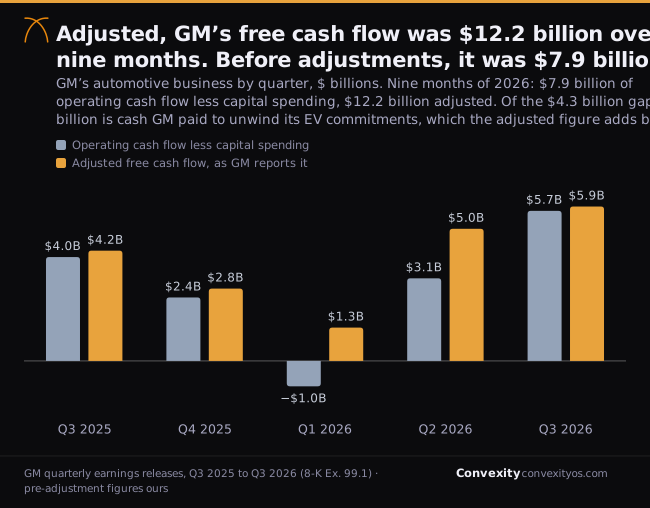
The March quarter is the clearest case. GM's automotive operations generated $533 million of cash and spent $1,500 million on capital projects, so after capital spending they used $967 million. Adding back $2,232 million of EV payments turned that into adjusted free cash flow of $1,269 million. In the June quarter, $3,147 million became $5,033 million. The September quarter is different: cash flow after capital spending was $5,716 million and adjusted free cash flow $5,882 million, because EV payments had nearly stopped. That quarter's strength is real, and Jacobson attributed the improvement to "higher earnings and tariff timing."
Over nine months, cash flow after capital spending was $7.9 billion, up $0.8 billion from $7.1 billion a year earlier. Adjusted free cash flow was $12.2 billion, up $4.3 billion from $7.8 billion. Of the $4.3 billion gap between the two measures this year, $4.2 billion is the EV add-back (our arithmetic on GM's reconciliations).
The full year looks the same way. In 2025, GM's automotive cash flow after capital spending was $9.5 billion and its adjusted free cash flow $10.6 billion. For 2026 GM now guides adjusted free cash flow of $11.5 billion to $12.5 billion, raised from $9.5 billion to $11.5 billion, and its guidance reconciliation adds back $4.2 billion of adjustments. Take those out and GM is guiding to $7.3 billion to $8.3 billion of cash flow after capital spending, below 2025's $9.5 billion (our arithmetic). The $4.2 billion matches what GM has added back through September, so the range appears not to include the roughly $1 billion of EV payments Jacobson expects in the December quarter; GM's guidance excludes "the potential impact of future adjustments related to special items." If those payments are made, cash flow after capital spending would be about $1 billion lower again, and adjusted free cash flow would not change (our reading of the reconciliation).
Two other items lift 2026 cash and will not recur. Capital spending is coming in at the lower half of GM's $10 billion to $12 billion range, and tariff refunds are arriving. GM recorded "a net $0.5 billion favorable adjustment primarily due to previously charged IEEPA tariffs" in the March quarter, after the Supreme Court ruled in February that the International Emergency Economic Powers Act did not authorize tariffs. Jacobson said GM had received about 60% of that so far and expected roughly a similar amount from its suppliers, which he put together at $600 million to $800 million this year, and added that the refunds are "not expected to repeat." The refund went into EBIT-adjusted: when GM first discussed the refunds earlier this year, he said, "we brought the EBIT guidance up, but we didn't bring the cash flow guide up because we were uncertain." That is the pattern we counted at 35 of 45 S&P 500 companies in our note on tariff refunds in adjusted earnings. For GM it is small: half a billion dollars against EBIT-adjusted guidance of $14.5 billion to $15.5 billion. Year to date, Jacobson said, GM's tariff costs were about $1.8 billion after the IEEPA reversal.
The buyback rests on next year's cash
GM is not spending money it does not have. In the first nine months it paid $5.3 billion for its own shares, about two-thirds of its cash flow after capital spending (our arithmetic), and it paid a quarterly dividend of 18 cents a share. Its automotive cash and marketable securities still rose to $23.1 billion at the end of September from $21.7 billion at the end of 2025, by our arithmetic on its balance sheet, against a target average of $18 billion. GM bought another $1 billion of stock in October, bringing 2026 purchases to $6.3 billion and completing its prior authorization. It has bought back $42.7 billion of stock since 2015, according to its presentation, and its shares outstanding have fallen to 849 million from 1,543 million.
What changes with the new authorization is its size. GM says it will be opportunistic and gave no schedule. "We believe the company is undervalued," Mary Barra, GM's chair and chief executive, said, and Jacobson cited GM's "double-digit free cash flow yield." A yield calculated on adjusted free cash flow includes this year's EV add-back; one calculated on the cash GM keeps does not. Jacobson's case for 2027 is that the two converge: "we expect the actual cash flow, the GAAP cash flow, to be significantly bigger year over year." On GM's payment schedule, about $3.4 billion of that improvement comes simply from paying less to unwind the EV business. Against it, he listed tariff refunds that will not repeat, and he said that if recent commodity inflation were simply annualized it would mean an additional $1 billion to $1.5 billion of EBIT-adjusted headwind in 2027. GM will give 2027 guidance in January.
Four-dollar gasoline, and what GM sold
GM's EV demand fell when the federal consumer purchase credit expired at the end of September 2025, and the retreat followed. The quarter GM just reported is compared with the one in which GM set its EV sales record, before the credit ended, and it shows the scale of the drop. GM delivered 25,473 EVs in the United States in the September quarter, down 61.7% from 66,501. Equinox EV deliveries fell to 1,905 from 25,085. Jacobson described EV volumes as declining "as we lapped the expiration of the consumer purchase incentive in the third quarter of 2025 and aligned EV production with demand."
That decline was larger than GM's entire U.S. decline. Total deliveries fell by 39,373, to 670,974, so GM's gasoline and diesel vehicles together rose by 1,655 to 645,501 (our arithmetic on GM's model-by-model table), which is what Jacobson meant by "ICE sales of 645,000 were up slightly year-over-year despite the impact of discontinued models."
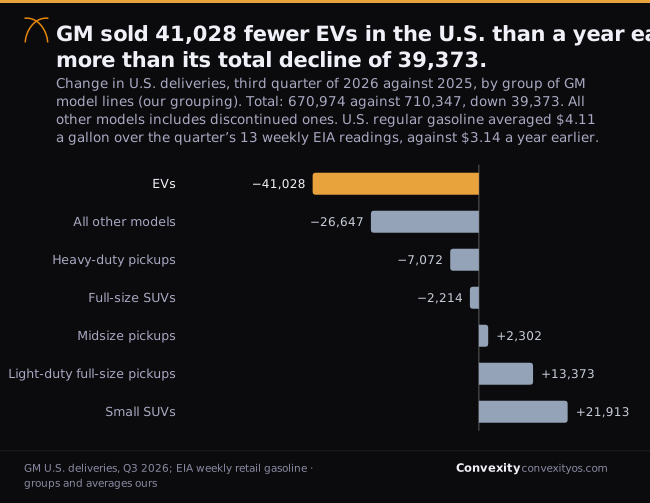
This happened in a quarter of expensive fuel. On the Energy Information Administration's weekly survey, U.S. regular gasoline averaged $4.11 a gallon over the September quarter, against $3.14 a year earlier, and was at $4 or more in 11 of the quarter's 13 weeks (our arithmetic). It was $4.28 in the week of October 19. Expensive gasoline did not bring GM's EV buyers back in the quarter. GM still thinks it might. The same answer about EV profitability went on: "with these oil prices and these fuel prices that EV penetration may continue to go up," and that "we want to make sure we're ready for that." GM's 10-Q says the retreat "does not impact today's retail portfolio" of Chevrolet, GMC and Cadillac EVs in production, and a new Chevrolet Bolt added 3,866 deliveries in the quarter. What GM has paid to cut is capacity behind those models, mostly in its battery supply chain.
Within gasoline and diesel vehicles, the mix moved in a direction consistent with expensive fuel and expensive cars, though GM's figures cannot separate the causes. Small SUVs (Trax, Trailblazer, Envista and Encore GX) rose 21,913, or 23.1%. Light-duty full-size pickups rose 13,373, or 9.3%, but GM's presentation credits its "best Q3 full-size pickup truck sales ever" to "commercial customer demand," and GM's fleet sales rose 10%. Heavy-duty pickups fell 8.8%. Full-size SUVs fell 3.2%, with Escalade down 15.4% and Suburban down 11.1%. Some of the declines elsewhere are supply rather than demand: Barra said production of the gasoline Equinox, down 8.8%, is "fully maxed out," and GM attributes part of its decline to discontinued models.
Barra was careful on fuel. Asked about diesel prices and demand for heavy-duty trucks, she said "it's early with the spike that's just happened in diesel," and that until a month or two ago "we weren't really seeing an impact." GM's 2026 guidance assumes a U.S. market in the mid-16 million unit range, raised from the low 16 millions, and Jacobson said October was consistent with that. Full-size trucks and SUVs remain the core of GM's profit, and the quarter's numbers do not show their buyers leaving. They show smaller vehicles growing fastest and fleet customers carrying the light-duty pickup gain, in a quarter when the retail pickup is being sold down ahead of a new model.
What would prove this wrong
This note argues three things: that GM's EV retreat costs more cash in 2026 than it saves, that the adjusted figures GM leads with show the savings and leave out the payments, and that the case for the new buyback depends on those payments ending, as GM says they will. Each can be checked against something with a date.
- The remaining EV payments. GM's 10-Q for the September quarter, filed on October 20, gives the same figures this note uses, $4.7 billion and $2.7 billion of cash charges and $0.4 billion and $4.2 billion paid, and says GM expects more charges this year. If GM negotiates a large part of the remaining $2.8 billion away in the fourth quarter, or if recoveries like the June quarter's $660 million recur at scale, the 2026 cash cost is smaller than this note says.
- GM's fourth-quarter results and 2027 guidance, due in January. For the title to be wrong for 2026, GM's EV payments for the year would have to come in far below about $5.2 billion, or its EV loss reduction would have to be several times the guided $1.0 billion to $1.5 billion. Neither is in GM's guidance.
- Cash flow before adjustments in 2027. If it rises by roughly the $3.4 billion step-down in EV payments, as Jacobson expects, the adjusted figure was the better guide to what the business earns and the retreat was a one-time cost, which would narrow this note's point to one about timing. If it does not rise, the step-down was absorbed by something else, commodities or capital spending among the candidates GM has named.
- Year-end dealer inventory. GM expects to end the year inside its 50-to-60-day range. If inventory is still well above that in January, the third quarter's volume gain on dealer lots was not just a plan for the truck changeover.
- EV demand at $4 gasoline. GM's fourth-quarter U.S. deliveries, due in early January, will show whether EV sales respond to fuel prices. A sustained rebound would test whether paying to shrink battery capacity left GM short of the demand Jacobson's own answer allowed for.
The filings and documents this is built on
- 8-KGeneral Motors, third quarter 2026 earnings release (Exhibit 99.1)Results, segment EBIT-adjusted, the EV strategic realignment adjustments, the free cash flow reconciliation, cash flow, balance sheet, guidance and the $20 billion authorizationOct 20, 2026
- CallGeneral Motors third quarter 2026 earnings call, transcript by GloomberbProduced from the public webcast replay; one of the two transcripts we read, and every quotation from the call is wording both carry; retrieved 2026-10-20Oct 20, 2026
- CallGeneral Motors third quarter 2026 earnings call, full transcript by Investing.comThe second of the two transcripts; speaker titles are taken from the investor relations introduction; retrieved 2026-10-20Oct 20, 2026
- DeckGeneral Motors, Q3 2026 earnings presentationEV-related charges and cash payments, the 2026 guidance assumptions, the EBIT-adjusted walks, U.S. dealer inventory and the share repurchase history; retrieved 2026-10-20Oct 20, 2026
- DataGeneral Motors, U.S. deliveries for the third quarter of 2026Deliveries by model line for both years, selling days and September dealer inventory; the groups and totals by group are ours; retrieved 2026-10-20Oct 1, 2026
- 10-QGeneral Motors, quarterly report for the period ended September 30, 2026EV charges and payments through September, the third-quarter EV inventory adjustments and Ultium earnings in North America EBIT-adjusted, and EV-related inventory allowances at September 30Oct 20, 2026
- 10-QGeneral Motors, quarterly report for the period ended June 30, 2026The composition of the EV charges, the compliance-related asset charge and the endangerment finding, EV inventory allowances, the IEEPA adjustment, the cost drivers of EBIT-adjusted and the definition of volumeJul 21, 2026
- 8-KGeneral Motors, second quarter 2026 earnings release (Exhibit 99.1)The June-quarter free cash flow reconciliation and EV add-backJul 21, 2026
- 8-KGeneral Motors, first quarter 2026 earnings release (Exhibit 99.1)The March-quarter free cash flow reconciliation and EV add-backApr 28, 2026
- 8-KGeneral Motors, fourth quarter and full year 2025 earnings release (Exhibit 99.1)The December-quarter and full-year 2025 free cash flow reconciliationsJan 27, 2026
- 8-KGeneral Motors, third quarter 2025 earnings release (Exhibit 99.1)The year-earlier quarter and its free cash flow reconciliationOct 21, 2025
- DeckGeneral Motors, Q3 2025 earnings presentationThe year-earlier tariff and warranty costs, EV sales and dealer inventory; retrieved 2026-10-20Oct 21, 2025
- DataU.S. Energy Information Administration, weekly U.S. regular all formulations retail gasoline pricesWeekly prices for both September quarters and the week of October 19, 2026; the quarterly averages are ours; read 2026-10-20Oct 20, 2026
Not investment advice. This note is an analysis of General Motors' public disclosures and of official fuel price statistics, published for research purposes, and not a recommendation to buy, sell or hold any security. A member of the Convexity team holds SPY, which holds General Motors; no other position.
What here is ours rather than GM's. As filed or stated by GM: every revenue, earnings, margin, EBIT-adjusted, cash flow, capital spending, cash balance, share count, buyback and guidance figure; the EV charges, the cash portion, the amounts paid by quarter, the $4.6 billion paid and the roughly $1 billion expected in the December quarter; the guided $1.0 billion to $1.5 billion reduction in EV losses and the other guidance assumptions; the EBIT-adjusted walks; every delivery figure by model line, dealer inventory and selling days; and every quotation, from GM's filings, its presentations, or the two transcripts of its call. As published by the Energy Information Administration: the weekly gasoline prices. Ours: the quarter's EV charges after tax, $181 million; cash flow after capital spending in each quarter and over nine months, and its change from a year earlier; the $4.3 billion gap between the two cash measures and the share of it that is the EV add-back; the 2026 guidance with GM's adjustment line removed, and our reading that it excludes the December-quarter EV payment; the $2.8 billion still to pay, the $1.8 billion for 2027, the $5.2 billion for 2026, its comparison with the guided EV loss reduction and the $3.4 billion step-down; buybacks as a share of cash flow and the change in automotive cash; the days of dealer supply; the delivery groups and their changes, the EV and ICE totals and the percentages; and the quarterly gasoline averages and the count of weeks at $4 or more.