









Disclosure. Not investment advice, and nothing here is a recommendation to buy, sell or hold any security. A member of the Convexity team holds the SPDR S&P 500 ETF (SPY), which holds JPMorgan Chase, Bank of America, Citigroup, Wells Fargo, U.S. Bancorp, PNC Financial Services, Synchrony Financial, Capital One, Goldman Sachs and Morgan Stanley; SPY does not hold Ally Financial. No other position. Figures are from the banks' third-quarter earnings releases and financial supplements filed with the Securities and Exchange Commission, and data from the Bureau of Labor Statistics, the Federal Reserve, the Federal Reserve Bank of New York and the Energy Information Administration. None of the banks discussed posts its own call transcript, so call quotations use only wording carried by two independently produced transcripts; one Ally remark, found in a single transcript, is paraphrased. Capital One reported after the market closed on October 20 and held its call that evening, after this note was written, so its figures come from its release and supplement only. The closing note lists what is our arithmetic. This note was drafted with Claude.
On October 13, JPMorgan Chase's third-quarter release carried a warning from Jamie Dimon, its chairman and chief executive. After noting strong business investment and consumer spending, he wrote: "However, large fiscal deficits, sticky inflation, elevated asset prices, rising interest rates and geopolitical conditions continue to shift under the surface. These forces may be manageable, but we remain prepared for a wide range of outcomes." The same release reported that the bank's credit card charge-off rate, the share of card loans written off as uncollectible, had fallen to 2.91% from 3.15% a year earlier.
That pairing, a worried tone over improving numbers, describes the whole week. Gasoline averaged $4.42 a gallon in the week of October 19, against $3.15 a year earlier, according to the Energy Information Administration. Consumer prices rose 3.7% in the year to September. Adjusted for inflation, average hourly earnings fell 0.7% over the same year. Yet card charge-off rates fell from a year earlier at all seven of the big card lenders that reported between October 13 and October 20: JPMorgan, Bank of America, Citigroup, Wells Fargo, U.S. Bancorp, Capital One and Synchrony. The early delinquencies that come before charge-offs fell at almost all of them too. Card spending grew faster than card balances at five of the six lenders whose figures compare. And the six that report a card loss reserve all hold less of it per dollar of card loans than they did a year ago.
So the strain of expensive fuel has not reached the banks' loss lines, and it has not reached the delinquency pipeline that feeds them either. The banks are not reserving for losses they cannot yet see; with one exception, they are doing the opposite. When asked why, the banks gave the same answer in different words: people have jobs. That makes the third quarter less a verdict on the consumer than a statement of what the verdict depends on. September added 29,000 jobs.
For a household, the bank figures say something narrower than "the consumer is fine." They say that the people these banks lend to are, on average, paying their card bills more reliably than a year ago, while paying more for gasoline. The bank figures do not see everyone, and the places where they show strain, in auto loans and in the newest loans, are worth knowing.
Third-quarter 2026 earnings releases and supplements of the seven lenders; Bureau of Labor Statistics, September 2026 employment report. Counts and sums are ours.
The loss line, a year on
Card charge-offs move with the seasons. They tend to peak in the first half of the year and fall in the third quarter, so the honest comparison is with the same quarter a year earlier. On that basis every one of the seven improved.
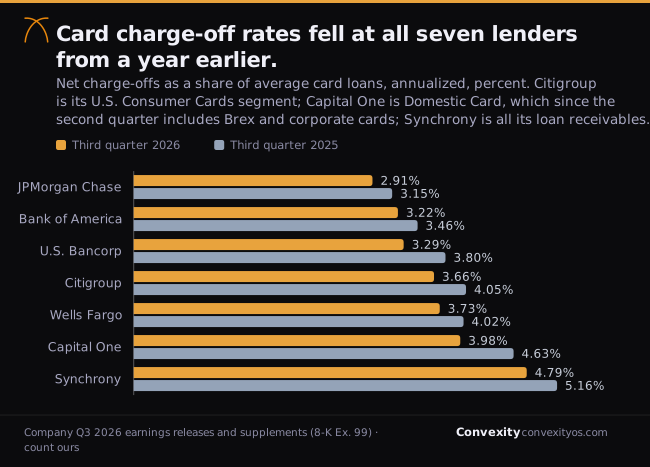
JPMorgan's Card Services rate fell to 2.91% from 3.15%. Bank of America's fell to 3.22% from 3.46%. Citigroup's U.S. Consumer Cards segment, which holds its own general purpose cards, its private label retail cards and a small installment book, fell to 3.66% from 4.05%. Wells Fargo's fell to 3.73% from 4.02%, U.S. Bancorp's to 3.29% from 3.80%, Capital One's domestic card rate to 3.98% from 4.63%, and Synchrony's to 4.79% from 5.16%. The declines run from 0.24 percentage points at JPMorgan and Bank of America to 0.65 points at Capital One (our arithmetic).
The guidance moved the same way. JPMorgan's chief financial officer, Jeremy Barnum, said on the call that the bank continues to expect a card charge-off rate of about 3.2% for the year, and its nine-month rate so far is 3.23%. Citigroup now expects a full-year card loss rate of around 4%, which its chief financial officer, Gonzalo Luchetti, called the low end of the range it gave earlier. Synchrony kept its forecast of charge-offs below 5.5% for 2026.
Two of the banks that reported the same week tell us almost nothing about consumer borrowers. Goldman Sachs moved its Apple Card loans to held for sale in the fourth quarter of 2025, ahead of JPMorgan taking over as the card's issuer, so it no longer reports a comparable loss rate; Morgan Stanley's provision for credit losses came from corporate and secured lending. PNC's card book, $7.5 billion at the end of September, is too small to set beside the others, though its card charge-offs also fell, to $49 million from $59 million.
Capital One, which reported after the close on October 20, is the largest of the seven by card loans, with $260.3 billion of domestic card loans at the end of September against JPMorgan's $252.7 billion, and it discloses that 27% of those loans are to borrowers with credit scores of 660 or below, the same share as a year earlier. Its domestic card charge-off rate fell the most of the seven. One caveat: since the second quarter its domestic card figures include Brex and its own corporate card, which the 2025 figures do not, so the comparison is not exact, and the filing does not separate the corporate cards out.
The pipeline is emptier, not fuller
A charge-off is the last step. A card balance is usually written off after about six months of missed payments, so a borrower who began to fall behind when gasoline jumped in March would only now be reaching the loss line. The earlier signal is delinquency: the share of balances 30 or more days past due, and the share 90 or more days past due. If $4 gasoline were pushing borrowers behind, it would show here first, and at the end of September it mostly did not.
| Card delinquency, percent of loans, September 30 | 30+ days, 2025 | 30+ days, 2026 | 90+ days, 2025 | 90+ days, 2026 |
|---|---|---|---|---|
| JPMorgan Chase, Card Services | 2.14 | 1.97 | 1.07 | 0.96 |
| Bank of America, credit card | 2.41 | 2.32 | 1.23 | 1.13 |
| Citigroup, general purpose cards | 2.48 | 2.37 | 1.27 | 1.21 |
| Citigroup, private label cards | 4.15 | 3.88 | 2.08 | 1.92 |
| Wells Fargo, credit card | 2.68 | 2.69 | 1.34 | 1.34 |
| Capital One, domestic card | 3.89 | 3.74 | not filed | not filed |
| U.S. Bancorp, credit card | not filed | not filed | 1.26 | 1.10 |
| Synchrony, all loans | 4.39 | 4.34 | 2.12 | 2.06 |
Citigroup files its 30 to 89 day and 90-plus day rates separately; its 30-plus figures above are the two added together (our arithmetic). Capital One's 30-plus figure counts only loans still accruing interest, which is how it reports. The 30-plus rate fell in six of the seven card books shown with one and rose by 0.01 point at Wells Fargo. The 90-plus rate fell in six of seven and was unchanged at Wells Fargo. Bank of America's release put it plainly: "Both early- and late-stage credit card delinquency rates improved for the sixth consecutive quarter on a year-over-year basis." Synchrony's chief financial officer, Brian Wenzel, described its delinquency trends in the release as "consistent with typical seasonality," with charge-offs "declining to a seasonal low."
Wells Fargo is the one flat line, and its own numbers suggest a reason other than strain. It has been opening card accounts much faster than before: 1.95 million in the first nine months of 2026, against 1.56 million a year earlier. Mike Santomassimo, its chief financial officer, said on the call that the card vintages of the past two years are the largest the bank has made, and that the older ones are performing as it expected; younger accounts are still seasoning, and delinquency normally rises as accounts age. Its charge-off rate still fell.
The national data, which cover every lender rather than six, tell a similar if slightly older story. The New York Fed's household debt report for the second quarter, drawn from Equifax credit records, found that the share of card balances moving into serious delinquency, 90 or more days late, was 6.97% at an annual rate, against 6.93% a year earlier, and that flows into early delinquency were "largely steady for credit cards." Its next report will cover the third quarter.
Synchrony offered the most granular evidence on who is paying. Wenzel said that the payment rate on its non-prime accounts rose 0.4 percentage points from the second quarter, the same increase as on accounts with scores of 780 and above. Brian Doubles, its chief executive, listed higher gasoline prices, broad inflation and consumer confidence that "has been weak all year," and then said: "None of those factors are really impacting consumer behavior."
Spending outran borrowing
The hypothesis we set out to test was that consumers are still paying, but on credit: spending and card balances both rising while losses stay flat, so the strain is being deferred onto cards. The first half holds. The second, at these banks, does not. Card balances grew, but at five of the six lenders whose figures compare, card spending grew faster.
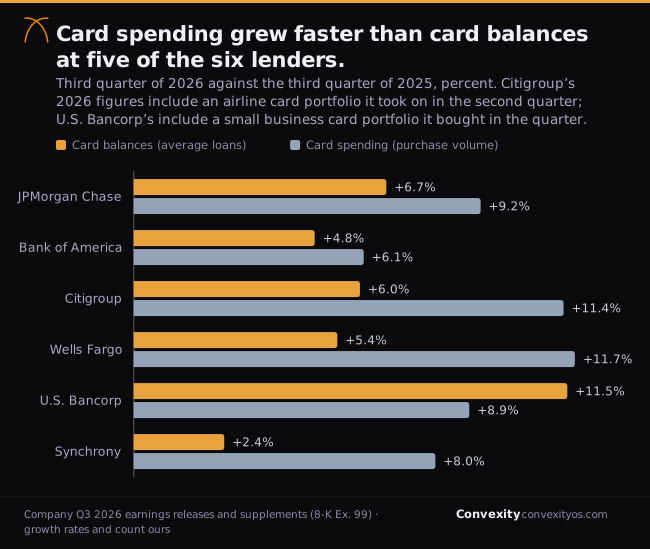
At JPMorgan, card sales volume rose 9.2% while average card loans rose 6.7%. At Wells Fargo the gap was widest: purchase volume up 11.7%, loans up 5.4%. Synchrony's purchase volume rose 8.0% on loans up 2.4%. The one exception is U.S. Bancorp, whose loans grew 11.5% on spending up 8.9%, because it bought a small business card portfolio during the quarter. Citigroup's numbers are also lifted by an American Airlines co-branded portfolio it took on in the second quarter, which raises both lines. Capital One is left out of the chart: its domestic card purchase volume rose 11% on average loans up 2%, but the 2026 figures include Brex's and its own corporate card spending and the 2025 figures do not, so the growth rates mix consumer and business cards.
When spending grows faster than balances, more of each month's bill is being paid off rather than carried. Synchrony reports this directly: its payment rate, the share of balances paid each month, was 16.9%, about 0.6 points higher than a year earlier. That figure needs a caveat that Wenzel gave himself. He attributed more than 90% of the increase to the mix of the portfolio, chiefly new partner programs and fewer promotional balances, rather than to existing customers paying more. Still, the direction is not the one a strained borrower produces.
The Federal Reserve's consumer credit report points the same way across all lenders. Revolving credit, which is mostly card balances, grew at a 4.9% annual rate in the second quarter and then fell at a 4.2% annual rate in August, the latest month published.
Part of the spending growth is simply the price of fuel. Gasoline prices were 34.2% higher in September than a year earlier, on the Bureau of Labor Statistics' index. Brian Moynihan, Bank of America's chairman and chief executive, said that "gas spending is up 20-odd percent" among its customers, and that inside convenience stores, spending is still growing but more slowly than it was. "So it crowds out a little bit," he said. JPMorgan said spending growth included gas and travel. Synchrony said higher gasoline prices lifted purchase volume on two of its five platforms. Santomassimo put gasoline at 3% to 6% of Wells Fargo customers' spending, depending on income.
So some of the spending growth is inflation, not appetite. But inflation in the gas tank shows up as a larger card bill, and the larger bills are being paid. Moynihan said the paychecks deposited into its customers' accounts are growing at all three of its income tiers, low, middle and high, and that growth at the low end had picked up. Asked whether he saw signs of pressure, his answer on credit was: "absolutely not in terms of credit quality." Deposits tell the same story with less enthusiasm. Bank of America's average consumer deposits were $949 billion, about where they were a year earlier, which in a year of 3.7% inflation means they shrank in real terms. JPMorgan's consumer deposits rose 4%.
Reserves went the other way
The third hypothesis was that banks might be building reserves ahead of losses they did not yet see, which would show as provisions for credit losses rising faster than charge-offs. Under the accounting rules banks now use, a loan loss reserve is a forecast: it is meant to cover the losses expected over the life of the loans, given each bank's view of the economy. A bank that expected trouble would add to it. Most of these banks did the reverse.
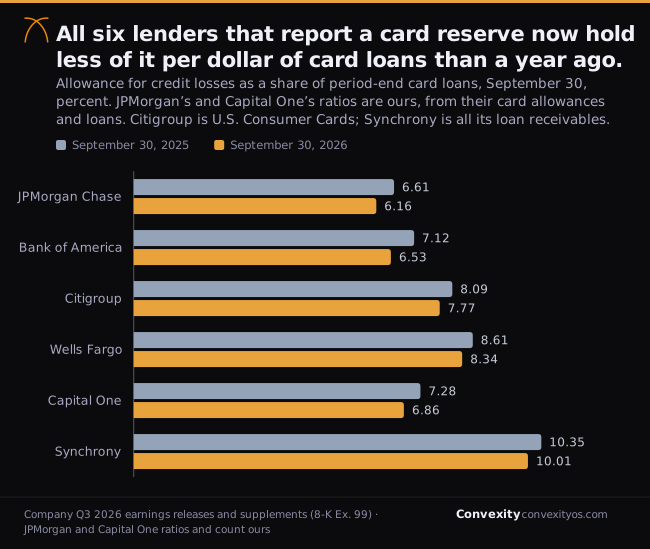
JPMorgan's allowance for card losses was $15,563 million at the end of September, the same figure it reported at the end of March and of June, while its card loans grew to $252.7 billion from $235.5 billion a year earlier. Per dollar of card loans, that is 6.16 cents of reserve against 6.61 cents (our arithmetic). The bank's $539 million reserve build for the whole firm was, in the release's words, "primarily in Wholesale"; its consumer bank added $50 million, against $575 million a year earlier. Bank of America's consumer bank released $94 million. Wells Fargo's consumer segment added $11 million and Synchrony $30 million. Capital One released $250 million from its domestic card reserve, against charge-offs of $2,560 million, after releasing $753 million a year earlier; its reserve per dollar of domestic card loans fell to 6.86 cents from 7.28 (our arithmetic).
Add up the six consumer units that state both figures, JPMorgan's consumer and community bank, Bank of America's consumer bank, Citigroup's card segment, Wells Fargo's consumer segment, Capital One's domestic card business and Synchrony, and together they released a net $45 million of reserves in the quarter against $9,361 million of charge-offs, so provisions came to 99.5% of charge-offs (our arithmetic). A year earlier the same six released $384 million against $9,806 million, and provisions were 96.1% of charge-offs. Provisions are a little closer to charge-offs than a year ago, mostly because Capital One released less and Citigroup built more. In neither year did they run ahead of charge-offs.
U.S. Bancorp's release, which does not break out a card reserve, said its provision was held down by "improvement in the economic outlook and favorable credit performance," offset by a $135 million initial provision for the card portfolio it bought.
The exception is Citigroup. Its card segment built $208 million of reserves, "primarily driven by changes in the macroeconomic outlook," against $58 million a year earlier. Luchetti gave the assumption behind it: "Our reserves incorporate an eight-quarter weighted average unemployment rate of 5.3%, which includes a downside scenario average unemployment rate of nearly 7%." The unemployment rate in September was 4.2%, so Citigroup's reserves assume, on a weighted basis, a labor market noticeably weaker than today's. It is the only one of these banks to say it added to card reserves because its economic outlook got worse. Even so, its card reserve per dollar of loans is lower than a year ago, 7.77% against 8.09%.
Where the margin shows
The second hypothesis was that strain would appear first at the margin, among borrowers with weaker credit, in auto loans, or among younger borrowers, while prime borrowers held up. In card books, the margin looks no worse than the middle. Capital One, with 27% of its domestic card loans to borrowers scoring 660 or below, had the largest decline in its charge-off rate of the seven. Citigroup's private label retail cards, whose loss and delinquency rates run well above those of its general purpose cards, improved by more: charge-offs fell to 4.19% from 4.67%, against 3.51% from 3.85% for general purpose cards. Synchrony's non-prime payment rates rose in step with its best-scored accounts. Synchrony says spending on its cards is growing fastest among Generation Z and millennial customers; it does not report their delinquency separately.
Auto loans are where the edges are fraying, slightly. Ally Financial, which holds $91.5 billion of consumer auto loans, said its retail auto charge-off rate was 1.89%, up 0.01 point from a year earlier, and that retail auto loans 30 or more days past due, including those no longer accruing interest, rose to 4.96% from 4.90%. On the call, its chief financial officer, Russ Hutchinson, said that loans it made in late 2025 and early 2026 are showing more delinquency early in their lives than earlier vintages, which Ally is watching closely, and attributed it to the mix of credit in those loans. Wells Fargo's auto charge-off rate rose to 0.57% from 0.45%, on a book that grew 31% in a year. Capital One's auto charge-off rate in the quarter was 1.59%, against 1.54% a year earlier, although its auto loans 30 or more days past due fell to 4.64% from 4.99%. It is also lending further down the credit scale: auto originations rose 22%, and the share of its auto loans made to borrowers who scored 620 or below at application rose to 32% from 30%. JPMorgan's auto charge-off rate fell, to 0.41% from 0.46%.
The national figures agree that autos and mortgages, not cards, are where early delinquency is creeping up. The New York Fed's second-quarter report said that "transition into early delinquency upticked slightly for auto loans and mortgages," and that the median credit score on newly originated auto loans fell by seven points in the quarter. The share of mortgage balances moving into serious delinquency rose to 1.52% from 1.29% a year earlier, from a low level.
Banks also described a lower-income consumer under more pressure without, so far, falling behind. Charlie Scharf, Wells Fargo's chief executive, said lower-income households "remain more sensitive to financing costs, inflation and higher living and fuel expenses," but "appear to be stable." Wenzel described Synchrony's customers as paying well "albeit inside of an affordability issue for some." Luchetti said that if rates kept rising over several quarters, borrowers at the low end of the credit scale would start to feel the pressure of their debt payments.
There is one thing worth noting about the lenders themselves. Having watched credit improve, some are easing. Doubles said of Synchrony: "We started to open up a bit earlier in the year, just given how good credit was looking." Ally reported record applications, up 20%, and auto originations up 10%. A loosening lender is a lender that believes the economy it sees. It is also how the next set of weaker loans gets made.
The one number underneath
The banks that explained their consumer results explained them the same way. "The consumer is currently very healthy primarily because of a healthy labor market," Barnum said. He added the other side of it: if the Federal Reserve needs an aggressive and extended rate cycle to cool the economy, "almost by definition that's going to involve higher unemployment, which will produce weaker consumer credit results." Santomassimo said Wells Fargo should keep seeing strong performance "as long as the employment picture stays pretty strong." Scharf told investors that the bank's underwriting assumes conditions will weaken at some point, and added: "we do not see signs of this yet."
The labor market they are leaning on is holding, but thinly. Payrolls rose 29,000 in September, after an average monthly gain of 45,000 over the previous 12 months, and the Bureau of Labor Statistics revised July down to a loss of 10,000 jobs. The unemployment rate was 4.2%, and has stayed between 4.1% and 4.3% since March. Average hourly earnings rose 3.0% over the year, less than prices. Real weekly earnings fell only 0.1% over the year, because the average workweek lengthened by 0.6%. Households are keeping up by working more hours, not by getting raises that beat prices.
One figure from the September price report is easy to misread. Real average weekly earnings fell 0.5% from August to September; over the year they fell 0.1%. It is real hourly earnings that fell 0.7% over the year.
The Federal Reserve raised its target range by a quarter point, to 3.75% to 4%, on September 16, saying that "inflation remains elevated" and that "job gains have kept pace with the workforce." It meets again on October 27 and 28. The banks are, in effect, telling investors that their card books are a bet on that sentence about job gains staying true while the Fed tries to bring inflation down. Citigroup has reserved for the bet going partly wrong. The others have not.
This fits what other parts of the economy have shown this month. In our note on Delta Air Lines, the airline raised fares about a fifth and reported little resistance from travelers; in our note on packaged food, volume fell at seven of the nine food makers that report it. Households with jobs are paying more for fuel and fares, buying less in the grocery aisle, and paying their card bills.
What would prove this wrong
This note argues three things: that the strain of higher prices has not reached the big banks' card loss lines or their early delinquencies; that card borrowers are paying their bills rather than rolling more of them over; and that the banks' confidence rests on employment, with reserves set accordingly. Each can be checked against data with a date.
- Capital One's monthly filings. Capital One's quarter was this argument's sharpest test: a higher card charge-off or delinquency rate than a year earlier at the largest card lender, with 27% of its loans to borrowers scoring 660 or below, would have confined the improvement to the other six. It came back the other way, with its domestic card charge-off rate down 0.65 points and its 30-day delinquency rate down 0.15 points. It files card charge-off and delinquency rates every month, so its October figures, expected in mid-November on the pattern of its recent filings, are the earliest read on whether that holds.
- Year-over-year 30-day delinquency in January. The fourth-quarter releases, due in mid-January on the pattern of past years, will show card delinquency at December 31. A rise from a year earlier at JPMorgan or Bank of America, whose card loss rates are the lowest of the seven, would mean the pipeline has started to fill.
- The October jobs report, on November 6. If payrolls fall and the unemployment rate rises above the 4.1% to 4.3% range it has held since March, the condition the banks named will have failed, and reserves should start to rise across the industry, not just at Citigroup.
- Reserve builds in the fourth quarter. If several of these lenders start building card reserves on their economic outlook, as Citigroup did this quarter, they will be telling us they no longer believe the labor market will hold.
- The New York Fed's next household debt report, covering the third quarter. Flows into early card delinquency moving up from "largely steady" would show strain at lenders these seven do not cover.
- Auto vintages. Ally said its newest loans are going delinquent faster early on. If its retail auto charge-off rate rises clearly above a year earlier in coming quarters, the margin will have moved from a few basis points to a trend.
The filings and documents this is built on
- 8-KJPMorgan Chase, third-quarter 2026 earnings release (Exhibit 99.1)Dimon statement, card charge-off rate, provision and reserve builds by segmentOct 13, 2026
- 8-KJPMorgan Chase, third-quarter 2026 earnings release financial supplement (Exhibit 99.2)Card Services loans, charge-offs, delinquency, allowance, sales volume; auto charge-offs; consumer depositsOct 13, 2026
- CallJPMorgan Chase third-quarter 2026 earnings call, transcript by GloomberbBarnum on the consumer and the labor market and the 3.2% card charge-off guide; checked against the Benzinga transcript belowOct 13, 2026
- CallJPMorgan Chase third-quarter 2026 earnings call, transcript by BenzingaSecond, independent transcript; quotations use only wording both carry; retrieved 2026-10-20Oct 13, 2026
- 8-KBank of America, third-quarter 2026 earnings release (Exhibit 99.1)Consumer Banking provision and reserve release, card spending, the statement on delinquencyOct 14, 2026
- 8-KBank of America, third-quarter 2026 supplemental information (Exhibit 99.3)Credit card loans, charge-offs, delinquency, purchase volumes, allowance by product, consumer depositsOct 14, 2026
- CallBank of America third-quarter 2026 earnings call, transcripts by Gloomberb and BullfincherMoynihan on credit quality, paychecks and gasoline; quotations use only wording both transcripts carry; Bullfincher copy at bullfincher.io; retrieved 2026-10-20Oct 14, 2026
- 8-KCitigroup, third-quarter 2026 earnings release (Exhibit 99.1)U.S. Consumer Cards reserve build and its stated driverOct 13, 2026
- 8-KCitigroup, third-quarter 2026 quarterly financial data supplement (Exhibit 99.2)U.S. Consumer Cards results and metrics by product: spend, loans, charge-offs, delinquency, reserve ratioOct 13, 2026
- CallCitigroup third-quarter 2026 earnings call, transcripts by StockAnalysis and GloomberbLuchetti on the unemployment assumption in reserves, FICO mix and the full-year card loss guide; retrieved 2026-10-20Oct 13, 2026
- 8-KWells Fargo, third-quarter 2026 earnings release (Exhibit 99.1) and financial supplement (Exhibit 99.2)Card and auto charge-offs, card delinquency, purchase volume, new accounts, allowance by productOct 13, 2026
- CallWells Fargo third-quarter 2026 earnings call, transcripts by StockAnalysis and BullfincherScharf on lower-income households; Santomassimo on employment and gasoline; retrieved 2026-10-20Oct 13, 2026
- 8-KU.S. Bancorp, third-quarter 2026 earnings release (Exhibit 99.1) and supplement (Exhibit 99.2)Card charge-offs and 90-day delinquency, card volume, the provision and the purchased small business card portfolioOct 15, 2026
- 8-KSynchrony Financial, third-quarter 2026 earnings release (Exhibit 99.1) and financial tables (Exhibit 99.2)Charge-offs, delinquency, allowance coverage, purchase volume, loan receivables, reserve buildOct 20, 2026
- CallSynchrony Financial third-quarter 2026 earnings call, transcripts by StockAnalysis and GloomberbDoubles and Wenzel on consumer behavior, payment rates by credit grade and underwriting; retrieved 2026-10-20Oct 20, 2026
- 8-KAlly Financial, third-quarter 2026 earnings release (Exhibit 99.1)Retail auto charge-offs and delinquency, provision, originations and applicationsOct 20, 2026
- CallAlly Financial third-quarter 2026 earnings call, transcript by StockAnalysisHutchinson on late-2025 and early-2026 auto vintages; the only transcript available when this was written, so paraphrased rather than quoted; retrieved 2026-10-20Oct 20, 2026
- 8-KCapital One, third-quarter 2026 earnings release (Exhibit 99.1) and financial supplement (Exhibit 99.2)Domestic Card charge-off and delinquency rates, allowance activity, loans, purchase volume and credit score mix; auto charge-offs, delinquency and originations. Released after the close; the call was not readOct 20, 2026
- 8-KCapital One, third-quarter 2025 financial supplement (Exhibit 99.2)Domestic Card allowance at September 30, 2025 and its third-quarter 2025 release, as first reportedOct 21, 2025
- 8-KGoldman Sachs, third-quarter 2026 earnings results (Exhibit 99.1)The Apple Card portfolio held for sale since the fourth quarter of 2025Oct 13, 2026
- DataBureau of Labor Statistics, The Employment Situation, September 2026Payrolls, revisions, unemployment rate, average hourly earnings; read 2026-10-20Oct 2, 2026
- DataBureau of Labor Statistics, Consumer Price Index and Real Earnings, September 2026All items 3.7%, gasoline 34.2%; real hourly earnings -0.7% and real weekly earnings -0.1% over the year; read 2026-10-20Oct 14, 2026
- DataU.S. Energy Information Administration, U.S. regular all formulations retail gasoline price, weekly$4.424 in the week of October 19, 2026 and $3.151 in the week of October 20, 2025; read 2026-10-20Oct 19, 2026
- DataFederal Reserve, G.19 Consumer Credit, August 2026Revolving credit growth by month and quarter; read 2026-10-20Oct 7, 2026
- ReportFederal Reserve Bank of New York, Quarterly Report on Household Debt and Credit, 2026 Q2Flows into serious and early delinquency by loan type; auto origination credit scores; read 2026-10-20Aug 11, 2026
- StatementFederal Open Market Committee statementThe quarter-point increase to 3.75% to 4% and the language on inflation and jobs; read 2026-10-20Sep 16, 2026
Not investment advice. This note is an analysis of the banks' public disclosures and of official economic statistics, published for research purposes, and not a recommendation to buy, sell or hold any security. A member of the Convexity team holds SPY, which holds JPMorgan Chase, Bank of America, Citigroup, Wells Fargo, U.S. Bancorp, PNC Financial Services, Synchrony Financial, Capital One, Goldman Sachs and Morgan Stanley, and does not hold Ally Financial; no other position.
What here is ours rather than the banks'. As filed by the banks: every charge-off rate, delinquency rate, allowance, coverage ratio, loan balance, spending figure, provision, reserve build, deposit balance, payment rate and guidance figure, except as listed below; and every quotation, which is from a bank's release or, for remarks on the calls, from wording carried by both of the two independent transcripts cited; quotations from the New York Fed and the Federal Reserve are from their own published text. As published by the Bureau of Labor Statistics, the Federal Reserve, the New York Fed and the Energy Information Administration: the payroll, unemployment, wage, price, gasoline, consumer credit and household delinquency figures. Ours: the counts of lenders whose charge-off rates, delinquency rates and reserve ratios moved, and the sizes of those moves in percentage points; Citigroup's 30-plus day delinquency rates, which add its two filed buckets; JPMorgan's and Capital One's card reserve ratios, from their filed allowances and loans; every growth rate in card spending and card balances; the totals of reserve builds and charge-offs across the six consumer units and provisions as a share of charge-offs; the comparison of Citigroup's unemployment assumption with the September rate; and the reading that Bank of America's flat consumer deposits shrank in real terms. The paraphrase of Ally's remark on its auto vintages is ours, from a single transcript.