








Disclosure. Not investment advice, and nothing here is a recommendation to buy, sell or hold any security. This note is about OpenAI, Anthropic's most direct competitor, and we are not neutral on it. A member of the Convexity team holds an economic interest in Anthropic through a special-purpose vehicle and a fund, and stands to benefit if its valuation rises; Convexity is a customer of Anthropic; and this note was researched and drafted with Claude, Anthropic's model. Amazon, Microsoft, Nvidia and Broadcom, all discussed below, are among Anthropic's suppliers or shareholders, and the comparison at the center of the story is with Anthropic's own revenue figure. The same team member holds the SPDR S&P 500 ETF (SPY), which holds Microsoft, Amazon, Nvidia, Oracle, Broadcom and AMD, all named below; no other position in any company named here, CoreWeave included. OpenAI and Anthropic are private and publish no financial statements, so every revenue figure for either is a press report and is labeled as one. The commitments are quoted from the counterparties' own filings. The closing note lists what is our arithmetic.
In the middle of the trading day on Thursday, October 8, the Financial Times reported that OpenAI had told its investors its annualized revenue was "approaching $50 billion," as TechCrunch quoted the paper. Nine days earlier, Axios had reported a figure nearing $70 billion. The difference, about $20 billion, moved more than a private company's reputation. The Nasdaq Composite closed 1.25% lower, and the companies that build and power OpenAI's computers fell further: CoreWeave 7.8%, Oracle 5.5%, Broadcom 4.3%, AMD 3.9% and Nvidia 2.9% (our arithmetic on session closes).
OpenAI has not disputed the $50 billion, and it has a good account of the gap. On the reporting of CNBC, CNN and Bloomberg, the larger figure was never OpenAI's. Its own investors built it to compare OpenAI with Anthropic, which counts the full value of certain sales made through cloud partners, while OpenAI counts only its own share. On that reading no revenue was lost, and OpenAI told the same investors that its run rate grew 77% in the third quarter and, according to Bloomberg, that it expects to reach $70 billion or more by the end of the year.
So the $20 billion tells you little about OpenAI. It tells you more about the companies whose backlogs are made of OpenAI's promises, because those promises are paid from the smaller number. The partner revenue inside the larger figure belongs to the partners. What pays Microsoft, Amazon, Oracle and CoreWeave is the money OpenAI keeps, plus the capital it can raise against its growth. Three of those suppliers have put a dollar figure on OpenAI's commitments in their own filings: $250 billion to Microsoft, $138.0 billion to Amazon and up to $18.4 billion to CoreWeave, $406.4 billion between them. Against a $70 billion run rate that is 5.8 years of revenue. Against $50 billion it is 8.1 years (our arithmetic). Oracle, whose reported OpenAI contract would be the largest of all, has never named the customer in a filing.
Our financing ledger of September 24 counted $2.47 trillion of backlog at five companies. This note is about the one customer that stands behind a large share of it, and about what the market has twice this year shown it believes that customer's numbers are worth to each supplier.
Run rates are press reports of what OpenAI told investors, first reported by the Financial Times (unread) and confirmed by CNBC. Commitments are from Microsoft's 10-Q for the quarter to September 30, 2025, Amazon's 10-Q for the quarter to June 30, 2026, and CoreWeave's 10-K for 2025. Closing prices are from our brokerage data feed. The sum, the multiples and the price changes are ours.
What was reported, and who said it
Neither number in this story appears in any filing. Both are annualized run rates, a recent month or so of revenue multiplied out to a year. A run rate is not audited, and nothing requires two companies to compute it the same way. OpenAI's revenue for all of 2025 was $13.1 billion, according to people familiar with its finances who spoke to CNBC in February.
The larger figure arrived on September 29. Axios reported that OpenAI's annualized revenue was nearing $70 billion, citing people familiar with the company's finances. We could not open the Axios story. Bloomberg's account of it says the same, and a write-up of Reuters' reporting adds that a source told Reuters the run rate had grown more than 70% since the start of the third quarter in July, with enterprise sales more than doubling. CNN reported on October 8 that the $70 billion figure had been "previously reported by media, including the FT, based on information from investors." Oracle closed 3.9% higher on September 29 (our arithmetic). Gil Luria, an analyst at D.A. Davidson, told Reuters that OpenAI accounts for around half of Oracle's computing backlog. That is an analyst's estimate, not a disclosure.
The smaller figure arrived on October 8. We could not read the FT, which refuses automated access, so everything attributed to it here comes through outlets that quote it. TechCrunch quotes the paper as saying the $70 billion figure was devised through "attempts by OpenAI's own investors to produce a direct comparison with Anthropic's annualised revenues." CNBC confirmed that OpenAI told investors it hit roughly $50 billion at the end of September, and reported, from a person familiar with the matter, that the $68 billion figure that had circulated "included gross revenue from OpenAI's partners." The same person said OpenAI's investor presentation showed 77% total run-rate growth in the third quarter and 107% for its enterprise business. CNN's source said the $70 billion figure did not come from OpenAI. OpenAI declined to comment.
A day later Bloomberg added the forward half. OpenAI expects to reach or exceed $70 billion of annualized revenue by the end of the year, people familiar with the matter told Bloomberg, and shared that projection with investors in talks to raise $30 billion or more at a valuation of $1.4 trillion before the new money. OpenAI declined to comment to Bloomberg too. As of October 12 we found no public statement from OpenAI on either figure, so its side of the story comes from people who have seen its materials.
The $20 billion is a definition, not a lost customer
Two explanations have been offered for the gap, and they are compatible.
The first is about who books what. When a business buys a model through a cloud provider's marketplace, the provider collects the money and the model's maker gets a share. Accounting rules make the model maker decide whether it is the principal in that sale, which records the whole amount, or an agent, which records only its share. Bloomberg, as Quartz summarized it, reported that Anthropic records the full value of sales made through cloud partners such as Amazon, while OpenAI books only its own cut of proceeds from partners such as Microsoft. Neither treatment is wrong. They measure different things, and a figure built to put OpenAI on Anthropic's basis adds money that OpenAI never receives. Our interest in Anthropic is disclosed at the top of this note, and it matters here: on OpenAI's net basis, Anthropic's widely reported $65 billion would also be smaller, by an amount no one outside the company has published.
The second explanation is arithmetic. Yahoo Finance's account of the FT report says investors first worked out that OpenAI's run rate had reached about $40 billion in August, and later, when OpenAI told them revenue had grown 70%, applied that growth to the $40 billion. Forty billion dollars grown by 70% is $68 billion, which is exactly the figure CNBC says was widely reported (our arithmetic). The problem is the base. If the 77% growth OpenAI reported for the third quarter describes the change from the start of July to the end of September, the run rate on OpenAI's own basis at the start of the quarter was about $28 billion, not $40 billion (our arithmetic, $50 billion divided by 1.77). The August figure, the September figure and the October figure were not all measured the same way, and compounding growth on a figure that already contained some of it counts that growth twice.
Either way, the $20 billion is not revenue that OpenAI had and lost, and OpenAI's case is, on the evidence, mostly right. Its net figure is the more conservative measure, its growth is intact on its own account, and on its own projection it reaches the $70 billion the market thought it had already reached in about one more quarter. Its finance chief, Sarah Friar, told CNBC the week before the report that the company is still "very well capitalized."
What the correction changes is a denominator: the comparison with Anthropic, which drew the headlines, and any ratio of what OpenAI has promised to pay against what it brings in, which moved the stocks.
What the suppliers have filed
OpenAI's commitments are not in any filing of OpenAI's. They are in its counterparties' filings, each written in that company's own terms, and only three of them put a dollar figure on what OpenAI has promised.
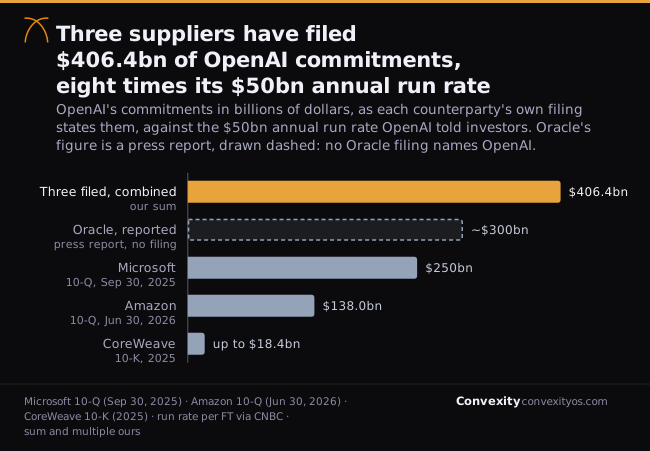
Microsoft. The subsequent-event note in Microsoft's 10-Q for the quarter to September 30, 2025, filed the day after Microsoft signed its new agreement with OpenAI, says: "Under the new agreement, OpenAI has contracted to purchase an incremental $250 billion of Azure services, and Microsoft will no longer have a right of first refusal to be OpenAI's compute provider." The word incremental matters. It is in addition to whatever OpenAI had already contracted, so $250 billion is a floor on OpenAI's Azure commitments, not the total. Later filings do not restate the figure. Microsoft's 10-K for the year to June 30, 2026 says the partnership was extended in October 2025 and again in April 2026, and that Microsoft "will continue to receive revenue-sharing payments." As OpenAI is an equity-method investee, Microsoft also discloses $24.1 billion of revenue from it in the fiscal year, "inclusive of revenue-sharing payments," and $6.0 billion of receivables at June 30.
Amazon. Amazon's 10-Q for the quarter to June 30, 2026 says: "In Q1 2026, AWS and OpenAI Group PBC ('OpenAI') announced an expansion of the existing $38.0 billion multi-year commitment and commercial arrangement with OpenAI by $100.0 billion over 8.0 years, which includes contractual obligations related to the performance of AWS chips." That is $138.0 billion (our sum). Amazon is also an OpenAI shareholder, with $50.0 billion of Series C preferred stock bought this year in three filed tranches (our sum). The sentence about OpenAI sits directly after Amazon's statement that commitments not yet recognized were "approximately $496 billion," but the filing does not say how much of that figure is OpenAI's. Amazon's chief executive, Andy Jassy, described the customers on the July 30 call as "the two leading AI labs in the world, Anthropic and OpenAI, making multi-year, multi-gigawatt commitments to Trainium," Amazon's own chip.
CoreWeave. CoreWeave's 10-K for 2025 records two agreements. Under the first, from March 2025, "OpenAI has committed to pay us up to approximately $11.9 billion through October 2030." Under the second, an order form signed in September 2025, OpenAI "has committed to pay us up to approximately $6.5 billion through May 31, 2031." Together that is up to $18.4 billion (our sum), and both are maximums. Its 10-Q for the quarter to June 30, 2026 lists OpenAI among its significant customers and adds the sentence that matters to a lender: "Our business is, and may in the future be, subject to the risks of non-payment and non-performance by these customers." Three customers were 36%, 26% and 10% of CoreWeave's second-quarter revenue.
Oracle. No Oracle filing names OpenAI. Its 8-K of June 30, 2025 quoted its then chief executive saying Oracle had signed "multiple large cloud services agreements including one that is expected to contribute more than $30 billion in annual revenue starting in FY28," the fiscal year that begins in June 2027. The Wall Street Journal reported on September 10, 2025 that OpenAI had agreed to buy about $300 billion of computing power from Oracle over about five years, a report we could not read and take from SiliconANGLE's account of it. Oracle's 10-Q for the quarter to August 31, 2026 reports $664 billion of remaining performance obligations, about 13% of it due to become revenue within a year. If the reported $300 billion is right and all of it is in that total, OpenAI is 45% of Oracle's backlog (our arithmetic), close to the half Luria estimated. The nearest Oracle has come to naming the customer was on its September 10 call, when Clayton Magouyrk, one of its two chief executives, said: "The recently released GPT-6 Astra was trained at our site in Abilene." Our August note set out why Oracle's audited customer-concentration disclosure, which tests revenue rather than backlog, cannot answer the question.
The chipmakers state their OpenAI exposure in gigawatts, not dollars. Nvidia's chief financial officer, Colette Kress, said on the August 26 call that "OpenAI's existing and planned commitments represent approximately 12 gigawatts of NVIDIA compute," and Nvidia's 10-Q records up to $105 billion of guarantees it signed in August on behalf of an OpenAI affiliate's data center leases, guarantees that terminate on events including "OpenAI achieving a satisfactory credit rating." AMD's 10-Q says OpenAI intends to deploy up to 6 gigawatts of its processors and holds a warrant for up to 160 million AMD shares that vests with those purchases, and that "As of June 27, 2026, no warrant tranches had vested or become exercisable." Broadcom's latest 10-Q does not mention OpenAI at all; on its September 2 call, its chief executive, Hock Tan, said a custom OpenAI chip "is on track for the planned deployment of 1.3 gigawatts in 2027," with a line of sight to more than 5 gigawatts in 2028, "which would make OpenAI our second largest XPU customer."
The arithmetic on the smaller number
Put the three filed figures together and they come to $406.4 billion. Measured against the run rate that circulated in September, $70 billion, that is 5.8 years of revenue. Measured against the $50 billion OpenAI told investors, it is 8.1 years (our arithmetic). Add the press-reported $300 billion for Oracle and the total reaches $706.4 billion, 10.1 years at $70 billion and 14.1 years at $50 billion.
The correction moves every one of those ratios by the same 40%, because $70 billion is 1.4 times $50 billion. The reason to prefer the smaller denominator is not that it is the more recent figure. It is that the difference between the two is money OpenAI does not collect. When a customer pays a cloud partner for an OpenAI model, OpenAI's share is already inside the $50 billion, and the rest stays with the partner. A commitment to Microsoft or Amazon cannot be paid out of revenue that Microsoft or Amazon kept in the first place.
Microsoft's own disclosures allow the same arithmetic from the other side. On January 28, its chief financial officer, Amy Hood, told analysts: "Approximately 45% of our commercial RPO balance is from OpenAI." Commercial remaining performance obligations were $625 billion at December 31, 2025, so OpenAI's share was about $281 billion (our arithmetic). At June 30, 2026 the balance was $678 billion, against $368 billion a year earlier, and on the July 29 call Hood said it "increased 25% when excluding OpenAI." If OpenAI had held none of the $368 billion, the part that was not OpenAI's would have grown to $460 billion, leaving at least $218 billion for OpenAI, about a third of the total. Any OpenAI contract already on the books a year earlier would make the figure larger (our arithmetic, on Microsoft's filed balances and Hood's growth rate). Microsoft's backlog alone therefore holds at least 4.4 years of OpenAI's current revenue.
None of these are annual bills. Amazon's $100.0 billion expansion runs over eight years, an average of $12.5 billion a year; CoreWeave's commitments run to 2030 and 2031; Microsoft has not said when its $250 billion will be spent. The one annual figure on file belongs to the supplier that does not name its customer: Oracle's single contract worth more than $30 billion a year from fiscal 2028 would by itself equal 60% of OpenAI's current run rate (our arithmetic). OpenAI's own plan, as people familiar with it described it to CNBC in February, is about $600 billion of compute spending through 2030. The commitments above run past 2030, so the two cannot be subtracted, but they are the same order of size.
The fair reading is a matter of timing. At 77% a quarter, ratios like these shrink quickly. If OpenAI reaches the $70 billion it projects for December, the filed commitments return to 5.8 years of revenue, where the market thought they already stood. The correction says the September headline put OpenAI about one quarter further along its own path than it was, not that the path is wrong. It also shows how much of the suppliers' backlog depends on that path continuing, and on the capital that pays the bills until revenue can.
Microsoft tells investors how much is OpenAI
Of the four cloud companies in this note that sell OpenAI computing capacity, Microsoft is the only one that has told investors how much of its backlog OpenAI accounts for, and its disclosure has moved from how much is OpenAI's to how much is not.
When an analyst asked in January about the durability of a backlog that was 45% OpenAI, Hood answered with the other 55%: "55%, or roughly $350 billion, is related to the breadth of our portfolio, a breadth of customers across solutions, across Azure, across industries, across geographies." By July, the disclosure had become a statement about growth: "All sequential commercial RPO growth was driven by commitments from customers outside of frontier model companies." And she put the year's cloud revenue, more than $214 billion, as "nearly 90% from customers outside of frontier model companies." Microsoft also publishes adjusted earnings that strip out its gains and losses on OpenAI, which we wrote about in August.
Microsoft carries the largest filed OpenAI commitment of any company in this note, and on October 8 its shares fell the least.
The market sorted the counterparties the same way twice
The October report was not the first time this year that a report on OpenAI's revenue moved its suppliers. On Monday, April 27, the Wall Street Journal reported that OpenAI had missed internal goals for revenue and new users. In Reuters' account of that report, which we read in place of the Journal's, Friar had "expressed concerns to other company leaders that the ChatGPT creator might not be able to pay for future computing contracts if revenue doesn't grow fast enough." Sam Altman, OpenAI's chief executive, and Friar answered in an emailed statement to Reuters: "This is ridiculous. We are totally aligned on buying as much compute as we can and working hard on it together every day."
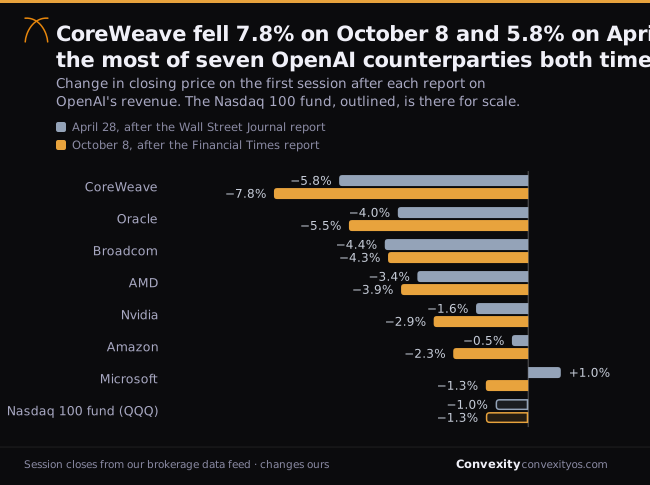
Set the two days beside each other and the order barely changes. On April 28, CoreWeave fell 5.8%, Broadcom 4.4%, Oracle 4.0%, AMD 3.4%, Nvidia 1.6% and Amazon 0.5%, while Microsoft rose 1.0% and the Nasdaq 100 fund fell 1.0%. On October 8, CoreWeave fell 7.8%, Oracle 5.5%, Broadcom 4.3%, AMD 3.9%, Nvidia 2.9%, Amazon 2.3% and Microsoft 1.3%, with the Nasdaq 100 fund down 1.3% (all our arithmetic on session closes). The Nasdaq Composite closed down 345.35 points at 27,193.34, by Nasdaq's own figures, and the S&P 500 fell 0.47%. CoreWeave fell the most of the seven both times, and Microsoft the least.
Other things moved those stocks too. Microsoft's April gain followed its renegotiated OpenAI agreement, and Quartz reported that rising oil prices and Treasury yields weighed on stocks on October 8. The next day the cloud companies recovered and CoreWeave did not: by Friday's close, Microsoft and Amazon were each about 1% above their Wednesday close, Oracle was 1.5% below it and CoreWeave 7.2% below (our arithmetic).
The order is consistent with a simple account of exposure, though two days cannot prove it. CoreWeave says plainly that a few customers drive its revenue, and Oracle, among the three largest fallers both times, declines to say how concentrated its backlog is; both borrow heavily to build what those customers ordered. The chipmakers sat in the middle. Microsoft and Amazon, the largest and most diversified sellers in the group, fell least, and Microsoft has shown investors that OpenAI is a minority of its backlog. Oracle's annual report states the dependence in its own words: "The economic returns on these investments are dependent on customer demand and the ability of our key customers to meet their contractual obligations."
The capital between the revenue and the bills
On any near-term timetable, OpenAI's commitments are paid with capital as much as with revenue, and that is how a revenue figure becomes a supplier's problem. OpenAI closed a $122 billion funding round in March, CNBC reported, and Quartz put the valuation at $852 billion including the new money. Amazon alone has put $50.0 billion into OpenAI's Series C preferred stock this year, on its own filing. The round now under discussion, $30 billion or more at $1.4 trillion before the new money, according to Bloomberg, is 28 times the $50 billion run rate. At $70 billion it would have been 20 times (our arithmetic). A revenue figure is the main input into the price of the next round, and the next round is what pays for the computing capacity that the suppliers have already booked as backlog.
The suppliers know this, and several now help finance the demand they record. Nvidia guarantees an OpenAI affiliate's leases until OpenAI earns a satisfactory credit rating, a clause that would be unnecessary for a tenant that already had one. AMD has given OpenAI a warrant for its own shares that vests as OpenAI buys its chips. Broadcom's chief financial officer, Amie Thuener, described its financing platform with outside investors on the September 2 call as "empowering 2 of our most strategic customers, the leading AI labs, to bridge the gap between their current cash flow and the significant upfront investments required for their businesses." Amazon is both OpenAI's shareholder and its cloud provider. Kress, on Nvidia's call, raised the obvious objection herself: "we know some will call this circular financing. We see it differently."
None of that is improper, and much of it may prove shrewd. But it means the suppliers' backlogs rest on OpenAI's revenue, OpenAI's access to capital and the suppliers' own willingness to keep supplying some of that capital, and a lower revenue figure touches all three.
The case against this note
The strongest case against this note is that the market overreacted to an accounting definition and this note dignifies the overreaction. Nothing in OpenAI's business changed on October 8. Its growth, 77% in a quarter on its own account, would close the gap in about three months, and OpenAI says it expects to. By the close the next day, Oracle had recovered most of its fall and Microsoft and Amazon all of theirs.
The second objection is that comparing a stock of commitments with a single year of revenue overstates the burden. The commitments run five to eight years and longer, CoreWeave's are maximums, Microsoft has not said when its $250 billion will be spent, and they will be paid from revenue that is growing quickly rather than from today's run rate. On OpenAI's own projection of more than $280 billion of revenue in 2030, as CNBC reported it, the three filed commitments come to less than a year and a half of that revenue (our arithmetic).
The third is that the suppliers are protected in ways a revenue multiple cannot capture. Computing capacity is not a stranded asset: Magouyrk said on Oracle's September call that "Of all the GPUs that came up for renewal in Q1, that capacity was renewed or resold at a 20% premium to prior contracts." Microsoft's cloud revenue is nearly 90% from customers outside frontier model companies. If OpenAI bought less, other buyers, Anthropic among them, are waiting for the same capacity.
We accept the second and third points as limits on this note. It does not argue that OpenAI cannot pay, and its multiples describe exposure, not a forecast of default. The first point we think is half right. The market did overreact to a definition, and the definition still matters, because the number that pays the suppliers is the smaller one and it was the smaller one before anyone noticed. Our own position is the fourth objection, and the reader should weigh it: we hold an interest in Anthropic, the company the larger figure was built to compare OpenAI with, and a note that makes OpenAI's commitments look heavier suits that interest.
What would prove this wrong
- OpenAI ends the year at $70 billion or more on its own net basis. That is its projection, as Bloomberg reported it. If that is reported in January, the filed commitments are back to 5.8 years of revenue and the correction was a matter of timing, which is the most likely way this note ages.
- The round prices at $1.4 trillion or more. A close at that valuation would show that investors read the correction as a definition, and that the channel from revenue to suppliers is narrower than this note argues.
- The next OpenAI headline moves Microsoft as much as CoreWeave. The ordering rests on two days. If the next report on OpenAI's finances moves the seven companies by similar amounts, the market is pricing AI demand in general, not exposure to OpenAI.
- Microsoft or Oracle discloses a smaller OpenAI share. Microsoft reports its quarter to September 30 in late October, and its call will show whether the backlog outside OpenAI is still growing faster than the total. If Oracle ever discloses OpenAI's share of its $664 billion backlog and it is far below the 45% the reported figure implies, the largest exposure in this note is smaller than it looks.
- OpenAI earns a satisfactory credit rating. Nvidia's guarantees end when it does, and an investment-grade rating would mean OpenAI's own credit, rather than its suppliers', stands behind its commitments.
The filings, calls and reports this is built on
- Press reportOpenAI's revenue is reportedly $20 billion less than previously projectedTechCrunch, quoting the Financial Times report of October 8, which we could not read; the approaching $50 billion phrase and the investors' comparison with Anthropic; retrieved 2026-10-12Oct 8, 2026
- Press reportNvidia, Oracle, CoreWeave and other AI stocks sink on OpenAI revenue reportCNBC confirmed the roughly $50 billion at the end of September; a person familiar said the $68 billion figure included gross revenue from partners; 77% and 107% run-rate growth; the $122 billion March round and $852 billion valuation; retrieved 2026-10-12Oct 8, 2026
- Press reportTech stocks drop after report that OpenAI’s revenue is lower than expectedCNN: the $70 billion was previously reported by media including the FT; a source said it did not come from OpenAI; OpenAI declined to comment; retrieved 2026-10-12Oct 8, 2026
- Press reportOpenAI's annualized revenue $20 billion lower than prior investor estimatesYahoo Finance account of the FT report, including the $40 billion base and 70% growth; retrieved 2026-10-12Oct 8, 2026
- Press reportOpenAI expects US$70bn in annualized revenueBloomberg report as republished by the Taipei Times: the year-end projection, about $50 billion at the end of September, and the round at $1.4 trillion before the new money; the Bloomberg original is unread; retrieved 2026-10-12Oct 10, 2026
- Press reportOpenAI is still projecting $70 billion in annualized revenue by end of 2026Quartz summary of Bloomberg's account of how Anthropic and OpenAI book sales made through cloud partners, and the $852 billion valuation including the new money; retrieved 2026-10-12Oct 9, 2026
- Press reportOpenAI corrects annualized revenue figure to $50 billionQuartz on the October 8 session, including rising oil prices and Treasury yields weighing on stocks; retrieved 2026-10-12Oct 8, 2026
- Press reportOpenAI's annualized revenue nears $70 billion, Axios saysBloomberg account of the Axios report of September 29, which we could not open; retrieved 2026-10-12Sep 29, 2026
- Press reportOpenAI's Annual Revenue Pace Nears $70 Billion as ChatGPT Maker Sees Explosive GrowthFirst For Money, on Yahoo Finance, summarizing Reuters reporting: growth of more than 70% since the start of the third quarter, and the D.A. Davidson estimate of OpenAI as around half of the Oracle backlog; retrieved 2026-10-12Sep 29, 2026
- Press reportOpenAI resets spending expectations, tells investors compute target is around $600 billion by 2030CNBC, from people familiar: 2025 revenue of $13.1 billion, about $600 billion of compute spending through 2030, more than $280 billion of revenue in 2030; retrieved 2026-10-12Feb 20, 2026
- Press reportOpenAI falls short of revenue and user targets as it races toward IPO, WSJ reportsReuters account of the Wall Street Journal report of April 27, which we could not read, and the statement from Altman and Friar; retrieved 2026-10-12Apr 27, 2026
- Press reportOracle, CoreWeave lead AI selloff on OpenAI growth concernsReuters on the April 28 session, including the Microsoft and OpenAI renegotiation of the previous day; retrieved 2026-10-12Apr 28, 2026
- Press reportOpenAI and Oracle strike $300B cloud computing deal to power AISiliconANGLE account of the Wall Street Journal report of September 10, 2025, which we could not read; the $300 billion is a press report, not an Oracle disclosure; retrieved 2026-10-12Sep 10, 2025
- 10-QMicrosoft Corporation, quarterly report for the quarter ended September 30, 2025Note 17, the subsequent event: the incremental $250 billion of Azure services and the 27 percent stakeFiled Oct 29, 2025
- 10-QMicrosoft Corporation, quarterly report for the quarter ended December 31, 2025Commercial remaining performance obligations of $625 billionFiled Jan 28, 2026
- 10-KMicrosoft Corporation, annual report for the fiscal year ended June 30, 2026Commercial remaining performance obligations of $678 billion; the partnership extensions of October 2025 and April 2026; the related-party revenue of $24.1 billion and receivables of $6.0 billion; the 25% interestFiled Jul 29, 2026
- 10-KMicrosoft Corporation, annual report for the fiscal year ended June 30, 2025Commercial remaining performance obligations of $368 billion, the base for the year-on-year arithmeticFiled Jul 30, 2025
- CallMicrosoft fiscal 2026 second quarter earnings callAmy Hood, chief financial officer: the 45% OpenAI share of commercial RPO and the remaining 55%, quoted from the transcript Microsoft posts on its investor relations siteHeld Jan 28, 2026
- CallMicrosoft fiscal 2026 fourth quarter earnings callAmy Hood: sequential RPO growth from customers outside frontier model companies, RPO up 25% excluding OpenAI, and cloud revenue nearly 90% from other customers, quoted from the transcript Microsoft posts on its investor relations siteHeld Jul 29, 2026
- 10-QAmazon.com, Inc., quarterly report for the quarter ended June 30, 2026The $38.0 billion OpenAI commitment and its $100.0 billion expansion over 8.0 years; the approximately $496 billion of commitments not yet recognized; the Series C investments of $15.0 billion, $13.7 billion and $21.3 billionFiled Jul 31, 2026
- CallAmazon second quarter 2026 earnings callAndy Jassy, chief executive, as introduced on the call, on multi-year, multi-gigawatt Trainium commitments. Motley Fool transcriptHeld Jul 30, 2026
- 10-KCoreWeave, Inc., annual report for 2025OpenAI commitments of up to approximately $11.9 billion through October 2030 and up to approximately $6.5 billion through May 31, 2031Filed Mar 2, 2026
- 10-QCoreWeave, Inc., quarterly report for the quarter ended June 30, 2026OpenAI as a significant customer and the non-payment risk factor; customer concentration of 36%, 26% and 10%; remaining performance obligations of $103.7 billionFiled Aug 12, 2026
- 8-KOracle Corporation, current reportThe unnamed contract expected to contribute more than $30 billion in annual revenue starting in fiscal 2028Jun 30, 2025
- 10-KOracle Corporation, annual report for the fiscal year ended May 31, 2026The concentration sentence and the dependence on the ability of key customers to meet their contractual obligationsFiled Jun 22, 2026
- 10-QOracle Corporation, quarterly report for the quarter ended August 31, 2026Remaining performance obligations of $664 billion and the 13% expected within twelve monthsFiled Sep 11, 2026
- CallOracle first quarter fiscal 2027 earnings callClayton Magouyrk, named a chief executive in the investor relations introduction, on GPT-6 Astra at Abilene and GPU renewals at a 20% premium. Motley Fool transcriptHeld Sep 10, 2026
- 10-QNVIDIA Corporation, quarterly report for the quarter ended July 26, 2026Note 10: guarantees capped at $105 billion on behalf of an OpenAI affiliate, and their termination on a satisfactory credit ratingFiled Aug 26, 2026
- CallNvidia second quarter fiscal 2027 earnings callColette Kress, chief financial officer, as introduced on the call: about 12 gigawatts of OpenAI commitments and the circular financing remark. Motley Fool transcriptHeld Aug 26, 2026
- 8-KAdvanced Micro Devices, Inc., current report on the OpenAI warrantThe warrant for up to 160 million shares, vesting on purchases of up to 6 gigawattsFiled Oct 6, 2025
- 10-QAdvanced Micro Devices, Inc., quarterly report for the quarter ended June 27, 2026The OpenAI agreement and warrant, and no tranches vested at June 27, 2026Filed Aug 5, 2026
- CallBroadcom third quarter fiscal 2026 earnings callHock Tan on OpenAI deployments of 1.3 gigawatts in 2027 and more than 5 gigawatts in 2028; Amie Thuener, chief financial officer as introduced on the call, on the financing platform. Motley Fool transcript, which mislabels her surname in one speaker tagHeld Sep 2, 2026
- DataNasdaq Composite daily closesNasdaq historical data: 27,538.69 on October 7 and 27,193.34 on October 8; retrieved 2026-10-12Oct 8, 2026
- PricesDaily closes for CRWV, ORCL, AVGO, AMD, NVDA, AMZN, MSFT and QQQFrom our brokerage data feed, the sessions around April 28 and October 8, 2026; the changes are oursOct 9, 2026
Not investment advice. This note is analysis of public filings, earnings calls and press reports, published for research purposes, and not a recommendation to buy, sell or hold any security. A member of the Convexity team holds an economic interest in Anthropic, OpenAI's direct competitor, through a special-purpose vehicle and a fund, and stands to benefit if its valuation rises; Convexity is a customer of Anthropic; and this note was drafted with Claude, Anthropic's model. Amazon, Microsoft, Nvidia and Broadcom are among Anthropic's suppliers or shareholders. The same team member holds SPY, which holds Microsoft, Amazon, Nvidia, Oracle, Broadcom and AMD; no other position in any company named here, CoreWeave included. OpenAI declined to comment to the outlets whose reporting this note relies on, and its account of the figures is given as those outlets reported it.
What here is the sources' and what is ours. As filed or published, and not ours: Microsoft's incremental $250 billion, its 45% statement, its commercial backlog balances and its 25% growth excluding OpenAI; Amazon's $38.0 billion and $100.0 billion and its Series C investments; CoreWeave's $11.9 billion and $6.5 billion maximums, concentration and backlog; Oracle's $664 billion, its 13% and its 8-K's more than $30 billion a year; Nvidia's $105 billion of guarantees; AMD's warrant terms; every quotation; and the Nasdaq Composite's closes. Press reports, not filings: both run rates, the 77% and 107% growth rates, the $70 billion year-end projection, the $1.4 trillion and $852 billion valuations, the $122 billion round, the $13.1 billion of 2025 revenue, the $600 billion and $280 billion plans, Oracle's reported $300 billion and the D.A. Davidson estimate. Ours: the $406.4 billion sum and the $18.4 billion and $138.0 billion within it; the $706.4 billion with Oracle's reported figure; every multiple of revenue (5.8, 8.1, 10.1, 14.1 and 4.4 years) and the 40% shift between them; the $68 billion reconstruction and the $28 billion start-of-quarter run rate; the $50.0 billion Amazon total; the 45% share of Oracle's backlog; the $281 billion and at least $218 billion OpenAI shares of Microsoft's backlog; the $12.5 billion a year and 60% figures; the 28 and 20 times valuation multiples; the comparison of the filed commitments with OpenAI's projected 2030 revenue; and every share price change, computed from closing prices.