








Disclosure. No position in ORCL, long or short, at publication. This is not investment advice. Every figure here comes from Oracle's own filings, linked at the bottom. Where a number is our arithmetic on Oracle's disclosed figures rather than a figure Oracle reported, we say so at the point of use. Oracle's fiscal year ends May 31, so fiscal 2026 is the year ended May 31, 2026, and the Form 10-K was filed June 22, 2026. Nothing here anticipates the first-quarter fiscal 2027 results, which are scheduled for September 14, 2026.
Oracle's remaining performance obligations reached $638 billion at the end of fiscal 2026. A year earlier the figure was $137.8 billion. Oracle has reported the measure at every fiscal year end since 2019, and its fastest year before this one was 46%. This year it grew 363%. It is the number the entire Oracle story now rests on.
It is also a real number. Remaining performance obligations are contracted revenue, not a pipeline and not a bookings estimate. The contracts exist and Oracle is obliged to deliver against them.
The question worth spending time on is not whether the backlog is real. It is when it becomes revenue, what Oracle has to spend in the meantime to be able to deliver it, and where that money is coming from. The 10-K answers all three, in a schedule most coverage of the number has skipped.
The short version: the backlog grew 4.6 times over, the portion of it converting within the next twelve months grew about 1.7 times, and the portion Oracle does not expect to recognize for more than five years grew about 31 times. Meanwhile capital spending passed operating cash flow, free cash flow ran to negative $23.7 billion, and Oracle raised $43.0 billion of senior notes and $5.0 billion of mandatory convertible preferred stock inside a single fiscal year.
Oracle Corporation Form 10-K for fiscal 2026, filed June 22, 2026. Free cash flow is operating cash flow less payments to acquire property, plant and equipment; Oracle does not report it as a line.
The company this happened to
Oracle has been a public company since 1986 and a database company since 1977, and for most of that time the story was the same one: it sold the relational database that large institutions ran their books on, charged for support in perpetuity, and defended the franchise. It was late to cloud, conspicuously and expensively late, and spent the 2010s being described as the incumbent that missed it while Amazon and Microsoft took the workloads.
Two things changed that. In June 2022 Oracle closed its acquisition of Cerner, the electronic health records company, for about $28.3 billion, the largest deal in its history and its entry into hospital IT (now Oracle Health). And it kept building Oracle Cloud Infrastructure through a period when almost nobody credited it, on an argument that its own database customers would eventually want somewhere to put those databases that was not a competitor's cloud.
Today the business has four pieces, and the fiscal 2026 numbers give their relative size:
| FY2026 revenue | $ millions | Share |
|---|---|---|
| Cloud infrastructure (IaaS) | 18,101 | 27% |
| Cloud applications (SaaS) | 15,888 | 24% |
| Software license and support | 24,612 | 37% |
| Services | 5,389 | 8% |
| Hardware | 3,368 | 5% |
The two cloud lines are as reported. The bottom three are our arithmetic: Oracle states that its cloud and software business was 87% of total revenues, services 8% and hardware 5%, so the software line is that 87% block less the reported cloud revenue.
The legacy franchise, on-premise licenses and the support annuity, is still the single largest line at about 37% of revenue, and it is the part that is flat to declining: software revenues fell 1% in the first quarter and 3% in the second. Cloud applications, meaning Fusion ERP and NetSuite, grew 11% and are a steady business nobody argues about.
The argument is entirely about the first line. Cloud infrastructure was $6.8 billion in fiscal 2024 and $18.1 billion in fiscal 2026, and its growth rate did not fade over that stretch, it accelerated:
| Cloud infrastructure (IaaS) | Revenue | Growth |
|---|---|---|
| Q1 FY2026 | $3.3B | +55% |
| Q2 FY2026 | $4.1B | +68% |
| Q4 FY2026 | $5.8B | +93% |
| FY2026 | $18.1B | +77% |
Accelerating growth on a base that has nearly tripled in two years is rare, and it is the fact that makes everything below worth taking seriously rather than dismissing. Oracle is not telling a story about a backlog while its business stagnates. The business is compounding, fast, in the exact line the backlog is about.
| $ millions | FY2026 | FY2025 |
|---|---|---|
| Total revenue | 67,357 | 57,399 |
| Cloud revenue | 33,989 | 24,506 |
| Cloud infrastructure | 18,101 | 10,234 |
| Operating income | 20,606 | 17,678 |
| Net income | 17,087 | 12,443 |
| Operating cash flow | 31,977 | 20,821 |
Revenue grew 17.4%, cloud passed half of total revenue for the first time at 51% against 43%, and operating cash flow grew 54%. For a company that spent a decade being described as the incumbent that missed cloud, this is a real second act, and the market's re-rating of Oracle is not irrational. Any argument about the balance sheet has to survive these numbers rather than ignore them.
The backlog changed shape, not just size
Oracle discloses, in the same note that gives the $638 billion, how much of it becomes revenue and when. Here is the fiscal 2026 sentence in full:
As of May 31, 2026, our remaining performance obligations were $638 billion, of which we expect to recognize approximately 12% as revenues over the next twelve months, 34% over the subsequent month 13 to month 36, 34% over the subsequent month 37 to month 60 and the remainder thereafter.
And here is the same sentence from the fiscal 2025 10-K:
As of May 31, 2025, our remaining performance obligations were $137.8 billion, of which we expect to recognize approximately 33% as revenues over the next twelve months, 41% over the subsequent month 13 to month 36, 23% over the subsequent month 37 to month 60 and the remainder thereafter.
The near-term share fell from 33% to 12%. The residual bucket, everything beyond five years, went from 3% to 20%.
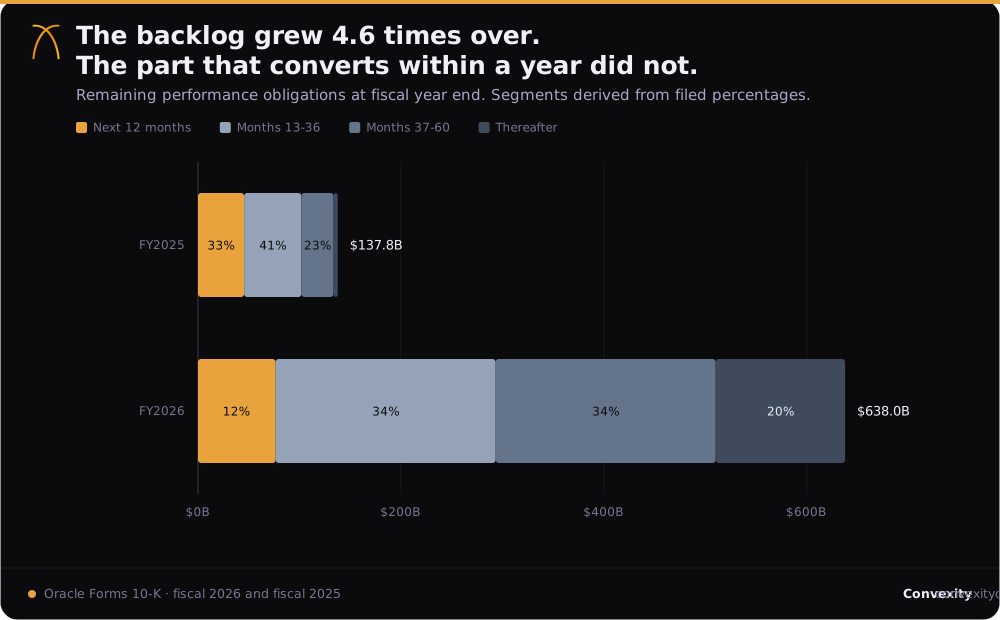
Applying those percentages to those totals, which is arithmetic on Oracle's figures rather than something Oracle discloses directly:
| $ billions | FY2025 | FY2026 |
|---|---|---|
| Next 12 months | 45.5 | 76.6 |
| Months 13 to 36 | 56.5 | 216.9 |
| Months 37 to 60 | 31.7 | 216.9 |
| Thereafter | 4.1 | 127.6 |
| Total | 137.8 | 638.0 |
Measured against the revenue run rate, the backlog went from about 2.4 years of revenue to about 9.5 years of it.
This is the whole argument, and it is worth stating precisely, because it is easy to overstate in either direction. Long-duration contracts are not a defect. They are what recurring revenue means, and a five-year cloud commitment is a better asset than a one-year one. The issue is the mismatch in timing. The 54% of the backlog that lands after May 2029 requires data centers that have to exist before then, and the money to build them is being spent now.
What it costs to stand up
Capital expenditure went from $6.9 billion in fiscal 2024 to $21.2 billion in fiscal 2025 to $55.7 billion in fiscal 2026. That last figure is 1.7 times the entire operating cash flow of the business.
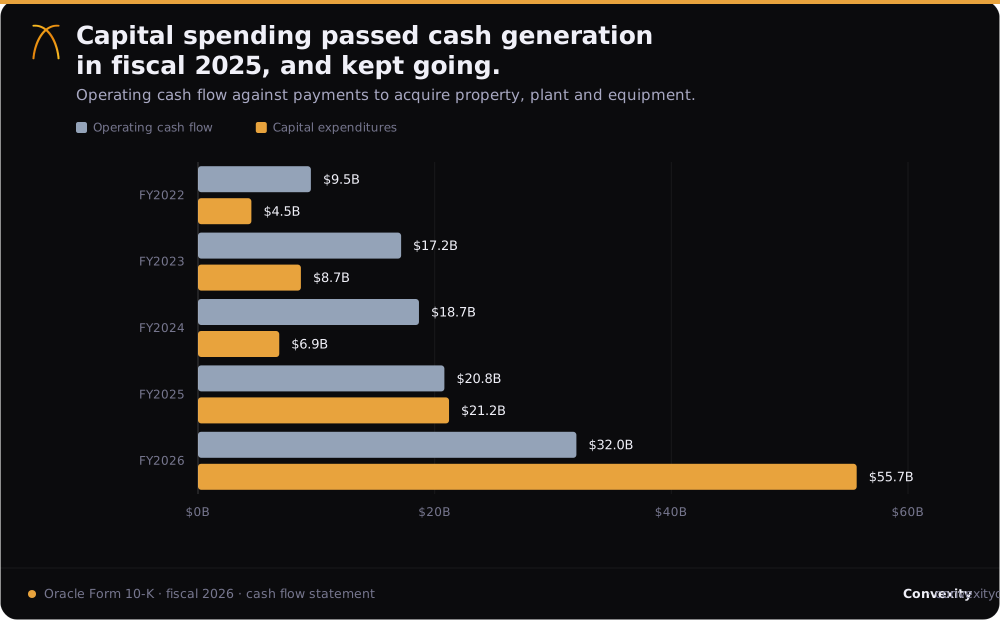
| $ millions | Op cash flow | Capex | Free cash flow |
|---|---|---|---|
| 2022 | 9,539 | 4,511 | 5,028 |
| 2023 | 17,165 | 8,695 | 8,470 |
| 2024 | 18,673 | 6,866 | 11,807 |
| 2025 | 20,821 | 21,215 | -394 |
| 2026 | 31,977 | 55,663 | -23,686 |
Oracle also paid $5,787 million of common dividends in fiscal 2026. So the cash shortfall to be financed was closer to $29.5 billion than to $23.7 billion.
The balance sheet shows where it went. Property, plant and equipment net of depreciation went from $43.5 billion to $100.0 billion in one year. Construction in progress alone went from $16.5 billion to $40.0 billion. Long-lived assets in the United States went from $45.4 billion to $102.7 billion, which is to say the buildout is overwhelmingly domestic.
Buybacks tell the same story from the other side. Oracle repurchased 3.9 million shares for $600 million in fiscal 2025 and 0.4 million shares for $93 million in fiscal 2026, against $16.2 billion in fiscal 2022. A company that was one of the market's more aggressive repurchasers has effectively stopped, while leaving $6.3 billion of authorization unused.
Where the money came from
Oracle raised capital three ways in fiscal 2026, and two of them are new.
Correction, September 10, 2026. There were four, and the sentence above was wrong when it was published. The same 10-K discloses $4.6 billion of customer prepayments carrying a significant financing component, on the face of the cash flow statement, in the management discussion and in a dedicated accounting policy note headed "Customer Prepayments and Sales of Financing Receivables." It was the newest of the four channels and it has since become the largest: in the first quarter of fiscal 2027 the same line was $11.4 billion. Our September 10 note covers what that changes.
| Raised in fiscal 2026 | Amount | Cost |
|---|---|---|
| Senior notes, 14 tranches | $43.0B | 4.45% to 6.85% |
| Mandatory convertible preferred | $5.0B | 6.50% |
| At-the-market equity, undrawn | $20.0B authorized | dilution |
The notes mature between February 2029 and February 2066, against $14.0 billion issued the prior year. Their weighted average coupon is about 5.62%, our calculation across the thirteen fixed-rate tranches, excluding a $500 million floater.
The preferred was issued on February 5, 2026: 100,000,000 depositary shares representing 50,000 shares of 6.50% Series D Mandatory Convertible Preferred Stock at a $100,000 per share liquidation preference, for $5.0 billion of net cash proceeds. It trades as ORCL-PRD and costs about $325 million a year. Note the word mandatory. The conversion into common stock is not optional, so the dilution is contractual rather than contingent.
The equity program deserves a note, because the 10-K is not the most recent word on it. Oracle entered the $20 billion equity distribution agreement on February 2, 2026 and had sold none of it at year end. Then, on June 23, 2026, the day after filing the 10-K that reported zero shares sold, it filed a prospectus supplement adding fifteen sales agents, among them BNP Paribas, HSBC, Wells Fargo, Mizuho, MUFG, Santander, TD, BNY Mellon and ING.
The syndicate went from five banks to twenty. Nobody broadens distribution on a facility they do not intend to use. The program remains undrawn as far as any filing discloses, and this is an observation about preparation, not a claim that shares have been sold.
Set against all of that, the maturity schedule is genuinely comfortable. Of $129.5 billion of total debt, $7.2 billion matures within twelve months and $90.2 billion falls due after year five. Oracle termed this out.
| Balance sheet, May 31, 2026 | |
|---|---|
| Total debt | $129,541M |
| Operating lease liabilities | $30,190M |
| Total stockholders' equity | $42,508M |
| Cash and cash equivalents | $31,289M |
| Total assets | $261,759M |
Interest expense was $4,599 million in fiscal 2026 against $3,578 million, up 29%. That figure understates the forward cost, because most of the $43.0 billion was issued partway through the year. At the weighted average coupon above, a full year of that paper alone runs about $2.4 billion, and fiscal 2026 did not carry a full year of it.
There are also commitments outside the debt. Unconditional purchase obligations totaled $13.3 billion at year end, which Oracle says are "primarily related to data center power arrangements." Subsequent to the year end, it entered an additional $19 billion of unconditional purchase commitments for cloud infrastructure assets, commencing in fiscal 2027 with a five-year term. And one lease carries a guarantee of up to $3.3 billion of the lessor's borrowing, maturing in September 2026.
Three customers
Oracle does not name the counterparties in its filings. It named the count on the call.
Here is Safra Catz, then chief executive, in Oracle's own first-quarter release on September 9, 2025, the quarter in which remaining performance obligations went from $138 billion to $455 billion:
We signed four multi-billion-dollar contracts with three different customers in Q1. This resulted in RPO contract backlog increasing 359% to $455 billion. It was an astonishing quarter and demand for Oracle Cloud Infrastructure continues to build.
Four contracts. Three customers. About $317 billion of new contracted revenue in ninety days.
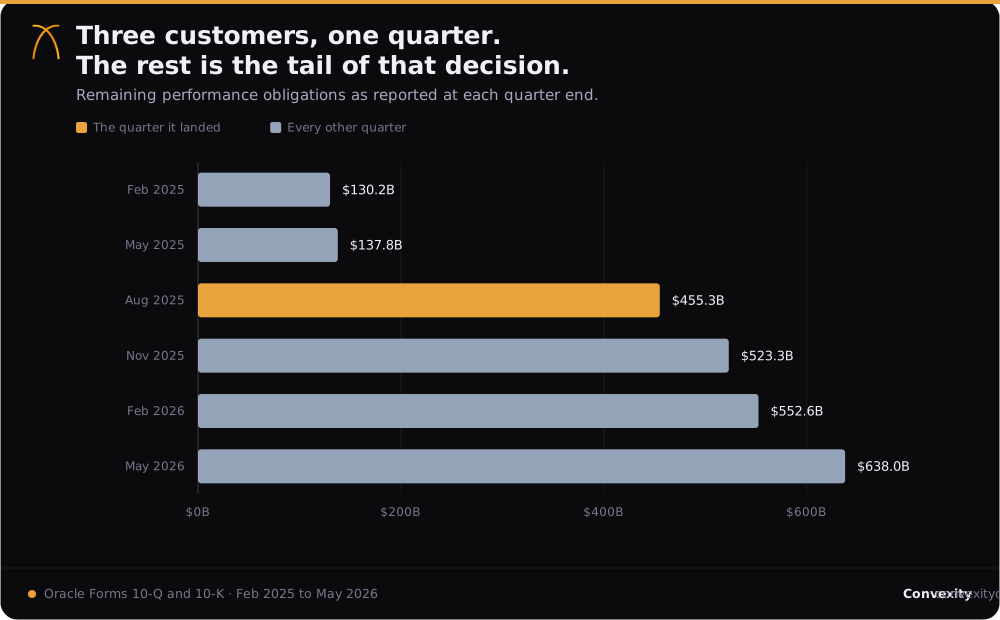
The market filled in the name the next day. The Wall Street Journal reported on September 10, 2025 that OpenAI had agreed to buy roughly $300 billion of compute from Oracle over five years beginning in 2027, and every subsequent account of Oracle has been built on that number (retrieved 2026-08-30). Oracle has not confirmed it in any filing we can find. What Oracle has confirmed is adjacent and looser: that it signed contracts with, in Catz's phrase, "the who's who of AI," and separately, with OpenAI and SoftBank, that it is a partner in Stargate, the data center venture announced in January 2025 with a stated ambition of $500 billion, including a 4.5 gigawatt Oracle capacity agreement announced in July 2025 (retrieved 2026-08-30).
The stock rose about 35% the day after that first print, its largest single-day gain since 1992. In December 2025, after a slide, Oracle publicly denied a report of delays in the OpenAI arrangement (retrieved 2026-08-30).
So the position is this. A reader who wants to know how concentrated $638 billion of contracted revenue is has: a company-stated customer count of three for the quarter that created most of it, a widely reported but unconfirmed $300 billion figure attached to a single counterparty, and a filing that names nobody.
What the filing does say, and what it cannot
Oracle discloses customer concentration in one sentence:
No single customer accounted for 10% or more of our total revenues in fiscal 2026, 2025 or 2024.
That statement is true, it is audited, and it is about revenue.
The $500 billion increase in the backlog came from what the 10-K calls "certain significant cloud contracts that were entered into during the period." Those contracts are barely revenue yet. Only 12% of the backlog becomes revenue in the coming twelve months. So the concentration, whatever it is, sits almost entirely in a measure the disclosure does not cover, and will keep sitting there for years.
This is not an accusation of concealment. The 10% test is what the accounting standard requires, Oracle applied it correctly, and there is no general requirement to disclose concentration within remaining performance obligations. It is a statement about what the disclosure can and cannot tell you. A reader who takes "no customer is 10% of revenues" as reassurance about the composition of a $638 billion backlog has read it as answering a question it was never asked. On the reported figures, one counterparty may be around half of it.
We are not going to put a number on that. Oracle does not publish it, the $300 billion is a press report rather than a filed fact, and the gap between those two things is the single largest hole in any analysis of this company right now, including this one.
The money goes in a circle, and Oracle takes the leg with the debt on it
This dispatch is the third in a row to land on the same structure from a different side, so it is worth drawing the shape once.
The AI buildout is being financed substantially by its own participants. Nvidia has committed to invest in OpenAI. OpenAI has committed enormous sums to cloud providers, Oracle reportedly the largest among them. Those providers use the money to buy Nvidia accelerators. Estimates of the total tangle vary and most are unauditable, but the direction is not in dispute and the participants describe the individual legs themselves.
None of that is fraud, and calling it a circle is not an accusation. Vendor financing is ordinary and often rational: it is how a supplier seeds a market it expects to be large. What circularity does is destroy diversification. If the demand is real, every leg pays. If it is not, the legs fail together, because they are the same bet wearing different instruments.
What is worth noticing is that the three companies we have looked at chose three different instruments for the same exposure, and they are not equally reversible.
- Alphabet and Amazon booked marks. Our August 27 note covered the June-quarter results in which unrealized fair-value gains on private AI labs dwarfed the cloud revenue those labs generate. A mark is non-cash and reverses on its own if the value falls. It costs nothing to carry.
- Nvidia extended guarantees and credit. Our August 26 note covered a 10-Q carrying $108.5 billion of guarantees the press release did not mention, plus committed equity in customers and capacity rented back from them. Contingent, off the income statement until it is not.
- Oracle borrowed cash. $43.0 billion of senior notes at 4.45% to 6.85%, $5.0 billion of 6.50% mandatory convertible preferred, out to 2066, on the balance sheet, with a coupon that is due whatever happens to the demand.
That is the distinction that matters. A mark can be written back down. A guarantee may never be called. A bond is paid. Oracle took the leg of the circle that is hardest to unwind, and it did so to serve contracts that Oracle itself schedules mostly past 2029.
There is a smaller signal in the same direction. In December 2025 Oracle sold its interest in Ampere, the chip company it had backed, for a $2.7 billion pre-tax gain that carried second-quarter GAAP earnings per share up 91%. Larry Ellison explained the sale plainly:
Oracle sold Ampere because we no longer think it is strategic for us to continue designing, manufacturing and using our own chips in our cloud datacenters. We are now committed to a policy of chip neutrality where we work closely with all our CPU and GPU suppliers. Of course, we will continue to buy the latest GPUs from NVIDIA.
Read as strategy, that is a reasonable call about where Oracle's advantage lies. Read as position, Oracle exited the one asset that would have given it an alternative to buying from the vendor at the other end of the circle, and booked a gain doing it that flattered a quarter's earnings. Both readings are available and the filing supports each.
Oracle's own language is the sharpest thing in the filing
Immediately after the concentration sentence, the 10-K says this:
We enter into certain large, long-term customer cloud arrangements that require us to make significant infrastructure investments, including data center capacity. For discretionary capital expenditures, the timing of such expenditures can be adjusted based on our liquidity position and access to additional financing. The economic returns on these investments are dependent on customer demand and the ability of our key customers to meet their contractual obligations.
That final clause is counterparty credit risk, named by the company, about its own key customers. Oracle is spending $55.7 billion a year, financed at 4.45% to 6.85%, on assets whose return depends on whether a small number of customers can pay what they have committed to.
The risk factors close the loop. A downgrade, Oracle warns, could "affect the terms or availability of certain long-term commitments (including data center leases)." The financing and the buildout are coupled in both directions.
The case against this note
The strongest arguments run the other way, and several of them are good.
This is a timing mismatch, not a solvency problem. Oracle is investment grade, holds $31.3 billion of cash, has $7.2 billion of debt maturing within a year, and has $20 billion of untapped equity capacity plus $6.3 billion of suspended buybacks it could redirect. None of the usual distress markers are present.
Front-loading capex against long-duration contracts is what building a cloud looks like. Amazon and Microsoft ran negative or thin free cash flow through their own infrastructure build phases. If the contracts perform, spending ahead of the revenue is correct rather than reckless, and the alternative was declining to compete.
The backlog is contracted, not speculative. These are signed obligations with counterparties, subject to revenue recognition rules and audited. Treating $638 billion as though it were a sales pipeline would be a serious misreading.
Long duration raises quality as well as pushing out timing. A contract that runs past 2031 is a longer annuity than one that runs to 2027. The duration extension that looks alarming in a conversion schedule is the same fact as a lengthening customer commitment.
The near-term number still grew. $76.6 billion converting in the next twelve months against $45.5 billion a year ago is 68% growth in the part that turns into cash soonest, on top of 17.4% total revenue growth.
Our disagreement is narrow and it is about sequence rather than direction. The capital is committed now, at 5.62% average and out to 2066, against revenue that Oracle itself schedules mostly past 2029. That mismatch is financed, and financing is a position that has to be maintained rather than a decision that is made once.
What would change the read
Named in advance, so this can be scored rather than argued.
| Trigger | When | Why it matters |
|---|---|---|
| Conversion schedule | Sep 14, quarterly | A near-term share recovering from 12% makes this note largely wrong |
| Free cash flow | Quarterly | Breakeven would mean revenue arriving faster than the schedule implies |
| The ATM | Any time | Funding shifts from debt to dilution; the interest burden stops growing |
| RPO concentration | Any filing or call | Settles the largest open question here, in either direction |
| Interest cover | FY2027 | The run rate on issued debt already exceeds the $4.6B reported |
| A ratings action | Any time | A downgrade could touch the availability of data center leases |
The first row is the one that matters most, and it is cheap to check. Oracle restates the conversion schedule every quarter. If the near-term share stabilizes or recovers, the timing mismatch was an artifact of when a few large contracts happened to be signed. If it falls again while the total grows, the pattern is structural.
Primary sources
- 10-KOracle Corporation annual report, fiscal year ended May 31, 2026The $638 billion figure, the conversion schedule, the senior note tranches, the mandatory convertible preferred, the concentration sentence and the purchase commitmentsFiled Jun 22, 2026
- 10-KOracle Corporation annual report, fiscal year ended May 31, 2025The prior-year conversion schedule: 33% / 41% / 23% and the remainderFiled Jun 18, 2025
- 424B5Prospectus supplement, at-the-market common stock programAdds fifteen sales agents to the $20 billion ATM program, one day after the 10-K reported none of it soldFiled Jun 23, 2026
- 8-KQ1 fiscal 2026 results, the quarter the backlog was createdSafra Catz on four contracts with three customers, and RPO reaching $455 billionFiled Sep 9, 2025
- 8-KQ2 fiscal 2026 resultsThe Ampere sale, the $2.7 billion gain, and Larry Ellison on chip neutralityFiled Dec 10, 2025
- 8-KQ4 and fiscal 2026 resultsRPO from $553 billion to $638 billion in one quarter; cloud infrastructure up 93% in Q4Filed Jun 10, 2026
- XBRLOracle Corporation company facts, US GAAP financial dataThe multi-year cash flow, capex, debt and equity series behind both figuresRetrieved Aug 30, 2026
Not investment advice. This is a reading of public filings, published for research purposes. It is not a recommendation to buy or sell any security, and it is not a price target. We hold no position in ORCL. Anyone acting on any of it should read the filings themselves, which are linked above, and form their own view. Figures described as derived are our arithmetic on Oracle's disclosed numbers and carry whatever imprecision Oracle's own "approximately" carries.