Disclosure. Not investment advice, and nothing here is a recommendation to buy, sell or hold any security. A member of the Convexity team owns Meta shares directly, and owns shares of the SPDR S&P 500 ETF Trust (SPY), which holds Microsoft, Alphabet, Amazon, Meta and Oracle, so stands to benefit if those shares rise. No other position in any of the six companies, long or short, at publication. Three more things a reader should weigh. Convexity is a customer of Anthropic, and this note was researched and drafted with Claude, Anthropic's own model. A member of the Convexity team holds an economic interest in Anthropic through a special-purpose vehicle and a fund, and stands to benefit if its valuation rises, so we are not neutral on anything touching the AI labs: Amazon's filing, quoted below, describes a financing facility for Anthropic, Amazon and Microsoft are among Anthropic's shareholders, Alphabet competes with it, and Microsoft, Amazon and CoreWeave each name OpenAI, Anthropic's direct competitor, in their filings. And every figure below is either quoted from a company's filing or earnings call, or is our arithmetic on figures in them; the closing note separates the two.
Six public companies sit at the center of the build-out of artificial intelligence infrastructure: Microsoft, Alphabet, Amazon, Meta, Oracle and CoreWeave. In the latest four quarters each has reported, they spent $606.9 billion on capital projects, most of it on data centers and the servers inside them. A year earlier the same six spent $327.3 billion.
The spending is well covered. How it is paid for is not, partly because the answer is scattered across each filing. Operating cash sits in one statement and debt in another. The largest commitments are in a lease footnote, guarantees are in a derivatives note, and customer prepayments sit inside operating cash flow, where they read like earnings. This ledger puts those pieces in one place, for all six companies, from their own filings. It will be refreshed each time they file.
The short version has three parts. Operating cash still pays for most of the build, but a rising share of it: 85.0% of the six companies' combined operating cash went to capital spending in the latest four quarters, against 63.5% a year earlier. The money that used to go back to shareholders has turned around: the six bought back $43.0 billion of their own stock and raised $77.4 billion by selling new shares. And the largest number in the picture is on no balance sheet. Between them, the six have signed $1.15 trillion of leases, mostly for data centers, that have not started yet.
Leases, debt and stock figures from each company's latest Form 10-Q or 10-K, for quarters ended June 30, 2026 (Oracle, August 31). Every total here is our sum of the six companies' filed figures, and the four-quarter figures are built from each filing's year-to-date columns as the method section describes.
The ledger
Two tables, one for cash and one for everything else. Figures are in billions of dollars. For five of the companies the four quarters run to June 30, 2026. For Oracle, whose fiscal year ends in May, they run to August 31, 2026. Microsoft's latest four quarters are its fiscal year 2026.
What came in, and where it went, over the latest four quarters (a year earlier in brackets):
| Company | Operating cash | Capital spending | Capex as a share of operating cash | Bought back | Raised selling stock |
|---|---|---|---|---|---|
| Microsoft | 182.9 (136.2) | 115.9 (64.6) | 63% | 22.3 (18.4) | none |
| Alphabet | 185.7 (133.7) | 132.4 (67.0) | 71% | 17.4 (59.1) | 49.6 |
| Amazon | 161.4 (121.1) | 173.0 (107.7) | 107% | none | none |
| Meta | 130.3 (102.3) | 89.3 (52.2) | 69% | 3.3 (31.7) | none |
| Oracle | 46.9 (21.5) | 75.7 (27.4) | 161% | none (0.5) | 24.9 |
| CoreWeave | 6.9 (0.6) | 20.6 (8.6) | 298% | none | 3.0 |
| Six combined | 714.2 (515.5) | 606.9 (327.3) | 85% | 43.0 (109.9) | 77.4 |
What they owe, what they have committed to, and what they have been promised, at each company's latest quarter end:
| Company | Debt on the balance sheet (a year earlier) | Leases signed, not yet started | Contracted backlog |
|---|---|---|---|
| Microsoft | 40.3 (43.2) | 329.1 | 684 |
| Alphabet | 100.2 (24.6) | 85.2 | 519.5 |
| Amazon | 132.2 (55.7) | 137.2 | about 496 |
| Meta | 83.7 (28.8) | 279.0 | none reported |
| Oracle | 125.3 (91.3) | 288.0 | 664 |
| CoreWeave | 35.1 (11.1) | 35.5 | 103.7 |
| Six combined | 516.8 (254.7) | 1,154.0 | 2,467.2 |
A few definitions, because each column hides a choice. Capital spending is the cash each company paid for property and equipment, as its cash flow statement reports it. It leaves out assets acquired through finance leases, which Microsoft and Meta include in the capital spending figures they quote on their calls, so their numbers here are lower than the ones they cite. Debt is the carrying value of borrowings on the balance sheet, current and long term together, and it leaves out lease liabilities. Stock raised counts only sales of new shares for cash (common stock, mandatory convertible preferred and private placements), not shares issued to employees. Leases not yet started are the undiscounted payments each company discloses for leases it has signed that have not commenced. Backlog is remaining performance obligations, contracted revenue not yet recognized, as each company defines it. Meta buys capacity rather than selling it and reports none. The method section at the end says exactly how each figure was built.
The rest of this page walks through the tables one line at a time.
Operating cash still pays for most of it
Start with the reassuring number. Across the six companies, operating cash in the latest four quarters was $714.2 billion, and capital spending was $606.9 billion. Taken together, the business still generates more cash than the build consumes.
The trend is the less reassuring part. Operating cash grew 38.5% on a year earlier, which would be an excellent year for almost any business. Capital spending grew 85.4%. So the share of operating cash going into the build rose from 63.5% to 85.0% in a single year, and that figure is the six combined. Inside it, three companies spent more on capital projects than their operations brought in.
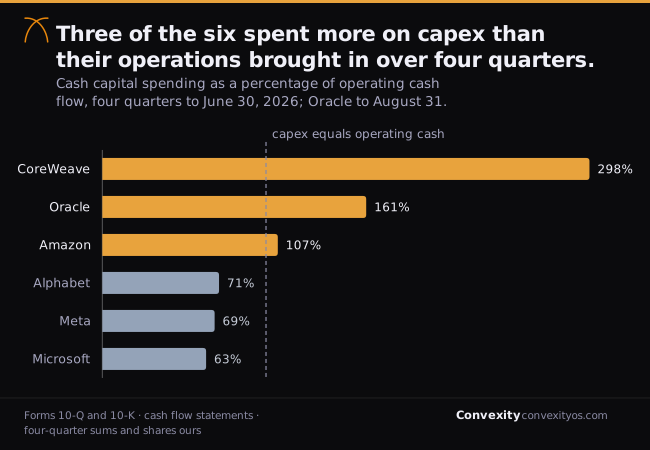
Microsoft is the one company of the six that pays for everything from operations. In its fiscal year to June 30, it generated $182.9 billion of operating cash and spent $115.9 billion on property and equipment, leaving $67.0 billion on our arithmetic. From that it paid $26.4 billion of dividends and bought back $22.3 billion of stock, more than the $18.4 billion of the year before, and it issued no debt at all. Its chief financial officer, Amy Hood, told investors on July 29: "In addition, we expect to remain free cash flow positive in FY '27." That excludes a large piece, discussed below: Microsoft's biggest commitments are leases, not capital spending.
Alphabet covered its capital spending over the four quarters, with $185.7 billion of operating cash against $132.4 billion spent. The quarterly trend is sharper than the annual one. In the second quarter, its chief financial officer, Anat Ashkenazi, said: "We had negative free cash flow of $5.9 billion in the second quarter." She also raised the company's guidance: "We are updating our full year 2026 CapEx guidance range to $195 billion to $205 billion." The previous range was $180 billion to $190 billion. Alphabet spent $80.6 billion in the first half, so the new range implies $114 billion to $124 billion in the second on our arithmetic, more than it spent in all of 2025.
Meta spent $89.3 billion against $130.3 billion of operating cash over four quarters, which looks comfortable, but the second quarter alone did not. Susan Li, its chief financial officer, reported on July 29: "Free cash flow was $784 million." That was on capital spending of $31.1 billion including finance lease principal, in a quarter when operating income fell, which she described as "representing an 8% decline year-over-year." Meta now expects 2026 capital spending, including principal payments on finance leases, of $130 billion to $145 billion. The bottom of that range is about the $130.3 billion of operating cash it generated over the last four quarters.
Amazon crossed the line. Its own cash flow statement carries twelve-month columns, and they show $161.4 billion of operating cash against $173.0 billion of purchases of property and equipment. On a gross basis that is $11.6 billion more going out than coming in. Netting off the $4.0 billion of proceeds from equipment sales and incentives, as Amazon's own free cash flow measure does, makes the gap smaller but leaves it negative, on our arithmetic. Its chief executive, Andy Jassy, described the pattern plainly on the July 30 call: "we'll spend a lot of CapEx and encounter free cash flow headwinds until these data centers come online." He then raised the year's plan: "We now believe we will spend approximately $220 billion in cash CapEx in 2026." He blamed memory prices for most of the increase: "The higher cost of memory pushing this number up from our prior estimate of about $200 billion." That is the same memory squeeze described in our note on the memory cycle.
Oracle spent $75.7 billion against $46.9 billion of operating cash, 161% of it, and the $46.9 billion flatters the picture. It includes $16.0 billion of customer prepayments that Oracle's own accounting treats as a financing, discussed in the prepayments section below. Excluding them, operating cash was $31.0 billion and capital spending was 244% of it, both on our arithmetic.
CoreWeave is the extreme case. Capital spending of $20.6 billion against $6.9 billion of operating cash is 298%. That is by design: its business is building capacity for contracts already signed, and its chief financial officer, Nitin Agrawal, says so directly: "The cost, primarily in the form of CapEx is front-loaded requiring a combination of debt, customer prepayments, and other corporate level capital to finance its build out." Our CoreWeave note takes its financing apart in detail.
So the six sort into three groups. Microsoft and Alphabet still cover their spending with room to spare over four quarters, although Alphabet's latest quarter did not. Meta covers the four quarters with less room, and its latest quarter barely. Amazon, Oracle and CoreWeave spent more than their operations brought in.
Buybacks became stock sales
A year earlier, the six bought back $109.9 billion of their own stock. Over the last four quarters, as a group, they raised more money by selling stock than they spent buying it back.
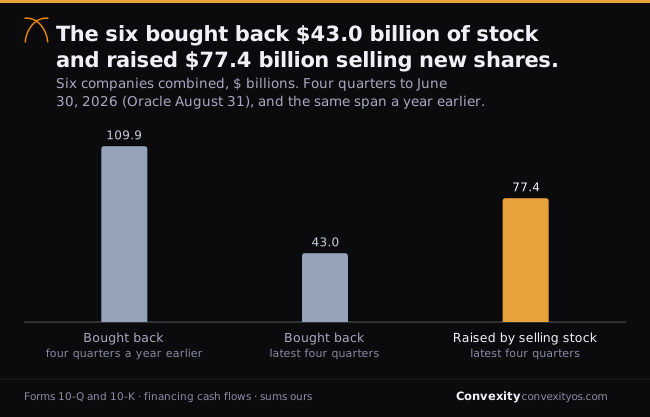
Buybacks fell from $109.9 billion to $43.0 billion, a drop of 60.9%. Alphabet and Meta account for all of it, and more, since Microsoft's rose.
Alphabet bought back $59.1 billion of stock in the four quarters to June 2025 and $17.4 billion in the four quarters to June 2026. All of the latest year's buying happened in the second half of 2025. In the first six months of 2026 its cash flow statement shows repurchases of zero, against $28.3 billion in the same months a year earlier. Meta's arc is the same: $31.7 billion down to $3.3 billion, with no repurchases at all in the first half of 2026 against $22.9 billion a year before.
Alphabet then went the other way and sold stock. "On June 4, 2026, the company completed an underwritten public offering of 29 million Class A shares," its 10-Q says, together with 29 million Class C shares. "Concurrently with the public offering, on June 4, 2026, the company completed a private placement of 14 million Class A and 14 million Class C shares to an affiliate of Berkshire Hathaway Inc." In the same quarter it sold 6.25% mandatory convertible preferred stock, which converts into common stock later. The cash flow statement puts the proceeds at $30.5 billion of common stock and $19.1 billion of preferred, net of costs, $49.6 billion in total.
Oracle did the same through a different channel. It set up an at-the-market program in February, which lets a company sell shares gradually into the market. In the quarter to August 31, its 10-Q says, "we fully utilized the ATM Program and issued 141 million shares of common stock under the ATM Program for net proceeds of $ 19.9 billion." In its previous fiscal year, after August 2025, it had also sold $5.0 billion of mandatory convertible preferred stock. CoreWeave raised $3.0 billion in private placements in the first half of 2026, including one Nvidia took part in, which our CoreWeave note covers.
Microsoft is the exception again. It raised no equity and increased its buybacks. Amazon has neither bought back stock nor sold any in either period.
None of this is a distress signal in itself. Selling stock at a high valuation to pay for assets expected to earn a return is ordinary corporate finance, and an affiliate of Berkshire Hathaway bought into Alphabet's offering. Both Alphabet and Meta still pay dividends. But it is a change of regime. Two of the most profitable companies in the world stopped buying back their stock in the first half of 2026, and one of them started selling it. Alphabet and Oracle could have borrowed more instead of issuing equity. That both chose to issue equity alongside heavy borrowing says something about how much capital the plans in front of them need.
The debt doubled
Debt on the six balance sheets was $254.7 billion a year earlier and $516.8 billion at the latest quarter ends, on our sums of the balance sheet lines. That is slightly more than double.
The increases are uneven. Alphabet's debt went from $24.6 billion to $100.2 billion, about four times. Meta's went from $28.8 billion to $83.7 billion, about three times. Amazon's went from $55.7 billion to $132.2 billion. CoreWeave's went from $11.1 billion to $35.1 billion. Oracle's rose from $91.3 billion to $125.3 billion, a smaller jump from a higher base. Microsoft's fell, from $43.2 billion to $40.3 billion.
The borrowing has two features worth noting. The first is how long it runs. Amazon's March issue of $37.0 billion of dollar notes includes maturities as far out as 2076, fifty years, and its 10-Q states that "The combined weighted-average remaining life of the Notes was 14.2 years as of June 30, 2026." This is mostly fixed-rate money borrowed for a very long time, which is sensible for assets like buildings and power connections, and less obviously matched to servers that wear out in a few years.
The second is how many currencies it came in. Alphabet's 10-Q says: "During 2026, we issued $ 20.0 billion of US dollar-denominated fixed-rate senior unsecured notes and $ 31.8 billion of foreign currency-denominated fixed-rate senior unsecured notes for general corporate purposes." The foreign currency notes came in sterling, Swiss francs, euros, Canadian dollars and yen. Amazon borrowed in dollars, euros, Swiss francs and Canadian dollars this year. Companies borrow abroad for cost and for diversification. At this scale it also means the deepest bond market in the world is not the only one being asked.
For Microsoft, Alphabet, Amazon and Meta none of this looks like near-term stress: the debt is long-dated, mostly fixed-rate, and smaller than a single year of each company's operating cash. For Oracle and CoreWeave the picture is tighter, as our note on Oracle's bond marks and the CoreWeave note both describe. But the debt line is not where the largest numbers are.
The bill that is not on the balance sheet
When a company signs a lease on a data center that is still being built, nothing reaches its balance sheet until the building is handed over. When the lease starts, the company records a liability for the payments it owes. Until then, the commitment exists only as a sentence in the lease footnote.
Those sentences, added together, are the largest figure in this ledger.
- Microsoft: "As of June 30, 2026, we had additional leases, primarily for datacenters, that had not yet commenced of $ 329.1 billion, with some arrangements subject to certain contractual conditions being met. These leases will commence between fiscal year 2027 and fiscal year 2033 with lease terms of 1 year to 20 years."
- Oracle: "As of August 31, 2026, we had $ 288 billion of additional lease commitments, substantially all related to data center arrangements." They are expected to begin between fiscal 2027 and fiscal 2029, for terms of fifteen to nineteen years, and "were not reflected on our condensed consolidated balance sheets as of August 31, 2026."
- Meta: "These lease obligations were approximately $ 278.99 billion, consisting of data centers, colocations, and certain network infrastructure, which will commence during the remainder of 2026 through 2036 with lease terms ranging from greater than one year to 30 years." Then, in the same filing: "In July 2026, we entered into additional data center leases with lease obligations of approximately $ 68 billion, which are expected to commence in 2027 and 2028."
- Amazon: $137.2 billion of "leases not yet commenced," in the commitments table of its 10-Q.
- Alphabet: "As of June 30, 2026, we have entered into leases, primarily related to data centers, that have not yet commenced with future lease payments of $ 85.2 billion that are not yet recorded." Separately, it signed a short-term lease with a commitment of about $5.8 billion, starting in the third quarter.
- CoreWeave: "The aggregate amount of estimated future undiscounted lease payments associated with such leases is $ 35.5 billion." That figure leaves out another lease whose rent depends on construction costs, "subject to a contractual maximum of $ 14.7 billion over the sixteen year term of this lease."
The six stated totals add up to $1,154.0 billion. That is a floor. It leaves out Meta's roughly $68 billion signed in July, Alphabet's short-term lease and CoreWeave's excluded lease. It is more than twice the $516.8 billion of debt on the six balance sheets, and nearly two years of their combined capital spending at the current rate.
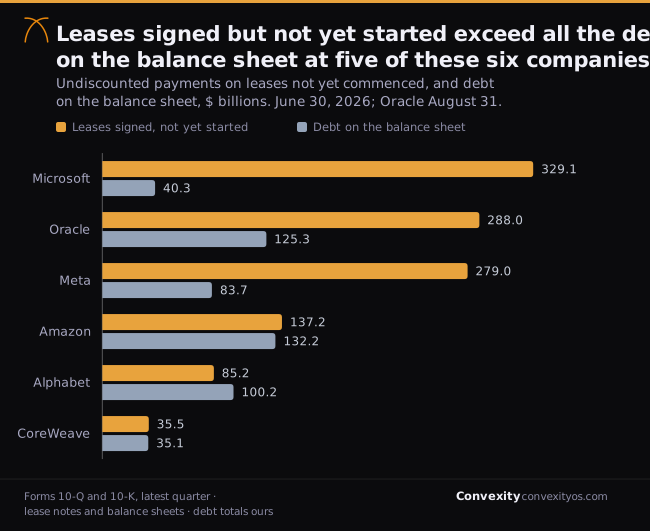
At five of the six companies, the leases not yet started exceed all the debt on the balance sheet. Microsoft is the clearest case. It has almost no net need to borrow, and it has signed $329.1 billion of leases, eight times its debt. Its largest existing obligation is already a lease rather than a bond: its finance lease liabilities were $66.6 billion at June 30, against $40.3 billion of debt. It added $24.6 billion of assets through finance leases during the year. On the July call, Hood gave the quarter's figure: "This quarter, total finance leases were $5.6 billion and were primarily for large data center sites."
Two cautions keep this comparison honest. First, the lease figures are undiscounted: they add up payments stretching fifteen or twenty years into the future. When a lease starts, the liability goes on the balance sheet at the present value of those payments, which is smaller. The comparison with debt is a comparison of scale, not of like-for-like liabilities. Second, some of these leases may never start. Microsoft's own sentence says some are "subject to certain contractual conditions being met," which is the language of an option as much as an obligation. The falsifier section below comes back to this.
The reason this matters for the question in the title is simple. A lease is how a company gets a building without paying for it up front. Someone else builds the data center and carries the construction cost, and the tech company commits to pay rent for fifteen or twenty years. The capital spending line counts the servers and the buildings the company owns. The leases are the part of the buildout that other people's money is paying for today, and that the tenants have promised to pay back over two decades.
Guarantees, ventures and backstops
Some commitments are not leases. They are promises to cover someone else's obligations if something goes wrong. Two of the six disclose large ones.
Meta's Louisiana venture. In October 2025, Meta agreed to co-develop a data center campus in Louisiana through a venture in which it holds a 20% interest. "The parties have committed to fund their respective pro rata share of approximately $ 27 billion in total estimated development costs." Meta will lease the campus, with leases starting in 2029 and an initial commitment of about $12.31 billion. It also stood behind the value of the buildings: "we have provided residual value guarantees (RVG) with an aggregate threshold of approximately $ 28 billion that decreases over time." If Meta ends or does not renew a lease, and certain other conditions are met, it pays any shortfall between the property's value at that time and the threshold. The venture is not on Meta's balance sheet, because Meta concluded "we are not the primary beneficiary and, therefore, do not consolidate the variable interest entity (VIE)." The filing states the full exposure: "our maximum exposure to loss related to the Venture was $ 46.03 billion." In July Meta entered an exclusivity agreement for a second venture of the same kind, in El Paso, Texas, still subject to definitive agreements, which would carry residual value guarantees of up to about $13 billion.
Alphabet's backstops. Alphabet discloses a quieter arrangement. "We have entered into agreements with certain third parties to backstop certain payment obligations relating to data centers, which we account for as credit derivatives." The total potential exposure, the notional amount, was $16.9 billion at December 31, 2025 and $43.8 billion at June 30, 2026. That is up $26.8 billion in six months. In plain terms, Alphabet has promised to cover certain payment obligations of data center companies if they default. It also gets something in return: "Upon a default under these backstops, we retain the right to assume the underlying leases for internal use or to sublease to third parties." Separately, it backstops its energy suppliers' purchases of long-lead equipment for future power agreements, and states that "our maximum potential amount of future payments under these guarantees was $ 7.6 billion."
Neither arrangement is unusual, and neither is likely to be called. But both are ways of supporting the buildout with credit rather than cash, and neither appears in the debt column. The same move is visible from the supplier side. Our Nvidia note found $108.5 billion of guarantees in its 10-Q, and our Broadcom note describes a vehicle arranged with Apollo and Blackstone to fund customers buying its chips.
Customers who pay early, and suppliers who lend
The last layer of financing sits between the companies and their customers, and it runs in both directions.
Oracle's customers are lending to it. Oracle's 10-Q for the quarter to August 31 says: "During the first quarter of fiscal 2027, we received $ 11.4 billion of prepayments from customers that included a significant financing component. No prepayments from customers that included a significant financing component were received during the first quarter of fiscal 2026." A significant financing component is the accounting term for a customer paying so far in advance that the payment is partly a loan. Oracle accounts for it that way, charging itself interest at a rate described in the filing: "We determine the discount rate based on a rate that reflects the credit characteristics of the party receiving financing, which is generally consistent with our incremental borrowing rate." With $4.6 billion received in fiscal 2026, such prepayments came to $16.0 billion over the latest four quarters on our sum. Our note on Oracle's quarter covers this in full.
Oracle presents it as a strategy, not a stopgap. Its chief financial officer, Hilary Maxson, said on the September 10 call that "the vast majority of those new contracts were via prepay or bring your own hardware or a similar mechanic so will not require incremental capital from Oracle." She guided to $90 billion to $95 billion of capital spending this fiscal year "with not more than $70 billion in net cash CapEx," meaning net of customer prepayments. Clayton Magouyrk, one of Oracle's two chief executives, put it as a principle: "It does not have to be Oracle CapEx."
Amazon finances one of its customers. Amazon's 10-Q describes commitments from both leading AI labs. OpenAI "announced an expansion of the existing $ 38.0 billion multi-year commitment and commercial arrangement with OpenAI by $ 100.0 billion over 8.0 years." And: "In Q2 2026, AWS and Anthropic announced an expansion of the strategic collaboration and existing multi-year commitment by more than $ 100.0 billion over 10.0 years." Amazon also finances the second of those customers. "In Q2 2026, we invested $ 5.0 billion in Anthropic Series G nonvoting preferred stock." At the same time it set up a financing facility of up to $20.0 billion, structured so that "as we reach certain delivery milestones of compute capacity under the amended commercial arrangement, amounts under this facility are made available for Anthropic to draw upon at its discretion." Anthropic draws on it in exchange for new convertible notes or stock. In the same quarter Amazon invested a further $5.0 billion in Anthropic's Series H, "which reduced the amount available under the facility to $ 15.0 billion." In plain terms, as Amazon delivers the computing capacity Anthropic has agreed to buy, it makes more money available to Anthropic. We repeat the disclosure at the top of this page: a member of our team holds an economic interest in Anthropic.
Alphabet has an unnamed commitment. Alphabet's 10-Q describes $20.0 billion of future funding for a private company that it does not name. It is "an agreement for future capital funding in the form of notes receivable or equity to be funded in multiple tranches contingent upon the achievement of specified operational and financial milestones through 2030." We do not know who the company is, and this note does not guess.
Microsoft spends to secure its components. Money also moves the other way down the supply chain. Microsoft's filing attributes part of the rise in its investing outflows to "a $22.2 billion increase in cash used in other investing primarily to facilitate the purchase of components." It says no more than that. Read literally, Microsoft is spending cash outside its capital spending line to secure the parts its build depends on.
So the chain runs in both directions. Customers prepay Oracle. Amazon makes financing available to a customer as it delivers that customer's capacity. Microsoft spends ahead on its supply chain. Nvidia and Broadcom, further up the chain, guarantee and arrange financing for the companies buying their chips. Each arrangement makes sense for the company that signed it. Together they mean the buildout is funded partly by the same parties that depend on it continuing.
The backlog that justifies it
The case for all this spending is the backlog: contracts customers have signed for capacity that has not yet been delivered. Five of the six sell capacity and report it. Together it comes to $2,467.2 billion on our sum, about twice the leases and nearly five times the debt.
| Company | Contracted backlog, $ billions | How soon it arrives, as the company states it |
|---|---|---|
| Microsoft | 684 | about 30% within 12 months |
| Oracle | 664 | about 13% within 12 months |
| Alphabet | 519.5 | just over 50% within 24 months |
| Amazon | about 496 | weighted-average remaining life of 6.4 years |
| CoreWeave | 103.7 | 41% within 24 months |
The timing differs a lot, and the companies do not all measure it the same way, so the column is not a like-for-like comparison. Microsoft says: "We expect to recognize approximately 30 % of both our total company remaining performance obligation revenue and commercial remaining performance obligation revenue over the next 12 months and the remainder thereafter." Oracle's backlog is the slowest: $664 billion, "of which we expect to recognize approximately 13 % as revenues over the next twelve months." Our earlier Oracle note tracked that share falling. Alphabet reports $519.5 billion, "of which $ 513.9 billion related to Google Cloud," and expects to recognize "just over 50 %" within 24 months. Amazon gives no percentage, only the average life of its contracts: "The weighted-average remaining life of our long-term contracts is 6.4 years."
Two points follow. First, the backlog and the leases run on similar clocks. Oracle's leases run fifteen to nineteen years, and most of its backlog arrives after the first year. Commitments on both sides stretch into the next decade. A backlog is only as good as the customers who signed it, and a lease only as manageable as the revenue that pays it.
Second, the backlog is concentrated. The filings name the same few customers repeatedly: OpenAI in Amazon's, Microsoft's and CoreWeave's, and Anthropic in Amazon's. Microsoft says that "Commercial bookings grew 18% when excluding the impact from OpenAI," and its 10-K notes that "Microsoft is a major investor in OpenAI." CoreWeave's filing names Meta too, as a customer committed to up to about $21.0 billion. Part of the backlog, in other words, is owed by AI labs financed in part by the companies they owe it to.
What the companies say comes next
None of the six cut its outlook this summer.
| Company | Period | Capital spending outlook, as stated on the latest call |
|---|---|---|
| Alphabet | 2026 | $195 billion to $205 billion, raised from $180 billion to $190 billion |
| Amazon | 2026 | approximately $220 billion of cash capex, up from about $200 billion |
| Meta | 2026 | $130 billion to $145 billion including finance lease principal, narrowed from $125 billion to $145 billion |
| Microsoft | fiscal 2027, to June 2027 | will grow year over year; the first quarter alone over $50 billion |
| Oracle | fiscal 2027, to May 2027 | $90 billion to $95 billion, of which not more than $70 billion net cash capex |
| CoreWeave | 2026 | $35 billion to $39 billion, raised from $31 billion to $35 billion |
The periods and definitions differ, so we do not add all six. For the four companies that report on a calendar year, Alphabet, Amazon, Meta and CoreWeave, the 2026 ranges come to $580 billion to $609 billion on our sum, against $415.3 billion of cash capital spending in their latest four quarters. Meta's range includes finance lease principal, which our capital spending figure does not, so the comparison is approximate. Hood said of Microsoft's current year: "And we expect FY '27 capital expenditures will grow year-over-year given demand signals across our portfolio." Oracle's 10-Q says the company expects "our capital expenditures in fiscal 2027 to be higher than fiscal 2026," when it spent $55.7 billion. Two companies have spoken about 2027. Ashkenazi said "we continue to expect our CapEx to increase significantly in 2027." Meta's Li declined: "we aren't providing a specific outlook for 2027 CapEx at this time."
The direction is not in doubt, and neither is the arithmetic that follows from it. If 2026 capital spending comes in near these ranges, while operating cash grows at anything like last year's 38.5%, the share of operating cash going into the build rises again. The gap is filled by the three channels this ledger tracks: debt, stock sales and other people's balance sheets.
What would prove this wrong
This ledger makes three claims, and each one can be checked against the next set of filings.
The leases do not convert. The headline claim is that $1.15 trillion of signed but unstarted leases is the largest bill in the buildout. That holds only if those leases become obligations. If a meaningful share is cancelled, renegotiated or simply never starts, the unstarted totals will fall in later filings without lease liabilities on the balance sheets rising to match. Then the bill was really an option. Microsoft's wording, "subject to certain contractual conditions being met," says outright that some of its $329.1 billion is conditional. Watch each company's not-yet-commenced figure against its lease liabilities, quarter by quarter.
Operating cash catches up. The claim that financing is shifting from cash to debt and stock rests on capital spending growing faster than operating cash. If the share of operating cash going to capital spending falls back toward the 63.5% of a year ago while spending keeps rising, the build has started paying for itself. The shift to outside money was then a phase, not a trend. Amazon's own framing predicts exactly that, once the data centers come online.
Buybacks come back. Alphabet and Meta stopped buying back stock in the first half of 2026. If either resumes at anything like its old pace, it is saying it no longer needs the cash, and the claim that the build is crowding out shareholder returns weakens.
A fourth test concerns the backlog. If the share of backlog arriving within a year rises materially from today's figures, Oracle's 13% among them, the commitments will be paid for by revenue that arrives sooner than the leases fall due.
What would not prove this wrong is a rising share price, or a larger backlog. A backlog growing faster than capacity is delivered is, on this ledger's reading, more of the same pattern rather than less.
How this ledger is built
This page will be updated as the six companies file their next quarterly reports: the others' third-quarter filings arrive in late October and November, and Oracle's in December. Each update will say what changed.
Four quarters. Microsoft's latest four quarters are its fiscal year, taken from the cash flows statement in its 10-K. Amazon's cash flow statement includes twelve-month columns, which are used directly. For Alphabet, Meta, Oracle and CoreWeave, a four-quarter figure is the latest fiscal year, plus the current year to date, minus the same year-to-date period a year earlier, each taken from the filed statements. A year earlier is the same calculation one year back.
Capital spending is cash paid for property and equipment on the cash flow statement: "Additions to property and equipment" at Microsoft, "Purchases of property and equipment" at Alphabet, Amazon and Meta, "Capital expenditures" at Oracle, and "Purchase of property and equipment, including capitalized internal-use software" at CoreWeave. Amazon's figure is gross, before $4.0 billion of proceeds from equipment sales and incentives. Assets acquired through finance leases are excluded everywhere.
Debt is the carrying value of borrowings on each balance sheet, current and non-current together. For Oracle that is "Notes payable and other borrowings." For CoreWeave it is the four recourse and non-recourse lines, as summed in our CoreWeave note. Oracle's fair value note gives a slightly different total, $125.0 billion of senior notes and other long-term borrowings, which our bond marks note uses.
Stock raised counts sales of common stock, mandatory convertible preferred and private placements for cash. It excludes shares issued to employees, which Microsoft and Oracle report on their own lines.
Leases not yet started are as each filing states them, undiscounted, at the latest quarter end. They are floors for the reasons given above.
Backlog is remaining performance obligations as each company defines them. Amazon states its figure as approximately $496 billion. The timing measures differ by company and are quoted rather than converted.
Every figure on the charts, and every total in the tables, is recomputed from the filed inputs by checks that run before a chart can be published, so a transcription error breaks a check rather than printing a plausible wrong number.
Primary sources
- 10-KMicrosoft Corporation, annual report for the fiscal year ended June 30, 2026Cash flows statements for operating cash, additions to property and equipment, repurchases, dividends and debt for fiscal 2026 and 2025; balance sheets for long-term debt and its current portion; Note 13 for the $329.1 billion of leases not yet commenced, their terms and conditions, the $66.6 billion of finance lease liabilities and the $24.6 billion of assets obtained through finance leases; the revenue note for the $684 billion of remaining performance obligations and the 30% expected within 12 months; the MD&A for the commercial remaining performance obligation, the $22.2 billion of other investing to facilitate the purchase of components, and the OpenAI investmentFiled Jul 29, 2026
- 10-QAlphabet Inc., quarterly report for the quarter ended June 30, 2026Cash flow statement for the first half of 2026 and 2025, including repurchases of zero, the $30.5 billion of common stock and $19.1 billion of mandatory convertible preferred; balance sheets and Note 6 for debt and the 2026 issuance by currency; Note 4 for the $85.2 billion of leases not yet commenced and the $5.8 billion short-term lease; Note 3 and Note 5 for the credit derivative backstops and the $20.0 billion equity derivative; Note 10 for the $7.6 billion of financial guarantees; Note 11 for the June 4 offering and Berkshire Hathaway placement; the revenue backlog of $519.5 billion; and the signature page for the chief financial officer titleFiled Jul 23, 2026
- 10-KAlphabet Inc., annual report for 2025Full-year 2025 and 2024 operating cash, capital spending and repurchases, used to build the four-quarter and year-earlier figuresFiled Feb 5, 2026
- 10-QAlphabet Inc., quarterly report for the quarter ended June 30, 2025First-half 2024 operating cash, capital spending and repurchases, and year-earlier debtFiled Jul 24, 2025
- 10-QAmazon.com, Inc., quarterly report for the quarter ended June 30, 2026Twelve-months-ended cash flow columns for 2026 and 2025; Note 5 for the $132.1 billion of senior notes, their issues, currencies and 14.2-year weighted-average remaining life; the commitments table for $137.2 billion of leases not yet commenced; the revenue note for the approximately $496 billion of commitments not yet recognized, their 6.4-year weighted-average life, and the OpenAI and Anthropic commitments; the non-marketable investments note for the Anthropic Series G and Series H investments and the financing facilityFiled Jul 31, 2026
- 10-QAmazon.com, Inc., quarterly report for the quarter ended June 30, 2025Year-earlier long-term debt and its current portionFiled Aug 1, 2025
- 10-QMeta Platforms, Inc., quarterly report for the quarter ended June 30, 2026Cash flow statement for the first half of 2026 and 2025, including repurchases of zero against $22.9 billion; long-term debt; Note 9 for the $278.99 billion of leases not yet commenced and the approximately $68 billion signed in July; Note 5 for the Louisiana venture, its development costs, lease commitment, residual value guarantees, non-consolidation and $46.03 billion maximum exposure; Note 13 for the El Paso ventureFiled Jul 30, 2026
- 10-KMeta Platforms, Inc., annual report for 2025Full-year 2025 and 2024 operating cash, capital spending and repurchases, used to build the four-quarter and year-earlier figuresFiled Jan 29, 2026
- 10-QMeta Platforms, Inc., quarterly report for the quarter ended June 30, 2025First-half 2024 operating cash, capital spending and repurchases, and year-earlier long-term debtFiled Jul 31, 2025
- 10-QOracle Corporation, quarterly report for the quarter ended August 31, 2026Cash flow statement for the quarter, including the $11.4 billion of prepayments with a significant financing component and the at-the-market proceeds; the customer prepayments note and its discount rate; balance sheet borrowings; the lease note for the $288 billion of commitments not yet commenced; remaining performance obligations of $664 billion and the 13% within twelve months; the stockholders' equity note on the ATM Program; the capital spending outlook; and the signature page for the chief financial officer titleFiled Sep 11, 2026
- 10-KOracle Corporation, annual report for the fiscal year ended May 31, 2026Fiscal 2026 and 2025 operating cash, prepayments with a significant financing component, capital expenditures, repurchases, borrowing proceeds and the mandatory convertible preferred proceedsFiled Jun 22, 2026
- 10-QOracle Corporation, quarterly report for the quarter ended August 31, 2025First-quarter fiscal 2025 figures and year-earlier borrowingsFiled Sep 10, 2025
- 10-QCoreWeave, Inc., quarterly report for the quarter ended June 30, 2026Cash flow statement for the first half of 2026, including private placements; recourse and non-recourse debt; the leases not yet commenced of $35.5 billion and the excluded lease with a $14.7 billion contractual maximum; the $103.7 billion of remaining performance obligations; the Nvidia private placementFiled Aug 12, 2026
- 10-KCoreWeave, Inc., annual report for 2025Full-year 2025 and 2024 operating cash, capital spending and financing, including the IPO as the only 2025 equity raiseFiled Mar 2, 2026
- 10-QCoreWeave, Inc., quarterly report for the quarter ended June 30, 2025First-half 2024 operating cash and capital spending, and year-earlier debtFiled Aug 13, 2025
- CallMicrosoft fiscal 2026 fourth quarter earnings callQuotations from chief financial officer Amy Hood, whose title is taken from the call's own introduction: fiscal 2027 capital spending growth, first-quarter spending over $50 billion, remaining free cash flow positive, the quarter's $5.6 billion of finance leases, and commercial bookings excluding OpenAIHeld Jul 29, 2026
- CallAlphabet second quarter 2026 earnings callQuotations from Anat Ashkenazi, whose title as chief financial officer is taken from the signature page of Alphabet's 10-Q because the call's introduction gives names only: the second quarter's negative free cash flow, the raised 2026 capital spending range and the expected 2027 increaseHeld Jul 22, 2026
- CallAmazon second quarter 2026 earnings callQuotations from chief executive Andy Jassy, whose title is taken from the call's introduction: approximately $220 billion of 2026 cash capex, the memory-driven increase from about $200 billion, and the free cash flow headwindsHeld Jul 30, 2026
- CallMeta second quarter 2026 earnings callQuotations from chief financial officer Susan Li, whose title is taken from the call's introduction: the second quarter's free cash flow and operating income decline, the 2026 capital spending range, and no 2027 outlookHeld Jul 29, 2026
- CallOracle first quarter fiscal 2027 earnings callQuotations from chief financial officer Hilary Maxson, whose name the transcript renders with an extra middle name and whose title is confirmed by the signature page of Oracle's 10-Q: the fiscal 2027 capital spending range and net cash capex ceiling, and contracts via prepayment or customer hardware; and from chief executive Clayton Magouyrk, named as a chief executive in the call's introductionHeld Sep 10, 2026
- CallCoreWeave second quarter 2026 earnings callQuotations from chief financial officer Nitin Agrawal, whose title is taken from the call's introduction: the front-loaded cost of capacity, and the 2026 capital spending rangeHeld Aug 11, 2026
- CallCoreWeave first quarter 2026 earnings callThe previous full-year 2026 capital spending range of $31 billion to $35 billion, which the second-quarter call raisedHeld May 7, 2026
Not investment advice. This is a reading of public filings and earnings calls, published for research purposes. It is not a recommendation to buy, sell or hold any security, and it is not a price target. A member of our team owns Meta shares directly and owns SPY, which holds Microsoft, Alphabet, Amazon, Meta and Oracle. No other position in any of the six, long or short, at publication.
What here is the companies' and what is ours. As filed, and not ours: every cash flow and balance sheet line; every lease commitment, backlog figure and its stated timing; the guarantees, venture terms, offering terms and financing facility; each company's capital spending outlook as stated on its call; and every quotation. Ours: every four-quarter figure, built from each filing's year-to-date columns as the method section describes; every total across the six companies and every year-earlier comparison; each company's capital spending as a share of operating cash; debt as the sum of each balance sheet's borrowing lines; the counts of companies above and below each line; Oracle's $16.0 billion of prepayments over four quarters, its operating cash excluding them and the resulting 244%; the differences between operating cash and capital spending; the growth rates and multiples; the implied range for Alphabet's second half; and the calendar-year sum of the four 2026 outlooks. Every one was recomputed from the filings' own figures by the checks that publish the charts.
On our own position. We are a customer of Anthropic, we drafted this with Anthropic's model, and a member of our team holds an economic interest in Anthropic through a special-purpose vehicle and a fund. The same team member owns the Meta shares and SPY noted above. This note describes Amazon's investments in Anthropic and its financing facility for Anthropic, and the commitments of Anthropic's competitor OpenAI to three of the six companies. A note about who pays for the AI buildout, written by us, is one where our interests are visible, and we would rather you weigh it with that in front of you than discover it afterwards.