









Disclosure. No position in GOOGL, AMZN, MSFT or NVDA, long or short, at publication. This is not investment advice. Every figure attributed to a filing below comes from that filing, linked at the bottom, and where a number is our arithmetic on disclosed figures rather than a figure the company reported, we say so at the point of use. Alphabet and Amazon report on calendar quarters and the figures used here are for the three months ended June 30, 2026. Microsoft's fiscal year 2026 ended the same day, so its annual figures cover twelve months to June 30, 2026 and are not comparable to a quarter. Anthropic and OpenAI are private, file nothing public, and every revenue figure attributed to them here is a press report, labeled as such.
Two numbers have been doing most of the work in the AI story this month. Anthropic's annualized revenue run rate passed $65 billion at the end of July. OpenAI's doubled to $40 billion from $20 billion at the end of 2025. Both come from Bloomberg, a week apart, sourced to people familiar with the figures (TechCrunch, Aug 17, 2026, reporting Bloomberg).
Neither company has published a financial statement, audited or otherwise. Anthropic confidentially submitted a draft Form S-1 to the SEC on June 1, 2026 and said so in a four-paragraph notice that discloses no financials at all, not revenue, not losses, not share count (Anthropic, Jun 1, 2026). Both companies have now filed confidential IPO paperwork, per the same TechCrunch report. A confidential submission is not public, which is the point of it. So the scoreboard for the most-watched commercial contest in technology consists of two figures that no reader can check, describing two companies whose financial statements no reader has seen.
Meanwhile, three companies that can be checked filed reports covering the quarter that ended June 30. Alphabet filed a 10-Q on July 23. Microsoft filed a 10-K on July 29. Amazon filed a 10-Q on July 31. All three are audited or reviewed, all three are on EDGAR, and all three are dominated by the AI revenue war.
They just do not describe it as revenue.
Alphabet booked a $77.4 billion unrealized gain on private company stock. Amazon booked $50.5 billion of upward adjustments on Anthropic. Microsoft went the other way and created a non-GAAP measure whose only function is to remove OpenAI from its earnings. Add the first two together and one three-month period produced $127.9 billion of income that nobody sold anything to earn.
That is the argument here. The parts of the AI revenue war that can be audited are not revenue. They are marks, and the people carrying them are the same people selling compute to both sides.
Alphabet and Amazon figures are for the three months ended June 30, 2026. The Microsoft figure covers its fiscal year ended June 30, 2026 and includes revenue-sharing payments.
The scoreboard is a set of press reports
Start by being fair to the run-rate numbers, because they are probably directionally right and they are the best anyone has.
Annualized run rate is a projection: take a recent short period, usually a month, and multiply. It is a reasonable way to describe a business growing this fast, and it is what the companies themselves use internally. The $65 billion and $40 billion figures come from Bloomberg, which has been accurate on this beat, and the trajectory they describe is corroborated by everything visible in the compute market.
But note what run rate is not. It is not a period of recognized revenue. It is not audited. It carries no revenue-recognition policy, so nothing tells you how prepaid enterprise commitments, credits, or committed-spend contracts are being counted. It is not comparable across the two companies, because nothing requires them to annualize the same month or to treat the same items as revenue. And it is not attributable, because the source is people familiar with the figures rather than the companies.
Epoch AI, which maintains the most careful public database of these numbers, says so directly in its methodology: its records "combine company disclosures and media reports into standardized annualized revenue records," and the figures "come primarily from media reports, which may have timing or accuracy uncertainties" (Epoch AI, retrieved 2026-08-27). That is an honest description of the state of the evidence, from the people with the strongest incentive to claim their dataset is better than that.
None of this makes the numbers wrong. It makes them uncheckable, which is a different problem and a worse one for anyone trying to size a market from them.
There is a second problem, and it is the one that matters for the rest of this piece. A large share of what gets counted as AI revenue is one participant's revenue and another participant's cost. When Anthropic pays AWS for compute, that is Anthropic's expense and Amazon's revenue. When OpenAI pays Microsoft, same. When either lab's revenue is itself a payment from a hyperscaler reselling its models, the loop closes again. Nothing about this is improper, and it is how every supply chain works. But it means you cannot add the AI industry's revenue figures together and get the size of the AI industry, and the run-rate numbers give you no way to net it out.
The filings do, in exactly one place. We will get there.
Alphabet's quarter was made by a company it does not name
Alphabet's June quarter looks, at the top, like a very good quarter at a very large company. Revenues of $119,796 million, up 24%. Income from operations of $40,770 million, up 30%.
Then the line below it.
| Alphabet, three months ended June 30 | 2025 | 2026 |
|---|---|---|
| Revenues | $96,428M | $119,796M |
| Income from operations | $31,271M | $40,770M |
| Other income (expense), net | $2,662M | $97,983M |
| Net income | $28,196M | $112,193M |
Other income of $97,983 million. Against $2,662 million a year earlier. It is 2.4 times income from operations, and it is most of the reason net income quadrupled.
Alphabet breaks it down. Gain on equity securities, net, was $99,031 million for the quarter. Of that, $77,354 million was the unrealized net gain on non-marketable equity securities accounted for under the measurement alternative, and $21,399 million was the unrealized net gain on marketable and other equity securities. The MD&A attributes the increase to "unrealized gains in our equity securities portfolio from SpaceX and a private company."
The marketable half is SpaceX, which Alphabet discloses by name: $80.0 billion of shares under short-term sale restrictions and $14.1 billion under restrictions running through the third quarter of 2027.
The non-marketable half is where the $77.4 billion sits, and there Alphabet says this, in a footnote to the carrying-value table:
As of June 30, 2026, our investments in non-marketable securities accounted for under the measurement alternative primarily consist of our investment in a private company.
That is the entire disclosure. A private company. The position is $124,259 million, up from $64,094 million at the end of December. Cumulative upward adjustments on it have reached $85,732 million against a total initial cost of $47,642 million. The single largest contributor to Alphabet's most profitable quarter ever is an investment in an issuer the filing declines to identify.
Alphabet is not required to name it, and there is no suggestion here that it should have. Under the measurement alternative, a non-marketable equity security is held at cost until an observable transaction in a similar instrument from the same issuer forces a remeasurement, and the disclosure requirement attaches to the accounting, not the counterparty. Alphabet is a disclosed investor in Anthropic and has been since 2023. It is also an investor in a long list of other private companies. The filing does not say which one this is, and we are not going to assert it, because the honest answer is that the filing does not say.
Hold that thought, because it is the shape of the whole problem. Here is the comparison that matters.
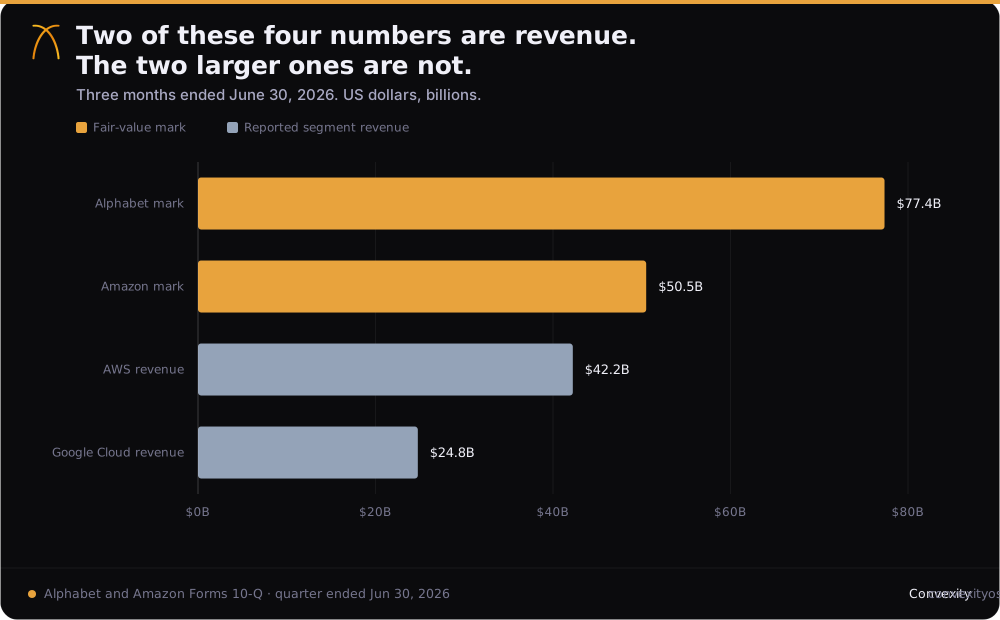
Google Cloud, the business that actually sells AI compute to customers, did $24,768 million of revenue in the quarter, against $13,624 million a year earlier. That is 82% growth, and it is a spectacular growth rate on a real business. It is also not quite like for like: Alphabet notes that "in the second quarter of 2026, we began recognizing revenue from the sale of TPU systems," a category that did not exist in the base period. Even so, the unrealized gain on the unnamed private company was 3.1 times the whole segment's revenue. Both ratios are our arithmetic, on Alphabet's reported figures.
Amazon marked up Anthropic by more than AWS sold
Amazon's version of this is more legible, because Amazon names the issuer.
Amazon began investing in Anthropic in the third quarter of 2023 and put $8.0 billion into convertible notes through the end of 2025. In the June 2026 quarter it added $5.0 billion of Series G nonvoting preferred and another $5.0 billion of Series H. Total cash into Anthropic, on the filing's own figures: $18.0 billion.
Here is what it is carried at.
| Amazon's Anthropic position | Dec 31, 2025 | Jun 30, 2026 |
|---|---|---|
| Nonvoting preferred stock, carrying value | $14.8B | $92.5B |
| Convertible notes, estimated fair value | $45.8B | $97.9B |
| Unrealized gain on notes, in AOCI | $39.5B | $92.0B |
Preferred plus notes is $190.4 billion at June 30, on $18.0 billion of cash. Our arithmetic, on Amazon's reported figures.
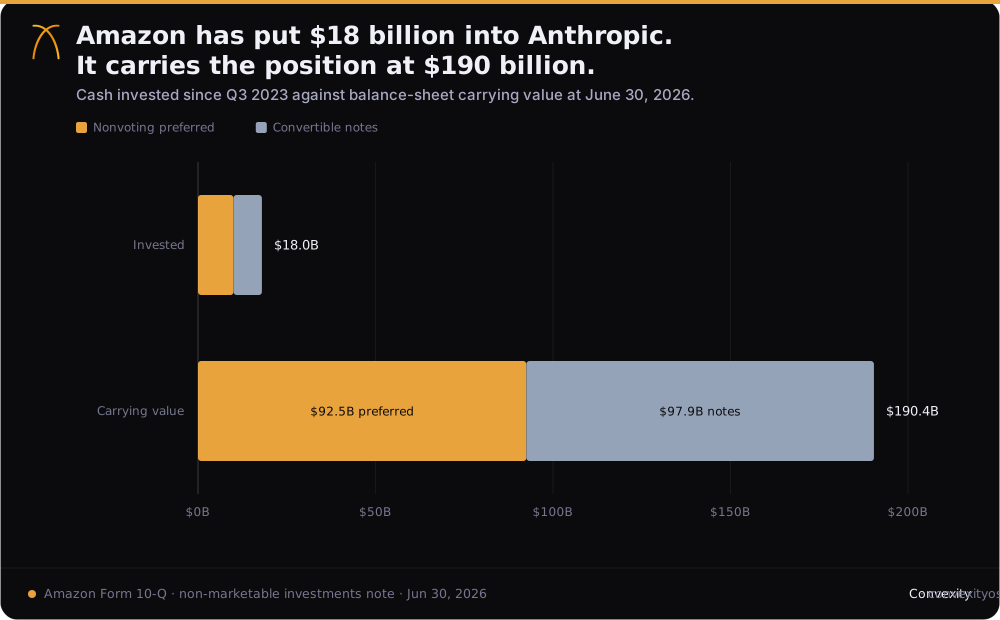
The income-statement piece is the preferred. Amazon "recorded upward adjustments of approximately $50.5 billion in Q2 2026 and $62.8 billion for the six months ended June 30, 2026 to our nonvoting preferred stock in 'Other income (expense), net' to reflect observable changes in price related to Anthropic's fundings."
Amazon's other income for the quarter was $53,415 million, against $1,117 million a year earlier. Operating income was $27,461 million. So the Anthropic markup alone was 1.8 times everything Amazon's entire operating business earned in the quarter, and 1.2 times AWS's total revenue of $42,232 million. Our arithmetic, on Amazon's reported figures.
The notes are the part that does not show up in earnings at all. They are classified as available-for-sale, so their $92.0 billion of unrealized gain sits in accumulated other comprehensive income rather than net income. The economic markup on Anthropic this half is therefore substantially larger than the $62.8 billion that reached the income statement. Which of the two numbers is the real one depends entirely on what happens at a liquidity event, and the filing says what happens: on an IPO, the notes convert to nonvoting common and the preferred converts to nonvoting common, subject to Amazon's ownership cap, after which Amazon expects a customary lock-up.
Microsoft built a number that removes OpenAI
Microsoft has the longest position in this war and the most conservative presentation of it, and the presentation is the interesting part.
Microsoft accounts for OpenAI under the equity method, using hypothetical liquidation at book value, because its liquidation rights and priorities differ from its underlying ownership interest. That means OpenAI's results flow into Microsoft's income statement every period, in both directions. In fiscal 2025 that was a $4,763 million net loss. In fiscal 2026 it was a $6,530 million net gain.
The swing is $11.3 billion between two consecutive years, on a line item Microsoft does not control and cannot forecast. So Microsoft did something about it.
| Microsoft, fiscal year ended June 30 | 2025 | 2026 | Change |
|---|---|---|---|
| Other income (expense), net | $(4,901)M | $10,697M | 318% |
| Net (gains) losses from investments in OpenAI | $4,763M | $(6,530)M | (237)% |
| Adjusted other income (expense), net (non-GAAP) | $(138)M | $4,167M | 3,120% |
| Net income | $101,832M | $133,749M | 31% |
| Adjusted net income (non-GAAP) | $105,452M | $128,786M | 22% |
| Diluted EPS | $13.64 | $17.95 | 32% |
| Adjusted diluted EPS (non-GAAP) | $14.13 | $17.28 | 22% |
Read the last four rows again. On a GAAP basis Microsoft's net income grew 31% and EPS grew 32%. On the adjusted basis Microsoft asks you to use, both grew 22%. The gap, nine points on net income and ten on EPS, is entirely OpenAI, and Microsoft is the one telling you to take it out.
Microsoft describes the measures as excluding "net (gains) losses from investments in OpenAI" and says they "aid investors by providing additional insight into our financial performance and help clarify trends affecting our business." That is a fair characterization. It is also an unusual thing for a company to do about its own flagship strategic partnership, and it points in the same direction as everything else here: the number is large, it is non-cash, it reverses, and the company that reports it does not think it tells you much about the business.
There is a further detail worth pulling out. Microsoft says the fiscal 2026 gain "primarily relate[s] to the dilution gain from the OpenAI Recapitalization." A dilution gain arises when an investee issues new equity at a price above the investor's carrying value per unit, so the investor's smaller percentage is worth more than its larger percentage was. It is a real accounting gain. It is also, precisely, a gain from owning less of something that was repriced upward by somebody else's money. It is not OpenAI making a profit. In this fiscal year, the largest single component of Microsoft's OpenAI gain was created by an OpenAI funding round.
The only visible loop is an accounting accident
Now the disclosure that no other filing here contains.
Because OpenAI is an equity method investee, it is a related party under ASC 850, and Microsoft has to disclose what it transacts with it. So the 10-K says:
For fiscal year 2026, we recorded revenue from commercial arrangements with OpenAI, inclusive of revenue-sharing payments, of $24.1 billion, and accounts receivable from OpenAI as of June 30, 2026 was $6.0 billion.
Twenty-four point one billion dollars of Microsoft revenue, in one fiscal year, from OpenAI. For scale, OpenAI's own reported run rate was about $20 billion at the end of December 2025 and about $40 billion by August 2026, so over the twelve months this figure covers, Microsoft recognized revenue from OpenAI on the order of OpenAI's entire revenue over the same period.
Be careful with that sentence, because it is easy to overread and we do not want to. The $24.1 billion is "inclusive of revenue-sharing payments," which means an unstated share of it is Microsoft's contractual cut of OpenAI's revenue rather than compute Microsoft sold. The filing does not break the two apart. And a run rate at a point in time is not recognized revenue over a period, so the two figures are not arithmetically comparable and we are not subtracting one from the other. The honest claim is narrower and still striking: the revenue lines of these two companies overlap heavily, in both directions, and the only reason anyone outside them can see it at all is that one of the two happens to use the equity method.
That last part is the accident. Search Amazon's 10-Q for "related party" and you get nothing. Search Alphabet's and you get nothing. Neither has to disclose, because neither holds its position in a way that triggers ASC 850: Amazon's Anthropic stake is nonvoting preferred and convertible notes explicitly "not accounted for under the equity-method," and Alphabet's is a non-marketable security under the measurement alternative. Both companies sell enormous amounts of compute to the labs they own pieces of. Neither is required to tell you how much, and neither does.
So the visibility of the circle is not a function of how big the circle is. It is a function of which accounting model the investor happened to land in. Microsoft's loop is disclosed to the dollar. Amazon's and Alphabet's are not disclosed at all, and on the evidence of the commitments below, they are not smaller.
Both sides bank at the same address
The framing of a revenue war implies two combatants and a winner. Look at where the money is committed and that framing falls apart.
Amazon is on both sides. In the first quarter of 2026 it entered a commercial arrangement with OpenAI for AWS cloud services, invested $15.0 billion in OpenAI Series C preferred, and signed an equity commitment letter for a further $35.0 billion. It invested $13.7 billion of that commitment in the second quarter and, after the quarter closed, the remaining $21.3 billion. That is $50.0 billion into OpenAI. Our arithmetic, on Amazon's reported figures. At the same time it put $10.0 billion more into Anthropic and carries that position at $190.4 billion.
The compute commitments are larger than the investments. In the first quarter of 2026, AWS and OpenAI "announced an expansion of the existing $38.0 billion multi-year commitment and commercial arrangement with OpenAI by $100.0 billion over 8.0 years." In the second quarter, AWS and Anthropic "announced an expansion of the strategic collaboration and existing multi-year commitment by more than $100.0 billion over 10.0 years." Both expansions, in Amazon's own words, "include contractual obligations related to the performance of AWS chips."
Whichever lab wins, Amazon has already booked the customer.
The financing structure is where it gets specific. Amazon made available to Anthropic "an aggregate facility not to exceed $20.0 billion that will expire 30 months after an Anthropic liquidity event, including an initial public offering." The mechanism is the part to read twice:
At inception, there is no amount available to be drawn against and as we reach certain delivery milestones of compute capacity under the amended commercial arrangement, amounts under this facility are made available for Anthropic to draw upon at its discretion.
Amazon's credit to Anthropic unlocks as Amazon delivers compute to Anthropic. The more AWS sells, the more AWS will lend. Draws come as new convertible notes, or as common stock after an IPO, issued to Amazon in exchange for cash. In the June quarter Amazon exercised its option under this arrangement to put $5.0 billion into Series H, which reduced the facility to $15.0 billion.
Alphabet discloses something structurally similar without naming anyone: "a certain strategic investment includes forward funding commitments that are accounted for as equity derivatives, as they include rights to participate in future capital funding, the exercise of which is contingent upon the achievement of specified operational and financial milestones." Alphabet does not say which investment, and we are not going to guess.
This is the same shape Nvidia disclosed on August 26, when its 10-Q showed $108.5 billion of guarantees, $25 billion committed to buying equity in its own customers and $36 billion committed to renting capacity back from them. We wrote that up the same evening. The difference is that Nvidia's version is on the chip layer and is now widely discussed, while the cloud layer's version is spread across three filings and has not been.
What the marks are made of
There is one more loop, and it is the tightest.
Ask what makes a mark move. Under the measurement alternative and under Amazon's Level 3 policy, a private position gets remeasured when there is an observable transaction in an identical or similar instrument from the same issuer. Amazon says so explicitly: the upward adjustments reflect "observable changes in price related to Anthropic's fundings."
So the marks are made of funding rounds.
Now ask who is in the funding rounds. In the same quarter it recorded $50.5 billion of upward adjustments on Anthropic, Amazon bought $5.0 billion of Anthropic Series G and $5.0 billion of Series H. Amazon does not say which transactions provided the observable price that drove the remeasurement, and it may well not have been its own. But the general structure is not in dispute: the price that revalues a hyperscaler's existing stake is set in rounds that hyperscalers participate in, using instruments the same hyperscalers help design, in companies whose largest cost is compute bought from those same hyperscalers.
Both Amazon and Alphabet disclose the valuation inputs, and they are honest about how soft they are. Amazon lists "estimates of expected time to and type of liquidity events and anticipated securities offerings, and discounts for lack of marketability." Alphabet lists "option pricing models, market comparable approach, and common stock equivalent method," with unobservable inputs including "volatility, expected time to exit, risk-free rate." Alphabet also notes that $87.9 billion of its $124.3 billion non-marketable book was remeasured during the June quarter alone.
These are the correct methods and both companies apply them properly. The point is not that the accounting is wrong. It is that a $127.9 billion combined quarterly gain rests on an estimate of what a private company would fetch, derived from private rounds, discounted by judgment, in a market where the buyers, the lenders, the landlords and the marks are the same four companies.
The run-rate numbers cannot be checked because the companies are private. The marks can be checked, and checking them tells you they are estimates of the value of the companies whose revenue cannot be checked.
What would prove this wrong
The strongest counter to everything above is short: the demand is real, the compute is genuinely scarce, and these positions are up because the businesses underneath them are worth vastly more than they were, which is what an early investment in a fast-growing company is supposed to do. Alphabet's non-marketable book went from $64.1 billion to $124.3 billion because someone paid a higher price, not because someone made one up. That is a good argument and it may simply be correct.
Here is what would settle it.
Anthropic's S-1 goes public with audited financials. This is the big one and it may land within weeks. A public S-1 would replace every press-reported run rate with audited revenue under a stated recognition policy, disclose the compute commitments and related-party arrangements from the lab's side, and show whether Amazon's $190.4 billion carrying value is conservative or generous. If audited revenue lands near $65 billion annualized with the growth rate intact, the marks look cheap and this piece looks overcautious.
A funding round prices flat or down. The marks move on observable transactions in both directions. One down round at either lab reverses a large piece of $127.9 billion, in one quarter, on companies that have never reported a decline.
Amazon and Alphabet start disclosing lab revenue. If either begins breaking out revenue from the labs it invests in, voluntarily or because the SEC asks, the circularity becomes measurable rather than inferable, and the argument that it is invisible dies immediately.
Microsoft drops the adjusted measure. If the OpenAI line stops swinging enough to be worth excluding, that is evidence the position has stabilized into something ordinary. Microsoft keeping it is evidence the opposite.
Operating cash flow tracks the marks. None of the gains here are cash. If AWS and Google Cloud revenue from the labs converts to collected cash at normal terms while the marks keep rising, the marks are lagging reality. Watch receivables. Microsoft is already carrying $6.0 billion due from OpenAI at year end, on $24.1 billion of revenue, which is about 91 days. Our arithmetic, on Microsoft's reported figures.
And one thing that would not prove it wrong, because it is already priced in: another record run-rate headline. The next one is coming, it will be bigger, and it will still be a press report about a company that has published no financial statements.
Not investment advice. This is analysis of public filings by Alphabet, Amazon and Microsoft, plus press reports about two private companies that publish nothing. It is not a recommendation to buy or sell anything, and it is not a claim that any company here has done anything improper. Every disclosure cited was made voluntarily, on time, in the required form, and in several cases in more detail than required. Anthropic and OpenAI are under no obligation to publish financials and are not doing anything wrong by declining to. The falsifiers above are listed because we expect some of them to happen, and the first one may happen before the end of the year.
Primary sources
- 10-QAlphabet Inc., quarterly report for the quarter ended June 30, 2026Note 3 (other income), Note 7 (non-marketable securities, the carrying-value table and the unnamed private company footnote), revenue backlog, and the Google Cloud segment lineJul 23, 2026
- 10-KMicrosoft Corporation, annual report for the fiscal year ended June 30, 2026The non-GAAP reconciliation removing OpenAI gains and losses, the ASC 850 related-party disclosure of $24.1B of revenue and $6.0B of receivables, and the HLBV equity method policyJul 29, 2026
- 10-QAmazon.com, Inc., quarterly report for the quarter ended June 30, 2026The non-marketable investments note covering the Anthropic and OpenAI positions, the $20.0B milestone-linked facility, and the AWS commitment expansionsJul 31, 2026
- AnnouncementAnthropic confidentially submits draft S-1 to the SECThe only statement either lab has published about its own registration; discloses no financial figuresJun 1, 2026
- Press reportAnthropic's annualized revenue surges to $65BReporting Bloomberg. Source of both the $65B Anthropic and $40B OpenAI run-rate figures used here. Anthropic did not commentAug 17, 2026
- DatasetAnthropic and OpenAI reported revenue run ratesEpoch AI's methodology note, quoted here for its statement that the figures come primarily from media reportsRetrieved 2026-08-27