









Disclosure. Not investment advice, and nothing here is a recommendation to buy, sell or hold any security. A member of the Convexity team holds the SPDR S&P 500 ETF (SPY), which holds CVS Health, UnitedHealth, Cigna, Elevance Health, Humana and Centene; no other position. Figures are from CVS Health's November 4 separation announcement and investor presentation, its third-quarter earnings release, guidance summary and Form 10-Q, and its Forms 10-K for 2007, 2018, 2023 and 2025. Call quotations appear in both of two independently produced transcripts of the November 4 call. State law is quoted from Arkansas's enacted act and Tennessee's bill as introduced; Tennessee's enacted text is described from a published policy explainer, because we could not read the chapter itself. Share prices are closing prices: Nasdaq's official closes for November 2 and 3, and CNBC's regular-session closes for November 4, because Nasdaq had not yet posted that day's closes when we wrote this. The closing note lists what is our arithmetic. This note was drafted with Claude.
In its annual report for 2018, the year it bought Aetna, CVS Health explained the purchase in one sentence. It was combining Aetna's insurance business "with CVS Health's more than 9,900 retail locations, approximately 1,100 walk-in medical clinics and integrated pharmacy capabilities with the goal of becoming the new, trusted front door to health care."
On Wednesday morning, CVS said it would separate the front door from the house. By the first half of 2028 it intends to become two public companies. One, keeping the name CVS Health, holds Aetna, the Caremark pharmacy benefit manager, the specialty pharmacy, and the Oak Street and Signify clinics and home-visit businesses. The other, CVS Pharmacy, takes about 9,000 drugstores, the mail-order pharmacy, MinuteClinic and a consumer technology business called Health100. Shareholders will own both.
Early coverage read this as the undoing of Aetna. CNBC wrote that the move "would reverse the company's massive $78 billion acquisition of its insurer, Aetna" (retrieved 2026-11-04). That is the question we set out to test: does the split undo the vertical integration CVS paid for? Mostly, it does not. The four big purchases that made CVS an insurer, a benefit manager and a primary care provider, Caremark, Aetna, Oak Street and Signify, stay together in one company. What leaves is the store chain. So the deal the split actually unwinds is not the Aetna merger of 2018 but the Caremark merger of 2007, which put a drugstore chain and a benefit manager under one roof, and which two states have since moved to outlaw.
The stock fell 12.5% on the day, while the health care sector fund rose 3.1% and four of the five large insurers gained; the fifth, Humana, ended 0.1% lower. That gap is the market's first attempt at a question the announcement left open: what the stores were worth to the rest of the company, and what the rest will pay to keep using them.
CVS Health Investor Update and Forms 10-K for 2007, 2018 and 2023; Nasdaq's November 3 and CNBC's November 4 closing prices, 2026. The sum and the price changes are ours.
Two companies, and how big each one is
CVS gave each company one size in its investor presentation: estimated 2026 revenue of about $320 billion for CVS Health and about $145 billion for CVS Pharmacy. Hold those against the consolidated guide CVS raised the same morning, revenue of at least $420 billion this year, and the two halves add to about $465 billion, roughly $45 billion more than the whole (our arithmetic).
The difference is not a mistake. Today, when a Caremark member fills a prescription at a CVS store, the sale is booked twice, once by the store segment and once by the benefit manager, and the duplicate is eliminated when CVS adds up its segments. The third-quarter 10-Q shows how much of that there is. The store segment, Pharmacy & Consumer Wellness, booked $11.2 billion of its quarterly revenue from other CVS segments, and $32.2 billion over nine months. At the quarter's pace that is about $45 billion a year (our arithmetic; the nine-month pace is about $43 billion). CVS did not itemize the gap between its two estimates, so the match is our reading. But it says something concrete about what the separation changes: about $45 billion a year of business that today never leaves the building becomes trade between two public companies, governed by contracts.
Profit is harder to divide, because CVS has not divided it. The presentation gives each company a revenue figure, a dividend promise and a "solid investment grade" rating, but no operating income, no debt split and no estimate of separation costs. The closest thing in the filings is CVS's segment guidance. Health Care Benefits, which is Aetna, is guided to adjusted operating income of at least $5.40 billion this year. Health Services, which holds Caremark, the specialty pharmacy, Oak Street and Signify, is guided to at least $7.25 billion. Pharmacy & Consumer Wellness, the stores, is guided to at least $6.50 billion.
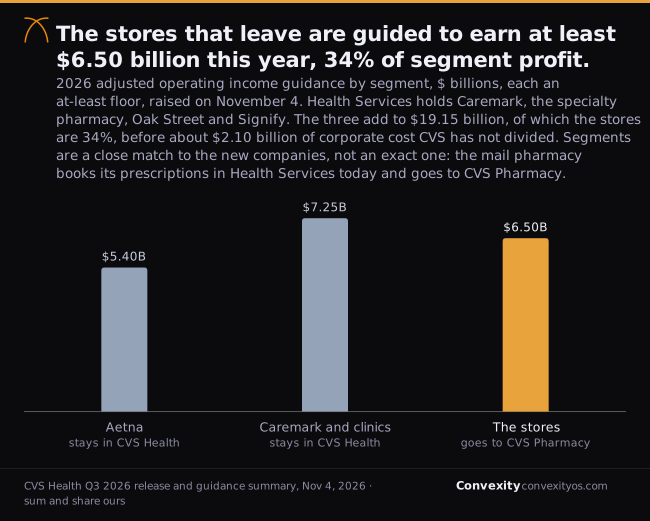
The three floors add to $19.15 billion. The stores are 34% of that, a little more than their 31% share of the two companies' revenue estimates. The consolidated floor is $17.05 billion, so roughly $2.10 billion of corporate cost sits above the segments and has not yet been assigned to either company (our arithmetic on floors, so approximate).
Two cautions keep this from being a clean map. First, the mail pharmacy does not sit where the split puts it. CVS's 10-K says Health Services "manages prescription drug distribution directly through the Company's specialty and mail order pharmacies," while the store segment "provides pharmacy fulfillment services to support the Health Services segment's specialty and mail order pharmacy offerings," for a fee. Mail order goes to CVS Pharmacy; the specialty pharmacy stays with CVS Health. The segment figures will be recast before anyone can see either company's true earnings. Second, the stores' guidance includes a pharmacy business that has been growing. The segment's adjusted operating income rose 10.6% in the third quarter, and CVS expects it to grow again in 2027, its third straight year of growth.
On debt, CVS ended September with $60.7 billion of borrowings, long-term and current, against $11.7 billion of cash. The Aetna deal alone was financed with about $45.0 billion of new debt in 2018. How the borrowing is divided will decide whether "solid investment grade" means the same thing for both companies, and the Form 10 that must become effective before the separation is where that split will first appear.
The deals CVS paid for stay together
Line up what CVS bought on its way here, and the pattern is plain.
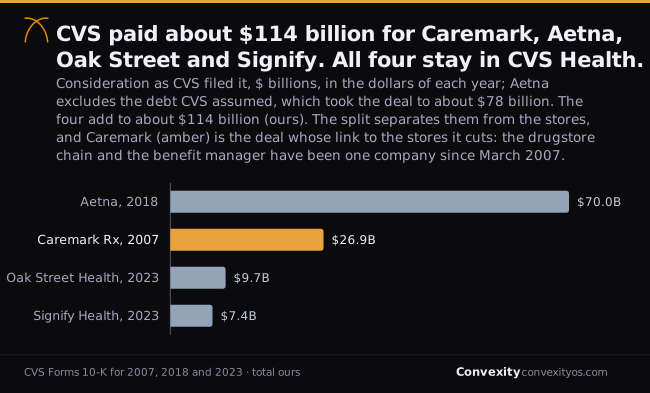
Caremark, in 2007, cost about $26.9 billion in total consideration, mostly CVS stock. Aetna, in 2018, was valued at about $70 billion, or about $78 billion including the debt CVS assumed. Signify Health and Oak Street Health, both in 2023, cost $7.4 billion and $9.7 billion. Every one of them stays in CVS Health. If the question is whether CVS is giving up on owning an insurer, a benefit manager and the doctors who see the insurer's patients, the answer in the filings is no. David Joyner, CVS's chairman and chief executive, said on the call that the structure lets CVS Health "maintain and expand integration where it matters."
That includes the purchase that has gone worst. Of the $17.0 billion CVS paid for Signify and Oak Street, $13.1 billion was recorded as goodwill. In the third quarter of 2025, CVS wrote off $5.7 billion of goodwill in the Health Care Delivery unit, which holds Oak Street, after opening fewer clinics than planned, closing some, and seeing peer valuations fall. At the year-end test, the unit's fair value exceeded its book value by only about 3%, the thinnest margin of any CVS reporting unit. That risk stays with CVS Health.
The goodwill tells the same story at the scale of the whole company. Of the $85.5 billion of goodwill on CVS's balance sheet at the end of 2025, the Aetna and Health Services segments carried 87.6% and the stores 12.4%. CVS Pharmacy leaves with about an eighth of the goodwill. The store segment's own troubled purchase, the long-term care pharmacy Omnicare, bought in 2015, is already gone: CVS deconsolidated it in September 2025, when the Omnicare subsidiaries filed for bankruptcy, and in the third quarter of 2026 recorded a further $193 million charge for a guarantee related to them.
What the split does undo: the stores' link to the benefit manager
What the split ends is the arrangement that began on March 22, 2007, when Caremark merged into a subsidiary of CVS Corporation and the company renamed itself CVS Caremark. An analyst on Wednesday's call, Lisa Gill of JPMorgan, marked the anniversary: "on November 1, 2006, 20 years ago, CVS and Caremark came together." That was the day the merger agreement was signed.
Joyner answered that the integration was never as deep as the organization chart suggested. Retail, he said, has for most of the last two decades "operated behind a firewall," so CVS has "always had to negotiate at arm's length." The products the two sides built together, he said, would be "preserved in commercial agreements" between the two companies.
That is the heart of the bet, and it is a bet in both directions. If the stores and the benefit manager already deal at arm's length, little is lost by making them separate companies, and Brian Newman, the chief financial officer, said the "strategic value created by taking this action is going to far outweigh" the lost synergies. Both executives called the one-time costs manageable, and Joyner said they were already contemplated in the guidance. Neither gave a number.
But the 2018 rationale was not arm's length. It was the opposite: the stores and clinics as the place an Aetna member would walk in, get care and fill a prescription. That plan is what CVS is now handing to contracts. Joyner named the new bridge: Health100, the consumer technology business going with CVS Pharmacy, "will be the connective tissue" between the two companies. He also explained why the mail pharmacy goes with the stores: CVS has reorganized it around 90-day supplies and how consumers want to get their medication, so it belongs with retail rather than with the benefit manager.
So the honest answer to our original question is split, like the company. The integration CVS paid for since 2018, insurer to benefit manager to primary care practice, survives intact. The integration it started with in 2007, benefit manager to drugstore, ends. And the reason the Aetna deal gave for itself, the stores as the front door, is the part that leaves.
Why now: what CVS said, and the laws it did not name
CVS's stated reasons are focus, tailored capital allocation, agility and simplicity. Joyner framed the timing as earned: CVS is "not doing anything out of a distressed decision," he said, and two years ago, when he became chief executive, CVS could not have made this choice "because we were struggling on our Medicare business." He said the company acts "from a position of strength," and later in the call that it was not acting because of "any issue that may be on the horizon" in 2028.
One of the four benefits in CVS's own presentation is more specific than the others. Each company, it says, will be able to "more effectively adapt to regulatory and other external dynamics." The filings say what those dynamics are. CVS's 2025 10-K lists, among its risks, "legislation prohibiting state licensure of pharmacies affiliated with a PBM." In the 10-Q filed Wednesday, the wording has hardened: "some states have recently enacted or are considering legislation related to prohibiting pharmacy licensure for pharmacies affiliated with a PBM," which "could limit the Company's ability to provide both pharmacy and PBM services within the same state."
Two such laws are on the books. Arkansas's Act 624, approved in April 2025, says a pharmacy benefit manager "shall not acquire direct or indirect interest in, or otherwise hold, directly or indirectly," a permit for the retail sale of drugs in the state. Its definitions reach both ways: a "permit" includes one for a mail-order pharmacy, and a "pharmacy benefits manager" includes any entity with "a direct or indirect ownership interest" in one, which is to say a parent company like CVS Health. The act also lets the state board issue limited-use permits for "rare, orphan, or limited distribution drugs."
Read that list against the split. Retail stores and mail order, the two permit types Arkansas names, go to CVS Pharmacy. The specialty pharmacy, the business closest to the carve-out for rare and limited-distribution drugs, stays with CVS Health. We do not know that CVS designed the split around Arkansas's statute, and CVS did not name it. But the boundary it drew runs along the same line.
Tennessee's law, signed in May 2026, goes further. As introduced, the bill barred a benefit manager from owning or controlling a pharmacy "whether through ownership, contract, or any other arrangement," including supply and formulary agreements, from January 1, 2027. We could not read the enacted chapter; the state's own file returned only a header page. A policy explainer from the National Organization for Rare Disorders describes the enacted law differently: it bars any one company from owning or controlling a pharmacy, a health insurer and a benefit manager at the same time, above a 5% interest, starting July 1, 2028, with a deadline to sell by December 31, 2028, and it defines control to include contracts and exclusive agreements (prepared May 29, 2026; retrieved 2026-11-04).
If that description is right, two things follow, and they cut in opposite directions. The timing lines up closely: CVS expects to finish the separation in the first half of 2028, just before the reported start date. But CVS Health after the split will still own a pharmacy, the specialty business, alongside an insurer and a benefit manager, so the split by itself may not take CVS Health outside the Tennessee law, depending on how its exemptions for orphan and limited-distribution drugs apply. And the commercial agreements Joyner described are the kind of contract the law's definition of control reaches. CNBC reports that both states' laws have been challenged in court by CVS and other companies (retrieved 2026-11-04). We have not read the court records, and we do not establish here whether either law is in force today.
Federal law is a further step away. Senate Bill 4509, the Patients Before Monopolies Act, introduced on May 13, 2026 by Senators Warren, Hawley, Fetterman and Marshall, would make it unlawful for one company to own a pharmacy and also own an insurer or a benefit manager, and would require divestment within a year. Its definition of pharmacy includes mail-order and specialty pharmacies. As introduced, it would reach CVS Health after the split, because the specialty pharmacy stays. The bill has sponsors from both parties and sits in the Judiciary Committee. The announcement came the morning after the midterm elections; what the next Congress can pass, and what it needs the president's signature for, is the subject of our note on the election and markets. How federal decisions already reach insurers through marketplace subsidies is traced in our note on 2027 marketplace premiums.
The quarter underneath the announcement
The split arrived with a quarter strong enough that CVS raised its full-year guidance. Revenue rose 5.4% to $108.4 billion. Adjusted operating income rose 21.2% to $4.19 billion, and adjusted earnings were $2.09 a share against $1.60 a year earlier. On a reported basis CVS earned $1.68 a share, against a loss of $3.13 in the year-earlier quarter, which carried the $5.7 billion Oak Street impairment.
Aetna did most of the work. Its adjusted operating income was $912 million, up from $314 million, and its medical benefit ratio, the share of premiums paid out in care, fell to 91.3% from 92.8%. Over nine months, Aetna's adjusted operating income is up $2.76 billion to $6.38 billion. The stores earned $1.64 billion in the quarter, up 10.6%. Health Services, the benefit manager and the clinics, rose 2.7% to $2.11 billion.
CVS raised its 2026 guidance across the board: adjusted earnings of at least $8.20 a share, from $7.90 to $8.10; adjusted operating income of at least $17.05 billion; and cash flow from operations of at least $15.5 billion, up from at least $11.5 billion. It will resume buying back stock in the fourth quarter.
The 2027 outlook is where the caution sits. CVS expects adjusted earnings of at least $8.65 a share, which Newman described as "approximately 13% growth off an adjusted 2026 baseline." Against this year's floor of $8.20, the 2027 floor is 5.5% higher (our arithmetic); CVS did not, in what we read, give the adjusted baseline itself. Newman said the earlier floor for next year had been $8.44 and that this year's 20-cent raise flows through to it, with share buybacks assumed only to offset dilution.
And the benefit manager steps back. CVS expects Health Services to earn at least $7 billion in 2027, down from at least $7.25 billion this year, citing a decline in its 340B drug-discount business, "a less robust selling season and health plan client membership attrition." Newman said CVS was confident 2027 "will reflect trough earnings for the segment." Prem Shah, CVS's group president, who will run CVS Pharmacy, noted that the 2026 selling season had been strong, with "approximately $6 billion of gross new wins."
How the market read it
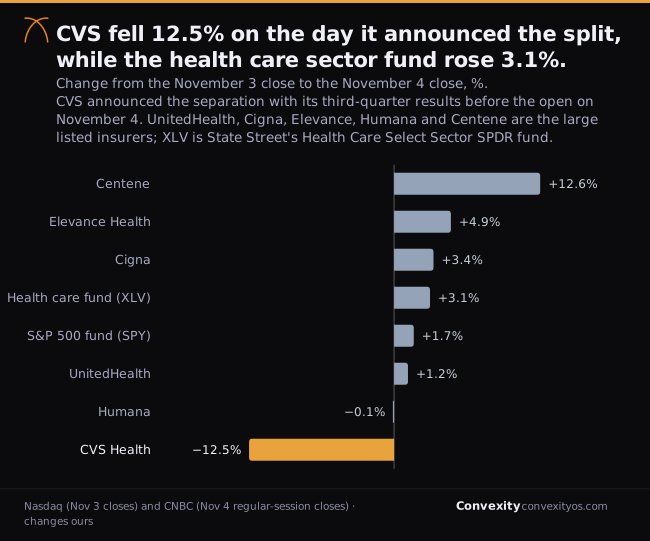
CVS closed on November 3 at $91.41, a market value of about $117.0 billion on the 1.28 billion shares outstanding on October 28 (our arithmetic). It closed on November 4 down 12.5%, about $14.6 billion lower. On the same day, four of the five large insurers rose, Centene by 12.6%; Humana, the fifth, ended down 0.1%, close to flat. The broad market rose too. Whatever moved CVS was specific to CVS.
There are three readings of the drop, and the evidence so far does not choose between them.
The first is the 2027 guide. Health Services is the largest of the three segments in this year's guidance, and CVS guided it down for next year while raising everything else. A segment calling its own coming year a trough is not what a market wants to hear on the day it learns that segment will lose its in-house store network.
The second is the split itself. Investors were told what each company sells and how big it is, but not what either one earns after paying for the services it used to get from the other, nor what the separation costs. The $45 billion a year of internal trade becomes contracts negotiated between two companies with different shareholders' interests at heart, and the arm's-length history Joyner described is a reason to think those contracts will look like today's, not a promise.
The third is that some of the news was already priced. CNBC reports that the Financial Times first reported the plan on Tuesday, November 3; we could not read the FT's story. CVS closed up 3.3% that day, but without knowing when the report appeared we cannot attribute that move to it.
What would prove this wrong
Our central claim is that the split keeps the integration CVS bought since 2018 and unwinds the one it started with in 2007. It would be wrong if the Form 10 moves more than the presentation said: for example, if the specialty pharmacy or the Oak Street clinics end up in CVS Pharmacy, or if CVS Health later sells Aetna or the clinics. It would also be wrong, in substance if not in form, if the commercial agreements between the two companies are exclusive and long enough that the stores and the benefit manager keep operating as one; then the split would change ownership without changing how prescriptions flow.
Our reading of the regulatory fit would be wrong if the enacted Tennessee chapter differs from the explainer we relied on, if Arkansas's limited-use permits do not cover the drugs CVS Specialty dispenses there, or if CVS Health's specialty pharmacy holds no permits in either state. The first can be settled by reading the chapter; the last two by the Form 10's disclosure of licenses.
Our reading of the market would be wrong if the shares recover once CVS publishes standalone earnings and separation costs for each company, which would suggest the drop was about uncertainty rather than value. If they do not recover after the 2027 guide is confirmed on the fourth-quarter call, the trough in Health Services, rather than the split, carries more of the weight.
And the "$45 billion of internal trade" is our reading of two rounded estimates. If the Form 10 shows a different figure for business between the two companies, that sentence should be revised.
What to watch
The Form 10, which will carry each company's historical financial statements, the debt split and the commercial agreements, is the document that turns this announcement into numbers. The fourth-quarter call early next year should confirm or revise the 2027 floor. The court challenges to the Arkansas and Tennessee laws will decide whether July 1, 2028 matters. And Senate Bill 4509, which would reach CVS Health even after the split, is the federal version of the question CVS has just answered for its stores.
The filings and documents this is built on
- 8-KCVS Health, announcement of the intended separation into two companies (Exhibit 99.1)What each company keeps, leadership, timing, conditions, advisers and the financial policy for eachNov 4, 2026
- PresentationCVS Health, Investor Update presentationEstimated 2026 revenue of about $320 billion and $145 billion, members, stores, clinics, and the four stated benefits of the separationNov 4, 2026
- 8-KCVS Health, third quarter 2026 earnings release (Exhibit 99.1)Revenue, adjusted operating income by segment, EPS, the medical benefit ratio, the Omnicare guarantee charge and the raised 2026 guidanceNov 4, 2026
- GuidanceCVS Health, Q3 2026 consolidated guidance summaryThe 2026 floors by segment and the guidance they replacedNov 4, 2026
- 10-QCVS Health, quarterly report for the period ended September 30, 2026Intersegment revenue by segment, debt, cash, goodwill, the share count on the cover, the separation as a subsequent event, and the risk factor on state pharmacy licensure lawsNov 4, 2026
- CallCVS Health Q3 2026 earnings call, full transcript (The Singju Post)Independently produced transcript; every call quotation here also appears in the Investing.com transcriptNov 4, 2026
- CallCVS Health Q3 2026 earnings call transcript (Investing.com)Second independent transcript, read on November 4; speaker titles are from the investor relations introduction it recordsNov 4, 2026
- 10-KCVS Health, annual report for 2025Goodwill by segment, the Health Care Delivery impairment and its 3% margin, the mail and specialty pharmacy arrangement between segments, Omnicare, and the state licensure riskFeb 2026
- 10-KCVS Health, annual report for 2023Consideration and goodwill for Signify Health and Oak Street HealthFeb 2024
- 10-KCVS Health, annual report for 2018The Aetna acquisition: terms, its stated purpose, its value with and without assumed debt, and the $45.0 billion of new debtFeb 2019
- 10-KCVS Caremark, annual report for 2007 (Exhibit 13)The Caremark merger: dates, terms and the $26.9 billion of total considerationFeb 2008
- LawArkansas Act 624 of 2025 (HB1150)The prohibition on a benefit manager holding a retail or mail-order pharmacy permit, its definitions and the limited-use permitApr 2025
- BillTennessee SB2040, the FAIR Rx Act, as introducedThe introduced text and its reach to contracts; the enacted chapter (Public Chapter 1111) was not readable to us2026
- ExplainerNORD Rare Action Network, policy explainer on Tennessee Public Chapter 1111Third-party description of the enacted law: the three-way ownership ban, the 5% threshold, July 1, 2028 start and exemptions; retrieved 2026-11-04May 29, 2026
- BillS. 4509, Patients Before Monopolies Act, as introducedSponsors, the ownership prohibition, the definition of pharmacy and the divestment periodMay 13, 2026
- HoldingsState Street, SPDR S&P 500 ETF Trust daily holdingsSPY membership of CVS Health, UnitedHealth, Cigna, Elevance Health, Humana and Centene, as of November 3, 2026Nov 3, 2026
- PricesNasdaq historical quotes for CVS, UNH, CI, ELV, HUM, CNC, XLV and SPYOfficial closing prices for November 2 and 3, 2026; every change and market value computed from them is oursNov 4, 2026
- PricesCNBC quotes for CVS, UNH, CI, ELV, HUM, CNC, XLV and SPYRegular-session closing prices for November 4, 2026, read at 4:29 p.m. ET, when Nasdaq had not yet posted the November 4 closes; the previous close on every quote matches the Nasdaq November 3 close; every change and market value computed from them is oursNov 4, 2026
- NewsCNBC, CVS to split off drugstore businessCoverage only: the reading of the split as reversing Aetna, the report that the FT first broke the plan, and the court challenges to the state laws; retrieved 2026-11-04Nov 4, 2026
Not investment advice. This note is an analysis of CVS Health's public disclosures, state and federal legislation, and market prices, published for research purposes, and not a recommendation to buy, sell or hold any security. A member of the Convexity team holds SPY, which holds CVS Health, UnitedHealth, Cigna, Elevance Health, Humana and Centene; no other position.
What here is ours rather than CVS Health's. As filed or stated by CVS: every revenue, operating income, earnings, medical benefit ratio, cash flow, debt, cash, goodwill, impairment, intersegment revenue and share count figure; the two companies' revenue estimates, members, stores and clinics; every guidance figure for 2026 and 2027; the consideration for each acquisition and Aetna's value with assumed debt; and every quotation, which is from CVS's filings or appears in both transcripts of the November 4 call. As enacted, introduced or described by others: the Arkansas act's text, the Tennessee bill as introduced, the explainer's account of the enacted Tennessee law, the Senate bill, and CNBC's reporting. Ours: the $465 billion sum of the two revenue estimates and the $45 billion difference from the consolidated guide; the $45 billion and $43 billion annual paces of the stores' intersegment revenue, and the reading that it explains the difference; the $19.15 billion sum of the segment floors, the stores' 34% share of it, the 31% revenue share and the roughly $2.10 billion of corporate cost; the $60.7 billion of total debt; the $114 billion total of the four acquisitions; the $17.0 billion and $13.1 billion for Signify and Oak Street together; the 87.6% and 12.4% shares of goodwill; the $2.76 billion rise in Aetna's nine-month operating income; the 5.5% gap between the 2026 and 2027 earnings floors; every share price change; and the market value of about $117.0 billion and the $14.6 billion one-day decline, from Nasdaq's November 3 close, CNBC's regular-session November 4 close and the 10-Q share count.