









Disclosure. Not investment advice, and nothing here is a recommendation to buy, sell or hold any security. We are not neutral on the companies in this note. A member of the Convexity team holds Meta shares directly and stands to benefit if they rise. The same team member holds the SPDR S&P 500 ETF (SPY), whose holdings include Microsoft, Alphabet's Class A and Class C shares, Amazon, Meta and Oracle; SPY's holdings file for October 28, 2026 lists no Nebius shares. A member of the Convexity team holds an economic interest in Anthropic through a special-purpose vehicle and a fund, and stands to benefit if its valuation rises. Convexity is a customer of Anthropic, and this note was drafted with Claude, Anthropic's model. That bears on this note: Alphabet, Amazon and Microsoft are investors in Anthropic and sell it computing capacity, which is part of what the spending below pays for, and Meta builds AI models that compete with Anthropic's. No other position in any company named here. Figures are from the companies' earnings releases and filings with the SEC, Nasdaq's daily prices and the Treasury's par yield curve. We read each earnings call in two independently produced transcripts and quote only wording both carry. The closing note lists what is our arithmetic.
For years, Big Tech paid for the AI buildout out of its own pocket. In the third quarter, the pocket came up short.
Microsoft, Alphabet, Meta and Amazon together paid $201.9 billion in cash for property and equipment in the three months to September 30. Their businesses brought in $175.5 billion. The $26.4 billion difference had to come from savings or from investors (our arithmetic).
We set out to test two claims. The first is that the buildout stopped fitting inside the four companies' own cash this quarter. It holds, on any of the measures we tried. The second is that the stock market's October verdict followed whoever had to raise money next. On the official closes it does not hold as we framed it: the market marked down the two companies that sold stock, not the heaviest borrower, and we say below why even that reading is thin.
Earnings releases and Forms 10-Q of Microsoft, Alphabet, Meta and Amazon for the quarter to September 30, 2026; Meta's prospectus supplements of October 26; the shares and the sum are ours.
The yardstick
Two lines from each company's cash flow statement carry this note. Operating cash flow is the money a business actually collects from its customers after paying its staff, its suppliers and its taxes. It is the closest thing a company has to a paycheck.
Capital spending, or capex, is the cash paid out for things that last: land, buildings, power equipment, and the servers and chips that go inside. For these four, most of it now goes into data centers and the machines that fill them.
When capex is smaller than operating cash, a company builds out of its paycheck and has money left for dividends and buybacks. When capex is bigger, the difference has to come from somewhere else: cash saved in earlier years, assets sold, or investors, in the form of bonds, loans or new shares.
For most of the past decade these four lived comfortably on the first side of that line. From the start of 2018 to the end of 2025, their combined capex never used less than 35% or more than 69% of their combined operating cash in any quarter (our arithmetic). Even in the heavy building of 2025, they spent about two-thirds of the paycheck.
In 2026 the line moved quickly. Capex took 86% of operating cash in the first quarter and 96% in the second. In the third it took 115% (our arithmetic).
Both halves moved, but not equally. Combined capex more than doubled from $97.3 billion a year earlier. Combined operating cash grew 10%, from $159.0 billion. The businesses are still growing. The building is growing much faster.
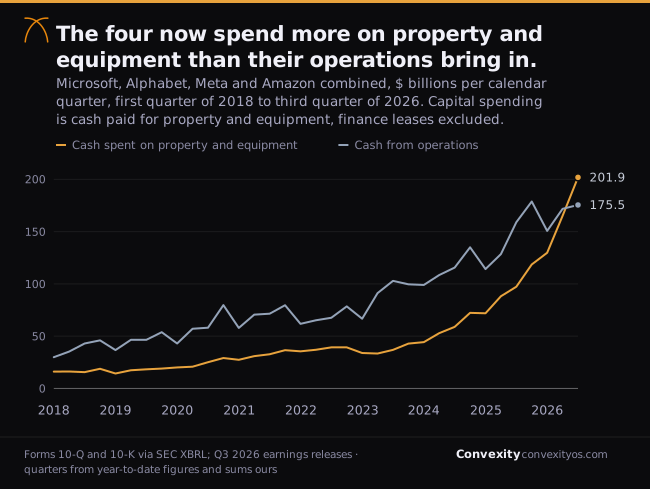
One caution about the chart's zigzag. Operating cash is seasonal, and Amazon's most of all, since it collects most heavily around the holidays. So the combined cash line jumps in every fourth quarter and sags in every first. Capex has no such rhythm. That matters for the quarter now under way, and we come back to it below.
Three of the four crossed the line
The total hides a wide spread. Amazon spent 182% of its third-quarter operating cash on property and equipment, Alphabet 121%, Meta 104% and Microsoft 68% (all our arithmetic). A year earlier only Amazon was near the line, at 99%, and Alphabet was spending about half of its cash.
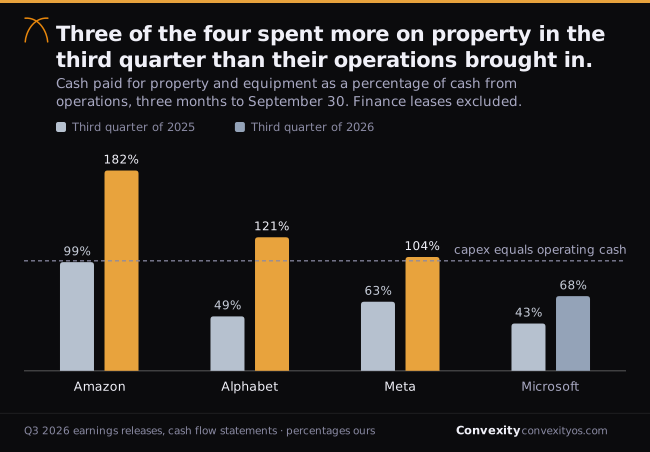
Amazon's gap is the largest by a distance. It paid $77.3 billion for property and equipment in the quarter, 2.2 times the $35.1 billion of a year earlier, while its operating cash rose 19%, to $42.4 billion. That left a gap of $34.8 billion in the quarter alone (our arithmetic).
Amazon's own measure of free cash flow nets out the money it gets back from selling equipment and from incentives, and it covers the last four quarters. On that measure Amazon paid out $42.4 billion more than it brought in, against an inflow of $14.8 billion in the four quarters to September 2025. Amazon attributes most of the change to its investment in artificial intelligence.
Alphabet's capex was $51.4 billion, 2.1 times a year earlier. Its operating cash fell 13%, to $42.3 billion, and Alphabet reported negative free cash flow of $9.1 billion. On the call, Anat Ashkenazi, the chief financial officer, said its spending on infrastructure and on a growing stock of TPU systems "will put pressure on free cash flows."
The TPU systems are new. Alphabet now sells its own AI computers to other companies, and it builds them before it is paid. "We build the inventory ahead of getting the revenue stream in," Ashkenazi said. Our note on Alphabet's quarter covers its earnings, which moved with its stake in SpaceX rather than with any of this.
Meta is the closest call. Its capex rose 80%, to $33.9 billion, and its operating cash rose 9%, to $32.8 billion. The difference was $1.2 billion (our arithmetic). Meta's own free cash flow, which also subtracts principal payments on finance leases, was negative $2.1 billion, and Susan Li, its finance chief, said so on the call.
Microsoft is the exception. Its cash capex rose 103%, to $39.4 billion, but its operating cash rose 29%, to $58.0 billion, and $18.6 billion was left over (our arithmetic). Our note on Microsoft's quarter explains what its several capex figures count. Here it is enough that on every one of them, Microsoft's spending stayed inside its operating cash.
Measured other ways, the answer holds
A ratio this close to 100% deserves a test of how it was built. We made one choice and kept it for all four. Capex here is the cash line for buying property and equipment, and it leaves out finance leases, the long leases on data centers that accounting treats almost like purchases. Our earlier ledger of the buildout's financing made the same choice.
Leaving the leases out keeps the comparison about cash, which is the question here. It also avoids counting a building on the day the lease starts, years before the rent is paid. The cost is that it understates what each company commits to. So here is what putting the leases back would do.
Adding the principal each company paid on finance leases during the quarter lifts the combined share from 115% to 117%. Company by company it becomes Amazon 183%, Alphabet 124%, Meta 106% and Microsoft 70% (our arithmetic). On Microsoft's own capex figure, $45.2 billion with leases counted at their start, it is 78%. Nothing crosses the line in either direction.
Amazon's figure falls a little if the equipment it sold and the incentives it received are netted out, as Amazon does. Its purchases become $75.9 billion, or 179% of operating cash (our arithmetic). Still nearly twice its cash.
Alphabet's quarter carries two items that will not repeat in the same form. In July it paid a $5.2 billion European antitrust fine, with interest, that it had already accrued. And it built $3.2 billion of inventory, which it tied to its TPU system sales.
Add both back to operating cash and Alphabet's share falls to 101%. It still spent $645 million more than its operations brought in (our arithmetic). Even the most generous reading leaves Alphabet over the line.
Meta's quarter cuts the other way. It took a $9.9 billion legal charge, which lowered earnings, but the charge was largely accrued rather than paid: its long-term legal accruals rose to $8.3 billion from $450 million at the end of 2025. So it barely touched operating cash this quarter. When the payments come, they will.
Amazon's quarter has a timing wrinkle worth knowing. In the first half of 2026, the equipment Amazon received but had not yet paid for rose by $20.6 billion. In the third quarter it rose by only $853 million (our arithmetic from Amazon's filings).
The bills caught up with the deliveries, which is part of why the cash line jumped. On our reading, the earlier quarters understated the pace more than this one overstates it.
Where the money is coming from
When spending runs past the paycheck, a company can draw down savings or go to investors. All three of the companies that crossed the line have gone to investors this year. Two of them have sold stock. Microsoft, which did not cross it, followed with bonds in October.
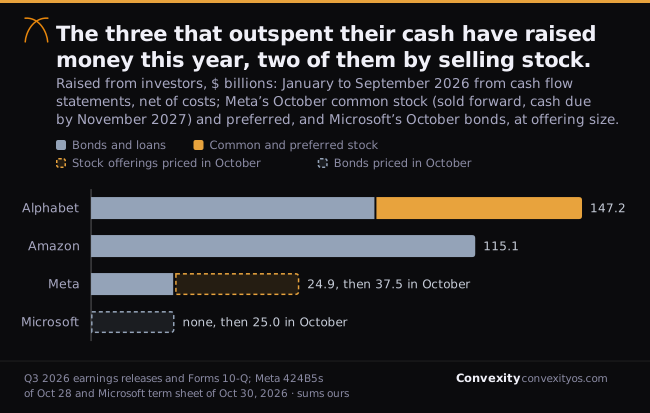
Amazon borrowed. Its cash flow statement shows $115.1 billion of long-term debt raised in the first nine months of 2026, $48.1 billion of it in the third quarter. Amazon has sold no stock.
The quarter's borrowing came in three pieces. On July 9 Amazon sold $25.0 billion of notes in eight series, one of them floating-rate, with fixed coupons from 4.600% on notes due 2029 to 6.250% on notes due 2066. On September 14 it sold £4.25 billion of sterling notes at 5.200% to 6.650%. And in June it arranged a $17.5 billion term loan that it had to draw by September 30 or lose.
Amazon's quarterly report, filed October 30, confirms it drew the term loan in September; the loan is due in September 2029. With the sterling notes at the $5.6 billion the report carries them at, the three come to $48.1 billion, the figure in the cash flow statement (our sum). Amazon also spent $24.0 billion in the quarter on acquisitions and non-marketable investments, a line that sits outside capex but draws on the same cash.
On the call, Andy Jassy, the chief executive, answered a question about the spending with one of his own. He asked whether it would be "more convenient if this type of acceleration and opportunity happened over 25 years and you could spread the capex over 25 years?"
His answer was that "that's not the world that we live in." Then: "we can fund this." He said the spending "will forever change our free cash flow."
The same quarterly report shows where some of that funding will come from. Amazon has arranged supplier financing for certain technology equipment, including a secured loan facility of up to about $80 billion that it can draw from the first quarter of 2027 through the third quarter of 2028. Each draw runs five years at a variable rate, and Amazon will pledge the equipment it buys as security. The filing names neither the lender nor the rate, and the facility did not appear in the June report.
Amazon expects about $220 billion of cash capex in 2026 and said it would spend meaningfully more in 2027. For what the spending buys inside AWS, see our note on Amazon's quarter.
Alphabet borrowed and sold stock. In nine months it raised $85.2 billion of debt, net of costs, $42.9 billion by selling common stock and $19.1 billion by selling mandatory convertible preferred stock. That is $147.2 billion, $61.9 billion of it stock (our sums). It bought back no stock at all, after $39.8 billion of buybacks in the same nine months of 2025.
The third quarter alone brought $29.0 billion of debt and $12.4 billion of common stock. The dollar notes sold in the quarter carry a weighted average coupon of 5.55% over 15 years, the Australian dollar notes 5.82% over eight. Alphabet held its 2026 capex range of $195 billion to $205 billion. On the call, Ashkenazi said: "We continue to expect our CapEx to increase significantly in 2027."
Meta went from no plans to $37.5 billion in five days. It had already borrowed $25.0 billion in May, in six series of notes. On its October 21 call it announced a new class of non-voting shares, to be handed to existing shareholders as a stock dividend and to begin trading in late January.
An analyst asked why. Li said the new class would "expand our funding tools," but that Meta did not have "any specific financing plans to announce at this time." She added that "we thought it was prudent to establish the appropriate capital structure framework to ensure that we have access to a diverse pool of funding sources." The plans arrived five days later.
On October 26, before the market opened, Meta launched two stock offerings and that evening priced them. One sold 40 million Class A shares at $625 for $25.0 billion, 0.9% below the previous close of $630.56 (our arithmetic). They were sold forward: Meta collects the cash when it chooses to settle, on or before November 19, 2027.
The other sold $12.5 billion of 6.50% mandatory convertible preferred stock, which closed on October 29.
Meta also said it plans an at-the-market program of up to $60 billion of the new non-voting shares, which it does not expect to start before the first quarter of 2027. Its offering document says it will fund its spending "through a balanced mix of operating cash flow, investment-grade debt, strategic partnerships, and equity capital."
Meta has bought back no stock this year, after $26.2 billion in the first nine months of 2025. Its 2026 capex guide, including finance lease payments, is $135 billion to $145 billion, and Li said Meta expects "to continue investing aggressively" beyond 2026.
Microsoft had not raised, until the day after its report. In its quarter it repaid $4.85 billion of debt, bought back $4.4 billion of stock and paid $6.8 billion in dividends, all out of its own cash. Its filings show no debt issued in either of its last two fiscal years.
On the October 28 call, Amy Hood, the chief financial officer, said Microsoft expects to "remain free cash flow positive" this fiscal year, and that "we will access additional sources of funding when we believe it is attractive to do so." Asked how, she said Microsoft has "a lot of flexibility in terms of our capacity to raise financing."
The next morning, Microsoft filed a preliminary prospectus for notes in ten series, two floating-rate and eight fixed. Every amount was blank. It was Microsoft's first filing of that form since January 2017. It priced the deal the same day at $25.0 billion: $2.0 billion floating-rate and $23.0 billion fixed at yields of 4.869% to 6.356%, with the last series due in 2066, according to the pricing term sheet filed on October 30.
So the four now fund the same buildout four different ways. Amazon borrows. Alphabet borrows and sells stock. Meta borrows and has agreed to sell stock. Microsoft paid from its own cash and then sold $25.0 billion of bonds anyway.
What the money costs
For the biggest borrowers in the world, debt is still cheap next to almost anyone else's. What has changed is how much of it they need, and that some of it is now stock.
Amazon's July notes due 2036 pay 5.300%. On the day they were priced, July 7, the 10-year Treasury yielded 4.55%, so Amazon paid about three-quarters of a point over the government for ten-year money (our arithmetic). Its term loan pays 0.625 to 0.875 points over SOFR, the benchmark overnight rate, depending on its credit ratings.
Compare a builder without a hyperscaler's balance sheet. On October 17 Nebius, which rents out AI computing capacity, signed a $3.5 billion bridge loan secured on substantially all its assets, at 2.75 points over SOFR, rising to 3.50 points over the year. That is roughly two points more than Amazon pays on unsecured money (our arithmetic). Amazon's new equipment facility is secured too, but its rate is not public.
Stock is the dearer currency. Meta's preferred pays 6.50% a year until it converts into common shares. The forward sale adds 40 million shares, and a share of every future dollar of earnings and dividends goes with them. A company sells stock when it wants money that never has to be repaid, and it pays for that in ownership.
Oracle, which is not one of the four but builds data centers on the same scale, went the other way. At its investor day on October 28 it promised to limit new capital raised through its 2030 fiscal year to $20 billion, split between equity and debt, on top of a $20 billion stock sale completed this summer. Its shares rose 10.7% that day (our arithmetic from Nasdaq closes).
The market's verdict in October
If investors were charging the buildout to whoever had to raise money, the companies over the line should have fared worst. Over the month to the October 28 close, the record is mixed. Only Meta had reported by then, and Amazon, the furthest over the line, was up.
| Company | Q3 capex as % of operating cash | Raised from investors in 2026 | Share price, Sep 30 to Oct 28 |
|---|---|---|---|
| Amazon | 182% | Bonds and a term loan | +2.2% |
| Alphabet | 121% | Bonds, common and preferred stock | -5.6% |
| Meta | 104% | Bonds; stock priced Oct 26 | -15.5% |
| Microsoft | 68% | None until $25.0bn of bonds priced Oct 29 | +3.5% |
| SPY (S&P 500 ETF) | +1.3% |
Meta, which turned to stock in October, fell furthest. It dropped 7.0% the day after its report, on a day when the S&P 500 ETF fell 1.2% and the Nasdaq-100 ETF 2.9%, then kept falling every day through October 28, across its stock offerings. Microsoft, the one that stayed inside its cash, rose.
The cleaner test is the day each company's cash shortfall became public. Alphabet closed 12.6% lower on October 29, the day after its report, while the S&P 500 ETF slipped 0.4%. Amazon reported after the market closed that day and traded about 7% lower that evening, but most of the fall did not last: on October 30 it closed 1.4% down, on a day the S&P 500 ETF fell 1.8%. Microsoft, the one under the line, ended October 29 down 0.2% (all our arithmetic from Nasdaq closes, and from our brokerage feed for the after-hours trade).
So the report days do not follow the line. Amazon, the furthest over it and the heaviest borrower, did no worse than the market. The two that fell hard, Alphabet and Meta, are the two that have sold stock this year. Four companies are too few to rank with any confidence, and every one of these days carried other news. Meta's report included its legal charge and arrived on a broad down day. Alphabet's earnings fell with the value of its SpaceX stake. Amazon's reaction is about AWS as much as about cash.
What the prices do support is narrower than our hypothesis. The market did not punish borrowing as such: Microsoft priced $25.0 billion of bonds the day after its report and its shares held, and Amazon's did no worse than the market after a quarter of heavy borrowing. The two it marked down hardest, Alphabet and Meta, are the two that have turned to stock this year, though Meta's offerings came five days after its report.
Counting each report, the two that sold shares this year fell furthest from their September 30 closes: Alphabet about 18% and Meta about 14% by October 29, against about 4% for Amazon by October 30. Microsoft was up about 3% (our arithmetic from Nasdaq closes).
What would prove this wrong
The first test is the fourth quarter, and it cuts both ways. Operating cash is strongest at the end of the year, and in the fourth quarter of 2025 the four brought in $178.8 billion. A normal holiday season could pull the combined share back under 100% without anything about the buildout changing.
The guides say it probably will not. On each company's own definition of capex, which differ from ours, this year's guides leave roughly $222 billion for the fourth quarter: about $68 billion at Alphabet, $54 billion at Meta, $52 billion at Microsoft and $48 billion at Amazon.
To cover that, fourth-quarter operating cash would have to rise about 24% from a year earlier (all our arithmetic, and only a rough guide given the mixed definitions).
Operating cash grew 10% in the third quarter. At that pace, the fourth quarter's share would be about 113%. If the fourth quarter comes in well under 100% on our measure, the claim that the buildout has outgrown the cash weakens to a claim about one quarter.
The second test is the one-offs. If Alphabet's operating cash bounces back without the fine and the inventory build, and Amazon's purchases fall back toward its deliveries, the third quarter will look like a bad bunching of payments rather than a turn.
The third test was Microsoft's bond, and it has come back. We said a large, long-dated deal from a company with $18.6 billion of spare operating cash in the quarter would say that even the one under the line expects to need the money, and a small one that it is borrowing because the money is there. The deal was $25.0 billion, more than that quarter's spare cash, and $8.0 billion of it is due in 2046 or later (our arithmetic). On our own test, Microsoft expects to need the money.
The fourth is the market claim, the weakest part of this note, and in its original form it has already given way: Amazon's shares held up on its report day. What is left is narrower, that the market marked down selling stock rather than borrowing. If Meta's shares recover as its offerings settle, that goes too, and October's pattern was about each company's news rather than its cash.
What to watch
Amazon can begin drawing on its $80 billion equipment facility in the first quarter of 2027, and any draws will show in its long-term debt. Microsoft's notes settle on November 4 and will show in its December-quarter debt. Meta's non-voting shares start trading in late January, and its $60 billion program cannot start before then.
All four report the fourth quarter in late January and early February, and with it their capex plans for 2027. Alphabet has said its capex will "increase significantly." Amazon said it would spend meaningfully more. Meta said it expects to keep investing aggressively.
Those words describe spending that is still growing faster than the businesses paying for it. The third quarter was the first time since at least 2018 that the gap showed up as a negative number. How each company fills that gap is now part of the price of its stock.
The filings and documents this is built on
- 8-KAmazon.com, third quarter 2026 earnings release (Exhibit 99.1)Operating cash, purchases of property and equipment, proceeds from sales and incentives, long-term debt raised, acquisitions and investments, finance lease principal, equipment acquired but not yet paid, trailing free cash flowOct 29, 2026
- CallAmazon.com Q3 2026 earnings call transcript, BenzingaCash capex of $75.9 billion, the 2026 and 2027 capex outlook, and Andy Jassy on funding; retrieved 2026-10-29Oct 29, 2026
- CallAmazon.com Q3 2026 earnings call transcript, roic.aiThe second, independently produced transcript; every quotation appears in both; retrieved 2026-10-29Oct 29, 2026
- 8-KAmazon.com, closing of $25.0 billion of notes in eight seriesSeries, amounts and coupons from 4.600% to 6.250%Jul 9, 2026
- 8-KAmazon.com, closing of £4.25 billion of sterling notesFour series at 5.200% to 6.650%Sep 14, 2026
- 8-KAmazon.com, $17.5 billion delayed draw term loan agreementCommitments expiring September 30, 2026 unless drawn; the margin over SOFR is from the 10-Q for the quarter to June 30, 2026Jun 10, 2026
- 10-QAmazon.com, quarterly report for the period ended September 30, 2026The term loan drawn in September and due in September 2029, the sterling notes at $5.6 billion, and the secured supplier loan facility of up to about $80 billionOct 30, 2026
- 10-QAmazon.com, quarterly report for the period ended June 30, 2026The term loan margin of 0.625% to 0.875% over SOFR, and no supplier loan facility yetJul 31, 2026
- 8-KAlphabet, third quarter 2026 earnings release (Exhibit 99.1)Operating cash, purchases of property and equipment, inventories, free cash flow, debt and stock issued, buybacksOct 28, 2026
- CallAlphabet third quarter 2026 earnings call, transcript published by The Motley FoolCapex, free cash flow, the 2026 and 2027 capex outlook and the TPU inventory; retrieved 2026-10-29Oct 28, 2026
- CallAlphabet third quarter 2026 earnings call, transcript published by roic.aiThe second, independently produced transcript; every quotation appears in both; retrieved 2026-10-29Oct 28, 2026
- 10-QAlphabet, quarterly report for the period ended September 30, 2026The notes issued in the quarter and their coupons, the $5.2 billion fine paid in July, finance lease principalOct 29, 2026
- 8-KMeta Platforms, third quarter 2026 earnings release (Exhibit 99.1)Operating cash, purchases of property and equipment, finance lease principal, free cash flow, debt issued, buybacks, the 2026 capex outlookOct 21, 2026
- CallMeta Platforms Q3 2026 earnings call transcript, BenzingaFree cash flow, the new non-voting class and Susan Li on financing plans; retrieved 2026-10-29Oct 21, 2026
- CallMeta Platforms Q3 2026 earnings call transcript, The Motley FoolThe second, independently produced transcript; every quotation appears in both; retrieved 2026-10-29Oct 21, 2026
- 10-QMeta Platforms, quarterly report for the period ended September 30, 2026The $25.0 billion of notes issued in May 2026Oct 22, 2026
- FWPMeta Platforms, free writing prospectus launching the offeringsThe funding mix and the planned $60 billion at-the-market programOct 26, 2026
- 424B5Meta Platforms, prospectus supplement for 40,000,000 Class A shares sold forwardPrice of $625.00, forward settlement on or before November 19, 2027Oct 28, 2026
- 424B5Meta Platforms, prospectus supplement for 6.50% Series A mandatory convertible preferred stock250,000,000 depositary shares at $50Oct 28, 2026
- 8-KMeta Platforms, underwriting agreements and closing of the preferred offeringThe preferred offering closed October 29, 2026Oct 29, 2026
- 8-KMicrosoft, first quarter fiscal 2027 earnings release (Exhibit 99.1)Net cash from operations, additions to property and equipment, debt repaid, buybacks and dividendsOct 28, 2026
- CallMicrosoft FY27 first quarter earnings call, transcript posted by MicrosoftCapex including finance leases, and Amy Hood on free cash flow and fundingOct 28, 2026
- CallMicrosoft (MSFT) Q1 2027 earnings call transcript, The Motley FoolThe second, independently produced transcript; every quotation appears in both; retrieved 2026-10-29Oct 28, 2026
- 10-QMicrosoft, quarterly report for the period ended September 30, 2026Finance lease principal payments; the fiscal 2026 Form 10-K shows no debt issued in fiscal 2025 or 2026Oct 28, 2026
- 424B2Microsoft, preliminary prospectus supplement for notes in ten seriesTwo floating-rate and eight fixed-rate series, amounts blankOct 29, 2026
- FWPMicrosoft, pricing term sheet for notes in ten seriesThe $25.0 billion, each series, the yields and maturities, and settlement on November 4Oct 30, 2026
- 8-KOracle, Investor Day 2026 press release (Exhibit 99.1)The $20 billion limit on new capital raised through fiscal 2030Oct 28, 2026
- 6-KNebius Group, bridge facility agreement with Citibank$3.5 billion secured term loan at SOFR plus 2.75% rising to 3.50%, due October 16, 2027Oct 22, 2026
- DataSEC, XBRL company facts for Microsoft, Alphabet, Meta and AmazonYear-to-date operating cash and capex from every 10-Q and 10-K since 2018, from which we derived each quarter; read 2026-10-29Oct 29, 2026
- PricesNasdaq, historical daily quotes for AMZN, GOOGL, META, MSFT, ORCL and SPYRegular-session closes, September 1 to October 30, 2026; read 2026-10-29 and 2026-10-31, and matched to our brokerage feedOct 31, 2026
- DataU.S. Treasury, daily par yield curve rates, 2026The 10-year yield on July 7, 2026; read 2026-10-29Oct 29, 2026
- DataState Street, SPDR S&P 500 ETF Trust (SPY) daily holdingsUsed for the disclosure only; holdings as of October 28, 2026, read 2026-10-29Oct 28, 2026
What here is ours rather than the companies'. As filed or stated by the companies: every operating cash, capex, free cash flow, finance lease, debt, stock, buyback, dividend, inventory, fine, legal charge, guide and offering figure, including Amazon's trailing $42.4 billion and Meta's negative $2.1 billion; the coupons and terms of every note, loan and stock offering; and every quotation, which is from a filing or appears in both transcripts of the call. As published by Nasdaq and the Treasury: share prices and yields. Ours: every quarterly figure before the third quarter of 2026, which we derived by subtracting year-to-date filings; every combined total, including the $201.9 billion, $175.5 billion and $26.4 billion; every capex share and its range from 35% to 69%; every growth rate and multiple; each company's gap or surplus; the sensitivities with finance leases, with Amazon's proceeds and without Alphabet's fine and inventory, including the $645 million; the $20.6 billion of unpaid equipment and our reading of it; the sums of money raised, including the $147.2 billion, $61.9 billion and $262.3 billion; the sum showing that Amazon's July notes, sterling notes and term loan make up its third-quarter borrowing; the 0.9% discount, the three-quarters of a point and the roughly two points; the $8.0 billion of Microsoft's notes due in 2046 or later; every share-price change; and the fourth-quarter arithmetic, including the $222 billion, 24% and 113%. Disclosure, repeated: a member of the Convexity team holds Meta shares directly and stands to benefit if they rise, and holds SPY, whose holdings include all four companies and Oracle. A member of the Convexity team holds an economic interest in Anthropic through a special-purpose vehicle and a fund, and stands to benefit if its valuation rises. Convexity is a customer of Anthropic, and this note was drafted with Claude, Anthropic's model. No other position in any company named here.