








Disclosure. Not investment advice, and nothing here is a recommendation to buy, sell or hold any security. Convexity takes no side in elections: this note describes what markets priced and what the new Congress can and cannot do, not which outcome is better. A member of the Convexity team holds the SPDR S&P 500 ETF (SPY), which holds First Solar, Centene, HCA Healthcare, Lockheed Martin, Northrop Grumman, RTX, Nvidia, Vistra and Tesla, all discussed here, and JPMorgan Chase and Wells Fargo, whose analysts are cited; Enphase Energy and Molina Healthcare, also discussed, are not in the fund; no other position. A member of the team also holds an economic interest in Anthropic, whose suppliers and shareholders include Nvidia, through a special-purpose vehicle and a fund, and stands to benefit if its valuation rises; Convexity is an Anthropic customer. Figures are from the Constitution and the statutes, proclamations and court rulings cited, the Treasury's Daily Treasury Statement and par yield curve, the Federal Reserve Board, the SEC and the CFTC, Nasdaq's record of official closing prices, CNBC's quote service for index levels, the November 4 stock closes and oil settlements, NBC News's results pages, and Robert Shiller's monthly S&P Composite series. The closing note lists what is our arithmetic. This note was drafted with Claude.
Democrats will hold both chambers of Congress in January, and on Wednesday the stock market rallied. The S&P 500 closed up 1.6%, at 7,688.62. The Dow Jones Industrial Average rose 3.0% and the Russell 2000 1.6%. Treasury yields fell, and oil fell further still: Brent crude settled 8.7% lower, at $94.62 a barrel.
Beneath the indexes, the market sorted companies by what it expects a Democratic Congress to do. Insurers that sell Medicaid plans rose, Centene by 12.6%, and so did solar makers, First Solar by 4.6%. Defense contractors, the builders of AI data centers, Elon Musk's companies and Trump Media fell.
Here is the difficulty. President Trump keeps his veto until January 2029, and the new majorities will not have the two-thirds of each chamber it takes to override one. He said in October what he would do with it. Asked about a Congress his party did not control, he told reporters on the White House lawn that "what happens is I veto everything." A bill becomes law, in other words, when he signs it.
That leaves the new Congress with an asymmetry that runs through the rest of this note. A majority can stop things. It can decline to pass a bill, decline to confirm a nominee, decline to raise the debt limit. It cannot start anything by itself. Some of Wednesday's moves rest on something being stopped, and a mechanism stands behind them. Others rest on something being started, and those are bets on what the president will sign or choose.
The place where stopping can be traded for starting is the bill that has to pass. The largest is the debt limit, which had about $798 billion of room left on November 2. At the pace of the past year that room lasts about four months (our arithmetic), which puts the next fight around March, unless the outgoing Republican majority, which runs Congress until noon on January 3, raises the limit first.
Index levels from CNBC's quote service, read at 16:16 ET on November 4; seat counts from NBC News at 15:42 ET; the debt limit and the debt subject to it from the Daily Treasury Statement for November 2, 2026; the funding date from Public Law 119-103. Index changes, the Senate shortfall, the room under the limit and its pace are our arithmetic.
What a majority without two-thirds can pass
The rule is in Article I, section 7 of the Constitution. A bill the president returns with his objections becomes law only if "two thirds of that House" agree to pass it, in each chamber.
The count is not close. By NBC News's tally at 15:42 ET on Wednesday, Democrats had won 242 House seats and Republicans 146, with 47 races still to be called. In the Senate, counting the independents who caucus with them, Democrats held 54 seats and Republicans 44, with Alaska and Mississippi uncalled. Both majorities are already settled by the races called: 242 is more than the 218 that make a House majority, and 54 is more than half the Senate.
Two-thirds is 290 House members and 67 senators when every seat is filled and every member votes. Give Democrats every race still uncalled, an assumption no forecaster makes, and they reach 289 and 56. The Senate is 11 votes short. NBC's own projection puts House Democrats at 258. No party has held 290 House seats since the Congress elected in 1976 (our count, from the House historian's table of party divisions).
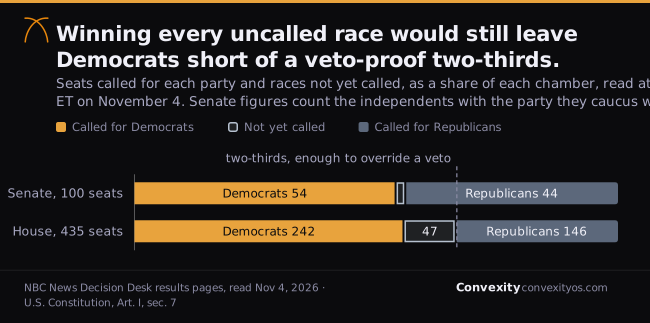
The Senate has a second threshold that comes before the president ever sees a bill. Under Senate Rule XXII, ending debate on most legislation takes three-fifths of the senators "duly chosen and sworn," which is 60 when every seat is filled. Democrats will have at most 56. Most bills will need Republican votes in the Senate before they need the president's signature.
Two tools that new majorities reach for look stronger than they are against a president who vetoes.
The first is the Congressional Review Act, which lets Congress overturn a federal agency's rule on a fast track that cannot be filibustered. The statute says a rule shall not take effect, or continue, "if the Congress enacts a joint resolution of disapproval." Enacting means the president signs it or Congress overrides him. Against a president defending his own agencies' rules, a disapproval resolution passes both chambers and stops on his desk.
The second is a war powers resolution, and the closest precedent is about Iran. In 2020, Senate Joint Resolution 68 directed the removal of American forces from hostilities against Iran that Congress had not authorized. It passed the Senate 55 to 45 in February and the House 227 to 186 in March. The president vetoed it on May 6, and the next day the Senate voted 49 to 44 to override. Two-thirds of the 93 senators voting was 62, so the override failed by 13 votes (our arithmetic). Congress can say a war should end. It cannot end one over a veto.
Tariffs follow the same shape, with one exception that has already run its course. On February 20 the Supreme Court held in Learning Resources v. Trump that the International Emergency Economic Powers Act "does not authorize the President to impose tariffs." The same day the president proclaimed a 10% import surcharge under Section 122 of the Trade Act of 1974, effective February 24, for 150 days. That statute is the rare tariff law with a clock: the surcharge may not run longer "unless such period is extended by Act of Congress," so congressional silence ended it, in July. The Court of International Trade had already held the proclamation unlawful on May 7, with relief limited to the plaintiffs it found had standing.
The tariffs that remain rest on statutes that delegate the decision. Duties on aluminum, steel and copper stand under Section 232 of the Trade Expansion Act, at 50% and 25% of full customs value since an April 2 proclamation. The trade representative's forced-labor duties of 10% and 12.5% on 60 economies, announced on July 23, rest on Section 301. Both continue until the administration ends them or a law does, and a law ending them is a law the president would have to sign.
What the market priced on Wednesday
Set the day's biggest moves against that asymmetry and they fall into three groups: moves that rest on something Congress can stop, moves that rest on something only the president can start, and moves that do not run through Washington at all.
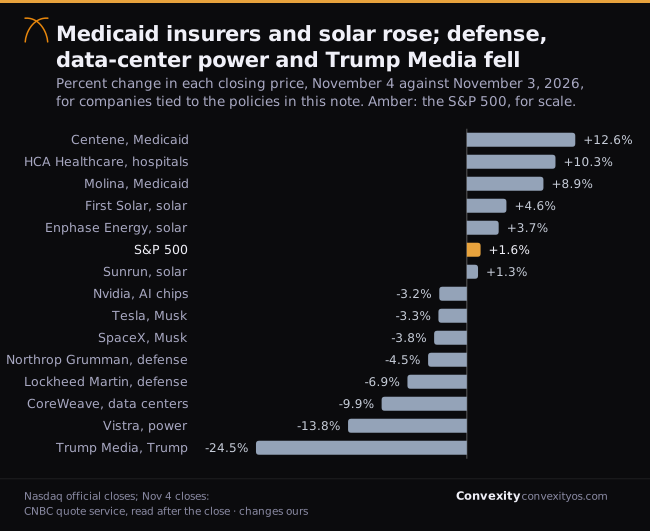
What Congress can stop. Defense contractors fell: Lockheed Martin 6.9%, Northrop Grumman 4.5%. This is the clearest case of a move with a mechanism behind it. Military spending is appropriated every year, a Democratic House can decline to pass an increase, and when no full-year bill passes, the usual fallback is a continuing resolution at the previous year's rates. Myles Walton of Wolfe Research called the result a headline negative for defense stocks in a note quoted by CNBC. The counterweight sits in the lame duck. The reconciliation package Republicans set aside before the election carried around $100 billion for defense and farm aid, Roll Call reported, and a version passed before January would arrive before the new majorities can stop it. Our RTX note showed how much of one contractor's backlog still waits on money Congress has not yet provided.
Treasury yields fell too. On the Treasury's par yield curve, the 2-year yield closed at 4.58%, down 3 basis points, and the 10-year at 4.90%, down 5 (the changes are our arithmetic). A divided government can stop the kind of party-line budget bill that added to deficits in 2025, and traders at JPMorgan, as quoted by CNBC, named reduced deficit spending as the issue Wall Street was focused on. Part of the fall belongs to oil, though. Cheaper energy lowers expected inflation, and both arrived on the same day, so a single session cannot separate them.
What only the president can start. Solar stocks rose: First Solar 4.6%, Enphase Energy 3.7% and Sunrun 1.3%. Nothing the new Congress can do alone changes the law those companies are priced against. The 2025 budget law ends the production and investment credits for wind and solar projects placed in service after 2027 unless construction began by July 4, 2026, a date that has passed, and it ended the credit for household solar for spending after December 31, 2025. Restoring either takes a bill the president signs, and he signed the law that ended them. What could move these stocks instead lies outside the Capitol: state policy in states whose governors changed, or the 2028 election. Neither is a mistake to price. Both are bets on something other than the Congress that was elected on Tuesday.
Insurers that sell Medicaid and marketplace plans rose, Molina 8.9% and Centene 12.6%, and so did the hospital chain HCA Healthcare, 10.3%. Here the line between stopping and starting runs through the middle of the trade. The 2025 budget law requires states to apply a work requirement to certain Medicaid adults no later than January 1, 2027, with exemptions for states that can run to the end of 2028, and the enhanced marketplace tax credits expired at the end of 2025, as our note on 2027 premiums describes. Undoing either is a start, and needs a signature. What the new majorities can do on their own is stop the next round: from January, no party-line bill can cut Medicaid or the marketplaces further without Democratic votes. That is worth something to an insurer. It is a smaller thing than restoration, and the size of Wednesday's move is the market's estimate of how much of each it is buying.
The move with the widest reach was not a stock. Brent crude settled at $94.62 a barrel, down 8.7%, and West Texas Intermediate at $88.12, down 8.3% (our arithmetic on the exchanges' settlements). CNBC reported that traders were betting the defeat would push the president to negotiate with Iran, after Vice President JD Vance wrote on Wednesday that the war had cost Republicans the election. Not all of the fall is the election: CNBC also reported that oil futures had already dropped more than 14% this week as both governments signaled openness to a settlement. Whatever the share, it is a bet on what the president chooses, not on what Congress can compel. A war powers resolution is the tool Congress has, and the last time it was aimed at Iran it was vetoed and the veto stood.
What does not run through Washington. AI and data-center stocks fell: CoreWeave 9.9%, the power producer Vistra 13.8% and Nvidia 3.2%. The mechanism behind this group is the most concrete of the day, and it does not run through Congress at all. In Texas, Gina Hinojosa, who campaigned for tighter limits on data-center development, defeated Governor Greg Abbott, and Wells Fargo estimates that 27% of planned data-center capacity, measured in gigawatts, is in Texas, both as CNBC reported. Siting, grid connections and power rates are decided in state capitals and at utility commissions, which is the point LPL Research's Jeff Buchbinder made to clients, according to CBS News. No veto reaches a state permit. Our note on AI's power suppliers followed the money already committed to that buildout; Wednesday's vote changes who governs the state where much of it is meant to land.
Three stocks moved on proximity rather than policy. Tesla fell 3.3% and SpaceX 3.8% after Elon Musk spent at least $474 million on the midterms, $224 million of it in Texas, much of it behind candidates who lost, as CNBC reported. Trump Media & Technology Group fell 24.5%. None of these moves needs a law to be right or wrong, and none tells us anything about what the new Congress can do.
What the new Congress can do without a signature
If a majority without two-thirds can only stop things, the question for markets is which stops are worth something in trade. Three are.
Bills that have to pass. Federal agencies are funded through December 11 by a continuing resolution, Division A of Public Law 119-103, which the president signed on September 2. It runs 72 days from October 1, and it expires 23 days before the new Congress is sworn in, so the next funding decision belongs to the outgoing Republican majority. If that majority funds the government for the full year, the next deadline is October 1, 2027. If it passes a short extension into the new year, the new majorities inherit a shutdown deadline in their first weeks, and with it their first chance to trade a vote for a policy.
The debt limit is the larger lever, because a default is a worse outcome than a shutdown for everyone at the table. The 2025 budget law, Public Law 119-21, raised the limit by $5 trillion, and the Treasury's daily statement puts it at $41.104 trillion. On November 2 the debt subject to that limit was $40.31 trillion, which leaves about $798 billion of room. A year earlier the same measure was $37.89 trillion, so it grew by about $201 billion a month, and at that pace the room runs out in about four months (our arithmetic). Reaching the limit is not default: the Treasury then turns to the accounting moves known as extraordinary measures, and estimates cited by Roll Call put the date it would run out of those in late 2027 or early 2028. The fight would come well before that date, because that is where the leverage is.
The outgoing majority knows this. Before the election, Senator Kevin Cramer of North Dakota told reporters he expected Republicans to try another budget reconciliation package in the lame-duck session, with more money for defense, and to act on the debt limit, either inside that package or in a bipartisan deal. Roll Call also reported that the president had asked Congress to raise the limit before the end of the year. Reconciliation needs only a simple majority in the Senate, so Republicans could do it without a single Democratic vote, provided they hold their own members. A large enough increase in December would move the debt limit past most of the new Congress's term and take its biggest bargaining chip with it. Whether that happens in the next eight weeks matters more to the policy outlook than anything in Wednesday's tape.
The Senate's vote on nominees. From January 3 every nomination needs a Democratic Senate's consent, and the financial regulators have openings. The Securities and Exchange Commission's site lists two of its five commissioners, Chairman Paul Atkins and Mark Uyeda. The Commodity Futures Trading Commission, which regulates futures and much of the crypto market, lists one of five: Chairman Michael Selig, sworn in on December 22, 2025. That is seven empty seats at the two agencies that write market rules, each of which now needs the new Senate.
The Federal Reserve is fuller. All seven seats on its Board of Governors are occupied, with Kevin Warsh as chair. The next two scheduled decisions both fall inside the new Senate's term. Philip Jefferson's four-year term as vice chair, which began on September 13, 2023, ends in September 2027. Jerome Powell's term as a governor ends on January 31, 2028, and the 14-year term that follows it begins the next day. Neither nominee can be seated without the Senate that convenes in January.
Hearings. Committee chairs set agendas and issue subpoenas. Senator Ron Wyden of Oregon, the senior Democrat on the Finance Committee and its expected chair, said on Wednesday that it would focus on chief executives' accountability, a billionaire tax, health care and trade, according to CNBC. Hearings can move a stock for a day. They do not change a tax rate.
The history the rally leans on
Much of Wednesday's commentary from Wall Street leaned on history, and the history is real. CBS News reported Edward Jones's figure that the S&P 500 rose an average of 15.5% in the six months after the last 14 midterm elections. We checked it against a primary series rather than a bank's note, using Robert Shiller's monthly S&P Composite, which averages each month's daily closes. Over the same 14 midterms, from each election November's average to the following May's, the index rose all 14 times, by 12.5% on average (our arithmetic). CBS did not give the dates behind Edward Jones's figure, and monthly averages smooth the path, so the two need not match; they agree on the direction. The longer record says the same thing.
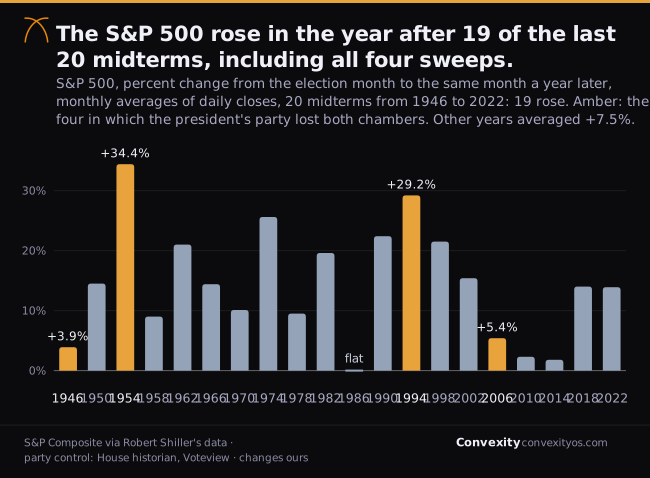
From each midterm November to the next, the index rose after 19 of the last 20, by an average of 14.4% and a median of 14.2%. The one that did not rise, 1986, was flat. Over the other 59 years of the series the same November-to-November change averaged 7.5%, and 41 of those 59 years rose (all our arithmetic).
Four of the 20 were sweeps like this one, in which the president's party held both chambers going in and lost both: 1946, 1954, 1994 and 2006. The index rose after all four, by 3.9%, 34.4%, 29.2% and 5.4%, an average of 18.2% against 13.4% for the other midterms.
Two cautions keep that table from saying more than it does. Four cases are not a sample, and the range inside them, from under 4% to over 34%, is wider than the gap between the sweeps and everything else. And the midterm pattern is a pattern of the calendar, not of the outcome. The index rose 15.4% after 2002, when the president's party won the Senate, just as it rose after the four years in which his party lost both chambers. That says the market tends to stop worrying once the votes are counted, not that it prefers any particular count. What the record supports is narrower: in the four sweeps since 1946, the market did not punish the result.
The calendar from here
The asymmetry gives the coming months an order. Watch these dates:
- The uncalled races. Alaska and Mississippi in the Senate, and the House's remaining seats. None can change control of either chamber or bring either within reach of two-thirds.
- December 8 and 9. The Federal Reserve's last meeting of the year, the subject of our note on the October hold. Lower oil and lower yields on Wednesday feed into the inflation picture that meeting will read.
- December 11. Funding expires. What the outgoing Congress passes, a full-year bill or a short extension, decides whether the new majorities begin with a shutdown deadline.
- Before January 3. Any lame-duck reconciliation bill, and whether it raises the debt limit, and by how much.
- January 1. The Medicaid work requirement takes effect in every state without a good-faith exemption, two days before the new Congress meets.
- January 3, at noon. The 120th Congress is sworn in, under the Twentieth Amendment.
- Around March 2027. At the past year's pace, the debt reaches the limit unless it has been raised (our arithmetic). Extraordinary measures follow.
- September 2027 and January 31, 2028. The Fed vice chair's term and Powell's seat.
What would prove this wrong
The argument here is that the index priced relief and lower deficits, which a divided government can deliver, while several sector moves priced laws or choices that the new Congress cannot deliver by itself. Here is what would show it is wrong:
- A law that needed no hostage. If in the first half of 2027 the president signs a bill that restores the solar credits or the expired marketplace subsidies, outside a funding or debt-limit deal, then a majority without two-thirds can start things after all, and the moves this note calls bets were early reads of a real channel.
- A debt limit settled in the lame duck, and the moves hold. If the outgoing majority raises the limit into 2028 and solar and Medicaid insurers keep Wednesday's gains anyway, those gains rest on something other than federal leverage, most likely the states or the 2028 election, and this note's framing of them is too narrow.
- A Senate that changes its own rule. A majority can change Rule XXII. That would lower the bar for Senate passage, though not for an override, and would make more of the new majorities' agenda a live bargaining chip.
- Oil that rises again without a congressional vote. If the war escalates and oil retraces Wednesday's fall, then the day's widest-reaching move was a reading of the president's intentions that the election did not settle, and the relief part of the rally was partly an oil trade.
The last test is the one we would watch first. Of the day's moves, oil's reaches furthest, is the least tied to anything Congress can do, and is the most likely to reverse on a single headline.
Related reading
- The ACA's 2027 price rise lands on full-price buyers, on what the expired marketplace credits changed for premiums and enrollment.
- AI's power suppliers are being paid before they build, on the cash behind the data-center buildout that Texas now governs differently.
- Missile contracts not yet final drove RTX's backlog jump, on how much of the defense order book still waits on appropriations.
- U.S. shale is drilling as if $100 oil won't last, on the futures curve that already priced the war as temporary.
- The tariff refund stayed in adjusted earnings, on what the IEEPA ruling paid back.
Sources for this note
- ConstitutionU.S. Constitution, Article I, section 7, and the Twentieth AmendmentTwo-thirds of each House to pass a bill over the president’s objections; terms of the new Congress begin at noon on January 3retrieved Nov 4, 2026
- RuleStanding Rules of the Senate, Rule XXIICloture by three-fifths of the senators duly chosen and swornretrieved Nov 4, 2026
- StatuteCongressional Review Act, 5 U.S.C. 801 and 802A rule falls only if Congress enacts a joint resolution of disapproval; the Senate’s ten-hour debate limitretrieved Nov 4, 2026
- RecordS.J.Res. 68, 116th Congress, bill status (Iran war powers)Senate 55-45, House 227-186, vetoed May 6, 2020, override failed 49-44 on May 7May 7, 2020
- CourtSupreme Court, Learning Resources, Inc. v. Trump, No. 24-1287IEEPA does not authorize the President to impose tariffsFeb 20, 2026
- ProclamationProclamation 11012, temporary import surcharge under section 122 of the Trade Act of 197410% surcharge for 150 days, effective February 24, 2026 (91 FR 9339)Feb 25, 2026
- Statute19 U.S.C. 2132 (section 122 of the Trade Act of 1974)The 150-day limit, unless extended by Act of Congressretrieved Nov 4, 2026
- CourtCourt of International Trade, State of Oregon v. United States, Slip Op. 26-47Proclamation 11012 held unlawful; injunction limited to plaintiffs with standingMay 7, 2026
- ProclamationProclamation 11021, adjusting imports of aluminum, steel and copper under section 232Full-value duties of 50% and 25%Apr 9, 2026
- ReleaseOffice of the U.S. Trade Representative, Section 301 forced-labor actionFinal action imposing duties of 10% or 12.5% on 60 economiesJul 23, 2026
- StatutePublic Law 119-21 (the 2025 budget reconciliation law)Sections 70506, 70512 and 70513 (residential and wind and solar credits), 71119 (Medicaid community engagement), 72001 (debt limit)Jul 4, 2025
- GuidanceInternal Revenue Service, Notice 2025-42Beginning of construction for wind and solar facilities after Public Law 119-21; effective September 2, 2025retrieved Nov 4, 2026
- ReportCongressional Research Service, R49353: Continuing Appropriations for FY2027 (Division A of P.L. 119-103)Funding through December 11, 2026, a 72-day continuing resolution signed September 2Sep 17, 2026
- DataU.S. Treasury, Daily Treasury Statement, Table III-C, debt subject to limitNovember 2, 2026 and November 3, 2025, via the Fiscal Data APINov 3, 2026
- DataU.S. Treasury, Daily Treasury Par Yield Curve Rates, 20262-year and 10-year yields, November 3 and 4Nov 4, 2026
- DataFederal Reserve Board of Governors, members and biographiesCurrent members; Jefferson’s vice chair term from September 13, 2023; Powell’s term ending January 31, 2028retrieved Nov 4, 2026
- DataSEC CommissionersTwo commissioners listed; page last updated October 3, 2026retrieved Nov 4, 2026
- DataCFTC, Chairman and CommissionersOne commissioner listed, sworn in December 22, 2025retrieved Nov 4, 2026
- DataNBC News Decision Desk, 2026 House and Senate resultsSeats called by party and races uncalled, read at 15:42 ETNov 4, 2026
- DataOffice of the Historian, U.S. House of Representatives, Party DivisionsHouse seats by party for each Congress since 1857retrieved Nov 4, 2026
- DataVoteview, congressional members dataSenate membership and party by Congress, for party control after each midtermretrieved Nov 4, 2026
- DataRobert Shiller, U.S. stock market data (S&P Composite, monthly)Monthly averages of daily closes, 1946 to 2025retrieved Nov 4, 2026
- PricesNasdaq, historical quotesOfficial closing prices for November 3 for every stock in the second chart (November 4 not yet posted when this note was written)Nov 4, 2026
- PricesCNBC quote service: S&P 500, Dow, Russell 2000, stocks, ICE Brent and NYMEX WTIIndex closes, November 4 stock closes and oil settlements, read at 16:16 ETNov 4, 2026
- HoldingsState Street, SPDR S&P 500 ETF Trust daily holdingsHoldings as of November 3, 2026, for the disclosureNov 3, 2026
- PressCNBC, 2026 midterm election live updatesVance on the war; Wyden on the Finance Committee’s agenda; the president’s postsNov 4, 2026
- PressCNBC, Crude oil prices fall below $90 a barrel as Vance blames GOP election defeat on Iran warTraders’ reading of the result; oil’s fall earlier in the weekNov 4, 2026
- PressCNBC, AI data center stocks and Musk’s SpaceX decline as Texas governor result raises risks of a slowdownTexas governor result; Wells Fargo’s 27% of planned data-center gigawatts; Musk’s campaign spendingNov 4, 2026
- PressCNBC, Defense stocks slide on fear Democrats will curb spendingWolfe Research noteNov 4, 2026
- PressCNBC, 10-year Treasury yield slides as traders mull over Democrats’ midterm victoriesJPMorgan traders on deficit spendingNov 4, 2026
- PressCBS News, Stocks soar after Democrats take control of CongressEdward Jones on six-month returns after midterms; LPL Research on state data-center policyNov 4, 2026
- PressColorado Politics and IBTimes UK, the president’s October 23 remarks on vetoesQuoted wording checked against bothOct 23, 2026
- PressRoll Call, Cramer calls for debt limit action in lame-duck sessionLame-duck reconciliation plans; estimates of when extraordinary measures run outOct 22, 2026
Not investment advice. This note is an analysis of public law, government data and market prices, published for research purposes, and not a recommendation to buy, sell or hold any security. Convexity takes no side in elections. A member of the Convexity team holds SPY, which holds First Solar, Centene, HCA Healthcare, Lockheed Martin, Northrop Grumman, RTX, Nvidia, Vistra and Tesla, and also JPMorgan Chase and Wells Fargo, whose analysts are cited; no other position. A member of the team holds an economic interest in Anthropic, whose suppliers and shareholders include Nvidia, through a special-purpose vehicle and a fund, and stands to benefit if its valuation rises; Convexity is an Anthropic customer. This note was drafted with Claude.
What here is ours rather than the sources'. As published: the wording of the Constitution, the statutes, the Senate rule, the proclamations and the court rulings; the 2020 votes on the Iran war powers resolution; the funding deadline and the continuing resolution's length; the debt limit and the debt subject to it on November 2, 2026 and November 3, 2025, from the Daily Treasury Statement; the Fed, SEC and CFTC members and terms as each agency lists them; NBC's seat counts and House projection; every closing price, index close, oil settlement and Treasury yield; the monthly index values in Robert Shiller's series; the House historian's and Voteview's party counts; and every figure attributed to CNBC, CBS News, Roll Call, Wells Fargo, Edward Jones, JPMorgan, Wolfe Research or LPL Research. Ours: every percent change in a price, an index or an oil settlement, and every yield change in basis points; the two-thirds and three-fifths thresholds in seats, the most seats Democrats could reach with every uncalled race, and the Senate's shortfall; that both majorities are settled by races already called; the last House in which one party held 290 seats; the votes the 2020 override needed and missed by; the debt limit's remaining room, the past year's monthly pace, the four months and the March date; the day counts between deadlines; the seven empty seats at the SEC and CFTC; every change, average, median and count in the post-midterm record and which midterms count as sweeps; and the sorting of Wednesday's moves into what Congress can stop, what only the president can start and what does not run through Washington. Each derived figure is recomputed in the figure files published with this note.