









Disclosure. Not investment advice, and nothing here is a recommendation to buy, sell or hold any security. A member of the Convexity team holds the SPDR S&P 500 ETF (SPY), which holds Apple, Alphabet and Micron Technology; no other position. A member of the team also holds an economic interest in Anthropic through a special-purpose vehicle and a fund, and stands to benefit if its valuation rises; this note names Google, and Convexity is an Anthropic customer. Figures are from Apple's earnings releases, its Form 10-K for fiscal 2026 and its earlier Forms 10-Q and 10-K. Apple does not publish transcripts of its calls, so every quotation from a call was read in at least two independent transcripts (The Motley Fool and Platform Aeronaut for every call, Gloom for the November call and Six Colors for the July call), and only wording they share is quoted. Share prices are Nasdaq's official closes. The closing note lists what is our arithmetic. This note was drafted with Claude.
On Apple's call of October 30, 2025, Kevan Parekh, its chief financial officer, summed up the cost of the parts that go into an iPhone or a Mac in one line. On commodities, he said, "we're seeing a slight tailwind on memory," and "nothing really to note there."
On Monday, a year and three days later, John Ternus took a question on the same subject on his first earnings call as Apple's chief executive. "What we're seeing with memory pricing right now is unprecedented," he said.
Between those two sentences sits the most important number Apple gave on Monday. It is not the September quarter's revenue, a record $114.5 billion, up 12%. It is the gross margin Apple expects in the quarter that ends in December.
That quarter is Apple's year in miniature. Last December it brought in $143.8 billion, 30% of everything Apple sold in fiscal 2026 (our arithmetic). For this December, Apple guided revenue up 7% to 10% and called it "the best quarter for revenue in the history of the company." It guided gross margin to between 45% and 46%.
A year ago, guiding the same quarter, Parekh said 47% to 48%, "which includes an estimated impact of $1.4 billion of tariff-related costs." Much has changed on tariffs since. In February the Supreme Court struck down certain tariffs imposed under the International Emergency Economic Powers Act, Apple applied for refunds, and on Monday it said that "we have received the vast majority of the refunds related to tariffs paid." The guide that replaced last year's names no tariff cost at all. It names "the impact of higher memory costs, as well as some costs related to the ramp of Siri AI." And it is still two points lower at the midpoint.
Two points sounds small. On next December's sales, each point of gross margin is worth about $1.6 billion (our arithmetic). Run every line of the new guide at its midpoint and Apple books record revenue of about $156.0 billion and operating income of about $50.4 billion, $483 million less than last December (our arithmetic). The memory bill eats the growth.
That reading comes with a large caveat, and the second half of this note is about it. Apple has guided its revenue low for a year, and if it does so again, the arithmetic turns. What does not turn is the direction of the margin, and the annual report Apple filed on Tuesday is more guarded about it than anything said on the call.
Apple's earnings releases of January 29 and November 2, 2026, its Form 10-K and Form 10-Q for the June quarter, and transcripts of its October 30, 2025 and November 2, 2026 calls; the operating income bridge and the change in obligations are ours.
The guide, line by line, against last December
The cleanest way to read a guide is against the one that came a year before it, for the same season. Here is what Apple said on October 30, 2025 about the December 2025 quarter, what that quarter delivered, and what Apple said on Monday about the December 2026 quarter.
| Guided Oct 30, 2025 | Delivered, Dec 2025 quarter | Guided Nov 2, 2026 | |
|---|---|---|---|
| Revenue growth | 10% to 12% | 15.7% | 7% to 10% |
| iPhone revenue growth | double digits | 23.3% | no figure given |
| Services revenue growth | similar to fiscal 2025 | 13.9% | 8% to 9% |
| Gross margin | 47% to 48%, with about $1.4B of tariff costs | 48.2% | 45% to 46%, mainly memory, some Siri AI |
| Operating expenses | $18.1B to $18.5B | $18.4B | $20.4B to $20.8B |
| Other income and expense | about $150M | $150M | about $300M |
| Tax rate | about 17% | 17.5% | about 17% |
The delivered growth rates, margin and tax rate in the middle column are our arithmetic from the figures in Apple's January 29 release, to one decimal; Apple's own release rounds revenue growth to 16% and Services growth to 14%.
Read across the rows and almost every line moves the same way. The revenue guide is three points lower at the bottom and two at the top. Some of that is the comparison: Parekh reminded analysts on Monday that "that is on top of a phenomenal December quarter last year where revenue grew 16%." Some of it is supply. Parekh described the 7% to 10% as Apple's "best view of constrained supply," and Sabih Khan, the chief operating officer, said that "for the December quarter, we expect constraints on Mac and iPad, primarily driven by memory, as demand has been higher than what we expected."
Last year's guide promised iPhone growth in double digits. This one gives no iPhone figure.
Services is guided to 8% to 9%, against 13.9% last December and 9.8% in the September quarter (both our arithmetic). Parekh said the range "contemplates sequential headwinds primarily driven by third-party licensing and foreign exchange." Apple's licensing revenue includes what Google and other companies pay to offer their search services on its platforms, as the 10-K describes it, and the annual report has something new to say about those payments, which comes later.
Operating expenses are guided up 11% to 13% from last December (our arithmetic: 11.0% to 13.2%). That is faster than revenue at every point of the revenue range. Apple told analysts a year ago that it was "significantly increasing our investments in AI," and its research and development spending rose 32% in fiscal 2026, to $45.8 billion, according to the 10-K. A company can afford to grow costs faster than sales when its gross margin is rising. This guide asks it to do so while the margin falls.
And the margin is the line that changed the most.
Four calls, one direction
Memory did not arrive in Apple's guide all at once. Read the four calls since last December in order and the language moves one step each quarter.
On January 29, Tim Cook, then chief executive, said "memory had a minimal impact" on the December quarter's gross margin, and that Apple expected a bit more of one in March.
On April 30, Cook said Apple expected "significantly higher memory costs" in June, and went further: "beyond the June quarter, we believe memory costs will drive an increasing impact on our business."
On July 30, on his last call as chief executive, Cook pointed at the market price itself: "if you look beyond September, we see the market pricing for memory continuing to increase, which could drive an increasing impact on our business."
And on Monday, Ternus called the pricing unprecedented and looked past December again: "looking beyond the December quarter, we see the pricing for memory purchases continuing to increase."
The gross margin shows the same path, but the tariff refunds make it hard to see. Apple's reported margin was 50.1% in the June quarter, about two points of which were refunds; we covered that in our note on how companies treated their tariff refunds. Parekh put June at 48.1% without them. The September quarter's 47.9% included "a favorable impact of approximately 1 percentage point from tariff refunds," which puts the margin without them at about 46.9% (our arithmetic, and approximate, because Apple's own figure is). Set the refunds aside and the margin has fallen at every step since March.
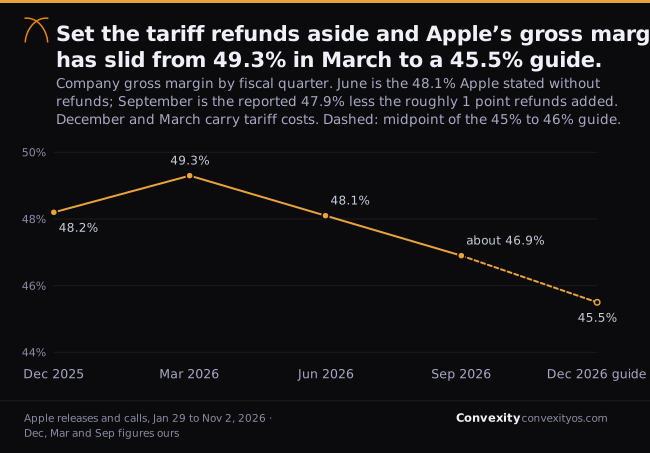
The analysts on the call had done the same subtraction. Amit Daryanani of Evercore said that if he excluded the refunds, the guide implied gross margin "down about 140 basis points sequentially at least." Parekh agreed: "the midpoint of the range is a decline sequentially in the magnitude you mentioned. We expect most of that decline to be driven by higher memory costs." Our 46.9% for September and 45.5% for December are 1.4 points apart.
Ternus then listed what is cushioning the blow. Apple raised prices on many products, the Mac and iPad at the end of June and the iPhone in September, and "these price increases provided some offset." It still holds memory bought before the latest increases, which it calls carry-in inventory. And some other components have become cheaper.
The second of those cushions wears out. "We do believe we'll see a decreasing benefit from the carry-in inventory on memory over time," Ternus said. Put that beside the earlier sentence, that memory prices keep rising past December, and the guide reads less like a trough than like a quarter on the way down a slope whose bottom Apple has not described.
Siri AI is the smaller, newer cost. Parekh explained that the cloud costs of running it are recognized in the cost of Services, and that Apple, which already defers part of each device's revenue for the services bundled with it and recognizes that part over the device's life, now includes Siri AI in the deferral. "Both of these items will have an impact to the gross margin," he said. Apple did not split the guide between memory and Siri AI, beyond saying memory drives most of the decline.
None of this is unique to Apple. In September we wrote that the memory cycle is the AI trade: the buildout of data centers competes for the same chips that go into phones and laptops. In October, our note on Micron's latest quarter found its memory price gains slowing but still positive, and more of its customers on take-or-pay contracts to secure supply. Apple buys in that market, and its guide says it is paying the going rate.
A record quarter that earns less, on paper
Revenue growth and margin pull in opposite directions in this guide, and the useful question is which one wins. The answer at the midpoints is in the chart below. We start from last December's operating income of $50,852 million, which is gross margin less operating expenses as Apple's January release prints them, and walk to next December with every line of the guide at its midpoint: revenue up 8.5%, gross margin at 45.5%, operating expenses of $20.6 billion.
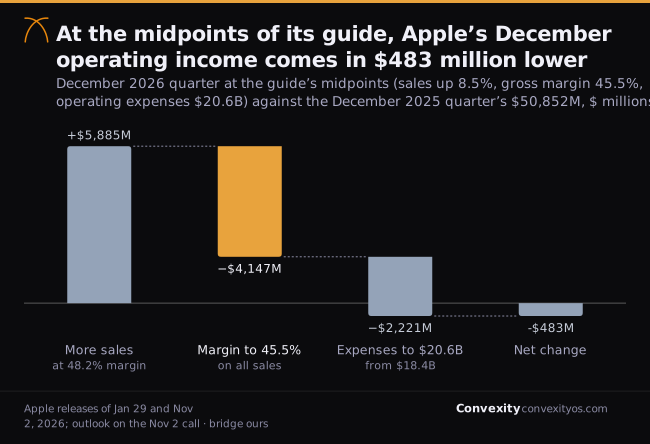
The extra sales, earning last December's 48.2% margin, would add $5,885 million of gross profit. Earning 45.5% instead on every dollar of next December's sales takes back $4,147 million. The higher operating expenses take another $2,221 million. The net is $483 million less operating income than a year earlier, a fall of about 1% (all our arithmetic).
The guide is a range, so the answer is too. At the bottom of every line (revenue up 7%, gross margin 45%, expenses $20.8 billion) operating income would be about $48.4 billion, down 4.8%. At the top of every line (10%, 46%, $20.4 billion) it would be about $52.3 billion, up 2.9% (our arithmetic). The guide holds both a decline and a rise.
The more useful number is where the line crosses zero. With margin and expenses at their midpoints, Apple needs revenue growth of about 9.2% to earn as much as it did last December (our arithmetic). At a 46% margin, the top of the range, it needs about 8.1%. Both sit inside the 7% to 10% Apple guided. So the guide, taken at face value, says operating income will be roughly flat in the biggest quarter of the year, give or take a few percent, while revenue sets a record.
That is the change memory has made. A year ago the same quarter carried $1.4 billion of tariff costs, about one point of its revenue, and still produced a margin of 48.2%; without the tariffs it would have been about 49.1% (our arithmetic). The new guide's midpoint sits 3.6 points below that figure. A year ago the question was how much of the tariff cost Apple could absorb. Now the cost it is absorbing is larger, and nobody is going to refund it.
Apple has been guiding low
There is a good reason not to take the revenue guide at face value: Apple has beaten the midpoint of every one it gave in the past year. In three of the last four quarters revenue came in above the top of the range Apple gave, and in the fourth it came in above the midpoint.
| Quarter | Revenue growth guided | Delivered | Above the midpoint by |
|---|---|---|---|
| Dec 2025 | 10% to 12% | 15.7% | 4.7 points |
| Mar 2026 | 13% to 16% | 16.6% | 2.1 points |
| Jun 2026 | 14% to 17% | 16.4% | 0.9 points |
| Sep 2026 | 9% to 11% | 11.7% | 1.7 points |
Each guide was given on the call a quarter earlier and read in two transcripts; the delivered growth and the gaps are our arithmetic from the releases.
On average, revenue beat the midpoint by 2.3 points (our arithmetic). Add that to this guide's midpoint and growth would be about 10.8%, and at a 45.5% margin and $20.6 billion of expenses, operating income would rise about 2% from last December rather than fall (our arithmetic). The bridge above is what the guide says. It is not what Apple's guides have recently turned into.
The gross margin guides have held up as well. In each of the four quarters the margin landed inside or above the range Apple gave: 48.2% against 47% to 48% last December, 49.3% against 48% to 49% in March, 48.1% without refunds against 47.5% to 48.5% in June, and 47.9% against 47% to 48% in September, where the range itself included the refund. Apple has not missed the bottom of a margin range in a year.
Three things make this December harder to beat than the last four, and Apple said all three on Monday.
The first is supply. Apple guided to its "best view of constrained supply," and the constraint is memory. A company that cannot get enough memory for the Macs and iPads customers want cannot sell its way through the top of a range with them. The new iPhone Duo is constrained too; Khan said "it's really hard to predict when supply and demand will be in balance."
The second is price. Apple raised prices to protect the margin, and Parekh said "we did reluctantly make the decision to change pricing." Asked how customers have responded, he said "it's early to really read price elasticity at this point in time." Price increases lift revenue per unit before anyone knows what they do to units.
The third is the comparison. Last December grew 16% by Apple's rounding, with iPhone revenue up 23.3% (our arithmetic). That quarter is the base this one is measured against.
None of that means Apple will miss. The last four quarters had constraints too, and Apple beat through them. It means the habit of beating is not the same thing as a reason to expect it, and this time a beat on revenue is worth less, because each extra dollar of sales carries a lower margin than it did.
What the 10-K says that the call did not
Apple filed its annual report on Tuesday, the day after the call. Ternus told analysts to look for it. The 10-K is where a company writes the risks its lawyers want on the record, and in four places it is more cautious than the call.
Memory gets its own sentence. The risk language on components has been tightening all year. The December quarter's 10-Q, filed in January, does not use the word memory. In the March quarter's 10-Q, Apple said it expected the supply constraints and rising costs for advanced chips, storage and memory "to intensify," and that its responses might hurt demand. The June 10-Q spelled out what those responses were: "Actions, such as price increases, that have been and may in the future be taken by the Company may not effectively mitigate these negative impacts, and may also reduce demand for the Company's products." The 10-K keeps that sentence and narrows the first: "The Company expects these trends to intensify for memory and storage components." Advanced chips are still named as a constraint but no longer as one expected to get worse, which matches Khan's remark on the call that Apple's "constraints on advanced nodes are easing." Memory and storage stay in. So the filing says what the call implied: the cost is memory, it is expected to get worse, and the price increases that are offsetting it might not keep doing so and might cost sales.
The management discussion adds a general line that is easy to skip: "the Company believes, in general, gross margins will be subject to volatility and downward pressure." Apple has carried language like it for years. This year the guide gives it a number.
The purchase commitments jumped, and some now run past a year. Ternus volunteered on the call that "our manufacturing purchase obligations have increased by $33 billion from June to the September quarter." The 10-K puts the total at $89.7 billion, of which $82.7 billion is payable within 12 months. The other $7.0 billion runs past a year (our arithmetic). At the end of June, that longer part was $0.8 billion.
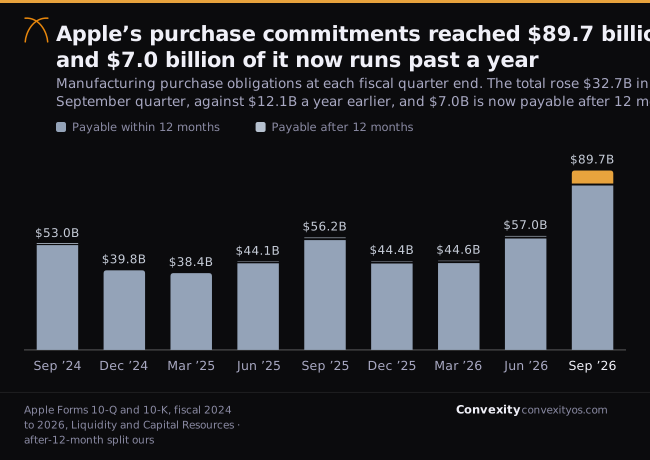
Some of the rise is seasonal. Apple's obligations climb every September as it buys for the holidays and fall back by December: from $53.0 billion to $39.8 billion two years ago, from $56.2 billion to $44.4 billion last year. But a year ago the September quarter added $12.1 billion. This one added $32.7 billion, and the total is 60% higher than a year earlier (both our arithmetic). The part that runs past a year is the one that is new. Apple did not say on the call what the longer commitments buy, and the 10-K does not either. The timing fits a buyer locking in memory supply while sellers like Micron move customers onto longer contracts, but that is our reading, not Apple's statement.
The balance sheet points the same way. Component inventory was $10.4 billion at the end of September, against $2.1 billion a year earlier, nearly five times as much (our arithmetic). Total inventory rose to $14.5 billion from $5.7 billion. The filing does not say which components these are, but the carry-in memory Ternus described as a cushion, bought before the latest price increases, would sit in this line. It is also the cushion he said will shrink.
A new sentence about Google. Services was the steady part of the September quarter, a record $31.6 billion. Its guide is 8% to 9%, with "third-party licensing" named as a headwind. The 10-K describes the licensing arrangements with Google and other companies that pay Apple to offer their search services, and the antitrust case against Google: a court ordered remedies in September 2025, and both the Department of Justice and Google have appealed. The June 10-Q said all of that. The 10-K adds one sentence: "In addition, regardless of the outcome of such proceedings, these licensing arrangements may not be renewed on favorable terms upon their expiration or at all." That sentence is not in last year's 10-K or in the June 10-Q. The filing does not say when the arrangements expire.
The App Store case is still open. The Epic Games litigation, in which a court barred Apple from charging any commission on purchases completed through external links in apps, is under review by the Supreme Court, which agreed in June to look at the legal standard for civil contempt. And the filing repeats, as the June 10-Q did, that the European Union's interoperability rules may cause Apple "to not launch or maintain products, services and features, such as Siri AI, in certain jurisdictions." The feature whose costs are in the margin guide may not ship everywhere.
The refunds have a caveat. The 10-K says Apple has applied for refunds of the struck-down tariffs and records them as a reduction of the cost of products, and then adds a sentence the June 10-Q did not carry: "If tariffs are subsequently rescinded or revoked, the Company may not be able to successfully claim and collect tariff refunds." It also notes "the recent imposition of tariffs under Section 301 of the Trade Act of 1974" and that a Commerce Department review of semiconductor imports under Section 232 imposed no additional tariffs on Apple's products when its initial results came out in January. The December guide assumes the tariff rates in effect on the day of the call. It does not say what those cost.
One more line is worth flagging because nothing on the call explained it. Licensed intangible assets on the balance sheet rose to $29.6 billion gross from $16.1 billion a year earlier, and Apple expects $6.6 billion of amortization on its intangible assets in fiscal 2027, up from $4.9 billion recorded in fiscal 2026. The 10-K does not say what was licensed or where the amortization is recorded, and we have not guessed.
Where the cash went
The September quarter itself was strong. Apple earned $30.7 billion, a September quarter record, generated $28.1 billion of operating cash flow, and returned $28 billion to shareholders, $24 billion of it in buybacks.
The year's buyback bought less stock for nearly the same money. In fiscal 2026 Apple repurchased 297 million shares for $85.8 billion, an average of about $289 a share. In fiscal 2025 it repurchased 402 million shares for $89.3 billion, about $222 a share (both averages our arithmetic). That is 26% fewer shares for 4% less money (our arithmetic). The diluted share count in the September quarter was 1.6% lower than a year earlier (our arithmetic), which added about that much to earnings per share.
Apple has $14.0 billion left from its May 2025 authorization and another $100 billion from the program it announced in April. It ended September with $137 billion of cash and marketable securities against $80 billion of debt, the figures Parekh gave on the call. Asked about the target Apple once called net cash neutral, Parekh said "we were no longer using net cash neutral as a target," and that Apple now evaluates its cash and debt positions independently. A company paying more for memory, more for each share it retires, and more to run Siri AI in the cloud has reasons to want that flexibility. Three days after the call, on November 5, Apple filed to sell bonds in seven parts, floating-rate notes due 2028 and 2029 and fixed-rate notes due between 2028 and 2036; the preliminary prospectus did not yet give the amounts. The final term sheet, filed that night, does: $7.5 billion across the seven (our sum), from $500 million of the 2028 floating-rate notes to $2 billion of 5.350% notes due 2036, for net proceeds Apple puts at about $7.47 billion. The notes settle on November 9. (Updated November 6 with the final terms.)
What the market did
Apple's shares closed at $338.32 on Monday, before the results. On Tuesday they opened at $325.58, 3.8% lower, and closed at $331.90, down 1.9% on the day, having made back about half of the opening drop (our arithmetic from Nasdaq's official prices). Prices alone cannot say which half of the guide, the record revenue or the lower margin, did the moving.
What would prove this wrong
The argument here is that memory has replaced tariffs as the cost in Apple's December guide, that the cost is larger and not temporary, and that at the guide's midpoints it takes away all of the growth in operating income. Each part can be tested in the next few months.
- Revenue grows more than about 9.2% in the December quarter with the margin inside its range. Apple reported last year's December quarter on January 29, and the next report is likely to come at about the same time. Its last four guides have been beaten by 2.3 points on average, so this is the likeliest way for the midpoint arithmetic to be wrong, and if growth lands near 11% at a 45.5% margin, operating income rises about 2%.
- The gross margin comes in above 46%. That would mean carry-in inventory, the price increases or cheaper non-memory parts did more than Apple expected. Apple has landed inside or above its margin range for four quarters running, so a result at the top would not be unusual. Above it would weaken the case that memory is a lasting cost.
- The March-quarter guide stops pointing down. Ternus said memory prices keep rising beyond December and the benefit of carry-in inventory shrinks. If the next guide holds the margin flat or raises it, the slope we drew has a bottom, and it is closer than the language suggests.
- The purchase obligations fall back the way they did in the last two Decembers. The 10-Q for the December quarter will show the total. A drop toward $45 billion to $55 billion, with the part beyond a year back under $1 billion, would make September's jump look like timing rather than a longer bet on memory supply.
- Services grows 10% or more and the Google arrangement is renewed. That would make the new 10-K sentence a lawyer's precaution rather than a warning about the licensing line.
The filings and documents this is built on
- 8-KApple Inc., fourth quarter fiscal 2026 earnings release (Form 8-K, Exhibit 99.1)September quarter revenue, gross margin and the approximately 1 point of tariff refunds, operating expenses, Services, iPhone, diluted shares, the balance sheet including inventories, and fiscal 2026 totalsNov 2, 2026
- 10-KApple Inc., Annual Report on Form 10-K for fiscal 2026Risk factors on memory and storage, price increases, Google licensing, the Epic Games review, the Digital Markets Act and tariff refunds; manufacturing purchase obligations; inventories; intangible assets; share repurchases; research and developmentNov 3, 2026
- CallApple fourth quarter fiscal 2026 earnings call, transcript by The Motley FoolDecember-quarter outlook and every quotation from the November 2 call, checked against Platform Aeronaut and GloomNov 2, 2026
- CallApple fourth quarter fiscal 2026 earnings call, transcript by Platform AeronautSecond transcript of the November 2 callNov 2, 2026
- CallApple fourth quarter fiscal 2026 earnings call, transcript by GloomThird transcript of the November 2 call; machine transcribed, so used only to confirm wording the other two shareNov 2, 2026
- CallApple fourth quarter fiscal 2025 earnings call, transcript by The Motley FoolThe December 2025 quarter outlook, including the $1.4 billion of tariff-related costs, and the remark on memory prices; checked against Platform AeronautOct 30, 2025
- CallApple fourth quarter fiscal 2025 earnings call, transcript by Platform AeronautSecond transcript of the October 30, 2025 callOct 30, 2025
- CallApple first quarter fiscal 2026 earnings call, transcript by The Motley FoolThe remark that memory had a minimal impact on December 2025 margin, and the March 2026 outlook; checked against Platform AeronautJan 29, 2026
- CallApple first quarter fiscal 2026 earnings call, transcript by Platform AeronautSecond transcript of the January 29 callJan 29, 2026
- CallApple second quarter fiscal 2026 earnings call, transcript by The Motley FoolThe remark on memory beyond the June quarter, and the June 2026 outlook; checked against Platform AeronautApr 30, 2026
- CallApple second quarter fiscal 2026 earnings call, transcript by Platform AeronautSecond transcript of the April 30 callApr 30, 2026
- CallApple third quarter fiscal 2026 earnings call, transcript by The Motley FoolThe remark on memory beyond September, the 48.1% June margin without refunds, and the September 2026 outlook; checked against Platform Aeronaut and Six ColorsJul 30, 2026
- CallApple third quarter fiscal 2026 earnings call, transcript by Platform AeronautSecond transcript of the July 30 callJul 30, 2026
- CallApple third quarter fiscal 2026 earnings call, transcript by Six ColorsThird transcript of the July 30 callJul 30, 2026
- 8-KApple Inc., third quarter fiscal 2026 earnings release (Form 8-K, Exhibit 99.1)June quarter revenue, gross margin and operating expensesJul 30, 2026
- 8-KApple Inc., second quarter fiscal 2026 earnings release (Form 8-K, Exhibit 99.1)March quarter revenue, gross margin and operating expensesApr 30, 2026
- 8-KApple Inc., first quarter fiscal 2026 earnings release (Form 8-K, Exhibit 99.1)December 2025 quarter revenue, gross margin, operating expenses, operating income, other income, tax, Services and iPhoneJan 29, 2026
- 10-QApple Inc., Forms 10-Q for the December 2025, March 2026 and June 2026 quartersManufacturing purchase obligations at each quarter end, and the earlier versions of the memory, Google and tariff risk language; linked: the June 2026 quarterJul 31, 2026
- 10-KApple Inc., Annual Reports on Form 10-K for fiscal 2024 and 2025, and Forms 10-Q for fiscal 2025Manufacturing purchase obligations from September 2024 to June 2025, the fiscal 2025 risk language and share repurchases; linked: fiscal 2025Oct 31, 2025
- 8-K/AApple Inc., Form 8-K/A on the chief executive transitionJohn Ternus chief executive and Tim Cook executive chair, effective September 1, 2026Sep 1, 2026
- 424B2Apple Inc., preliminary prospectus supplement for floating and fixed rate notesThe seven tranches, maturing from 2028 to 2036; amounts not yet setNov 5, 2026
- FWPApple Inc., final pricing term sheet for floating and fixed rate notesThe amount, rate and maturity of each of the seven tranches, priced November 5 and settling November 9; net proceeds of about $7.47 billionNov 6, 2026
- DataState Street Global Advisors, SPDR S&P 500 ETF Trust (SPY) daily holdingsMembership of Apple, Alphabet and Micron Technology, holdings as of November 3, 2026; read 2026-11-04Nov 3, 2026
- PricesNasdaq, Apple Inc. (AAPL) historical pricesOfficial open and close for November 2 and 3, 2026; read 2026-11-04Nov 3, 2026
Not investment advice. This note is an analysis of Apple's public disclosures and of transcripts of its earnings calls, published for research purposes, and not a recommendation to buy, sell or hold any security. A member of the Convexity team holds SPY, which holds Apple, Alphabet and Micron Technology; no other position. A member of the team holds an economic interest in Anthropic through a special-purpose vehicle and a fund, and stands to benefit if its valuation rises; this note names Google, and Convexity is an Anthropic customer.
What here is ours rather than Apple's. As filed or stated by Apple: every revenue, gross margin, expense, income, cash, inventory, obligation, intangible asset, share repurchase and share count figure; every guidance range; the 48.1% June margin without refunds and the approximately 1 point of refunds in September; the $1.4 billion of tariff costs in last year's guide; and every quotation, each read in at least two independent transcripts. Ours: the December quarter's 30% share of fiscal 2026 revenue; every growth rate and margin to one decimal (15.7%, 16.6%, 16.4%, 11.7%, 23.3%, 13.9%, 9.8%, 48.2%, 49.3%, 17.5%) and the gaps between delivered growth and each guide's midpoint, with their 2.3-point average; the September margin of about 46.9% without refunds; the $1.6 billion value of a point of margin; the midpoint revenue of $156.0 billion and operating income of $50.4 billion; the $5,885 million, $4,147 million and $2,221 million steps and the $483 million, about 1%, net change; the $48.4 billion and $52.3 billion operating income at the ends of the range, down 4.8% and up 2.9%; the 9.2% and 8.1% break-even growth rates; the 10.8% growth and 2% rise at the average beat; the 11.0% to 13.2% growth in expenses; the 49.1% margin without tariffs and the 3.6-point gap; the $7.0 billion of obligations past a year, the $32.7 billion and $12.1 billion quarterly rises and the 60% annual rise; the near-fivefold rise in component inventory; the $289 and $222 average repurchase prices, 26% fewer shares and 4% less money; the 1.6% fall in diluted shares; the $7.5 billion total of the seven notes; and the share price changes, including the half of the opening drop made back by the close, from Nasdaq's official prices.