









Disclosure. Not investment advice, and nothing here is a recommendation to buy, sell or hold any security. A member of the Convexity team holds the SPDR S&P 500 ETF (SPY), which holds AMD, Meta, Microsoft, Oracle and Nvidia, and a member of the team owns Meta shares directly; no other position in any company named here. A member of the team also holds an economic interest in Anthropic through a special-purpose vehicle and a fund, and stands to benefit if its valuation rises; this note names Anthropic as an AMD customer, and names OpenAI, Microsoft and Nvidia. Convexity is an Anthropic customer. Figures are from AMD's third-quarter earnings release and slides, its Forms 10-Q and 8-K, and AMD's earnings calls. The November 3 call is quoted only where two independently produced transcripts, The Motley Fool's and Benzinga's, carry the same words; earlier calls are quoted from the transcripts AMD posts. Share prices are official closes. The closing note lists what is our arithmetic. This note was drafted with Claude.
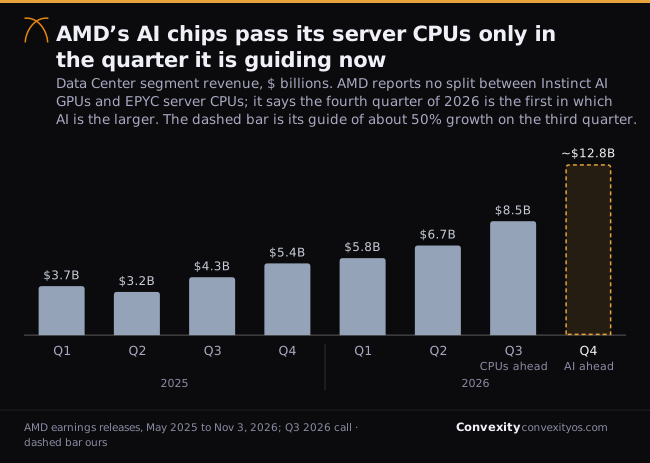
AMD's third quarter was the largest in its history, and the line that carried it is the one investors now read as a gauge of the AI boom. Data Center segment revenue was $8,546 million, up 97% from a year earlier. Revenue for the whole company rose 45% to $13,377 million. And AMD guided the fourth quarter to about $17 billion, with Data Center up about 50% in a single quarter.
It is tempting to read that 97% as the growth of AMD's AI chips. AMD's own call says otherwise. Lisa Su, its chair and chief executive, told analysts that the fourth quarter "is the first quarter where the data center AI business will cross over in terms of size compared to the CPU business."
Put plainly: in every quarter AMD has reported, this one included, it sold more EPYC server processors than Instinct AI accelerators. The near-doubling of the Data Center segment was, in its larger half, a server CPU story.
That matters to anyone using AMD as a reading on the AI buildout, and AMD does not make the split easy. It reports one Data Center number. What it says about the two halves arrives as words, record, double-digit, more than doubled, and the words change from quarter to quarter. This note sets those words against the numbers, works out what can and cannot be known about the AI half, and then follows the AI deals that are supposed to make the fourth quarter different.
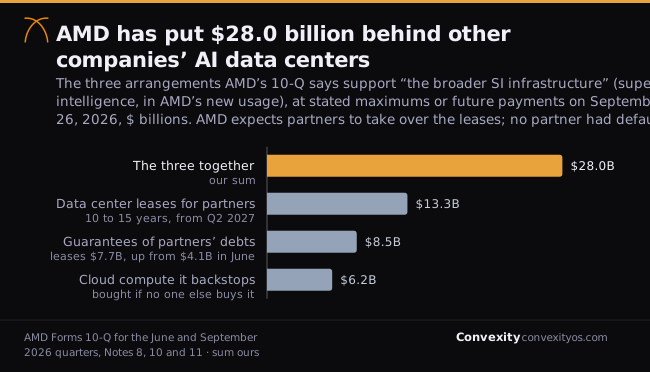
Those deals are starting to show up in AMD's accounts, though not where a reader hunting for revenue would look. They appear as a $1.1 billion charge for warrants AMD gave its two largest AI customers, and as $28.0 billion of leases, guarantees and cloud capacity AMD has signed up for so that other companies can build the data centers its chips go into.
AMD's third-quarter 2026 earnings release and Form 10-Q; the November 3 call in two transcripts. The ceiling, the guide and the sum are ours.
Two businesses in one line
AMD reports three segments. Data Center, as the release's footnote defines it, "primarily includes Artificial Intelligence (AI) accelerators, microprocessors (CPUs) for servers," followed by a list of smaller products: GPUs, APUs, DPUs, AI network cards, FPGAs and adaptive chips for data centers. That one line holds two businesses with different customers and different economics. EPYC server processors sell to every large cloud and to thousands of enterprises. Instinct accelerators sell, mostly, to a handful of very large AI buyers who order by the gigawatt. AMD runs them separately and talks about them separately on its calls. It reports them together.
It holds that line on purpose. In February, with 2025 over, Stacy Rasgon of Bernstein asked for a single number: "the annual 2025 Instinct number now that we're through the year, how big was it?" Su declined, in AMD's own transcript of that call: "as you know, we don't guide at the business level." She offered a modeling hint instead. That is AMD's habit. Each half gets an adjective each quarter, and sometimes a growth rate, but never a dollar figure. Here is what AMD has said about each half in 2026, beside the segment growth it reported.
| Quarter | Data Center segment, from a year earlier | Server CPUs, as AMD described them | Data center AI, as AMD described it |
|---|---|---|---|
| Q1 2026 | up 57% | "greater than 50%" | "a significant double-digit percentage"; down modestly from Q4, on lower China sales |
| Q2 2026 | up 107% | cloud and enterprise each more than 70% | "more than doubled" |
| Q3 2026 | up 97% | cloud and enterprise each "more than doubled" | "record"; no growth rate given |
The segment growth rates are our arithmetic on AMD's releases; the descriptions are from the first-quarter and second-quarter calls in AMD's transcripts and from the third-quarter call in both public transcripts.
Look at what changed in the third quarter. In the second, AMD gave the AI half a growth rate, more than double, measured against a year-earlier quarter that U.S. export controls had hollowed out (more on that below). In the third, the server half got the growth rate and the AI half got the word "record." Jean Hu, AMD's chief financial officer, said the 27% sequential rise in the segment was "primarily driven by initial MI450 series sales and strong server revenue growth," in that order, with no weights attached.
Su also gave a reason the server half is growing so fast, and it is an AI reason. AI agents, she said, work continuously across applications, "adding to accelerator demand while creating a substantial increase in CPU demand." And the server chips ride along even on AI systems AMD does not supply: "OpenAI selected Turin EPYC processors as the host CPUs for its first custom accelerator platforms." Some of the CPU half, in other words, is AI money too. But it is not the AI money that AMD's Instinct deals, and AMD's 2027 promises, are about.
What the arithmetic allows
Two of AMD's statements, taken together, set limits on the AI half that AMD did not volunteer.
The first is a ceiling. If AI was still smaller than server CPUs in the third quarter, and both sit inside a segment of $8,546 million, then AI was less than half of it: under $4,273 million (our arithmetic). The true figure is lower still, by whatever the rest of the segment sold (the networking cards, DPUs, FPGAs and adaptive chips AMD also books there) and by however far AI trailed CPUs. AMD does not say how large either gap is. A ceiling is all its disclosures support, and it is a ceiling, not an estimate.
The second is about growth. Su said that in server, "both cloud and enterprise sales more than doubled" from a year earlier. If both parts of a business more than doubled, the business did. The segment as a whole grew 97%, a little less than double. So everything in Data Center that is not a server CPU, Instinct included, grew by less than 97% taken together (our arithmetic, from AMD's words). In the quarter that was read as an AI blowout, the CPU half of AMD's data center business outgrew the rest of it.
That bound has an honest limit. Everything in the segment that is not a server CPU is not the same thing as Instinct. If the smaller products in the segment shrank, Instinct alone could have grown faster than 97% while the group grew more slowly. AMD reports those products no more than it reports Instinct, so the bound applies to the group and to nothing narrower. What it does rule out is the comfortable reading, that the AI half carried the segment and server CPUs came along for the ride.
Then comes the fourth quarter. Hu guided Data Center to grow "approximately 50%" from the third, which puts it at about $12.8 billion (our arithmetic). That is more than double the $5,380 million of a year earlier, and about three quarters of the roughly $17 billion AMD expects in total. Rasgon asked whether the crossover would be "just barely there." AMD's answer was that data center AI would be "much higher" than the server business in the quarter, and, when he pressed, "in terms of dollars." The two transcripts disagree about who said it (one names Su, the other Hu), so we attribute it to AMD.
So the shape is clear even where the numbers are not. A server CPU business grew faster in each quarter of 2026, by more than half in the first and more than double in the third. An AI business sat below it in every reported quarter and steps past it in the fourth, on the first MI450-series shipments. The fourth quarter will be the first in which AMD's Data Center growth is mostly AI growth. It has not been so far.
The base that flattered, then stopped
A growth rate is only as good as its base, and AMD's AI base in 2025 was bent by U.S. export controls on the MI308, the version of its accelerator built for China.
In the second quarter of 2025, with the MI308 caught by the restriction, AMD took $800 million of inventory and related charges. Data Center revenue that quarter fell to $3,240 million, its lowest of the year, and the segment posted an operating loss of $155 million. The third-quarter 2025 release said results "did not include any revenue from shipments" of MI308 to China. In the fourth quarter of 2025, AMD sold about $390 million of MI308 into China and released about $360 million of the reserves it had taken, which lifted gross margin that quarter to 57%. For the year, the MI308 charges netted to about $440 million.
That is why "more than doubled" in the second quarter of 2026 means less than it sounds. It was measured against the quarter of the $800 million charge, AMD's weakest Data Center quarter of 2025. The third-quarter comparison is cleaner, against a year-earlier quarter with no China MI308 revenue in it.
What AMD sold into China this quarter is not known. Its third-quarter release and call do not mention China. The 10-Q says only that AMD began shipping MI308 under licenses at the end of 2025, and that licenses granted in the first half of 2026 for its MI325 to certain China-based customers require the chips to be inspected in the United States first. That inspection, the 10-Q says, makes any MI325 shipped under those licenses "subject to a 25% tariff upon importation into the United States."
What the mix does to margins
The split is more than a matter of labels, because the two halves do not earn the same margin, and AMD has now said which way the difference runs.
Non-GAAP gross margin was 56% in the third quarter, up from 54% a year earlier and level with the second quarter. AMD guides the fourth quarter to about 55%, a point lower, in a quarter when it expects revenue to rise 27%. Hu explained why on the call. Data center AI is about to pass servers, and "we all know" its margin is "a little bit dilutive to corporate average."
That is the plainest statement AMD has made that the two halves differ, and it cuts against a common assumption that the AI chip is the rich product. AMD gives neither half's margin. But an AI business below the company average, in a company whose PC and console chips pull that average down, suggests the server CPU is the richer of the two (our inference). The likely reasons are not hard to find: accelerators go into a few enormous deployments, each package carrying expensive high-bandwidth memory, for customers who buy by the gigawatt and negotiate accordingly. AMD's answer is that gross profit dollars rise fast enough for the percentage not to matter much. Asked by Joshua Buchalter of TD Cowen about memory costs, Su said AMD is working with customers "to ensure that those costs are shared as we go forward."
On a reported basis, the year-to-date improvement is larger. GAAP gross margin for the first nine months of 2026 was 54%, against 47% a year earlier, which the 10-Q attributes to "the absence of inventory and related charges associated with the U.S. government export control" on MI308, along with a richer mix. No export-control charge appears in the third quarter of 2026.
The segment has also become far more profitable at the operating line. Data Center operating income was $2,882 million, a 34% margin against 25% a year earlier (both margins our arithmetic, and both match the rounded figures Hu gave). AMD does not split that either, so how much of the improvement came from CPUs is another thing it leaves unsaid.
How the OpenAI and Meta deals reach the accounts
The fourth quarter's crossover rests on a few very large customers. On the call, Su named Anthropic, Meta, Microsoft, OpenAI and Oracle as lead customers that "brought their first Helios racks online" in the quarter. Two of them have unusual contracts.
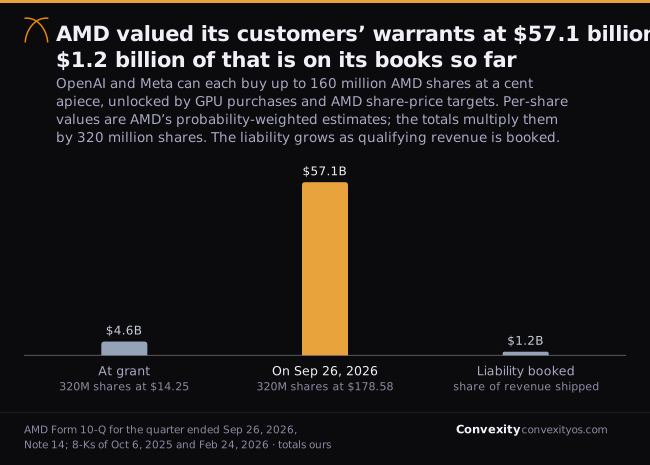
In October 2025, AMD agreed to supply OpenAI with six gigawatts of Instinct GPUs, starting with one gigawatt of the MI450 series. In February 2026, it struck a similar arrangement with Meta. Each customer made a binding commitment to buy the first gigawatt. Each received a warrant to buy up to 160 million AMD shares for a cent apiece. The shares vest in tranches as the customer buys GPUs, the first on the first gigawatt and the last on the sixth, and only if AMD's stock clears price targets that rise to $600 a share for the final tranche. Even vested shares cannot be exercised until certain "technical and commercial conditions" are met.
Under the accounting rules, a warrant handed to a customer is a discount on what the customer pays. The third quarter is when that discount began to land, because it is when AMD started shipping the chips. "Third quarter was the first quarter that we shipped MI455 and Helios racks for revenue," Su said.
The accounting runs on two tracks.
On the first track, the warrants' value on the day they were granted, AMD's estimate of $14.25 a share on average, comes off revenue in proportion as qualifying sales are booked. AMD's reported revenue is already net of it. As Hu put it, "whenever we talk about the revenue, it's always net revenue."
On the second track, any change in the warrants' value after the grant runs through other income and expense until a tranche can be exercised. This was the big one in the third quarter. AMD's share price had risen and its estimate of the odds that the conditions would be met had changed, so by September 26 the warrants' fair value had climbed to $178.58 a share. AMD booked a charge of $1,097 million. That brought GAAP earnings down to $1.46 a share, against non-GAAP earnings of $2.09 that leave it out; the charge alone was worth $0.66 a share. Hu described it as "primarily reflecting the increase in our share price and the changes in the estimated probability of meeting the warrant conditions."
The first track is still small. The cash-flow statement shows a total non-cash warrant impact of $1,179 million. Take away the $1,097 million remeasurement and $82 million is left, which fits the grant-date value deducted from revenue so far. That reading is ours; AMD does not state the figure. What AMD does state is what remains: $4.5 billion of grant-date value not yet recognized, which will come off revenue as qualifying sales are booked. Against revenue AMD has put at double-digit billions of dollars per gigawatt, across up to twelve gigawatts, that is a small discount.
The second track is where the size is. At $178.58 a share, the 320 million warrant shares were worth about $57.1 billion on AMD's own estimate at quarter-end, against about $4.6 billion when they were granted (both totals our arithmetic). The liability on the balance sheet, $1.2 billion, is only the slice attributable to revenue booked so far. As shipments continue, that liability grows toward whatever the warrants are then worth, and the growth beyond grant-date value passes through GAAP earnings on the way. Hu said the quarterly adjustment would increase "as we and our customers progress."
Since then, the stock has moved the other way. AMD closed at $630.63 on September 25, the last trading day of its quarter, above the $600 top price target. It closed at $483.90 on November 3, the day it reported, 23.3% lower (our arithmetic). It rose 1.0% to $488.78 on November 4, the first session after the report. On November 5 it fell 17.3%, to $404.40, on a day when the PHLX Semiconductor Index fell 12.2%; that close is 35.9% below September 25's (our arithmetic). (Corrected November 6: this sentence first gave the close as $403.80, the last trade of the session rather than the official close, and so put the fall at 17.4% and the gap at 36.0%.) A lower stock lowers the value of each warrant share. More shipments raise the share of them AMD must carry. AMD has not said which will win in the fourth quarter.
Neither track touches cash or non-GAAP results. The share count is the third thing to watch. The 320 million shares would be 19.5% of the 1,640 million AMD had outstanding on October 28 (our arithmetic), though only shares that vest and are exercised would count. AMD's fourth-quarter guide of about 1.67 billion diluted shares includes none of them, and Hu said guidance on the warrants' dilution would come in 2027.
The commitments behind the customers
The warrants are one way AMD helps pay for its own demand. The 10-Q describes others, and they are growing quickly.
Under a heading it calls "Additional Commitments," AMD lists three arrangements "intended to support the development of the broader SI infrastructure." SI stands for super intelligence, the term AMD's filings now use where they used to say AI.
The first is cloud compute. AMD has committed to buy up to $6.2 billion of GPU computing capacity from cloud providers, either "to the extent the capacity is not purchased by third-party customers" or for capacity it reserved and may resell. The commitment runs from the rest of 2026 into the next decade and shrinks as outside customers pay for the capacity. In effect, AMD is the buyer of last resort for that capacity.
The second is leases. AMD has signed data center leases, not yet started, with $13.3 billion of future payments over terms of 10 to 15 years beginning in the second quarter of fiscal 2027. It expects them "to be assigned or subleased to commercial partners."
The third is guarantees. AMD will pay up to $8.5 billion if commercial partners default on their data center leases ($7.7 billion, for up to 15 years) or on borrowings used to finance data center infrastructure ($750 million, for up to six months). At the end of June, its lease guarantees stood at $4.1 billion, and that quarter's 10-Q noted they "may be issued in exchange for warrants," so AMD can receive a claim on equity from the partner it is backing. In one quarter, the lease guarantees rose 88%, to $7.7 billion (our arithmetic), and the debt guarantees, which the June filing does not mention, appeared. As of September 26, no partner was in default and AMD had paid nothing.
Together, those three come to $28.0 billion (our sum). Beside them sit two more commitments: up to $5.1 billion of equity investments, "primarily in privately held companies that develop SI and other technologies," and a $1.0 billion investment AMD made in October in an equity offering by a public company it does not name. The earnings release mentions these guarantees only in its list of risk factors, with no amount.
The equity commitments come with as little detail as the segment line. AMD's 10-Q for the June quarter records that after June 27 it "entered into investment commitments of up to $5.0 billion, subject to certain contingencies," to be made through fiscal 2028. The September filing puts the total at up to $5.1 billion, "subject to certain conditions," on the same timetable. Neither filing names a company, so neither does this note.
Su described the approach on the call. Vivek Arya of Bank of America asked whether AMD's anchor customers had the financing and the physical infrastructure for what he called roughly three gigawatts of planned AMD deployments into 2027, his estimate rather than AMD's. Su said AMD is "selectively investing with our lead partners where we see it's helpful to have, for example, the data center infrastructure identified way in advance." She added: "we know where the GPUs are going in terms of which data centers and which locations."
This is the pattern our note on Nvidia's second quarter found at far larger scale, a chipmaker becoming part of the credit behind its own demand, and the one our ledger of the AI buildout's financing found among the cloud companies, whose biggest bills are leases signed but not yet started. AMD now has both kinds of line in its own 10-Q.
None of this means anything is likely to go wrong. Leases can be assigned as planned, guarantees can expire unused, and cloud capacity can be sold through. The point is narrower. Part of AMD's AI revenue no longer arrives as a plain sale. It comes with AMD's stock, AMD's credit or AMD's purchasing power attached, and none of that is visible in the Data Center segment line.
Running ahead of the revenue
Two more figures in the filings show how far ahead of its revenue AMD is building.
Inventory rose about $3.0 billion in the quarter, to $11,463 million, which Hu said was "to fulfill our strong data center demand." Purchase commitments for wafers, substrates and other components reached $48.8 billion, of which $33.4 billion falls due by the end of 2027. Free cash flow was $554 million, about 4% of revenue, against $1,530 million and about 17% a year earlier (the percentages are ours).
Meanwhile the multi-gigawatt agreements barely register as backlog. The only contracted-revenue figure AMD discloses, its remaining performance obligations on contracts with an original term of more than a year, was $246 million. OpenAI and Meta each made a binding commitment for a first gigawatt, and Su said last quarter that revenue per gigawatt runs to "double digit billions." Whatever those first gigawatts are worth, they are not in that $246 million, and AMD gives them no dollar value anywhere else.
A risk factor in the 10-Q adds a detail the release leaves out: "Although we supply certain products used in Helios rack-scale solutions, we do not manufacture or sell the completed Helios rack-scale solutions." AMD sells the chips and licenses the design. Partners build the racks, with networking, memory, power and cooling from other suppliers. When AMD says Helios racks shipped for revenue, the revenue it books is for its own parts of the rack.
What AMD has promised for 2027
AMD went further on 2027 than it did a quarter ago. Su said she now expects revenue "to grow more than 80% in 2027," that server revenue will double, and that "data center AI revenue" will "grow even faster than we projected 90 days ago." Data Center, she said, will be "more than 80% of our total revenue in 2027."
Those statements can be turned into a floor. Take the first nine months of 2026, $35,166 million, add the $17 billion midpoint of the fourth-quarter guide, and 2026 revenue comes to about $52.2 billion. Growth of more than 80% puts 2027 above $93.9 billion, and more than 80% of that puts Data Center above about $75 billion, against roughly $33.9 billion in 2026 on the same guide (all our arithmetic). The segment would have to grow about two and a quarter times in a year.
How that splits, AMD again declines to say exactly. Timothy Arcuri of UBS asked whether the right way to think about it was that GPUs would be bigger than server CPUs in dollars, "but not much." Su answered with figures she asked analysts to treat loosely: "you should just consider them markers." The data center CPU business, she said, "will about double," and the data center AI business "will significantly more than double." In May she had said AMD expected "tens of billions of dollars in annual data center AI revenue in 2027."
So the 2027 story is the reverse of the 2026 one. Until the fourth quarter of 2026, the CPU half was the larger. In 2027 the AI half has to carry it, starting from the fourth quarter, on the first full year of MI450 shipments into data centers that partners are building, in some cases with AMD's leases, guarantees and capital behind them. Anyone tracking the AI buildout through AMD's Data Center line should know that the line only now starts to measure it, and that the measurement will arrive, as it has all year, without a split.
What would prove this wrong
- The crossover meant something else. If the "CPU business" Su compared AI against was something wider than server CPUs, all of AMD's CPUs including PCs for instance, the ceiling on the third quarter's AI sales would not hold. The context points to server: the question was about the Data Center segment, and Hu's own version on the call compared data center AI with the "server business."
- The smaller products shrank. If sales of FPGAs, DPUs and networking cards fell enough, Instinct alone could have grown faster than the segment in the third quarter. A disclosure of those lines, or of Instinct revenue, would settle it.
- The fourth quarter misses. If Data Center comes in well short of about $12.8 billion, or AMD reports that AI did not pass server CPUs after all, the crossover moves out a quarter or more, and the 2027 floor with it.
- The backstops expire quietly. If the leases are assigned on schedule, the guarantees run off unused and the cloud capacity is sold through to others, the $28.0 billion will have been a bridge rather than a burden, and this note's attention to it will look overcautious.
- The warrant charges stay small. If the stock stays well below its September level, remeasurement charges could shrink or reverse even as shipments rise, and the $57.1 billion figure will overstate what eventually passes through earnings.
The filings and documents this is built on
- 8-KAMD third quarter 2026 earnings release (Exhibit 99.1)Revenue, segment revenue and operating income, gross margins, EPS, the warrant adjustment, cash flow, the fourth-quarter outlook and the Data Center segment definitionNov 3, 2026
- 8-KAMD third quarter 2026 earnings slidesSegment and non-GAAP detailNov 3, 2026
- CallAMD Q3 2026 earnings call transcript, The Motley FoolEvery November 3 quotation was checked against this transcript and Benzinga’s; retrieved 2026-11-04Nov 3, 2026
- CallAdvanced Micro Devices Q3 2026 earnings call transcript, BenzingaThe second transcript; where the two name different speakers for an answer, the note attributes it to AMD; retrieved 2026-11-04Nov 3, 2026
- 10-QAMD Form 10-Q, quarter ended September 26, 2026Note 3 (other income and the warrant remeasurement), Note 8 (credit derivatives), Notes 10 and 11 (leases, commitments, guarantees), Note 14 (customer warrants), remaining performance obligations, inventory, MI308 and MI325 export licenses, the Helios risk factor, shares outstandingNov 4, 2026
- 10-QAMD Form 10-Q, quarter ended June 27, 2026$4.1 billion of lease guarantees, which may be issued in exchange for warrants; investment commitments of up to $5.0 billion entered after June 27Aug 5, 2026
- 8-KAMD second quarter 2026 earnings release (Exhibit 99.1)Second-quarter segment revenue, with the year-earlier quarter and its $800 million MI308 chargeAug 4, 2026
- 8-KAMD first quarter 2026 earnings release (Exhibit 99.1)First-quarter segment revenue, with the year-earlier quarterMay 5, 2026
- 8-KAMD fourth quarter and full year 2025 earnings release (Exhibit 99.1)Fourth-quarter 2025 segment revenue, MI308 China sales and reserve release, the year’s net MI308 chargesFeb 3, 2026
- 8-KAMD third quarter 2025 earnings release (Exhibit 99.1)Third-quarter 2025 segment revenue; no MI308 revenue from China in the quarterNov 4, 2025
- CallAMD Q2 2026 earnings call, AMD’s transcriptSecond-quarter descriptions of the server and AI halves; revenue per gigawatt in double-digit billionsAug 4, 2026
- CallAMD Q1 2026 earnings call, AMD’s transcriptFirst-quarter descriptions of the server and AI halves; tens of billions of data center AI revenue expected in 2027May 5, 2026
- CallAMD Q4 2025 earnings call, AMD’s transcript“We don’t guide at the business level”Feb 3, 2026
- 8-KAMD and OpenAI agreement and warrantSix gigawatts; binding commitment for the first; warrant for up to 160 million shares with price targets rising to $600Oct 6, 2025
- 8-KAMD and Meta arrangement and warrantSix gigawatt equivalents; binding commitment for the first; warrant for up to 160 million sharesFeb 24, 2026
- DataNasdaq, AMD historical quotesOfficial closes of September 25 and November 3, 4 and 5, 2026; retrieved 2026-11-05, November 5 retrieved 2026-11-06Nov 5, 2026
- DataNasdaq, PHLX Semiconductor Index (SOX)Closes of November 4 and 5, 2026; retrieved 2026-11-05Nov 5, 2026
- DataState Street, SPDR S&P 500 ETF Trust daily holdingsHoldings as of November 3, 2026, used for the disclosure; retrieved 2026-11-04Nov 3, 2026
Not investment advice. This note is an analysis of AMD's public disclosures and its earnings calls, published for research purposes, and not a recommendation to buy, sell or hold any security. A member of the Convexity team holds SPY, which holds AMD, Meta, Microsoft, Oracle and Nvidia, and a member of the team owns Meta shares directly; no other position in any company named here. A member of the team holds an economic interest in Anthropic through a special-purpose vehicle and a fund, and stands to benefit if its valuation rises; Convexity is an Anthropic customer, and this note was drafted with Claude, Anthropic's model.
What here is ours rather than AMD's. As filed or stated by AMD: every revenue, segment, margin, operating income, earnings, cash flow, inventory, commitment, lease, guarantee, warrant and share-count figure; the fourth-quarter outlook, including the roughly 50% Data Center growth Hu gave on the call; the 2027 statements; and every quotation, from AMD's filings, from AMD's own transcripts of earlier calls, or, for November 3, from wording both public transcripts carry. Ours: the year-on-year segment growth rates in the table; the $4,273 million ceiling on the third quarter's AI sales and the bound that everything in the segment other than server CPUs grew less than 97%, both derived from AMD's statements; the roughly $12.8 billion fourth-quarter Data Center figure, its share of the $17 billion guide and its comparison with a year earlier; the $28.0 billion total of the three backstops and the 88% rise in lease guarantees since June; the $82 million left after the warrant remeasurement and our reading of it as the grant-date value deducted from revenue; the $4.6 billion and $57.1 billion warrant totals; the warrants' 19.5% share of shares outstanding; the 23.3% fall in the stock to November 3, its 1.0% rise on November 4, its 17.3% fall on November 5, that close's 35.9% gap below September 25's, and the semiconductor index's 12.2% fall; the segment's operating margins and the free cash flow margins; the 2026 revenue and Data Center totals on the guide and the 2027 floor of about $75 billion; and the inference that server CPUs carry the higher margin.
Correction, November 6, 2026. As first published, this note gave AMD's November 5 close as $403.80. That was the session's last trade, taken from Nasdaq's quote page before its historical table carried the day, not the official close, which Nasdaq publishes as $404.40. With the official close, the November 5 fall is 17.3% rather than 17.4%, and the close is 35.9% below September 25's rather than 36.0%. The semiconductor index figures were right, and no other figure or argument in the note changed.