








Disclosure. Not investment advice, and nothing here is a recommendation to buy, sell or hold any security. A member of the Convexity team holds the SPDR S&P 500 ETF (SPY), which holds Eli Lilly and IQVIA, the data provider whose prescription counts Novo cites; no other position. Novo Nordisk is not an S&P 500 member, and SPY does not hold it. Figures are from Novo Nordisk's financial reports furnished to the SEC on Form 6-K, its third-quarter investor presentation and its November 4 earnings call, and from Eli Lilly's Form 10-Q and earnings release; policy facts are from the White House, the Centers for Medicare & Medicaid Services and the Food and Drug Administration, and exchange rates from the Federal Reserve. We read the call in two independently produced transcripts and quote only wording both carry. Novo reports in Danish kroner, so every dollar figure for Novo is our conversion. Share prices are official closes: Nasdaq Copenhagen for the B shares in kroner, and Nasdaq's historical table for the American depositary receipts listed in New York. The closing note lists what is our arithmetic.
In February, Novo Nordisk told investors to expect its sales to shrink in 2026, by somewhere between 5% and 13% at constant exchange rates. On November 4 it said the year would land between 2% lower and 2% higher. The company that built the market for weight-loss drugs has spent 2026 working its way back to flat.
How it got there is the story. Novo cut the price of Wegovy, its obesity drug, and cut it on purpose: cash prices for people who pay out of pocket, a Medicare program that opened in July, and a pill whose cash price starts at $149 a month. The prescriptions came back. Novo's U.S. Wegovy sales rose 21% in the third quarter at constant exchange rates.
All of that growth came from the pill. And a pill prescription brought in about $179 in the quarter, by our arithmetic, against about $415 for a prescription of the injection. Novo is selling more Wegovy for less.
Our companion note on Eli Lilly's third quarter asked how much of Lilly's growth was volume and how much price it gave up to get it. This note asks the same question of Lilly's rival, with a hypothesis we brought to the report: that Novo's U.S. price is falling faster than its volume is growing, while Lilly takes share.
For the first nine months of 2026, Novo's own report says as much. U.S. sales fell 2% at constant exchange rates, "reflecting lower realised prices, largely offset by volume growth." For the third quarter, the hypothesis is only half right. In obesity, volume outran price. The U.S. business barely grew because of diabetes, where Ozempic lost prescriptions in a market that is still growing. And measured the same way, in dollars, Lilly's U.S. sales of tirzepatide grew 44% while Novo's U.S. sales of semaglutide stood still.
- +21%
- Novo’s U.S. Wegovy sales growth in Q3 at constant exchange rates, injection and pill together; the injection alone fell 13%
- 30–35%
- the fall in Wegovy’s U.S. price that Novo’s head of U.S. operations said it saw in the quarter
- $179
- U.S. sales per Wegovy pill prescription in Q3, our arithmetic; about $415 for the injection
- +44%
- growth in Lilly’s U.S. tirzepatide sales in Q3, in dollars; Novo’s U.S. semaglutide sales were about flat (ours)
Novo Nordisk's Q3 2026 financial report and November 4 call; Eli Lilly's Q3 2026 Form 10-Q. Per-prescription figures and the growth comparison are our arithmetic.
Where the growth came from
Novo's sales rose 4% at constant exchange rates in the third quarter, to DKK 79.2 billion, about $12.2 billion at the quarter's average exchange rate (our conversion). Nothing was adjusted out of the third quarter's sales. That matters because two earlier quarters carry one-time reversals of a rebate provision under the U.S. 340B drug discount program, DKK 26.8 billion in the first quarter of 2026 and DKK 2.6 billion in the second quarter of 2025, which Novo strips out of its "adjusted" figures. Every growth rate here uses those adjusted figures.
The split by geography is the first clue. Sales in International Operations, Novo's name for everywhere outside the U.S., rose 8%. U.S. sales rose 1%.
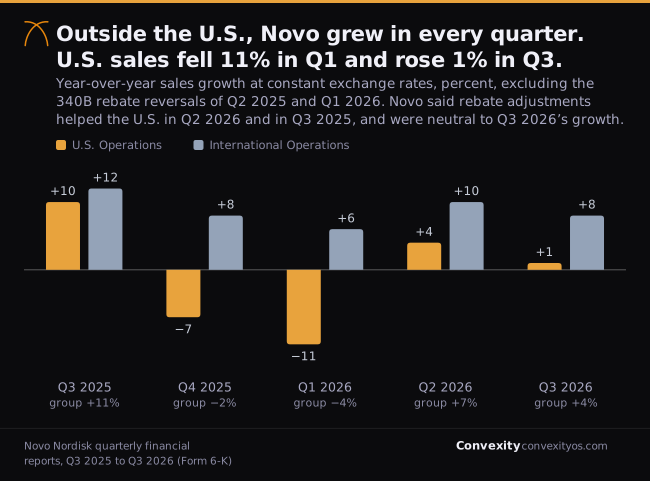
| U.S. Operations | International Operations | |
|---|---|---|
| Q3 2025 | +10 | +12 |
| Q4 2025 | −7 | +8 |
| Q1 2026 | −11 | +6 |
| Q2 2026 | +4 | +10 |
| Q3 2026 | +1 | +8 |
The U.S. line swings, and some of the swing is accounting. A year earlier, Novo's U.S. sales were flattered by about DKK 2 billion of favorable adjustments to its estimates of rebates and discounts, which Novo calls gross-to-net adjustments, and about DKK 1 billion of wholesalers building stock. The second quarter of 2026 was helped by rebate adjustments too. In the third quarter of 2026, Novo said, "Gross-to-net sales adjustments in the US were neutral to growth," with similar positive effects in both years. So the third quarter's 1% is about as clean a reading of the U.S. business as the last five quarters offer.
Outside the U.S. the picture is broader and steadier. Europe and Canada, which Novo reports together, grew 18%. Emerging markets grew 6%. Asia Pacific fell 7% and China fell 5%, where Novo cut Wegovy's list price late in 2025. In Canada, semaglutide has lost patent exclusivity, and Novo said prices fell there while its volumes held roughly steady.
Emil Kongshøj Larsen, who runs International Operations, described the trade abroad as mostly volume. "I would say very disciplined pricing where we've not given up," he said on the call, adding that "volume growth year to date" for the Wegovy injection had "been close to 70%." Novo said it holds 54% of GLP-1 volume outside the U.S.
Profit moved more than sales, for reasons that sit outside this note. Adjusted operating profit rose 27% at constant exchange rates to DKK 31.7 billion, against a year-earlier quarter that carried about DKK 9 billion of restructuring costs, and reported operating profit fell 9% after DKK 8.7 billion of impairment charges.
More Wegovy, at a lower price
Novo's U.S. obesity sales rose 20% at constant exchange rates in the third quarter, to DKK 15.3 billion. Inside that number, two products moved in opposite directions.
Sales of the Wegovy injection fell 13%. Sales of the Wegovy pill, launched in the U.S. on January 5, were DKK 4.2 billion. Together, U.S. Wegovy sales rose 21%. The pill accounts for all of the increase and then some, because the injection shrank.
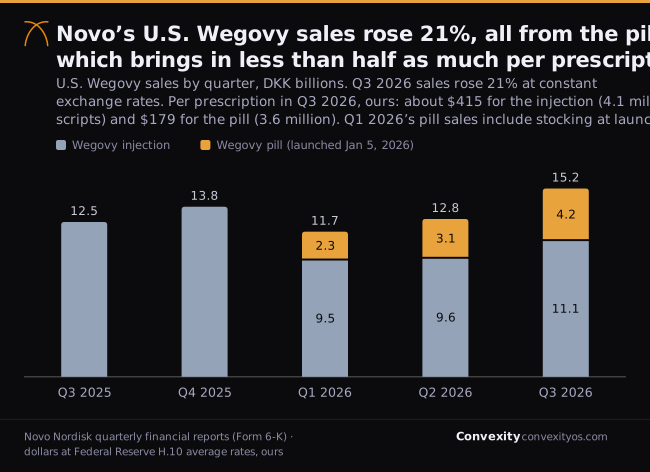
| Wegovy injection | Wegovy pill (launched Jan 5, 2026) | |
|---|---|---|
| Q3 2025 | 12.532 | – |
| Q4 2025 | 13.767 | – |
| Q1 2026 | 9.4939.5 | 2.2562.3 |
| Q2 2026 | 9.6369.6 | 3.1413.1 |
| Q3 2026 | 11.06611.1 | 4.1784.2 |
The prescriptions explain the money. Novo counted about 4.1 million U.S. prescriptions for the Wegovy injection in the third quarter and about 3.6 million for the pill. That is about 7.7 million in all, or roughly 590,000 a week. A year earlier, Novo's report put Wegovy at "around 270,000 weekly prescriptions." On those figures, Novo was filling more than twice as many Wegovy prescriptions as it had been a year before (our arithmetic, and rough, since the two counts come from different kinds of statement). Its U.S. Wegovy sales were up a fifth.
Divide the quarter's sales by its prescriptions and the price of that volume shows. The injection brought in about DKK 2,700 a prescription, about $415. The pill brought in about DKK 1,160, about $179. Those are our figures, and they are approximate: Novo's prescription counts are rounded, and a quarter's sales include more than the scripts filled in it. But the gap is too wide for rounding to close. A pill prescription earns Novo less than half what an injection prescription does.
The $179 sits where Novo's own price list says it should. Novo said about 90% of pill prescriptions are self-pay, and that its self-pay prices run from $149 to $299 a month depending on the dose. Most patients start low and step up. Novo said on November 4 that more than 30% of weekly pill prescriptions were for the two highest doses, and our per-prescription figure rose from about $169 in the second quarter. Dose is the pill's built-in source of price growth, though prescriptions through Medicare's new program, described below, may have lifted the average too; Novo does not say.
The injection is getting cheaper too. Asked on the call how to think about pricing into 2027, Jamey Millar, Novo's head of U.S. operations, said: "on the Wegovy side, we've again seen 30%, 35% in the quarter." That was, he said, "a little on the high end, but we expect that or a little better moving forward." He gave the figure alongside Novo's yearly rate for Ozempic, and read the same way, a decline of 30% to 35% a year would halve Wegovy's U.S. price in about two years (our arithmetic).
Set against the market, Novo's growth looks smaller still. The volume of branded obesity drugs sold in the U.S. grew 71% in the twelve months to August, by IQVIA's count as Novo reports it. Novo's U.S. obesity sales grew 11% at constant exchange rates in the first nine months. The gap between those two numbers is made of price and of share, and Novo's report does not separate them.
Novo argues it is winning the share half. It said its Wegovy brands take more than half of new U.S. patients starting a branded obesity drug, and that the pill takes about 80% of new patients starting an oral one. Lilly, on its own call six days earlier, said about six in 10 of all U.S. prescriptions for obesity incretins were for a Lilly medicine. Those two can both be true, since one counts new starts and the other every prescription.
The pill numbers cannot. Lilly also said its pill, Foundayo, was approaching four in 10 new prescriptions among oral obesity drugs. Eight in 10 for Novo and four in 10 for Lilly add up to more than the whole market.
Novo's explanation is a counting gap. Millar said the pharmacy data most investors use misses part of Novo's pill business, because many of its telehealth and cash-pay partners do not report to IQVIA, the data provider. Novo has "consistently seen a lower capture rate for Wegovy pill than the competitive oral product," he said. Novo's own counts blend IQVIA data with its internal self-pay records. A count built on IQVIA alone would show Novo's share lower and Lilly's higher. Neither company publishes enough to settle it from outside, so treat every oral share figure, ours included, as a claim about method as much as about patients.
Novo is also trying to make cash-pay patients stay. It sells three-, six- and twelve-month subscriptions to Wegovy at fixed prices, and had about 55,000 active at the end of September. Against 7.7 million prescriptions a quarter, that was a test, not yet a channel.
The contest for those patients got harder on November 6, when Lilly and Hims & Hers, the telehealth company that has sold Wegovy and Ozempic since March, said Hims would also sell Zepbound and Foundayo on its platform, at self-pay prices starting at $299 and $149 a month. Foundayo's floor matches the Wegovy pill's.
The Bridge did much of the lifting
The third quarter had something the first two did not. On July 1, Medicare coverage for obesity medicines became available through a demonstration the Centers for Medicare & Medicaid Services calls the Medicare GLP-1 Bridge. It runs through December 31, 2027, operates outside the normal Part D drug benefit, and charges an eligible patient a $50 copay.
The price behind it was set in November 2025. A White House fact sheet of November 6, 2025 announced agreements with Novo and Lilly under which "the Medicare prices of Ozempic, Wegovy, Mounjaro, and Zepbound will be $245." The same agreements set a price of $350 for Ozempic and Wegovy on the government's TrumpRx site, against list prices of $1,000 and $1,350 a month. Those prices have since changed. As of November 9, 2026, TrumpRx and Novo's own NovoCare site show the Wegovy pen at $199 for a new patient's first two monthly fills, an offer that runs through December 31, 2026, and $349 a month after that for standard doses. NovoCare lists the pill at $149 to $299 by dose.
Millar was direct about how much of the quarter's growth came through that door. He said Novo was seeing "about 60,000 TRXs across injectable and oral in terms of Bridge," meaning total prescriptions a week. In Q3, he said, "Wegovy pill volumes grew around 20% versus Q2, and injectable Wegovy volumes grew around 10% sequentially." And: "The sequential growth of 20% in the quarter is largely, but not exclusively, Bridge volume."
Asked what the market looked like without it, he answered for the whole category, not just Novo: from May to October, excluding the Bridge, "the whole category is relatively flat, consistent with the seasonality." People start weight-loss treatment around the New Year, he said, and the summer is slow.
So the volume that rescued Novo's U.S. obesity business in the third quarter came largely from a government program priced, by the White House's account, at $245 a month. That is below the $349 Novo charges cash buyers for the injection after those introductory fills, and a fraction of the old list price. Lilly sells into the same program at the same price. It said on its October 29 call that seven in 10 new Bridge patients start on a Lilly obesity medicine, and our Lilly note expected its own price per prescription to keep falling in 2027 as Medicare's share of its mix rises.
The Bridge is good for Novo's volume and hard on its price, and both effects grow in 2027. It started in July 2026, so 2027 gets twelve months of it. Novo's chief executive, Mike Doustdar, put that on his list of reasons for optimism.
Ozempic is losing on volume, not price
The hypothesis we brought expected price to be the U.S. problem. In the third quarter, the larger problem was Ozempic, and it was not price.
Ozempic is still Novo's biggest product. Its U.S. sales in the quarter were DKK 19.2 billion, more than the Wegovy injection and pill combined. They fell 11% at constant exchange rates. Novo's U.S. sales of GLP-1 drugs for diabetes fell 10% in all, which Novo attributed to "lower volumes and wholesaler inventory movements, partly offset by slightly higher prices due to channel mix."
Read that sentence twice. Prices were slightly higher. Volumes fell. And the market Novo sells into did not shrink: by IQVIA's count, U.S. volume of GLP-1 diabetes drugs grew 12% in the twelve months to August. Novo's volume fell in a growing market, which is a loss of share.
Its likeliest winner is visible in Lilly's 10-Q. Mounjaro, Lilly's tirzepatide brand for diabetes, sold $5.0 billion in the U.S. in the third quarter, up 41% from $3.55 billion a year earlier. Novo's U.S. Ozempic sales fell 10% in kroner over the same quarter (our arithmetic from the product tables).
On price, Millar repeated Novo's guidance for Ozempic: 10% to 15% "price erosion on an annual basis is the way to think about it." He said the third quarter came in significantly better than that range, but that over a year the range still holds and that payers keep pressing on diabetes prices.
Novo is fighting back with a pill here too. On May 4 it began selling Ozempic pill nationwide in place of Rybelsus, its older oral diabetes drug. Novo said weekly new-to-brand prescriptions were up about 100% from the Rybelsus level, and U.S. sales of the two together rose 5% in the quarter. At DKK 2.1 billion, the pair is about a ninth the size of the injection, so it cannot carry Ozempic alone. A higher 25 mg dose of the pill was submitted to the FDA earlier in 2026; Novo expects a decision in the fourth quarter, and as of November 9 the agency's drug database listed no 25 mg strength.
Lilly, measured the same way
Comparing the two companies takes one step, because they report in different currencies. Lilly reports in dollars. Novo reports in Danish kroner and publishes no dollar sales. We converted Novo's figures at the simple average of the Federal Reserve's daily dollar-krone rates for each quarter. Over the nine months, those averages sit within half a percent of the averages Novo itself prints. But they put Novo's total U.S. growth in the third quarter at 0.1%, against the 1% at constant exchange rates Novo reports, so our dollar figures may understate Novo's growth by up to about a point.
The other step is choosing like for like. Both companies sell one molecule under several brand names, for diabetes and for obesity. Novo's is semaglutide: Ozempic, Wegovy and Rybelsus, in injection and pill. Lilly's is tirzepatide: Mounjaro and Zepbound. Lilly's new pill, Foundayo, is a different molecule and is left out.
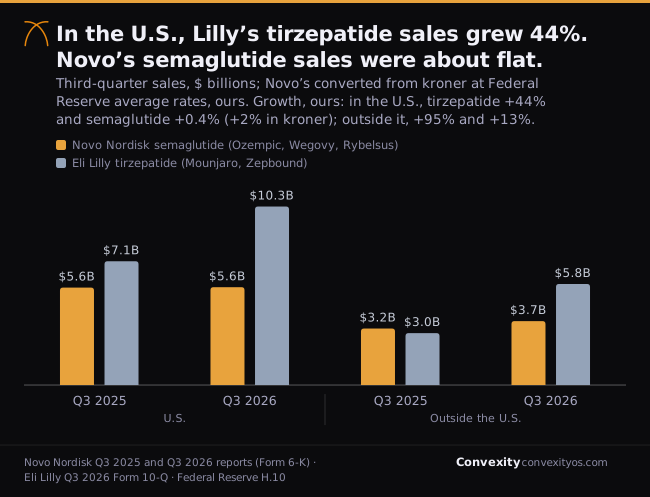
| Novo Nordisk semaglutide (Ozempic, Wegovy, Rybelsus) | Eli Lilly tirzepatide (Mounjaro, Zepbound) | |
|---|---|---|
| US Q3 2025 | $5.6B | $7.1B |
| US Q3 2026 | $5.6B | $10.3B |
| OUS Q3 2025 | $3.2B | $3.0B |
| OUS Q3 2026 | $3.7B | $5.8B |
In the U.S., Lilly's tirzepatide sales rose from $7.1 billion to $10.3 billion, up 44%. Novo's semaglutide sales were $5.6 billion in both quarters, up 0.4% in dollars and 2% in kroner. Outside the U.S., tirzepatide rose 95% and semaglutide 13%, and the order flipped: a year earlier Novo sold more abroad than Lilly did, and by the third quarter of 2026 Lilly sold more. Across the world, Lilly's tirzepatide sales were 1.14 times Novo's semaglutide sales in the third quarter of 2025 and 1.73 times in the third quarter of 2026 (all ours).
The price gap between the two companies is not small either, though the measures differ. Lilly said its U.S. prices fell 7% in the third quarter, or 10% before one-time rebate true-ups, across its whole U.S. business. Millar's 30% to 35% is for one Novo brand. Those are not the same yardstick, but they are not close.
There is one race Novo is clearly ahead in, whatever the share data say. Wegovy pill sales worldwide were DKK 5.4 billion in the third quarter, about $830 million by our conversion. Lilly's Foundayo had $184 million of revenue, so Novo's pill sold about 4.5 times as much. Novo launched first, on January 5, and the lead shows. It is also the cheapest Wegovy Novo sells, so the race it is winning is the one with the thinnest margin per patient.
What the raised guidance says about the fourth quarter
Novo has raised its 2026 sales guidance three times. In February it expected adjusted sales growth at constant exchange rates of −5% to −13%. In May, −4% to −12%. In August, −6% to 0%. In November, −2% to +2%, a midpoint of zero.
"[W]e are at the growth recovery phase, and that is progressing well," Doustdar said. The guidance says something more cautious about the fourth quarter.
Sales rose 2% at constant exchange rates in the first nine months. A full year at zero growth leaves the fourth quarter to give that back. By our arithmetic, the November range implies fourth-quarter sales at constant exchange rates somewhere between about 15% below the fourth quarter of 2025 and 1% above it, with the midpoint about 7% lower. The calculation mixes exchange rates from slightly different periods, so treat it as approximate.
One analyst on the call put the width of that implied fourth-quarter range at about DKK 12 billion of sales, and our arithmetic gets the same. Karsten Munk Knudsen, the chief financial officer, said a range that wide is normal at this point in a volatile category, and pointed to two reasons for a weak quarter: "we do have a tough comparator in the fourth quarter," because of a U.S. gross-to-net benefit of about DKK 3 billion in the same quarter of 2025, and the loss of exclusivity, mainly in Canada, would bite harder in the fourth quarter than in the first nine months.
Take that DKK 3 billion out of the fourth quarter of 2025 and the midpoint implies a decline of about 3% (ours). Either way, the guidance midpoint does not assume the third quarter's growth carries on. Knudsen leaves at the end of December 2026, and Luigi La Corte, the chief financial officer of Galderma, succeeds him.
Cash is moving the other way. Novo raised its free cash flow forecast for 2026 to DKK 60 billion to 70 billion, from DKK 45 billion to 55 billion, and cut planned capital spending to about DKK 50 billion.
The market's first reaction did not last. Novo's B shares, which trade in kroner on Nasdaq Copenhagen, closed at DKK 285.20 on November 4, up 5.6% from the day before, and at DKK 269.45 on November 6, a shade below the DKK 270.15 where they started (official closing prices; the percentage is ours). The American depositary receipts listed in New York traced the same arc in dollars, from $40.19 to $42.18 and back to $40.31 at the November 6 close. Two sessions prove little.
2027 starts with a lower list price
On January 1, 2027, Novo will cut the U.S. list price of Wegovy and Ozempic, in every dose and in both injection and pill, to $675 a month. That is a cut of about 50% for Wegovy and about 35% for Ozempic. Novo announced it earlier in 2026 and repeated in its November 4 report that the change "is expected to impact Novo's cash flow in 2027." The report does not say by how much.
A list price is not what Novo collects. The cash, Medicare and TrumpRx prices above are all far below it, and Novo already pays insurers and pharmacy benefit managers large rebates off list. The price Medicare negotiated for semaglutide under its drug price negotiation program, $274 for a 30-day supply, takes effect the same day. How much a lower list price lowers what Novo actually keeps depends on contracts it does not disclose.
Doustdar declined to guide for 2027 but offered a list. "Let me give you three plus and three minus," he said. The pluses: more uptake of the Wegovy pill in and outside the U.S., a full year of the Bridge, and two launches, CagriSema in the U.S., which Novo expects in early 2027 subject to approval, and a hemophilia drug, Frehemgo. The minuses: more loss of exclusivity outside the U.S., continued weakness in China, where exclusivity also ends in 2027, and rebates. Novo had some favorable gross-to-net effects in 2026, he said, and should not, under normal circumstances, expect them to the same degree in 2027.
Read against the third quarter, the pluses are mostly volume and the minuses mostly price. The pill and the Bridge add patients at prices far below what an injection prescription brings in. The loss of exclusivity abroad and the absence of rebate tailwinds take price away. The list price cut lands on top of both.
The buyers on the other side are watching the same arithmetic. Asked why employers and insurers are not covering more obesity treatment as prices fall, Millar said: "Price keeps coming down, net prices." What worries payers, he said, is the volume, "which is the price times volume equation, is the challenge." Some large employers have dropped coverage when their costs rose, he said. Those choices feed straight into what health coverage costs, the subject of our note on 2027 ACA premiums.
At a capital markets day in September, Novo set out a 2030 ambition: compound annual sales growth in the mid-single digits from 2026 to 2030, which its report says is not a forecast. The third quarter shows how it means to get there in obesity. It will sell to many more people, at prices that keep falling, and hope volume wins the race.
What would prove this wrong
The argument here is that Novo bought back its U.S. obesity volume with price, that lower-priced channels did most of the work, and that Lilly is growing much faster on a comparable measure. Here is what would undo it.
- The pill's price per prescription climbs fast. Our $179 rose from about $169 in the second quarter, helped by patients moving to higher doses. If it keeps rising quickly toward the top of the $149 to $299 range, the pill earns more of its volume back and "for less" fades.
- Volume grows without the Bridge. Millar said the category was flat from May to October outside Medicare. If the start of 2027 brings a strong cash and commercial season, Novo's volume growth stops depending on it.
- Ozempic steadies. The U.S. diabetes decline was volume, not price. If Ozempic pill, and the 25 mg dose if the FDA approves it, stop the loss of share, the biggest drag on U.S. sales goes away.
- The fourth quarter lands at the top of the range. The guidance allows for fourth-quarter sales up about 1%. A result there would mean the third quarter's momentum carried, and the midpoint was conservative.
- Our yardsticks are off. Our dollar conversion may understate Novo's growth by up to a point, which narrows the gap with Lilly without closing it. Our per-prescription figures depend on Novo's rounded counts, which Novo itself says are measured differently from the pharmacy data other companies cite.
- Lilly slows. The comparison is relative. Our Lilly note laid out what could slow Lilly's growth, from Medicare's share of its mix to price cuts abroad.
The filings and documents this is built on
25 documents
- 016-KNovo Nordisk, earnings release for the first nine months of 2026 (Company announcement No 65/2026)Sales and growth by operating unit, region, therapy area and product; Wegovy and Ozempic commentary; prescription counts; IQVIA market volume growth; the 340B reconciliation (Appendix 6); impairments; the raised 2026 outlook and the 2027 list price cut; the CFO change; the submission of the 25 mg Ozempic pill and the expected timing of the FDA’s decisionNov 4, 2026sec.gov
- 026-KNovo Nordisk, financial report for the first six months of 2026Q2 2026 growth by operating unit, the U.S. rebate adjustments, Wegovy pill prescriptions and the August outlookAug 4, 2026sec.gov
- 036-KNovo Nordisk, financial report for the first three months of 2026Q1 2026 adjusted growth, the 340B reversal, the pill launch and the May outlookMay 6, 2026sec.gov
- 046-KNovo Nordisk, financial report for 20252025 sales, Q4 2025 by operating unit and the February outlook for 2026Feb 3, 2026sec.gov
- 056-KNovo Nordisk, financial report for the first nine months of 2025Q3 2025 growth, the gross-to-net and stocking effects, U.S. Wegovy weekly prescriptions and the GLP-1 diabetes prescription sharesNov 5, 2025sec.gov
- 06SlidesNovo Nordisk, investor presentation for the third quarter of 2026The self-pay share of Wegovy pill prescriptions, dose mix, oral share and the source of Novo’s prescription estimates; retrieved 2026-11-04Nov 4, 2026novonordisk.com
- 07CallNovo Nordisk third quarter 2026 earnings call, transcript by Stock Analysis (provided by Quartr)One of the two transcripts we read; every quotation from the call is wording both carry; speaker titles are taken from the investor relations introduction; retrieved 2026-11-04Nov 4, 2026stockanalysis.com
- 08CallNovo Nordisk third quarter 2026 earnings call, transcript by GloomberbThe second of the two transcripts, a separate machine transcription that differs from the first in its wording and its errors, and renders the fourth-quarter comparator in dollars where the first has kroner; retrieved 2026-11-09Nov 4, 2026gloom.sh
- 0910-QEli Lilly, Form 10-Q for the quarter ended September 30, 2026Mounjaro and Zepbound revenue in and outside the U.S. for the third quarters of 2026 and 2025, and U.S. revenueOct 29, 2026sec.gov
- 108-KEli Lilly, third quarter 2026 earnings release (Exhibit 99.1)Foundayo revenue and the 7% decline in U.S. realized pricesOct 29, 2026sec.gov
- 11CallEli Lilly third quarter 2026 earnings call, transcript by GloomberbLilly’s share of U.S. obesity incretin prescriptions and of new Bridge patients, Foundayo’s share of new oral prescriptions, and the 10% U.S. price decline excluding the rebate estimate adjustment; also read in a second transcript for our Lilly note; retrieved 2026-11-04Oct 29, 2026gloom.sh
- 12DataFederal Reserve, H.10 historical rates, Denmark (kroner per U.S. dollar)Daily noon buying rates, averaged by us for each quarter to convert Novo’s sales to dollars; release of Nov 2, 2026, retrieved 2026-11-04Nov 2, 2026federalreserve.gov
- 13StatementThe White House, fact sheet on most-favored-nation pricing agreements with Eli Lilly and Novo NordiskThe $245 Medicare price, the $350 TrumpRx price and the $1,000 and $1,350 list prices it replaced; retrieved 2026-11-04Nov 6, 2025whitehouse.gov
- 14CMSCenters for Medicare & Medicaid Services, Medicare GLP-1 BridgeProgram dates, the $50 copay and operation outside Part D; page last modified Jul 13, 2026; retrieved 2026-11-09Jul 13, 2026cms.gov
- 15CMSCenters for Medicare & Medicaid Services, Medicare GLP-1 Bridge, information for pharmaciesThe covered drugs, Wegovy injection and tablets among them; the page does not state the $245 price; last modified Aug 17, 2026; retrieved 2026-11-09Aug 17, 2026cms.gov
- 16CMSCenters for Medicare & Medicaid Services, negotiated prices for initial price applicability year 2027The $274 price for a 30-day supply of semaglutide, effective January 1, 2027; retrieved 2026-11-09Nov 25, 2025cms.gov
- 17FDAU.S. Food and Drug Administration, Drugs@FDA, NDA 213051 (semaglutide tablets)The strengths listed for Ozempic tablets, 1.5, 4 and 9 mg, with no 25 mg; retrieved 2026-11-09Nov 9, 2026accessdata.fda.gov
- 18PricesTrumpRx, price page for the Wegovy penThe $199 introductory fills, the $349 later price and the dates of the offer; retrieved 2026-11-09Nov 9, 2026trumprx.gov
- 19WebNovo Nordisk, NovoCare savings offer for WegovyMonthly self-pay prices for the Wegovy pen and for the pill by dose, and that they are to be updated after December 31, 2026; retrieved 2026-11-09Nov 9, 2026novocare.com
- 20ReleaseEli Lilly and Hims & Hers, “Lilly and Hims & Hers expand access to FDA-approved Lilly medicines” (Business Wire text, carried by Finviz)Zepbound and Foundayo on the Hims platform and their starting self-pay prices; retrieved 2026-11-09Nov 6, 2026finviz.com
- 21NewsFierce Healthcare, “Hims & Hers inks deal with Eli Lilly to offer branded weight loss drugs”That Novo has sold Wegovy and Ozempic through Hims & Hers since March; retrieved 2026-11-09Nov 6, 2026fiercehealthcare.com
- 22PricesNasdaq Copenhagen, Novo Nordisk B shares, historical pricesOfficial closing prices in kroner, November 3 to 6, 2026; retrieved 2026-11-09Nov 6, 2026nasdaq.com
- 23PricesNasdaq, Novo Nordisk American depositary receipts (NYSE: NVO), historical pricesClose/Last in dollars, November 3 to 6, 2026; retrieved 2026-11-09Nov 6, 2026nasdaq.com
- 24NoteConvexity, Lilly’s prices are falling faster than its headline saysOur companion note on Eli Lilly’s third quarter: volume and price, the U.S. true-ups, Medicare and the Bridge, and Lilly’s prescription shareNov 2, 2026
- 25NoteConvexity, The ACA’s 2027 price rise lands on full-price buyersOur note on 2027 health insurance premiumsOct 17, 2026
Not investment advice. This note is an analysis of Novo Nordisk's and Eli Lilly's public disclosures and of U.S. government statements, published for research purposes, and not a recommendation to buy, sell or hold any security. A member of the Convexity team holds SPY, which holds Eli Lilly and IQVIA; no other position. Novo Nordisk is not an S&P 500 member.
What here is ours rather than the companies'. As filed or stated by Novo Nordisk: every sales, growth, profit, impairment, cash flow, capital spending and guidance figure in kroner or at constant exchange rates; product sales by operating unit; the 340B reversals; the gross-to-net and stocking effects; prescription counts, self-pay shares, dose mix, cash prices, subscriptions and new-patient shares; the IQVIA market volume growth rates and the prior-year prescription shares, as Novo reports them; the 2027 list price and the size of the cut; and every quotation, from Novo's reports or from both transcripts of its call. As filed or stated by Eli Lilly: Mounjaro, Zepbound and Foundayo revenue, U.S. revenue, U.S. price changes, and its prescription shares in obesity, in oral drugs and among new Bridge patients. As stated by Lilly and Hims & Hers: the self-pay prices on the Hims platform. As published by the government: the Medicare, TrumpRx and former list prices, the 2027 negotiated price for semaglutide, the Bridge's dates, copay and structure, and the strengths the FDA lists as approved. As published by the exchanges: every share price here, each an official close. Ours: every dollar figure for Novo, converted at Federal Reserve average rates for each quarter, and the check of those rates against Novo's own; sales per prescription and its change since the second quarter; weekly prescriptions and the comparison with a year earlier; growth in kroner where Novo states only constant-currency rates; the semaglutide and tirzepatide totals, their growth and their ratio; Mounjaro's U.S. growth; Wegovy pill sales against Foundayo; the size of the Ozempic pill and Rybelsus against the Ozempic injection; the halving time implied by a 30% to 35% annual price decline; the fourth quarter implied by the guidance, with and without the DKK 3 billion comparator, and the width of the range; and the percentage rise in Novo's B shares on November 4.