






Disclosure. Not investment advice, and nothing here is a recommendation to buy, sell or hold any security. A member of the Convexity team holds the SPDR S&P 500 ETF (SPY), whose holdings include Nvidia and seven other companies named below: AMD, Broadcom, Microsoft, Intel, Cisco, Synopsys and BlackRock. The same team member holds an economic interest in Anthropic through a special-purpose vehicle and a fund, and stands to benefit if its valuation rises. Nvidia has an investment and technology partnership with Anthropic, so we are not neutral about Nvidia. Convexity is an Anthropic customer. No other position in any company or fund named here. Every statement about the resignation comes from Nvidia's own Form 8-K, its press releases and the statements it published, linked at the bottom; nothing here relies on press reports of the events behind them. Share prices are Nasdaq's official closes, except for November 12, which is the last trade on Nasdaq's quote page at 11:03 a.m. Eastern, taken while the market was open and labeled as such wherever it appears. The closing note lists what is our arithmetic.
At 8:52 a.m. Eastern on Thursday, November 12, Nvidia filed a Form 8-K that runs to three short paragraphs. The first says that the day before, the board accepted Jen-Hsun Huang's resignation as president, chief executive and director, effective immediately. The second makes Colette Kress, the chief financial officer since 2013, interim chief executive, while she keeps the finance job. The third makes Harvey C. Jones, a director since 1993, chair of the board, a title the press release says nobody at Nvidia has held before.
That ends a tenure as long as the company. Huang co-founded Nvidia in 1993, and its last annual report says he had served as president, chief executive and a director "since our inception." Thirty-three years, one chief executive.
Four days before the filing, the board said it had confidence in him.
What happened in between is mostly not in the filings, and this note does not try to rebuild it from reporting. What the filings and the tape do show is narrower, and for anyone who holds the stock, or the index funds it sits in, more useful. The market has treated this as a problem for Nvidia, not for the trade Nvidia leads.
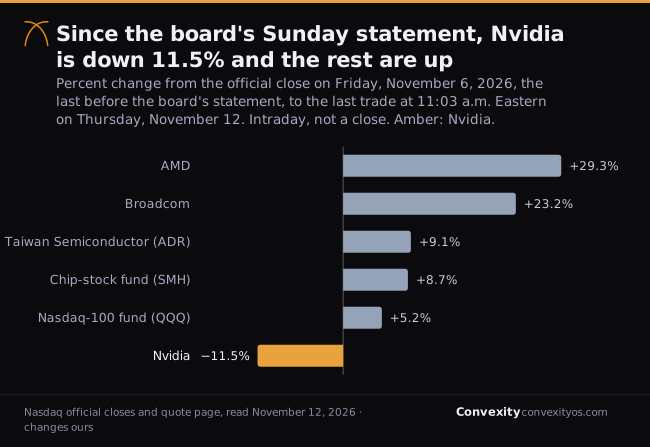
From the last close before the board's first statement to 11:03 a.m. on Thursday, Nvidia's shares are down 11.5%. Over the same stretch, AMD is up 29.3%, Broadcom up 23.2%, Taiwan Semiconductor's American shares up 9.1%, and the VanEck Semiconductor ETF (SMH), a fund of the largest listed chip stocks with Nvidia among them, up 8.7%. Whatever investors are marking down, they are not marking down artificial intelligence. The selloff did not spread.
- 4 days
- from the board saying it had confidence in Huang to his resignation, November 8 to November 12
- −11.5%
- Nvidia from its November 6 close to 11:03 a.m. Eastern on November 12 (our arithmetic, intraday)
- +8.7%
- a fund of the largest chip stocks, Nvidia included, over the same stretch (our arithmetic)
- 3.58%
- of Nvidia owned by Huang in March, 870.6 million shares, per the proxy
Nvidia's Form 8-K of November 12, its statements of November 8, its 2026 proxy, and Nasdaq's prices. The changes in price are ours.
Four days in Nvidia's own words
The sequence is short enough to set out whole, and every step of it is in a document Nvidia published.
Sunday, November 8. The board announced it was "initiating an independent investigation in light of recent reporting that founder and CEO Jensen Huang has been the target of a foreign intelligence effort." A committee of independent directors, working with outside counsel, would oversee it. The statement went on: "While the Board has no reason to believe that either national security or NVIDIA secrets were compromised, the Board's inquiry will examine all available information." It ended: "The Board has confidence in Jensen and his leadership team and will provide further updates as appropriate."
The same day, Nvidia published an email Huang had sent to employees. In it he said he had been unfaithful to his wife, took responsibility for it, and asked that his family be given privacy. On the security question, he wrote that he supported the board's investigation and would "cooperate fully." This note leaves the personal matter where he asked it to be left. It belongs here only as the reason a board statement and a chief executive's apology arrived on the same Sunday.
Tuesday, November 10. The independent directors said they had retained Joon H. Kim, a former acting U.S. Attorney for the Southern District of New York, and his firm, Wachtell, Lipton, Rosen & Katz, "to conduct a thorough and independent investigation as was announced on Sunday."
Wednesday, November 11. According to the 8-K, the board accepted Huang's resignation that day and appointed Jones chair. Nothing was announced. The stock closed up 2.9%, at $173.73.
Thursday, November 12. The 8-K went in before the open, alongside a press release. The release thanks Huang for "immeasurable contributions," says the board is beginning a search for a permanent chief executive that will consider internal and external candidates, and says the board expects "the company's operations, customer commitments and product roadmap to continue without interruption." It also confirms that third-quarter results will come out on Tuesday, November 17, "as previously scheduled."
One thing the Thursday documents do not mention is the investigation. Neither the 8-K nor the release says whether it continues, what it has found, or whether it had anything to do with the resignation. On Sunday the board promised "further updates as appropriate." The resignation is the only update so far, and it is silent on the question the inquiry was opened to answer.
That silence is worth holding onto, because it shapes how to read the price. A market that knew the answer would price the answer. A market that does not is pricing the range of answers, and some of that range is about national security and export licenses rather than about who runs the company.
The selloff that did not spread
The week was already rough before the board said anything. On Thursday, November 5, the whole AI complex fell. Nvidia lost 9.3%, but the chip fund lost 11.2% and QQQ, the largest fund tracking the Nasdaq-100, lost 6.5%. A day on which Nvidia falls less than its own sector is the opposite of a company-specific problem, and this note sets it aside.
The split begins on the first session after the Sunday statement. On Monday, November 9, QQQ rose 3.5% and the chip fund rose 5.1%. Nvidia fell 4.3%. In one session it gave up 9.4 percentage points to a fund that holds it. In every session since, Nvidia has done worse than that fund.
| Session | Nvidia | Chip-stock fund (SMH) | Nasdaq-100 fund (QQQ) |
|---|---|---|---|
| Thu, Nov 5 | −9.3% | −11.2% | −6.5% |
| Fri, Nov 6 | +2.8% | +3.6% | +1.4% |
| Mon, Nov 9 (after the Sunday statement) | −4.3% | +5.1% | +3.5% |
| Tue, Nov 10 | −5.5% | −0.8% | −0.7% |
| Wed, Nov 11 | +2.9% | +4.8% | +2.3% |
| Thu, Nov 12, to 11:03 a.m. (intraday) | −5.0% | −0.6% | 0.0% |
Each figure is the change from the previous session's official close, our arithmetic on Nasdaq's prices. Thursday's row runs to the last trade at 11:03 a.m., not to a close.
Wednesday is the instructive row. The board had accepted the resignation that day, but no one outside the boardroom knew. Nvidia rose with everything else, if by less than the chip fund. Then the filing went in, and Thursday's row went back to the pattern of Monday and Tuesday, with Nvidia falling far further than the funds that hold it.
Put the sessions together and the gap is wide. From the November 6 close to 11:03 a.m. on Thursday, Nvidia is down 11.5%. The chip fund is up 8.7%. QQQ is up 5.2%. Against the chip fund, which counts Nvidia among its holdings and so carries some of Nvidia's own fall, the gap is 20.2 percentage points.
| Change from the November 6 close | |
|---|---|
| AMD | 29%+29.3% |
| Broadcom | 23%+23.2% |
| Taiwan Semiconductor (ADR) | 9%+9.1% |
| Chip-stock fund (SMH) | 9%+8.7% |
| Nasdaq-100 fund (QQQ) | 5%+5.2% |
| Nvidia | -12%−11.5% |
In dollars, the fall is large even by Nvidia's standards. Nvidia's latest 10-Q gives 24.1 billion shares outstanding as of August 21. At that count, the move from $186.64 to $165.13 took about $520 billion off the company's market value, our arithmetic. That is about 4.8 times the $108.0 billion of revenue Nvidia guided for the quarter it reports on Tuesday.
What the rally in its rivals does and does not show
It is tempting to read the other side of the chart as money walking from Nvidia to its competitors: a bet that, without Huang, customers will buy more from AMD and from Broadcom's custom chip business. The prices cannot carry that much.
AMD has its own reasons to be moving. It reported its third quarter on November 3 and then fell 17.3% with everything else on November 5. Part of its rise since is that fall coming back. Broadcom fell 10.4% on November 5, and the same is true of it.
So measure from November 4 instead, the last close before the market-wide fall, and take that day out of everyone's numbers at once. From there to 11:03 a.m. on Thursday, Nvidia is down 17.5%. AMD is up 18.8%, Broadcom up 11.1%, Taiwan Semiconductor up 3.5%, the chip fund unchanged and QQQ down 0.2%.
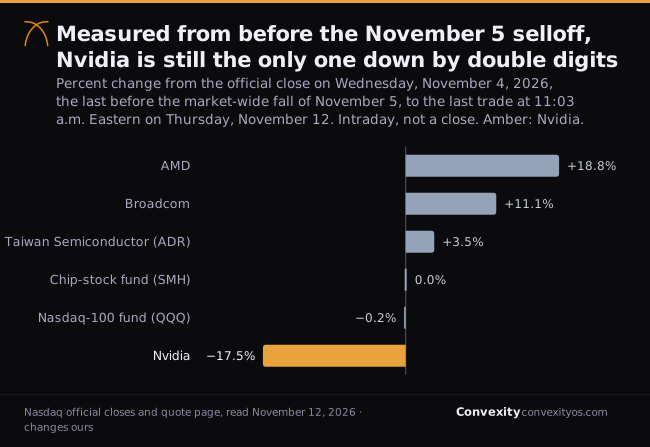
| Change from the November 4 close | |
|---|---|
| AMD | 19%+18.8% |
| Broadcom | 11%+11.1% |
| Taiwan Semiconductor (ADR) | 4%+3.5% |
| Chip-stock fund (SMH) | 0.0% |
| Nasdaq-100 fund (QQQ) | -0%−0.2% |
| Nvidia | -18%−17.5% |
On that base the rivals' gains shrink, and the funds are close to where they started. Nvidia is still the only one down by double digits. That is the robust claim, and it is a narrow one: whichever starting point you pick, Nvidia is the outlier. Rotation into its rivals is one explanation. Another is that investors are marking down something particular to Nvidia, its leadership or the security question its board raised, while holding the rest of the trade they never stopped believing in. The prices cannot tell those two apart.
They can rule out a third. If investors had concluded that demand for AI chips was in doubt, the place it would show most plainly is Taiwan Semiconductor, which manufactures for Nvidia, AMD and Broadcom alike. Nvidia's annual report names TSMC first among the foundries that produce its wafers. Its American shares are up 9.1% since the November 6 close. The factory is not being sold. One of its customers is.
What the filing says, and what it leaves out
The 8-K is notable for how little it contains.
It does not say why Huang resigned. It discloses no separation agreement and no payment. That fits what Nvidia told shareholders in May, in a sentence that reads differently this week: "Our executive officers are 'at-will' employees and we do not have employment, severance, or change-in-control agreements with our executive officers." There was no severance contract to honor, at least as of the proxy.
Huang does have unvested stock awards. The same proxy, in its table of potential payments on termination or a change in control, counted 1,411,679 unvested restricted and performance share units in his name on January 25, worth $264.9 million at that day's price. Some of those have vested since, on Nvidia's usual quarterly schedule. The 8-K says nothing about what happens to the rest, and this note has not read his award agreements, so it makes no claim either way. A later filing may.
It appoints Kress to run the company, and keeps her running its finances. "Ms. Kress has served as NVIDIA's Executive Vice President and Chief Financial Officer since 2013 and will continue in that role while she serves as the interim Chief Executive Officer," it says. She is 59. Before Nvidia, the release says, she spent nearly 25 years in finance at technology companies including Cisco and Microsoft.
Holding both jobs at once is not unheard of in an interim arrangement, and Kress is the executive investors already hear from every quarter: the written commentary that accompanies each set of Nvidia's results carries her name. What the arrangement removes is a separation that usually exists between the person who sets a company's direction and the person who reports on how it went.
She also inherits commitments made under Huang that have not closed. In September, Nvidia agreed to buy Hugging Face, the platform for sharing open-source AI models, for about $11.9 billion, with a retention program of up to about $1.0 billion for the staff who join. The 8-K it filed says the deal is expected to close in the first half of 2027, subject to regulatory approvals.
The people around her have changed this year too, which the 8-K does not mention but earlier filings do. In April, Nvidia said its chief accounting officer, Donald Robertson, would retire, and Scott Gawel joined from Intel on May 4 as vice president and chief accounting officer. At the start of July it said that Ajay Puri, who had led worldwide field operations, Nvidia's sales organization, for 21 years, would retire and stay on as a senior adviser. His successor, Nicholas Parker, came from Microsoft, with a start date set for August 24. Neither change has anything to do with this week. Together they mean that the interim chief executive is also the finance chief, and that the accounting chief below her and the sales chief beside her both arrived this year.
And it leaves the board without an employee on it. The 8-K appoints Kress chief executive but not to the board. Shareholders elected ten directors in June, Huang among them, and Suzanne Nora Johnson joined in July as an eleventh. With Huang gone, by our count of those filings, Nvidia has ten directors, none of whom works there.
A chair, after 33 years without one
The release calls Jones the company's "first-ever Chair of the Board." That is a real change, and Nvidia argued against it six months ago.
Its 2026 proxy, filed on May 12, explained the arrangement it had always used. "Our Board ensures that each member has an equal voice in the affairs and management of NVIDIA by having an independent Lead Director, rather than a chairperson," it said. A few paragraphs on: "We believe that our current structure best serves our stockholders, without the need to appoint a person to serve as chairperson of the Board." The lead director at the time was Stephen C. Neal, chairman emeritus of the law firm Cooley, who also chaired the board's nominating and governance committee.
The proxy left the door open. It said the board had discretion to adopt other structures, but would consider a change only if it "best aligned with the interests of our stockholders, management, and the Board," and that any change "would take into account stockholder views." What it pictured was a deliberate review. What happened was a board that needed someone to lead it, in a week.
The person it chose is telling. Jones, 73, has sat on the board since 1993, the year Nvidia was founded. He is the former chief executive and executive chairman of Synopsys, the chip design software company, and runs a family office, Square Wave Ventures. The proxy lists him with 7.0 million Nvidia shares. He and Tench Coxe are the only directors other than Huang who have served since that first year.
A board that wanted to signal a clean break might have reached for someone new. This board reached for one of its two longest-serving directors. That reads as a vote for continuity, which is consistent with the release's promise that customer commitments and the roadmap will carry on "without interruption." Whether continuity is what the moment calls for is a question the search for a permanent chief executive will answer, and the release gives it no deadline.
The largest individual holder is now outside the room
Huang leaves as one of the company's largest owners, not merely a former employee holding some stock.
The proxy counted 870,604,104 shares as beneficially owned by him on March 23, 3.58% of the company, held through family trusts, limited liability companies whose sole member is one of those trusts, and the Jen-Hsun and Lori Huang Foundation. Of those, 58,683,830 are the foundation's, in which the proxy says he and his wife have no financial interest. Only BlackRock and Vanguard, at 7.43% and 7.31%, held more on the proxy's table, and both are fund managers holding for their clients. No other person on it comes close.
The Forms 4 he has filed since then report shares withheld to pay taxes on vesting awards and shares given away. None reports a sale on the open market.
At the November 6 close, those 870.6 million shares were worth about $162.5 billion. At 11:03 a.m. on Thursday they were worth about $143.8 billion, a fall of about $18.7 billion since that Friday, our arithmetic. He no longer has a seat at the table that decides what comes next.
That cuts two ways. A founder with that much of the company has every reason to want it to do well, and nothing about his resignation changes that. It also means the largest individual stake in Nvidia now sits with someone who has no role in it. What he does with it, and when, is now a question for the market rather than the boardroom.
Tuesday's quarter closed before any of this
Nvidia reports on Tuesday, November 17, with results at about 1:20 p.m. Pacific and the call at 2 p.m. Pacific, 5 p.m. Eastern. The quarter it reports ended on October 25, more than two weeks before the board's first statement. Its books were kept while Huang ran the company, and the numbers on Tuesday will reflect that.
The outlook Nvidia gave in August, in the commentary Kress signed, was for revenue of $108.0 billion, plus or minus 2%, with no data center compute revenue from China assumed. Gross margins were guided to 74.0%, plus or minus half a point, and GAAP operating expenses to about $9.2 billion.
The notice Nvidia published on October 28 already said that Kress would provide the written commentary ahead of the call. That was always going to be her job. What changes on Tuesday is that she will also be the most senior person on the line, answering the questions a chief executive would usually take.
Three things on Tuesday will say more than the quarter itself.
The outlook for the January quarter. The third quarter is history. The fourth-quarter guide is the first number Nvidia will put out after the resignation, and the first test of the release's line that customer commitments will continue without interruption. A guide in line with the trajectory Nvidia has been on says the business has not noticed. A cut would say it has, and nothing in this note's argument would survive that unscathed.
What, if anything, is said about the investigation. The board's Thursday release is silent on it. Analysts will ask. An answer that the inquiry is closed, or that it found nothing compromised, would narrow the range the market is pricing. No answer leaves it open.
Who else speaks. The call notice names only Kress. Whether other executives join her on the line, and which ones, will be the first public signal of how the company is being run while the board looks for a successor.
The risk Nvidia already named
None of this is a risk Nvidia failed to disclose. Its annual report for fiscal 2026, filed on February 25, carries the warning almost every company carries, and it is more direct than most.
"We are highly dependent on the services of our longstanding executive team," it says. "Failure to ensure effective succession planning, transfer of knowledge, and smooth transitions involving executives and key employees could hinder our strategic planning, execution, and long-term success."
It does not name Huang. It did not need to. What is unusual is not that the risk materialized, since every founder eventually leaves, but the way it did: in four days, with a national security inquiry open and no successor named, five days before the company reports.
The national security thread is the one most likely to reach beyond Nvidia, and also the one where Nvidia's own guidance limits the damage. Its sales of data center chips into China already depend on U.S. export licenses, and the outlook for the quarter it reports on Tuesday assumed none of that revenue. Whatever the investigation finds, it cannot take out of that guide a number the guide never contained. Where it could matter is in what it does to Nvidia's standing with the government that issues those licenses, and that is not a question any filing can answer yet.
What would prove this wrong
This note argues that the market has treated Huang's departure as a problem for Nvidia, not for the AI trade, and that Thursday's selloff did not spread. Several things would show that to be wrong, or early.
The rest of the trade follows. If AMD, Broadcom, Taiwan Semiconductor and the chip funds give back their gains over the next several sessions while Nvidia stabilizes, the divergence was a lag, not a judgment. The claim here rests on three full sessions and part of a fourth. That is not much.
The gap closes on no news. If Nvidia recovers its distance from the chip fund before Tuesday without anything new from the board or the company, the selloff was more about flows and positioning than about anything particular to Nvidia, and reading meaning into it was a mistake.
Tuesday's guide is cut, and the rivals fall with it. A weaker fourth-quarter outlook from Nvidia on its own would confirm that the problem is Nvidia's. A weaker outlook that also drags the rest of the sector down would mean investors were right to worry about the whole trade and were simply slow to act on it.
The investigation reaches the industry. If the inquiry turns up something that leads to tighter export rules or new restrictions that apply to every American chip company, this stops being a story about one company's leadership. Nothing published so far points that way. The board said on Sunday it had "no reason to believe" national security had been compromised, and it has said nothing since.
Not investment advice. This note is an analysis of Nvidia's public filings and statements and of public share prices, published for research purposes, and not a recommendation to buy, sell or hold any security. A member of the Convexity team holds SPY, whose holdings include Nvidia, AMD, Broadcom, Microsoft, Intel, Cisco, Synopsys and BlackRock; no other position in any company or fund named here. The same team member holds an economic interest in Anthropic through a special-purpose vehicle and a fund, and stands to benefit if its valuation rises; Nvidia has an investment and technology partnership with Anthropic, so we are not neutral. Convexity is an Anthropic customer.
What here is ours rather than Nvidia's. As filed or published by Nvidia: the dates and contents of the resignation, the appointments and the investigation; every quotation; Kress's and Jones's ages and histories; the absence of employment, severance and change-in-control agreements; the 1,411,679 unvested units and their $264.9 million value; the 870,604,104 shares, the 58,683,830 foundation shares and the 3.58%; BlackRock's and Vanguard's 7.43% and 7.31%; the 24.1 billion shares outstanding; the executive changes of 2026; the Hugging Face terms; and the third-quarter outlook. The share prices are Nasdaq's: official closes through November 11, and for November 12 the last trade on Nasdaq's quote page at 11:03 a.m. Eastern, which is not a close. Ours: every percentage change in any share price, each day's and each period's, including the 11.5% fall in Nvidia since November 6 and the 20.2-point gap; the $520 billion change in market value and its multiple of the guide; the $162.5 billion and $143.8 billion values of Huang's shares; the count of ten directors, none of them employees, read from the proxy and three 8-Ks; and the readings of what the prices do and do not show. Thursday's figures will differ from the close.
The filings, statements and prices this is built on
17 documents
- 018-KNvidia Form 8-K, Item 5.02: Huang’s resignation, Kress as interim chief executive, Jones as chairEvent date November 11; filed before the open on November 12. Ages, tenures and the appointmentsNov 12, 2026sec.gov
- 02EX-99.1NVIDIA Announces CEO Transition (press release)The “first-ever” chair, the search, the continuity statement and the November 17 scheduleNov 12, 2026sec.gov
- 03StatementStatement From NVIDIA Board of DirectorsThe independent investigation and the board’s confidence in HuangNov 8, 2026nvidianews.nvidia.com
- 04LetterA Message to Our Company (Huang’s email to employees)Nov 8, 2026nvidianews.nvidia.com
- 05StatementStatement From the Independent Members of the NVIDIA BoardJoon H. Kim and Wachtell, Lipton, Rosen & Katz retainedNov 10, 2026nvidianews.nvidia.com
- 06ReleaseNVIDIA Sets Conference Call for Third-Quarter Financial ResultsThe November 17 call, and Kress’s written commentary ahead of itOct 28, 2026nvidianews.nvidia.com
- 07DEF 14ANvidia 2026 proxy statementBoard leadership structure, the lead director, beneficial ownership on March 23, the absence of severance agreements, and unvested awardsMay 12, 2026sec.gov
- 0810-KNvidia annual report for fiscal 2026Huang’s tenure, the key personnel risk factor, and TSMC among its foundriesFeb 25, 2026sec.gov
- 0910-QNvidia Form 10-Q for the quarter ended July 26, 2026Shares outstanding as of August 21, 2026Aug 26, 2026sec.gov
- 10CFO commentaryCFO commentary on second-quarter fiscal 2027 resultsThe outlook for the third quarter of fiscal 2027Aug 26, 2026sec.gov
- 118-KNvidia Form 8-K: chief accounting officer retirement and appointmentApr 27, 2026sec.gov
- 128-KNvidia Form 8-K: Suzanne Nora Johnson joins the boardMay 8, 2026sec.gov
- 138-KNvidia Form 8-K, Item 5.07: the ten directors elected at the 2026 annual meetingJun 30, 2026sec.gov
- 148-KNvidia Form 8-K: worldwide field operations retirement and appointmentJul 2, 2026sec.gov
- 158-KNvidia Form 8-K, Item 8.01: agreement to acquire Hugging FaceSep 3, 2026sec.gov
- 16Form 4Huang’s Forms 4 filed in 2026Shares withheld for taxes and gifts; no open-market salesMar to Sep 2026sec.gov
- 17PricesNasdaq historical prices and quotes: NVDA, AMD, AVGO, TSM, SMH, QQQOfficial closes November 4 to 11; November 12 is the last trade on the quote page at 11:03 a.m. EasternNov 12, 2026retrieved Nov 12, 2026nasdaq.com