








Disclosure. No position in NVDA, long or short, at publication. This is not investment advice. Every figure here comes from Nvidia's own filings, linked at the bottom. Where a number is our arithmetic on Nvidia's disclosed figures rather than a figure Nvidia reported, we say so at the point of use. The fiscal second quarter ended July 26, 2026. The results were released after the close on August 26, 2026, the Form 10-Q was filed the same day, and the earnings call followed at 5:00 p.m. Eastern. Figures stated on the call are cross-checked against the filings wherever both report them, and where they differ the filed number is the one used here.
Nvidia beat on every line that mattered. Revenue of $96.2 billion, up 106% from a year ago and the largest quarter in its history. Data Center revenue of $89.0 billion, up 117%. Gross margin of 75.0%. Guidance for the October quarter of $108.0 billion against a consensus that had settled near $104 billion, and that guide assumes no Data Center compute revenue from China at all.
The market spent the evening changing its mind. The stock had already closed down 1.5% at $209.95 before the numbers landed. It traded down to $206.97 by 4:43 p.m. Eastern, recovered to $209.09 by 4:56 as the call began, and by 5:31, once Nvidia had guided the whole of next fiscal year, it was at $218.22, up about 4% from the close. Three prices, three verdicts, ninety minutes. Anyone reading a thesis into that tape is reading noise.
So set the price aside. The reason to spend time on this quarter is not the reaction to it.
It is that Nvidia filed its Form 10-Q the same afternoon, and the 10-Q describes a company doing something the press release does not mention. Over the last six months Nvidia has taken on $108.5 billion of guarantees, committed $25 billion to buying equity in its own customers, committed another $36 billion to renting capacity back from those customers, extended payment terms far enough to add $22.3 billion to receivables in one quarter, and borrowed $25 billion for the first time at scale.
None of that is hidden. All of it is disclosed plainly, in a document Nvidia published voluntarily and on time. The argument here is not that anyone was misled. It is that the shape of the risk changed this quarter, the filings say so, and the release does not.
Give the quarter its due
A bear case that starts by minimizing these results is not worth reading. The operating business is performing about as well as an operating business can.
| Metric | Q2 FY27 | Q1 FY27 | Q2 FY26 | Y/Y |
|---|---|---|---|---|
| Revenue | $96,221M | $81,615M | $46,743M | +106% |
| Data Center | $89,023M | $75,246M | $41,096M | +117% |
| Gross margin (GAAP) | 75.0% | 74.9% | 72.4% | +2.6 pts |
| Operating income (GAAP) | $63,734M | $53,536M | $28,440M | +124% |
| Net income (GAAP) | $59,688M | $58,321M | $26,422M | +126% |
| Diluted EPS (GAAP) | $2.46 | $2.39 | $1.08 | +128% |
| Diluted EPS (non-GAAP) | $2.22 | $1.87 | $1.01 | +120% |
Operating income grew 124% year over year on 106% revenue growth, which is operating leverage at a scale that essentially does not occur in hardware. Operating expenses grew 55% while revenue doubled.
The demand signals underneath are not soft, and three of them are hard to fake. Raw materials inventory went from $3.8 billion to $11.3 billion over six months while finished goods actually fell, from $8.8 billion to $6.9 billion. That is the inventory profile of a company buying components as fast as it can secure them and shipping everything it can finish, which is the opposite of a channel-stuffing build. Customer advances inside deferred revenue went from $160 million to $2.8 billion, and the first half took in $15.6 billion of customer advances in total. Customers are prepaying.
The China exclusion in the guide is also less dramatic than it sounds, and it is worth deflating rather than trading on. Nvidia shipped less than 1% of Data Center revenue as Hopper product into China this quarter, so a forecast that assumes none of it is giving up very little. China-headquartered customers were $7.9 billion of total revenue, but that is a different measure, counting every product line by where the direct customer is based.
Customer concentration also improved, which cuts against the obvious worry. In Q2 a year ago, two direct customers were 23% and 16% of revenue. This quarter, one direct customer was 16%, and no other crossed the disclosure threshold.
And the mix is broadening away from the hyperscalers. Within Data Center, Hyperscale was $48.7 billion and the category Nvidia calls AI Clouds, Industrial, and Enterprise was $40.3 billion, up 138% year over year against Hyperscale's 102%. The fastest-growing part of Nvidia's largest business is the neocloud and AI-lab tier.
On the call Nvidia also did something it does not normally do, which is guide a full fiscal year in advance: revenue growth of roughly 70% in fiscal 2028, with supply expected to stay the bottleneck at least through the end of that year. The number underneath it is the more interesting one. Customer forecasts, Kress said, point to growth closer to doubling. The gap between 100% and 70% is not a demand problem. It is Nvidia's estimate of what it can physically build.
Hold the neocloud fact. It is the same tier that shows up on the other side of the balance sheet.
Three profit numbers, three different quarters
Here is where the quarter starts to come apart into pieces that disagree with each other.
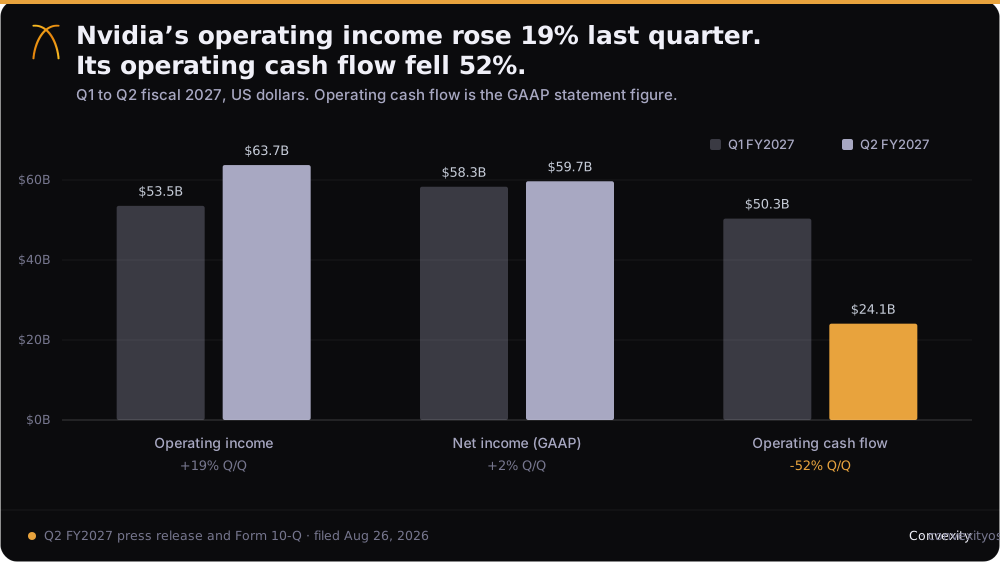
Operating income rose 19% sequentially. GAAP net income rose 2%. Operating cash flow fell 52%, from $50.3 billion to $24.1 billion.
Three measures of the same three months, pointing in three directions. Each gap has a specific cause, and the causes are the story.
The gap between operating income and net income is the investment portfolio. Below the operating line sits "Other income, net" of $7,773 million. Of that, $7,771 million was gains from equity securities. Strip those out and the entire non-operating line for the quarter is $2 million: interest income of $496 million, interest expense of $227 million, and other charges of $267 million, netting to almost exactly nothing.
So $7.77 billion, or 10.9% of pretax income, came from the value of things Nvidia owns rather than things Nvidia sold. Net income rose only 2% sequentially because that contribution shrank: it was $15.9 billion in Q1 and $7.8 billion in Q2. The operating business accelerated. The portfolio decelerated. They nearly canceled out.
The gap between net income and cash is working capital. Of $59.7 billion in net income, $22.3 billion went into accounts receivable, $5.8 billion into inventory, and $5.5 billion into prepaid and other assets, while the $7.8 billion of equity gains came back out as non-cash. What survived to the bottom of the operating section was $24.1 billion.
That is a cash conversion of 40 cents on the dollar of net income, against 86 cents in Q1. Our arithmetic, on Nvidia's reported figures. Free cash flow, which Nvidia reports directly, fell the same way: $21.3 billion against $48.6 billion in Q1.
Not all of that is receivables, and the honest version says so. Nvidia attributes the sequential decline to "higher working capital adjustments and cash taxes," and the tax half is a timing artifact rather than a trend: the 10-Q notes the company made two federal income tax payments in Q2 and none in Q1. Strip the calendar quirk out and the working capital build is still the larger share, but it is not the whole of it.
Where the extra profit came from
It is worth being precise about what those gains are, because they are not all the same kind of thing.
Note 6 of the 10-Q reports $4.9 billion of unrealized gains on non-marketable equity securities in the quarter, and $7.5 billion for the first half. These are stakes in privately-held companies. Nvidia states the method plainly: they are "carried at cost less impairment, and adjusted for observable price changes," valued "using observable comparable transactions and other inputs including volatility, expected time to liquidity, the risk-free rate, and security-specific rights and obligations."
Translated: when a private AI company raises a round at a higher valuation, Nvidia marks its stake up and books the difference as income.
Note 5 adds $1.5 billion of net unrealized gains for the quarter on publicly-held equity securities still held at period end. Between them, roughly $6.4 billion of the quarter's $7.77 billion in equity gains was marks rather than realized proceeds.
To Nvidia's credit, all of this is excluded from the non-GAAP number that most people quote. Non-GAAP EPS of $2.22 strips the equity gains out entirely, which is why GAAP EPS of $2.46 sits above it, an inversion that almost never happens and is itself the tell. Nvidia is not dressing up the number. It is reporting two numbers and letting you pick.
But the GAAP number is the one that flows into book value, into the tax line, and into every screen that ranks companies by reported earnings. And on a six-month basis, $23.7 billion of $141.4 billion of pretax income, or 16.8%, came from equity gains.
The sentence the press release left out
Among the Data Center highlights in the August 26 release is this line:
Secured land, power and shell capacity through a partnership with SB Energy at the PORTS-Pike Technology Campus in Ohio to host NVIDIA compute.
Nvidia Q2 FY2027 press release, August 26, 2026
Here is how the same arrangement is described in Note 10 of the 10-Q filed the same day:
In August 2026, we entered into guarantees, capped at a total of $105 billion, to provide credit support on a land, power, and shell buildout with affiliates of SB Energy Corp. on behalf of a customer, an affiliate of OpenAI Group PBC, related to leases for approximately 4.25 gigawatts of IT load.
Nvidia Form 10-Q, quarter ended July 26, 2026, Note 10
"Secured land, power and shell capacity" and "guarantees, capped at a total of $105 billion" are descriptions of the same transaction. Only one of them tells you that Nvidia is now standing behind an OpenAI affiliate's lease and power obligations.
The mechanics matter, and they cut both ways. The guarantees become effective as each of nine construction phases completes, the first expected in fiscal 2029. Payment obligations trigger only on certain tenant defaults. They cover defined portions of lease and power payments, not the full site cost or all of the tenant's obligations. They shrink over each phase's twenty-year term. And they terminate if OpenAI achieves a satisfactory credit rating.
That last clause is the most revealing sentence in the filing. The guarantee exists precisely because the tenant cannot currently carry this obligation on its own credit. Nvidia is lending its balance sheet to close that gap, and the arrangement is written to unwind the moment the gap closes on its own.
That is not an inference. It is Nvidia's own description of the problem, from the CFO commentary published alongside the release:
AI clouds and model makers are seeing extraordinary demand for AI infrastructure, yet many are growing faster than their balance sheets and long-term credit profiles can support. In response, we have entered into arrangements that help select customers secure the land, power and data center capacity needed to support their growth.
Colette Kress, CFO commentary, Q2 fiscal 2027
And the return Nvidia expects for it is stated just as plainly. Each generation of infrastructure deployed at PORTS-Pike could be about 1.5 million GPUs, which Nvidia sizes at roughly $150 billion to $200 billion of its own revenue, across a site it expects to support multiple upgrade cycles over twenty years. Against that, a $105 billion contingent exposure that only attaches on tenant default, beginning in fiscal 2029, is a defensible trade. It is arguably a good one.
The point is not that the trade is bad. It is that this is a different business than selling chips to people who pay for them, and it is carried in a document most readers of the headline will never open.
In exchange, the site hosts Nvidia infrastructure exclusively, and Nvidia holds an option, at its sole discretion, to extend credit support to roughly 3.8 additional gigawatts.
Total maximum gross exposure across all guarantees is $108.5 billion: $105.0 billion for SB Energy, and $3.5 billion of land, power and shell guarantees for AI clouds. For scale, Nvidia's total shareholders' equity is $229.0 billion. The guarantees equal 47% of book equity. Our arithmetic, on Nvidia's reported figures.
Form 10-Q, quarter ended July 26, 2026, Note 10. The guarantees were signed in August 2026, after the quarter closed.
What Nvidia has promised
The guarantees sit outside the commitments table. The commitments table is its own event.
| Commitment | Total | Remainder of FY27 |
|---|---|---|
| Supply and capacity | $279B | $92B |
| Cloud service agreements | $29B | $3B |
| Data center leases not commenced | $25B | $0B |
| Equity investments | $25B | $18B |
| Capital expenditures | $8B | $7B |
| AI cloud agreements | $36B | $0B |
| Data center leases for third party | $20B | $0B |
| Total | $422B | $120B |
Two rows deserve attention.
Supply and capacity went from $119 billion last quarter to $279 billion. Nvidia says these commitments are "primarily memory and manufacturing facilities." A $160 billion increase in one quarter is the clearest statement anyone has made about where memory pricing is going, and it is a genuine demand signal. It is also $279 billion of obligations that assume the demand persists.
Equity investments of $25 billion, with $18 billion falling in the next two quarters. Nvidia describes these as commitments "to make certain equity investments in AI model makers, infrastructure financiers, and other private companies." AI model makers are customers.
Then there is the row that closes the loop. Under AI cloud agreements, Nvidia commits $36 billion. The 10-Q describes this opaquely: AI clouds buy Nvidia infrastructure, Nvidia commits to cloud service agreements in return, and the clouds may unilaterally stop serving Nvidia and resell that capacity to someone paying more. Read cold, that sounds like Nvidia renting back compute it needs for its own model work.
The call said otherwise, and the real structure is more interesting than the filing makes it sound. A neocloud serving many small customers cannot get a data center financed, because lenders want a single long-term offtake contract before they will underwrite one. Nvidia supplies the missing piece: a take-or-pay commitment on part of the facility, a minimum revenue floor that makes the project bankable. In exchange it takes a share of the cloud's revenue above that floor. Kress was explicit that this is not lending, that independent capital still underwrites each deal on its own merits, and that Nvidia gets paid twice, once on the hardware and again on a slice of the rent.
So the $36 billion is not compute procurement. It is Nvidia standing behind the revenue line of the companies that buy its chips, so that somebody else will lend them the money to buy more.
The portfolio has grown to match.
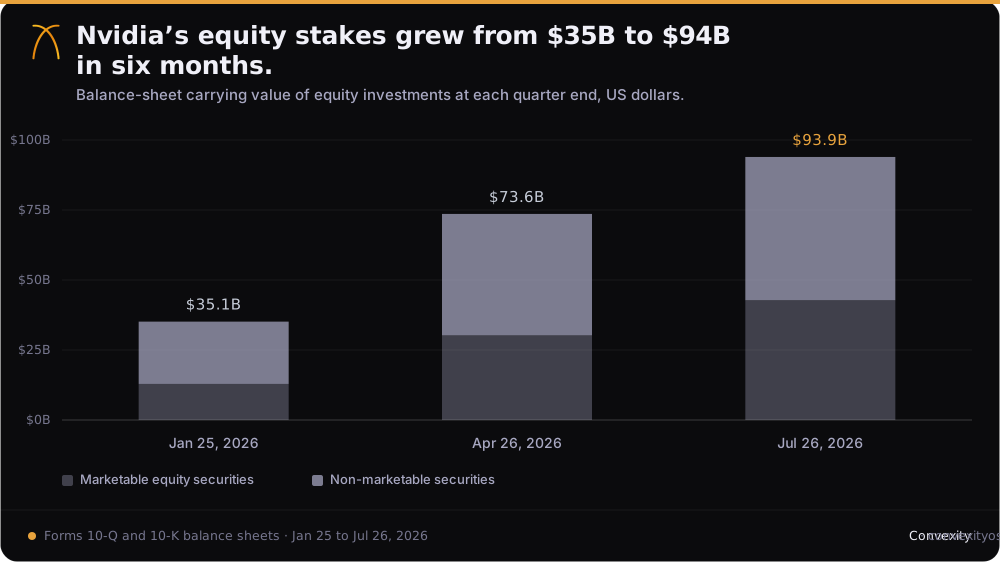
Marketable equity securities plus non-marketable securities went from $35.1 billion at the January year-end to $73.6 billion in April to $93.9 billion in July, a 167% increase in six months. In the first half Nvidia spent $42.4 billion buying equity securities and $4.4 billion on property, equipment and intangibles. It put 9.6 times more into other companies’ equity than into its own property and equipment. Our arithmetic, on Nvidia's reported cash flow statement.
The 13F Nvidia filed on August 14, covering June 30, names the public side. Intel at $30.0 billion and Space Exploration Technologies at $21.0 billion are the two largest, followed by CoreWeave at $4.7 billion, Coherent, Nokia, Synopsys, and Nebius at $0.3 billion. CoreWeave and Nebius both appear in Nvidia's own press release, two paragraphs apart, as Vera Rubin launch partners. They are customers Nvidia owns stock in.
Funding this required something new. In June 2026 Nvidia issued $25.0 billion of senior unsecured notes across seven tranches, taking long-term debt from $7.5 billion to $32.4 billion. Against $56.6 billion of cash and marketable debt securities and $229.0 billion of equity, the leverage is trivial. The signal is not the leverage. It is that a company generating $74 billion of operating cash in six months needed to borrow at all, and did so in the same period it spent $39.0 billion on buybacks, $6.3 billion on dividends and $42.4 billion on equity stakes.
Nvidia raised the objection itself
The most striking thing on the call was not a number. It was that Nvidia named the criticism before anyone asked, and then argued with it.
The setup came first. Nvidia has invested nearly $50 billion in the frontier AI labs, a sum it frames as a small fraction of expected free cash flow over the same period. It has lined up six infrastructure capital providers, Apollo, BlackRock, Blackstone, Brookfield, Goldman Sachs and KKR, to raise more than $500 billion of third-party capital for lab buildouts. Beyond the OpenAI guarantee it is providing selective credit enhancement for nearly two more gigawatts at a second frontier lab. OpenAI's existing and planned commitments run to roughly 12 gigawatts of Nvidia compute through 2030.
Then the figure that settles what kind of company this is becoming. Nvidia expects demand from the AI labs where it leverages its own balance sheet to be roughly a quarter of its business next year.
Kress said the labs are growing faster than their balance sheets and credit profiles can support, that they have the customer demand but not the decades-long contracts or investment-grade financing to secure infrastructure alone, and that what limits them is neither technology nor demand but compute. Then she said Nvidia knows some will call this circular financing, and that Nvidia sees it differently.
The rebuttal deserves stating at full strength, because it is not a weak one. These are, in Nvidia's view, once-in-a-generation companies with proven technical leadership and compounding usage. The investments are small against the demand they unlock and the business they create. The equity returns should be good. And the risk is contained by the nature of the asset: Nvidia compute is fungible and durable, so if a counterparty fails, the hardware is redeployed to somebody else. Nvidia adds that what it ships will be consumed by investment-grade customers or by companies backed by one.
Most of that is probably right, and the fungibility point is the strongest thing said all evening. A GPU whose tenant defaults is not a stranded fiber ring or a half-built pipeline. It is an asset with a queue of other buyers, in a market the same call describes as supply constrained into fiscal 2028.
What the rebuttal does not reach is correlation. Each position is individually defensible, and that is not the question. The question is that the equity stakes, the lease guarantees, the take-or-pay floors, the extended payment terms and the revenue itself now all point at the same small set of counterparties and rest on the same assumption about AI demand. Nvidia has answered "is any one of these a bad trade" convincingly. Nobody can answer what the book looks like if the assumption underneath all of them moves at once.
That is not a prediction that it will. It is an observation that a quarter of next year's business is, by the company's own account, business its balance sheet helps make possible.
The one number that got worse
The release guided Q3 gross margin to 74.0%, down from 75.0%. The call went considerably further, and this was the real negative of the evening.
Memory pricing is running at extreme levels, the increases have exceeded Nvidia's own prior expectations, and they are headed higher into next year. So Nvidia reset the entire curve: 74% in Q3, a trough of 71 to 72% in Q4, then 72 to 73% across fiscal 2028, once price increases it has already executed reach customers in Q1.
That is three to four points of gross margin on a business guided to grow about 70%. It is also the mirror image of the supply commitment: the $279 billion Nvidia has contracted for is primarily memory, and the reason that number more than doubled in a quarter is the same reason margins are compressing.
Nvidia's framing is fair and worth repeating. Memory scarcity is not an exogenous cost shock, it is a symptom of the same buildout driving Nvidia's own growth, which is a better problem to have than the alternative. But it is still three to four points, and management chose to reset expectations in advance rather than let them be discovered a quarter at a time.
The receivables tell the same story
Accounts receivable went from $40.7 billion in April to $63.1 billion in July. Nvidia does the arithmetic for you in the CFO commentary: 60 days of sales outstanding, up from 45 the quarter before. Fifteen days of extension in three months.
Nvidia explains it directly in the liquidity discussion, and the explanation is more interesting than a denial would have been:
Cash provided by operating activities increased in the first half of fiscal year 2027 compared to the first half of fiscal year 2026 due to higher revenue, partially offset by an increase in accounts receivable due to extended payment terms on large multi-quarter agreements with certain investment-grade customers.
Nvidia Form 10-Q, quarter ended July 26, 2026, Liquidity and Capital Resources
"Extended payment terms on large multi-quarter agreements" is vendor financing described accurately. "Investment-grade customers" is a meaningful reassurance and should be taken seriously; it is also a category that, by construction, excludes the private AI labs Nvidia is guaranteeing and investing in.
Put the pieces beside each other and one pattern runs through all of them. Nvidia is buying equity in its customers, guaranteeing its customers' leases, committing to rent capacity back from its customers, and letting its customers pay later. Each decision is individually defensible. Together they describe a company that has become a source of financing for the demand it books as revenue.
What would prove this wrong
This argument is falsifiable, and here is what would falsify it.
Receivables normalize next quarter. If Q3 receivables grow slower than revenue and DSO returns toward 45 days, the working capital build was timing on a late-quarter Vera Rubin ramp and nothing more. That is a genuinely likely outcome and it is the single most important number in the October report.
The guarantees never attach. They begin in fiscal 2029, phase in over nine stages, and terminate if OpenAI reaches a satisfactory credit rating. If OpenAI is rated before the first phase commences, the $105 billion never becomes exposure and this section ages badly. A credit rating for OpenAI would substantially defuse the argument.
The marks turn out to be conservative. If the private stakes are later realized at or above carrying value, then the mark-to-model income was simply early recognition of real value, and the complaint about earnings quality dissolves. Nvidia realized $7.2 billion of proceeds from equity sales in the quarter, which is evidence in this direction.
Operating cash flow recovers. One quarter at 40% conversion is a data point. Four quarters is a trend. If Q3 converts back above 70%, the second section of this piece is describing noise.
A counterparty fails and the hardware moves. This is the test Nvidia's own rebuttal invites, and it is the cleanest one available. If an AI cloud or a lab misses and those GPUs are redeployed to another buyer at or near carrying value, the fungibility argument is proven in the only way that counts, and the correlation worry loses most of its force.
What would confirm it: receivables outgrowing revenue again in October, the equity investment commitments drawing down on schedule into private AI labs, a second tranche of guarantees against the 3.8 gigawatt option, the balance-sheet-supported share of revenue drifting past the quarter Nvidia guided to, or any AI cloud counterparty failing to raise its next round on terms that hold Nvidia's carrying value.
The chips are not the question. Demand for them is the most verified fact in technology right now, and this quarter added to that pile of evidence rather than subtracting from it.
The question is what happens to a supplier that has also made itself the credit, the guarantor, the revenue floor and the shareholder of its own customer base. Two quarters ago that company did not exist. It does now, and the most persuasive evidence for that is not this piece. It is Nvidia, on its own call, describing the arrangement in detail and putting it at about a quarter of next year's revenue.
Nvidia believes this is simply what financing a once-in-a-generation platform shift looks like from the inside, and it may well be right. Either way it will show up in the filings before it shows up in the tape, which is the only reason to read them first.
Not investment advice. This is analysis of Nvidia's public filings and its August 26 earnings call, published the same evening. Call quotations are from the live webcast, before Nvidia posted an official transcript, so they are given as delivered and kept short. It is not a recommendation to buy or sell anything. Nvidia disclosed every figure cited here in its own documents and on its own call, on time and without prompting, and it raised the central objection to its own strategy before anyone else did. Reasonable people read the same material and reach opposite conclusions, and the falsifiers above are listed because we expect some of them to happen.
Primary sources
- Press releaseNVIDIA Announces Financial Results for Second Quarter Fiscal 2027Headline results, segment detail, Q3 outlook, and the SB Energy highlight lineAug 26, 2026
- 10-QQuarterly report for the quarter ended July 26, 2026Note 5 and 6 (the equity portfolio), Note 10 (commitments and the $105B guarantees), and the liquidity discussion on payment termsAug 26, 2026
- CFO commentaryQ2 FY2027 CFO Commentary, Colette KressThe 60-day DSO, free cash flow, and the passage on customers outgrowing their own credit profilesAug 26, 2026
- Press releaseNVIDIA Announces Financial Results for First Quarter Fiscal 2027The April 26 balance sheet used for every sequential comparison hereMay 20, 2026
- Earnings callQ2 FY2027 earnings call, Jensen Huang and Colette KressThe fiscal 2028 growth guide, the gross-margin reset, the take-or-pay structure, and the circular-financing rebuttalAug 26, 2026
- 13F-HRHoldings report for the quarter ended June 30, 2026Names the public equity positions, including CoreWeave and NebiusAug 14, 2026