









Disclosure. Not investment advice, and nothing here is a recommendation to buy, sell or hold any security. We are not neutral on the companies in this note. A member of the Convexity team holds an economic interest in Anthropic through a special-purpose vehicle and a fund, and stands to benefit if its valuation rises. Convexity is a customer of Anthropic. This note was drafted with Claude, Anthropic's model. Alphabet is an investor in Anthropic and one of its suppliers, and on our reading of Alphabet's filings, Anthropic is the private company whose valuation is discussed below. SpaceX, which owns the maker of the Grok models, competes with Anthropic. The same team member holds the SPDR S&P 500 ETF (SPY), whose holdings include Alphabet's Class A and Class C shares and Broadcom, both named below; SPY's holdings file for October 28, 2026 lists no SpaceX shares. No other position in any company named here. Figures are from Alphabet's earnings releases and Forms 10-Q, Google's Schedule 13G on SpaceX, SpaceX's prospectus, Anthropic's registration statement and Nasdaq's daily prices. We read the October 28 call in two independently produced transcripts and quote only wording both carry. The closing note lists what is our arithmetic.
Alphabet's operating income rose $9.3 billion in the third quarter from a year earlier. Its earnings per share fell anyway, because SpaceX's share price did.
Diluted earnings were $2.12 a share, against $2.87 a year earlier. Between those two numbers sits one line of the income statement: gains and losses on equity securities, meaning the stakes Alphabet holds in other companies. A year ago that line added $10.7 billion before tax. This quarter it took away $8.7 billion.
Anat Ashkenazi, the chief financial officer, gave the reason on the call in one clause: an "unrealized loss from our investment in SpaceX from a decline in its stock price." Nobody on the call asked about it. That is understandable on a night when Cloud revenue doubled. It is also the most important thing about how to read Alphabet's earnings from here.
We went back through seven quarters of Alphabet's releases to see how much of the headline that one line now decides. In 2026 so far, diluted EPS has ranged from $2.12 to $9.11. Each release states, in a footnote, how much the stakes added to or took from EPS. Subtract it and the rest of the company ranged from $2.67 to $2.85 (our subtraction). Almost all the movement is the stakes.
Two holdings drive them. One is SpaceX, which went public in June and is now marked to its share price every quarter. The other is a private company Alphabet does not name, carried at $128.2 billion, whose terms match Google's investment in Anthropic as Anthropic's own filing describes it. That match is our reading, not Alphabet's statement, and Anthropic filed to go public this week.
The business underneath is growing, though by less than the headline suggests. The year-earlier quarter carried a $3.5 billion European Commission fine, so operating income grew about 17% on a like-for-like basis, not 30% (our arithmetic). Search slowed to 12% growth. Cloud doubled and is now the fastest-improving part of the company.
Alphabet's third-quarter 2026 and 2025 earnings releases; the like-for-like growth rate and the subtraction are ours.
The quarter, before and after the stakes
Start with the operating business, because it had a good quarter. Revenue was $127.6 billion, up 25%, and up 25% in constant currency too. Operating income was $40.6 billion against $31.2 billion, and the operating margin was 31.8%. Google Cloud's revenue was $30.7 billion against $15.2 billion a year earlier.
Then comes other income and expense, the line below operating income where Alphabet's investments land. A year ago it was a gain of $12.8 billion. This quarter it was a loss of $8.2 billion. Income before taxes fell to $32.4 billion from $44.0 billion, net income available to common stockholders fell to $26.2 billion from $35.0 billion, and diluted EPS fell to $2.12 from $2.87.
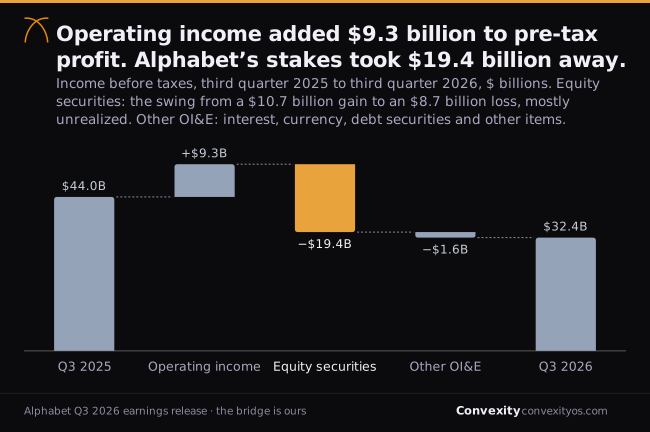
The bridge makes the scale plain. Operating income added $9.3 billion to pre-tax profit. The swing in equity securities took away $19.4 billion, a little more than twice as much.
Everything else in other income and expense took away another $1.6 billion, mostly because last year's catch-all "other" line, a $1.1 billion gain, shrank to $146 million, and debt securities swung to a $383 million loss. Interest expense rose to $967 million from $143 million as Alphabet borrowed, though higher interest income offset most of that.
Ashkenazi's next sentence on the call was the whole of management's commentary on the result: "Net income and earnings per share decreased due to the decline in OI&E." OI&E is other income and expense. The release is more specific. Its footnote says the $8.7 billion loss on equity securities reduced the tax provision by $1.9 billion, net income by $6.7 billion and diluted EPS by $0.55.
A year earlier, the same footnote said the gain on equity securities added $0.68 a share. So the stakes swung from adding 68 cents to subtracting 55 cents, a swing of $1.23 a share (our arithmetic). EPS fell by 75 cents. Everything else in the company, taken together, added about 48 cents a share, and the stakes took away all of it and more.
How Alphabet came to own a piece of SpaceX
The stake is old. Google's quarterly report for the first three months of 2015 records "our $900 million investment in SpaceX, a space exploration and space transport company, made during January 2015." SpaceX's prospectus says Donald Harrison, now Google's president of global partnerships and corporate development, has sat on its board since February 2015.
For a decade the stake was a private holding, and it was accounted for like one. Alphabet carries most private stakes under what accounting standards call the measurement alternative: at cost, adjusted only when an observable transaction, such as a new funding round, prices the same or a similar security. The value moves in jumps, and only when someone trades.
That changed on June 12, 2026, when SpaceX's Class A stock began trading on Nasdaq under the symbol SPCX. Its final prospectus, filed that day, set the offering price at $135.00 a share. The stock closed its first day at $160.95 and reached its highest close, $201.80, on June 16. By August 5 it had closed as low as $108.27.
Google LLC filed a Schedule 13G in August reporting 551,189,500 SpaceX Class A shares as of June 30, 2026, 7.2% of the class. Once the stock traded, Alphabet had a market price for those shares, and its accounting followed. A listed stock is carried at fair value, and every change in that value runs through other income and expense each quarter, whether or not a share is sold.
Alphabet's second-quarter 10-Q put the SpaceX shares at $80.0 billion under short-term sale restrictions plus $14.1 billion under "long-term restrictions on the ability to sell through the third quarter of 2027." The 13G count at the June 30 close of $170.86 comes to $94.2 billion (our arithmetic), against the $94.1 billion Alphabet reported. On that arithmetic, the restrictions carry no discount: the shares are carried at the market price.
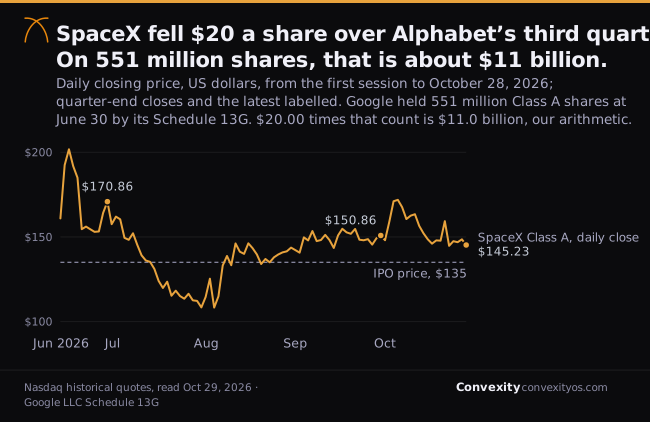
Over Alphabet's third quarter, SpaceX fell from $170.86 to $150.86. Twenty dollars a share on 551 million shares is about $11.0 billion (our arithmetic). Alphabet's 10-Q reports a $12.4 billion unrealized loss on marketable and other equity securities for the quarter, which its management discussion attributes "largely" to SpaceX. Our cross-check accounts for nearly nine-tenths of it.
What Alphabet still holds is not quite stated
The third-quarter 10-Q says Alphabet's marketable equity securities include "$75.2 billion of Space Exploration Technologies Corp." shares "subject to short-term restrictions on the ability to sell." It gives no share count, and the long-term line from June is gone. At the September 30 close, $75.2 billion is about 498 million shares (our arithmetic), roughly 53 million fewer than the 13G count.
The likeliest reading is that those shares, worth about $8 billion, came out of their restrictions rather than out of Alphabet. SpaceX's prospectus releases locked-up shares in stages from August 20. Two disclosures in the 10-Q point the same way. The first is the gain on everything Alphabet sold in the quarter, measured against what it originally paid: $980 million.
That is far too small to include 53 million SpaceX shares, unless Alphabet paid close to today's price for them, which a stake that began as a $900 million investment in 2015 makes unlikely (our reasoning).
The second is the balance sheet. If Google still held the 13G count, the rest of Alphabet's equity measured at quoted prices came to about $6.8 billion at September 30, against about $6.0 billion at June 30 (both our arithmetic). That is a plausible drift. Had Alphabet sold the 53 million shares, the rest of the portfolio would have had to grow by almost $9 billion in a quarter.
That is an inference, and we label it as one. The next 13G amendment or the annual report will settle it. Until then, this note uses the June 30 count of 551 million shares for every sensitivity below, which overstates them if Alphabet has sold.
There is one more thing about what Alphabet owns. SpaceX is no longer only a rocket and satellite company. Its prospectus says xAI was "acquired by SpaceX in early 2026," and it lists the peers of its Grok models as "OpenAI, Anthropic, and Google." Alphabet's most volatile earnings input is a stake in a company whose AI arm competes with Google's own.
The web runs further than that. Our note on Anthropic's registration statement found that SpaceX's AI arm rents computing capacity to Anthropic, the company we read as Alphabet's other large stake. Alphabet sells Anthropic computing capacity too. So the two stakes that now decide Alphabet's EPS are in companies that buy from, sell to and compete with one another, and with Google.
Seven quarters of the same footnote
Every Alphabet earnings release carries the same footnote under its other income table: the gain or loss on equity securities, and the effect on the tax provision, net income and diluted EPS. Line them up and the pattern is hard to miss.
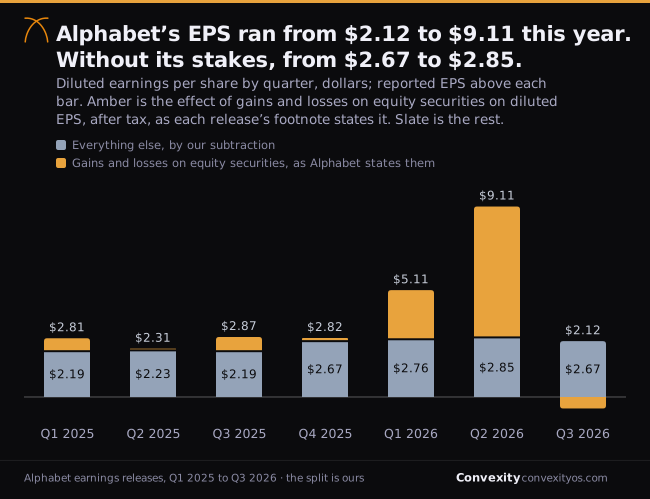
Through 2025 the stakes mattered at the margin. They added 62 cents, 8 cents, 68 cents and 15 cents a share in the four quarters, and for the first three of them Alphabet folded performance fees on certain investments into the same figure. Everything else moved between $2.19 and $2.67. Reported EPS mostly followed the business.
In 2026 the relationship broke. The stakes added $2.35 a share in the first quarter and $6.26 in the second, then took away 55 cents in the third. Reported EPS went $5.11, $9.11, $2.12. Everything else went $2.76, $2.85, $2.67. In each of the three quarters, 96% to 98% of the change in reported EPS from the quarter before was the stakes (our arithmetic).
The gains of the first half came from both holdings. The first-quarter 10-Q attributes its increase to fair value adjustments on non-marketable securities. The second-quarter 10-Q says "SpaceX and a private company." The third-quarter 10-Q, looking across nine months, says the gains came "largely from a private company, and SpaceX prior to its initial public offering." The third quarter's loss is SpaceX after it listed.
That last sentence corrects something we wrote. Our August note, on the AI revenue war, read the whole of Alphabet's $77.4 billion second-quarter gain on non-marketable securities as the unnamed private company's, and compared it with Google Cloud's revenue on that basis.
The nine-month wording now shows SpaceX's gain before listing sat in the same line. Alphabet does not split the two, so that comparison overstated the private company's share by an amount nobody outside Alphabet can measure.
The slate bars are not a measure of operating profit, and it would be easy to read them as one. They are what is left of EPS after the stakes, so they still carry interest income and expense, currency effects, the tax rate, dividends on Alphabet's new mandatory convertible preferred stock and a share count that rose as Alphabet sold new stock.
That is why the slate bar fell from $2.85 in the second quarter to $2.67 in the third even though the business did not shrink. Income before taxes without the equity line rose to $41.0 billion from $39.7 billion between the two quarters (our arithmetic). The difference lies below pre-tax income, in tax, preferred dividends and the share count.
The year-on-year comparison needs a caveat too. Against $2.19 a year earlier, $2.67 is a rise of 22% (our arithmetic).
But that year-earlier quarter carried the $3.5 billion fine, about 29 cents a share if it brought no tax benefit. Put it back and everything else grew between about 8% and 11%, depending on how the fine was taxed (our arithmetic). That is the honest growth rate per share of the part of Alphabet that is not its stakes.
What Alphabet says about its marks
Alphabet does not publish an adjusted EPS. The release's only non-GAAP measures are free cash flow and constant-currency revenue, so the headline number is the reported one, stakes included. Some companies with large investments strip such gains out. Alphabet shows them and explains them.
The explanation is the footnote, which each quarter gives the per-share effect, and a sentence that has appeared in the release all year: "Fluctuations in the value of our investments may be affected by market dynamics and other factors and could significantly contribute to the volatility of OI&E in future periods." On this year's evidence, "significantly" is an understatement.
The approach has a cost and a merit. The cost is that the number most widely quoted, EPS, now tells a reader more about SpaceX's share price than about Google. The merit is that nothing is hidden. Anyone can subtract the footnote, as we did, and the reported number shows shareholders exactly what they owned during the quarter.
On the call, the subject came up once. Ashkenazi's prepared remarks gave the SpaceX sentence quoted above and moved on. No analyst asked about SpaceX, the investment portfolio or the private stake. Anthropic came up twice, both times as a customer: Thomas Kurian, chief executive of Google Cloud, spoke of strong demand for Google's TPU chips, "In addition to our work with Anthropic, both directly and via Broadcom."
Later an analyst asked how Alphabet's own capital spending would change "as you help companies like Anthropic bring on more of their own kind of first-party infrastructure." That is a question about Anthropic as a buyer of chips. The question of Anthropic as the source of most of Alphabet's investment gains was not asked.
The other stake, and why its listing matters
Alphabet's third-quarter 10-Q puts its non-marketable securities under the measurement alternative at $128.2 billion, and says they "primarily consist of our investment in one private company." The table beneath shows a cost of $48.6 billion, cumulative upward adjustments of $88.8 billion and cumulative downward adjustments of $9.2 billion.
Alphabet never names the company. Its filings describe it in enough detail to compare. The first-quarter 10-Q says: "In March 2026, we committed to a $40.0 billion investment in a private company consisting of a $10.0 billion capital commitment and $30.0 billion of future capital funding contingent upon the achievement of specified operational and financial milestones."
Anthropic's registration statement describes a financing arrangement with Google entered into in March 2026, under which Google bought 38.6 million shares of Series G-2 preferred stock at $259.1364 a share, about $10.0 billion, and "will provide up to $30.0 billion of debt and/or equity financing through December 31, 2030."
Alphabet's third-quarter 10-Q carries $20.0 billion of milestone-contingent funding commitments to "a private company" running "through 2030." Anthropic's table shows $20.0 billion still available to it under the Google agreement, with a draw period ending in December 2030.
Same month, same sums, same horizon. Our reading is that the private company is Anthropic. Alphabet does not say so, and it is possible that other holdings sit in the same balance. But the match is close enough that we treat it as the working assumption, and flag it as ours.
Anthropic's statement also records a later price for its stock. It sold Series H preferred at $589.0095 a share in May and June 2026, about 2.3 times what Google paid for Series G-2 (our arithmetic). Under the measurement alternative, a sale of a similar security at a higher price is exactly the kind of observable transaction that obliges the holder to mark its stake up.
Now Anthropic has filed to list. Its registration statement says Google may buy up to $10.0 billion of shares in the offering, which would reduce what remains of its financing commitment. If the listing turns Google's preferred stock into listed shares, the measurement alternative ends, and the stake will be marked to its share price every quarter, as SpaceX's was from June.
The scale is the reason this matters. A 10% move on a $128.2 billion holding is $12.8 billion before tax, about 81 cents a share after Alphabet's own stated tax effect (our arithmetic, illustrative, and it assumes most of that balance is one company). That is larger than the same move in SpaceX. Alphabet's EPS would then answer to two share prices, not one.
A worked sensitivity, all ours
Here is how the arithmetic works, using only figures Alphabet and the exchange publish. Each $10 move in SpaceX's share price, on 551 million shares, is about $5.5 billion before tax.
Alphabet's footnotes this year imply a tax effect of about 22% on its marks: $1.9 billion on $8.7 billion in the third quarter, $21.9 billion on $99.0 billion in the second. After that, each $10 is about 35 cents a diluted share.
A 10% move from the September 30 close, about $15 a share, is worth about $8.3 billion before tax and about 52 cents of EPS, about a fifth of the $2.67 the rest of Alphabet earned per share in the quarter.
For comparison, the whole operating business raised its quarterly operating income by $9.3 billion in a year, or by $5.8 billion if last year's fine is set aside (both our arithmetic).
The fourth quarter has started the same way. SpaceX closed at $145.23 on October 28, $5.63 below its September 30 close. If Google held the 13G count and the price ended the quarter there, the loss would be about $3.1 billion before tax and about 20 cents a share (our arithmetic).
The quarter has two months to run, and in its first 96 sessions SpaceX's close moved by more than $5.63 from one day to the next 31 times (our count).
Two caveats apply. If Alphabet has sold shares, every figure here is too large in proportion; a sale would not reverse gains already booked, it would only stop future marks on what was sold. And the 22% is Alphabet's average on its marks this year, not a rate it has promised.
The business underneath
Search is the part of Alphabet investors watch most, and it slowed. Revenue from Google Search and other was $63.4 billion, up 12.0%, after growth of 19% in the first quarter and 17% in the second (our arithmetic from the releases).
Sundar Pichai, the chief executive, said in the release that the "year-over-year query growth rate is the highest it's been in the last five years." Searches grew faster than at any time in five years, and Search revenue grew more slowly than at any time this year.
Philipp Schindler, the chief business officer, gave three reasons on the call. On currency, he said: "It was the single largest driver of Search deceleration relative to Q2." He pointed to some Asia-Pacific retail advertisers hit by the end of the European Union's de minimis exemption, and to World Cup spending pulled into June.
The third was AI Mode itself. Schindler said "the strong growth in AI Mode queries had an impact because of the lower monetization" Google is seeing in AI Mode.
That third reason is the one to watch, because it is structural rather than a timing effect. Schindler said ad experiments in AI Mode had shown promising results and were being scaled. Ashkenazi warned that Google Services "will continue to lap the search performance acceleration that began in the third quarter last year, which will pressure revenue growth in Q4."
The rest of Services was steadier. YouTube ads rose 9% to $11.2 billion; subscriptions, platforms and devices rose 11% to $14.3 billion; Google Network rose 1% (all our arithmetic). Google Services' operating income rose 17% to $39.2 billion, but the year-earlier figure carried the whole $3.5 billion fine. Without it, Services' operating income grew about 6% (our arithmetic).
Cloud is where the operating story is. Revenue was $30.7 billion, up 103% in Pichai's words, and operating income was $11.1 billion against $3.6 billion. The operating margin was 36.2%, against 23.7% a year earlier (our arithmetic).
Part of the growth is new: in the second quarter Alphabet began recognizing revenue from agreements to supply TPU systems for customers' on-premises infrastructure, "with the significant majority to be recognized in 2027," according to the 10-Q.
Google Cloud's backlog, the revenue it has contracted but not yet recognized, was $560.8 billion at September 30, up $46.9 billion in the quarter (our arithmetic). Alphabet expects to recognize "just over 55%" of its total backlog within 24 months.
The figure includes $16.8 billion from Crux AI, a joint venture Alphabet accounts for under the equity method and counts as a related party. Alphabet changed how it counts backlog in the first quarter, so year-ago figures are not comparable.
Selling hardware has changed the balance sheet. Inventory was $13.3 billion at September 30, against $2.4 billion at December 31, about five and a half times as much (our arithmetic). Ashkenazi explained the sequence: a TPU agreement enters the backlog first, then "We build the inventory ahead of getting the revenue stream in."
She also said Google had begun renting third-party computing capacity because supply is tight: "We expect margin headwinds in the near term as we utilize this capacity."
The remaining segments cost more than they did. Other Bets had revenue of $372 million and an operating loss of $2.0 billion, against $1.4 billion a year earlier. Alphabet-level costs, which the release says "primarily reflect expenses related to our shared AI research and development," rose to $7.7 billion from $4.5 billion.
Cash, briefly
Cash flow deserves its own treatment, which this note does not attempt. For the record: operating cash flow was $42.3 billion and capital expenditure $51.4 billion, so free cash flow was negative $9.1 billion, after negative $5.9 billion in the second quarter. The 2026 capital spending guide of $195 billion to $205 billion is unchanged, and Ashkenazi said: "We continue to expect our CapEx to increase significantly in 2027."
What would prove this wrong
The claim here is narrow: that Alphabet's reported EPS now moves more with the prices of its stakes than with its operating business. Several things would weaken it.
- Alphabet has sold SpaceX stock. Our share count is from June 30. A 13G amendment or the 10-K could show a smaller holding, and every sensitivity here would shrink with it.
- The private company is not Anthropic, or not mostly Anthropic. Alphabet has never named it. If the match of dates and sums is a coincidence, the channel through which an Anthropic listing would reach Alphabet's EPS does not exist.
- Anthropic's listing does not create a quarterly mark. If the offering is delayed, or Google's stake does not convert into listed shares, the private holding stays under the measurement alternative and moves only when a transaction prices it.
- SpaceX goes quiet. In 2025 the stakes moved EPS by between 8 and 68 cents a quarter. A few calm quarters for SpaceX's price would bring the headline back toward the business.
- The business accelerates. Our like-for-like reading puts everything else per share up between 8% and 11% on the year. If Search re-accelerates as currency effects reverse and AI Mode advertising scales, the operating business would claim a larger share of each quarter's change in EPS.
What to watch next: SpaceX's closing price on December 31, Anthropic's pricing and Google's decision on buying into the offering, and whether Alphabet's fourth-quarter release keeps the same footnote or begins to present the stakes differently.
The filings and documents this is built on
- 8-KAlphabet, third quarter 2026 earnings release (Exhibit 99.1)Revenue by line, segment results, operating income, other income and expense with its equity-securities footnote, EPS, cash flow, the at-the-market program and the notes issuedOct 28, 2026
- CallAlphabet third quarter 2026 earnings call, transcript published by The Motley FoolOne of the two independently produced transcripts we read; every call quotation appears in both. Its machine-written summary at the top mislabels the $2.12 as non-GAAP EPS, and we did not use it; retrieved 2026-10-29Oct 28, 2026
- CallAlphabet third quarter 2026 earnings call, transcript published by roic.aiThe second independently produced transcript; every call quotation appears in both; retrieved 2026-10-29Oct 28, 2026
- 10-QAlphabet, quarterly report for the period ended September 30, 2026The $75.2 billion of restricted SpaceX shares, Level 1 equity, the equity-securities components, the private company and its carrying value, the $20.0 billion contingent commitment, backlog, Crux AI, TPU revenue timing and inventoryOct 29, 2026
- 10-QAlphabet, quarterly report for the period ended June 30, 2026The $80.0 billion and $14.1 billion of restricted SpaceX shares, the second-quarter gains by type, Level 1 equity and the Cloud backlog at June 30Jul 23, 2026
- 10-QAlphabet, quarterly report for the period ended March 31, 2026The March 2026 commitment of $40.0 billion to a private company and the Cloud backlog at March 31Apr 30, 2026
- 8-KAlphabet, second quarter 2026 earnings release (Exhibit 99.1)EPS, the equity-securities footnote, operating income, OI&E and Search revenueJul 22, 2026
- 8-KAlphabet, first quarter 2026 earnings release (Exhibit 99.1)EPS, the equity-securities footnote, operating income and Search revenueApr 29, 2026
- 8-KAlphabet, fourth quarter and full year 2025 earnings release (Exhibit 99.1)Fourth-quarter EPS and the equity-securities footnoteFeb 4, 2026
- 8-KAlphabet, third quarter 2025 earnings release (Exhibit 99.1)EPS, the equity-securities footnote and the $3.5 billion European Commission fine in Google ServicesOct 29, 2025
- 8-KAlphabet, second quarter 2025 earnings release (Exhibit 99.1)EPS and the equity-securities footnoteJul 23, 2025
- 8-KAlphabet, first quarter 2025 earnings release (Exhibit 99.1)EPS and the equity-securities footnoteApr 24, 2025
- 13GGoogle LLC, XXVI Holdings and Alphabet, Schedule 13G on Space Exploration Technologies Corp. Class A common stock551,189,500 shares, 7.2% of the class, as of June 30, 2026Aug 14, 2026
- 424B4Space Exploration Technologies Corp., final prospectus for the initial public offeringThe $135.00 offering price, the SPCX symbol, the acquisition of xAI, Grok’s named peers, the board and the staged release of locked-up sharesJun 12, 2026
- S-1Anthropic, PBC, registration statementThe Google 2026 note purchase agreement, the Series G-2 and Series H prices, the $20.0 billion still available and Google’s option to buy in the offeringOct 26, 2026
- 10-QGoogle Inc., quarterly report for the period ended March 31, 2015The $900 million investment in SpaceX made in January 2015Apr 2015
- PricesNasdaq, SpaceX (SPCX) historical daily quotesEvery regular-session close from June 12 to October 28, 2026; read 2026-10-29 and matched against our brokerage data feedOct 28, 2026
- DataState Street, SPDR S&P 500 ETF Trust (SPY) daily holdingsUsed for the disclosure only: Alphabet Class A and Class C and Broadcom are held, SpaceX is not; holdings as of October 28, 2026, read 2026-10-29Oct 28, 2026
Not investment advice. This note is an analysis of public filings and exchange prices, published for research purposes, and not a recommendation to buy, sell or hold any security. A member of the Convexity team holds an economic interest in Anthropic through a special-purpose vehicle and a fund, and stands to benefit if its valuation rises; Convexity is a customer of Anthropic; and this note was drafted with Claude, Anthropic's model. The same team member holds SPY, whose holdings include Alphabet and Broadcom but not SpaceX. No other position in any company named here.
What here is ours rather than Alphabet's. As filed or stated by Alphabet: every revenue, operating income, other income, pre-tax, tax, net income, EPS, segment, backlog, inventory, cash flow and capital spending figure; the effect of equity securities on diluted EPS in each quarter and its tax effect; the $75.2 billion, $80.0 billion and $14.1 billion of restricted SpaceX shares; the $128.2 billion carrying value and its components; the 103% Cloud growth; and every quotation, which is from Alphabet's filings or appears in both transcripts of the call. As filed by others: the 551,189,500 shares and 7.2% in Google's 13G, SpaceX's offering price and history from its prospectus, and the Anthropic financing terms and share prices from Anthropic's registration statement. As published by Nasdaq: SpaceX's daily closes. Ours: the $9.3 billion, $19.4 billion and $1.6 billion steps from one year's pre-tax income to the next; the swing of $1.23 a share and the roughly 48 cents everything else added; every "everything else" EPS figure, which is reported EPS less Alphabet's stated effect; the 96% to 98% share of each 2026 quarter's change; the 22% and the 8% to 11% growth figures and the 29 cents attributed to the fine; the 17% and 6% like-for-like growth rates and the $5.8 billion; the $41.0 billion and $39.7 billion pre-tax figures without the equity line; the 22% tax effect on marks; the $94.2 billion and $11.0 billion valuations of the 13G count and the nine-tenths share; the 498 million and 53 million shares, the $8 billion and the $6.8 billion and $6.0 billion of other quoted equity, and the almost $9 billion that equity would have had to grow had the shares been sold; the reading that the $980 million of gains on securities sold is too small to include them, and that Google still held the 13G count; the count of 31 daily moves larger than $5.63; the identification of the private company as Anthropic; the 2.3 times price ratio; every sensitivity, including the 35 cents, $8.3 billion, 52 cents, a fifth, $3.1 billion, 20 cents, $12.8 billion and 81 cents; the 19%, 17% and 12% Search growth rates and the YouTube, subscriptions and Network growth rates; the Cloud and Services margins; the $46.9 billion backlog increase; and the five-and-a-half-times inventory multiple. This note also corrects our August 27 note on the AI revenue war, which read Alphabet's whole $77.4 billion second-quarter gain on non-marketable securities as the private company's; Alphabet's third-quarter 10-Q shows SpaceX's gain before its listing was in the same line.