









Disclosure. Not investment advice, and nothing here is a recommendation to buy, sell or hold any security. A member of the Convexity team holds the SPDR S&P 500 ETF (SPY), which holds Microsoft and Oracle. A member of the Convexity team also holds an economic interest in Anthropic through a special-purpose vehicle and a fund, and stands to benefit if its valuation rises. That bears on this note: Microsoft is an Anthropic shareholder, Anthropic has committed to buy Azure capacity from Microsoft, and OpenAI, which this note discusses at length, competes with Anthropic. Convexity is a customer of Anthropic, and this note was drafted with Claude, Anthropic's model. No other position in any company named here. Figures are from Microsoft's Forms 10-Q, 10-K, 8-K and 424B2, Anthropic's Form S-1, and Microsoft's earnings calls, quoted only where Microsoft's posted transcript and the Motley Fool's carry the same words. The closing note lists what is our arithmetic.
Microsoft guided Azure to grow 44% to 45% in the September quarter, and it grew 48%. It managed that in a quarter when much of the capacity it had planned on arrived late.
That is not how the AI buildout usually gets told. The usual version runs in a straight line from money to machines to revenue: Microsoft spends, datacenters fill with chips, and Azure grows as fast as the chips arrive. We went into the quarter expecting to confirm that version, with the beat explained by new capacity coming online. Microsoft's own account says the beat was made of something else.
Capital expenditures were $45.2 billion, at least $4.8 billion below the "over $50 billion" Microsoft had guided (our arithmetic), because, as Amy Hood, its chief financial officer, put it, "some third-party capacity deliveries we expected in Q1 were delayed." The extra growth came from the fleet Microsoft already had: engineering that got more work out of its chips, and higher prices for the AI work they ran.
The other half of the quarter is about what Microsoft has promised in return. Its backlog of customer commitments has grown only 8.3% since December, the quarter OpenAI's contract landed in (our arithmetic). Over the same nine months, the datacenter leases Microsoft has signed but not yet started have more than doubled, to $364.6 billion. The customers' side of the ledger has slowed sharply. Microsoft's side has not.
Microsoft's earnings release, Form 10-Q and earnings call of October 28, 2026, and its Form 10-Q for the quarter to December 2025; the shortfall and the change in the backlog are ours.
Where the extra growth came from
Microsoft reported on October 28 for the quarter to September 30, the first of its 2027 fiscal year. Revenue was $92.3 billion, up 19%. Azure, the business that rents computing power and AI models to other companies, took in $33.2 billion, up 48%. That is $10.8 billion more than a year earlier, and 36% of Microsoft's revenue (our arithmetic).
Some scale for the beat. A point of Azure growth this quarter was worth about $224 million of revenue, 1% of the $22.4 billion Azure took in a year earlier (our arithmetic). Azure beat the midpoint of its guide by 3.5 points, so the thing to explain is about $0.8 billion of revenue that Microsoft did not expect to have three months ago.
Hood gave the explanation in her prepared remarks: "Azure revenue was ahead of expectations and increased 48%, even with the 3P capacity delays noted earlier, driven by Foundry and improved CPU monetization." Foundry is Microsoft's service for building software on AI models. Its revenue more than tripled, she said, helped by "efficiency gains across our GPU fleet that allowed us to allocate additional capacity to customers" and by "higher revenue per token."
The ordinary servers did their part too. "Across our CPU fleet, engineering work enabled us to identify and monetize underutilized capacity this quarter," Hood said. In plain terms, Microsoft found processors that were sitting partly idle and rented them out.
On the call, Karl Keirstead of UBS asked what lay behind the guidance. Hood started with engineering, which she said had improved efficiency at every layer of the stack, and moved on to price: "We had higher token pricing than we expected in the quarter." Tokens are the units in which AI work is metered, so a higher price per token is more revenue from the same chips.
She tied those prices to high-quality models on which Microsoft sees good margins, which is a matter of which models customers run; she did not describe it as shortage pricing. Either way, the extra revenue came from machines Microsoft already had.
None of those three ingredients is new capacity. Better software let the same GPUs serve more customers, idle processors found buyers, and the work paid more per unit. New capacity was the one ingredient that went the wrong way. The "3P capacity" Hood mentioned is third-party capacity, machines Microsoft rents from other operators, and it did not arrive on time.
Five beats in a row, and what Microsoft said made each
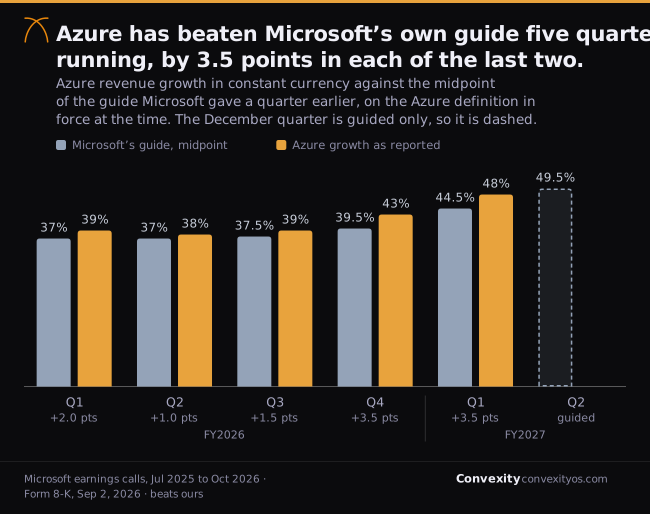
This was not the first beat. Azure has come in above the midpoint of Microsoft's own guide in each of the last five quarters. The chart compares growth in constant currency, which strips out exchange rates, with the guide given a quarter earlier. One adjustment: in September Microsoft redefined Azure, moving GitHub's cloud services and Security Copilot elsewhere, and restated this quarter's guide from about 45% to 44% to 45% on the new basis.
| Quarter | Guide | Reported | Beat, points (ours) | What Microsoft said drove it |
|---|---|---|---|---|
| Q1 FY26 | about 37% | 39% | +2.0 | "better than expected growth in our core infrastructure business, primarily from our largest customers" |
| Q2 FY26 | about 37% | 38% | +1.0 | "efficiency gains across our fungible fleet enabling us to reallocate some capacity to Azure" |
| Q3 FY26 | 37% to 38% | 39% | +1.5 | "we delivered capacity earlier in the quarter" |
| Q4 FY26 | 39% to 40% | 43% | +3.5 | "efficiency gains across our CPU and GPU fleet as well as process improvements to enable earlier delivery of new capacity" |
| Q1 FY27 | 44% to 45% | 48% | +3.5 | "driven by Foundry and improved CPU monetization" |
Read down the last column and the hypothesis we started with holds cleanly for one quarter in five. Capacity arriving early was the whole explanation only in the March quarter, and it shared the credit with efficiency in June. Efficiency carried December's beat, and efficiency and pricing carried September's. The first beat in the run came from Microsoft's largest customers buying more than expected.
That does not make capacity irrelevant. In January Hood said it was "probably better to think about the Azure guidance that we give as an allocated capacity guide about what we can deliver in Azure revenue." Capacity sets the guide: Microsoft decides how much of its fleet Azure gets, and guides to what that fleet can earn. The beat is what engineering and pricing add on top.
The distinction matters because the two kinds of beat behave differently. Capacity, once built, keeps earning quarter after quarter. An efficiency gain lifts output once; to beat again, the engineers have to find another one. And a gain from pricing depends on which models customers choose to run next quarter.
The next beat has to be found again
Microsoft's guide for the December quarter asks for more of the same. Azure is guided to grow 49% to 50% in constant currency, which on last year's $24.1 billion is about $36.0 billion to $36.2 billion of revenue (our arithmetic, ignoring currency, which Microsoft expects to have no meaningful effect on total revenue). It is the highest guide on the chart.
Hood said "continued efficiency gains across our CPU and GPU fleet" would help offset third-party GPU-as-a-service contracts "that have been delayed to H2," the six months to June 2027.
She was candid that not all of the gains are in hand. The engineers' work would carry into the quarter, she said, but "We need to find some more, which we're counting on," because "we had some supply we were counting on Q2 move out into H2."
On price she was more guarded still. There was "some unknown on some token pricing through the quarter," she said, and "that stuff can change."
Leaning on efficiency is not new. In July Hood said Microsoft was "focused on delivering efficiencies that help us bridge the gaps we see," and then beat by 3.5 points. What has changed is the size of the gap being bridged. The guide is higher than any before it, the third-party GPU capacity it would normally rest on has slipped into 2027, and part of the engineering it depends on has not been done yet.
A shortage with a moving end date
Is Microsoft still short of capacity? By its own account, yes. "Customer demand continues to exceed available supply," Hood said in the outlook. What has changed is that the sentence no longer comes with a date. For almost two years Microsoft named a point when supply would catch up, and then moved it.
| When Microsoft said it | When it expected supply to catch up |
|---|---|
| January 2025 | "better supply demand shape by June," as Hood recalled it in July 2025 |
| July 2025 | "in better shape by December," and constrained "through the first half of our fiscal year" |
| October 2025 | "through at least the end of our fiscal year," which ended June 2026 |
| April 2026 | "at least through 2026" |
| October 2026 | no date given |
Hood was clear in July 2025 that the slipping date was "not because we slowed" spending. Demand kept outrunning the build. This July she said demand exceeded supply in a "relatively extreme moment," and that the strain showed in the pricing of the "spot market for assets."
So the honest answer to when the constraint ends is that Microsoft no longer says. That matters for the beat. A company that is short of capacity can sell everything its engineers free up, which is why squeezing the fleet turned straight into revenue this quarter. The same squeeze is worth less on the day supply catches up.
What the $45.2 billion counts, and what it leaves out
Microsoft's quarter carries two capex numbers, $45.2 billion and $39.4 billion, and both are right. They measure different things, and the difference is where much of the buildout now sits.
The larger figure is Microsoft's own definition of capital expenditures. It includes finance leases, datacenters Microsoft rents on terms long enough that accounting treats them almost as purchases. Hood explained the timing on the call: Microsoft counts "the full principal value of finance leases" in capex "at the time of lease commencement," the day it takes possession. This quarter, finance leases were $7.4 billion.
The smaller figure, $39.4 billion, is "Additions to property and equipment" in the cash flow statement: cash actually paid in the quarter for servers, buildings and land that Microsoft owns. It includes no leases at all, but it does include payments for equipment delivered in earlier quarters.
Add the two and they overshoot. Cash paid of $39.4 billion plus $7.4 billion of finance leases is $46.8 billion, which is $1.6 billion more than the $45.2 billion of capex (our arithmetic). The gap is timing. Capex counts equipment when it arrives, and cash counts it when it is paid for. In April Hood described the same offset as "differences between the receipt of goods and payment."
Our reading is that Microsoft paid for more equipment this quarter than it took delivery of, settling bills from earlier deliveries. That fits a quarter in which deliveries ran late.
Three more pieces sit outside both numbers. First, the 10-Q's lease note records $5.2 billion of new finance-lease assets in the quarter, not $7.4 billion. Microsoft does not reconcile the two, and we could not. Second, cash spent in "other investing" rose $6.7 billion from a year earlier, which the 10-Q says was "primarily to facilitate the purchase of components." That is money for parts, and it is in neither figure.
Third, and largest over time, a growing share of new datacenters arrives as operating leases, which never enter capex at all. In July Microsoft said that from this fiscal year it would depreciate datacenters and office buildings over 25 years rather than 15, and that as a result more future datacenter leases would be operating leases rather than finance leases.
The mechanism, in our reading of the lease standard, is that a lease which used to cover most of a building's useful life now covers less of it. New operating-lease assets were $6.5 billion this quarter, 4.6 times the $1.4 billion a year earlier.
So the headline capex figure now understates the buildout compared with a year ago. Capex including finance leases rose 29.5%, slower than Azure. Strip the finance leases out and the rest rose 59%, to $37.8 billion from $23.8 billion. Cash paid for property and equipment rose 103%. Finance leases were 16% of capex this quarter, against 32% a year earlier (all our arithmetic).
That also settles the second half of our hypothesis, that spending grows faster than the revenue it unlocks. On cash, it does. Over the past four quarters Microsoft paid $135.9 billion for property and equipment, up 97%, while Azure revenue was $112.7 billion, up 43%. That is $1.21 of cash spending for each dollar of Azure revenue, against 87 cents a year earlier (our arithmetic).
The comparison is rough, since the same fleet also runs Microsoft 365 Copilot and Microsoft's own AI products. Free cash flow was still $18.6 billion in the quarter, and Microsoft expects to "remain free cash flow positive" this fiscal year. How that holds up across the largest spenders is a question for another note.
The $170 billion is calendar 2026
The other large number on the call was "approximately $170 billion," and it is easy to misread as a fiscal-year figure. It is Microsoft's forecast of capex, including finance leases, for calendar 2026, January to December, which straddles two of its fiscal years.
Three of those quarters are reported, at $118.1 billion together, which leaves about $51.9 billion for October to December (our arithmetic). That squares with Hood's guide of "over $50 billion" for the quarter.
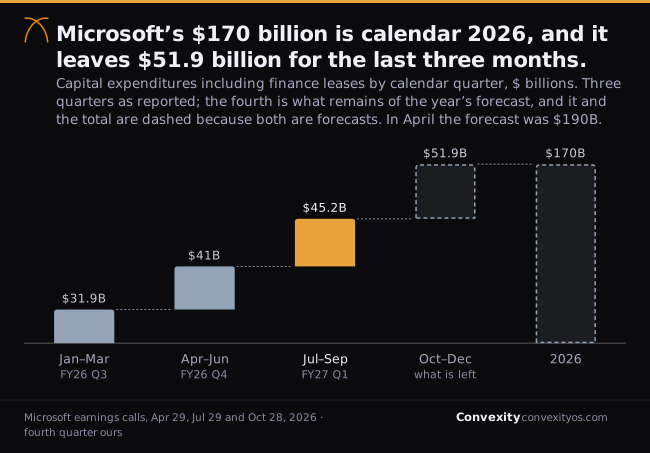
The forecast has come down twice. In April it was "roughly $190 billion," including about $25 billion from higher component prices. In July it became about $175 billion, and not because plans changed. "Outside of this useful life impact, our calendar year 2026 CapEx investment expectations remain unchanged," Hood said; the cut came from "the shift from finance to operating leases."
Now it is about $170 billion "due to the 3P capacity delays noted earlier." That $5 billion is deliveries pushed into 2027, not cancelled. Hood said she expects capex to accelerate in the second half of the fiscal year, mainly on processors and on "the 3P capacity deliveries that shifted to H2."
By Microsoft's account, none of the $20 billion reduction since April is a decision to build less. Fifteen billion is accounting, and five is the calendar.
A backlog that has hardly grown since December
Microsoft's commercial remaining performance obligation, the contracted revenue it has yet to recognize, was $677 billion at September 30. The release puts it up 73% from a year earlier, which sounds like momentum. Almost all of that growth arrived in a single quarter.
Over the year to September the backlog grew $285 billion. The December quarter alone added $233 billion of it, or 82% (our arithmetic). That quarter included OpenAI's recapitalization, under which, Microsoft's 10-Q said that October, "OpenAI has contracted to purchase an incremental $250 billion of Azure services."
In January Hood said "Approximately 45% of our commercial RPO balance is from OpenAI," which is about $281 billion of the $625 billion then on the books (our arithmetic).
Since December the backlog has grown $52 billion, or 8.3% (our arithmetic). That is not the same as no new business. Revenue recognized each quarter draws the backlog down, so a flat total means new contracts have roughly matched what Microsoft delivered. Oracle's backlog has a similar shape, one enormous quarter followed by much smaller additions, as our note on its latest quarter showed.
Microsoft has been careful to show that the rest of its backlog is healthy. In July Hood said "All sequential commercial RPO growth was driven by commitments from customers outside of frontier model companies," and that RPO "increased 25% when excluding OpenAI."
This quarter the backlog slipped by $1 billion (our arithmetic), which Microsoft called a "smaller sequential decline relative to historical seasonality due to the large Azure commitment this quarter." It did not name the customer.
Anthropic's prospectus, filed on October 26, says Anthropic committed in November 2025 to spend "an aggregate of at least $44.9 billion" with Microsoft between November 2026 and May 2033, under an agreement amended in February and October 2026. Neither amendment falls in Microsoft's September quarter, so this quarter's large commitment does not appear to be one of them. Our note on the S-1 covers the rest of Anthropic's compute bill.
Commercial bookings, the new contracts signed in the quarter, fell 12%, against a year-earlier quarter that included large Azure commitments. And the backlog is lengthening. The part Microsoft expects to recognize in the next 12 months, "roughly 30%" of it, grew 29%, while the part beyond 12 months grew 98%.
Then there is concentration. Satya Nadella, Microsoft's chairman and chief executive, told analysts he wanted a broad base of enterprise customers rather than four customers "who buy a lot of capacity from you," with which "you can show a few quarters of growth." "And that's not a business," he said. In the same quarter, Microsoft recorded $10.0 billion of revenue from OpenAI, 10.8% of its total (our arithmetic).
That figure comes from the 10-Q's related-party note, which counts all "revenue from commercial arrangements with OpenAI, inclusive of revenue-sharing payments," so it is not all Azure. It is 66% above the $6.0 billion a quarter OpenAI averaged in fiscal 2026, when the full year came to $24.1 billion (our arithmetic). Gabriela Borges of Goldman Sachs put it on the call as "OpenAI at 11% of revenue in the quarter."
What the leases commit Microsoft to
The other side of the ledger has not stalled. At September 30 Microsoft had "additional leases, primarily for datacenters, that had not yet commenced of $364.6 billion," its 10-Q says. That is up $35.5 billion in the quarter, $209.5 billion since December, and $271.9 billion since June 2025, when the total was $92.7 billion (our arithmetic).
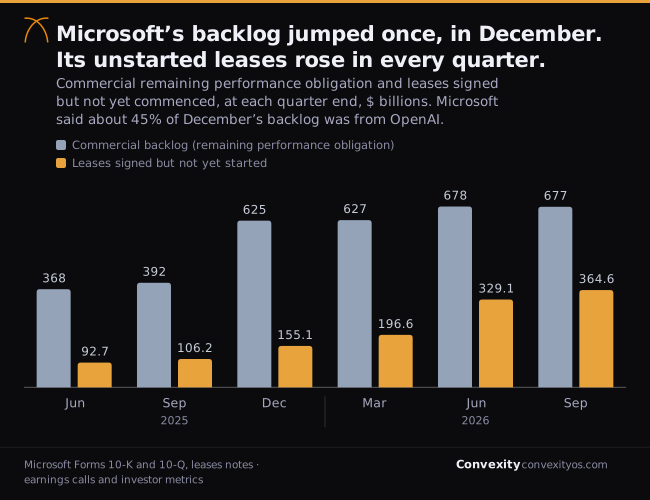
Since December, then, Microsoft's unstarted leases have grown 4.0 times as much as its backlog (our arithmetic). The two are not like for like. The leases start between fiscal 2027 and fiscal 2034 and run for terms of up to 20 years, while Microsoft puts the backlog's weighted average duration at 2.3 years. The comparison shows direction, not a bill that comes due at once.
Two details in the lease note are new this year. The commencement window, which ran to fiscal 2031 in the March 10-Q, now runs to fiscal 2034. And since June the note has said that "some arrangements" are "subject to certain contractual conditions being met," which suggests that not every lease in the total is binding yet. Microsoft does not say how much is conditional.
For scale, Microsoft's total debt at September 30 was $35.5 billion, according to the capitalization table in a bond prospectus it filed the morning after the call. Its finance-lease liabilities, from leases that have already started, were $71.0 billion, twice its debt. Leasing is how Microsoft finances much of the buildout, and Hood said so: "There's a form of financing called leasing, and we've been using that one as a vehicle."
The prospectus is the other half of that answer. Asked how Microsoft would raise capital, Hood said it had access to the debt markets and had not yet tapped them. The preliminary prospectus supplement filed on October 29 offers notes in ten tranches, two floating-rate and eight fixed-rate, with every amount still blank, for "general corporate purposes" that it says may include "capital expenditures." The pricing term sheet, filed the next morning, set the size at $25.0 billion: $2.0 billion of floating-rate notes and $23.0 billion of fixed-rate notes due from 2028 to 2066 that yield 4.869% to 6.356%, 0.25 to 1.05 percentage points over Treasuries. When the notes settle on November 4, Microsoft's debt rises by about seven-tenths, to roughly $60.5 billion before any repayment, still below its $71.0 billion of finance-lease liabilities (our arithmetic).
Hood's case for comfort is that most of the spending can be slowed. In July she said that "if the demand environment changes, you just slow down what is, in fact, the largest component," the GPUs and CPUs, and that "the investment into land and data center builds is actually quite flexible," since it is a smaller share of costs and its timing can be changed.
About three quarters of this quarter's capex went to short-lived assets such as chips, she said, so most of the spending is the kind she describes as easy to slow.
Signed leases are where that argument is thinnest, in our reading. Microsoft may be able to move when a building is handed over, and some of the arrangements still have conditions to meet. But a lease that has commenced obliges payments for its term whatever demand does, and $364.6 billion more is signed and waiting.
The chips can be slowed; the buildings, once handed over, have to be paid for. Microsoft's unstarted leases were already the largest of six big spenders in our ledger of AI buildout financing, and they have grown since.
OpenAI, on two lines of the income statement
OpenAI appears in Microsoft's income statement twice, and the two lines move for unrelated reasons. The first is revenue: the $10.0 billion above, with $7.2 billion owed by OpenAI at the end of the quarter, up from $6.0 billion in June.
The second is Microsoft's stake, about 24% on an as-converted basis, down from about 25% in June. Microsoft accounts for it by the equity method, using what accountants call hypothetical liquidation at book value. Each quarter it books the change in what it would receive if OpenAI's net assets were distributed at book value.
The basis changed with OpenAI's recapitalization in October 2025. In January Hood explained that Microsoft now records gains or losses "based on our share of the change in their net assets on their balance sheet as opposed to our share of their operating profit or losses from their income statement." Before that, Microsoft booked its share of OpenAI's losses.
That is why the line flipped sign. This quarter, other income included $272 million of net gains from OpenAI. A year earlier it included $4.1 billion of net losses, which Hood said then were "all due to our percentage of losses." For fiscal 2026 the line was a $6.5 billion gain, which the 10-K says came mainly from "the dilution gain" as Microsoft's share of OpenAI shrank with the recapitalization and other funding.
In practice the line now moves with OpenAI's balance sheet, so a quarter in which OpenAI raises money can produce a gain for Microsoft even while OpenAI loses money (our reading of the method). Our note on OpenAI's revenue gap covers what those losses look like from OpenAI's side.
Microsoft strips the OpenAI line out of its adjusted results. On that basis earnings per share were $4.89, up 18%. On the reported basis they were $4.92, up 32%, because last year's quarter carried the loss. Microsoft has committed $13.0 billion to OpenAI, of which $12.0 billion is funded. Both earnings figures are real; they answer different questions.
What would prove this wrong
This note makes three claims: that Azure's beat was squeezed from the fleet Microsoft already had rather than delivered by new capacity, that a beat of that kind is harder to repeat, and that Microsoft's commitments to its landlords are growing far faster than its customers' commitments to it. Each can be checked against evidence with a date.
- The December-quarter results, which Microsoft has not yet scheduled and usually reports in late January. If Azure grows 50% or more while the third-party GPU contracts are still delayed, efficiency is a more repeatable engine than this note allows. A miss with capacity still late would support the note.
- What Microsoft credits. If the next beat is explained by capacity arriving, the hypothesis we started with was right about the business and merely wrong about this quarter.
- Token pricing. If Microsoft reports lower token prices and Azure still beats, pricing was not doing the work we credit it with.
- The backlog. A commercial backlog well above $677 billion in December, without a single large contract from a frontier lab, would mean customers are adding faster than we describe. A jump from one lab would instead deepen the concentration.
- The leases. If the unstarted total falls in the December 10-Q because leases commence faster than new ones are signed, the gap narrows in the ordinary way. If it falls because conditional arrangements lapse, Microsoft has more flexibility than this note gives it.
- Calendar 2026 capex. The December quarter should come in near $51.9 billion. A figure well below it would mean the third-party delays are running longer than Microsoft said in October.
- A date. If Microsoft names a quarter when supply will catch up with demand, the end date stops moving, and the case for squeezing the fleet weakens with it.
- The next bond deal. October's came to $25.0 billion, less than a tenth of the $364.6 billion of leases not yet started (our arithmetic), so leases remain the main channel. Deals of that size every quarter or two would mean the financing of the buildout is widening beyond them.
The filings and documents this is built on
- 8-KMicrosoft, first quarter fiscal 2027 earnings release (Exhibit 99.1)Revenue, Azure growth, commercial RPO, EPS on both bases, the OpenAI adjustment, the cash flows statementOct 28, 2026
- CallMicrosoft FY27 first quarter earnings call, transcript posted by MicrosoftCapex, finance leases, cash paid for property and equipment, the Azure explanation, the December-quarter and calendar 2026 guidance, and the Q&A; every quotation also checked against the Motley Fool transcriptOct 28, 2026
- CallMicrosoft (MSFT) Q1 2027 earnings call transcript, The Motley FoolThe second, independently produced transcript; retrieved 2026-10-29Oct 28, 2026
- 10-QMicrosoft, quarterly report for the period ended September 30, 2026Leases note (leases not yet commenced, right-of-use assets obtained, lease liabilities), the OpenAI related-party and equity-method disclosures, other income, the cash flow discussion and the capacity risk factorOct 28, 2026
- 424B2Microsoft, preliminary prospectus supplement for senior notesTen tranches with amounts blank, the use of proceeds and the capitalization table at September 30, 2026Oct 29, 2026
- FWPMicrosoft, pricing term sheet for senior notesThe $25.0 billion across ten series, their yields and spreads over Treasuries, and settlement on November 4Oct 30, 2026
- 8-KMicrosoft, fiscal year 2027 segments and investor metrics (Exhibit 99.1)The redefinition of Azure, restated Azure revenue by quarter for fiscal 2025 and 2026, and the restated 44% to 45% guideSep 2, 2026
- DataMicrosoft Investor Relations, FY27 first quarter investor metricsAzure revenue in dollars, commercial RPO and bookings growth by quarter; retrieved 2026-10-29Oct 28, 2026
- 10-KMicrosoft, annual report for the fiscal year ended June 30, 2026Leases not yet commenced at June 30, revenue from OpenAI for fiscal 2026, the OpenAI stake, the dilution gain and the cash paid for property and equipmentJul 29, 2026
- 10-QMicrosoft, quarterly report for the period ended March 31, 2026Leases not yet commenced at March 31 and their commencement window; cash paid for property and equipmentApr 29, 2026
- 10-QMicrosoft, quarterly report for the period ended December 31, 2025Leases not yet commenced at December 31; cash paid for property and equipmentJan 28, 2026
- 10-QMicrosoft, quarterly report for the period ended September 30, 2025Leases not yet commenced at September 30, 2025, OpenAI’s incremental $250 billion Azure commitment and the year-earlier cash flowsOct 29, 2025
- 10-KMicrosoft, annual report for the fiscal year ended June 30, 2025Leases not yet commenced at June 30, 2025, and fiscal 2025 cash paid for property and equipmentJul 30, 2025
- CallMicrosoft FY26 fourth quarter earnings call, transcript posted by MicrosoftThe useful-life change, the $175 billion forecast, the Azure beat, the RPO remarks and the remarks on flexibility and the spot marketJul 29, 2026
- CallMicrosoft (MSFT) Q4 2026 earnings call transcript, The Motley FoolSecond transcript for the July 2026 quotations; retrieved 2026-10-29Jul 29, 2026
- CallMicrosoft FY26 third quarter earnings call, transcript posted by MicrosoftThe $190 billion forecast, the receipt-of-goods offset, the Azure guide and the constraint through 2026Apr 29, 2026
- CallMicrosoft (MSFT) Q3 2026 earnings transcript, The Motley FoolSecond transcript for the April 2026 quotations; retrieved 2026-10-29Apr 29, 2026
- CallMicrosoft FY26 second quarter earnings call, transcript posted by MicrosoftThe OpenAI share of RPO, the allocated capacity guide, the equity-method change and the Azure guideJan 28, 2026
- CallMicrosoft (MSFT) Q2 2026 earnings call transcript, The Motley FoolSecond transcript for the January 2026 quotations; retrieved 2026-10-29Jan 28, 2026
- CallMicrosoft FY26 first quarter earnings call, transcript posted by MicrosoftThe constraint through the fiscal year, the OpenAI loss and the Azure guideOct 29, 2025
- CallMicrosoft (MSFT) Q1 2026 earnings call transcript, The Motley FoolSecond transcript for the October 2025 quotations; retrieved 2026-10-29Oct 29, 2025
- CallMicrosoft FY25 fourth quarter earnings call, transcript posted by MicrosoftCapex, finance leases and cash paid for property and equipment, and the shortage dates of January and July 2025Jul 30, 2025
- CallMicrosoft (MSFT) Q4 2025 earnings call transcript, The Motley FoolSecond transcript for the July 2025 quotations; retrieved 2026-10-29Jul 30, 2025
- S-1Anthropic, PBC, registration statement on Form S-1The commitment of at least $44.9 billion to Microsoft from November 2026 to May 2033 and its amendmentsOct 26, 2026
Not investment advice. This note is an analysis of Microsoft's public disclosures, published for research purposes, and not a recommendation to buy, sell or hold any security. A member of the Convexity team holds SPY, which holds Microsoft and Oracle. A member of the Convexity team also holds an economic interest in Anthropic through a special-purpose vehicle and a fund, and stands to benefit if its valuation rises; Microsoft is an Anthropic shareholder and supplier, and OpenAI competes with Anthropic. Convexity is a customer of Anthropic, and this note was drafted with Claude, Anthropic's model. No other position in any company named here. Positions are as of October 29, 2026.
What here is ours rather than Microsoft's. As filed or stated by Microsoft: every revenue, Azure, capex, finance lease, cash flow, backlog, bookings, lease, debt, OpenAI and earnings figure; the October notes' size, yields, spreads and settlement date; every guide and forecast, including the roughly $190 billion, about $175 billion and about $170 billion for calendar 2026; the restated Azure figures; and every quotation, which is from Microsoft's filings or from wording that both Microsoft's posted transcripts and the Motley Fool's carry. As filed by Anthropic: the $44.9 billion commitment and its dates. Ours: every beat against the guide's midpoint and the $0.8 billion it is worth; the $224 million value of a point of Azure growth, the $10.8 billion added and Azure's 36% share of revenue; the $36.0 billion to $36.2 billion implied for the December quarter; the $4.8 billion capex shortfall; the $46.8 billion sum of cash and finance leases and the $1.6 billion timing gap, and our reading of it; capex less finance leases and every year-over-year change in capex, cash paid and finance leases' share; the trailing four-quarter totals for cash paid and Azure revenue, their growth, and the $1.21 and 87 cents per dollar of Azure revenue; the $118.1 billion reported for calendar 2026 and the $51.9 billion left for its last quarter; the $15 billion and $5 billion steps between forecasts; every change in the backlog, including the $285 billion, $233 billion, 82%, $52 billion, 8.3% and $1 billion, and OpenAI's roughly $281 billion share of December's backlog; OpenAI's 10.8% of revenue and its 66% rise on the fiscal 2026 average of $6.0 billion; every change in the unstarted leases and the 4.0 times comparison with the backlog; the 4.6 times rise in new operating-lease assets; the comparison of finance-lease liabilities with debt; the October notes set against Microsoft's debt and its unstarted leases, and the roughly $60.5 billion of debt once they settle; and our readings of the lease standard and of the equity method.