








Disclosure. Not investment advice, and nothing here is a recommendation to buy, sell or hold any security, including in an offering that has not yet been priced. We are not neutral on this company. A member of the Convexity team holds an economic interest in Anthropic through a special-purpose vehicle and a fund, and stands to benefit if its valuation rises. Convexity is a customer of Anthropic, and this note was researched and drafted with Claude, Anthropic's model. The same team member holds the SPDR S&P 500 ETF (SPY), whose holdings include Amazon, Microsoft, Alphabet, Nvidia, Broadcom and AMD, all named below, and holds no other position in any company named here. Every figure is from Anthropic's registration statement unless it is labelled otherwise. The closing note lists what is our arithmetic, and the section near the end names what would prove this note wrong.
Anthropic made money for the first time in the three months to June: $974 million of operating income on $11.6 billion of revenue. The prospectus it filed on Monday explains how, and the explanation is also the risk.
The company buys its computing power 12 to 18 months before it arrives. So in the spring, Claude was earning revenue on compute that had been ordered for a much smaller company. Revenue rose 144% from the first quarter. The compute bill rose 64% (our arithmetic on the filed quarters).
The same document lists what Anthropic has ordered since. Seven named suppliers account for $637.0 billion of commitments (our sum), and the filing leaves two more out of its own table. One of the seven, the AI arm of SpaceX, starts billing about $3.1 billion a month in December. Three months of that would be more than the whole second-quarter compute line.
So the offering, under the ticker ANT on the Nasdaq, asks investors to decide which quarter describes the company. Is it the one in which sales outran the machines, or the one coming, in which the machines arrive?
From Anthropic, PBC's registration statement on Form S-1, filed with the SEC on October 26, 2026. The 8% margin and the $637.0bn sum are ours; the 251% and 48% are the filing's own.
The quarter the lines crossed
Start with the six quarters the filing prints, because the story is in their shape.
In the first quarter of 2025, Anthropic booked $376 million of revenue and spent $944 million on compute and infrastructure. Every dollar of sales cost $2.51 of machines. The filing puts that ratio at 251%, and it kept falling, but slowly, for a year: compute still exceeded revenue in every quarter of 2025.
Then two things happened at once. In November 2025 the company released Opus 4.5, more capable and cheaper per task than the model before it, and the filing says quarter-on-quarter revenue growth "accelerated from 48%" in the fourth quarter "to 132%" in the first quarter of 2026. Revenue passed the compute bill that quarter, $4.7 billion against $3.4 billion. In the second quarter it more than doubled again, to $11.6 billion, while compute rose to $5.6 billion.
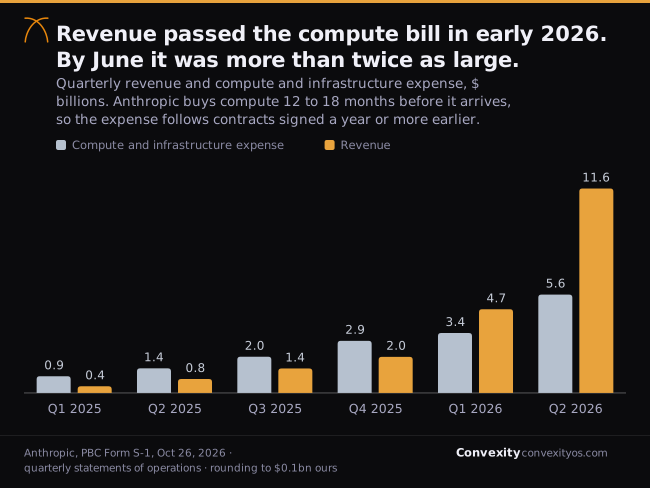
The filing is unusually direct about why the two lines moved so differently. Because the company procures compute "12 to 18 months in advance of availability," it says, these expenses "are generally fixed in the near term and increased as committed compute became available to us rather than in response to in-period demand."
Read that as a timetable. The machines that served the second quarter's customers were ordered in 2025, when quarterly revenue was a fraction of what it became. Demand arrived faster than the hardware. The result was an operating margin of 8% in the June quarter (our arithmetic), and 19% on the company's adjusted measure, which excludes $1.3 billion of stock-based compensation.
That is a real profit. It is also, by the company's own description of how it buys compute, a profit earned in the gap between an order and its delivery.
What the compute was doing
The headline compute line is a single number, but a note to the financial statements splits the company's costs by function. That split answers a question our September note left open, about how much of the compute bill serves paying customers and how much builds the next model.
For the first half of 2026, cost of revenue was $2.4 billion. The filing says that line is "substantially all" compute "associated with customer-serving workloads." Against $16.3 billion of revenue, that is a gross margin of about 85% (our arithmetic). The Financial Times reported in September that the margin was above 80% before revenue shared with partners and the cost of training. The filing's split supports that shape.
Research and development was $9.7 billion over the same six months, about 60% of revenue (our arithmetic). The filing describes it as mainly "compute and infrastructure costs associated with model development, research, and internal usage workloads," plus people and software. Sales and marketing was $3.8 billion, and it includes two things worth knowing: the fees paid to cloud partners who resell Claude, and the compute that runs the free tier.
Put the pieces side by side. The company spent $8.9 billion on compute and infrastructure in the first half (our sum of the two quarters). At most $2.4 billion of it served paying customers, since cost of revenue also carries some personnel and overhead. So roughly three-quarters went elsewhere: model development and research, internal use, and the free tier (our arithmetic).
This matters for the IPO in a specific way. The gross margin that will be quoted most, about 85%, describes the cheap part of the business. The expensive part is the frontier itself, and it sits below that line. A company that keeps the lead keeps paying for it.
Where the revenue comes from
Almost half the revenue arrives through other companies' storefronts. Sales through cloud marketplaces were 48% of first-half revenue, up from 11% in 2023. The filing says the platforms "bill end customers, collect payments on our behalf, and remit such amounts to us, net of applicable platform and other fees."
Anthropic books those sales gross, as the principal in the transaction, and records the partners' fees as an expense. That is the accounting difference our October note on OpenAI described, from the other side: OpenAI's investors had built a larger revenue figure to compare it with Anthropic, which counts the full value of certain partner sales. The S-1 confirms the treatment. It also shows where the fees land. The quarterly line called sales, marketing and partnerships went from $246 million in the fourth quarter of 2025 to $1.0 billion and then $2.1 billion in the two quarters of 2026.
The customer counts are the part of the filing that will sell the deal, and they are striking. Customers paying $100,000 or more a year rose from more than 950 at September 30, 2025 to more than 11,900 a year later. More than 1,900 pay over $1 million, and about 250 pay over $10 million. Net revenue retention, a measure of how much existing customers expand, was about 900%.
Concentration is falling, too. About 79% of third-quarter revenue came from outside the five largest customers, up from 64% in the first quarter, and no customer was more than 10% of revenue in the first nine months. Even so, each of the top five spent a record amount with the company in the third quarter.
Three smaller disclosures describe what kind of revenue this is.
It belongs to the newest models. Model versions released in the six months to September 30 accounted for over 80% of third-quarter revenue. Customers move to the frontier as soon as it moves, which is good while Anthropic holds it and is the whole risk if it does not.
It is consumption, and consumption is seasonal. About 80% of first-half revenue was billed by usage rather than by subscription. In the two weeks to January 2, 2026, total customer spend fell about 20% from the two weeks before, as companies froze their code over the holidays. The filing warns that as growth slows, such swings "become more apparent."
Some of it will not recur. The company estimates that 5% to 7% of its revenue in the first nine months came from customers later found to be breaking its usage policy or commercial terms. It recognizes that revenue before it cuts them off, tightened enforcement in August and September, and expects the share to decline.
The bill that has not arrived
Now turn to the other side of the timetable: what has been ordered for the next 12 to 18 months, and for the decade after.
The S-1's contractual commitments table is still blank in this filing, along with the share count and the price. But the narrative beside it names seven arrangements with dollar figures, and they are enough to show the scale.
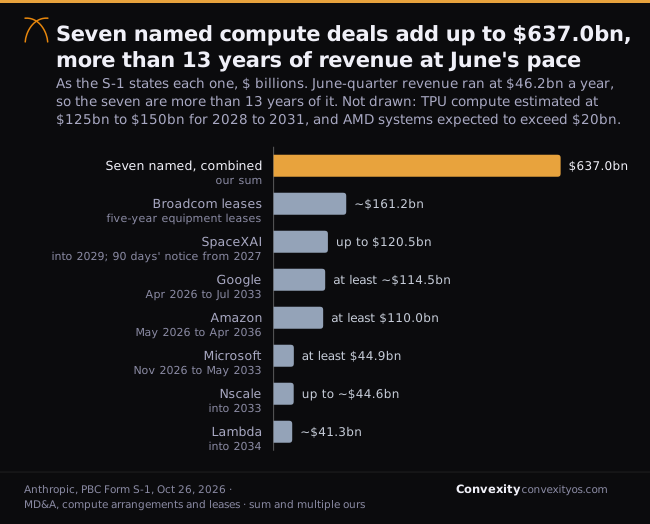
Three of the seven are the big cloud companies, and their contracts are written as minimums. Amazon's is "at least $110.0 billion between May 2026 and April 2036." Google's is "at least approximately $114.5 billion" through July 2033. Microsoft's is "at least $44.9 billion between November 2026 and May 2033." The first two say "regardless of actual usage," with a true-up payment if spending falls short, and Microsoft's agreement uses the same words.
The largest single line is not a cloud contract at all. Anthropic leases equipment from Broadcom on five-year terms, with rent totalling "approximately $161.2 billion excluding interest," and the leased hardware gives it "access to TPU-based compute capacity" in data centers others run on its behalf. Some of that capacity came online in 2026, and more starts in 2027. The leases cannot be cancelled.
Then there are the newer suppliers. Nscale (up to about $44.6 billion) and Lambda (about $41.3 billion) are paid only as capacity is "delivered to and accepted by us," which shifts the building risk to them.
And there is SpaceXAI, the former xAI, now a subsidiary of SpaceX. Our September note estimated this contract at about $45 billion from SpaceX's own filing. The S-1 puts it at up to $120.5 billion, "consisting of approximately $3.1 billion in the aggregate per month once all capacity has been delivered, which we expect in December 2026."
Here is what that means in practice. $3.1 billion a month is $9.3 billion a quarter (our arithmetic). Anthropic's entire compute and infrastructure expense in the second quarter was $5.6 billion. One supplier, at full delivery, would bill two-thirds more than everything the company spent on compute in its first profitable quarter. Over a year, $37.2 billion, it would equal about 80% of the second quarter's revenue at an annual rate (our arithmetic).
SpaceXAI is also the one contract with a door. After non-cancelable periods that end in January and March 2027, either side can end each agreement "upon 90 days' advance written notice." That is flexibility for Anthropic. It is also flexibility for a supplier that is a competitor: SpaceX's own filing said in June that it was training Grok-5 at Colossus II, one of the two clusters Anthropic rents.
Beyond the seven, the filing names two commitments it leaves out of the table because their size depends on deployment. Additional TPU compute from Google and others for 2028 to 2031 is estimated at "approximately $125.0 billion to $150.0 billion." AMD Helios systems in 2027 would cost more than $20 billion if fully procured.
Add it up loosely and the company has committed to roughly $780 billion to $810 billion of compute that a reader can put a number on (our arithmetic, counting AMD at its $20 billion floor). Against a June quarter of $11.6 billion, that is a long way ahead of the revenue. It is also exactly the bet the second quarter appears to reward: buy early, and let demand catch up.
Suppliers that lend
A company with $637.0 billion of named commitments needs a balance sheet to match, and Anthropic's suppliers have helped build it.
At June 30 the company held $112.4 billion of cash and $19.3 billion of short-term investments, $131.7 billion in all (our sum). That is before a single share is sold to the public.
Then there are the lines it has not touched. Three note purchase agreements let it issue up to $77.0 billion of new convertible notes to its suppliers, none of it drawn at June 30. Google's allows $20.0 billion, Amazon's $15.0 billion, and Broadcom's $42.0 billion. The Broadcom notes would carry 9% interest paid in kind, and they can be used only to pay the lease rent. In September an amended credit agreement raised the company's revolving facility to $15 billion.
The pattern is the same one our September note found in Amazon's filing. The companies selling Anthropic compute also lend it the money to buy more. That is efficient while demand holds. It also means a supplier's appetite for the customer's paper is part of what holds the customer up.
Google's facility carries a twist. It can be reduced by up to $10.0 billion if Google uses an option to buy Class N shares in a private placement alongside the offering, at the public offering price.
Why the net loss is $80.7 billion
The income statement's bottom line looks catastrophic. The first half of 2026 shows a net loss of $80.7 billion. The second quarter alone, the profitable one, shows a net loss of $66.3 billion.
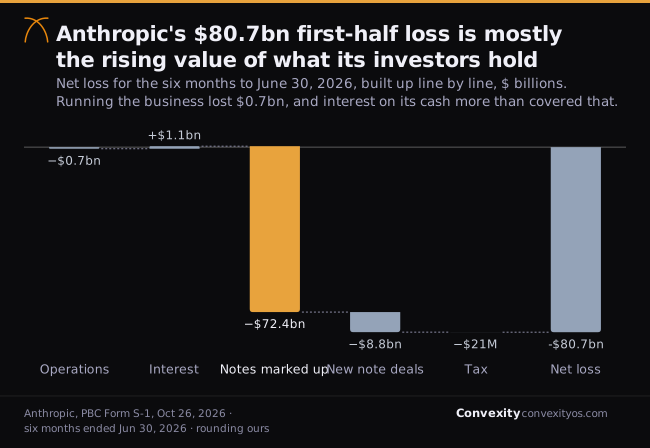
Almost none of it is the business. Operations lost $693 million in the half, and interest on the cash pile, $1.1 billion, more than covered that. The $72.4 billion line is the change in the fair value of convertible notes and related instruments, which the filing attributes to "an increase in our enterprise valuation." Another $8.8 billion comes mainly from first recording the new note purchase agreements at fair value.
In plain terms, Anthropic's investors hold notes that convert into shares at old prices. Every time the company's value goes up, the notes are worth more, and the company books the difference as a loss. Of the $132.9 billion accumulated deficit at June 30, $113.2 billion is this kind of mark.
Amazon's notes show the scale. Amazon holds $6.2 billion of principal under two agreements from 2023 and 2024, convertible at $2.09 and $5.05 a share into about 1.84 billion non-voting Class N shares. At the Series H price of $58.90 a share (the $589.01 preferred price, adjusted for the 10-for-1 split in September), those shares are worth about $108.4 billion (our arithmetic). The balance sheet carries the notes, the only convertibles outstanding at June 30, at $108.6 billion. They convert with the offering, subject to a cap on Amazon's ownership.
So the net loss is a measure of how much the company's early backers have made, not of how much the company is losing. Investors should read the operating line.
Who will run it
The offering sells Class A shares, and Class A shares will not control the company.
An LLC of the seven co-founders will hold Class F stock with "an aggregate number of votes that equals 50.1% of the total voting power," and no economic rights. The founders own about a tenth of the shares between them, each holding roughly 240 million (our arithmetic on the ownership table). Separately, the Long-Term Benefit Trust, a body with no financial stake, holds a single class of stock, Class T, that elects directors who "will constitute a majority" of the board.
That makes Anthropic a "controlled company" under Nasdaq's rules, exempt from some of the governance requirements other listed companies follow. On most matters, new Class A holders will share the 49.9% of votes the founders do not hold. Amazon's conversion shares, and the shares of the company's own charitable arm, are Class N, which does not vote.
The charitable arm is new. The company has given 846,840,960 Class N shares, 5% of its fully diluted count, to the Anthropic Public Benefit Fund, a wholly owned subsidiary. Its board may add up to 2% more of the outstanding shares each time the stock rises 50% above the last milestone, starting from the IPO price. The seven founders have each also pledged 80% of their personal equity to philanthropy.
The 5% figure lets a reader work out the scale (our arithmetic). It implies about 16.9 billion fully diluted shares, so the Series H price values the company at about $998 billion on that count. That is close to the $965 billion post-money valuation the company announced in May, though the two are not computed on the same share count. The fund's own stake is worth about $49.9 billion at that price.
The government problem
One risk factor is unlike anything in a normal software prospectus.
In February 2026, after the company said its models should not be used for mass domestic surveillance or fully autonomous weapons, the President directed federal agencies to stop using its technology. The Secretary of War ordered Anthropic designated a "supply-chain risk to national security." On August 27 a federal court in Northern California ruled largely in Anthropic's favor, finding the actions retaliatory and in breach of the First Amendment.
On September 25 a divided panel of the D.C. Circuit went the other way on a separate designation, 2 to 1, holding that the Department of War's Section 4713 designation "was proper." Anthropic has asked the full court to rehear the case. The filing says it "cannot predict the ultimate outcome," and that a bad one could hurt sales to government agencies and to "other customers that sell products and services to the U.S. government."
A second episode shows how fast policy can reach revenue. In June the Commerce Department imposed worldwide export restrictions on Fable 5 and Mythos 5, and the company switched both models off for every customer until the restrictions were lifted. Remember that models released in the last six months drove more than 80% of third-quarter revenue. A rule that reaches the newest models reaches the revenue that matters most.
What our September note got right, and what the filing changed
Our September 16 note on Anthropic promised that if the prospectus contradicted any of its figures, we would say so, by name. Here is the reckoning.
The compute commitments were far larger than we counted. We summed four dollar-denominated commitments to about $225 billion. The S-1 names seven totalling $637.0 billion (both sums ours). SpaceX, which we put at about $45 billion from its $1.25 billion monthly fee in SpaceX's June filing, is up to $120.5 billion at about $3.1 billion a month. Microsoft's Azure deal, $30 billion when announced, is now at least $44.9 billion after two amendments. AWS, "more than $100 billion," is $110.0 billion. The Google and Broadcom arrangement, which we did not draw because it was stated only in gigawatts, turns out to be the largest of all: at least about $114.5 billion with Google, and about $161.2 billion of Broadcom leases for TPU capacity. The $50 billion Fluidstack figure from Anthropic's own posts does not appear by name in the S-1.
The reported revenue and margin held. The Financial Times reported second-quarter revenue of $11.5 billion; the filing says $11.555 billion. It reported a gross margin above 80% before partner revenue share and training; the filing's split gives about 85% on that basis (our arithmetic). It reported that adjusted operating income would be positive for a second straight quarter; the filing shows the June quarter positive at $2.2 billion, after a $617 million adjusted loss in the first quarter, and leaves the third quarter blank.
One of our falsifiers fired, partly. We wrote that the argument would weaken if the commitments turned out to be take-or-pay with no exits. The three largest cloud contracts are minimums payable "regardless of actual usage." Our other falsifier, that training might prove a small line, did not fire: research and development, mostly compute for model work, was about 60% of first-half revenue.
The September note now carries a correction at the top that names each of these changes.
The case against this note
The strongest objection is that we are comparing a decade of spending with a single quarter of sales, and that the quarter is the wrong one to use.
Revenue grew 2.4 times from the first quarter to the second. If it grows even half that fast for a few more quarters, $637.0 billion stretched over seven to ten years stops looking large. The S-1's own evidence leans this way: the third-quarter customer counts, the 900% retention, and the 40% cut in cost per task that Opus 5.5 delivered all point to demand that has not finished arriving. On that reading the profit was not a timing accident. It was a preview.
A second objection is that commitments are not all expenses. Nscale and Lambda bill only on delivery. SpaceXAI can be cancelled. The Broadcom leases are finance leases, so their cost reaches the income statement through depreciation and interest spread over the term rather than all at once.
We take both seriously. Our claim is narrower than "the profit is fake." It is that the second quarter's margin was earned with a compute base sized for an earlier, smaller company, and that the filing names enough new capacity arriving from December onward to test whether revenue keeps outrunning it.
What would prove this wrong
These are the signs that the profit is durable rather than a moment between orders.
- The third quarter holds the margin. The S-1 leaves third-quarter revenue and run-rate revenue blank, and an amended filing will fill them in. If operating margin rises above 8% while compute expense keeps climbing, revenue is still outrunning the machines and our framing is too cautious.
- Customer-serving compute takes a larger share. If cost of revenue grows as a share of compute while research and development falls as a share of revenue, the new capacity is mostly being sold rather than spent on the frontier, and it pays for itself as it arrives.
- Price cuts keep expanding demand. The filing says lower cost per task has "generally" led customers to expand usage. If revenue grows faster than the cost per task falls, each new tranche of compute earns more than it costs.
- The SpaceXAI ramp proves optional. If Anthropic scales the contract down after the non-cancelable periods end in early 2027, the largest new monthly bill is smaller than drawn here.
- The courts settle the government dispute. A rehearing that reverses the D.C. Circuit panel would remove the one risk in the filing that can switch off revenue overnight.
And the reverse: if the third quarter shows compute rising faster than revenue, or the share of revenue from usage-policy violators turns out larger than 5% to 7%, the second quarter will look like the high point of the gap rather than its start.
What to watch next
The next amendment will carry the price range, the share count, and the third-quarter numbers the draft leaves blank. Watch whether Google takes up its option to buy shares alongside the offering, which would shrink its note facility. Microsoft's commitment starts in November and SpaceXAI's full rate in December, so the first quarter of 2027 is the first one that pays for both.
The filings and reports this is built on
- S-1Anthropic, PBC, registration statement on Form S-1Quarterly results, the functional expense split, cloud-marketplace share, customer counts, net revenue retention, usage-policy revenue, compute arrangements and leases, note purchase agreements, the credit facility, the convertible notes, governance, the Public Benefit Fund, and the Department of War and export-control risk factorsFiled Oct 26, 2026
- IndexAnthropic, PBC, EDGAR filing index for the S-1Accession 0001628280-26-067168, accepted 09:00 ET, with exhibitsOct 26, 2026
- PostAnthropic, announcement of its public S-1 filingThe filing, the proposed Nasdaq listing under ANT, and that the number of shares and the price range have not been set; retrieved 2026-10-26Oct 26, 2026
- PostAnthropic, "Anthropic raises $65B in Series H funding at $965B post-money valuation"The $965 billion post-money valuation compared with our fully diluted arithmeticMay 28, 2026
- S-1/ASpace Exploration Technologies Corp., amended registration statementThe $1.25 billion monthly fee our September estimate was built on, and Grok training at Colossus IIFiled Jun 3, 2026
- ReportFinancial Times, "Anthropic tells investors it will be profitable for second straight quarter," as republished by the Irish TimesThe reported second-quarter revenue, gross margin and adjusted operating income that the S-1 is compared against hereSep 14, 2026, retrieved Sep 16, 2026
- ReportCNBC, live coverage of the Anthropic S-1 filingContext for the filing day; no figure in this note is taken from it; retrieved 2026-10-26Oct 26, 2026
- NoteConvexity, "Anthropic will slow down only while it is ahead"Our September note, its commitment estimates and its falsifiers, corrected hereSep 16, 2026
- NoteConvexity, "OpenAI's suppliers are paid from the smaller number"Gross and net treatment of cloud-partner sales, from the OpenAI sideOct 13, 2026
Not investment advice. This note is analysis of a registration statement that is not yet effective, published for research purposes, and not a recommendation to buy, sell or hold any security or to participate in the offering. A member of the Convexity team holds an economic interest in Anthropic through a special-purpose vehicle and a fund, and stands to benefit if its valuation rises; Convexity is a customer of Anthropic; and this note was drafted with Claude, Anthropic's model. Assume the authors are not neutral. The same team member holds SPY, whose holdings include Amazon, Microsoft, Alphabet, Nvidia, Broadcom and AMD, and no other position in any company named here. Anthropic has not seen or approved this note.
What here is the filing's and what is ours. As filed, and not ours: every quarterly revenue, compute, operating income and adjusted operating income figure; the 251% and 48%; the first-half functional expenses; the 48% cloud-marketplace share; the customer counts, the 900% retention, the 79% and 64% shares, the over 80% from recent models, the 20% holiday decline and the 5% to 7% from usage-policy violations; every commitment and its qualifier, the $3.1 billion monthly fee, and the excluded $125 billion to $150 billion and more than $20 billion; the cash, the short-term investments, the $77.0 billion of note facilities and the $15 billion revolver; every line of the net loss and the accumulated deficit; Amazon's principal, conversion prices and share count; the Series H preferred price; the governance terms and the 846,840,960 fund shares. Reported, not filed: the Financial Times figures our September note relied on. Ours: the 144% and 64% quarterly growth rates and the 2.4 times; the 8% operating margin; the 85% gross margin, the 60% research share and the three-quarters of compute not serving paying customers; the $8.9 billion first-half compute sum; the $637.0 billion sum and the more than 13 years of June-quarter revenue; the $9.3 billion a quarter, $37.2 billion a year and 80% for SpaceXAI; the $780 billion to $810 billion range; the $131.7 billion cash total; the $58.90 split-adjusted price, the 16.9 billion fully diluted shares, the $998 billion, the $108.4 billion for Amazon's shares and the $49.9 billion for the fund's; the founders' tenth of the shares; and the $225 billion from our September note.