








Disclosure. Not investment advice, and nothing here is a recommendation to buy, sell or hold any security. A member of the Convexity team holds an economic interest in Anthropic through a special-purpose vehicle and a fund, and stands to benefit if its valuation rises. Convexity is a customer of Anthropic, and this note was drafted with Claude, Anthropic's model. Amazon is both an Anthropic shareholder and its supplier, and this note discusses both roles. A member of the team also holds the SPDR S&P 500 ETF (SPY), which holds Amazon, Microsoft, Alphabet, Meta, Nvidia, Salesforce and Oracle, all named here, and owns Meta shares directly, so stands to benefit if they rise; no other position. Positions are as of October 29, 2026. Figures are from Amazon's earnings releases furnished on Form 8-K, its Forms 10-K and 10-Q, Anthropic's registration statement and Microsoft's 10-Q. We read Amazon's July and October calls, each in two independently produced transcripts, and quote only wording both carry. The closing note lists what is our arithmetic.
Amazon's earnings releases guide one quarter ahead. On Thursday its chief executive, Andy Jassy, gave AWS two years: growth above 40% in 2027, and again in 2028.
That is a large promise for a business this size. AWS took in $46.0 billion in the third quarter, a $184 billion annual run rate, and grew 39.3%, its sixth straight quarter of faster growth. Forty percent on top of that, twice, would mean adding more revenue in 2028 alone than AWS earned in the whole of 2023 (our arithmetic).
The forecast is more than a guess about appetite. Jassy said in July that most of the capacity Amazon adds in 2027 is already reserved, and AWS's backlog, the contracted revenue it has not yet recognized, reached $578 billion at September 30, against $244 billion in December. Two contract expansions disclosed in Amazon's quarterly filings, with OpenAI and Anthropic, were worth at least $200 billion between them.
What those customers bought is capacity that does not exist yet. Amazon's own description of its backlog changed this year to say as much: when it becomes revenue now depends on "customer usage and our performance." So this note reads the forecast as a construction schedule. It asks what has to be built, who is paying for it, and what would show the schedule slipping.
Amazon's Q3 2026 earnings release and October 29 call, its Form 10-K for 2025 and Forms 10-Q for 2025 and 2026. The ratios, the $334 billion and the attribution of backlog growth to named contracts are our arithmetic.
Forty percent, twice, in dollars
Percentages flatter a forecast like this, so start with dollars. AWS booked $125.8 billion in the first nine months of 2026. Suppose the fourth quarter merely matches the third. The year then ends near $172 billion, and 40% growth on that comes to about $241 billion in 2027 and $337 billion in 2028. Every figure in this paragraph after the first is our arithmetic, an illustration rather than Amazon's.
Seen as additions, the climb is steeper. AWS added about $21 billion of revenue in 2025 and is on course to add at least $43 billion in 2026. The forecast asks for about $69 billion more in 2027 and $96 billion more in 2028. That 2028 step alone would be larger than the $91 billion AWS earned in all of 2023.
The pace is less daunting than the dollars. Forty percent a year compounds to about 8.8% a quarter. AWS grew 8.9% from the second quarter to the third, and 12.4% from the first to the second, so it is already running at the forecast's speed.
What the forecast requires is that the speed hold while each quarter's step, in dollars, keeps getting bigger. Held at 8.8% a quarter from September's base, the step is about $4.0 billion next quarter and about $7.9 billion by the end of 2028 (our arithmetic). Nothing in AWS's history rules that out. Amazon's own account of its recent quarters says it depends on new capacity arriving on time.
An analyst asked about the capital behind the forecast. Jassy did not put a number on it. "Would it be more convenient if this type of acceleration and opportunity happened over 25 years," he asked, and allowed that it might be. Then: "We can fund this plan."
Another pressed on the other end of the claim. Jassy had said AWS could become "a trillion-dollar revenue business" within five to ten years, more than Amazon usually offers. His answer was not a model of demand. It was the reservations customers have already made, which the section on building below takes up.
Six quarters faster, in uneven steps
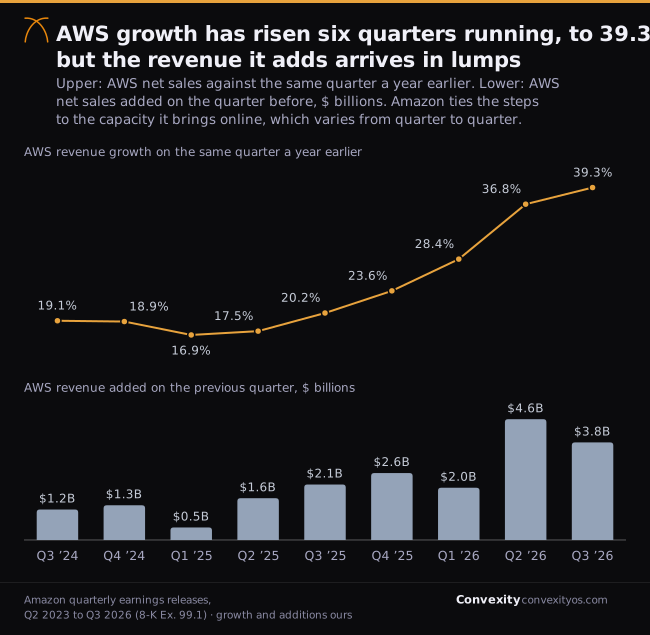
AWS's growth bottomed at 16.9% in the first quarter of 2025 and has risen in each of the six quarters since, to 39.3%. Jassy opened the call by stressing the base it beat: AWS accelerated "despite lapping a comparable year-over-year period where we added a lot of capacity."
The dollars tell a lumpier story, and an analyst noticed. AWS added $4.6 billion of revenue in the second quarter, which Jassy called in July "about 80% more than our largest increase ever." The filed quarters agree: the previous high in our series was $2.6 billion, in the fourth quarter of 2025.
In the third quarter AWS added $3.8 billion. An analyst asked why growth from one quarter to the next had slowed while the yearly rate kept rising.
Jassy's answer was capacity. "The amount that we add every quarter is not equal," he said, and later, "The amount of capacity we add each quarter will vary." On this account revenue follows the building. In his opening remarks he described the pace: "We're installing an AI accelerator about every 14 seconds," and "almost as fast as we install capacity, customers are gobbling it up."
One accelerator every 14 seconds is about 2.25 million a year (our arithmetic). Jassy's description amounts to saying that AWS growth is limited by what Amazon can install rather than by what it can sell. It also explains the lumps. A quarter in which a large block of capacity switches on adds more revenue than one in which it does not.
Not all of the growth is AI. Jassy said core compute and storage revenue "grew at their fastest rates in several years," and that inference, the running of trained models for customers, is now well over half of AWS's AI revenue. His argument is that customers who move AI work to AWS bring their data and ordinary computing with them, so the two halves pull each other along.
The release gives two measures of the AI demand itself. Fortune 500 companies spent nearly seven times as much on Bedrock, AWS's service for running other companies' models, as a year earlier, and Bedrock's token volume grew nearly 17 times. Jassy added that customers' revenue commitments for Graviton and Trainium, Amazon's own chips, had each risen more than 20 times.
A backlog that reaches further out
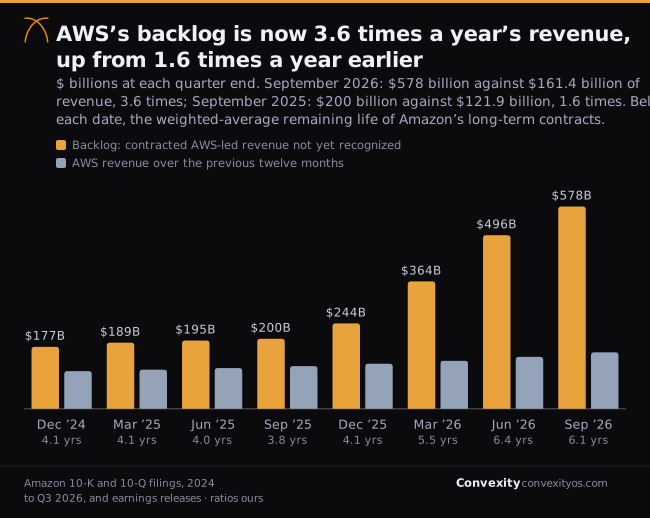
The second support is the backlog. Amazon reports it once a quarter as commitments not yet recognized on contracts longer than a year, mostly AWS's. A year ago it stood at $200 billion, 1.6 times AWS's revenue over the previous twelve months. At $578 billion it is 3.6 times (both ratios ours). Jassy called it "growing triple digits year-over-year and well-diversified."
A bigger backlog is not the same as nearer revenue. The same filings give the weighted-average remaining life of Amazon's long-term contracts, and it has stretched: 3.8 years in September 2025, 4.1 in December, 5.5 in March, 6.4 in June. The quarterly report filed on October 30 put September's at 6.1, the first fall since September 2025. That says less than it seems: every contract already running is a quarter of a year nearer its end each quarter, so a fall of 0.3 years is about what time alone would do.
The eight- and ten-year expansions added in the first half are the likely reason for the stretch. Dividing crudely, $578 billion over 6.1 years is about $95 billion a year, roughly three-fifths of the $161 billion AWS booked in the twelve months to September (our arithmetic). The division ignores ramps and renewals, and it is not a forecast. It does suggest that much of the backlog lies beyond 2028.
The two biggest contracts show the same thing at a smaller scale. Spread evenly, OpenAI's $100 billion over eight years is $12.5 billion a year, and Anthropic's $100 billion over ten is $10 billion, together $22.5 billion a year. That is about a third of the $69 billion the forecast adds in 2027 (our arithmetic). Big contracts usually ramp, so their early years run lower still.
Microsoft, which reported a day earlier, makes the contrast. Its commercial backlog was $677 billion at September 30, with a weighted average duration of about 2.3 years, and it expects to recognize about 30% of it within twelve months. Amazon gives no twelve-month figure. Microsoft's figure includes software subscriptions, so the two are not like for like, but Amazon's is plainly the longer promise (our Microsoft note has its side).
Amazon's filings also changed how they describe the promise. Until the 2025 annual report, the timing of revenue was "largely driven by customer usage." Since then it "will be driven by customer usage and our performance in accordance with contractual obligations," and the commitments are ones "that we expect to fulfill." Both large expansions, the filings add, include "contractual obligations related to the performance of AWS chips."
Put plainly, the backlog is now partly a list of things Amazon has promised to deliver, including its own chips performing as specified. Anthropic's registration statement, filed October 26, shows the other side of one contract. Its commitment to Amazon is non-cancelable "except in the event of Amazon's uncured material breach."
Two labs wrote most of the new backlog
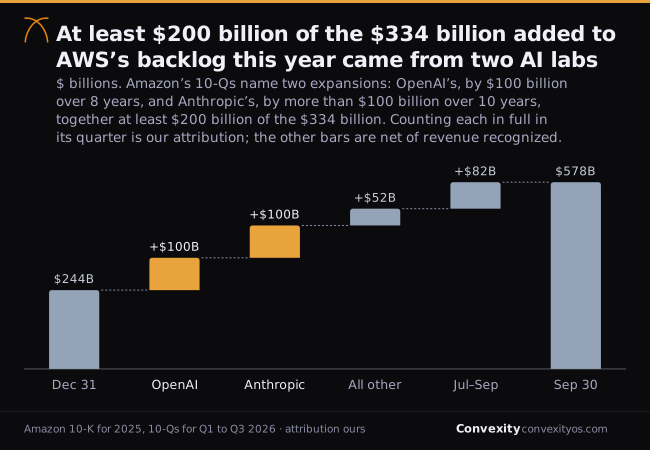
The backlog grew by $334 billion between December and September. Amazon's quarterly filings name two expansions in that span. In the first quarter, OpenAI's existing $38 billion commitment grew by $100 billion over eight years. In the second, Anthropic's grew by "more than $100.0 billion over 10.0 years." Together that is at least $200 billion, about 60% of the rise (our attribution and arithmetic).
The attribution is ours because Amazon does not say how much of each expansion entered the backlog, or when. The timing fits. The backlog jumped $120 billion in the first quarter and $132 billion in the second, so each expansion would be most of its quarter's growth. Anthropic's registration statement puts its total AWS commitment at "at least $110.0 billion between May 2026 and April 2036."
Count the two labs' whole commitments at signing, OpenAI's $138 billion and Anthropic's $110 billion, and they come to about $248 billion. That is some 43% of the September backlog, before subtracting whatever the two have already used (our arithmetic).
Jassy's "well-diversified" is true of the customer list. The release names 23 new AWS agreements in the quarter, from Meta, Nvidia, OpenAI, Salesforce and Oracle to NATO, "and more." It is less true of the dollars, where the only commitments Amazon has sized are the two labs'.
The September quarter added $82 billion, and the 10-Q names no contract behind it: the only expansions it lists are the two from the first half. It is the first quarter of 2026 in which the backlog grew without a disclosed lab expansion. That suits Jassy's "well-diversified" better than the first half did, though an unnamed contract is not necessarily a small one.
Microsoft carries the same shape. In January its chief financial officer, Amy Hood, said about 45% of its commercial backlog came from OpenAI, as our Microsoft note records. The two largest clouds now hold order books in which frontier labs are the largest disclosed customers, and both own equity in OpenAI.
The customers Amazon also finances
The two labs are not only customers. Amazon invested $50.0 billion in OpenAI's preferred stock this year: $15.0 billion in the first quarter and $35.0 billion under a commitment letter signed in February alongside the AWS arrangement, the last $21.3 billion after June 30. In the second quarter it put $10.0 billion into Anthropic's Series G and Series H preferred stock.
It also agreed to a financing facility of up to $20.0 billion for Anthropic, cut to $15.0 billion by the Series H purchase. Its design is the point. Nothing can be drawn at the start. Amounts open up "as we reach certain delivery milestones of compute capacity," and Anthropic draws them as convertible notes or, after a listing, as stock.
So the circle runs both ways. Amazon builds capacity, the capacity unlocks financing, and the financing helps the customer pay for the capacity. By our count Amazon put about $60 billion of equity into the two labs in 2026, against at least $200 billion of expanded commitments. Our financing ledger tracks how common this pattern has become.
Anthropic's side is written tightly. Its commitment holds "regardless of actual usage," and if its spending falls short it must pay Amazon the difference, subject to adjustments. Amazon's filings describe OpenAI's terms only in summary. How each lab pays for commitments this size is the subject of our OpenAI revenue note and our S-1 note. For AWS, it means the forecast leans on two customers' ability to keep raising money.
What has to be built
If the demand is largely spoken for, the forecast turns on supply, and Amazon has put dates on some of it.
Several quarters ago it said it expected to double its power capacity by the end of 2027 against 2025, and in July Jassy said "we continue to be on that track." Doubling in two years is about 41% a year (our arithmetic), almost exactly the growth the forecast asks of revenue.
That match is the strongest support the forecast has, and it covers only 2027. For 2028 Amazon relies on reservations. In July Jassy said the "lion's share of capacity in" 2027 was "largely reserved," and that there was "quite a bit of capacity that's already been reserved for" 2028.
On Thursday he explained why customers book so early. The biggest blocks run to hundreds of megawatts, he said, and "those big chunks are reserved well in advance," because nobody leaves "a gigawatt of capacity hanging around." For those blocks he claimed "very good visibility into" 2027 and 2028 "and some of" 2029.
He added that Amazon always keeps some capacity free for on-demand customers, the ones who rent by the hour without a contract. That is the part of AWS the backlog does not cover. On our reading, it is also the part a capacity squeeze would starve first, since a reserved block cannot be given to someone else.
Chips are the other ceiling, and it is shared. Asked about selling Trainium, Amazon's AI chip, outside AWS, which Amazon plans to start late in 2027, Jassy described the constraint: "everybody is producing their advanced chips with the same provider. There's only so many chips that provider can provide each year. Everybody gets an allocation." He did not name the provider.
He framed the choice as revenue now from a chip sold against more revenue over five or six years from a chip run in AWS. Amazon has not said whether outside sales would count in AWS revenue. Either way they draw on the same allocation the 40% depends on, unless the allocation grows.
Building also costs money. Cash capital spending was $75.9 billion in the quarter. Amazon kept its 2026 estimate at about $220 billion, which after $172.2 billion in nine months leaves about $48 billion for the fourth quarter (our arithmetic), and said 2027 would be meaningfully higher. Free cash flow over twelve months was an outflow of $42.4 billion; financing it is another note's subject.
Where the strain shows instead
If capacity is the limit, the cost of building shows up in margins before growth. AWS's operating margin was 38.7% in the quarter, down from 39.4% in the second and up from 34.6% a year earlier. Brian Olsavsky, the chief financial officer, gives no AWS margin guidance, and warned that "the outsized growth of AI puts margin pressure on the business as a whole because the margins are lower there."
Prices are a second squeeze. Explaining in July how rising component costs reach AWS's contracts, Jassy said that for deals already signed, "those will be the prices and those will be the agreements that we have over the duration of that contract." New agreements price in current costs.
On Thursday Jassy said AI margins were improving even "with heightened component costs like memory," and argued that they are already ahead of where AWS's core business stood at the same stage, which is Amazon's case for spending now.
So the backlog's long life cuts both ways. Contracts running to 2034 and 2036 lock in revenue, and they also lock in prices while the cost of the capacity behind them is still moving, memory being the example Amazon gives.
If component inflation persists, the forecast's revenue can arrive on schedule while the profit on it comes in lower. That is a margin risk rather than a growth risk, and the forecast does not speak to it.
The rest of the quarter
Amazon's group numbers were strong and partly flattered. Revenue rose 12% to $201.9 billion, held back by about four percentage points because Prime Day moved into the second quarter this year. Operating income rose 61% to $28.1 billion, a record 13.9% margin. A year earlier, though, operating income carried a $2.5 billion settlement with the Federal Trade Commission and about $1.8 billion of severance.
Add those back and last year's operating income was $21.7 billion, so the like-for-like gain is about 29% (our arithmetic). AWS supplied $6.3 billion of the $10.7 billion increase. North America's margin was 7.7%, against 6.9% a year earlier with the settlement taken out (ours). Advertising grew 12% excluding currency, which Amazon put down to timing, and it expects high-teens growth in the fourth quarter.
Net income fell to $20.7 billion from $21.2 billion, because a year earlier Amazon booked $9.5 billion of pre-tax gains on Anthropic. This quarter Anthropic barely touched the income statement, where other income was a $0.7 billion loss. The movement went to equity instead: $36.0 billion after tax of unrealized gains on available-for-sale debt securities, the category in which Amazon carries its Anthropic convertible notes.
The 10-Q confirms the notes are the source. Their unrealized gain rose from $92.0 billion in June to $140.3 billion in September, $48.3 billion before tax and all of the category's $48.2 billion (our arithmetic). The preferred shares, which Amazon revalues only on an observable price such as a funding round, held at $92.5 billion, and they are what reaches the income statement. How stake marks now swing a big technology company's earnings is the subject of our Alphabet note, and how Amazon's Anthropic position grew is in Anthropic will slow down only while it is ahead. For the fourth quarter Amazon guided revenue of $240 billion to $247 billion and operating income of $28.5 billion to $33.5 billion.
What would prove this wrong
Our reading is that the capacity behind the 40% forecast is largely spoken for, so the forecast is mostly a question of building. Here is what would show that reading wrong, roughly in the order the evidence will arrive.
The 10-Q, filed October 30. The first test has come back, and it did not go against this reading. A longer weighted-average life would have put more of the $578 billion beyond 2028; September's fell to 6.1 years instead. A named lab contract behind the $82 billion would have deepened the concentration; the filing names none. The fourth-quarter filings set both tests again.
The fourth quarter, reported early in 2027. On September's base, the forecast's pace means adding about $4 billion of quarterly revenue now, rising toward $8 billion by late 2028 (our arithmetic). Several quarters well below that, with Amazon still describing customers as waiting for capacity, would say the building is falling behind the promise.
Growth that does not follow capacity. The case against our reading is that demand, not supply, is the swing factor. If AWS's quarterly additions shrink in a quarter when Amazon says a large block of capacity switched on, the limit is the customers, and the reservations are softer than Jassy describes.
The labs' funding. Anthropic's commitment is take-or-pay, but such a contract is only as good as the buyer's funding. A cut to either lab's AWS commitment would show in the backlog first. The pace of draws on Anthropic's $15.0 billion facility will show how much of that customer's spending Amazon is financing.
Power, chips and price. Amazon says its power doubling by the end of 2027 is on track. A slip there, a smaller chip allocation, or a 2027 capital spending figure that falls rather than rises would cap 2027 directly. An AWS margin well below the mid-30s with growth intact would mean the long contracts were priced before costs rose.
The filings and documents this is built on
- 8-KAmazon.com, third quarter 2026 earnings release (Exhibit 99.1)Segment sales and operating income, the trailing-twelve-month AWS sales and free cash flow, the cash flow statement, other comprehensive income, the list of new AWS agreements, fourth-quarter guidance and the 2026 capital spending estimateOct 29, 2026
- 10-QAmazon.com, quarterly report for the period ended September 30, 2026The $578 billion backlog and its 6.1-year life, the two expansions it lists and no third, the Anthropic notes and preferred stock at September 30, and the change in unrealized gains before and after taxOct 30, 2026
- CallAmazon.com third quarter 2026 earnings call, transcript by GloomberbProduced from the public webcast; one of the two transcripts we read, and every quotation from the October call is wording both carry; retrieved 2026-10-29Oct 29, 2026
- CallAmazon.com third quarter 2026 earnings call, transcript by MarketBeat, provided by QuartrThe second transcript of the October call; speaker titles are taken from the investor relations introduction; retrieved 2026-10-29Oct 29, 2026
- CallAmazon.com second quarter 2026 earnings call, transcript by GloomberbThe July call: capacity reservations for 2027 and 2028, the power doubling, contract pricing and the $4.6 billion quarter; retrieved 2026-10-29Jul 30, 2026
- CallAmazon.com second quarter 2026 earnings call, transcript by The Motley Fool, republished by WebullThe second transcript of the July call; every quotation from it is wording both carry; retrieved 2026-10-29Jul 30, 2026
- 10-QAmazon.com, quarterly report for the period ended June 30, 2026The $496 billion backlog and 6.4-year life, the Anthropic expansion, the OpenAI and Anthropic investments, the $20.0 billion facility and its delivery milestones, the unrealized gain on the Anthropic notes at June 30, and first-half cash capital spendingJul 31, 2026
- 10-QAmazon.com, quarterly report for the period ended March 31, 2026The $364 billion backlog and 5.5-year life, and the OpenAI expansionApr 30, 2026
- 10-KAmazon.com, annual report for 2025The $244 billion backlog and 4.1-year life, the revised wording on what drives its timing, and AWS sales for 2025Feb 6, 2026
- 10-QAmazon.com, quarterly report for the period ended September 30, 2025The $200 billion backlog, its 3.8-year life and the earlier wording, “largely driven by customer usage”Oct 31, 2025
- 10-QAmazon.com, quarterly report for the period ended June 30, 2025The $195 billion backlog and 4.0-year lifeAug 1, 2025
- 10-QAmazon.com, quarterly report for the period ended March 31, 2025The $189 billion backlog and 4.1-year lifeMay 2, 2025
- 10-KAmazon.com, annual report for 2024The $177 billion backlog and 4.1-year life, and AWS sales for 2022 to 2024Feb 7, 2025
- 8-KAmazon.com, third quarter 2025 earnings release (Exhibit 99.1)The year-earlier quarter, the FTC settlement and severance charges, and AWS sales by quarter from late 2024Oct 30, 2025
- 8-KAmazon.com, third quarter 2024 earnings release (Exhibit 99.1)AWS sales by quarter from the second quarter of 2023Oct 31, 2024
- 8-KAmazon.com, current report on the OpenAI equity commitment letterThe $35.0 billion commitment, the separate $15.0 billion purchase and the AWS commercial arrangementFeb 27, 2026
- S-1Anthropic, PBC, registration statementThe AWS commitment of at least $110.0 billion from May 2026 to April 2036, regardless of usage, with a true-up and cancelable only on Amazon’s uncured material breach (page 171)Oct 26, 2026
- 10-QMicrosoft, quarterly report for the period ended September 30, 2026Commercial remaining performance obligation of $677 billion, its 2.3-year weighted average duration and the share expected within twelve monthsOct 28, 2026
- DataState Street, SPDR S&P 500 ETF Trust (SPY) daily holdingsHoldings as of October 28, 2026, checked for the companies named in the disclosures; retrieved 2026-10-29Oct 28, 2026
Not investment advice. This note is an analysis of Amazon's public disclosures, and of Anthropic's and Microsoft's where they bear on Amazon, published for research purposes, and not a recommendation to buy, sell or hold any security. A member of the Convexity team holds an economic interest in Anthropic through a special-purpose vehicle and a fund, and stands to benefit if its valuation rises. Convexity is a customer of Anthropic, and this note was drafted with Claude, Anthropic's model. A member of the team holds SPY, which holds Amazon, Microsoft, Alphabet, Meta, Nvidia, Salesforce and Oracle, and owns Meta shares directly, so stands to benefit if they rise; no other position. Positions are as of October 29, 2026.
What here is ours rather than Amazon's. As filed or stated by Amazon: every sales, operating income, margin, net income, other income, comprehensive income, cash flow, capital spending and guidance figure; the backlog at each quarter end and its weighted-average life; the wording on what drives its timing; the OpenAI and Anthropic expansions, investments and facility; the Anthropic notes' unrealized gain at each quarter end and the preferred stock's carrying value; the $184 billion run rate, the 39.3% growth and the list of new agreements; and every quotation, from Amazon's filings or from the two transcripts of each call. As filed by Anthropic: its AWS commitment and its terms. As filed by Microsoft: its backlog, duration and twelve-month share. Ours: every growth rate and quarterly addition in the first chart except the third quarter's 39.3%; the trailing-twelve-month sums and the 3.6x and 1.6x ratios; the illustration of 2026 to 2028 revenue and its additions, the 8.8% quarterly pace, the 8.9% and 12.4% quarterly growth and the $4.0 billion to $7.9 billion steps; the 2.25 million accelerators a year; the 0.3-year fall in the contract life; the $95 billion a year from dividing the backlog by its life, and the three-fifths of a year's revenue that makes; the $12.5 billion, $10 billion and $22.5 billion a year from spreading the two expansions evenly, and the third of 2027's step that makes; the $2.6 billion previous high in our quarterly series; the $334 billion added since December, the attribution of at least $200 billion of it to the two expansions, the 60%, the $248 billion and the 43%; the $60 billion of equity into the two labs; the 41% a year from doubling power; the $172.2 billion of nine-month capital spending and the $48 billion it leaves; the $48.3 billion rise in the notes' unrealized gain and the category's $48.2 billion before tax; and the operating income without last year's charges, the 29%, the $6.3 billion from AWS and North America's 6.9%.