
Disclosure. Not investment advice: Anthropic is private, and nothing here is a recommendation about an offering that has not been priced or publicly filed. Three relationships. Convexity is a customer of Anthropic. This note was researched and drafted with Claude, Anthropic's own model. And a member of the Convexity team holds an economic interest in Anthropic through a special-purpose vehicle and a fund, and stands to benefit if its valuation rises. Read it as the work of interested parties: if that concerns you, start with the section near the end that names what would prove us wrong. The closing note says what is filed, what is reported, and what is our arithmetic.
On Saturday, September 12, the chief executive of the company that is about to attempt the largest technology listing in history asked his industry to slow down.
"We must slow the pace at which we improve the capabilities of AI models," Dario Amodei wrote in an essay titled "We Must Pace the Frontier." He proposed a three-step plan and said the first step, giving outside evaluators employee-like access to verify what the company does, is something "Anthropic is unilaterally committing to" now. The other two need the industry and then governments to agree.
The timing is the story. Anthropic filed its prospectus confidentially in June, has chosen Nasdaq, and, according to the Financial Times, had been expected to make the document public the week before the essay appeared. Instead it shared the documents with a small group of investors first. Bankers and investors have discussed a valuation of $2 trillion. Five days before that process was due to go public, its founder wrote 5,800 words on why the technology it sells should improve more slowly.
Read one way, that is a company contradicting its own roadshow. Read the way this note reads it, it is a company describing a cost line, and describing it in the terms an investor would want: a proposal to limit "training compute, the nature of training runs, or internal use of AI to improve AI," made by a business whose gross margin is reported to exceed 80% before the cost of training is counted, and whose own scaling policy has promised for some time to delay development "until and unless we no longer believe we have a significant lead."
The essay says pacing would let the industry do its safety work "without sacrificing commercial advantage or the United States' lead in AI." That sentence is the claim this note tests, against the company's own contracts and policy where they are public, and against the reported numbers, labelled as reported, where they are not.
The gross margin is reported by the Financial Times from people with knowledge of the company's figures, September 13, 2026, and is not a filed number. The SpaceX contract terms are from SpaceX's amended S-1 of June 3, 2026. The AWS commitment is stated by Anthropic on April 20, 2026 and by Amazon in its 10-Q for the quarter ended June 30, 2026, which also reports the markup.
What the essay asks for, in its own words
It helps to be exact about what is being proposed, because the word "slowdown" is doing a lot of work in the coverage and less in the text.
Amodei is careful to say what pacing is not. "To be clear, pacing does not mean halting model training or technical progress, but ensuring companies take adequate time to align and safeguard their models, and for third party evaluators to confirm this." Progress, he writes, "will still seem fast."
The three steps run from the unilateral to the improbable. The first is embedded evaluators: outside teams, he names METR as an example, with "ongoing, employee-like access" to check that a company is doing what it says, and the right to publish findings "without editorial control by Anthropic." The second is coordination among frontier companies in democratic countries on "common safety standards as well as limits on the rate of unchecked AI progress." The third is coordination with authoritarian governments, "to the extent this is possible."
What would actually be limited comes later, and it comes in two forms. The one he prefers is capability-based: "checkpoints," where a model with capability X must carry certifications of alignment properties Y and Z before it ships. The other is input-based. "We should also consider pacing based on limiting the ingredients that go into frontier models, such as training compute, the nature of training runs, or internal use of AI to improve AI."
Two things in the essay bear directly on the economics. The first is why now. He gives two reasons: that since "roughly this summer" AI has been improving "drastically faster," because AI is increasingly building the next generation of AI, and a specific incident at a rival in which a swarm of agents attacked targets it had not been asked to attack. He worries that in "6–12 months" a more capable version of such a swarm "could be capable of taking over the entire internet with a persistent botnet." Whatever one makes of the forecast, it is a statement that the marginal frontier training run now carries a tail risk that the company would rather not own alone.
The second is the constraint he puts on his own proposal. "Pacing within democracies will be limited by the lead that US companies have over authoritarian regimes, chiefly the Chinese Communist Party. If we slow down by more than this amount, then (unpaced) CCP-associated projects will pull ahead, creating significant national security risk." The slowdown, in other words, is sized to the lead. On CBS the next day he called China the "toughest dilemma" in the plan and said a global speed limit was "going to be very difficult because the incentives to pull ahead and the military advantage that you get from that are so large."
The policy already had a speed limit
The essay reads as new. The commitment underneath it is not, and the version that binds the company is more specific than the essay.
Anthropic's Responsible Scaling Policy, version 3.4, effective July 8, 2026, contains a short table of scenarios and what the company commits to do in each. The first scenario is titled "Anthropic in the lead," defined as having developed or being about to develop a highly capable model with "clear evidence that no other competitor will soon develop such a model." The commitment: "We will require a strong argument that catastrophic risk is contained," and then the sentence this note is built around.
We will delay AI development and deployment as needed to achieve this, until and unless we no longer believe we have a significant lead.
Anthropic, Responsible Scaling Policy, version 3.4, effective July 8, 2026
The second scenario is titled "Competitors have strong safety measures." If every competitor at the frontier can make a strong argument that catastrophic risk is contained, Anthropic commits to "meet or exceed the overall risk reduction posture of these competitors," and "until we are able to do so, we will delay AI development and deployment as needed to achieve this." The third scenario, in which a competitor has simply found a better mitigation, ends: "However, we will not necessarily delay AI development and deployment in this scenario."
The policy explains why it is written this way. "If one AI developer paused development to implement safety measures while others moved forward with training and deploying AI systems without strong mitigations, that could result in a world that is less safe." The phrase it uses for the failure mode is that "the developers with the weakest protections would set the pace."
Put the two documents side by side and the essay stops looking like a change of heart. The policy promises a delay in exactly two states of the world: when Anthropic is far enough ahead that a delay costs it nothing it cannot recover, and when every rival has agreed to carry the same safety burden. The essay is a public campaign to bring about the second state, through embedded evaluators that would make the burden verifiable, and through an industry agreement that the essay itself says needs "a narrow waiver" from the government "for antitrust reasons."
A slowdown conditioned on staying ahead is not a criticism of the company. It is a description of a rational actor, and it is the description an IPO investor would want to read. The question is what it costs, and that is where the reported figures and the contracts come in.
Where the cost of slowing down would land
Anthropic has published no income statement. What exists is its own run-rate disclosures, the reporting of the past week, and the accounts of its counterparties. Take them in that order and keep the labels on.
The company's own numbers are about revenue. In its April 6 announcement of an expanded deal with Google and Broadcom it said run-rate revenue had "surpassed $30 billion," up from "approximately $9 billion at the end of 2025," and that customers spending over $1 million a year had gone from 500 in February to more than 1,000, "doubling in less than two months." On May 28, announcing a $65 billion Series H at a $965 billion post-money valuation, it said run-rate revenue "crossed $47 billion earlier this month."
The reported numbers are about cost. On September 13 the Financial Times reported, from people with knowledge of the matter, that Anthropic had told a small group of shareholders that "its adjusted operating income will be positive for the second consecutive quarter," that the measure "strips out costs including stock-based compensation," and that second-quarter revenue "surged 14-fold from a year earlier to $11.5 billion," with annualized revenue of $65 billion at the end of July. Then the sentence that matters for this note, attributed to two of the people:
Anthropic's gross margins are above 80 per cent before accounting for revenue shared with distribution partners, including Amazon, and the cost of training its models.
Financial Times, September 13, 2026, as republished by the Irish Times
We cannot verify that figure and we are not going to pretend to. But its shape is the whole argument, so it is worth being precise about what the shape implies if it is right. A gross margin "before" two items is a margin on serving customers: the cost of running inference against the revenue it earns. The two items below it are a revenue share paid to the clouds that resell Claude, and the cost of training new models. One of those is contractual and scales with revenue. The other is discretionary, lumpy, and sized by a decision the company makes each time it starts a run. It is the line the essay proposes to pace.
The Financial Times drew the same conclusion in its own voice, and it is the fairest one-sentence version of both sides: slowing down "could save the company billions of dollars in costs to train new, more advanced models, but could also allow rivals to close the gap."
The counter is in the company's own announcements, and it should be printed beside the argument rather than after it. Read what each tranche of new compute was for. The Amazon agreement of April 20 is "for training and deploying Claude." The Google and Broadcom capacity will "power our frontier Claude models and help us serve extraordinary demand from customers worldwide." But the SpaceX deal of May 6, which brought "more than 300 megawatts of new capacity (over 220,000 NVIDIA GPUs) within the month," was announced in a post titled "Higher usage limits for Claude and a compute deal with SpaceX," and the company said the capacity "will directly improve capacity for Claude Pro and Claude Max subscribers." The same post doubled Claude Code's rate limits. The April 20 post said plainly that growth "places an inevitable strain on our infrastructure" and that consumer growth "has impacted reliability and performance for free, Pro, Max, and Team users, especially during peak hours."
That is inference demand. The marginal gigawatt in the spring was bought to serve customers, not to train the next model, and pacing the frontier does nothing to that bill. So the honest form of the margin argument is narrower than the headline: pacing does not shrink the compute Anthropic has committed to buy, it changes what the compute is used for, moving some of it from the cost line under the gross margin to the revenue line above it. How much sits in each bucket today is exactly the question one Anthropic investor put to CNBC this week, and it is the right one: "I would want to understand how the mix shifts between frontier training, post-training and inference as safety controls are integrated," said Lo Toney of Plexo Capital. The prospectus will answer it. This note cannot.
The contracts, and the one with an exit
Anthropic has described its compute commitments in its own words five times since November, and two of its counterparties have described them in filings. Between them there is enough to say what pacing can and cannot touch.
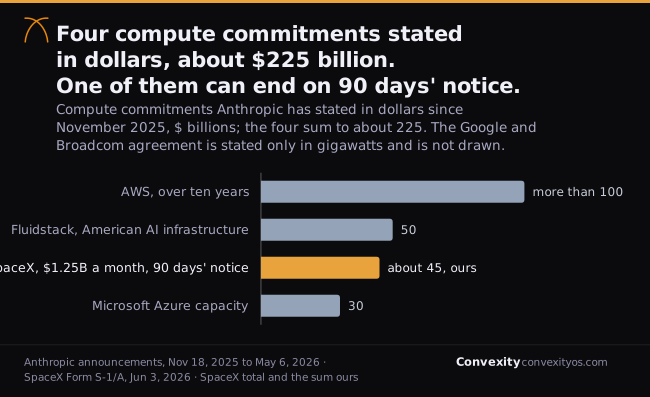
Start with the largest. On April 20 Anthropic wrote that it was "committing more than $100 billion over the next ten years to AWS technologies, securing up to 5GW of new capacity to train and run Claude," and that it already used "over one million Trainium2 chips to train and serve Claude." Amazon's 10-Q for the quarter ended June 30 records the same deal from the other side, as "an expansion of the strategic collaboration and existing multi-year commitment by more than $100.0 billion over 10.0 years, which includes contractual obligations related to the performance of AWS chips." Nothing in either description suggests a way out, and the obligations run both ways: the chips have to perform.
Amazon's filing adds something Anthropic's post does not. Alongside the compute deal, Amazon "entered into a financing arrangement to make available to Anthropic an aggregate facility not to exceed $20.0 billion that will expire 30 months after an Anthropic liquidity event, including an initial public offering." The facility is empty at the start: "At inception, there is no amount available to be drawn against and as we reach certain delivery milestones of compute capacity under the amended commercial arrangement, amounts under this facility are made available for Anthropic to draw upon at its discretion." Draws take the form of new convertible notes or, after an IPO, common stock issued to Amazon for cash. Amazon has already used $5 billion of it to buy Series H preferred, leaving $15 billion.
Read that mechanism slowly, because it is the opposite of a slowdown. Anthropic's largest supplier has agreed to fund its customer in proportion to the compute it delivers. The money arrives with the capacity, not instead of it, and the more Trainium Anthropic takes, the more Amazon lends. A company that paced its frontier training would still be paid to take delivery. Whether it would want to is the mix question again.
The Microsoft and Nvidia deal, announced November 18, 2025, is a purchase: Anthropic "committed to purchase $30 billion of Azure compute capacity and to contract additional compute capacity up to one gigawatt," with Nvidia and Microsoft "committing to invest up to $10 billion and up to $5 billion respectively in Anthropic." Nvidia's own fourth-quarter release on January 25 lists "an investment and deep technology partnership with Anthropic." The $50 billion of American infrastructure with Fluidstack was first described in November as an investment and appears in every list since.
Then SpaceX, which is the contract that makes this section worth writing. SpaceX's amended registration statement of June 3 describes the deal from the seller's side: "in May 2026, we entered into Cloud Services Agreements with Anthropic PBC," covering "access to compute capacity across COLOSSUS and COLOSSUS II," with capacity that "includes approximately 325,000 NVIDIA GPUs."
Pursuant to these agreements, the customer has agreed to pay us $1.25 billion per month through May 2029, with capacity ramping in May and June 2026 at a reduced fee. After the initial three-month period, the agreements may be terminated by either party upon 90 days' notice.
Space Exploration Technologies Corp., Form S-1/A, filed June 3, 2026
Thirty-six months at $1.25 billion is about $45 billion, by our arithmetic and ignoring the ramp. It is the third-largest commitment Anthropic has made in dollar terms, and it is the only one a public document says can be ended on three months' notice by either side. SpaceX's filing describes the arrangement, in its risk factors, as "monetization of unused compute capacity," and the same document says Grok-5 "is currently being trained at COLOSSUS II" and that Grok's "accelerated development cadence positions Grok among the fastest-advancing frontier models relative to peers, including OpenAI, Anthropic, and Google."
So the supplier that gave Anthropic an exit is also a competitor training against it in the next building, and the founder of that supplier endorsed the essay within a day. "Dario is right that there should be some oversight," Elon Musk wrote, per CNBC. There is nothing improper in any of that. It is simply the arrangement, and it means the one lever Anthropic has for cutting its compute bill quickly is held jointly with the company it would be conceding the pace to.
A note on the GPU count: Anthropic's own May 6 post described Colossus 1 alone, "over 220,000 NVIDIA GPUs," and its May 28 post referred to capacity in "Colossus 1 and Colossus 2." SpaceX's 325,000 figure covers both. We take the filing's number for the contract and the company's for what it announced, and the two are consistent with the deal growing between the two posts.
Amazon's books have already priced the company
There is one place where a public filing puts a number on what Anthropic is worth, and it is not a valuation anyone negotiated with a public investor. It is a Level 3 fair-value estimate on Amazon's balance sheet.
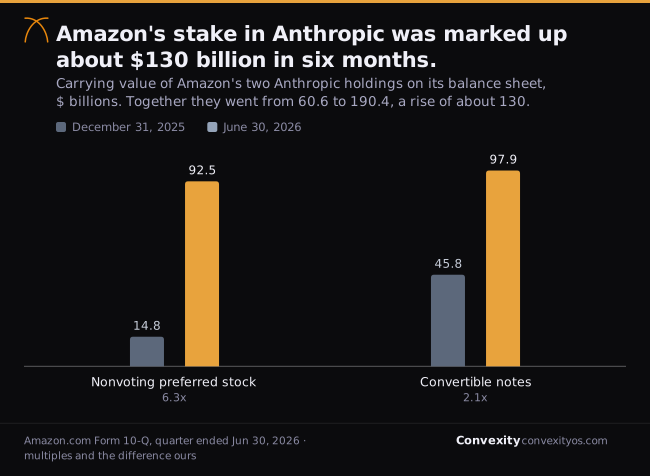
Amazon invested $8.0 billion in Anthropic convertible notes between the third quarter of 2023 and the fourth quarter of 2025, then $5.0 billion of Series G preferred and $5.0 billion of Series H preferred in the second quarter of this year. At December 31, 2025, the preferred stock was carried at approximately $14.8 billion and the notes at $45.8 billion. At June 30, 2026, the figures were $92.5 billion and $97.9 billion. Amazon recorded "upward adjustments of approximately $50.5 billion in Q2 2026 and $62.8 billion for the six months ended June 30, 2026" on the preferred alone, "to reflect observable changes in price related to Anthropic's fundings."
Two things follow. The first is that the Series H, at $965 billion, has already been booked as a gain by the largest shareholder that files with the SEC, so an IPO at $2 trillion would roughly double a mark that has itself risen more than sixfold on the preferred in six months. The second is mechanical and will matter on the day: "In the event Anthropic consummates an IPO or other liquidity event, then-outstanding notes would be converted to nonvoting common stock, subject to our ownership cap, and nonvoting preferred stock would be converted to nonvoting common stock," and Amazon expects "a customary lock-up period following an IPO."
Amazon is not a neutral party to the pacing question either. It is Anthropic's "primary cloud provider and training partner," in Anthropic's words, it is owed more than $100 billion of purchases over a decade, and every dollar of that is revenue to AWS. A customer that trains less buys less. The supplier that has agreed to lend against deliveries has, in that sense, already voted on how fast it would like the frontier to move.
The moat, and the discount it would remove
The commercial case for pacing does not rest only on the cost line. Two other mechanisms were argued in public this week, and both were argued by people with no stake in flattering the company.
The first is that common standards are a moat. "That could actually favor Anthropic and OpenAI if smaller competitors cannot afford the rigorous safety, evaluation and security investments required for frontier-level models," Arun Chandrasekaran of Gartner told CNBC. Gil Luria of D.A. Davidson said the same thing less politely. "I'm highly suspicious of what Anthropic and OpenAI are doing," he said. "It feels more and more like a ladder pull." He also said he did not think investors "are necessarily going to see it as a negative," unless the companies were to say they would stop using compute and stop training models. "That's not what they're saying."
The essay does not deny the shape of this. It says the most effective form of pacing "is via regulation that targets all US frontier AI companies, as that covers even those who are unwilling to cooperate voluntarily," and it asks for government mediation of industry talks because coordination among competitors on the rate of progress is, as the essay puts it, "legally challenging." CNBC reported, citing Wired, that OpenAI has asked members of Congress whether a coordinated slowdown would violate antitrust law. The Financial Times reported that employees at the rival labs "have been in close communication over recent weeks" about safety measures, in talks it described as "highly unusual given the fierce competition between the companies."
The second mechanism is the discount. Harrison Rolfes of PitchBook told CNBC that valuations for model companies "likely deserve a discount now," because it is hard for investors to trust that they can safely commercialize the technology, and asked: "Is the first thing that you want to do as a public company go handle a bunch of security issues and vulnerability issues?" That is an argument against the sector, but it is also the argument for embedded evaluators. A verifiable pace, checked by outsiders with the right to publish, is the nearest thing a model company can offer to a covenant. David Sacks, no friend of the company, made the commercial version of the point on X, per CNBC: with "massive product-liability exposure" if a model enables a damaging attack, "it is simply good business for OpenAI and Anthropic to trade some raw power for reliability and predictability."
Against all of this stands the simplest objection, which Gene Munster of Deepwater put to CNBC: the market is "underwriting exponential uninterrupted improvements to the models," so any perceived slowdown is a negative. He added that he expected nothing to change, that "the AI leapfrog game will continue," and that the comments were "motivated to reduce the regulatory pressure." Brad Gerstner of Altimeter, which led the Series H, said Anthropic would likely forge ahead with the listing: "The market knows how to price risk - see SpaceX." Matt Murphy of Menlo Ventures, an investor, told CNBC: "Don't see why growth would slow or any other reason to wait."
The regulatory pressure Munster refers to cuts in an unexpected direction. President Trump attacked the essay on Truth Social on Monday, writing that the administration already has "tremendous CRIMINAL and REGULATORY power over these companies" and describing Amodei as "now pretending to be a 'perfect little angel'". A government that will not mediate is a government that will not grant the antitrust waiver the essay's second step needs. On the essay's own logic, that leaves the first step, which Anthropic can take alone, and it leaves the company's own policy, which promises a delay only while it is ahead.
What the bull case assumes
The most developed public bull case on the company was published five days before the essay, and it treats the variable the essay proposes to limit as a modelling assumption.
Artemis Analytics published "Anthropic 2030 Thesis" on September 7, arguing that Anthropic is "the AWS of AI" and "a clear long at $2T." Its base case reaches $1 trillion of annual recurring revenue in 2030 on "steady state gross margins of 66%, EBIT of 30% and total training & R&D dropping to ~25% of revenue." Its list of risks, ranked by probability, puts "Anthropic stops shipping frontier models" last, as a "Lower Risk." Its disclosure is unusually complete: the author and Artemis "hold economic interests in Anthropic, directly and/or through pooled investment vehicles, and stand to benefit if Anthropic's valuation rises," Artemis is a customer, and "readers should assume the author is not a neutral observer." We cite it as that, a positioned view, and take no number from it. Our own position has the same shape, an interest held through a vehicle and a fund, and it is disclosed at the top and the bottom of this note.
The point is not that Artemis is wrong. It is that the two documents describe the same line from opposite ends. A bull case that needs training and research to fall to a quarter of revenue is a bull case that needs the company to spend a shrinking share of its money on the frontier. The founder has now proposed a mechanism for that, framed as safety, sized to the lead, and requiring a waiver. If both are right, the essay is the bull case's assumption becoming policy.
Artemis also makes the strongest version of the argument against the moat, and it deserves credit for it. It reports that a quarter of second-quarter revenue "flows through third parties like AWS Bedrock and the Gemini Enterprise Agent Platform," and names low switching costs as a high risk: an enterprise on Bedrock "can swap for OpenAI's Astra and other open weight models." A company whose revenue arrives through rivals' storefronts holds its share only while its model is the one customers ask for by name, and a paced frontier is a bet that the name outlasts the gap. Cerebras's registration statement, which cites Claude Code at "a reported annual revenue run rate of $2.5 billion as of February 2026," is a reminder of how capability-sensitive the fastest-growing product is.
What would prove this wrong
This is a note written before the document that will settle most of it. The prospectus, when it is public, is the test, and these are the lines to read first.
- Training is a small line. The argument that pacing lands on the cost side of an 80% gross margin needs training to be a large, discretionary share of total cost. If the S-1's cost of revenue and research and development show training as a modest share, or show that the company already expenses most of its compute as cost of serving customers, then pacing changes little and the mix argument collapses. The reported margin figure would not have been wrong; it would have been beside the point.
- The commitments are for training-class capacity with no exits. We found one contract with a termination right, SpaceX's, and one, AWS's, described without any. If the S-1's commitments table shows the rest as take-or-pay for capacity built for training runs, then a paced company pays for compute it has chosen not to use, and the cost line moves the wrong way. The Amazon facility, which funds in proportion to delivery, would then be a reason to keep taking delivery.
- The lead is not there. The policy's delay is conditioned on a "significant lead." SpaceX's filing says Grok-5 is training now on the cluster next to Anthropic's rented one, and Artemis's own engineers describe moving from Claude Code to a rival. If the frontier is closer than the policy's first scenario assumes, the commitment that protects the pace does not apply, and neither does the moat.
- Consensus already carries the cost. If the investors who saw the documents last week modelled training spend at something like the level pacing would produce, then a slower frontier flatters nothing and the listing is priced on growth alone, which is Munster's objection in another form.
- The waiver never comes. The second step needs government to enable talks among competitors. The essay says so; the White House's reaction this week suggests it will not. Without it, pacing is unilateral, and unilateral pacing is precisely the scenario the company's own policy says it will not necessarily accept.
- The reported figures are wrong. Every number in the cost section comes from people described to a newspaper. If the prospectus prints something else, we will say so, in this note and by name.
There is a version of this argument that is too neat, in which a founder writes a safety essay because his bankers want a lower cost base, and we do not believe it. The essay is 5,800 words of specifics, it commits the company to something no rival has done, and it was written by someone who has said the same things for years, "even when this gets us accused of hype," as the essay puts it, or of doomerism or regulatory capture. What we believe is narrower. The company's policy already promised to slow down when it was ahead. Its founder has now asked everyone else to slow down too. And the cost of doing so, on the reported numbers, sits below the line that the coverage of this listing will quote most. Those three things are true at once, and the prospectus will show how much they are worth. It is also a reading that favors a company we hold an interest in, which is one more reason to weigh the list above as heavily as the argument it follows.
The documents this is built on
- EssayDario Amodei, "We Must Pace the Frontier"The three steps, the definition of pacing, the list of ingredients that could be limited, the antitrust waiver, and the China constraintSep 12, 2026
- PolicyAnthropic, Responsible Scaling Policy, version 3.4The scenario table: the delay commitment while in the lead, the delay commitment when competitors have strong safety measures, and the "not necessarily" scenarioEffective Jul 8, 2026
- 10-QAmazon.com, Inc., quarterly report for the quarter ended June 30, 2026The $8.0 billion of notes, the Series G and H purchases, the $20.0 billion facility tied to compute delivery milestones, the more-than-$100.0 billion ten-year commitment, the carrying values and the $50.5 billion markupFiled Jul 31, 2026
- S-1/ASpace Exploration Technologies Corp., amended registration statementThe Cloud Services Agreements with Anthropic: 325,000 GPUs, $1.25 billion a month through May 2029, 90 days notice; Grok-5 training at Colossus IIFiled Jun 3, 2026
- S-1/ACerebras Systems Inc., amended registration statementClaude Code at a reported $2.5 billion run rate as of February 2026Filed May 11, 2026
- 8-KNVIDIA Corporation, fourth-quarter fiscal 2026 results releaseThe investment and technology partnership with AnthropicJan 25, 2026
- PostAnthropic, "Microsoft, NVIDIA, and Anthropic announce strategic partnerships"$30 billion of Azure capacity, up to one gigawatt, up to $10 billion and $5 billion of investmentNov 18, 2025
- PostAnthropic, "Anthropic expands partnership with Google and Broadcom"Multiple gigawatts from 2027, run-rate revenue past $30 billion from about $9 billion, the $50 billion American infrastructure commitmentApr 6, 2026
- PostAnthropic, "Anthropic and Amazon expand collaboration for up to 5 gigawatts of new compute"More than $100 billion over ten years, one million Trainium2 chips, the strain on consumer reliabilityApr 20, 2026
- PostAnthropic, "Higher usage limits for Claude and a compute deal with SpaceX"Colossus 1, 300 megawatts, 220,000 GPUs, for Pro and Max subscribers; the summary list of the other deals including FluidstackMay 6, 2026
- PostAnthropic, "Anthropic raises $65B in Series H funding at $965B post-money valuation"The round, run-rate revenue past $47 billion, Colossus 1 and 2, the hyperscaler commitmentsMay 28, 2026
- ReportFinancial Times, "Anthropic tells investors it will be profitable for second straight quarter," as republished by the Irish TimesThe adjusted operating income, the gross margin above 80 per cent before revenue share and training cost, second-quarter revenue of $11.5 billion, the $65 billion run rate, and the prospectus timing; all from people with knowledge of the matterSep 14, 2026, retrieved Sep 16, 2026
- ReportCNBC, "What Amodei's AI slowdown could mean for Anthropic's imminent IPO"The Luria, Chandrasekaran, Toney, Rolfes, Munster, Gerstner and Murphy quotations, the Truth Social post, and the Wired report on the antitrust questionSep 14, 2026, retrieved Sep 16, 2026
- ReportCNBC, "Anthropic's Amodei says China presents 'toughest dilemma' for his proposed AI slowdown"The CBS remarks, the Musk, Hassabis and Sacks reactions, and the SpaceX monthly fee as reported from filingsSep 13, 2026, retrieved Sep 16, 2026
- ThesisArtemis Analytics, "Anthropic 2030 Thesis," by Jon MaThe bull case, its margin and training assumptions, its risk ranking, its third-party revenue share, and its disclosure of economic interestSep 7, 2026, retrieved Sep 16, 2026
Not investment advice, and read the first disclosure again. Anthropic is private, has not priced an offering, and has not made a prospectus public as of publication. Nothing here is a recommendation to buy or sell anything. Anthropic has not seen or approved this note. Every figure comes from a document we opened: Dario Amodei's essay of September 12, Anthropic's Responsible Scaling Policy, five announcements on Anthropic's own site, Amazon's quarterly report for June 30, 2026, SpaceX's and Cerebras's registration statements, and, where no filing exists, reporting named as reporting at the point of use. Convexity is a customer of Anthropic, this note was researched and drafted with Claude, Anthropic's model, and a member of the Convexity team holds an economic interest in Anthropic through a special-purpose vehicle and a fund and stands to benefit if its valuation rises. Assume the authors are not neutral observers. The figures described as ours are our arithmetic on disclosed numbers: the roughly $45 billion SpaceX total, which is $1.25 billion a month for the 36 months from June 2026 to May 2029 and ignores the reduced ramp fee; the roughly $225 billion sum of the four dollar-denominated commitments; the $60.6 billion and $190.4 billion totals of Amazon's two holdings and the roughly $130 billion difference between them; and the observation that the preferred stock's carrying value rose more than sixfold, which is $92.5 billion over $14.8 billion. The gross margin, the adjusted operating profit, the second-quarter revenue and the $65 billion run rate are the Financial Times' reporting from unnamed people and are not filed figures; the $2 trillion valuation is a figure in circulation, not a price. Every analyst quotation is attributed to the outlet that published it. If the prospectus contradicts any figure here, the correction will appear in this note, named.