
Disclosure. Not investment advice, and nothing here is a recommendation to buy, sell or hold any security. A member of the Convexity team holds the SPDR S&P 500 ETF (SPY), which holds Accenture and Palantir. The same member holds an economic interest in Anthropic, which Accenture says selected it for AI safety work, through a special-purpose vehicle and a fund, and stands to benefit if Anthropic's valuation rises; no other position. Convexity is an Anthropic customer, and this note was drafted with Claude. Figures are from Accenture's earnings release, filed on Form 8-K, its fourth-quarter earnings presentation, and its October 1 call, quoted from the transcript Accenture published and checked against two independently produced ones. The closing note lists what is our arithmetic.
Accenture's shares rose 15.8% on October 1, the day it reported its fiscal fourth quarter. The quarter earned it. Revenue of $18.68 billion came in about $280 million above the top of the company's own guided range, every geographic market grew 7% in local currency, and the year ended with a record $11.5 billion returned to shareholders. By the close on October 6 the stock had given back more than half of the gain, at $193.40 against $212.30 on results day and $183.37 the day before.
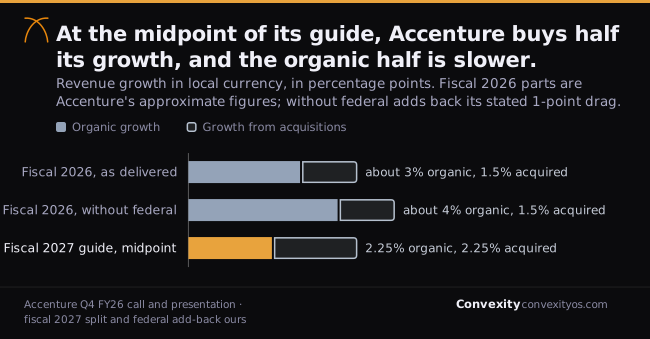
The fourth quarter is not what the market spent the next three sessions reading. The outlook for fiscal 2027 is. Accenture expects revenue to grow 3% to 6% in local currency, and its chief financial officer, Angie Park, said in the next sentence: "This year, we expect an inorganic contribution of 2% to 2.5%." At the midpoint, half of next year's growth is bought. The organic half, about 2.25% by our arithmetic, is slower than the roughly 4% Accenture's existing business grew last year once a federal contracting drag that has since ended is added back. An analyst put it plainly on the call, saying the guide "does imply an organic deceleration," and the answer that followed did not dispute it.
The rest of the call explains why that matters more than usual. Accenture saw "lower pricing in many areas" of its business in the fourth quarter. It stopped reporting its AI bookings and revenue after its December 2025 quarter, so the one dollar figure that would show whether AI is adding to the business or deflating it no longer exists outside the company. And its headcount, after a severance program aimed at people whose skills it said it could not retrain, ended the year 35,118 higher. Accenture holds an investor day in New York on Wednesday, October 14. This note is about what to read for there.
Accenture fiscal 2026 earnings release (Form 8-K exhibit 99), fourth-quarter earnings presentation, and its official transcript of the October 1 call.
The quarter that beat
Revenue for the three months to August 31 was $18.68 billion, up 6% in U.S. dollars and 7% in local currency, against a guided range of $17.75 billion to $18.40 billion, or 1% to 5% in local currency. Consulting revenue was $9.28 billion and managed services $9.40 billion, each up 7% in local currency. New bookings were $22.17 billion, up 5% in local currency, a book-to-bill of 1.2: 1.0 in consulting and 1.4 in managed services. The operating margin was 15.3%, and diluted earnings were $3.29 a share, 9% above the year-earlier quarter's $3.03 once that quarter's business optimization costs, mostly severance, are excluded.
Chair and chief executive Julie Sweet listed what put the quarter above its range. "We saw an uptick in small deals. We were able to mobilize faster for some of the new contracts. Some of our acquisitions in our federal business overdelivered, and we allowed our people to carry over PTO, which meant we had people for the demand." Park added that "no one factor was material in the outperformance."
The last of Sweet's four reasons is worth a second look. Letting staff carry paid time off into the next year means more of them were working, and billable, in the quarter that just ended. It is a legitimate way to meet demand, and it is also a timing effect: the days off are still owed. Accenture did not size it, and Park's comment says it was not material on its own. It is still a reason the fourth quarter is a weaker guide to fiscal 2027 than its 7% growth suggests.
Two other numbers in the release point the same way. Free cash flow in the quarter was $2.85 billion, down from $3.81 billion a year earlier, and days services outstanding, the time clients take to pay, rose to 50 from 47. For the full year, free cash flow was $11.6 billion, up 7%, so the quarter's dip is not a problem. It is a sign that some of the fourth quarter's revenue has not yet turned into cash.
What the guide is made of
For fiscal 2026, Accenture said revenue of $74.2 billion grew 5% in local currency, "reflecting approximately 3% organic growth," and that it delivered this "while absorbing an approximately 1 percentage point impact from our Federal business, which sunset at the end of Q3." The drag came from Accenture's U.S. federal government business. It is now gone, and for fiscal 2027 Sweet said "we expect that federal will be a significant contributor." Add the drag back and Accenture's existing business grew about 4% organically last year (our arithmetic).
Now the guide. Revenue growth of 3% to 6%, of which 2% to 2.5% comes from acquisitions. Take the midpoint of each and organic growth is about 2.25%. Pair the ends and the range runs from about 0.5% to 4% (our arithmetic). Even the top of that range, 6% growth with only 2 points acquired, is organic growth no faster than last year's once the federal drag is removed, and this year federal is expected to help rather than hurt.
Last year's guide makes the comparison cleaner. In September 2025, Accenture guided fiscal 2026 to "2% to 5% growth in local currency over fiscal 2025, including an estimated 1% to 1.5% impact from our federal business. Excluding the impact of federal, our revenue is expected to be an estimated 3% to 6%." It expected "an inorganic contribution of about 1.5%," and it delivered the top of the range. This year's headline range is the same 3% to 6%, with no federal drag inside it, and the acquired share is half a point to a full point larger. The range did not move. What fills it did.
The split by type of work shows where the slower half sits. Consulting, the project work that clients can most easily postpone, grew 3% in local currency in fiscal 2026 to $36.9 billion, with acquisitions inside that figure. Managed services, the multi-year outsourcing contracts, grew 6% to $37.3 billion. Park said that for fiscal 2027 "as you think about the 3% to 6% for Consulting and Managed Services, they'll both be in the range." Consulting starts the year at the bottom of it, which is also where discretionary spending, the variable Park said separates the two ends, does its work.
The rest of the outlook says where the range's two ends come from. On discretionary spending, the projects clients can delay, Park said that "at the top end of the range, we have allowed for a stable to slightly improving discretionary spend environment, while at the bottom, we allow for deterioration." On the Middle East, where Sweet said the direct impact on Accenture's business "continued to be a headwind and in fact, worsened in Q4," Park said the business is "roughly about $1 billion on an annualized basis" and that "the top-end of the range doesn't assume any growth." For the first quarter alone, Accenture guides revenue of $18.95 billion to $19.60 billion, 2% to 6% growth in local currency, with currency about 1% against it.
Earnings are guided to $14.39 to $14.81 a share, 3% to 6% above fiscal 2026's adjusted $13.97, on an operating margin of 15.9% to 16.1%. Park also said Accenture expects "to reduce our weighted average share count by approximately 3% in FY27." That is the arithmetic worth holding onto: at the bottom of the earnings range, the whole of the growth in earnings per share comes from there being fewer shares (our arithmetic).
Pricing, and what AI gives back
The pricing comment came in answer to a question about competitors cutting prices to win large deals. "When you think about pricing in '26, it was overall stable," Sweet said. "And at the same time, in Q4, we saw lower pricing in many areas of our business." She added that the fiscal 2027 guidance, including the margin expansion, "assumes that we're going to have continued intense competition."
A later question asked directly about AI deflation: whether clients renewing contracts expect the work to cost less because AI makes it faster. Park said passing productivity on to clients has always been part of what Accenture does, and that "as we look at the impact overall, it's really been steady." Sweet was more specific. "We are definitely giving more productivity due to AI," she said, and Accenture is "absolutely giving more AI efficiencies and more than offsetting that as a whole" with new work and wider scope.
Both can be true at once. A services firm that passes AI savings to clients on every renewal can still grow if each client buys more. But the offset has to show up somewhere, and the only place it can show up is organic growth. In fiscal 2026 that was about 3%. The guide for fiscal 2027 puts it nearer 2.25%, in the same year Accenture told analysts its prices fell in the quarter just ended.
The AI number Accenture stopped printing
Accenture says it was the first in its industry to report bookings and revenue from generative AI, which it began doing in 2023. In September 2025 it said that in fiscal 2025 it had "tripled our revenue over FY24 from Gen AI and increasingly agentic AI to $2.7 billion," and "nearly doubled our Gen AI bookings to $5.9 billion." Asked on that call why the figures excluded data work, Sweet said that "going forward, now that advanced AI is, in fact, in all of the work," Accenture would "think about how to share that."
Three months later, it stopped. On the December 2025 call, Accenture reported advanced AI bookings of $2.2 billion for the quarter and revenue of about $1.1 billion, and a cumulative $11.5 billion of bookings across 11,000 projects with revenue of $4.8 billion. Then: "This will be the last quarter in which we share these specific metrics." The reason given was that AI is now part of almost everything, and that "it has become less meaningful to isolate the data specifically for advanced AI as it does not reflect how the demand is evolving on the ground," or the full scope of its AI work.
That reason is plausible, and we do not suggest the figures stopped because they turned bad. The last bookings figure published was up from the quarter before it. But the disclosure that replaced them is made of counts, not dollars. This quarter Accenture said "nearly 100 additional clients initiated their first advanced AI work with us this quarter, bringing the fiscal 2026 total to more than 400," that it has "nearly 110,000 AI and data professionals," and that bookings with eight emerging AI and data partners more than tripled while revenue with them more than doubled. Sweet also said Anthropic had selected Accenture for its AI safety expertise, in a relationship she described as non-exclusive, and that Accenture is "investing $1 billion over the next five years to build out that safety business."
None of those numbers can be set against revenue. When Accenture printed AI revenue, an investor could watch a fast-growing line inside a slow-growing total and judge how much of the rest was shrinking. Now there is only the total, and the total is the organic growth figure in the chart above.
The people
Accenture's headcount is the other place the AI argument should show up. If AI makes consulting and outsourcing work less labor-intensive, a services firm should need fewer people for each dollar of revenue, and for a while Accenture's numbers looked like that.
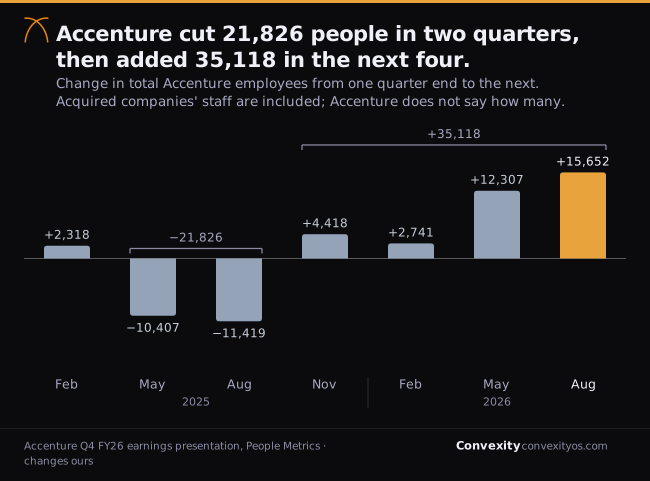
In September 2025 Accenture described what it called a refreshed talent strategy, under which it was "exiting on a compressed timeline, people where reskilling, based on our experience, is not a viable path for the skills we need." The business optimization program that carried it out ran from June to November 2025 and cost $923 million, "primarily related to employee severance." Headcount fell by 21,826 in the two quarters to August 2025 (our arithmetic), to 779,273.
Then it rose. In the four quarters since, Accenture added 35,118 people, 15,652 of them in the fourth quarter alone, to end the year at 814,391. That is about 5% more people for about 5% more revenue in local currency. Some of the increase came with the 17 companies Accenture bought during the year, and it does not say how many. Utilization, the share of available time that is billed, held at 93%.
An analyst asked about exactly this, saying that "to be honest with you, I thought with agentic we'd be probably decreasing headcount." Sweet's answer was that "we increased revenue per person this year," that Accenture is "in growth mode," and that next year "we do expect to hire, but it will be at a lower rate in part due to AI." She also said Accenture still expects to hire more entry-level staff.
The fair reading is that Accenture rotated its workforce rather than shrinking it: it paid to exit people with the old skills and hired, or bought, people with new ones. That is a reasonable strategy. It is not yet evidence that AI lets Accenture grow revenue faster than its headcount by a margin that changes the business, which is the outcome the AI argument for services firms depends on.
What the acquisitions buy
Accenture spent $4.9 billion on 17 acquisitions in fiscal 2026. For fiscal 2027 it has already closed about $3 billion of operational-technology security deals, including Dragos, that "shifted from Q4 of FY26 into Q1 of FY27 due to regulatory timing," and it expects "to deploy another approximately $5 billion in acquisitions." That is about $8 billion in all, the most in the eight years the presentation shows, where the previous high was $6.6 billion in fiscal 2024.
What it is buying has changed as well. Sweet said Accenture's acquisitions "increasingly include businesses with non-FTE commercial models," meaning businesses whose revenue is not priced by the hour or by the head. In the fourth quarter it closed Ookla, which she described as "a global leader in network intelligence, competitive benchmarking, and customer experience analytics" and "an expansion into a new growth area with a non-FTE commercial model."
That is the strategic logic behind the guide, and Park stated it: "We're planning for this level of investment because we currently see a number of opportunities that will position us for higher organic growth over the long term." If AI compresses the price of work billed by headcount, buying revenue that is not billed by headcount is a hedge. It is also a different business from the one investors have valued for two decades, and the acquired half of the guide is where the change is happening.
The money adds up to more than the year's cash. Accenture expects to return "at least $9.5 billion," about 75% of operating cash flow, through dividends growing 5% a share and $5.5 billion of buybacks. With about $8 billion of acquisitions, that is roughly $17.5 billion of planned spending against free cash flow guided to $11.0 billion to $11.8 billion, a gap of about $6 billion (our arithmetic). Accenture ended August with $12.8 billion of cash, so it can fund the gap. It is still a choice to spend more than the cash it expects to generate this year, on buying growth and buying back its own shares.
The case against this note
There is a better reading of the guide, and Accenture's history supports it.
The first part is that Accenture has always bought growth. Its presentation puts the inorganic contribution at 2% in fiscal 2020, 3% in 2021, 5% in 2022, 2% in 2023, and 3% in each of 2024 and 2025. Fiscal 2026's 1.5% was the lowest in the series. By that record, 2 to 2.5 points is normal, and the acquired businesses are meant to become organic growth later. Accenture's own example from September 2025 is its capital projects business, "initially built through several acquisitions around the world," which became a $1.2 billion business and "grew 49% year-on-year, largely organically" in fiscal 2025.
The second is that Accenture guides conservatively and then beats. It guided fiscal 2026 to 2% to 5% and delivered about 5%. It guided the fourth quarter to 1% to 5% and delivered 7%. Its presentation says it met or beat every element of its original guidance for the year. If it delivers the top of this year's range with 2 points acquired, organic growth is about 4%, the same pace as last year without federal.
The third is bookings. Accenture booked $84.5 billion in fiscal 2026, had 141 quarterly bookings above $100 million, 12 more than a year earlier, and said managed services deals that slipped out of its third quarter will come "sometime in FY27."
We think all three are fair, and this note does not argue that Accenture is in trouble. It argues something narrower: that the midpoint of the guide implies organic growth below last year's, in a year with no federal drag and with prices that fell in the fourth quarter, and that the disclosure which would show whether AI is adding to the business or taking from it is no longer published. The investor day on October 14 is Accenture's chance to replace it.
What would prove this wrong
- The investor day sets a higher organic bar. If Accenture's targets on October 14 put organic growth for fiscal 2027 or the medium term clearly above the 2.25% midpoint, the guide was conservatism rather than a slowdown.
- The first quarter lands at the top. Accenture reports in December against a range of 2% to 6%. Growth near 6% with an acquired share near 2 points would mean organic growth held at last year's pace.
- Pricing recovers. If Accenture says the fourth quarter's lower pricing did not continue, the main pressure on the organic half eases.
- Revenue outgrows headcount. A year in which revenue grows clearly faster than the number of people, with acquisitions accounted for, would be the AI productivity case appearing in the numbers rather than in the commentary.
- The AI dollars come back. If Accenture restores a revenue or bookings figure for AI work, investors can judge the offset Sweet described directly.
The filings and documents this is built on
- 8-KAccenture plc, fiscal 2026 fourth quarter and full year earnings release (Exhibit 99)Revenue by type of work and market, bookings, margins, EPS, cash flow, DSOs and the fiscal 2027 outlookOct 1, 2026
- ReportAccenture, fourth quarter fiscal 2026 earnings presentationOrganic growth, the inorganic contribution and capital invested by year, and quarter-end headcountOct 1, 2026
- CallAccenture fourth quarter fiscal 2026 conference call, official transcriptPublished by Accenture; the fiscal 2027 outlook, pricing, headcount and acquisitionsOct 1, 2026
- CallAccenture fourth quarter fiscal 2026 call, Motley Fool transcriptAn independently produced transcript used to check the official oneOct 1, 2026
- CallAccenture fourth quarter fiscal 2026 call, gloom.sh transcriptA second independently produced transcriptOct 1, 2026
- CallAccenture first quarter fiscal 2026 call, Motley Fool transcriptThe last advanced AI bookings and revenue figures, and the decision to stop reporting themDec 18, 2025
- CallAccenture fourth quarter fiscal 2025 call, Motley Fool transcriptThe fiscal 2026 guide, the business optimization program, fiscal 2025 AI revenue and the capital projects exampleSep 25, 2025
- PricesAccenture daily closes, September 30 to October 6, 2026Nasdaq historical quotes; settled closesOct 6, 2026
Not investment advice. This note is an analysis of Accenture's public disclosures, published for research purposes, and not a recommendation to buy, sell or hold any security. A member of the Convexity team holds SPY, which holds Accenture and Palantir, and holds an economic interest in Anthropic through a special-purpose vehicle and a fund, so the authors are not neutral on Anthropic; no other position.
What here is ours rather than Accenture's. As stated by Accenture: every revenue, bookings, margin, earnings, cash and headcount figure; the organic growth and inorganic contribution for fiscal 2026 and the fiscal 2027 outlook; the history of inorganic contributions and capital invested; the acquisition and shareholder-return plans; and every quotation, which is from Accenture's transcript of the October 1 call or from the transcripts of earlier calls listed above. Ours: the roughly 4% organic growth without the federal drag, the 2.25% midpoint and the 0.5% to 4% range of organic growth implied by the outlook, the reading that at the bottom of the earnings range all growth in earnings per share comes from the lower share count, the quarter-to-quarter headcount changes and their sums, the roughly $17.5 billion of planned spending and the gap of about $6 billion to free cash flow, the stock's moves from Nasdaq's closing prices, the reading of carried-over paid time off as a timing effect, and the characterization of what the investor day needs to show.