
Disclosure. Not investment advice, and nothing here is a recommendation to buy, sell or hold any security. A member of the Convexity team holds the SPDR S&P 500 ETF (SPY), which holds Nike; no other position. Figures are from Nike's earnings releases, its Form 10-Q and 10-K, the Form 8-K announcing its restructuring program, and its October 1 earnings call, quoted from the transcript Nike published and checked against a second, independently produced one. The closing note lists what is our arithmetic. This note was drafted with Claude.
Nike's fourth quarter of fiscal 2026, reported in June, carried a gross margin of 49.2%, and about nine points of it were a tariff refund. The company said so plainly: "The expected recovery of the IEEPA tariffs of $986 million increased gross margin by approximately 900 basis points." Its chief financial officer told analysts that excluding the refund, gross margin "would have been 40.2%, down 10 basis points versus the prior year." Our count of tariff refunds in adjusted earnings in September included Nike, and the first quarter of fiscal 2027 was the test: the quarter without the refund.
It passed that test, quietly. Gross margin in the quarter to August 31 was 42.8%, up 60 basis points from a year earlier. Neither the release nor the call used the word "tariff." The refund turned up only in the cash flow statement, where the 10-Q notes that receivables fell "primarily due to receipt of the International Emergency Economic Powers Act tariff receivable." Nike had booked $986 million of recovery; $302 million had arrived by May 31 and, the 10-K said, "substantially all of the remaining" after it. The refund that flattered June's margin became cash in August and changed nothing about the quarter's earnings.
So the tariff story ended without incident. The story that replaced it is longer. Nike announced a multi-year restructuring it calls Pace, with about $1.0 billion of charges and about $2.5 billion of cumulative savings through fiscal 2031, and its new chief financial officer said the company expects "the majority of the program savings to be realized in fiscal years '29 and '30." Meanwhile it guides revenue down by a high-single-digit percentage for fiscal 2027, with operating profit falling faster. The turnaround has a date, and the date is two fiscal years away.
Nike fiscal Q1 2027 earnings release and Form 10-Q; Form 8-K of October 1, 2026 (Item 2.05); Nike's official transcript of the October 1 call.
The quarter without the refund
Revenue was $11.2 billion, down 4% as reported and 5% on a currency-neutral basis. Wholesale revenue was $6.8 billion, down 1%. Nike Direct, the company's own stores and apps, was $4.1 billion, down 8%, "due to a 13 percent decrease in NIKE Brand Digital and a 5 percent decrease in NIKE-owned stores." Diluted earnings were $0.48 a share against $0.49 a year earlier. Inventories were $7.8 billion, down 3% from a year earlier and up 5% from May.
The gross margin is the number this note set out to test, and the 10-Q explains it line by line.
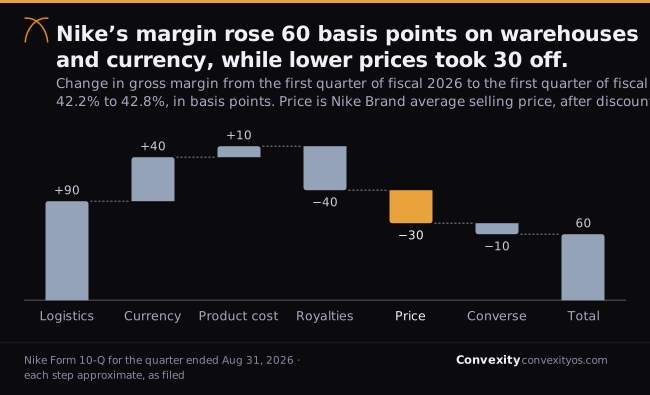
Warehousing and logistics added about 90 basis points and currency about 40. Those two alone are more than the whole improvement. Product costs added 10. Against them, higher other costs, "primarily due to third-party royalties," took off 40; lower Nike Brand average selling prices took off 30, "primarily due to higher discounts and channel mix, partially offset by strategic pricing"; and Converse took off 10.
Two things in that walk matter. The first is that the improvement came from costs and currency, not from the product selling for more. Nike's average selling price fell, because it is discounting to clear inventory, which is a cleanup cost it has said it would pay. The second is the comparison. Last year's first quarter was not a clean base. Nike's 10-Q for that quarter put "higher NIKE Brand product costs" at about 100 basis points, "primarily due to higher tariffs in North America," and those were the tariffs that were later refunded and recognized in the fourth quarter rather than restated into the first. So the year-over-year gain is measured against a quarter that carried tariff costs Nike has since recovered. On the other side of the ledger, Nike's guidance in June assumed new tariff rates of 10% through July "and then increasing to 15% thereafter," and this quarter's margin absorbed whatever those cost without the company quantifying them.
Against the 40.2% Nike said its fourth quarter would have been without the refund, 42.8% is 260 basis points higher (our arithmetic). Some of that is seasonal: a year earlier, the margin rose 190 basis points from the fourth quarter to the first, from 40.3% to 42.2%. The quarter without the refund was not worse than the refund quarter looked once the refund was taken out. That is the answer to the question our tariff note posed, and it is a clean one.
Where the revenue went
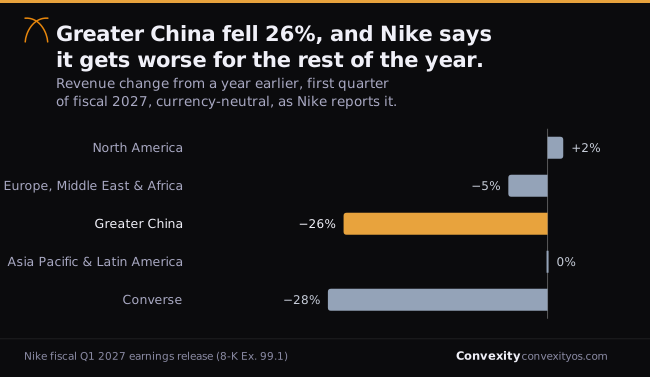
North America, about 46% of revenue, grew 2%, with apparel up and equipment down. Europe, the Middle East and Africa fell 5%, with footwear down 11%. Asia Pacific and Latin America was flat on a currency-neutral basis. Converse fell 28%. Greater China fell 26%, its footwear 26% and apparel 27%.
The call explained the shape. Nike is deliberately shrinking parts of its business that it thinks have been sold too hard. Elliott Hill, the chief executive, said Nike Sportswear, "which accounted for just under half of this quarter's revenue, was down low double digits," and that "as planned, we reduced revenue from the Dunk by nearly 50% in the quarter. That resulted in roughly $200 million headwind in Sportswear." The Jordan Brand "represented 13% of our global business with revenue falling by mid-teens." Some of the decline was not planned: "some aged, higher volume, sportswear footwear sold through below expectations," which "has impacted our future order books as we proactively work with our wholesale partners to work through excess inventory."
China is the part with no floor in sight. Dave Denton, the chief financial officer, said the full-year guidance "assumes that China actually gets worse from a revenue perspective for the balance of this year, and that's because of some of the actions we're taking today to make sure that we return this business to health in the long term."
Where the profit is, and where it is going
Revenue tells half of the regional story. The 10-Q's segment tables tell the other half, and they make the plan easier to read.
North America is where Nike is doing best and where its strategy is most visible. Its gross margin rose 110 basis points to 43.4%, and its earnings before interest and taxes rose 3% to $1,170 million. Inside it, wholesale revenue grew 9% while Nike Direct fell 6%, with digital and store sales each down 6%. Footwear units rose 2%, though lower average prices per pair took about a point off footwear revenue, and apparel units were flat while higher prices per unit added about 6 points. That is the turnaround Nike has been describing for a year, visible in one region: more product through the department stores and sporting goods chains it had pulled back from, fewer sales through its own app, and a little more pricing power in apparel than in shoes.
Europe, the Middle East and Africa held its profit roughly level. Gross margin rose 140 basis points to 44.4% and earnings before interest and taxes slipped 1% to $728 million, on revenue down 5%.
Greater China is the opposite case. Its gross margin, 47.5%, is still the highest of Nike's regions and rose 30 basis points. But revenue fell by a quarter, and operating earnings fell 34%, to $248 million from $377 million. Wholesale revenue there fell 31% on a currency-neutral basis and Nike Direct 18%, which is what a company clearing inventory through its partners rather than pushing more into them looks like. China is profitable per sale and shrinking in sales, and Nike says the shrinking continues.
Asia Pacific and Latin America lost 150 basis points of gross margin, to 42.3%, and 7% of its operating earnings. Converse lost 210 basis points, to 45.2%, and its operating earnings fell 36% to $25 million on revenue down 28%.
What Nike is spending on instead
The cost side of the quarter shows Pace's direction before its savings arrive. Selling and administrative expense fell 3% to $3,910 million, but its two halves moved in opposite directions. Demand creation, Nike's term for marketing and brand spending, rose 5% to $1,252 million, which the 10-Q says was "primarily due to higher brand marketing expense, reflecting higher investment in key sports events." Operating overhead, the salaries and administration Pace targets, fell 6% to $2,658 million, on "lower wage-related expense and lower other administrative costs."
That is the mix the company has promised: less overhead, more marketing behind the sports it calls its priorities. It is also why the near-term profit guide is weak. The overhead cuts are early and partial, the marketing is spent now, and revenue is falling in the businesses the marketing does not cover.
Cash is the last piece. Operating cash flow in the quarter was $135 million, against $222 million a year earlier, even with the tariff receivable collected inside it. The March 2026 plan left $243 million of severance in accrued liabilities at the end of May, and the 10-Q attributes the quarter's fall in accrued liabilities primarily to "payments related to employee compensation." Pace adds about $0.3 billion of charges this year, most of which will be paid in cash. Inventories rose 5% from May, which the 10-Q says "was primarily due to shifts in product mix." None of that is a strain on a company of Nike's size. It is a description of a year in which the restructuring costs money before it saves any.
A new chief financial officer, and a new way of guiding
One more change happened between June and October. Nike announced on June 23 that David Denton would become chief financial officer in mid-August, succeeding Matthew Friend, who gave the fourth-quarter call. A second 8-K, in August, added that Nike's chief accounting officer was leaving and that Denton would also serve as interim corporate controller and principal accounting officer from September 4. Denton's first call replaced Nike's quarterly guidance with an annual view, declined to guide gross margin for the year, and put the restructuring's payback in fiscal 2029 and 2030.
He also said how he sets a guide: it should be "set at a level that we believe is reasonable and attainable based on the information we have today." A guide set on that basis, in a new chief financial officer's first quarter, is worth reading carefully in both directions. A high-single-digit revenue decline, operating profit falling faster and China worse are numbers chosen to be met, and the first quarter beat the guide set in June. They are also numbers that describe a company planning a smaller year on purpose.
Pace, and when it pays
The program is described in an 8-K filed under Item 2.05, the section for exit and disposal costs. Nike "announced a multi-year enterprise program, which includes and builds upon the previous cost realignment plan announced in March 2026, collectively known as Pace." It covers the supply chain, "the establishment of a new campus in India and realigning the Company's operating model into three geographies," and "further streamlining of the organization to reduce costs." The 10-Q names the three geographies as the Americas, Asia Pacific and Greater China, and Europe, the Middle East and Africa, from fiscal 2028.
The costs: "pre-tax charges of approximately $1.0 billion, which is in addition to approximately $0.3 billion of severance costs recognized in fiscal 2026," expected to be "primarily of employee severance and other employee-related costs." About $0.3 billion lands in fiscal 2027, "with the remainder expected to be recognized through fiscal 2031," and "the majority of the charges will result in future cash expenditures." Nike gives no headcount. Hill said only that "over time, those changes will reduce the overall number of roles across NIKE Inc."
The savings: "approximately $2.5 billion in cumulative savings through fiscal 2031," a figure the 8-K says "is stated before the expected pre-tax charges described above and any future reinvestment." That last clause matters. Nike has not promised $2.5 billion of profit. It has promised $2.5 billion of cost removed over five years, from which the $1.0 billion of charges come out and into which reinvestment goes back in.
And the timing comes from the call. Denton: "We have begun taking actions and expect the majority of the program savings to be realized in fiscal years '29 and '30, with the full realization of the program to continue into fiscal year '31." He added that "we are beginning to see savings now even through Q1," in the supply chain lines visible in the margin walk above, because "some of the actions that we took as it related to supply chain are bearing fruit and gross margin." But the majority waits. Nike's fiscal 2029 begins in June 2028.
What the guide says about the years in between
Denton's first guide is annual: "beginning today, we intend to provide a view of our expectations for the full fiscal year," he said, rather than quarter by quarter. The view for fiscal 2027 is that "revenues are expected to decline high-single digits," with adjusted diluted earnings of $1.15 to $1.35 a share, excluding about $0.15 of Pace charges. On profit: "We currently expect EBIT to decline by a greater percentage than revenue. This outlook reflects continued pressure on gross margin and fixed cost deleverage associated with lower revenue levels, higher input costs, but partially offset by disciplined expense management." For the second quarter alone, he named two comparisons, the lapping of promotions in Europe during last year's Cyber Week and higher sell-in in North America a year ago, that "will represent a headwind of approximately 400 basis points to revenues in the second quarter." On gross margin for the year: "we're probably not going to provide guidance specifically for gross margin."
Put the two documents side by side and the shape of the next two years is clear enough. Fiscal 2027 is a year of falling revenue, falling operating profit, a deeper China and deliberate shrinkage in Nike's two largest lifestyle franchises, paying about $0.3 billion of restructuring charges. Fiscal 2028 brings the new geographic structure. The bulk of Pace's savings arrives after that. The turnaround Nike describes is real and specific, and it is scheduled to show up in the results of a fiscal year that has not started.
The market's first answer was skepticism. Nike's stock closed at $35.15 on October 1, before the release, and at $33.87 on October 2, down 3.6% on our brokerage data, after trading lower in the morning.
The dividend, and the November answer
The last question on the call was about the dividend, and it is the one place where the guide and the capital plan meet.
Nike declared $0.41 a share in the quarter, up from $0.40 a year earlier, and paid $610 million in dividends, against the $135 million of operating cash flow described earlier. It bought back no shares; the 10-Q says repurchases have been paused since the first quarter of fiscal 2026. Four quarterly payments of $0.41 come to $1.64 a share a year. The guide for adjusted earnings is $1.15 to $1.35 a share, before about $0.15 of Pace charges. So at the guide, Nike will pay out between about 121% and 143% of its adjusted earnings this year, and more of its reported earnings (our arithmetic). The analyst who asked put it more simply: "the dividend ratio is over 100%."
Denton's answer was unequivocal. "Dividend is a very significant priority for us here at NIKE," he said, and "under all scenarios, we have support for maintaining and ultimately growing the dividend over time." Nike can afford that. It ended the quarter with $6.9 billion of cash and $1.5 billion of short-term investments, and a payout above earnings for a year or two is a choice a balance sheet like that permits. But the choice ties the schedule together. A dividend that runs ahead of earnings through fiscal 2027 and 2028 is a bet that earnings catch up in fiscal 2029, the year Pace is meant to start paying in earnest.
The rest of that answer was deferred. Asked whether revenue could return to growth in fiscal 2028, Denton said Nike would present "a financial algorithm" at its investor day in November, covering the next five years "both from a top line and a bottom line perspective." That is the next date that matters for this note. If November's targets bring the margin recovery forward into fiscal 2028, the schedule is shorter than the 8-K implies. If they confirm fiscal 2029 and 2030, the two years in between are what an investor is being asked to hold, with a dividend larger than the earnings.
The case against this note
There is a more generous reading, and Nike made it on the call.
The first part is that the quarter was better than the guide. In June Nike guided first-quarter gross margin "to be slightly positive" and revenue "down low to mid-single digits"; it delivered plus 60 basis points and minus 4%. North America grew. The cleanup is happening on the schedule management set, and a company that says what it will do and then does it has earned some credit for what it says next.
The second is that a deliberate decline is not the same as a weak one. Cutting Dunk revenue in half and shrinking Jordan by mid-teens are choices, made to protect brands that were being sold too cheaply and too widely. If they work, revenue falls for a year or two and then grows from a healthier base at a higher price. The margin walk already shows Nike paying for that with discounts. On this reading, fiscal 2027 is the cost of fixing a problem that was building for years, and fiscal 2029 is when the fix pays.
We think both points are fair, and this note does not argue that Pace will fail. It argues something narrower: that the quarter without the refund answered the tariff question cleanly, and that the answer to the next question, whether the turnaround works, is by Nike's own schedule mostly two years out. Investors who buy the stock now are buying a fiscal 2029 plan with fiscal 2027 earnings.
What would prove this wrong
- The savings arrive early. If Nike's later updates move the bulk of Pace's savings into fiscal 2028, or show operating margin expanding in fiscal 2027 despite the revenue guide, the turnaround is closer than its own schedule says.
- China bottoms this year. Nike guides Greater China worse for the rest of fiscal 2027. A stabilization by the third quarter would remove the largest drag the guide assumes.
- The discounting stops. If the next margin walk shows average selling price adding to margin rather than subtracting, the cleanup is done sooner than planned.
- November moves the date. If the investor day's five-year targets put most of the margin recovery in fiscal 2028, the gap between the guide and the payback is a year shorter than this note assumes.
- Tariffs show up. Nike said nothing about tariffs this quarter. If a later 10-Q quantifies a material tariff cost in cost of sales, the 60 basis points of improvement were better than they looked, and the next quarters face a headwind the guide did not name.
The filings and documents this is built on
- 8-KNIKE, Inc., fiscal 2027 first quarter earnings release (Exhibit 99.1)Revenue by channel and geography, gross margin, EPS, inventories and the fiscal 2027 outlookOct 1, 2026
- 8-KNIKE, Inc., Form 8-K, Item 2.05: the Pace programCharges, timing, cash, and the $2.5 billion of cumulative savingsOct 1, 2026
- 10-QNIKE, Inc., quarterly report for the period ended August 31, 2026The gross margin walk, segment results, the receipt of the IEEPA tariff receivable, dividends and the paused buyback, the three geographiesOct 2, 2026
- CallNIKE, Inc. fiscal 2027 first quarter earnings call, official transcriptPublished by Nike; every call quotation is from this textOct 1, 2026
- CallNIKE, Inc. fiscal 2027 first quarter earnings call, gloom.sh transcriptThe second, independently produced transcript used to check the official oneOct 1, 2026
- 8-KNIKE, Inc., fiscal 2026 fourth quarter earnings release (Exhibit 99.1)The 49.2% gross margin and the $986 million recovery worth about 900 basis pointsJun 30, 2026
- CallNIKE, Inc. fiscal 2026 fourth quarter earnings call, official transcriptThe 40.2% excluding the refund, the first-quarter guidance and the tariff rate assumptionsJun 2026
- 8-KNIKE, Inc., Form 8-K, Item 5.02: appointment of David Denton as chief financial officerEffective in August 2026, succeeding Matthew FriendJun 23, 2026
- 8-KNIKE, Inc., Form 8-K, Item 5.02: chief accounting officer departureDenton to serve as interim corporate controller and principal accounting officer from September 4Aug 10, 2026
- 10-KNIKE, Inc., annual report for the fiscal year ended May 31, 2026The $302 million received and $684 million receivable, and its collection after year endJul 15, 2026
- 10-QNIKE, Inc., quarterly report for the period ended August 31, 2025The 100 basis points of higher product costs, mainly tariffs, in last year’s first quarterOct 1, 2025
- PricesNike daily closes, October 1 and 2, 2026From our brokerage data feed; settled closesOct 2, 2026
Not investment advice. This note is an analysis of Nike's public disclosures, published for research purposes, and not a recommendation to buy, sell or hold any security. A member of the Convexity team holds SPY, which holds Nike; no other position.
What here is ours rather than Nike's. As filed or stated by Nike: every revenue, margin, earnings, inventory and cash figure; each step of the gross margin walk; the Pace charges, timing and savings; the outlook; and every quotation, which is from Nike's official transcript of the call or from the filings. Ours: the $1.64 annual dividend from four payments of $0.41 and the 121% to 143% payout of adjusted earnings it implies at the guide, the 260 basis points between the 42.8% and the 40.2% excluding the refund, the 190 basis points of the prior year's fourth-to-first-quarter rise, North America's share of revenue, the reading of the savings figure as gross of charges and reinvestment (which the 8-K states), the stock's move from the closes in our data feed, and the characterization of fiscal 2027 and 2028 as the years before most of the savings arrive.