
Disclosure. Not investment advice, and nothing here is a recommendation to buy, sell or hold any security. A member of the Convexity team holds the SPDR S&P 500 ETF (SPY), which holds Micron and Nvidia, both named below; no other position. Figures are from Micron's earnings releases, its prepared remarks, its 10-Q and 10-K filings, and its September 30 earnings call, read in two independently produced transcripts and quoted only where both agree or where the company's own prepared remarks carry the words. The closing note lists what is our arithmetic. This note was drafted with Claude.
On September 6 we argued that the memory cycle is the AI trade, and we named the argument's weakness in the same piece: the rate at which memory prices were rising had already fallen hard. DRAM contract prices, on the industry tracker we cited, rose 93% to 98% in the first quarter of 2026 and 13% to 18% in the third. The level was still climbing. The second derivative had turned.
Micron's results for the quarter that ended September 3 are the first company figures to answer that, and they answer it plainly. On Micron's own account, its DRAM prices rose in the "high-teens percentage range" over the quarter, after rising in the "low-60s percentage range" the quarter before and the "mid-60s" the one before that. NAND prices rose about 30%, after the mid-80s and high-70s. For the current quarter, Micron guides to higher gross margins "with a more moderate rate of price increases."
That is half the quarter. The other half is what Micron did while it happened. In the same three months it went from 16 to 26 multi-year take-or-pay contracts with its customers, collected $12.3 billion of cash deposits against them, and now reports about $150 billion of contracted revenue at minimum prices. The largest of those contracts carry a ceiling price that, in the company's own words, "approximates the market price in the second calendar quarter of 2026," and a floor for their full term.
So the story of the print is not that the boom ended. Micron's revenue rose 31% in the quarter and it guides to another 13%. It is that the company spent the quarter in which price momentum slowed converting as much of the boom as it could into contracts, with a cap near the spring's prices and a floor underneath. That is a sensible thing to do at the top of a price cycle, and it is worth being clear that it is what Micron did.
Micron fiscal Q4 2026 earnings release and prepared remarks, September 30, 2026; fiscal Q3 2026 prepared remarks, June 24, 2026. Price ranges are Micron's own descriptions.
The quarter, in Micron's numbers
Revenue was $54.23 billion, against $41.46 billion the quarter before and $11.32 billion a year earlier. Gross margin was 86.8% on Micron's reported basis and 87.0% on its adjusted one, above the "approximately 86%" it had guided to. Adjusted earnings were $33.42 a share. Operating cash flow was $44.0 billion and capital spending $10.8 billion, which Micron puts at $33.2 billion of free cash flow. The company ended the quarter with $73.5 billion of cash and investments against $5.2 billion of debt.
Every one of those is a record, and the company said so. Fiscal 2026 revenue was $133.19 billion, against $37.38 billion in fiscal 2025. For the current quarter Micron guides to revenue of $61.5 billion, plus or minus $1.5 billion, an adjusted gross margin of about 86.25%, and adjusted earnings of $38.15 a share.
Two details change how those numbers read. The first is the calendar. Micron's fiscal 2026 had 53 weeks, and the extra week fell in the fourth quarter, which ran 14 weeks against 13 for the third. Per week, revenue grew about 21.5% rather than 31% (our arithmetic: $54,229 million over 14 weeks against $41,456 million over 13). The guided 13% for the current quarter is measured against that 14-week base.
The second is how big a surprise the quarter was. Each quarter Micron guides to the next one's revenue, and for most of the boom it beat that guidance by a wide margin. Against the midpoint of its own guidance, it beat by 27.6% in its fiscal second quarter and 23.7% in its third. In the fourth it beat by 8.5%.
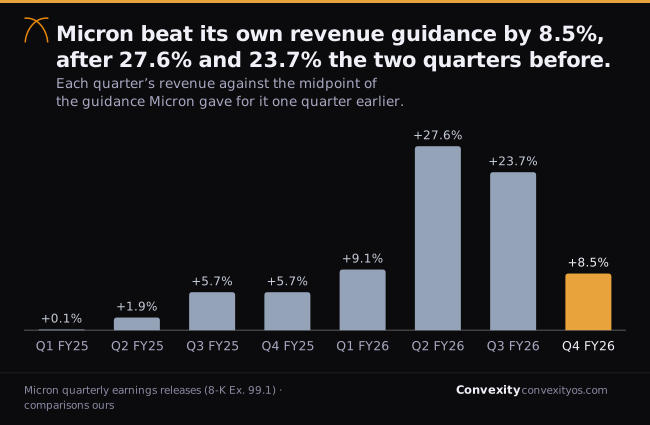
An 8.5% beat is still a beat, and the extra week accounts for some of the quarter's size. But the pattern is the one the price data describes: the market moved faster than Micron expected for two quarters, and then moved roughly as fast as Micron expected.
The second derivative, in the company's own words
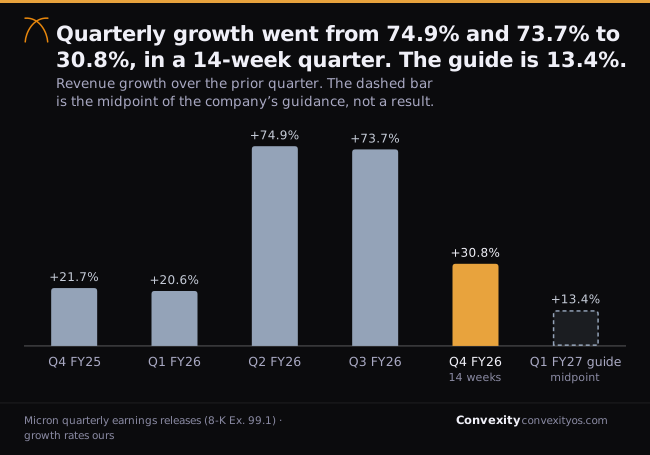
Revenue growth is price times volume, and Micron reports both in words rather than figures. Over the last five quarters, as its prepared remarks describe them, DRAM prices rose in the low-double-digit percentage range, then about 20%, then in the mid-60s, then in the low 60s, then in the high teens. NAND prices rose in the high single digits, then the mid-teens, then the high 70s, then the mid-80s, then about 30%. Bit shipments did little of the work: DRAM bits were up in the mid-single digits in the fourth quarter, over 14 weeks, and NAND bits about 10%.
That sequence is the moderation our September note warned about, now in the seller's own disclosures. And the guide says it continues. Micron expects "higher gross margins beyond fiscal Q1 for the remainder of fiscal 2027, with a more moderate rate of price increases." Higher margins on slower price increases is not a contradiction: margins are a level, and prices are still going up. But a business whose revenue rose 75% a quarter on price is now guiding to 13%, and the price component is the part that is slowing.
The company does not describe this as a turn, and on its own account it is not one. The prepared remarks put it this way: "Even with additional industry DRAM cleanroom space plans, with robust demand trends including new upside requests from customers, we do not have line of sight to when supply and demand will return to balance." On the call, Sanjay Mehrotra, the chief executive, said that "more than 75% of our output is already committed for 2027." Those are the statements of a company in a seller's market, and they should be taken at face value. Supply is tight, and Micron expects it to stay tight through 2028.
What the second derivative describes is the speed of the price gains, not their direction, and the speed matters for a stock priced on them. Micron closed at $1,065.11 on September 30, before the release. It rose to $1,097.39 the next day and closed at $1,063.96 on October 5, on our brokerage data, a little below where it started. A record quarter with a higher guide bought no net gain in the stock.
Where the volume actually fell
The company-level figures hide the one place the price rise has already met resistance, and Micron's own business-unit results show it.
Micron reports four business units. Three of them grew on price and volume together in the quarter. The Core Data Center unit's revenue rose 56% from the third quarter, "driven by higher pricing and bit shipments," at a 90% gross margin. The Automotive and Embedded unit's rose 47%, "driven by higher pricing and higher bit shipments." The Cloud Memory unit, which carries the high-bandwidth memory that sits beside AI accelerators, rose 18% at a gross margin of 83%, "flat sequentially, driven by higher pricing, offset by higher HBM mix."
The fourth is different. The Mobile and Client unit, which sells memory for phones and personal computers, grew revenue 14%, "driven by higher pricing, partially offset by lower bit shipments." It shipped fewer bits in a 14-week quarter than in a 13-week one. That is the consumer half of the market doing what consumer markets do when a component's price rises this fast: buying less of it. It is also where the industry tracker our September note cited placed the slowdown, which it attributed to weaker consumer demand and a high comparison base. Phones and PCs have no AI budget behind them.
The data center unit is where the margins are, and it is not slowing yet. But the same prepared remarks that report its 56% growth also say that server memory content is growing at "a modestly lower rate of content growth than prior expectations, amid tight memory supply." The first effect of price on the data center is not fewer servers. It is less memory per server than planned, which is the same response the phone and PC makers are showing, arriving more gently and one step later.
What Micron did with the slowdown
The agreements are the most important thing in the print, and they deserve to be read closely rather than counted.
Micron calls them strategic customer agreements, or SCAs, and it began signing them this year. Its 10-Q for the quarter that ended May 28 describes them: they "are structured as take-or-pay agreements, with binding commitments for specific volumes over the multi-year contract terms." On price, "Pricing for most agreements is either fixed, or is subject to minimum and maximum pricing." And on the largest of them: "The largest agreements generally have a ceiling price for existing products that approximates the market price in the second calendar quarter of 2026, and a floor price through the term of the agreement."
In June, Micron said it had signed 16, covering "roughly 20% of our DRAM volume and a third of our NAND volume" over their terms. On September 30 it said it had signed 26, "which we currently estimate to be over 35% of our revenue through 2030," and some now run into 2031. Three-quarters of that revenue "has a defined pricing framework, a majority of which have pricing bands with floor and ceiling prices." The remaining quarter is priced periodically at market. New agreements, Micron added, "are negotiated with higher pricing based on prevailing market conditions and outlook."
The money attached is large. Customers have committed $32 billion, "the vast majority of which are cash deposits." Micron received $12.3 billion of those deposits in the fourth quarter alone and held $12.7 billion at its end. It reports remaining performance obligations of about $150 billion, a figure it says "reflects the contract value for only SCAs that have a determined pricing framework" and "is based on committed volumes and minimum pricing."
Three things follow from those terms, each in Micron's own description.
The ceilings sit near the peak of the price acceleration. The largest agreements cap prices for existing products near the market price in April to June 2026. That was the quarter in which Micron's DRAM prices rose in the low 60s percent; in the quarter after, they rose in the high teens. Customers who signed then bought protection against the possibility that prices kept rising at the old pace. Micron sold that protection in exchange for volume commitments and a floor. If prices keep climbing, the ceilings bind and Micron gives up some of the upside on that share of its output. If they fall, the floors bind and the customers pay above market. On the evidence of the last two quarters, Micron chose its moment well.
The deposits are customer financing, and they sit outside free cash flow. The prepared remarks say plainly that "customer cash deposits associated with SCAs are reported within financing activities and therefore do not affect our free cash flow," and that they "are unrestricted and will be returned to customers over time, toward the latter half of each agreement's term, assuming minimum purchase requirements are met." So the $33.2 billion of free cash flow is the operating business, and the $12.3 billion beside it is money customers advanced to secure supply, which Micron can spend now and expects to hand back in the second half of the decade. That is the clearest sign in the filing of how tight the market is. Buyers are lending the seller money to make sure they get the product.
The floors are what turns a cycle into a contract. Micron said in June, and repeated this quarter, that "even at floor prices, we expect margins meaningfully above any prior cycle peak margins." Its revenue at minimum prices on the priced agreements, about $150 billion, is the closest thing memory has had to a contracted backlog. A memory down-cycle has always meant price falling through cost. On the share of output under these agreements, it now means price falling to a floor that Micron says still earns more than any previous peak.
What the agreements cannot do
They cover a share of the business, not all of it. Over 35% of revenue through 2030 leaves most of Micron's output priced in the market, contract by contract, as before. The "more than 75%" of 2027 output that Mehrotra described as committed includes customers who are not on SCAs; he said on the call that the figure is "between the SCA customers as well as non-SCA customers," and that Micron does business with some large customers on an annual basis. Annual commitments are not take-or-pay through 2030.
They also bind Micron. The 10-Q's risk factors note that the agreements carry "binding commitments for specific volumes," which is a commitment to supply as well as a commitment to buy, and that the company has "received, and expect[s] to continue to receive, customer deposits and other related financial commitments." A seller that has promised volume at a ceiling price has less room to chase a higher market with that volume.
And they do not answer the second question our September note asked, about whether some of today's demand is inventory being built ahead of need. Two lines in the print bear on it. Micron's own days of inventory rose nine days in the quarter, to 129, which it attributes to a build-ahead before older products reach end of life and to incentive pay absorbed into inventory, and it expects the figure to fall. And in data centers, the prepared remarks say, strong server unit growth "is supported by a modestly lower rate of content growth than prior expectations, amid tight memory supply." That is a company saying its customers are putting a little less memory in each server than planned, because memory is scarce and expensive. It is not a demand problem yet. It is the first sentence in the filing where price is visibly shaping the buyer's design.
The part of the business with its own contract
High-bandwidth memory, the stacked DRAM packaged beside AI accelerators, is the one line where Micron's pricing was settled a year ahead before any of the SCAs existed. Its remarks this quarter say it has "completed agreements for the vast majority of our calendar 2027 HBM bit supply with significant price increases year over year, narrowing the gross margin gap with conventional DRAM." HBM revenue, Micron says, grew faster than total company revenue in the quarter.
That last clause is telling. Micron describes next year's HBM price increases as narrowing the gross margin gap with conventional DRAM, which can only mean conventional DRAM is now the more profitable of the two. The product the AI buildout is built around carries, for the moment, a lower gross margin than the commodity memory that goes into everything else, which is why the Cloud Memory unit's margin held flat at 83% while the other three units' rose to 84% and 90%. Micron also names Nvidia as its partner on the first custom HBM4 product. The year ahead for HBM is sold. What it is sold at is the question its next contracts, not its next quarter, will answer.
The capital that follows
Micron will spend more. Capital spending in the current quarter is projected at about $11.5 billion, and "first-half fiscal 2027 capex to be approximately $25 billion," with the second half higher. Most of the increase is construction, "most of which is to help accelerate clean room space availability in late calendar 2028 and beyond." The agreements are the reason it can: they give Micron, in its words, "greater visibility from SCAs into our demand through the end of the decade and beyond."
That is the cycle's oldest mechanism, now with a contract attached. Tight supply and high prices lead to new capacity, which arrives two or three years later into whatever the market is then. The agreements mean that when the cleanrooms of late 2028 fill, a share of what they make is already sold at prices with a floor. The rest is not.
The case against this note
The strongest argument against reading the quarter this way is that the second derivative is the wrong thing to watch when the level is this high.
Micron's adjusted gross margin was 87.0%. It guides to about 86.25% for the current quarter and higher after that. Its own estimate is that even at the floor prices in its agreements, margins stay "meaningfully above any prior cycle peak margins." A business earning those margins can absorb price increases slowing from 60% a quarter to nothing at all and still have its best year ever, which is what Micron says fiscal 2027 will be. On that reading, the deceleration is arithmetic, not a signal: prices could not keep rising 60% a quarter forever, and the fact that they stopped rising that fast says nothing about whether they will fall.
The second argument is supply. Micron says it has no "line of sight to when supply and demand will return to balance," expects the industry to remain "supply constrained" in calendar 2027 and 2028, and points out that the new cleanroom space it is now building arrives in late 2028 and after. Memory cycles turn when supply catches up with demand. If supply cannot catch up before 2029, a slowing rate of price increase is a plateau, not a peak.
We think both are right as far as they go. This note does not argue that prices will fall, or that Micron's margins are at risk this year. It argues something narrower: that the rate of price increase fell sharply in the quarter just reported, that Micron's own guide says it will keep falling, and that Micron spent that quarter locking more than a third of its revenue through 2030 into contracts, the largest of them priced near the spring's levels. A company that expected the acceleration to continue would have had little reason to sell ceilings near the spring's prices. Micron's own behavior is the best evidence of what Micron expects.
What would prove this wrong
The argument is that Micron's price gains slowed sharply in the quarter that ended September 3, and that the company responded by locking a growing share of its revenue into multi-year contracts priced near the spring's levels with a floor underneath. Either half can fail.
- Prices reaccelerate. If Micron's first-quarter prepared remarks describe DRAM price increases back above the low-60s range, the fourth quarter was a pause, the ceilings in the largest agreements bind hard, and the contracts cost Micron more than they protected it.
- The guide was conservative again. A fiscal first-quarter beat well above the 8.5% of the fourth would say the market is still outrunning the company's own forecasts.
- The ceilings are not where the 10-Q puts them. If later disclosures show the largest agreements were repriced upward, or that "new discussions on SCAs" reset the old ones, the agreements are less a lock than a floor, which is better for Micron than this note assumes.
- Inventory keeps rising. If days of inventory rise again rather than falling as Micron expects, the build-ahead explanation weakens and the borrowed-demand question from our September note gets sharper.
- Content growth slows further. If the "modestly lower rate of content growth" becomes a lower rate of server memory demand, the floors will be tested sooner than 2030.
The filings and documents this is built on
- 8-KMicron Technology, fiscal fourth quarter 2026 earnings release (Exhibit 99.1)Revenue, gross margin, EPS, cash flow, fiscal 2026 totals and the fiscal Q1 2027 guidanceSep 30, 2026
- RemarksMicron Technology, fiscal Q4 2026 earnings call prepared remarksPrice and bit-shipment descriptions, the SCA update, RPO, deposits, inventory, capex and guidanceSep 30, 2026
- CallMicron Technology fiscal Q4 2026 earnings call, gloom.sh transcriptBuilt from the webcast captions; quoted only where it agrees with the second transcriptSep 30, 2026
- CallMicron Technology fiscal Q4 2026 earnings call, Benzinga transcriptThe second, independently produced transcript used to check every quotation from the question periodSep 30, 2026
- RemarksMicron Technology, fiscal Q3 2026 earnings call prepared remarksThe first 16 SCAs and their share of DRAM and NAND volume; the low-60s DRAM price increaseJun 24, 2026
- 10-QMicron Technology, quarterly report for the period ended May 28, 2026The SCA terms: take-or-pay, fixed or banded pricing, the ceiling near the second calendar quarter of 2026, deposits and the 53-week fiscal yearJun 25, 2026
- 8-KMicron Technology, fiscal third quarter 2026 earnings release (Exhibit 99.1)Fiscal Q3 revenue and the fiscal Q4 guidanceJun 24, 2026
- 8-KMicron Technology, fiscal second quarter 2026 earnings release (Exhibit 99.1)Fiscal Q2 revenue and the fiscal Q3 guidanceMar 18, 2026
- 8-KMicron Technology, fiscal first quarter 2026 earnings release (Exhibit 99.1)Fiscal Q1 revenue and the fiscal Q2 guidanceDec 17, 2025
- PricesMicron daily closes, September 30 to October 5, 2026From our brokerage data feed; settled closesOct 5, 2026
Not investment advice. This note is an analysis of Micron's public disclosures, published for research purposes, and not a recommendation to buy, sell or hold any security. A member of the Convexity team holds SPY, which holds Micron and Nvidia; no other position. Quotations from the question period of the call appear only where both transcripts carry the same words; quotations from the prepared remarks are from Micron's own published text.
What here is ours rather than Micron's. As reported by Micron: every revenue, margin, earnings, cash flow, inventory, deposit, RPO and capex figure, the guidance, the count of agreements, and every price and bit-shipment description, which Micron gives in words and which we reproduce rather than convert to figures. Ours: every quarter-over-quarter growth rate, the per-week growth of about 21.5%, the guided growth of 13.4%, each quarter's revenue against the midpoint of its prior guidance, the reading that the ceilings sit near the peak of the price acceleration, and the stock's moves from the closes in our data feed.