
Disclosure. No position in ADBE, long or short, at publication. This is not investment advice. Every figure here comes from an Adobe filing or from the September 10 earnings call, both linked at the bottom. Where a number is our arithmetic on Adobe's disclosed figures rather than a figure Adobe reported, we say so at the point of use. Adobe's fiscal year ends in late November, so the quarter discussed here, the third quarter of fiscal 2026, is the three months ended August 28, 2026. The Form 10-Q for it had not been filed when this was written, so quarter-end figures come from the earnings release filed as an 8-K exhibit.
Adobe's third quarter of fiscal 2026 was the largest the company has reported. Revenue was $6.76 billion, up 13 percent, and on the strength of it Adobe raised both its full-year revenue target and its full-year earnings target. The release is headlined "Adobe Reports Record Q3 Results," and the word is earned.
Four bullets below that headline is a figure that moved the other way. Remaining performance obligations, the revenue Adobe has under contract and has not yet recognized, were $22.16 billion at the end of the quarter. Three months earlier they were $22.27 billion.
That is a decline of $110 million, which on a $22 billion balance is nothing. What makes it worth reading is that Adobe has disclosed the figure in every quarterly filing since fiscal 2019, and in that time it has never once fallen between the second quarter and the third. In each of the seven prior years it rose, by between $280 million and $750 million. This year it fell.
The quarter, before any of that
The argument below is narrow, and it does not work if the business underneath it is weak. It is not weak.
| Three months ended, $ millions | Aug 28, 2026 | Aug 29, 2025 | Change |
|---|---|---|---|
| Subscription | 6,582 | 5,791 | 14% |
| Product | 67 | 68 | -1% |
| Services and other | 111 | 129 | -14% |
| Total revenue | 6,760 | 5,988 | 13% |
| Gross profit | 5,997 | 5,346 | 12% |
| Operating income | 2,354 | 2,173 | 8% |
| Net income | 1,827 | 1,772 | 3% |
| Diluted earnings per share | 4.62 | 4.18 | 11% |
Subscription revenue is 97 percent of the total and grew 14 percent. Adobe crossed one billion monthly active users across its creativity and productivity products, a number Shantanu Narayen said on the call grew more than 20 percent year over year. Acrobat and Express alone passed 900 million, growing more than 25 percent. Creative freemium monthly actives, which Adobe defines as Firefly, Express and the web and mobile versions of Premiere, Photoshop and Lightroom, crossed 100 million and grew more than 70 percent.
The enterprise side is holding. Adobe reported year-over-year ending recurring revenue growth above 20 percent for each of Experience Manager and its agentic web apps, GenStudio, and Experience Platform and its apps. Firefly recurring revenue across the apps and the credit packs grew 40 percent quarter over quarter. Paid customers for the brand visibility products, which combine Adobe's own optimizer with technology from the Semrush acquisition, doubled quarter over quarter. The named enterprise wins in the quarter run from Amazon and Wells Fargo to the Premier League and Los Alamos National Laboratory.
Adobe also raised. Full-year revenue now targets $26.576 billion to $26.626 billion and full-year non-GAAP earnings $24.45 to $24.50 a share. Steve Day, the interim chief financial officer, put the raise at "around $50 million at the midpoint" of revenue, and said a Q4 currency headwind is netting off part of the third-quarter beat.
None of that is in dispute here. The question this note asks is narrower: the third quarter produced several growth rates, and they do not agree with each other. Which one you believe depends entirely on how far ahead you are willing to look.
Four growth rates, in the order they look forward
Adobe reported four measures of the same business growing at four different speeds, and they sort almost perfectly by horizon.
Revenue is the most backward-looking number in the set. It counts what was delivered and recognized in the three months that already happened. It grew 13 percent, and subscription revenue inside it grew 14 percent.
Annualized recurring revenue is a snapshot of today. It is the annual value of the subscription contracts in force at the moment the quarter closed, regardless of how long each one runs. Adobe ended at $27.50 billion, which Day said on the call was 11.2 percent growth.
Current remaining performance obligations is contracted revenue expected to be recognized within the next twelve months. It grew 9 percent.
Remaining performance obligations is every dollar under contract and not yet recognized, at any horizon. It grew 8 percent.
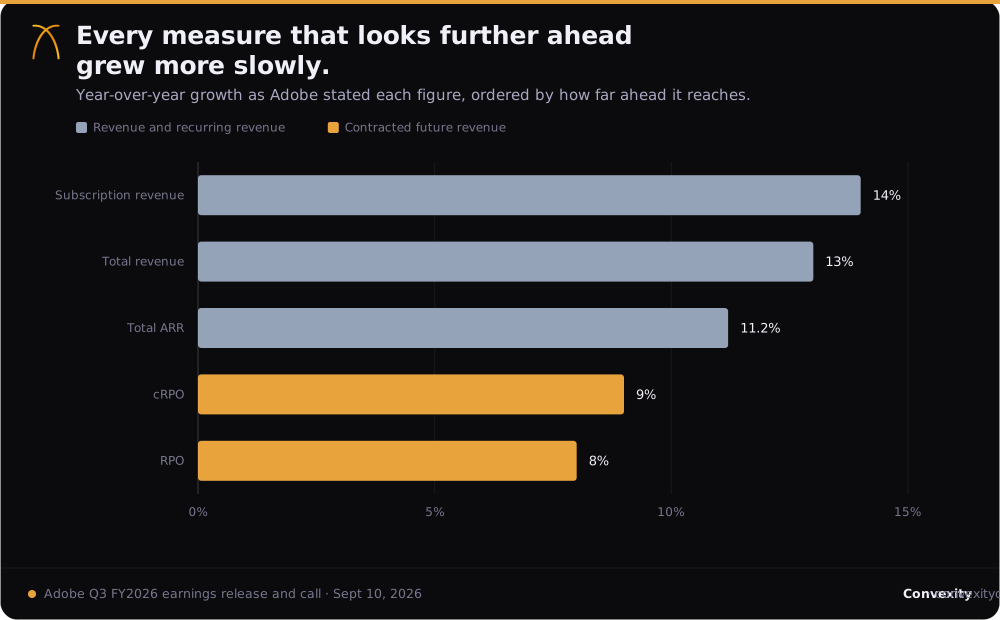
There is nothing improper about a ladder like this. Growth rates measured over different horizons routinely differ, and a company whose mix is shifting will always produce a spread. What is worth noticing is the direction. The measure of the business that already happened is the fastest one Adobe reported, and each step further into the future is slower than the step behind it.
Adobe's own guidance extends the pattern by one more rung. The full-year target for ending recurring revenue growth is 10.2 percent, reiterated on this call, against the 11.2 percent just delivered. The company is guiding its own recurring revenue growth down in the fourth quarter.
Seven years of third quarters, and one exception
Remaining performance obligations is the rung that did more than slow. It shrank.
Adobe has reported the figure in every 10-Q and 10-K since fiscal 2019, so the record is long enough to say what normal looks like. Normal is a large step up in the fourth quarter, Adobe's enterprise-heavy selling quarter, followed by three quieter quarters that give some of it back and then build again. What has never happened is the third quarter coming in below the second.
| Second quarter to third quarter, $ billions | Q2 | Q3 | Change |
|---|---|---|---|
| Fiscal 2019 | 8.37 | 8.77 | +0.40 |
| Fiscal 2020 | 9.92 | 10.34 | +0.42 |
| Fiscal 2021 | 12.23 | 12.63 | +0.40 |
| Fiscal 2022 | 13.82 | 14.11 | +0.29 |
| Fiscal 2023 | 15.22 | 15.72 | +0.50 |
| Fiscal 2024 | 17.86 | 18.14 | +0.28 |
| Fiscal 2025 | 19.69 | 20.44 | +0.75 |
| Fiscal 2026 | 22.27 | 22.16 | -0.11 |
The year-over-year rate tells the same story from a different angle. At 8.4 percent, this is the slowest growth in remaining performance obligations of the twenty-seven year-over-year comparisons Adobe's filings support, slower even than the 8.6 percent it printed in the quarter ended December 2022. That the growth rate had gone single-digit was noticed on the call. Jay Vleeschhouwer of Griffin Securities said he was "a little concerned about your RPO number," correctly placed the last single-digit reading in early fiscal 2023, and asked whether anything unusual had happened.
Day's answer is the most useful thing said on the call, and it concedes the mechanism:
The growth is consistent with our ARR trends, I would say. It does reflect our focus to accelerate new user acquisition through the freemium business model.
Steve Day, interim chief financial officer, Adobe Q3 FY2026 earnings call
He then added that "both RPO and cRPO step up in our fourth quarter, and then remain fairly flat over the next three quarters. This year is no different to prior years in that shape."
The first half of that is right and the second half is worth testing, because it is a claim about a series that is on file. Measured against the fourth-quarter peak each year starts from, fiscal 2026 has been flatter than flat. Adobe entered the year at $22.52 billion and stood at $22.16 billion three quarters later, 1.6 percent below the starting point. In fiscal 2025 the same three quarters ended 2.4 percent above the starting point, and in fiscal 2024 they ended 5.3 percent above it. So the magnitude is fairly described as flat. The direction is the opposite of the two years before it, and those are the years the shape is being compared to.
A third measure moved the same way, on a different statement. The cash flow statement carries a line for the change in deferred revenue during the quarter, which is money collected ahead of delivery and the closest thing in the filings to a billings signal. In the quarter just reported it was negative $46 million. In the same quarter last year it was positive $200 million. Deferred revenue on the balance sheet is still higher than it was at the fiscal year end, so nothing is collapsing, but the direction inside the quarter reversed and the swing is about $246 million. Remaining performance obligations, current remaining performance obligations and deferred revenue are three different views of the same question, which is how much of tomorrow Adobe has already sold. All three decelerated, and two of them went backwards.
The freemium answer, taken at full strength
Day's explanation is not a deflection, and the note is worse if it is treated as one. It is a real mechanism and it would produce exactly this number.
Remaining performance obligations counts contracted revenue. An enterprise term agreement signed for three years puts three years of committed revenue into the balance on the day it is signed. A self-serve subscriber who signs up on the website, pays monthly and can cancel at any time puts approximately nothing into it, however much that subscriber is worth. A company deliberately moving acquisition from the first channel toward the second will show slowing contracted revenue growth while the underlying business is fine, and the slowdown is an accounting consequence of the strategy rather than evidence against it.
Adobe is doing exactly that, openly, and has been saying so for two quarters. Anil Chakravarthy described taking "a portion of our traffic to make sure that we are sending them to the right place so we can acquire customers through the freemium funnel," engaging those users, raising the intensity of their AI usage, and converting them "at the right time." On the same call Narayen confirmed Adobe deferred Creative Cloud pricing actions it had previously planned, and defended the choice in terms that leave no ambiguity about the tradeoff being made:
I am actually really happy that we did not focus on the pricing actions, because that, while it may have provided some short-term relief, would not be as critical as continuing to drive new user adoption.
Shantanu Narayen, chair and chief executive, Adobe Q3 FY2026 earnings call
That is a company choosing users over near-term revenue, in public, with the numbers to show the users arrived. One hundred million creative freemium monthly actives growing 70 percent is not a rounding error, and 400 billion PDFs opened a year through Acrobat is a distribution position most software companies would trade a great deal for. If the conversion machinery works, the contracted revenue line reaccelerates and this section is the whole story.
The reason the note does not stop here is that the explanation covers one number and there is a second one it does not reach.
The recurring revenue has no such excuse
Annualized recurring revenue is indifferent to contract length. A month-to-month self-serve subscriber counts in it at the annualized value of the subscription, the same as an enterprise seat under a three-year commitment. It is the metric specifically designed to survive the mix shift that depresses remaining performance obligations. Adobe made it the center of its reporting this year, telling investors in December that guidance would focus on customer group subscription revenue and total company ending recurring revenue growth.
By that metric, Adobe added $400 million in the third quarter.
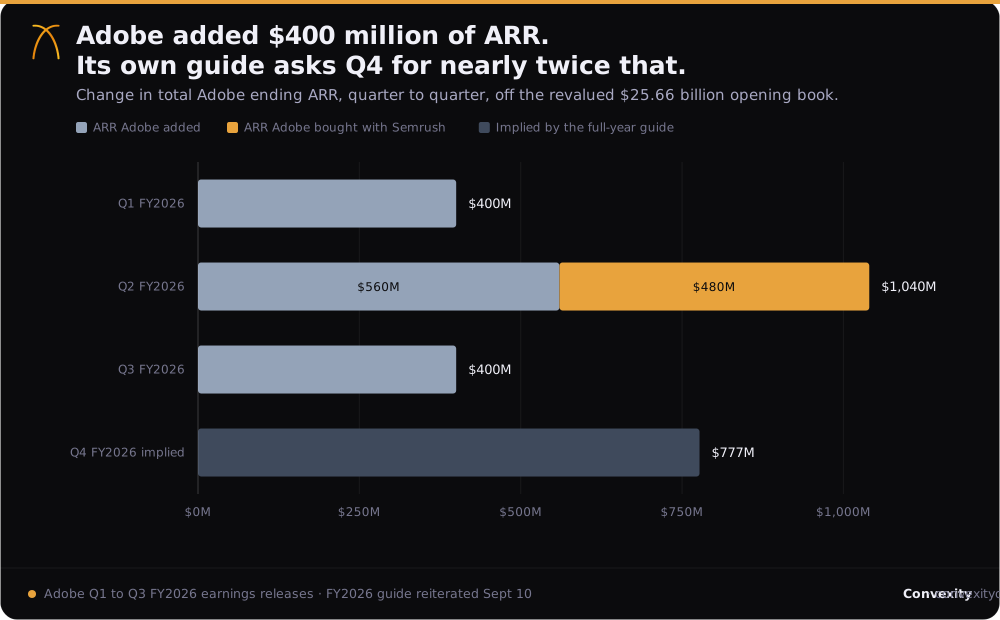
Four things about that chart are worth saying out loud.
The first is that the $400 million in the third quarter is the same $400 million Adobe added in the first. Two of the three quarters reported this year produced an identical figure, with the seasonally larger second quarter between them.
The second is the comparison the second quarter invites. Of the $1.04 billion added in the quarter ended May, approximately $480 million arrived with Semrush, which Adobe bought. Adobe's organic addition in its largest quarter of the year was therefore about $560 million, and in the quarter just reported it added less in total than it paid for in a single acquisition one quarter earlier. We have not seen a price disclosed alongside that recurring revenue figure, so this is a comparison of two quantities of recurring revenue and not a comment on what the deal cost.
The third is what the fourth quarter now has to do. Adobe reiterated 10.2 percent growth on an opening book of $25.66 billion, which works out to about $28.28 billion at year end. Against the $27.50 billion just reported, that leaves roughly $777 million to find in one quarter, more than the first and third quarters produced together. Both inputs are rounded, so the true requirement sits somewhere between about $764 million and $790 million; the conclusion does not move inside that band.
The fourth is that Adobe has an answer for this too, and it is the same answer. The fourth quarter is the seasonally strongest one, heavily weighted to enterprise renewals, and Day said on the second-quarter call that the fourth quarter would be larger than the third and repeated on this one that it is "exactly how it is playing out." That is a fair description of the shape. It is also a large ask stated plainly, and it is the single clearest test of whether the freemium explanation is right.
There is one wrinkle in how that test will read when it arrives. Adobe announced during the quarter that it has agreed to acquire Topaz Labs, which Chakravarthy said has over one million users, and expects the transaction to close in the fourth quarter subject to regulatory approvals. Whatever recurring revenue Topaz brings will land inside the same fourth-quarter figure the 10.2 percent target is measured against, exactly as Semrush landed inside the second quarter's. That is not a criticism. Buying recurring revenue is an ordinary thing for a company with Adobe's balance sheet to do, and the Semrush contribution was disclosed cleanly at the time, to the nearest ten million dollars, in the release that carried it. It does mean that hitting the number and growing into the number are two different achievements, and that telling them apart in December will depend on Adobe disclosing the Topaz contribution the way it disclosed the Semrush one.
The balance sheet already carries the earlier deal's shape. Goodwill rose from $12.86 billion at the fiscal year end to $14.04 billion, and other intangibles from $495 million to $956 million, together about $1.64 billion of new acquired assets across the nine months, our subtraction on the two filed balance sheets. Adobe spent no cash on acquisitions in the third quarter itself.
One number from the call bears on it, and it came from an analyst rather than from Adobe. Kirk Materne's team at Evercore ISI put net new recurring revenue down 36 to 37 percent year over year and asked what was driving it. Chakravarthy answered by describing the freemium funnel and the deliberate decision about when to convert users into recurring revenue. He did not dispute the figure. We have not been able to reconstruct it precisely from Adobe's disclosures, because Adobe revalued its opening book by $460 million entering fiscal 2026 and the prior-year quarterly levels on the current basis are published in an investor datasheet rather than in the releases, so we cite it as the analyst's arithmetic and note that management let it stand.
Where the earnings per share came from
The release leads with double-digit earnings growth, and the chief financial officer's quote in it says "Adobe delivered double-digit revenue and EPS growth in Q3." Both statements are true. Neither is a statement about profit.
| Three months ended | Aug 28, 2026 | Aug 29, 2025 | Change |
|---|---|---|---|
| GAAP net income, $M | 1,827 | 1,772 | 3.1% |
| GAAP diluted EPS | 4.62 | 4.18 | 10.5% |
| Non-GAAP net income, $M | 2,424 | 2,252 | 7.6% |
| Non-GAAP diluted EPS | 6.13 | 5.31 | 15.4% |
| Diluted shares, millions | 395 | 424 | -6.8% |
The percentages in that table are ours; the dollars are Adobe's. Adobe earned 7.6 percent more on a non-GAAP basis than it did a year ago and reported 15.4 percent more per share, because it divided by a share count 6.8 percent smaller. Multiply 1.076 by the reciprocal of 0.932 and you get 1.155, which is the per-share figure. Slightly more than half of the headline earnings growth is the denominator.
On a GAAP basis the split is starker. Net income rose 3.1 percent and earnings per share rose 10.5 percent, so roughly seven tenths of the per-share growth is the buyback. The gap between the two bases is mostly tax: Adobe's GAAP effective rate was 22.5 percent this quarter against 19.0 percent a year ago, our arithmetic on the filed provision and pre-tax income, which is enough on its own to hold GAAP net income growth to a third of revenue growth.
The buyback is not incidental spending. Adobe repurchased approximately 9.5 million shares and paid out $2.232 billion for stock repurchases in a quarter that generated $2.523 billion of operating cash flow, so 88 percent of the cash the business produced went to shrinking the share count. That is a choice a company with Adobe's margins can afford, and Adobe has been making it for years. It is now being made against a slightly different balance sheet. Cash and short-term investments were $5.64 billion at quarter end against $6.36 billion of total debt, so Adobe carries about $724 million of net debt where nine months earlier it had about $385 million of net cash. That is our arithmetic on the filed balance sheets, and the swing is roughly $1.1 billion.
Operating margin is the other thing the per-share figure conceals. Non-GAAP operating income grew 7.3 percent on revenue that grew 12.9 percent, which took the non-GAAP operating margin from 46.3 percent to 44.0 percent, a decline of about 230 basis points. On a GAAP basis the margin went from 36.3 percent to 34.8 percent. Those are our percentages on Adobe's filed dollars. Adobe is guiding a roughly 44 percent non-GAAP operating margin for the fourth quarter, so the compression is expected to hold rather than reverse, and the cost lines say where it went: research and development up 18 percent, general and administrative up 20 percent, both well ahead of revenue.
The AI number, against the book it sits in
The first bullet of the release is that AI-first recurring revenue grew more than 150 percent year over year. On the call Narayen put the figure above $650 million.
Growing anything 150 percent is genuinely difficult and the trajectory is real: Adobe's own releases put AI-first recurring revenue above $250 million at this point last year and above $500 million one quarter ago. The rate is not in question.
The size is worth stating beside it. More than $650 million out of $27.50 billion is about 2.4 percent of Adobe's recurring revenue book, our arithmetic on the two figures Adobe gave. Applying Adobe's stated 11.2 percent growth rate to the reported total puts the book about $2.77 billion higher than a year ago, which would make AI-first products roughly a seventh of the year's addition. That last figure is the softest number in this note and we flag it as such: both AI-first inputs are stated as floors, and the $460 million opening revaluation sits inside the comparison in a way the releases do not let us strip out. Adobe separately tracks a much larger AI-influenced figure, which counts recurring revenue from product tiers that contain AI features rather than from AI products, and passed $5 billion a year ago.
None of this makes the AI-first number a bad one. It makes it a young one. A business growing at 150 percent from $650 million adds real money quickly, and if it keeps that rate for two more years it is no longer a rounding item in the book. It is simply not yet large enough to be what moved, or failed to move, the numbers in this quarter, and the release presents it first.
There is one more piece of context the quarter arrives in. Two days before the release, Adobe announced that Anil Chakravarthy will become president and chief executive on December 1 and that Narayen will move to executive chair after 29 years. Narayen also thanked David Wadhwani, who ran the digital media business, "for over a decade of partnership," and confirmed the board had two internal candidates. Steve Day signs the release as interim chief financial officer. A company changing its chief executive, running an interim finance chief, and asking its seasonally biggest quarter for nearly twice the recurring revenue its last two produced is doing several hard things at once. The market read it cautiously: Investing.com reported shares down 2.1 percent after hours at $243.50, extending a 2.3 percent decline in the regular session, against a consensus it had beaten on both revenue and earnings (retrieved 2026-09-11).
What would make this wrong
This note argues that Adobe's forward-looking measures decelerated faster than its reported results, and that the conversion step in the freemium strategy has not yet shown up in recurring revenue. Four things would disprove it, and three of them arrive within a few months.
Adobe hits the fourth-quarter number without buying it. If ending recurring revenue comes in at or above roughly $28.28 billion in December, Adobe will have added about $777 million in a single quarter, more than the first and third combined, and the deceleration this note describes will have been a timing artifact of a deliberate strategy. The one qualification is Topaz Labs, which Adobe expects to close inside that quarter: if the contribution is disclosed the way Semrush was and the organic remainder still clears the bar, the test passes cleanly. This is the sharpest of the four and it settles in December.
Remaining performance obligations step up normally in the fourth quarter. Day says the shape is unchanged. If the fourth-quarter step is comparable to the $2.08 billion added in the fourth quarter of fiscal 2025 or the $1.82 billion added the year before, the sequential dip in the third quarter was noise inside a seasonal pattern and the eight-year record will read as one odd quarter rather than a break.
The fiscal 2027 recurring revenue guide comes in at or above 11 percent. Adobe will give it in December. A guide above the 11.2 percent just reported would say management sees the conversion working in the next twelve months, and would be hard to reconcile with a reading that the funnel is filling faster than it drains.
The mix shift is confirmed as the whole cause. If Adobe discloses the split between contracted and self-serve recurring revenue, or the fourth-quarter figures let the two be separated, and the contracted portion turns out to be growing in line with prior years while only the self-serve portion has expanded, then the remaining performance obligations line was never a signal about demand and this note read an accounting consequence as a business one.
The reverse case is narrower than it looks. Nothing here says Adobe's quarter was bad, that the freemium strategy is wrong, or that the products are losing. Revenue set a record, margins are still in the forties, and one billion monthly actives is a genuine asset. The claim is only that the quarter's best numbers describe the past, that its weakest numbers describe the future, and that the company's own fourth-quarter target is where those two meet.
Positions and arithmetic. No position in ADBE at publication. Nothing here is investment advice. Adobe's reported figures are its own; the following are ours, computed from the figures Adobe filed or stated, and are labeled at the point of use above: every percentage change in the two comparison tables; the quarter-to-quarter recurring revenue additions, which are differences between the levels Adobe reported; the organic share of the second quarter, which subtracts Adobe's approximate Semrush figure from the reported step; the implied fourth-quarter requirement, which applies Adobe's reiterated 10.2 percent target to the $25.66 billion opening book it stated; the operating margins and the effective tax rates; the net cash and net debt positions; the year-ago recurring revenue total implied by Adobe's 11.2 percent growth rate, which carries a $460 million opening revaluation we cannot strip out; the $246 million swing in the deferred revenue line, which is the difference between two figures Adobe filed on the same statement; the $1.64 billion of new goodwill and intangibles, which subtracts one filed balance sheet from another; and the sequential changes in remaining performance obligations, read from the figures in Adobe's own 10-Q and 10-K filings. The 36 to 37 percent decline in net new recurring revenue is an Evercore ISI analyst's figure stated on the call and not disputed by management, not ours and not Adobe's. The share price move is a third-party report, cited and dated above rather than taken from a filing.
Primary sources
- 8-KAdobe Q3 fiscal 2026 earnings release, exhibit 99.1Every reported figure for the quarter: the income statement, balance sheet and cash flow statement, the non-GAAP reconciliation and the tax rate reconciliation, total ARR of $27.50 billion, RPO of $22.16 billion with cRPO at 67 percent, the customer group subscription revenue lines, the 9.5 million shares repurchased, the AI-first growth headline, the one billion monthly active user milestone, and the fourth-quarter and full-year targetsFiled Sep 10, 2026
- CallAdobe Q3 fiscal 2026 earnings call transcriptThe management statements used here. Steve Day, interim chief financial officer: ARR growth of 11.2 percent, RPO growth of 8 percent and cRPO growth of 9 percent, cash and short-term investments of $5.64 billion, the $24.55 billion remaining under the April 2026 repurchase authorization, the 10.2 percent full-year target against a $25.66 billion opening book of business, the $50 million midpoint raise and the fourth-quarter currency headwind, the answer on RPO quoted above, and the statement that the fourth quarter will be larger than the third. Anil Chakravarthy: the freemium funnel and the decision about when to convert users into ARR, the segment results, the Topaz Labs agreement expected to close in the fourth quarter, and the brand visibility products. Shantanu Narayen: AI-first ARR above $650 million, monthly active user growth above 20 percent, the deferred Creative Cloud pricing actions quoted above, and the thanks to David Wadhwani. Analyst questions cited: Jay Vleeschhouwer of Griffin Securities on RPO, and Kirk Materne's team at Evercore ISI on net new ARR. Adobe hosts the replay on its own investor relations site, which refuses automated requests, so the link here is the EDGAR filing index for the same companyHeld Sep 10, 2026
- 8-KAdobe announces Anil Chakravarthy to become president and CEO, exhibit 99.1The December 1 effective date, Narayen moving to executive chair, Frank Calderoni leading the special committee, and Chakravarthy having championed the Workfront and Semrush acquisitionsFiled Sep 8, 2026
- 8-KAdobe Q2 fiscal 2026 earnings release, exhibit 99.1Total ARR of $27.10 billion including approximately $480 million from Semrush, RPO of $22.27 billion, and AI-first ARR exceeding $500 millionFiled Jun 11, 2026
- 8-KAdobe Q1 fiscal 2026 earnings release, exhibit 99.1Total ARR of $26.06 billion and RPO of $22.22 billion, the two levels the first-quarter and second-quarter additions are measured fromFiled Mar 12, 2026
- 8-KAdobe Q4 and fiscal 2025 earnings release, exhibit 99.1Total ARR of $25.20 billion exiting fiscal 2025, the $460 million revaluation to a $25.66 billion opening book attributed primarily to exchange rates, RPO of $22.52 billion with cRPO at 65 percent, and the fiscal 2026 reporting change to customer group subscription revenue and total company ending ARRFiled Dec 10, 2025
- 8-KAdobe Q3 fiscal 2025 earnings release, exhibit 99.1The prior-year comparative quarter: RPO of $20.44 billion, AI-influenced ARR above $5 billion, and AI-first ARR already above the $250 million year-end targetFiled Sep 11, 2025
- XBRLAdobe remaining performance obligations, every 10-Q and 10-K since fiscal 2019The full quarterly series behind the seven-year comparison table and the statement that 8.4 percent is the slowest of twenty-seven year-over-year readings. Every point except the quarter just reported comes from a filed 10-Q or 10-K; the August 28, 2026 figure is from the earnings release, because the 10-Q for that quarter had not been filed when this was writtenRetrieved Sep 11, 2026
- ReportAdobe Q3 FY2026 slides: AI revenue soars, stock falls on cautionThe only third-party source used: the after-hours share price move and the analyst consensus the quarter was measured against. Not a filing, and cited as coverage rather than as a primary figureRetrieved Sep 11, 2026