
Disclosure. No position in PYPL, long or short, at publication. This is not investment advice. Every figure here comes from a PayPal filing, from the July 28 earnings call, or from the September 9 conference appearance, all linked at the bottom. Where a number is our arithmetic on PayPal's disclosed figures rather than a figure PayPal reported, we say so at the point of use. The takeover approach discussed near the end has never appeared in a PayPal filing and is press reporting only, which is said again where it comes up.
On September 9, at the Goldman Sachs Communacopia and Technology Conference, Enrique Lores gave the first full account of what he intends to do with PayPal. He has been chief executive since March 1. In the six months since, he has cut the company into three business units, started a cost program, and watched a buyout consortium approach and then walk away.
The plan he described is coherent. PayPal has leaned on its branded checkout button for profit, that button has stopped growing, and the company is going to earn its money somewhere else. "We have been relying on branded checkout as a source of profit for the company," Lores said. "We are rebalancing that, and we see a big opportunity across the full portfolio in financial services."
Then he said what it adds up to. "Our goal is to be able to deliver double-digit EPS growth sustained by transaction margin growth."
That sentence has two halves, and they are doing very different amounts of work. Transaction margin dollars, the measure Lores named as the engine, grew 1 percent in the quarter PayPal reported in July. For the full year the company guides them to about $15.6 billion, which against the $15.465 billion we compute from the 2025 Form 10-K is growth of about 0.9 percent.
The other half of the promise is the share count, and it is moving roughly fourteen times faster.
What Lores actually announced
The reorganization is real and it is specific. PayPal now runs as three businesses: Checkout, Processing and Venmo, and Consumer Financial Services. Lores described the point of it as decision rights rather than reporting lines. "We have split the company in three different businesses," he said. "The leaders of the three businesses are the final decision makers." He was blunter than that a moment later: "They have 51% of the vote. If at the end there is not alignment, they will make the call."
Underneath it is a cost program of "at least $1.5 billion in gross run-rate cost savings over two to three years," achieved, in his description, "by reducing the number of layers, expanding span of control." The organizational work was done over the two months before the conference. Two general managers, Michelle Gill and Diego Scotti, left effective June 2, disclosed in an 8-K filed April 30.
Two qualifiers on the cost number are PayPal's own, not ours. The savings are gross, and they run over two to three years rather than landing in any one of them. On the July earnings call Lores said the point of the program was to pay for the strategy: "The savings program is so important, because the majority of these investments will be self-funded with the savings." A gross saving that mostly funds new spending is not a margin, and the company is not claiming it is one.
On capital, Lores was precise. PayPal expects "to keep generating about $6 billion in adjusted free cash flow, return about $6 billion through buybacks and continue its dividend."
That is the whole plan: three businesses, $1.5 billion of gross savings mostly reinvested, and the entire free cash flow of the company spent retiring stock.
The quarter the plan is being built on
The argument in this note is narrow, and it is worth seeing what it is not. It is not that PayPal is collapsing. Volume is growing well.
| Three months ended June 30, $ millions | 2026 | 2025 | Change |
|---|---|---|---|
| Net revenues | 8,682 | 8,288 | 5% |
| Transaction expense | 4,385 | 3,968 | 11% |
| Transaction and credit losses | 397 | 476 | -17% |
| Operating income | 1,427 | 1,504 | -5% |
| Net income | 1,104 | 1,261 | -12% |
| Diluted earnings per share | 1.25 | 1.29 | -3% |
| Diluted weighted average shares | 882 | 977 | -10% |
Total payment volume was $486.4 billion, up 10 percent, and 9 percent currency-neutral. Payment transactions reached 6.8 billion, up 8 percent. Transactions per active account on a trailing twelve-month basis rose 3 percent to 60.0, and 7 percent excluding the unbranded card-processing accounts. Operating cash flow was $1.983 billion against $898 million a year earlier.
Venmo is the part of the story with genuine momentum behind it. Lores put its 2025 revenue above $1.7 billion at the conference and said it has posted seven straight quarters of double-digit volume growth. Branded checkout volume grew 2 percent currency-neutral, which Lores described as continued stabilization, and he guided the third quarter to "the 1% to 2% range." He also gave a candid account of why it has been slower than expected: a European tariff effect the company originally sized at "0.5% to 1.0%" turned out "larger and lasted longer."
Two lines from that table are where the problem lives. Revenue grew 5 percent and transaction expense grew 11 percent. That gap is the entire subject of the next section.
Active accounts are the other flat line. They ended the quarter at 439 million, up 0.3 percent year over year and down 0.04 percent, about 200,000 accounts, from the quarter before. On the call Jamie Miller put monthly active accounts at 228 million, up 1 percent. A payments network whose account base is flat and whose volume per account is rising is a business getting more out of the customers it has, which is a real achievement and a different thing from growth.
Transaction margin is the number the promise rests on
Transaction margin dollars are what PayPal keeps out of the volume it moves, after the cost of moving it and the losses on it. PayPal does not print the line on the face of its income statement, so we compute it the way the company defines it: net revenues, less transaction expense, less transaction and credit losses. On the 2025 Form 10-K that is $33,172 million less $15,987 million less $1,720 million, or $15,465 million. The two prior years work out to $14,658 million and $13,704 million on the same three lines. Those three figures and the growth rates below are ours, from PayPal's filed statements.
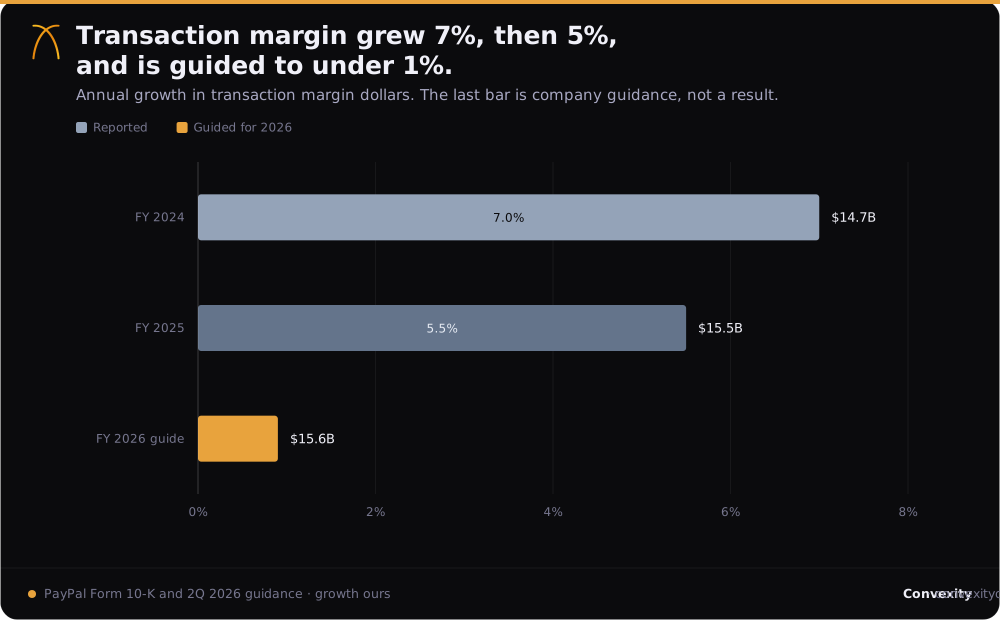
Seven percent, then five and a half, then a guide to under one. In the second quarter the reported growth was 1 percent, to $3.9 billion. Excluding interest earned on customer balances it was 3 percent, to $3.619 billion, and PayPal leads with that second figure for a defensible reason: interest income moves with rates rather than with the business. Either way, the number Lores named as the engine of double-digit per-share growth is growing in the low single digits at best and is guided to less than one.
This is not a hidden number. PayPal discloses it prominently, guides it, and raised the guide in July. The company is not concealing the size of the engine. What has not been reconciled in public is how an engine this size produces double-digit output.
Three years of earnings per share outrunning earnings
The reconciliation is already visible in the filings, because PayPal has been doing it for three years.
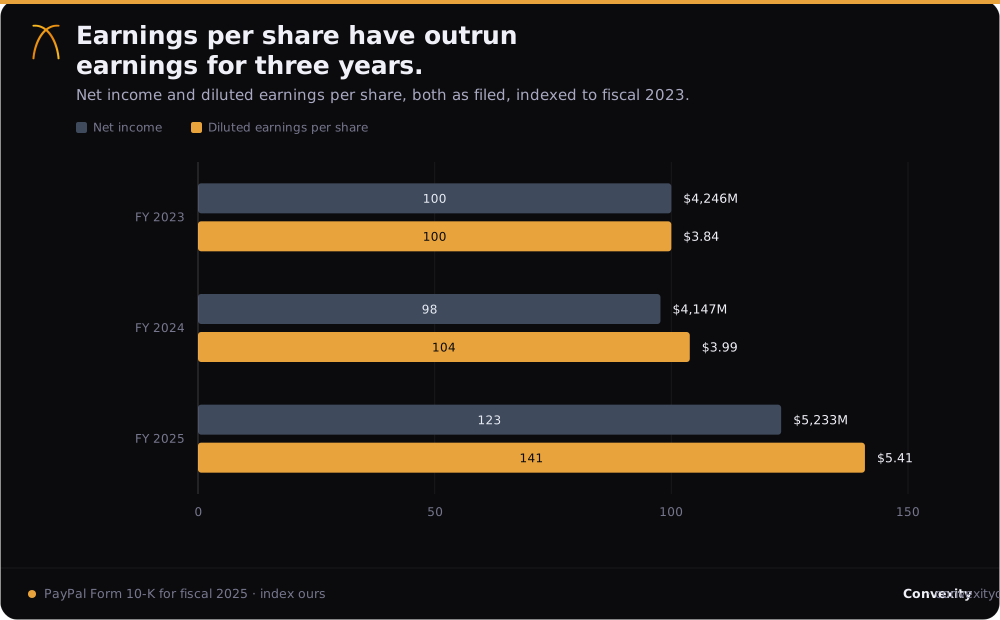
In fiscal 2024 PayPal earned less money than in 2023 and reported higher earnings per share. Net income fell 2.3 percent and per-share earnings rose 3.9 percent. Across the full three years net income grew 23.3 percent and per-share earnings grew 40.9 percent. The difference is the denominator: diluted weighted average shares went from 1,107 million to 968 million, a decline of 12.6 percent. Those percentage changes are ours, computed from the filed figures.
The second quarter of 2026 is the same mechanism at higher resolution. On a non-GAAP basis net income was $1,219 million against $1,370 million, a decline of 11.0 percent. Non-GAAP earnings per share were $1.38 against $1.40, a decline of 1.4 percent. Diluted shares fell 9.7 percent. Nearly the whole of an 11 percent profit decline was absorbed before it reached the per-share line. On a GAAP basis the same quarter shows a 12.5 percent net income decline arriving as a 3.1 percent per-share decline. Those five percentages are ours, from the figures in the earnings release.
There is nothing improper about any of this. A buyback is a legitimate use of cash and PayPal discloses every input needed to take it apart. The reason to take it apart is that the company has now attached a forward promise to the per-share number, and named a different variable as its cause.
What the guided buyback does arithmetically
PayPal returned $6.0 billion over the twelve months to June 30, retiring approximately 111 million shares. That implies an average price of about $54.05, which is ours, from the two figures in the earnings release. There were 862 million shares outstanding at quarter end, so the trailing year of repurchases took out the equivalent of 12.9 percent of the current count.
Lores guided to about $6 billion a year continuing. Hold the price near where the stock trades and that is roughly 12 to 14 percent of the company retired annually: at $50 a share, $6 billion buys 120 million shares, or 13.9 percent of 862 million; at $54, 111 million shares, or 12.9 percent; at $58, 103 million shares, or 12.0 percent. Those are ours.
Take the middle case and run it forward. If the share count falls 12.9 percent, per-share earnings grow 10 percent as long as net income is at least 95.8 percent of what it was. Net income can fall 4.2 percent a year and the double-digit promise still lands. That figure is ours, and it is the whole argument: 1.10 multiplied by 0.871 is 0.958.
So the honest statement of the plan is that the buyback supplies roughly thirteen points of per-share growth, the transaction margin engine supplies about one, and the strategy's job is to keep profit from falling more than four points a year. That is a genuinely easier task than the sentence at the conference describes, and it is a different task.
PayPal's own near-term guidance shows how much work the buyback is already doing. Full-year non-GAAP earnings per share are guided to about $5.38 against $5.31 in 2025, which is growth of about 1.3 percent, ours. In the first half, diluted shares averaged 901 million against 988 million, down 8.8 percent. A year with per-share earnings up about 1 percent and a share count down close to 9 percent is a year in which the underlying profit fell. GAAP earnings per share are guided to a mid-single-digit decline, and the third quarter is guided to a low-single-digit decline on both bases.
The double-digit target is a long-term goal and Lores framed it as one. This is not a claim that PayPal has missed a promise. It is a description of what would have to be true for the promise to arrive, and at present the transaction margin line is not where it is coming from.
The buyback is not free
Through the first half of 2026, PayPal spent $3,052 million on treasury stock and paid $252 million of dividends, returning $3,304 million. Operating cash flow for the same six months was $3,117 million, before any capital expenditure. Capital returned exceeded cash generated, and the balance sheet shows where the difference came from.
| $ millions | Jun 30, 2026 | Dec 31, 2025 | Change |
|---|---|---|---|
| Short-term debt | 2,505 | 1,596 | 909 |
| Long-term debt | 10,895 | 9,987 | 908 |
| Cash and equivalents | 8,306 | 8,049 | 257 |
| Short-term investments | 2,950 | 2,373 | 577 |
| Long-term investments | 4,009 | 4,330 | -321 |
| Net cash position | 1,865 | 3,169 | -1,304 |
Total debt rose $1.817 billion in six months. On May 15 PayPal issued $2.0 billion of senior notes in three tranches, at 4.550 percent due 2028, 4.950 percent due 2031 and 5.550 percent due 2036, disclosed in an 8-K the same day. Net cash, which is ours, subtracting total debt from the three investment and cash lines PayPal reports, fell from $3.169 billion to $1.865 billion. The changes column is ours.
None of that is alarming on its own. A company with $15.3 billion of cash and investments and an investment-grade rating can carry more debt, and refinancing in May at those coupons was ordinary treasury work. It matters because of what the plan asks the buyback to do. Returning approximately 100 percent of adjusted free cash flow, plus a dividend that cost $252 million in the half, is a capital policy with no slack in it. The savings program is explicitly meant to fund the strategy's own investment rather than to expand the margin. If profit declines faster than 4 percent a year, the buyback has to get bigger to hold the per-share line, and it is already consuming everything the business produces.
What the pay package requires
The clearest statement of what PayPal's board expects is not in the strategy deck. It is in the compensation table.
When Lores was appointed, the February 3 8-K disclosed a base salary of $1.45 million, a target bonus of 200 percent of salary, $20 million of make-whole restricted stock units, $16.5 million each of annual restricted and performance units for 2026, $11 million representing a third of his anticipated 2027 grant, and one further award: "one-time PSUs with a target grant date value of $25,000,000 that vest generally based on the Company's stock price," with a maximum payout of 250 percent of target.
The 2026 proxy statement gives the hurdles. They are measured on the average closing price over any consecutive 60-calendar-day period ending between the third and fifth anniversaries of his March 1, 2026 start date, so between March 2029 and March 2031. The baseline is the $42.58 used to convert the award's value into shares.
| Tier | Price increase | Minimum stock price | Total payout | Value at target grant |
|---|---|---|---|---|
| Target | 60% | not applicable | 100% | $25.0M |
| Stretch | 100% | $100 | 175% | $43.8M |
| Max | 150% | $125 | 250% | $62.5M |
The first three columns are the proxy's table. The fourth is ours, applying each payout percentage to the $25 million target value.
Two things follow. The target tier requires $68.13, which is $42.58 increased by 60 percent, ours. That is 26.3 percent above the $53.96 the stock closed at on September 11, and it is the floor: below it the award pays nothing at all. And at the higher tiers the dollar minimums bind above the percentages printed beside them. A hundred dollars is 134.9 percent above $42.58, not 100 percent, and $125 is 193.6 percent above it, not 150 percent. Both of those are ours.
This is a demanding package, and it was plainly designed to be. It is also the most precise available statement of the outcome the board is paying for, and it is a stock price rather than a margin. A buyback that retires an eighth of the company every year is one of the more reliable ways to move a stock price, and it is the one lever in this plan that does not depend on branded checkout reaccelerating.
The price the plan has to beat
The last piece of context is the one PayPal has never filed anything about, and it is included here as press reporting rather than as a company disclosure.
In August, Reuters reported that a consortium of Advent International and Stripe had bid $60.50 a share and, according to Bloomberg, abandoned the pursuit; the report says PayPal's board had considered the offer inadequate. Shares had closed at $61.47 the session before the news, above the offer itself, and fell about 13 percent in premarket trading to $53.20 (retrieved 2026-09-11). At the 862 million shares outstanding on June 30, $60.50 a share values the equity at about $52.2 billion, which is ours. The Wall Street Journal reported on September 11 that the approach remains stalled rather than formally dead.
Set the three numbers beside each other, because they sort in an order worth seeing. The stock closed at $53.96 on September 11. The offer the board judged inadequate was $60.50. The floor at which the chief executive's inducement award begins to pay is $68.13.
The plan announced on September 9 is, in effect, a commitment to clear a price 12.6 percent above the one a buyer was willing to pay, ours, and to do it inside a window that opens in March 2029. Lores was direct about the choice: "What we have done is to first look at the strategy that we have, have confidence in the strategy that we have, and use this as a benchmark to compare any other alternatives."
That is a reasonable thing for a chief executive to say, and it may well prove right. It is also a bet that the company is worth more shrunk than sold, and the mechanism by which it shrinks is the buyback.
What would make this wrong
This note argues that PayPal's stated engine of double-digit per-share growth is guided to grow under 1 percent, and that the share count is doing the work instead. Four things would disprove it. Three of them arrive within about a year.
Transaction margin dollars reaccelerate. This is the direct refutation and the company has already raised the guide once, in July. If the full-year figure lands meaningfully above $15.6 billion, or if the fourth quarter posts growth in the mid single digits rather than the low, then 2026 was the trough of a deliberate reset rather than the run rate, and the engine Lores named is working. Branded checkout is the thing to watch inside it: he guided the third quarter to 1 to 2 percent, and a print above that range would matter more than the headline.
Financial services scales faster than the checkout decline. Lores said financial services across PayPal and Venmo is "becoming the largest driver of future transaction margin growth." Venmo's seven straight quarters of double-digit volume growth and a Utah industrial bank charter application filed in December are the real assets behind that. If consumer financial services adds a point or two of transaction margin growth in 2027, the promise reconciles without the buyback and this note read a transition year as a destination.
The $1.5 billion in savings reaches the margin line. The program is stated as gross, over two to three years, and mostly self-funding new investment. If a material net share of it shows up in operating margin instead, profit stops falling, and the arithmetic that lets earnings decline 4.2 percent a year becomes a cushion rather than a description.
The buyback shrinks and per-share growth holds anyway. The strongest disproof would be PayPal cutting repurchases toward, say, $3 billion while still delivering double-digit per-share growth. That would demonstrate the growth was operating rather than financial, and nothing in this note survives it.
The reverse case is narrower than it may read. Nothing here says the buyback is improper, that the reorganization is wrong, or that PayPal is a bad business: it moved $486 billion of volume in a quarter, converted it at a 16.4 percent operating margin, and generated $1.98 billion of operating cash. Repurchasing stock at ten times earnings is a defensible allocation of capital and arguably the best one available. The claim is only that a plan described as double-digit growth sustained by transaction margin is, on the company's own guidance, double-digit growth sustained by a 13 percent annual reduction in the share count, and that those are different promises with different things that can go wrong with them.
Positions and arithmetic. No position in PYPL at publication. Nothing here is investment advice. PayPal's reported figures are its own; the following are ours, computed from figures PayPal filed or stated, and labeled at the point of use above: transaction margin dollars for fiscal 2023, 2024 and 2025 and their growth rates, each computed as net revenues less transaction expense less transaction and credit losses from the Form 10-K; the 0.9 percent growth implied by the approximately $15.6 billion full-year guide; every percentage change in the quarterly comparison table; the index of net income and earnings per share to fiscal 2023; the three-year changes in net income, per-share earnings and diluted share count; the non-GAAP and GAAP declines for the second quarter; the $54.05 average repurchase price and the 12.9 percent of shares outstanding it represents; the share counts $6 billion would retire at $50, $54 and $58; the 4.2 percent net income decline consistent with 10 percent per-share growth; the 1.3 percent implied by the full-year non-GAAP guide against the prior year; the first-half capital returned and the net cash position on both balance sheets, with the change column; the $68.13 target hurdle and the 134.9 and 193.6 percent figures for the two dollar minimums, all computed from the $42.58 baseline in the proxy; the dollar values of the three payout tiers; and the $52.2 billion implied by $60.50 a share. The takeover approach is press reporting, attributed and dated above, and has never appeared in a PayPal filing. The September 11 closing price is a third-party market data source, cited and dated rather than taken from a filing.
Primary sources
- 8-KPayPal second quarter 2026 earnings release, exhibit 99.1Every reported figure for the quarter: net revenues of $8.682 billion, transaction margin dollars of $3.900 billion and $3.619 billion excluding interest on customer balances, GAAP and non-GAAP net income and earnings per share, total payment volume of $486.4 billion, active accounts of 439 million, the $1.5 billion and approximately 33 million shares repurchased in the quarter and $6.0 billion and approximately 111 million shares on a trailing twelve-month basis, cash and investments of $15.3 billion and debt of $13.4 billion, and the third-quarter and full-year guidance including non-GAAP earnings per share of approximately $5.38Filed Jul 28, 2026
- CallPayPal second quarter 2026 earnings call transcriptThe management statements used here. Enrique Lores: branded checkout volume stabilizing at 2 percent currency-neutral, the simplified operating model around three businesses, financial services becoming the largest driver of future transaction margin growth, and the statement that the majority of the strategy investments will be self-funded by the savings program. Jamie Miller, chief financial and operating officer: the approximately $15.6 billion full-year transaction margin guide and the raise to $5.38 of non-GAAP earnings per share, the $1.5 billion gross run-rate savings over two to three years, monthly active accounts of 228 million, branded checkout guided to low single digits in the second half, and the $1.5 billion of repurchases taking the trailing twelve-month total to $6 billionHeld Jul 28, 2026
- CallPayPal at the Goldman Sachs Communacopia and Technology ConferenceThe announcement this note is about. Lores on rebalancing away from branded checkout toward financial services, the three business units and the 51 percent vote held by their leaders, at least $1.5 billion in gross run-rate savings over two to three years, about $6 billion of adjusted free cash flow returned through about $6 billion of buybacks plus the dividend, the double-digit earnings per share goal sustained by transaction margin growth, third-quarter branded checkout guided to the 1 to 2 percent range, the European tariff effect proving larger and longer than the original 0.5 to 1.0 percent estimate, Venmo revenue above $1.7 billion in 2025 and seven straight quarters of double-digit volume growth, and the statement about benchmarking the strategy against any other alternativeHeld Sep 9, 2026
- 10-QPayPal quarterly report for the period ended June 30, 2026The filed statements behind the comparison tables: the income statement lines including transaction expense of $4,385 million and transaction and credit losses of $397 million, diluted weighted average shares of 882 million against 977 million, the balance sheet showing 862 million shares outstanding and short-term and long-term debt of $2,505 million and $10,895 million against $1,596 million and $9,987 million at December 31, cash and investment lines on both dates, and the cash flow statement showing operating cash flow of $3,117 million, treasury stock purchases of $3,052 million and dividends of $252 million for the six monthsFiled Jul 2026
- 10-KPayPal annual report for fiscal 2025The three-year record: net revenues of $33,172 million, $31,797 million and $29,771 million, transaction expense of $15,987 million, $15,697 million and $14,385 million, transaction and credit losses of $1,720 million, $1,442 million and $1,682 million, net income of $5,233 million, $4,147 million and $4,246 million, diluted earnings per share of $5.41, $3.99 and $3.84, and diluted weighted average shares of 968 million, 1,039 million and 1,107 million. These are the inputs to both figuresFiled Feb 2026
- 8-KPayPal appoints Enrique Lores president and chief executive officerThe compensation arrangement quoted above: a $1,450,000 base salary and 200 percent target bonus, $20 million of make-whole restricted stock units, $16.5 million each of 2026 annual restricted and performance units, $11 million representing a third of the anticipated 2027 grant, and the one-time performance units with a $25 million target grant date value vesting on stock price between the third and fifth anniversaries with a 250 percent maximum. Also records Alex Chriss ceasing to serve on February 2 and Jamie Miller serving as interim chief executive until March 1Filed Feb 3, 2026
- DEF 14APayPal 2026 proxy statementThe stock price hurdle table reproduced above, with its target, stretch and max tiers at 60, 100 and 150 percent price increases, the $100 and $125 minimum stock prices, the 100, 175 and 250 percent payouts, and footnote 1 giving the $42.58 conversion price the increases are measured from. Also the 60-calendar-day averaging window between the third and fifth anniversaries of the March 1, 2026 start date, the 25 and 75 percent vesting split, and the separate 2026 to 2028 performance units tied to currency-neutral revenue growth and non-GAAP earnings per share with a relative shareholder return modifierFiled 2026
- 8-KPayPal announces departures of Michelle Gill and Diego ScottiThe executive changes accompanying the reorganization, effective June 2, 2026Filed Apr 30, 2026
- 8-KPayPal issues $2.0 billion of senior notesThe three tranches behind the increase in debt during the first half: $650 million of 4.550 percent notes due 2028, $850 million of 4.950 percent notes due 2031 and $500 million of 5.550 percent notes due 2036Filed May 15, 2026
- ReportPayPal shares fall after report Advent, Stripe consortium abandons takeover pursuitReuters coverage of the August 28 Bloomberg report: the $60.50 per share bid, the board having considered it inadequate, the $61.47 close the session before and the roughly 13 percent premarket decline to $53.20. Press reporting, not a PayPal disclosure, and the only source here for the takeover approachRetrieved Sep 11, 2026
- ReportPayPal CEO plans for a fixContemporaneous coverage of the September 9 conference appearance, used to confirm the three business segments and the stated purpose of the reorganization against the transcriptRetrieved Sep 11, 2026
- DataPayPal Holdings share price and market capitalizationThe $53.96 close on September 11, 2026 and the $46.16 billion market capitalization. Third-party market data, not a filingRetrieved Sep 11, 2026