Disclosure. No position in Oura, which is private at publication and has not priced. This is not investment advice. Every figure here comes from Oura's Form S-1 filed September 3, 2026, linked at the bottom. Where a number is our arithmetic on Oura's disclosed figures rather than a figure Oura reported, we say so at the point of use. Oura's fiscal year ends September 30, so fiscal 2026 is the year ending September 30, 2026 and the filing stops nine months into it, at June 30, 2026. There is no earnings call to read: a company filing its first registration statement has never held one.
The first number a reader meets in Oura's IPO filing is a loss of $924.3 million.
It is on the summary financial page, it is the bottom line of the statement of operations, and it produces a loss per share of $89.53. It is the figure a headline writer will reach for, and it is the figure that will be wrong in almost every direction that matters.
Oura made money over those nine months. Net income was $60.8 million. Operating income was $71.2 million. Cash from operations was $328.0 million, up from $135.3 million a year earlier. Revenue was $1.21 billion, growing 74%. By every measure of whether the business works, it worked.
The distance between $60.8 million of profit and $924.3 million of loss is one line, and the line has a name: a deemed dividend to holders of redeemable convertible preferred stock, $985.0 million. It is not an impairment, a writedown, or a charge against the business. It is the accounting record of Oura paying its own shareholders roughly a billion dollars for their shares in the nine months before asking the public for money.
That transaction, not the loss, is the largest financial event in this filing. It is larger than the year's profit, larger than the cash the business generated, and larger than everything Oura has ever raised from new investors except the round that immediately preceded it.
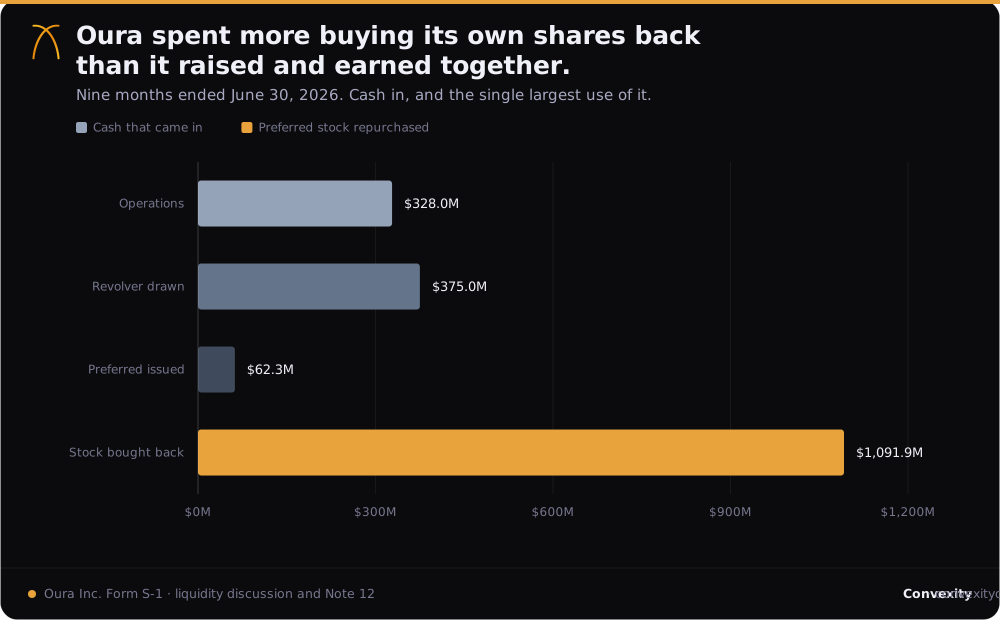
Oura Inc. Form S-1, filed September 3, 2026. The repurchase total is the foot of the Note 12 table; the other three are as filed on the summary financial page.
The company this happened to
Oura makes a ring. That is very close to the whole product description, and it is worth pausing on how unusual it is to reach a billion dollars of revenue selling one object.
The company started in Oulu, Finland, in 2013, as Oura Health Oy. It shipped its first ring in 2015 and spent most of a decade as a niche sleep tracker with a devoted following and no obvious path to scale. The ring measures heart rate, heart rate variability, temperature, blood oxygen and movement from the finger, which turns out to be a better place to take those readings during sleep than the wrist. The app turns them into a nightly sleep score, a readiness score and a growing set of longer-horizon signals.
Five generations have shipped. Ring 4 arrived in October 2024, a ceramic variant in October 2025, and Ring 5 on June 4, 2026, at manufacturer's suggested retail prices from $399 to $499. Membership costs $5.99 a month or $69.99 a year in the United States, and roughly 63% of new members start on the annual plan.
In January 2026 the company formed Oura Inc. in Delaware and made the Finnish entity a subsidiary, completing a redomiciliation that became effective for tax purposes on March 31, 2026. Headquarters are now on Kearny Street in San Francisco, in a 47,000 square foot building the company bought outright in July 2026. About 1,350 people work there and in ten other countries, more than 350 of them on hardware and operations, with a significant contingent still in Helsinki and Oulu.
It has applied to list on Nasdaq under OURA, with eighteen underwriters on the cover led by Goldman Sachs, Morgan Stanley and J.P. Morgan. Robinhood is on the list, which is a sign of how much retail interest the bankers expect.
The financial history is short and very steep:
| $ millions | FY2024 | FY2025 | 9M FY2026 |
|---|---|---|---|
| Revenue | 406.8 | 907.9 | 1,214.5 |
| Gross profit | 264.1 | 471.0 | 662.2 |
| Gross margin | 64.9% | 51.9% | 54.5% |
| Operating income | 13.4 | 45.3 | 71.2 |
| Net income | 3.6 | 0.012 | 60.8 |
| Cash from operations | 28.2 | 121.7 | 328.0 |
| Rings sold | 1.0m | 2.3m | 3.1m |
| Paid members | 1.3m | 2.9m | 5.0m |
The $12 thousand of net income in fiscal 2025 is real and it is not a typo. Pre-tax income was $23.573 million and the tax provision was $23.561 million, an effective rate of 99.95%. Oura explains it: a valuation allowance established in the United States that year, recorded in a period of lower pre-tax income. It is an accounting event rather than an operating one, but it is a useful reminder that this company's bottom line has been pushed around by things other than the ring business for two years running.
The business underneath the loss is a good one
It would be easy to write the rest of this note as though the buyback were evidence of a problem. It is not, and the case has to start with what the filing actually shows about the operating company, because that case is strong.
The membership line is the part worth watching. It has grown in every one of the seven quarters the filing discloses, without exception:
| Membership revenue | $ millions | Share of revenue |
|---|---|---|
| Dec 2024 | 28.1 | 12% |
| Mar 2025 | 36.5 | 16% |
| Jun 2025 | 44.3 | 19% |
| Sep 2025 | 49.6 | 24% |
| Dec 2025 | 65.1 | 14% |
| Mar 2026 | 82.5 | 23% |
| Jun 2026 | 92.9 | 23% |
The share column bounces around because the hardware line is lumpy, not because membership faltered. In dollars it has gone up every quarter, from $28.1 million to $92.9 million, a 3.3 times increase in eighteen months.
That line carries an 89% gross margin, which Oura states directly. Since total gross profit for the nine months was $662.2 million on revenue of $1,214.5 million, the hardware business can be solved for: applying the stated 89% to membership revenue of $240.5 million leaves $448.1 million of gross profit on $974.0 million of hardware, a hardware gross margin of about 46%. That split is ours, derived from one stated margin and three filed totals, and Oura does not report segment gross profit itself.
Two businesses, then. A 46% margin hardware business that is large, seasonal and expensive to run, and an 89% margin subscription attached to it that has never had a down quarter. About 94% of ring activations convert to a paid membership, and the weighted-average twelve-month retention of those paid members was approximately 85% as of June 30, 2026. Daily active users run at about 65% of monthly active users, which for a consumer health app is a very high number.
Repeat purchases are starting to show up too: 5% of rings sold in fiscal 2024, 9% in fiscal 2025, 11% in the first nine months of fiscal 2026. Oura says it operates no formal trade-in or upgrade discount program, so those are people buying a second ring at list price.
This is a real company with a real annuity forming inside it. Keep that in mind for everything below.
What happened to the money
Between October 1, 2025 and June 30, 2026, Oura repurchased 27,933,119 shares of its own redeemable convertible preferred stock for $1,091,854,000.
The table in Note 12 lists twenty-one separate tranches across Series Seed, A, B, C and C-1, at prices from $17.71 to $56.12. They sum to the filed total exactly, and the weighted average price works out to $39.09 per share. That average is ours; Oura gives the tranches and the total but not the mean.
The same nine months a year earlier, the comparable figure was $240.3 million. So the pace of buying went up more than fourfold, in the run-up to a public offering.
Where the money came from is the part that repays attention.
In September 2025, in the fiscal year immediately before this one, Oura sold approximately 16.9 million shares of Series E preferred stock at $53.57 per share for gross proceeds of about $908 million. That round closed the fiscal year with $860.5 million of cash, cash equivalents and restricted cash on the balance sheet.
Over the following nine months the company drew $375.0 million on its revolving credit facility, sold another $62.3 million of Series E at the same $53.57, generated $328.0 million from operations, and spent $1.09 billion buying stock back. Oura says so plainly in the liquidity discussion: it used the revolver borrowings "primarily to fund repurchases of our common and redeemable convertible preferred stock."
By June 30, 2026 cash was $371.8 million with no restricted cash, a decline of $488.7 million from the September figure, which is our subtraction of two filed numbers. Total debt was $380.1 million. Total liabilities of $1,181.2 million exceeded total assets of $1,063.2 million, and total stockholders' deficit stood at $1,617.7 million.
None of this is hidden. All of it is in the filing, stated clearly, in the places you would look. What is striking is the shape rather than the disclosure: a company raised roughly $908 million from new investors, and within a year had paid out roughly $1.09 billion to existing ones, borrowing to close the gap.
Oura states the logic itself, and it is unusually direct
Most registration statements treat pre-IPO repurchases as housekeeping. Oura devotes a section to explaining why they were the right call, and the argument is worth quoting in substance because it is the company's own frame rather than ours.
Under "Capital Allocation," Oura says it manages the business "to compound long-term value per share," and then illustrates. The price per share of its most recent preferred was $14.87 as of June 30, 2024 and $53.57 as of June 27, 2026. Its implied enterprise value over the same window grew from $3.065 billion to $9.656 billion. The company then notes that the growth in price per share, 260%, exceeded the growth in implied enterprise value, 215%.
Both of those percentages check out against the two pairs of figures. And the observation only has one mechanism behind it. If price per share grows faster than total value, the share count fell. Dividing each stated value by its stated price implies roughly 206.1 million fully diluted shares in June 2024 against roughly 180.3 million two years later, a reduction of about 12.6%. That derivation is ours, and it is arithmetic on four figures Oura supplies in the same paragraph.
So the buyback is not incidental to the story Oura tells about itself. It is the story: the company is telling prospective investors that shrinking the share count is a deliberate part of how it creates value, and offering the two-year record as evidence.
That is a defensible strategy and a common one for mature public companies. It is a less common thing to do with borrowed money, at scale, in the months before a listing, at prices well below the round you closed just before it. Fifteen and a half million of the shares were bought in a band around $40, which is $620.9 million of the total, and another $373.4 million went out between $53 and $57. Both of those subtotals are ours, added from the tranches in the Note 12 table.
There are legitimate reasons the older series traded below the newest one. Series E is the most recently priced instrument and sits at the top of the preference stack; Seed and Series A carry different rights and were bought from holders who had waited a decade for liquidity. A tender that lets early employees and seed investors cash out before a lockup is a normal and often generous thing for a company to arrange. None of that is in dispute.
What the filing establishes is only the fact pattern: in the year it prepared to go public, Oura was simultaneously issuing shares at $53.57 and retiring them at an average of $39.09.
Oura's former chief executive is suing over an earlier repurchase
The filing discloses two actions brought by Harpreet Singh Rai, who ran the company until December 2021.
The first, filed November 7, 2025 in the Northern District of California, claims entitlement to additional equity compensation in connection with his departure. Oura has moved to compel arbitration or dismiss.
The second is the one that touches this note. On May 29, 2026, Rai sued Oura, its chief financial officer and certain of its directors in the District of Delaware, over an equity repurchase agreement he entered into in September 2024. He alleges equitable fraud, state and federal securities fraud, breach of fiduciary duty and aiding and abetting it, and negligent misrepresentation, and is seeking rescission and restitution.
These are allegations, and they are contested. Oura states that it believes each action is without merit and intends to defend vigorously. Nothing has been decided, and a complaint is not evidence.
The reason it belongs here is the timing rather than the merits. September 2024 sits between the $14.87 per share reference point Oura uses in its capital allocation section and the $25.69 Series D that priced two months later. A seller in that window was selling into the steepest part of the repricing, and the buyer was the company. Whatever a court eventually makes of the claim, it is the same transaction type, one cycle earlier, that the company went on to run at eleven-figure scale.
Three other equity-related suits are disclosed alongside it. Peter Attia sued in July 2023 claiming entitlement to equity for advisory services, with a jury trial scheduled for August 31, 2026. Gurinder Bal and CTR Capital filed a similar claim in December 2025, set for trial in September 2027. Brees Company filed one in September 2024 that has been sent to arbitration and not yet initiated. Oura disputes all of them.
The quarter that actually lost money
Return to that $924 million. It contains no operating loss at all. But there is one in the filing, and it is in the most recent quarter, which is the one a reader should care about most.
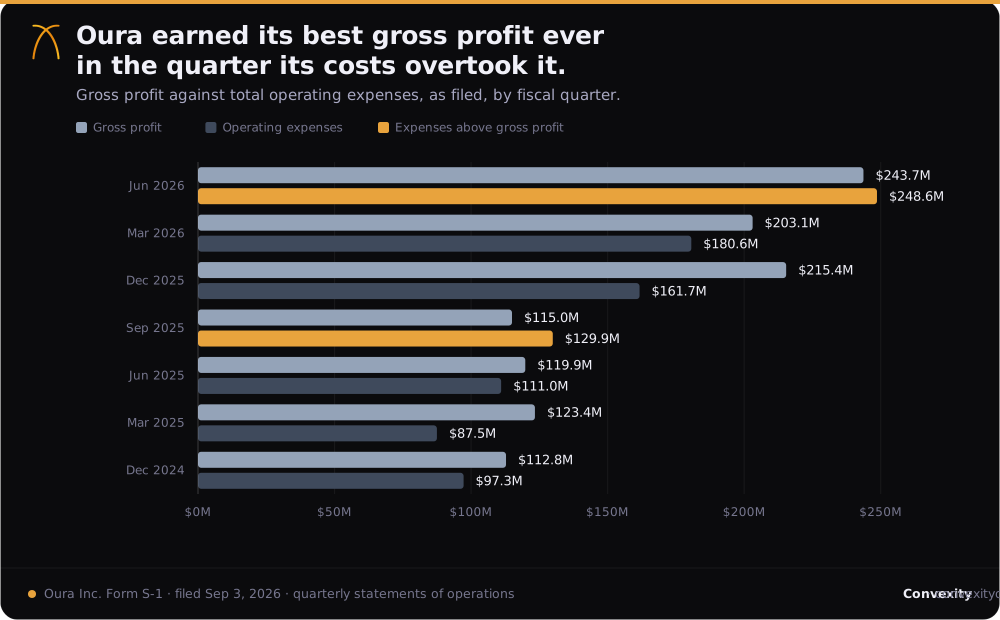
In the three months ended June 30, 2026, Oura earned $243.7 million of gross profit. That is the most it has ever earned in a quarter. The gross margin behind it, 59.6%, is also the highest in the filing, comfortably above the 47.8% of the launch quarter two before it.
Total operating expenses in the same quarter were $248.6 million. The company lost $4.955 million at the operating line and $9.966 million after tax.
The composition of that overrun is the interesting part:
| Share of revenue | Jun 2025 | Jun 2026 |
|---|---|---|
| Sales and marketing | 21.5% | 25.3% |
| Research and development | 17.1% | 21.7% |
| General and administrative | 8.8% | 13.9% |
| Total operating expenses | 47.4% | 60.8% |
Revenue grew 74.5% year over year in that quarter. Operating expenses grew 124.0%. Every one of the three lines took a larger share of revenue than it did a year earlier, and general and administrative nearly doubled as a proportion.
Some of this is clearly timing. Ring 5 launched on June 4, 2026, twenty-six days before the quarter closed. Oura attributes the sales and marketing jump directly to that launch, and for the nine months it names $72.8 million of additional paid media and advertising to support it. A launch quarter carries a full period of promotion against a few weeks of sales, and the September 2025 quarter, which is the other loss in the chart, was the pre-launch trough of the previous cycle. This is a company whose quarterly margins swing between 12% and negative 7% depending on where it sits in a ring cadence, and the filing period happens to end at the expensive end of one.
Some of it is not timing. Research and development rose 105% over the nine months, mostly headcount. General and administrative rose 132%, and Oura attributes $48.3 million of that increase to third-party professional fees "predominantly related to intellectual property litigation, other advisory services, and public company readiness initiatives." Litigation costs and public company costs do not reverse when the next ring ships.
The measure that captures the whole pattern is Oura's own adjusted EBITDA. Over the nine months it grew from $83.5 million to $106.7 million, which is 27.7% growth. Revenue over the same period grew 74.1%. The adjusted EBITDA margin therefore fell from 12.0% to 8.8% while the business nearly doubled, which is negative operating leverage on the company's own preferred metric.
The ring got more expensive and the revenue per ring fell
Oura discloses average revenue per unit, and the direction is down: $332 in fiscal 2024, $326 in fiscal 2025, $311 in the first nine months of fiscal 2026.
Over the same stretch the list price went up. Ring 4 started at $349 in October 2024. Ring 5 starts at $399. The cheapest ring Oura sells today costs 14% more than the cheapest ring it sold two years ago, and the average ring brings in 6% less.
Oura gives the reasons and they are credible: channel mix, product generation mix, partnership structures, and "certain discounts and sales incentives that reduce a portion of the revenue we recognize for those sales." The channel point is the biggest one. Roughly 49% of hardware revenue in the nine months came through retail partners including Amazon, Best Buy, Costco, Harrods and Target, against a direct-to-consumer channel that used to be nearly all of it. Wholesale revenue per ring is structurally lower than direct.
That is a deliberate trade, and it is probably the right one. Retail buys shelf presence, in-store sizing, and first-time buyers who would never have found the website. But it means the hardware line is being asked to do more volume at lower unit revenue and a 46% gross margin, while the marketing spend required to fill those shelves runs through the income statement immediately. It also means the membership attach rate, currently 94%, is carrying more of the economic weight of each sale than it used to.
Samsung is at the International Trade Commission
On December 12, 2025, Samsung Electronics filed a complaint with the ITC alleging that certain Oura products infringe four patents, including patents on software and printed circuit board design. The relief sought "could include restrictions on the importation of certain Oura Ring products."
The ITC is the venue that matters for a company whose entire revenue is one imported object. It does not award damages; it issues exclusion orders. Oura says the claims are without merit and will be defended vigorously, and the filing notes that the core patent of Oura's own smart ring form factor family has been found valid by both the ITC and the Patent Trial and Appeal Board, so this is a contest between two portfolios rather than a one-way attack.
Separately, on December 20, 2025, Omni MedSci filed in the Eastern District of Texas alleging infringement of wearable health sensor patents and seeking approximately $120 million.
Two other concentrations sit beside that risk. Oura derives substantially all revenue from one product line and the membership sold with it, and it says so as its own risk factor. And in the customer concentration note, one customer accounted for 12% of total revenue in fiscal 2025 and 13% in fiscal 2024, with a second reaching 10% in fiscal 2025. Oura anonymizes them as Customer E and Customer B, which is permitted and unhelpful.
Manufacturing sits with a limited number of contract manufacturers, and components and finished units move through Estonia, Finland, Mexico, South Korea, China and the Netherlands, all of which the filing names in the context of tariffs. Freight, tariffs and hardware overhead added $64.1 million to cost of revenue over the nine months.
The case against this note
The strongest arguments run the other way, and several are good.
A pre-IPO tender is a normal and often admirable thing to do. Employees and seed investors who have held illiquid stock for a decade get paid before a lockup rather than after one. Companies that skip this step are not being more disciplined, they are pushing the liquidity problem onto people with the least ability to solve it. Nothing in the filing suggests the tender was anything but voluntary and broadly offered.
The buyback appears to have been accretive, and Oura's own figures make that case. If value per share grew 260% while total value grew 215%, holders who stayed did better than they would have. Retiring stock below the newest round's price is, arithmetically, good for everyone who did not sell.
The deemed dividend is an accounting construct, not a destroyed asset. It exists because preferred stock carried at $108.3 million was bought for $1.09 billion, and US accounting requires the excess to be charged against common stockholders. No operating value was lost. The $924 million loss will never recur, and it will vanish from the comparatives the moment the preferred converts at listing.
The June quarter loss is genuinely a launch artifact. Ring 5 shipped twenty-six days before the period closed. The quarter that follows, which is not in this filing, will carry the revenue that the marketing spend was buying. Judging a hardware company on the expense side of a product launch is close to the definition of an unfair comparison.
The operating business is compounding fast and is cash generative. $328 million of operating cash flow on 74% revenue growth, with a subscription line that has never had a down quarter, an 85% retention rate and 94% attach. Most companies filing at this size have neither the growth nor the cash.
Borrowing against a revolver is cheap and reversible. Oura has already repaid $25 million of it, in August 2026, and another $245 million of commitments become available on completion of the offering. This is working capital management, not leverage in any meaningful sense.
Our disagreement with the bull case is narrow. It is not that the business is weak, because it is not. It is that a reader who anchors on either headline number will misjudge it in opposite directions: the $924 million loss makes the company look far worse than it is, and the profitability it obscures makes the June quarter's cost structure look better than it is. Both numbers need the same footnote, and the footnote is a billion dollars that left the company before the public was invited in.
What would change the read
Named in advance, so this can be scored rather than argued.
| Trigger | When | Why it matters |
|---|---|---|
| The September 2026 quarter | First 10-Q after listing | Ring 5's first full quarter. If gross profit reclears operating expenses, the June loss was timing |
| Operating expense ratio | Quarterly | The 60.8% needs to fall toward the high forties. If it does not, the launch was not the reason |
| Average revenue per unit | Any filing that repeats it | A fourth consecutive decline while list prices rise makes the retail trade look worse than stated |
| Membership share of revenue | Quarterly | The annuity crossing 30% of revenue would change the margin profile structurally |
| The ITC investigation | Any time | An exclusion order is the one disclosed risk that could stop the product at the border |
| Further repurchases | Any filing | A public company continuing to buy back stock while running a stockholders' deficit is a different posture than a one-time pre-IPO tender |
| The Rai case in Delaware | Any time | A ruling either way informs how the 2024 and 2026 repurchases get read |
The first row is the one that matters most and it is cheap to check. Every other question in this note is downstream of whether the June 2026 quarter was a launch trough or a cost structure.
Primary sources
- S-1Oura Inc. registration statement for its initial public offeringEvery figure in this note: the summary financial data, the quarterly statements of operations, the Note 12 preferred repurchase table, the capital allocation section, the liquidity discussion, the legal proceedings and the key operating metricsFiled Sep 3, 2026
- EDGAROura Inc. filing index, CIK 0002133022The confidential draft was submitted May 19, 2026 and amended three times before the public filing; useful for dating how long this offering has been in preparationRetrieved Sep 9, 2026
Not investment advice. This is a reading of one public filing, published for research purposes. It is not a recommendation to buy or sell any security, it is not a price target, and Oura has not priced its offering. We hold no position. Anyone acting on any of it should read the S-1 themselves, which is linked above, and form their own view. The figures described as ours are our arithmetic on Oura's disclosed numbers: the $39.09 weighted-average repurchase price and the $620.9 million and $373.4 million price-band subtotals, added from the twenty-one tranches in the Note 12 table; the roughly 46% hardware gross margin, solved from the stated 89% membership margin against filed totals; the implied fully diluted share counts of 206.1 million and 180.3 million and the 12.6% reduction between them, divided out of the four figures in the capital allocation paragraph; the $488.7 million decline in cash; and the $765.3 million sum of three separately reported sources of cash. The claims made by Harpreet Singh Rai, Peter Attia, Gurinder Bal, CTR Capital, Brees Company, Samsung Electronics and Omni MedSci are allegations that Oura disputes and no court has resolved.