
Disclosure. No position in ORCL, long or short, at publication. This is not investment advice. Every figure here comes from Oracle's own filings, linked at the bottom. Where a number is our arithmetic on Oracle's disclosed figures rather than a figure Oracle reported, we say so at the point of use. Oracle's fiscal year ends May 31, so the quarter discussed here, the first quarter of fiscal 2027, is the three months ended August 31, 2026. This note corrects an omission in our own August 30 note on the same company, described in full below.
Oracle's first quarter of fiscal 2027 produced the largest operating cash flow in the company's history: $23.1 billion, which the press release describes as up 184% and attributes to "strong operating income."
Two lines above that figure in the cash flow statement is a line that did not exist a year ago. It reads "Increase in deferred revenues from customer prepayments with significant financing component," and its value is $11,363 million.
That is 49% of the record. Take it out and operating cash flow for the quarter was $11.7 billion, up 44% rather than 184%, which is a good result on a business growing revenue 30% and is not a record of anything.
The phrase "significant financing component" is not a euphemism and it is not ours. It is the term of art in the revenue recognition standard, and Oracle defines it in the accounting policy note of its own annual report: a contract carries one when the customer has made a significant prepayment before Oracle delivers anything. In the same note, Oracle states how it prices that arrangement. The discount rate "reflects the credit characteristics of the party receiving financing," and it is "generally consistent with our incremental borrowing rate."
The party receiving financing is Oracle. The rate is Oracle's own cost of debt. This is a loan from a customer, priced like a bond, and it arrives inside the line called cash from operations.
The quarter, before any of that
The argument below is narrow, and it does not survive if the business underneath it is weak. It is not weak. The first quarter of fiscal 2027 is the best operating quarter Oracle has ever reported and the growth is in the line that matters.
| Revenue, $ millions | Q1 FY2027 | Q1 FY2026 | Growth |
|---|---|---|---|
| Cloud infrastructure (IaaS) | 7,388 | 3,347 | 121% |
| Cloud applications (SaaS) | 4,219 | 3,839 | 10% |
| Software license | 655 | 766 | -15% |
| Software support | 4,895 | 4,955 | -1% |
| Hardware | 774 | 670 | 15% |
| Services | 1,414 | 1,349 | 5% |
| Total revenues | 19,345 | 14,926 | 30% |
Cloud infrastructure more than doubled. Growth in that line has risen in each of the last four quarters, from 55% to 68%, 84%, 93% and now 121%, while the line itself went from $6.9 billion of annual revenue in fiscal 2024 to $18.1 billion in fiscal 2026. A percentage growth rate that keeps climbing while its own base triples is rare enough to state plainly before anything is qualified. Oracle also delivered 850 megawatts of additional data center capacity in the quarter and more than 300,000 graphics processors to cloud customers since the end of May, which it describes as almost triple the capacity delivered in the prior quarter. Those are physical facts about a physical buildout, and they are consistent with the revenue.
Operating income was $6.7 billion, up 57%, and the operating margin went from 29% to 35%. Net income available to common shareholders was $4.7 billion, up 60%, and diluted earnings per share were $1.56 against $1.01. Oracle raised its full year outlook to at least $90 billion of revenue and $8.10 of non-GAAP earnings per share.
One more thing about the top line, which the release does not point out and the call does. Revenue grew sequentially, from $19,184 million in the fourth quarter to $19,345 million. That is small, and Maxson flagged it as a first: a record fourth quarter has always been followed by a lighter first, because Oracle's license business is seasonal and lands in May. It stopped being true this quarter, and the reason is that infrastructure is now large enough to carry the seasonality.
The applications line is worth unpacking too, because 10% understates the parts anyone is buying it for. On the call, Sicilia put Fusion at 14% and Oracle's industry applications above 20%, with health accelerating. NetSuite is the drag, and he attributed that to slower decision cycles a year ago rather than to anything current.
Two lines in that table deserve a note before we move on, because they are the parts of Oracle that are shrinking. Software license revenue fell 15%. Software support, the annuity that funded the company for two decades and is still a quarter of its revenue, fell 1%, having grown 1% across fiscal 2026. Oracle attributes both to customers migrating from on-premise software to the cloud, which is a benign explanation and probably the right one. It is still worth knowing that the base is now declining rather than flat.
The other thing worth knowing before the argument starts: outside the Americas, almost nothing is happening. Americas revenue grew 42% year over year. Europe, the Middle East and Africa grew 7%. Asia Pacific grew 7%. The AI buildout, on these numbers, is a domestic business.
The line inside the record
Here is the top of the cash flow statement as filed, with the two lines that carry the story in bold.
| $ millions | Q1 FY2027 | Q1 FY2026 |
|---|---|---|
| Net income | 4,760 | 2,927 |
| Depreciation | 3,156 | 1,351 |
| Stock-based compensation | 1,127 | 1,124 |
| Prepayments with significant financing component | 11,363 | 0 |
| Increase in other deferred revenues | 3,997 | 2,550 |
| Other working capital, net | -1,425 | -911 |
| Amortization, deferred taxes and other | 125 | 1,099 |
| Net cash provided by operating activities | 23,103 | 8,140 |
The prepayment line is larger than net income, larger than depreciation, and larger than every other reconciling item put together. It is the single biggest thing in the statement.
Oracle did not hide it. It is a named line on the face of the cash flow statement, it has a dedicated paragraph in the annual report's accounting policies, and the press release builds a whole supplemental table around it. What the press release does not do is mention it in the narrative paragraph that announces the record. That paragraph reads, in full:
Oracle's strong operating income translated to a record Q1 operating cash flow of $23 billion, up 184%. Free cash flow was negative $5 billion for Q1 as Oracle continued to execute on investments to support the growth of its Cloud Infrastructure business.
Strong operating income did not translate to $23 billion. Operating income was $6.7 billion. The gap between $6.7 billion and $23.1 billion is depreciation, stock compensation and, for the largest part, a customer handing over cash for services Oracle has not yet performed.
On the call an hour later, the chief financial officer said so herself. Hilary Maxson described the quarter as a "record cash flow from operations of $23 billion in Q1, again reflecting our strong execution against a backdrop of strong demand as well as collection of customer prepayments." That is the accurate version, and it is the one the written release does not carry. The criticism here is narrow and it should stay narrow: this is about what the release put in the paragraph everyone quotes, not about whether Oracle disclosed the mechanism. Oracle disclosed it four separate ways.
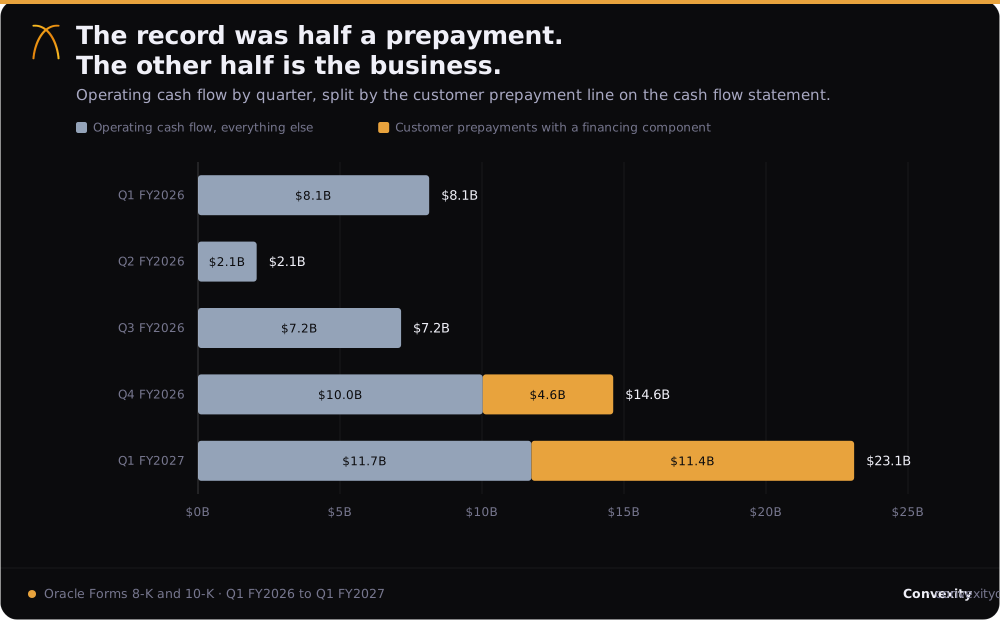
This did not start in August. The same line appears in the fiscal 2026 annual report at $4,592 million, all of it in the fourth quarter, and the annual report is explicit that it was new then too: "No prepayments were received from customers that included a significant financing component during fiscal 2025 and 2024." So the practice is two quarters old, and it went from $4.6 billion to $11.4 billion between them.
Applied to the full prior year, the same subtraction reduces fiscal 2026 operating cash flow from $31,977 million to $27,385 million, and its growth rate from the 54% Oracle reported to 32%.
What it costs
Oracle's accounting note says it recognizes interest expense on these arrangements separately from revenue, and that in fiscal 2026 the amounts were "immaterial." On $4.6 billion received in the last month of a fiscal year, immaterial is right.
It will not stay immaterial. Oracle has now taken in $16.0 billion of this money, and the rate on it is set by Oracle's own incremental borrowing rate. In our August note we calculated the weighted average coupon on the $43.0 billion of senior notes Oracle issued during fiscal 2026 at 5.62%, across the thirteen fixed-rate tranches. At that rate, $16.0 billion carries roughly $900 million of interest a year.
That figure is ours, it is an approximation, and it is wrong in both directions for reasons worth naming. It is too high because the balance amortizes down as Oracle performs the services, and because the discount rate is set per contract at inception rather than off any published average. It is too low because the balance grows with every further prepayment, and Oracle has just told the market it expects more of them. The honest version is that a cost the annual report called immaterial is now somewhere in the high hundreds of millions a year, and the first quarter's report to show it separately will be the fiscal 2027 second quarter Form 10-Q.
There is a second effect, and it runs the other way, which is why the standard exists. When a customer pays in advance under a contract with a significant financing component, the seller accretes interest onto the contract liability, and the revenue eventually recognized is larger than the cash originally received. So Oracle's future reported revenue on these contracts will exceed the cash the customer paid, by the amount of that accretion. The interest expense and the revenue uplift are the same number seen from two sides. Neither is a gain; together they are the price of borrowing.
Oracle built a measure for it
The press release introduces a non-GAAP measure that has not appeared before: Net Cash Outlay for Capital Expenditures. It is defined as capital expenditures less short-term financing related to capital expenditures and less customer prepayments with a significant financing component.
| $ millions | Q1 FY2027 |
|---|---|
| Capital expenditures | 28,499 |
| Less: short-term financing related to capex | 830 |
| Less: customer prepayments with financing component | -11,363 |
| Net cash outlay for capital expenditures | 17,966 |
Read on its own, this is defensible and even useful. Oracle says management uses it when forecasting capital spending, and if a customer is funding part of a data center then the cash Oracle has to find is genuinely smaller than the invoice.
The difficulty is that the same $11,363 million is doing two jobs in two tables of the same document. In the free cash flow table it is inside operating cash flow, making the record. In the net cash outlay table it is deducted from capital expenditure, making the buildout look cheaper. A reader who takes "record operating cash flow of $23 billion" from one and "net cash outlay of $18.0 billion" from the other has counted the customer's money twice.
Oracle discloses the overlap. Footnote 3 to that table says the deduction "represents customer prepayments with significant financing component as reported in cash flows from operating activities." It is one sentence, in a footnote, under a table, and it is the sentence that keeps the presentation honest. It is also the sentence nobody quotes.
The measure that would settle it does not exist in the release. Free cash flow with the prepayment removed from operating cash flow was negative $16.8 billion for the quarter. That is our arithmetic, and it is the figure that answers the question the buildout actually poses: what does this cost Oracle, before anyone else pays for it. Fiscal 2026, a full year, was negative $23.7 billion.
The new measure is a guidance metric
The call settled what the new table is for. Oracle does not merely report it. It guides to it.
Maxson told analysts the company still expects "$90 billion to $95 billion in capex for the full year, with not more than $70 billion in net cash capex." Neither figure appears in the press release.
Read those two together and they are a forecast of the prepayment. The gap between them is $20 billion to $25 billion of fiscal 2027 capital spending that Oracle expects somebody other than Oracle to fund. The first quarter delivered $10.5 billion of it, counting the prepayment less the short-term financing Oracle repaid, so the guide implies roughly $9 billion to $14 billion more across the remaining three quarters. That is our arithmetic on the two figures Maxson gave.
It also closes the question this note would otherwise have had to leave open until December. One quarter is an arrangement with a counterparty. Oracle has now guided to a year of them.
The headline capital number deserves its own moment. Fiscal 2026 capital expenditure was $55.7 billion, itself 1.7 times that year's operating cash flow. The fiscal 2027 guide is $90 billion to $95 billion, which is another 62% to 71% on top.
Where the quarter's money actually came from
Reconstruct the quarter from the cash flow statement and the shape is unambiguous.
| $ millions | Cash in | Cash out |
|---|---|---|
| Operations, excluding the prepayment | 11,740 | |
| Customer prepayment | 11,363 | |
| Common stock sold | 19,909 | |
| Capital expenditures | 28,499 | |
| Debt repaid | 5,032 | |
| Dividends paid | 1,565 | |
| Everything else | 277 | 548 |
| Total | 43,289 | 35,644 |
The two columns differ by $7,645 million, which is exactly the increase in cash on Oracle's balance sheet during the quarter. Oracle spent $28.5 billion on capital assets, funded $11.7 billion of it from operations, and finished the quarter with $5.1 billion more cash than it started with.
Two entries in that table are the news.
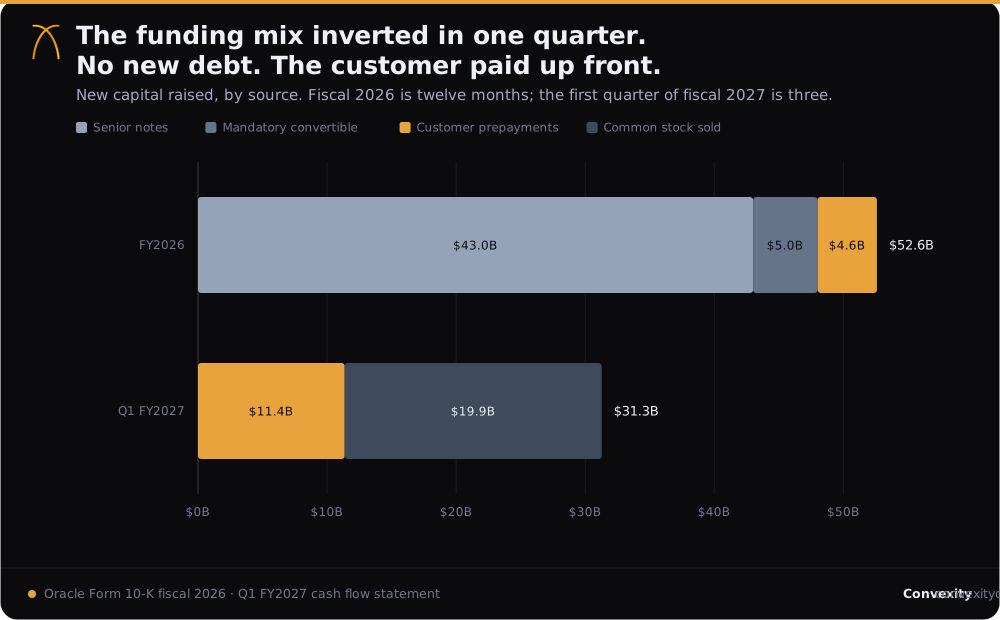
Oracle sold $20 billion of stock. The at-the-market equity program, which had been authorized in February 2026 and stood entirely undrawn at the end of fiscal 2026, was completed inside a single quarter for $19,909 million net of issuance costs. Stockholders' equity rose $24.1 billion during the quarter, and $19.9 billion of that, 82%, was Oracle selling shares rather than earning money.
Oracle borrowed nothing. There were no new senior notes. Oracle repaid $4,202 million of senior notes, term loans and other borrowings, and a further $830 million of short-term financing related to capital expenditures. Total debt fell from $129,541 million at May 31 to $125,337 million at August 31.
That is a complete reversal of fiscal 2026, when Oracle raised $43.0 billion of senior notes and $5.0 billion of mandatory convertible preferred stock and sold no common stock at all. In one quarter the company went from funding the buildout with bonds to funding it with equity and customer cash.
Interest expense has not caught up yet. It was $1,428 million in the quarter, up 55%, because the fiscal 2026 issuance is only now carrying a full quarter's coupon. But the stock of debt is falling, and if this quarter's mix persists, the interest line stops compounding.
The correction we owe
Our August 30 note on Oracle's fiscal 2026 annual report contained a table headed "Oracle raised capital three ways in fiscal 2026, and two of them are new." It listed the senior notes, the mandatory convertible preferred and the undrawn equity program.
There were four. The same annual report disclosed $4.6 billion of customer prepayments with a significant financing component, on the face of the cash flow statement, in the management discussion, and in a dedicated accounting policy paragraph. We read that filing closely enough to quote its conversion schedule, its concentration sentence and its risk factors, and we did not read that paragraph. It was the fourth funding channel, it was the newest, and it is the one that has since grown fastest. The August note has been amended to say so.
There is one thing that note got right, and it is worth stating alongside the miss because both were tests of the same reasoning. It observed that Oracle had broadened the syndicate on its equity program from five banks to twenty the day after filing an annual report that reported none of it sold, and it said: "Nobody broadens distribution on a facility they do not intend to use." Eleven weeks later the facility was fully drawn.
The backlog stopped compounding
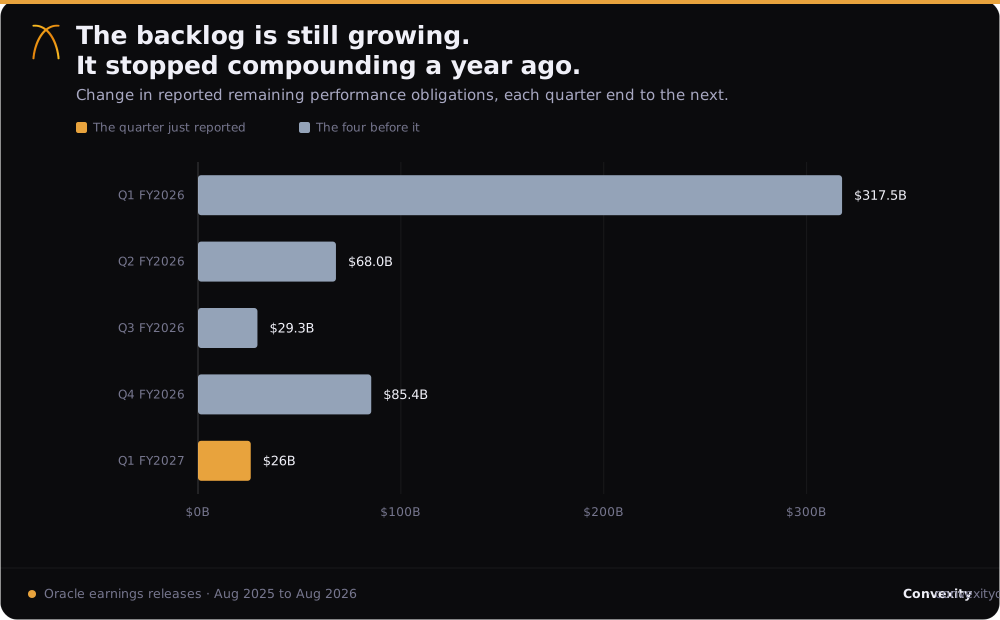
Remaining performance obligations reached $664 billion at August 31, up $209 billion from a year earlier. Sequentially, they rose $26 billion.
| Quarter end | RPO | Change |
|---|---|---|
| May 2025 | $137.8B | |
| Aug 2025 | $455.3B | +$317.5B |
| Nov 2025 | $523.3B | +$68.0B |
| Feb 2026 | $552.6B | +$29.3B |
| May 2026 | $638.0B | +$85.4B |
| Aug 2026 | $664B | +$26B |
$26 billion of net new contracted revenue in ninety days would be a spectacular quarter for almost any company on earth, and it is the smallest quarterly addition Oracle has posted since the AI contracts began.
It is also the wrong number to read on its own, and the call is why. Maxson named two things happening at once. Oracle kept adding contracts, and "we started to see a strong conversion of our RPO into revenues this quarter." Backlog falls as revenue is recognized against it, so a quarter with heavy conversion posts a small net change even when gross bookings are large. Oracle booked more than $30 billion of AI contracts and the backlog rose $26 billion. The difference is conversion, which is the thing the whole buildout exists to produce.
So the honest reading of $26 billion is that it is the smallest net addition since the AI contracts began, and that this is not by itself evidence of slowing demand. What it does mean is that the backlog has stopped being the story it was a year ago, when a single quarter added $317 billion, and that the number worth tracking is now gross bookings. Oracle gives that only as "more than $30 billion."
Two things Maxson said about those contracts matter more than the total. The first is the structure:
The vast majority of those new contracts were via prepay or bring-your-own-hardware or similar mechanic, so won't require incremental capital from Oracle.
Magouyrk made the same point in his own section, that Oracle closed more than $30 billion "without requiring additional capital from Oracle." Read alongside the cash flow statement, that is the answer to what this note is about. Prepayment is not an arrangement with one counterparty any more. It is the shape of the new business, and bring your own hardware is a second mechanism doing the same job by a different route: the customer supplies the accelerators, so the asset never reaches Oracle's balance sheet and neither does the depreciation.
The second is the timing. "That new RPO won't impact our capex or revenues until fiscal 28 or beyond." Everything signed this quarter is a fiscal 2028 event in both directions.
On the conversion schedule itself, Maxson gave a figure the release does not carry: "We now expect around half of our RPO to convert into sales over the next 36 months." The fiscal 2026 annual report put that window at 46%, being 12% inside twelve months plus 34% across the two years after. Around half against 46% is a modest improvement on a base that has grown, and it says nothing about the twelve-month share specifically, which is the number our August note built on. That arrives with the Form 10-Q.
Then there is the sentence that explains the quarter, which Oracle placed immediately after the backlog figure:
Based on the structuring of those new contracts, the Company confirms there is no incremental impact on its plans to raise capital.
"The structuring of those new contracts" is the prepayment. The sentence is telling the market that Oracle does not need to issue more paper to serve the $30 billion it just signed, because the counterparty is paying up front. It is a statement about capital markets, made in a paragraph about demand, and it is the clearest thing in the release about what has actually changed.
What the margin says
The operating margin went from 29% to 35%, which sounds like the buildout reaching scale. Oracle's own non-GAAP presentation says otherwise: excluding stock compensation, intangible amortization and restructuring, the operating margin was 42% this quarter and 42% a year ago. The improvement is 35 basis points.
The entire GAAP margin expansion is the absence of charges the prior year carried. Restructuring fell from $415 million to $94 million. Intangible amortization fell from $420 million to $202 million. Neither is a sign of the cloud business getting more profitable.
Underneath, it is getting less profitable per dollar. Cloud and software cost of revenue grew 77%, against 62% growth in cloud revenue and a 3% decline in software revenue. Combining the two lines the expense covers, gross margin on cloud and software fell from 72.1% to 62.7%. On the incremental dollar it is starker: revenue on that block grew $4,250 million while its cost of revenue grew $2,793 million, so the additional business came in at a 34% gross margin against a 72% base. That is our arithmetic on Oracle's reported lines, and the direction is what matters rather than the decimal.
None of that is in dispute, and the call is where Oracle says it. Maxson:
Our gross margin did decline as expected, driven by impacts from ramping up our data centers and the acceleration of infrastructure revenue. However, this was offset in the quarter by lower operating costs and strong operating leverage tied to simplification and efficiency actions. Net-net our operating margin remained around flat for the quarter at 42%, on a non-GAAP basis.
Note "as expected." Oracle planned the gross margin decline, planned the offset, and describes the result accurately. There is no disagreement about what happened this quarter. The disagreement, if there is one, is about which of the two effects has more room left. Gross margin compresses for as long as infrastructure grows faster than everything else, which is the plan. A cost program runs out.
Two expense lines did the offsetting. Sales and marketing fell 12% in absolute dollars, from 13.8% of revenue to 9.4%. Research and development fell 4%, from 16.7% of revenue to 12.4%. Oracle used this quarter's release to announce an AI data platform that automatically generates enterprise ontologies and an entirely agentic health care records system, and it spent $90 million less on research and development than it did a year ago. Maxson's phrase for that is "simplification and efficiency actions," which is a cost program rather than an accounting effect, and it is the single reason the reported operating margin expanded while the cost of delivering the cloud rose faster than the cloud revenue.
And depreciation is only beginning. It was $3,156 million in the quarter against $1,351 million a year ago, up 134%, on property and equipment that grew from $100.0 billion to $127.8 billion in three months. Every dollar of the $28.5 billion spent this quarter becomes an expense over the years the backlog is scheduled to convert.
The risk a prepayment creates
Cash received in advance is not revenue and it is not profit. It is a liability Oracle discharges by building and operating the thing it sold. Until it does, the money is owed, and the interest accrues. So delivery is the risk that actually matters here, and it is what the analysts spent the call on.
Two sites drew the questions, after press reports of delays. Magouyrk said construction in New Mexico is on track and that Oracle is working through an air permit for on-site power generation using fuel cells from Bloom Energy, whose own backlog disclosure we went through in July. In Wisconsin there is no on-site generation, and Oracle is working with the state Public Service Commission and the local utilities on grid capacity. He said neither site affects the fiscal 2027 revenue or earnings guidance, and made a structural point worth keeping: a gigawatt campus does not arrive in a single quarter, it phases in over many, so a slip at one site does not land as one bad quarter.
He also said this, which is the most useful sentence on the call for anyone weighing execution risk:
Anyone that is in the business of doing construction or large-scale infrastructure development, if their plan relies on 100% achievement of every one of their deliverables, we have a term for that. It is called a bad plan.
The delivery record backs him up. Oracle brought 850 megawatts and more than 300,000 graphics processors online in the quarter, which Magouyrk put at almost three times the prior quarter and 73% of everything delivered in the whole of fiscal 2026. At the Abilene campus, 131,000 processors landed in the quarter, six of eight buildings are handed over, and customer acceptance has compressed to 24 hours. He also said the recently released GPT-6 Astra was trained there, which is the closest Oracle has come to naming the counterparty everyone assumes. It confirms that OpenAI trains at Abilene. It confirms nothing about the size of any contract.
The gain comes back
Oracle guided the second quarter of fiscal 2027 to non-GAAP earnings per share of $1.85 to $1.93, and described that as growth of 21% to 25% "excluding a one-time gain from Q2 FY2026." A footnote at the bottom of the release gives the other number. Including the gain, the same guidance is a decline of 14% to 18%.
The gain was the sale of Oracle's stake in Ampere, the chip company it had backed, which closed in December 2025 and carried that quarter's GAAP earnings per share up 91%. Our August note took it as evidence about strategy: Larry Ellison said Oracle no longer thought designing its own chips was strategic and committed the company to buying from every supplier. The point we made then was about position rather than logic. Oracle exited the one asset that would have given it an alternative to buying accelerators from the vendor at the other end of the AI financing circle, and booked a gain doing it.
The gain is now the comparative. Working back from Oracle's own two growth rates, the prior year quarter without it was about $1.53 of non-GAAP earnings per share against the $2.26 reported, so the Ampere sale was worth roughly 72 cents of that quarter. That figure is ours, implied by the two percentages Oracle published rather than disclosed by Oracle. A one-time gain flatters the quarter it lands in and penalizes the quarter a year later, and companies footnote the second half. There is nothing improper in it. It is just the same event being counted twice, once in each direction, and only one of those countings made the headline.
The full-year guide is the more interesting number. At least $90 billion of revenue against $67.4 billion in fiscal 2026 is 34% growth, and Oracle has $19.3 billion of it. The remaining three quarters have to average $23.6 billion against $17.5 billion in the same three quarters last year, which is 35% growth, faster than the 30% just delivered. That is our arithmetic on Oracle's guide, and it is consistent with the second quarter guidance of 30% to 34%. The company is not guiding to deceleration anywhere.
Scoring the August note
That note named six things that would change its read. Five are now scoreable, and the call moved two of them that the release alone would have left open.
| Named in August | What happened | Read |
|---|---|---|
| Free cash flow reaching breakeven | -$5.4B reported, -$16.8B excluding the prepayment, and no date offered on the call | Against the recovery |
| The equity program being drawn | Fully drawn, $19.9B net, debt repaid | Triggered |
| Interest cover | $1,428M expense, covered 4.7 times by operating income | Comfortable |
| Conversion schedule recovering from 12% | Around half inside 36 months, said on the call, against 46% in the 10-K | Roughly unchanged |
| Backlog concentration | No counterparty named, though Abilene was tied to a specific model release | Open |
| A ratings action | None we can find | Open |
The first row is worth one more line, because it was put to management directly. Asked when Oracle returns to positive free cash flow, Maxson said: "We haven't given a particular time frame on that yet, and we don't expect to give that today." She then argued the projects are strongly cash generative once ramped, which is the right argument and not a date.
The second row is the one that matters most, and it cuts against the August thesis directly. That note's argument was that Oracle had taken the leg of the AI financing circle that was hardest to unwind, because a bond is paid whatever happens while a mark can be written back down and a guarantee may never be called. In the first quarter of fiscal 2027 Oracle stopped issuing bonds, repaid $4.2 billion of them, and funded the quarter with equity and customer cash instead. Equity is permanent capital with no coupon. On that evidence the financing is more reversible than we argued, not less.
What replaces it is a different question rather than an easier one. A prepayment is not permanent capital. It is a liability that has to be discharged by performance, and it carries interest until it is.
The case against this note
The strongest arguments run the other way, and one of them is very strong.
A prepayment is the best evidence of demand that exists. Our August note's largest open question was counterparty credit: Oracle itself wrote that the returns on its buildout "are dependent on customer demand and the ability of our key customers to meet their contractual obligations." A customer who has already wired $11.4 billion has answered that question for $11.4 billion of it. Cash received retires credit risk in a way no contract term can. If the choice is between a receivable from a well-funded AI lab and the cash itself, the cash is better, and Oracle taking it is management doing its job.
The financing cost is cheap for what it buys. Oracle is paying roughly its own bond rate for money it did not have to go to the bond market for, at a moment when it is already carrying $125 billion of debt and every incremental issue widens its spread. Borrowing from a customer who wants the capacity built is a better trade than borrowing from a syndicate that does not care.
The assets are holding their value, and this is the strongest counter to the depreciation point. Magouyrk said utilization ran at 97.9% and that capacity coming up for renewal in the quarter "was renewed or resold at a 20% premium to prior contracts," on hardware a majority of which is four years or older. Depreciation on a rising asset base is the largest forward cost this note points at. A four-year-old accelerator repricing upward is real evidence that the schedule is conservative rather than optimistic, and it is the sort of number that is easy to check next quarter and hard to fake.
Prepayment is not the only mechanism, and the other one is better. Bring your own hardware means the customer supplies the accelerators. That is not a loan and it is not a liability. It removes the asset from Oracle's balance sheet along with its depreciation, and it is a genuinely new answer to the question of who funds an AI buildout. Magouyrk described the whole set as "constantly finding interesting ways to fund the business," and on the evidence of one quarter it is working.
Nothing here is undisclosed, and this is the point that most limits the criticism. The line is on the face of the cash flow statement. The policy is in the annual report. The supplemental table's footnote names the overlap explicitly. The chief financial officer said the words "collection of customer prepayments" out loud, described the contract structure, and guided to the measure that nets it against capital spending. Every number in this note came from Oracle's own documents and Oracle's own call in an afternoon. That is a company explaining an unusual arrangement properly, and what is left to argue about is emphasis rather than transparency.
The business is compounding. 121% growth in cloud infrastructure, 850 megawatts delivered, a raised full-year outlook. Arguments about the quality of a cash flow line matter much less if the revenue keeps arriving, and so far it keeps arriving.
Equity funding is the conservative choice. Selling $20 billion of stock, rather than issuing more paper into a balance sheet already carrying $125 billion of debt, is what a management team does when it is being careful. It dilutes, and dilution is the one cost that does not compound.
Our disagreement is narrow, and after the call it is narrower than it was. It is not that Oracle hid anything, because Oracle did not. It is about what a reader takes from the sentence that travels. "Record operating cash flow, up 184%" invites the conclusion that the business has begun to fund itself. It has not, and Oracle is not claiming it has. Excluding the customer's money, operations covered 41% of the quarter's capital spending and the rest came from selling stock. Both are legitimate ways to build a data center. Neither is the business generating cash, and the guide says the same arrangement funds a fifth to a quarter of this year's spending too.
What would change the read
Named in advance, so it can be scored rather than argued.
| Trigger | When | Why it matters |
|---|---|---|
| Net cash capital expenditure | Quarterly | Oracle guided to not more than $70B against $90B to $95B of capex; the gap is the customer contribution, and it is now a target rather than an outcome |
| The prepayment line in Q2 | Dec 2026 | The guide implies $9B to $14B more across three quarters; a quarter near zero would mean the year rests on one contract |
| Interest on financing components | Q1 FY2027 Form 10-Q | Oracle discloses it separately; the word "immaterial" disappearing is the tell |
| Operating cash flow ex-prepayment | Quarterly | This is the series to track, and Oracle does not publish it |
| Conversion schedule | Q1 FY2027 Form 10-Q | The call gave 36 months; the filing gives the twelve-month share it did not |
| Debt issuance resuming | Any time | Would reverse the funding shift this note is built on |
| Cloud and software gross margin | Quarterly | 34% incremental against a 72% base is the number that decides whether scale ever arrives |
The first two rows are the whole question, and the call answered more of it than a release usually does. Oracle has told the market it intends roughly $20 billion to $25 billion of this year's capital spending to come from somewhere other than Oracle. If that lands, a company whose second largest source of operating cash is its customers' balance sheets is a different company from the one the headline describes, and it is a deliberate one rather than an accident of a single contract.
Primary sources
- 8-KQ1 fiscal 2027 earnings release, exhibit 99.1Every reported figure here: the income statement, balance sheet, cash flow statement, the free cash flow table, the new net cash outlay table and its footnote 3Filed Sep 10, 2026
- CallOracle Q1 fiscal 2027 earnings call transcriptThe management statements used here. Hilary Maxson, chief financial officer: the prepay and bring-your-own-hardware structure of the new contracts, full year capital expenditure of $90 billion to $95 billion against net cash capital expenditure of not more than $70 billion, around half the backlog converting inside 36 months, the gross margin decline and the flat non-GAAP operating margin, collection of customer prepayments inside the record operating cash flow, the first sequential first-quarter revenue growth, and her answer declining to date free cash flow breakeven. Clay Magouyrk, chief executive officer: more than $30 billion of contracts closed without additional Oracle capital, 97.9% utilization and renewals at a 20% premium on hardware four years or older, the 850 megawatts and 300,000 processors delivered, and New Mexico and Wisconsin. Held the same day as the release, and every figure in it that also appears in the filed release agrees with the release. Oracle hosts the webcast replay on its own investor relations site, which refuses automated requests, so the link here is the EDGAR filing index for the same dayHeld Sep 10, 2026
- 10-KOracle Corporation annual report, fiscal year ended May 31, 2026The Customer Prepayments and Sales of Financing Receivables policy note, the $4.6 billion fiscal 2026 figure, and the statement that no such prepayments were received in fiscal 2025 or 2024Filed Jun 22, 2026
- 8-KQ4 and fiscal 2026 earnings releaseRemaining performance obligations rising from $553 billion to $638 billionFiled Jun 10, 2026
- 8-KQ3 fiscal 2026 earnings releaseRemaining performance obligations of $553 billionFiled Mar 10, 2026
- 8-KQ2 fiscal 2026 earnings releaseThe quarter the second-quarter guidance is compared against: $2.26 of non-GAAP earnings per share including the Ampere gain, and remaining performance obligations of $523 billionFiled Dec 10, 2025
- 8-KQ1 fiscal 2026 earnings releaseThe prior-year comparative quarter, and remaining performance obligations of $455 billionFiled Sep 9, 2025
- 424B5Prospectus supplement, at-the-market common stock programThe syndicate broadening from five banks to twenty, eleven weeks before the program was fully drawnFiled Jun 23, 2026
Not investment advice. This is a reading of public filings, published for research purposes. It is not a recommendation to buy or sell any security, and it is not a price target. We hold no position in ORCL. Anyone acting on any of it should read the filings themselves, which are linked above.
What here is ours rather than Oracle's. Oracle reports operating cash flow, free cash flow and the prepayment line separately; every figure that removes the prepayment from either is our arithmetic on those filed numbers. The split of the quarter into sources and uses is ours, assembled from filed cash flow lines. The cloud and software gross margins, the incremental margin, the expense ratios, the total debt figure, the equity bridge and the sequential backlog changes are ours. The $20 billion to $25 billion of non-Oracle funding implied for fiscal 2027 is ours, being the difference between the two figures Oracle guided to on the call, as is the $9 billion to $14 billion remaining after the first quarter. The estimated interest cost on the prepayment balance is ours, uses a weighted average coupon we calculated in a previous note, and is an approximation rather than a disclosure. Quotations from management are from the transcript of the September 10 call.
Correction. Our August 30 note stated that Oracle raised capital three ways in fiscal 2026. There were four. The annual report disclosed $4.6 billion of customer prepayments carrying a significant financing component, and we missed it. That post has been amended to record the omission.