








Disclosure. Not investment advice, and nothing here is a recommendation to buy, sell or hold any security. A member of the Convexity team holds the SPDR S&P 500 ETF (SPY), which holds Vertiv, Quanta Services, GE Vernova and Alphabet; no other position in any of the four. A member of the Convexity team holds an economic interest in Anthropic through a special-purpose vehicle and a fund, and stands to benefit if its valuation rises. Convexity is a customer of Anthropic, and this note was drafted with Claude, Anthropic's model. Alphabet, discussed below as a buyer of AI infrastructure, is an investor in Anthropic and one of its suppliers, and also competes with it. Figures are from the third-quarter earnings releases and Forms 10-Q of Vertiv, Quanta Services and GE Vernova, their earlier 2026 quarterly reports, Vertiv's 2025 annual report and Alphabet's third-quarter earnings release. We read all three companies' earnings calls in two independently produced transcripts each and quote only wording both carry. The closing note lists what is our arithmetic.
The companies that power and cool the AI buildout are now being paid before they build it. At Vertiv, Quanta Services and GE Vernova, customers' advance payments grew more this year than all the cash the three companies' operations produced.
The three sit at different links of one chain. Vertiv makes the power and cooling equipment that goes inside a data center. Quanta builds the transmission lines, substations and grid connections that bring electricity to it. GE Vernova makes the gas turbines that generate that electricity and the grid equipment that carries it. All three reported their September quarters in the last week of October, and all three raised their forecasts for 2026.
The headline numbers were large. Vertiv's sales rose 61% from a year earlier, Quanta's revenue 57% and GE Vernova's 27% (our arithmetic on their releases). But the number that ties the three together sits lower down, in the cash flow statement, on a line most readers skip: the money customers paid, or were billed, before anything was delivered.
Over the first nine months of 2026, that line added $23.8 billion of cash across the three companies. Their combined operating cash flow was $22.3 billion. A year earlier, the same line added $2.6 billion against $4.7 billion of operating cash (all four are our sums of filed figures). Customers are financing their suppliers, at a scale that did not exist twelve months ago.
That changes what the order books mean. The worry about the AI buildout is that its buyers are spending more than they earn, so the suppliers' record backlogs are only as good as the buyers' ability to keep paying. The order books turn out sturdier than that, because so much of them is already paid for. And a slowdown would show first not in the suppliers' revenue, but in their cash.
Forms 10-Q of Vertiv, Quanta Services and GE Vernova for the September quarter of 2026, GE Vernova's October 28 earnings call and Alphabet's Q3 2026 earnings release. The sum and the percentages are our arithmetic.
A line most readers skip
When a customer pays a deposit, the supplier books the cash and a liability of the same size: it now owes the customer a turbine, a switchboard or a finished substation. The liability becomes revenue only when the work is delivered. So in a stretch when deposits arrive faster than deliveries go out, operating cash flow runs ahead of profit, and the difference is the customers' money.
Each company describes the line in its own words. GE Vernova's 10-Q says its contract liabilities "primarily represent cash received from customers under ordinary commercial payment terms in advance of delivery of equipment orders or servicing of customers' installed base." It puts this year's increase down to "down payments on orders and slot reservation agreements at Power, and down payments at Electrification."
Vertiv's annual report says that "Payments received in advance for service arrangements or product delivery are recorded as deferred revenue," and its latest 10-Q says working capital supplied cash this year "primarily driven by deferred revenue." Quanta's 10-Q attributes the rise in its contract liabilities "primarily" to "an increase in favorable billing terms on certain large projects." On its October 29 call, Jayshree Desai, its chief financial officer, credited "the contract terms we're getting on a significant part of our revenue," naming its mechanical, electrical and plumbing work, its engineering and construction contracts and its renewables business.
Quanta is also collecting faster. Its days sales outstanding, a measure of how long revenue takes to turn into cash, fell to 50 at the end of September from 66 a year earlier, against a five-year average of 69. A contractor that can bill ahead and collect quickly is one whose customers want it on site badly enough to agree.
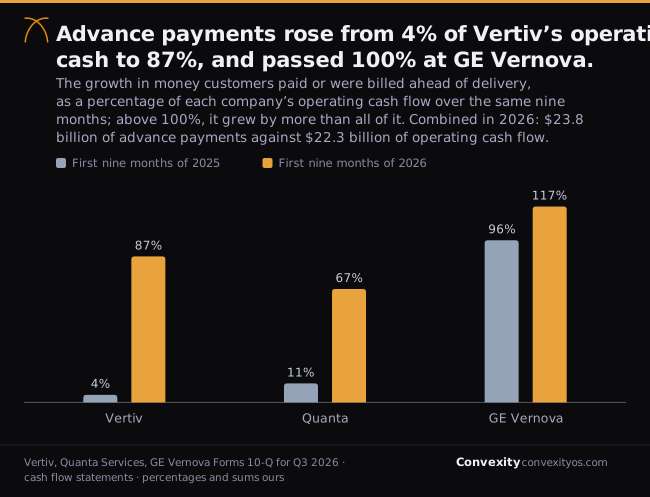
The chart shows where the change happened. At GE Vernova, advance payments were already almost all of operating cash a year ago, 96%, and its 10-Q attributed that year's increase to the same down payments and slot reservations. What is new is Vertiv and Quanta. Taken together, their advance payments grew by the equivalent of 8% of their operating cash in the first nine months of 2025, and by 77% in 2026 (our arithmetic).
Vertiv's line tells the story in miniature. In the first nine months of 2025, deferred revenue added $49.4 million to its cash. In the same months of 2026, it added $2.3 billion, while operating cash rose to $2.7 billion. The balance customers had prepaid stood at $1.8 billion at the end of 2025 and $4.1 billion at the end of September.
What the money reserves
Why would a buyer pay years early? At GE Vernova, the answer is a queue. It sells gas turbines partly through slot reservation agreements, which hold a place in its production schedule before a firm order is signed, and its 10-Q shows that both reservations and orders carry down payments.
In the third quarter, GE Vernova signed 11 gigawatts of new gas contracts, 8 of them reservations, converted 13 gigawatts of earlier reservations into firm orders, and shipped 5. Its gas backlog rose to 64 gigawatts from 53, and reservations fell to 58 from 63. "This quarter, we sold multiple slots for" 2032 delivery, Scott Strazik, its chief executive, said on the October 28 call, and "backlog is now greater than our SRA balance."
Asked how long the cycle in its aeroderivative turbines could run, Strazik said orders now reach far into the future "because we're sold out so far." Scarcity carries a price. He said third-quarter gas equipment orders were "priced more than 20% above" those of the fourth quarter of 2025, and that pricing per kilowatt for 2026 as a whole would be "approximately 50% higher" than for 2025.
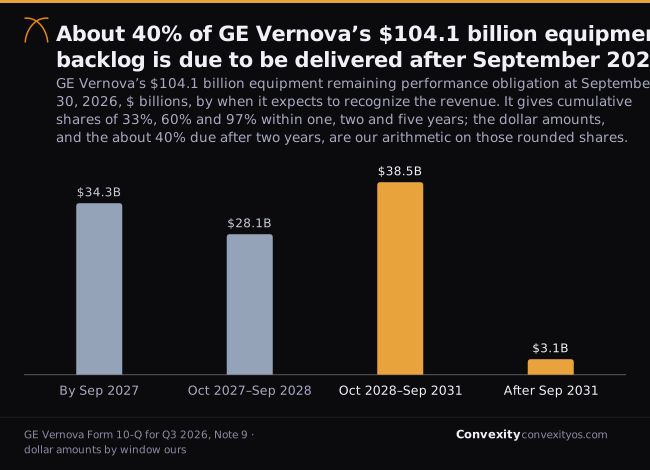
On this side, the hypothesis behind this note holds plainly: the commitments run far past 2027. Of the $104.1 billion of equipment GE Vernova has contracted to deliver, it expects to recognize 33% within a year and 60% within two, which leaves about 40%, roughly $41.6 billion, for after September 2028 (our arithmetic on its rounded shares).
That equipment order book is 92% larger than a year earlier, while quarterly revenue grew 27%. Of the whole order book's growth since December, $5.0 billion came with GE Vernova's purchase of the half of Prolec GE, a transformer maker, that it did not already own. The order book excludes, its 10-Q says, any order a customer can cancel "without incurring a substantive penalty."
Quanta's book is large next to its revenue, and shorter. Its remaining performance obligations, the contracted work it has yet to do, were $41.8 billion at the end of September, 99% more than a year earlier, against third-quarter revenue up 57%. In the quarter alone they rose $8.2 billion, more than two-thirds of its $12.0 billion of revenue (our arithmetic), though this year's acquisitions muddy that comparison.
Total backlog, which adds Quanta's own estimate of work under its master service agreements, was $63.7 billion, and those agreements made up 37% of it. Quanta expects 67% of the contracted portion to be done within twelve months.
Its 10-Q is plain about the estimate. Under those agreements, "our customers are not contractually committed to specific volumes of services," and "most of our contracts can be terminated on short notice even if we are not in default."
Vertiv's book is the shortest of the three. Giordano Albertazzi, its chief executive, said third-quarter orders were "more than 100% up" from a year earlier on an organic basis, against organic sales growth of 55%. But he also said customers place orders roughly 12 to 18 months ahead of delivery, and that Vertiv counts as backlog only what is "squarely a purchase order," not the capacity agreements some customers sign.
Vertiv's annual report said orders were by then "being placed in advance of our ability to fulfill them." On a lead time of 12 to 18 months, an order placed in the September quarter is due between the summer of 2027 and early 2028 (our reading of Albertazzi's range).
So the hypothesis needs its first correction here. The order books do reach beyond what the suppliers ship today, but how far depends on the product: turbines into the 2030s, grid work mostly within a year, data center equipment within a year and a half.
Who signed the orders
The second correction is about who is paying. The fear is that a handful of AI buyers whose spending has outrun their cash are carrying these order books on their own. The filings and the calls show that this is true of one of the three suppliers far more than the other two.
At GE Vernova, Strazik said gas demand comes from "approximately 100 customers in 25 different countries," of which "approximately 80% are traditional customers and 20% are for data centers." Discussing the grid business, he said "Total segment data center orders are now more than $6 billion year-to-date, including roughly $1.4 billion in 3Q." Electrification, the segment that makes GE Vernova's grid equipment, booked $5.4 billion of orders in the quarter in all.
Quanta does not split its revenue by end market, and its 10-Q says no customer accounted for 10% or more of revenue in the quarter or the year to date. Its release describes demand "broadening across utility, power generation, industrial and technology customers." Duke Austin, its chief executive, said in the release that Quanta sees "opportunity to deliver strong double-digit adjusted EPS growth in 2027, supported by continued backlog growth."
On the call he gave no data center share either. Asked about acquisitions, he said he keeps asking what would happen to Quanta with its "data center business cut in half," and answered that it would "still see growth in the business." That speaks to resilience, not to how large the data center business is, which Quanta still does not say.
Vertiv is the purest exposure of the three, since its customers build data centers. David Cote, its executive chairman, opened the call by paraphrasing Mark Twain: "the rumors of our demise have been greatly exaggerated." One analyst on the call referred to investor concerns during the quarter about Vertiv's product quality and possible loss of market share, and said the order growth suggested the opposite.
Albertazzi said Vertiv's customer mix, from the largest cloud providers to enterprises to the newer cloud companies, "very much represents the market mix." Cote said, "Orders are strong no matter how you look at them," with or without those newer companies, the neoclouds. That is the category that includes CoreWeave, whose borrowing we examined in September.
Asked whether data center projects were slipping, Albertazzi said what Vertiv sees at project level is "nothing out of the ordinary from what we have seen in the industry over the years." Customers, he said, are "pretty savvy" and buy equipment "when they know that the project can be taken to completion." He named "power availability, permitting, general sentiment" among the things pacing the industry, not slowing it.
The buyers' side of the ledger
Now the other side. Alphabet, one of the largest spenders on the AI buildout, reported on October 28, the same day as Vertiv and GE Vernova. Its capital spending was $51.4 billion in the third quarter, against $42.3 billion of cash from operations. Free cash flow, as Alphabet computes it, was negative $9.1 billion, after negative $5.9 billion in the second quarter.
Over the first nine months of 2026, Alphabet spent $132.0 billion on property and equipment and generated $127.1 billion from operations, a gap of $4.8 billion (our arithmetic). Over the last four quarters free cash flow was still positive, $19.7 billion, because the December quarter of 2025 was strongly so.
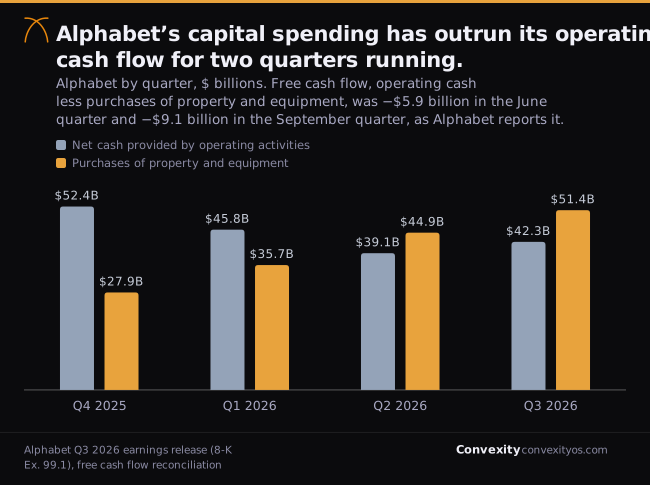
The point is the direction. In our ledger of the six largest AI spenders, published in September, Alphabet's capital spending came to 71% of its operating cash over the four quarters to June. Over the four quarters to September it was 89% (our arithmetic), and in each of the last two quarters it was over 100%. In that ledger, three of the six had already spent more than their operations brought in.
Across the largest buyers, part of that gap is filled by borrowing. Hyperscalers have sold $244 billion of fixed-rate bonds since the start of 2025, as our note on the long end of the bond market counted. When a buyer pays for equipment partly with borrowed money, and pays a deposit out of that spending, the supplier's operating cash is in part the buyer's borrowing, passed one link up the chain.
GE Vernova was asked about exactly this. David Arcaro, an analyst at Morgan Stanley, asked whether its customers were showing "any financing challenges leading to disruptions or slowdowns," or asking to exit their reservations. Strazik answered: "No, David, we're not." There was, he said, "no change in our cash terms required to secure the equipment," and "the customer archetype that we're serving have very strong balance sheets."
That answer fits GE Vernova's customer split, four-fifths of its gas customers being traditional buyers rather than data centers. It is a weaker answer for Vertiv, whose customers are nearly all building data centers. And Vertiv, the supplier most exposed to the AI buyers, has just made itself harder to read.
Vertiv stops counting out loud
"We do not disclose orders," Albertazzi said on the call, before sharing the 100% figure as an exception and saying the policy would stay. Cote was blunter: Vertiv is "not planning to share orders data going forward."
Its 10-Qs do not disclose backlog either. Its annual report does: $15.0 billion at the end of 2025, up from $7.2 billion a year before, "the majority" of it firm and expected to ship within 12 to 18 months.
That leaves the deferred revenue line as the nearest thing to a quarterly order signal left in Vertiv's filings, since an advance payment is made against an order. In the third quarter the line slowed. It added $651 million to Vertiv's cash in the first quarter and $1.17 billion in the second, but $490 million in the third (our arithmetic on its 10-Qs), while orders, on Albertazzi's account, more than doubled.
There are innocent explanations, and the filings support some of them. Deposits turn into revenue when equipment ships, and Vertiv shipped a great deal: sales rose 61%, and Craig Chamberlin, its chief financial officer, said about $100 million to $150 million of revenue delayed from the second quarter landed in the third. The line is lumpy, too. In the third quarter of 2025 it shrank, by $122 million (our arithmetic).
But without orders or backlog, a reader cannot tell a quarter of heavy shipping from a quarter of lighter ordering, because both look the same on this line. Vertiv's release said its third-quarter adjusted free cash flow was driven by higher adjusted operating profit "partially offset by increased working capital." Advance payments covered 62% of the quarter's operating cash, down from 107% in the second quarter (our arithmetic).
What a slowdown would look like
Advance payments are not loans. Under Vertiv's contracts, its annual report says, cancellation and refund provisions "apply only in the event of contract breach" and "have historically not been invoked," though customers can reduce or defer firm orders, "usually with penalties or other termination consequences." The money is the suppliers' to spend, and they are spending it.
GE Vernova bought back $5.3 billion of its shares in the first nine months, equal to 27% of the advance payments it took in (our arithmetic), and paid $4.9 billion, net, for acquisitions. In October it doubled its buyback authorization to $20 billion and agreed to buy Trench Group, a maker of high-voltage grid equipment, for $9.0 billion, a deal it expects to close in late 2027.
Its contract liabilities were $45.7 billion at the end of September, against $25.8 billion in December. In the Power segment alone they doubled. They now equal 53% of GE Vernova's total liabilities and equity, and 3.6 times its shareholders' equity (our arithmetic). Its cash, $16.8 billion, is a little over a third of what it owes customers in equipment and service (our arithmetic).
Here is the mechanism the hypothesis was reaching for. Revenue follows the order book, which is long. Cash follows the pace of new deposits, which can change within a quarter. In the first nine months of 2026, the three companies recognized about $15.3 billion of revenue out of balances customers had paid or been billed before the year began (our sum of the figure each discloses).
That revenue brought in little new cash this year, because its cash came earlier. As long as new deposits outpace those drawdowns, operating cash runs ahead of profit. When they stop, cash falls behind, while revenue keeps rising. A supplier in that position reports a record quarter and a cash shortfall at the same time.
The third quarter offered a first, small look at that turn. Combined, the three took in $7.6 billion of advance payments, down from $9.4 billion in the second quarter, and for the first time this year less than their $8.3 billion of operating cash (our arithmetic).
GE Vernova's inflow fell to $5.8 billion from $8.1 billion and Vertiv's to $490 million from $1.17 billion, while Quanta's rose to $1.28 billion from $117 million. One quarter is not a trend, and these lines are lumpy.
GE Vernova's own guidance points the same way. Its raised forecast of $16 billion to $17 billion of free cash flow for 2026, against $15.3 billion generated through September, implies $0.7 billion to $1.7 billion in the fourth quarter, down from $5.4 billion in the third (our arithmetic). Ken Parks, its chief financial officer, said the company expects "growth in revenue and adjusted EBITDA" in the fourth quarter alongside "positive free cash flow."
GE Vernova did not explain the drop, and taxes or other items could account for part of it. Strazik said on the same call that fourth-quarter aeroderivative orders would be lighter than the pace of the second and third quarters. Fewer orders mean fewer down payments, whatever else is in the number.
So the AI buildout's suppliers stand on firmer ground than their critics assume, and on less firm ground than their order books suggest. Much of the order book is paid for, the deposits are hard to claw back, and at GE Vernova the queue runs to 2032.
But the suppliers' cash now depends on buyers continuing to pay early, and at Alphabet, as at three of the six companies in our ledger, the buyers' own spending has run past their cash.
If the buildout slows, the first sign at these companies will probably not be a canceled order or a revenue miss. It will be a quarter in which advance payments stop growing, revenue rises anyway, and operating cash falls.
What would prove this wrong
This note argues three things: that the suppliers' order books are backed by real money to an unusual degree, that their cash flow now depends on the pace of new advance payments, and that the AI-specific risk in those payments sits mostly with Vertiv. Each can be checked against something with a date.
- Advance payments in the December quarter. The three companies' 10-Ks, due in the first quarter of 2027, will show the fourth quarter's inflow. If it climbs back above the second quarter's $9.4 billion, the third-quarter dip was timing and the turn this note describes has not begun. If it falls again while revenue rises, the turn is under way.
- GE Vernova's cash terms and reservations. Strazik said no change in cash terms was needed and no customers were asking to exit. If GE Vernova starts accepting smaller down payments, or reservations are canceled rather than converted, the deposits stop being evidence of commitment.
- Vertiv's year-end backlog. Its annual report for 2026 should disclose backlog at December 31. Orders that more than doubled in the third quarter should show up as a backlog well above the $15.0 billion of a year earlier. If the report drops the backlog figure too, the deferred revenue line will be all that is left to watch.
- The buyers' cash. Alphabet's fourth-quarter results and its spending plans for 2027 will show whether its free cash flow stays negative. If the largest buyers return to positive free cash flow while still raising capital spending, the suppliers' cash depends less on borrowed money than this note argues.
- The customer mix. GE Vernova's split was 80% traditional customers and 20% data centers. If the data center share rises sharply, more of its order book rests on AI buyers' financing than this note says. Quanta's call gave no share; if a future filing shows a concentration in data center work, the same applies to it.
The filings and documents this is built on
- 8-KVertiv, third quarter 2026 earnings release (Exhibit 99.1)Net sales, organic growth, operating cash flow, adjusted free cash flow and its drivers, liquidity and the raised 2026 guidanceOct 28, 2026
- 10-QVertiv, quarterly report for the period ended September 30, 2026The deferred revenue balance and cash flow line, operating cash flow, trade working capital and the 2025 comparativesOct 28, 2026
- 10-QVertiv, quarterly report for the period ended June 30, 2026Six-month operating cash flow and deferred revenue, for the quarterly splitJul 29, 2026
- 10-QVertiv, quarterly report for the period ended March 31, 2026Three-month operating cash flow and deferred revenueApr 22, 2026
- 10-KVertiv, annual report for 2025Backlog at December 31, 2025 and 2024, the revenue recognition policy for advance payments, and cancellation and refund termsFeb 13, 2026
- CallVertiv third quarter 2026 earnings call, transcript by The Motley FoolOne of the two transcripts we read; every quotation from the call is wording both carry, and speaker titles are from the call introduction and the release; retrieved 2026-10-29Oct 28, 2026
- CallVertiv third quarter 2026 earnings call, transcript by GloomberbThe second of the two transcripts; retrieved 2026-10-29Oct 28, 2026
- 8-KQuanta Services, third quarter 2026 earnings release (Exhibit 99.1)Revenue, the chief executive’s comments, the reconciliation of remaining performance obligations to backlog at September 30, 2026, December 31, 2025 and September 30, 2025, and financingOct 29, 2026
- 8-KQuanta Services, second quarter 2026 earnings release (Exhibit 99.1)Remaining performance obligations and backlog at June 30, 2026Jul 30, 2026
- 10-QQuanta Services, quarterly report for the period ended September 30, 2026Contract liabilities and the reason for their increase, operating cash flow, days sales outstanding, customer concentration, and the terms and share of master service agreements in backlogOct 29, 2026
- 10-QQuanta Services, quarterly report for the period ended June 30, 2026Six-month operating cash flow and change in contract liabilitiesJul 30, 2026
- 10-QQuanta Services, quarterly report for the period ended March 31, 2026Three-month operating cash flow and change in contract liabilitiesApr 30, 2026
- CallQuanta Services third quarter 2026 earnings call, transcript by The Motley FoolOne of the two transcripts we read; every quotation from the call is wording both carry, and speaker titles are from the call introduction; retrieved 2026-10-29Oct 29, 2026
- CallQuanta Services third quarter 2026 earnings call, transcript by Stock AnalysisThe second transcript we read; retrieved 2026-10-29Oct 29, 2026
- 8-KGE Vernova, third quarter 2026 earnings release (Exhibit 99.1)Orders, revenue, gas gigawatts signed, converted and shipped, free cash flow, the raised 2026 guidance, the share repurchase authorization and the Trench Group agreementOct 28, 2026
- 10-QGE Vernova, quarterly report for the period ended September 30, 2026Contract liabilities by segment and what they represent, remaining performance obligations and their timing, the cash flow statement, buybacks and acquisitions, and the balance sheetOct 28, 2026
- 10-QGE Vernova, quarterly report for the period ended June 30, 2026Six-month operating cash flow and change in contract liabilitiesJul 22, 2026
- 10-QGE Vernova, quarterly report for the period ended March 31, 2026Three-month operating cash flow and change in contract liabilitiesApr 22, 2026
- CallGE Vernova third quarter 2026 earnings call, transcript by The Motley FoolOne of the two transcripts we read; every quotation from the call is wording both carry, and speaker titles are from the investor relations introduction; retrieved 2026-10-29Oct 28, 2026
- CallGE Vernova third quarter 2026 earnings call, transcript by GloomberbThe second of the two transcripts; retrieved 2026-10-29Oct 28, 2026
- 8-KAlphabet, third quarter 2026 earnings release (Exhibit 99.1)The quarterly reconciliation of operating cash flow to free cash flow, Q4 2025 to Q3 2026, and the trailing-twelve-month columnOct 28, 2026
Not investment advice. This note is an analysis of public filings and earnings calls, published for research purposes, and not a recommendation to buy, sell or hold any security. A member of the Convexity team holds SPY, which holds Vertiv, Quanta Services, GE Vernova and Alphabet; no other position in any of the four. A member of the Convexity team holds an economic interest in Anthropic through a special-purpose vehicle and a fund, and stands to benefit if its valuation rises; Alphabet is an investor in Anthropic and one of its suppliers. Convexity is a customer of Anthropic, and this note was drafted with Claude, Anthropic's model.
What here is ours rather than the companies'. As filed or stated by the companies: every revenue, sales, order, backlog, remaining performance obligation, cash flow, contract liability, deferred revenue, balance sheet, buyback, acquisition and guidance figure; GE Vernova's gigawatts signed, converted and shipped, its shares of equipment RPO due within one, two and five years, and its pricing and customer-mix statements; Quanta's 12-month RPO, the share of master service agreements in its backlog and its days sales outstanding; the revenue each company recognized from balances outstanding at the start of the year; Alphabet's quarterly operating cash flow, capital spending and free cash flow; and every quotation, from the filings, the releases or the two transcripts of each call. Ours: the year-over-year growth rates; the combined $23.8 billion of advance payments, the $22.3 billion of operating cash flow and the 107% and 55% shares, the per-company percentages in the first chart, and the 8% and 77% for Vertiv and Quanta together; every quarterly figure for advance payments and operating cash, which are differences between the year-to-date columns of each company's 10-Qs, including Vertiv's $122 million decline a year earlier and the 62% and 107% shares; the dollar amounts by delivery window in the second chart, the about 40% and the $41.6 billion due after September 2028; Quanta's $8.2 billion quarterly increase in remaining performance obligations; our reading of Vertiv's lead time as reaching into 2028; GE Vernova's buybacks as a share of its advance payments, its contract liabilities as a share of its balance sheet and as a multiple of its equity, and the doubling in Power; the $15.3 billion sum of revenue recognized from opening balances; the implied $0.7 billion to $1.7 billion of fourth-quarter free cash flow at GE Vernova; and Alphabet's nine-month sums, the $4.8 billion gap and the 89% four-quarter ratio of capital spending to operating cash.