
Disclosure. Not investment advice, and nothing here is a recommendation to buy, sell or hold any security. We hold no position in CoreWeave. Three things a reader should weigh. Convexity is a customer of Anthropic, and this note was researched and drafted with Claude, Anthropic's own model. A member of the Convexity team holds an economic interest in Anthropic through a special-purpose vehicle and a fund, and stands to benefit if its valuation rises, so we are not neutral on anything touching the AI labs: CoreWeave's filing names OpenAI, one of Anthropic's direct competitors, as a customer, and its principal supplier and a shareholder is Nvidia, which is also one of Anthropic's own counterparties. And every figure below is either quoted from a CoreWeave filing or its earnings call, or is our arithmetic on figures in them; the closing note separates the two line by line.
On its August 11 earnings call, CoreWeave's chief financial officer, Nitin Agrawal, gave the number the company is built around: "Revenue backlog ended the quarter at $104 billion, up 246% year-over-year." He added that it did not include "the over $25 billion of net new customer commitments we added early in Q3."
A hundred and four billion dollars of signed demand, at a company that booked $2.6 billion of revenue in the quarter. On the backlog alone, CoreWeave has about ten years of current revenue already under contract.
The backlog is real, and this note does not argue otherwise. It asks a narrower question, the one the filing answers precisely: how is the company paying to build the capacity that backlog requires, and how fast?
The answer, from CoreWeave's own cash flow statement, is that in the first six months of 2026 the business generated $3.7 billion of operating cash, spent $14.1 billion building, and borrowed $16.7 billion to cover the difference. Then, on September 17, it announced a program to sell up to 35 million new shares and $3.0 billion more of convertible debt.
All figures from CoreWeave's Form 10-Q for the quarter ended June 30, 2026. The 25% is our arithmetic, interest expense of $640 million over revenue of $2,575 million. The $15.0 billion is our sum of the filing's maturity table for the remainder of 2026, 2027 and 2028.
What the backlog is
CoreWeave calls it revenue backlog on the call and remaining performance obligations in the filing. The filing's definition is careful and worth reading in full, because it is more conservative than a headline number usually is.
Remaining performance obligations, it says, represent "the aggregate amount of the transaction price, net of estimated variable consideration, allocated to performance obligations not delivered, or partially undelivered." The variable consideration it nets out includes expected credits to customers when service falls short, "amounts that may not be recognized as revenue due to delivery delays," and "estimates of committed cloud computing capacity that the Company has the right to resell."
So the $103.7 billion is not a gross contract value. It has already been reduced for the credits CoreWeave expects to owe, for the revenue it expects to lose to its own late deliveries, and for capacity a customer has committed to that CoreWeave expects to resell rather than bill. That is a more honest construction than many backlogs, and the filing deserves credit for it.
The timing is disclosed too, and it is the first thing that matters for everything that follows. As of June 30, 2026, the company "had $103.7 billion of unsatisfied RPO, of which 41% was expected to be recognized over the initial 24 months ending June 30, 2028, 39% between months 25 and 48, and the remaining balance recognized between months 49 and 78."
On our arithmetic that is roughly $42.5 billion in the next two years, $40.4 billion in the two years after, and $20.7 billion out to month 78, which is late 2032. Note the unit: CoreWeave reports its backlog in 24-month buckets where most companies, Oracle among them, report a 12-month one. Two-year buckets are not wrong, but they make the near-term number impossible to compare directly with anyone else's.
Nearly all of the revenue comes from this kind of commitment. "Revenue recognized related to customer commitments, including revenue from delivering capacity prior to commitment start dates, represented 98% of total revenue" in the quarter. This is a contracted business, not an on-demand one.
It is also a concentrated one. Three customers were 36%, 26% and 10% of second-quarter revenue, 72% between them, and two customers held 32% of receivables each. The largest single customer was 71% of revenue a year earlier and 36% now, which reads as diversification. The filing warns against reading it too literally: its customer letters "may represent different customers than those reported in a previous period," so Customer A this year need not be Customer A last year. Two customers the filing does name are OpenAI, under a master services agreement signed in May 2025, and Meta, which "initially committed to pay us up to approximately $21.0 billion."
What it costs to deliver
The backlog is what CoreWeave has sold. The income statement is what delivering it costs, and in the second quarter the two came out very close.
Revenue was $2,575 million, up 112% from $1,212 million a year earlier. Total operating expenses were $2,624 million. The difference is an operating loss of $49 million, against operating income of $19 million a year before. For the first six months, revenue of $4,653 million met operating expenses of $4,846 million, an operating loss of $193 million.
So the business, before it pays a dollar of interest, currently runs at a small loss. That is not unusual for a company building capacity this fast, since depreciation on newly delivered hardware lands before the revenue from it has fully ramped. Management says margins expanded in the quarter and expects them to keep expanding through the rest of the year. But it sets the scale of what comes next.
Interest expense, net, was $640 million in the quarter. That is 24.9% of revenue, about a quarter of every dollar CoreWeave billed. It grew 140% from $267 million a year earlier, faster than revenue's 112%. After interest and a $125 million other-income credit, the pre-tax loss was $564 million and the net loss $626 million.
The debt footnote shows the interest bill is larger than the income statement's line. Contractual interest on the debt was $592 million in the quarter. Of that, $79 million was capitalized, meaning it was added to the cost of the data centers under construction rather than expensed, which is the correct accounting for interest on assets still being built. It is also 13% of the quarter's contractual interest that does not reach the income statement this year, and will instead be depreciated over the life of the equipment.
How the build was paid for
The cash flow statement answers the question in the title directly, and it is the one table in the filing worth reading first.
For the six months to June 30, 2026, net cash from operating activities was $3,663 million. That is a genuine positive, up from an outflow of $190 million a year before, and it is the first thing a defender of the company would point to. Two things sit inside it. Depreciation and amortization of $2,540 million is added back, as it should be, since it is not cash. And $1,365 million, 37% of the total, is the increase in deferred revenue: customers paying CoreWeave in advance for capacity it has not yet delivered.
Against that, purchases of property and equipment were $14,117 million. Operating cash less capital spending was therefore minus $10,454 million for the half year.
The difference was borrowed. Proceeds from issuing debt were $16,747 million. Repayments were $5,219 million. Net new borrowing of $11,528 million covered the gap, with room to spare.
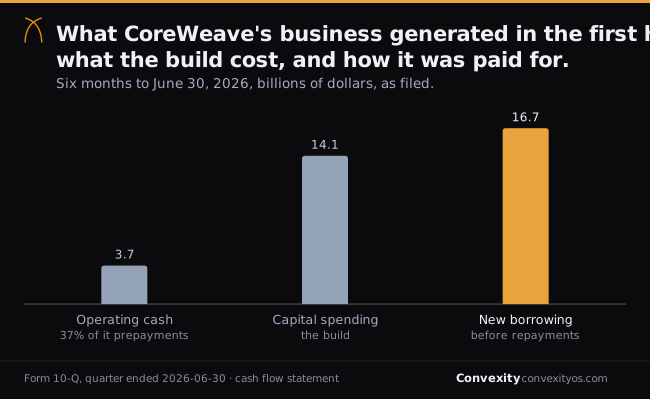
That is the sense in which CoreWeave borrows faster than its backlog pays. In the half year its delivered contracts produced $3.7 billion of operating cash, over a third of it paid in advance by customers. It borrowed $16.7 billion. The build is running roughly four times ahead of what the operating business returns, and debt is the bridge.
The debt already on the balance sheet shows how long that has been true. Total debt was $35,068 million at June 30, up $13,695 million in six months from $21,373 million at the end of 2025. Beside it sit $16,319 million of operating lease liabilities for data center space. Against $51.4 billion of debt and leases, stockholders' equity was $5,024 million.
What the debt costs, and when it is due
CoreWeave's September offering documents list the company's existing notes in one sentence, because the new securities are guaranteed alongside all of them. The list is the clearest single view of what this capital structure costs: "9.250% senior notes due 2030, 9.000% senior notes due 2031, 9.750% senior notes due 2031, 9.625% senior notes due 2032, 8.500% senior notes due 2032, 1.75% convertible senior notes due 2031 and 1.75% convertible senior notes due 2032."
Five series of straight senior notes, every one priced between 8.5% and 9.75%. Two of them, the 9.75% notes due 2031 and the 9.625% notes due 2032, were sold this year, for $2.8 billion in April and $1.3 billion in June. Those are high-yield coupons, the price the credit market charges a borrower it does not rate investment grade. The two convertibles carry 1.75% because the holder also gets an option on the shares, which is the other way this company pays for money: in potential dilution rather than coupon.
The filing's maturity table sets out when the principal comes due:
| Year | Principal due, $ millions |
|---|---|
| Remainder of 2026 | 4,413 |
| 2027 | 6,184 |
| 2028 | 4,416 |
| 2029 | 2,421 |
| 2030 | 3,221 |
| Thereafter | 14,896 |
| Total | 35,551 |
On our sum, $15.0 billion falls due by the end of 2028. That is almost the same window as the first backlog bucket, the $42.5 billion expected to be recognized in the 24 months to June 2028, and it is tempting to set one against the other and conclude that the backlog covers the debt nearly three times over.
It does not work that way, and the reason is the whole argument of this note. Recognized revenue is not cash available to repay lenders. It first has to pay for the operating costs of delivering it, which in the second quarter consumed all of it and $49 million more, and then for the interest, which consumed another quarter of it. What is left to retire principal is free cash flow, and in the first half free cash flow was minus $10.5 billion. On the numbers filed so far, the debt that comes due is refinanced by new debt, not repaid by the backlog.
Management's answer, and why it is not wrong
The company knows all of this, and on the call its chief financial officer made the case for why it is the right way to build. It deserves to be stated in its own terms, because it is coherent.
The economics of each deployment, he said, "do not arrive evenly. The cost, primarily in the form of CapEx, is front loaded, requiring a combination of debt, customer prepayments and other corporate level capital to finance its build out." Once a cluster is delivered, contracted revenue ramps and becomes "predictable and highly cash flow generative." Over the life of the contract the cluster ends up "fully repaying asset level debt used to fund the CapEx while generating significant additional free cash flow," so that "when an initial contract ends, the cluster no longer has any leverage."
That is project finance, and at the level of a single cluster it can be exactly right. Borrow against a signed contract with a creditworthy customer, build the capacity, collect the payments, retire the loan by the end of the term, and own an unlevered asset you can lease again. Much of CoreWeave's borrowing is structured that way, which is why the balance sheet separates recourse from non-recourse debt: $3.7 billion of the total is non-recourse, secured against specific assets rather than the company as a whole.
Two more of the chief financial officer's figures support the case. "Of the existing backlog, more than 50% is attached to a contract where customer delivery has commenced," and "We expect this figure to reach more than two thirds of our Q2 backlog by the end of this year." Delivery commencing is what turns a backlog from a promise into a paying cluster. And the cost of borrowing is falling: "we have reduced our weighted average cost of debt by almost 300 basis points," which he put at about $1.1 billion of annualized interest saving on the quarter-end debt.
So the disagreement is not about whether the model works. It is about timing and aggregation. Every individual cluster may repay its own debt over its own life, and the company as a whole can still need more new capital every quarter than its delivered clusters return, for as long as it keeps signing contracts faster than it finishes delivering them. That is precisely the situation the first half shows, and the over $25 billion of new commitments signed early in the third quarter says it is still true. Growth this fast is financed from outside until it slows. The only question is whether the outside keeps lending at a price the clusters can carry.
The September raise
On September 17, CoreWeave went back to that outside.
It filed a prospectus supplement for an at-the-market program to sell "Up to 35,000,000 shares of Class A Common Stock," through eleven sales agents and, alongside them, four banks acting as forward purchasers under collared forward sale agreements. A collared forward lets the company agree to sell shares at a price within a band and take the cash later, on settlement, rather than issuing the shares at once. The same day it announced $3.0 billion of new convertible senior notes due 2033, with an option for the initial purchasers to take $500 million more.
The supplement states what the money is for. Net proceeds are for general corporate purposes, which it says may include repayment of indebtedness, operating expenses, capital spending, acquisitions, and "support of our objective of migrating our enterprise credit profile toward investment grade."
That phrase is the most candid sentence in the document. It confirms, in the company's own words, what the 8.5% to 9.75% coupons already imply: CoreWeave is not investment grade today, and it is raising equity partly to get there. Issuing shares to reduce the weight of debt is a sensible thing for a company in its position to do, and saying so plainly is to its credit. It is also the clearest possible statement that the backlog, on its own, is not yet enough to get the company where it wants its credit to be.
The insider sales, which are not the story
Anyone reading CoreWeave's filing index for September will notice something that looks damning, and it is worth heading off.
Company officers sold roughly $110.7 million of stock on the open market in Form 4 filings dated September 3 to September 17. The chief executive, Michael Intrator, sold 307,692 shares on each of September 3, September 10 and September 17, the last of them on the same day the company announced the share program and the convertible. Read without context, a chief executive selling on the day his company sells new shares to the public is a headline.
The context removes it. Every one of the chief executive's sales was, in the filing's words, "effected pursuant to a Rule 10b5-1 trading plan adopted by the reporting person on November 20, 2025," ten months before the raise. A 10b5-1 plan fixes the schedule in advance precisely so that an insider cannot time sales to information, and the identical 307,692-share lots are what such a plan produces. The general counsel's sales and those of the executive vice president for product and engineering were under plans adopted in May. The one sale in the month not made under a plan was the chief financial officer's, about $5.6 million on September 15.
So the timing is a coincidence of the calendar, not a signal, and this note does not treat it as one. It is mentioned here only because a reader who finds it independently deserves to know that.
Where Nvidia sits
Nvidia appears in this filing twice, and in two roles that are worth holding together.
It is the supplier. CoreWeave's risk factors describe its dependence on a small number of component suppliers, including for NVIDIA GPUs, and the company expects to deploy Nvidia's Rubin platform in the second half of 2026. And it is an investor: "In January 2026, we entered into a securities purchase agreement with NVIDIA Corporation for a private placement of approximately 23 million shares," at $87.20 a share, for $2.0 billion.
That is the pattern we described in August in our note on Nvidia's own quarter: the company that sells the chips also supplies part of the capital that buys them. It does not make either transaction improper, and a supplier investing in a fast-growing customer is ordinary. It does mean that some of the equity cushion under CoreWeave's $35 billion of debt came from the vendor whose hardware that debt pays for. We looked for any statement in this filing that Nvidia is also a customer or guarantees any of CoreWeave's capacity, and found none, so this note does not claim it.
What would prove this wrong
Four things, and the first would retire the title.
Operating cash overtakes capital spending. The claim is about rates: that CoreWeave currently borrows faster than its delivered contracts return. If operating cash flow, excluding customer prepayments, rises to meet capital spending within the next few quarters, the build has started to fund itself and management's cluster-level argument has become visible in the aggregate. The chief financial officer's expectation that more than two thirds of the backlog will be in delivery by year-end is the mechanism, and the fourth-quarter cash flow statement is where to check it.
The operating loss becomes a durable margin. A $49 million operating loss on $2.6 billion of revenue is close to breakeven, and management expects margins to keep expanding. If operating income turns clearly positive and grows faster than interest expense, the arithmetic of servicing the debt from operations changes quickly. The inflection to watch is operating income crossing interest expense, which on the second quarter's numbers is still about $690 million a quarter away.
The credit markets price it as investment grade. The company's stated objective is an investment-grade credit profile. If a rating agency grants it, or if new straight debt prices well inside the 8.5% to 9.75% of the existing notes, then lenders have judged the backlog sufficient security on their own, and this note's reading of the same numbers was too conservative.
The concentration is safer than it reads. Seventy-two percent of revenue from three customers is a risk only if those customers are fragile. If the largest counterparties are among the best-capitalized companies in the world, the backlog is as secure as their own balance sheets, and the concentration is a strength rather than a weakness. The filing does not name all of them, which is exactly why a reader cannot settle this from the document alone.
What would not prove this wrong is the stock going up, or the backlog growing further. A larger backlog signed faster than it is delivered is, on the argument here, more of the same pattern rather than less.
Primary sources
- 10-QCoreWeave, Inc., quarterly report for the quarter ended June 30, 2026The remaining performance obligations definition and its $103.7 billion total with the 41%, 39% and remainder schedule; the 98% of revenue from customer commitments; the significant-customers table and its warning that customer letters may name different companies across periods; the named OpenAI master services agreement and the Meta commitment of up to approximately $21.0 billion; the statements of operations, balance sheets and cash flows for every income, debt, lease, equity and cash figure; Note 10 for the principal maturity schedule, the Q2 contractual, amortized and capitalized interest, and the April and June 2026 senior note issues; and the January 2026 Nvidia private placement of about 23 million shares at $87.20Filed Aug 12, 2026
- CallCoreWeave Q2 2026 earnings callEvery call quotation is from chief financial officer Nitin Agrawal, whose title is taken from the call's own introduction rather than from a speaker label: the $104 billion backlog up 246% and the over $25 billion of third-quarter commitments excluded from it; the more than 50% of backlog in delivery, expected to reach more than two thirds by year-end; the front-loaded cost argument and the cluster that ends with no leverage; the nearly 300 basis point reduction in weighted average cost of debt; and second-quarter capital expenditure of $9.4 billionHeld Aug 11, 2026
- 424B5CoreWeave, Inc., prospectus supplement for up to 35,000,000 shares of Class A common stockThe at-the-market program, its eleven sales agents and four forward purchasers under collared forward sale agreements; the use of proceeds including support of the objective of migrating the enterprise credit profile toward investment grade; the announced $3.0 billion of convertible senior notes due 2033 with a $500 million option; and the list of existing senior and convertible notes with their couponsFiled Sep 17, 2026
- Form 4CoreWeave, Inc. insider transaction reports, September 2026Open-market sales reported under transaction code S, their Rule 10b5-1 plan flags, and the footnotes giving each plan's adoption date: November 20, 2025 for the chief executive, May 13 and May 29, 2026 for the general counsel and the executive vice president for product and engineering, and no plan for the chief financial officer's September 15 saleFiled Sep 3 to Sep 18, 2026
Not investment advice. This is a reading of public filings and an earnings call, published for research purposes. It is not a recommendation to buy, sell or hold any security, and it is not a price target.
What here is ours rather than CoreWeave's. As filed, and not ours: every income statement, balance sheet and cash flow line; the backlog total, its definition and its percentage schedule; the customer percentages; the maturity schedule; the contractual, amortized and capitalized interest; the note coupons; the offering terms; and every quotation. Ours: interest expense as 24.9% of revenue; the growth rates of revenue and interest; the $10.5 billion of operating cash less capital spending; the $11.5 billion of net borrowing; the 37% of operating cash that was prepayments; total debt of $35.1 billion, its $13.7 billion rise, and the $3.7 billion non-recourse portion, each summed from the balance sheet's recourse and non-recourse lines; the $5.0 billion of equity as total assets less total liabilities; the $15.0 billion due by 2028 as the sum of three rows of the maturity table; the dollar values of the backlog buckets; and the 13% of contractual interest capitalized. Every one of those was recomputed from the filing's own figures, and the filing's arithmetic ties in every column we used.
On our own position. We hold no position in CoreWeave. We are a customer of Anthropic, we drafted this with Anthropic's model, and a member of our team holds an economic interest in Anthropic through a special-purpose vehicle and a fund. CoreWeave supplies OpenAI, an Anthropic competitor, and is part-owned by Nvidia, an Anthropic counterparty. A note about the financing of an AI compute supplier, written by us, is one where our interests are visible, and we would rather you weigh it with that in front of you than discover it afterwards.