








Disclosure. Convexity builds research tools for public-market data. This note is analysis, not investment advice, and nothing in it is a recommendation to buy, sell, or short anything. We hold no position in Archer Aviation, in Boeing, or in any other company named below, and no relationship with any of them. Every figure traces to a filing or a release, and every figure that is our own arithmetic on filed numbers is labeled as such in the sentence that uses it.
On August 9, 2026, Archer Aviation signed an agreement to buy three Boeing subsidiaries: Wisk Aero, the autonomous eVTOL developer; SkyGrid, an air traffic management platform; and Insitu, the maker of the ScanEagle surveillance drone. The announcement went out the following morning and the stock rose 12% on four and a half times its normal volume. The coverage settled quickly on one number, which was that the deal adds a profitable defense business with more than $200 million of annual revenue.
The agreement itself contains no dollar price. Archer is paying in shares of Archer, and the number of shares is set as a percentage of the company rather than as a value: 19.75% of its Class A common stock outstanding immediately before closing, plus two warrants (Archer 8-K, Aug 2026).
So the transaction hands over a permanent fifth of a public company in exchange for a business whose revenue investors know from a single line in a press release, footnoted to "Insitu's current financials and financial estimates" (Archer press release, Aug 10, 2026). Audited financial statements for what Archer is buying are due no later than sixty days after the deal closes, which is to say after the shares have already been issued.
The price is not in dollars
Set out what Boeing receives at closing, all of it from the 8-K.
Boeing gets Consideration Shares equal to 19.75% of Archer's Class A common stock outstanding immediately prior to the closing date, adjusted for the target companies' cash position against an agreed target. It gets a First Warrant for $100.0 million divided by the five-day volume-weighted average price before closing, struck at $13.00, exercisable between twelve and thirty-six months after closing. It gets a Second Warrant on the same construction for another $100.0 million, struck at $17.88, exercisable between twelve and forty-eight months.
Archer had 770,023,800 shares outstanding as of August 5, the cover date of its most recent quarterly report (Archer 10-Q, Aug 2026). Applying 19.75% to that count gives about 152.1 million shares, worth roughly $957 million at the August 21 close of $6.29. The warrants add about 31.8 million more shares at that price, for total new issuance near 184 million, or 23.9% of the current count. Those three figures are our arithmetic on a share count that will be different by closing, and the percentage is fixed while the dollar value is not.
The strikes are worth reading against the tape. At $6.29, the $13.00 warrant needs the stock to roughly double and the $17.88 warrant needs it to nearly triple, and Boeing is receiving that upside rather than paying for it.
There is one clause in the consideration paragraph that does more work than its length suggests. If Archer raises additional equity capital under certain conditions, the shares issued in that raise may be excluded from the calculation of the Consideration Shares. Boeing's 19.75% is measured against a share count that does not include the money Archer is expected to go raise. New investors dilute the existing holders. They do not dilute Boeing.
Consideration terms from Archer's Form 8-K filed August 10, 2026. The $6.29 comparison is the August 21, 2026 close.
Then there is the $55 million. Most coverage described Boeing as investing in Archer, and the Forward Equity Purchase Agreement is where that comes from. Read the conditions. Archer may elect, once, at its own discretion, to sell Boeing up to $55.0 million of stock. It can only do so in connection with an offering to third-party investors that is expected to gross at least $400.0 million. The price Boeing pays is the lowest per-share price paid by any investor in that offering. The right expires at the later of March 31, 2027 and three months after closing, and it requires a stockholder vote.
So the investment is capped at $55 million, is contingent on somebody else first putting in $400 million, and is priced at the best terms in the room. Boeing has not agreed to fund Archer. It has agreed to participate on the most favorable terms available if Archer succeeds in funding itself.
The revenue everyone quoted has a footnote
The press release's second bullet reads that the transaction "adds a profitable defense business generating over $200M in annual revenue, with operations across 35 countries." A superscript 1 sits on that sentence. At the bottom of the release, past both companies' forward-looking statement disclaimers, footnote 1 reads in full: "Based on Insitu's current financials and financial estimates."
Three things follow from those nine words, and each of them is checkable.
The revenue is Insitu's alone. Archer is acquiring three businesses and the release attributes revenue to one. Wisk and SkyGrid appear in the release described by capability rather than by financial result: Wisk has flown six generations of aircraft over sixteen years and roughly 2,000 flight tests, SkyGrid has built an aircraft-agnostic air traffic management platform. Neither is called profitable and neither is given a revenue figure. Boeing put $450 million into Wisk in a single January 2022 round, on top of earlier rounds Wisk has never disclosed (Wisk Aero, Jan 24, 2022, retrieved 2026-08-23). Archer is acquiring one business that generates cash and two that consume it, and the headline number describes the first only.
The figure is partly estimated. "Current financials and financial estimates" is not a statement about a completed period. It is a blend, and the release does not say what the blend is, which twelve months it covers, or what "over $200M" is measured from.
Nobody outside the two companies has audited any of it. Under the purchase agreement, Boeing must deliver audited and unaudited financial statements for the target companies no later than sixty days after closing. The deal is expected to close by the end of 2026. Archer's shareholders will therefore see audited numbers for the business their company bought sometime in early 2027, months after the shares are gone.
None of this means the revenue is not there. Insitu is a real defense contractor with real federal work: a $102.3 million Navy award for Blackjack and ScanEagle systems (reported by The Defense Post, retrieved 2026-08-23), and selection to compete for Navy and Marine Corps ISR task orders under a contractor-owned, contractor-operated model (Insitu, retrieved 2026-08-23). Boeing has owned it since 2008. The business exists.
The gap is between what exists and what has been shown. A shareholder being diluted by a fifth at closing, and by roughly a quarter once the warrants become exercisable, is entitled to a set of financial statements for what the dilution bought, and the transaction is structured so that they arrive afterward rather than before.
Boeing kept the parts that cannot go wrong
Read the related agreements as a group and a pattern shows up: at nearly every point where the deal could have allocated risk to Boeing, it does not.
Boeing takes a twelve-month lock-up on the Consideration Shares. The lock-up has express carve-outs permitting Boeing to enter hedging transactions, to pledge the shares as collateral in connection with a bona fide hedge, and to hold them in a margin account, provided settlement does not require a transfer during the lock-up. Boeing is restricted from selling the position. It is not restricted from neutralizing its exposure to the position.
Boeing keeps the technology it is selling. At closing the parties enter an intellectual property cross license, granting each other reciprocal worldwide licenses. Boeing retains access to Wisk's core autonomous flight technology for its own current and next-generation commercial and defense aircraft, which the press release states plainly. Archer is buying the companies. It is not buying exclusivity.
Boeing gets a board seat, and the threshold that keeps it is frozen. The governance side letter gives Boeing the right to designate a director for as long as it holds at least the number of shares equal to 10% of Archer's Class A stock outstanding immediately prior to closing. That is a fixed share count, not a floating percentage, so every share Archer issues after closing dilutes everyone's ownership without moving Boeing any closer to losing the seat. The designee is assigned to the class of directors with the longest remaining term.
Boeing can walk if Archer's stock falls far enough. The termination rights include one available to Boeing alone: it may terminate if Archer's enterprise value, calculated per the agreement, sits below a minimum level for a specified period. Archer has no reciprocal right tied to the value of what it is buying. If Archer's currency weakens materially before closing, the seller can leave. If the acquired business weakens, the buyer cannot.
The one asymmetry running the other way is the representation and warranty insurance. The parties bound a buy-side policy, and Archer must claim against that policy before it may seek indemnification from Boeing for breached representations. Boeing sold the risk of its own representations to an insurer. That is common in modern M&A and it is not sharp practice. It is, though, one more place where the answer to "who carries this" is not Boeing.
Set beside all of that is a fact about how the two companies filed. Archer filed a Form 8-K running to six agreement exhibits, including a 937-kilobyte purchase agreement (Exhibit 2.1). Boeing filed nothing. Its 8-K filings for all of 2026 are three earnings releases, an annual meeting vote, and a director change on August 21 (Boeing EDGAR filing index, retrieved 2026-08-23). On $89.5 billion of 2025 revenue (Boeing 10-K, Jan 2026), the disposal did not rise to a current report. The same agreement was a material definitive agreement for one party and unremarkable for the other.
Boeing had also been trying to sell Insitu since February 2025, when it hired an adviser to market the unit and Jefferies analysts put a figure near $500 million on it (Bloomberg News reporting, summarized by GuruFocus, Feb 24, 2025, retrieved 2026-08-23; that valuation is Jefferies' and we have not reproduced it). Eighteen months of a marketed process ended with a buyer paying in paper.
Archer already buys things this way
The most useful context for a stock-funded acquisition is what else the acquirer buys with stock, and Archer's quarterly report answers it directly.
In the six months to June 30, Archer issued 11,093,897 shares of Class A common stock to vendors, to satisfy $70.6 million of current and future obligations. In the second quarter alone it was 4,546,337 shares against $28.5 million. A year earlier the same line read 4,331,384 shares and $40.2 million. Then on August 18, eight days after announcing the Boeing deal, Archer filed a prospectus supplement covering the resale of a further 8,261,273 shares issued to vendors on or about August 17 in exchange for services rendered or goods purchased, from which the company received no cash proceeds (Archer 8-K, Aug 18, 2026).
Stock-based compensation ran $156.0 million in the same six months, against $81.9 million a year earlier.
Now put those against what the company sold. Revenue in the first half was $6.6 million. The composition is in note 2 of the 10-Q and it is not what the phrase "revenue base" suggests: $3.0 million of fixed base operator revenue, $2.0 million of lease revenue, and $1.6 million of other. FBO revenue, the filing says, "consists of aviation fueling, ground handling, and related services provided at Hawthorne Airport," and those operations began when Archer acquired Hawthorne FBO LLC on April 1, 2026. The lease revenue is space rented at the same airport. Archer recognized no revenue at all in the first half of 2025.
It is thin at the margin as well as at the top. Cost of revenue was $5.6 million against that $6.6 million, so the entire revenue base produced about $1.0 million of gross profit in six months, against $357.7 million of research and development in the same period.
Archer has not sold an aircraft. Of the $6.6 million, $5.0 million is named in the filing as fuel sales, ground handling, and rent at one airport, and the remaining $1.6 million is disclosed only as "other".
Six months ended June 30, 2026, from Archer's Form 10-Q filed August 10, 2026. The 34x is our arithmetic: $226.6 million of obligations settled in stock against $6.6 million of revenue.
The share count records the cumulative effect. Archer had 503,777,464 shares outstanding at the end of 2024 and 744,046,194 at the end of 2025. By August 5 it was 770,023,800, and the vendor issuance since then takes it near 778 million. That is 53% more shares in nineteen months, before the Boeing consideration adds its 19.75%.
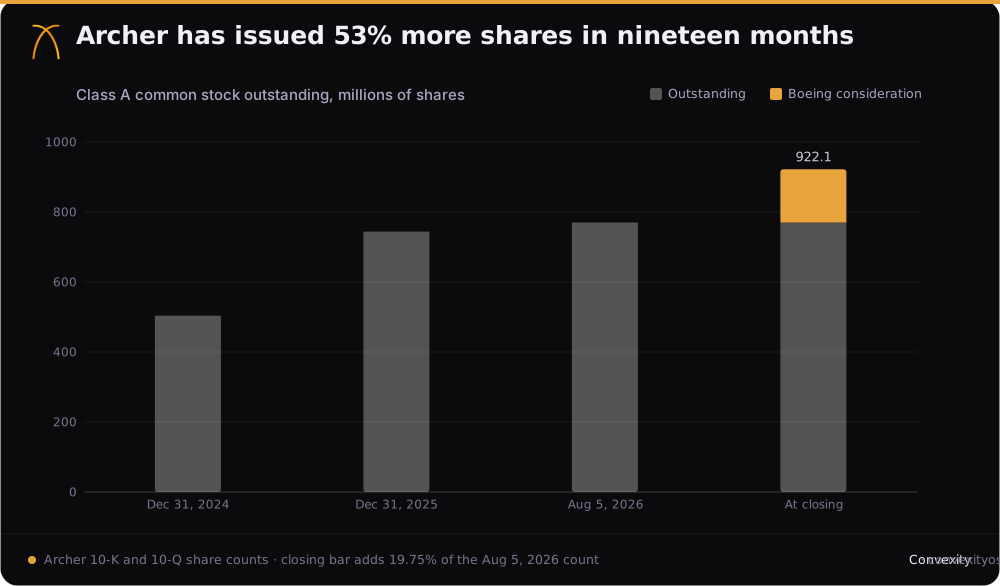
None of this is hidden and none of it is unusual for a company at this stage. Development-stage aerospace is expensive and equity is the cheapest capital available to a business with no product revenue. The point is narrower: Archer's equity is not incidental to how it operates, it is the operating currency. Suppliers take it, employees take it, the Hawthorne sellers can earn up to $21.4 million more of it in milestone shares, and Boeing is now taking a fifth of the company in it. When the consideration for an acquisition is the same instrument the company uses to pay its fuel bill, "what did this cost" and "what is this worth" are not the same question, and only the first one has been answered.
The going-concern language is standard and worth quoting accurately. Archer holds $1,560.6 million of cash, cash equivalents and short-term investments, carries an accumulated deficit of $2,784.7 million, and management believes its capital is sufficient to fund the current operating plan for at least twelve months. Cash and short-term investments fell from $1,964.7 million at December 31 to $1,560.6 million at June 30, a decline of $404.1 million in six months. That is our subtraction of two balance-sheet lines, not a forecast, and at that rate the position runs a little under two years before the acquired cost base is added to it.
What the tape did
The market's reaction is the cleanest evidence that this was received as a revenue story rather than a dilution story.
Archer closed at $5.59 on August 7, the last session before the announcement. On August 10 it opened at $6.41, traded as high as $6.87, and closed at $6.26, up 12.0% on the day, on volume of 128,441,359 shares against a prior ten-session average near 28.5 million. It closed at $6.29 on August 21 (market data, retrieved 2026-08-23; the percentage moves and the volume ratio are our arithmetic on those prices).
Boeing went the other way, closing at $232.79 on announcement day, down 0.7%, and at $214.20 on August 21. We are not attributing that two-week drift to this transaction and neither should anyone else, because Boeing is an $89 billion business with a great deal else moving. The announcement-day move is the one worth reading, and it is consistent with the filing record: a transaction that reshaped one party barely registered for the other.
The stock rose on the announcement of a transaction that will lift the share count by about a fifth, so the market marked the acquired businesses as worth more than the stake being surrendered, on the strength of a footnoted figure. That may prove correct, but it has not yet been tested against an audited statement.
One further note on the coverage, because it recurred. Several outlets reported the stake as 19.9%. The 8-K uses 19.75% for the Consideration Shares; 19.9% is a separate number, the beneficial ownership ceiling above which Boeing may not exercise the warrants, a limitation Boeing may waive at its sole discretion.
What would make us wrong
Four things would break this argument, each observable in a public document within roughly six months.
The audited financials arrive and confirm the number. Boeing owes statements for the target companies within sixty days of closing. If they show Insitu at or above $200 million of revenue and genuinely profitable, and if Wisk and SkyGrid turn out to carry less cash drag than their sixteen-year development history implies, the central complaint here reduces to a timing objection about disclosure sequencing rather than a substantive one about value. This is the falsifier most likely to fire, and we would say so.
Archer raises the $400 million on good terms. The Forward Equity Purchase Agreement presumes a large third-party offering. If that offering prices at or above current levels and clears quickly, the "equity is a weak currency" reading loses most of its force, because the market will have repriced the currency in Archer's favor at scale.
The stockholder vote passes and the warrants stay in stock. Archer must call a special meeting within sixty days of closing. Failing to obtain approval converts the warrants into cash-settled instruments, which would turn Boeing's $200 million of upside into a claim on Archer's cash rather than on its stock. A clean approval means the structure works as designed and the dilution was understood and accepted by the people bearing it.
Aircraft revenue shows up. The FBO-and-rent composition of the current revenue line is the most concrete fact in this piece. Two or three quarters with material revenue from aircraft, certification progress, or defense work recognized by Archer itself would retire it, and the "revenue base" language in the announcement would read as forward guidance that came good rather than as a description of a fuel desk.
What has happened so far is narrower than any of those. A company with $6.6 million of half-year revenue, nearly all of it fuel sales and rent at an airport operation it assembled between December and April, agreed to issue a permanent fifth of itself for three businesses whose combined financial statements no auditor has signed, to a seller that kept a license to the core technology, a board seat, $200 million of warrants struck at roughly two and three times the market, the right to hedge during its own lock-up, and the right to walk away if the buyer's stock falls too far. Every one of those terms is in a document that has been public since August 10.
The filings this is built on
- 8-KArcher Aviation, entry into a material definitive agreementThe 19.75% consideration, both warrants, the lock-up hedging carve-out, the forward equity purchase, and Boeing's enterprise-value termination rightAug 10, 2026
- EX-99.1Archer and Boeing joint announcementThe "over $200M in annual revenue" bullet and footnote 1, "Based on Insitu's current financials and financial estimates"Aug 10, 2026
- EX-2.1Equity Purchase Agreement, Archer and The Boeing CompanyThe full agreement the 8-K summarizesAug 10, 2026
- 10-QArcher Aviation, quarter ended June 30, 2026Revenue of $6.6M split FBO/lease/other, vendor share issuances of $70.6M, $156.0M of stock compensation, and the going-concern paragraphAug 10, 2026
- 8-KArcher Aviation, vendor share issuances8,261,273 shares issued to vendors on or about August 17, no cash proceedsAug 18, 2026
- 424B7Prospectus supplement covering the vendor resale sharesAug 18, 2026
- 10-KThe Boeing Company, fiscal year 2025The $89.5 billion revenue base the disposal was measured againstJan 30, 2026
- EDGARBoeing Form 8-K filing indexNo current report was filed for the transaction; 2026 holds three earnings releases, an annual meeting vote, and a director change
- WiskWisk Aero secures $450 million from The Boeing CompanyThe January 2022 round, for scale on what Wisk has absorbedJan 24, 2022
- InsituScanEagle and Integrator selected by the US Navy for ISR servicesEvidence the acquired revenue rests on live federal work
- PressBoeing looks to offload Insitu drone unitThe February 2025 sale process and the Jefferies estimate near $500 million, both Bloomberg's and Jefferies' work rather than oursFeb 24, 2025
Disclosure, again. Convexity builds research tools for public-market data. This note is analysis, not investment advice, and nothing in it is a recommendation to buy, sell, or short any security. We hold no position in Archer Aviation or Boeing and no relationship with either company or with any organization whose reporting is cited. The transaction described here has not closed and its terms may change: the share count that sets the 19.75% is not final, the cash adjustment is not known, and closing is subject to antitrust and national security clearances that may not be granted. Figures attributed to Bloomberg, Jefferies, GuruFocus, and The Defense Post are those outlets' work, retrieved 2026-08-23 and not independently reproduced, and the Wisk and Insitu releases cited are the companies' own descriptions of their business. Prices and volumes are market data retrieved 2026-08-23; percentage moves, share-count arithmetic, and the burn figure are ours, computed from the filed numbers named in each sentence.